
First Year Experience FYE101 Expansion What is FYE
- Slides: 14
First Year Experience (FYE-101) Expansion
What is FYE? FYE is a series of 3 classes that helps first year students adjust and navigate the expectations of college life, while forming a sense of belonging in the CCC community through participation, engagement, and resource awareness. Only the first of the 3 courses (FYE-101) would be required for students at CCC. FYE -101 Course Description: This is the first course in a 3 -course sequence designed to help students adjust to a new campus, connect with other students, understand college expectations and systems, and access services available through the college. The First Year Experience Level I course is designed to help students in developing relationships with students and faculty, and to build student behaviors for successfully completing classes and continuing college through to completion.
FYE-101 major topics ● ● ● Self-Management Goal Setting Personal Responsibility Educational Planning Personal Awareness Stress Management
FYE Benefits demonstrated for CCC students 1. 2. 3. Increased retention: More FYE students continued to be enrolled as compared to the non‐FYE student group Feelings of belonging Skills for other courses: FYE teaches students skills that are commonly requested by faculty. Learning outcomes include the following: 1. complete course assignments using Moodle and My. Clackamas; 2. demonstrate elements of comprehensive college planning including developing an academic plan; 3. demonstrate self-reflection in evaluating their academic progress; 4. exhibit effective student behaviors including applying study skills and using the Learning Center; 5. attend college activities or events that lead to increased knowledge of the college and engagement with members of the college community.
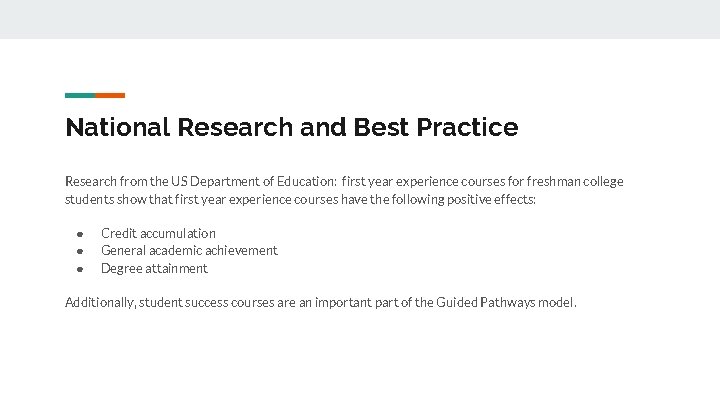
National Research and Best Practice Research from the US Department of Education: first year experience courses for freshman college students show that first year experience courses have the following positive effects: ● ● ● Credit accumulation General academic achievement Degree attainment Additionally, student success courses are an important part of the Guided Pathways model.
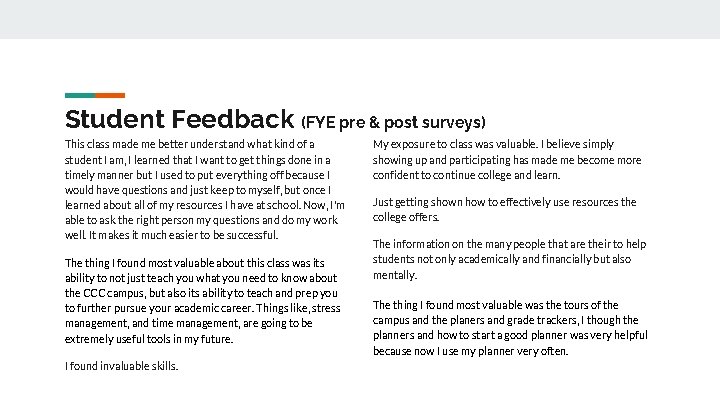
Student Feedback (FYE pre & post surveys) This class made me better understand what kind of a student I am, I learned that I want to get things done in a timely manner but I used to put everything off because I would have questions and just keep to myself, but once I learned about all of my resources I have at school. Now, I'm able to ask the right person my questions and do my work well. It makes it much easier to be successful. The thing I found most valuable about this class was its ability to not just teach you what you need to know about the CCC campus, but also its ability to teach and prep you to further pursue your academic career. Things like, stress management, and time management, are going to be extremely useful tools in my future. I found invaluable skills. My exposure to class was valuable. I believe simply showing up and participating has made me become more confident to continue college and learn. Just getting shown how to effectively use resources the college offers. The information on the many people that are their to help students not only academically and financially but also mentally. The thing I found most valuable was the tours of the campus and the planers and grade trackers, I though the planners and how to start a good planner was very helpful because now I use my planner very often.
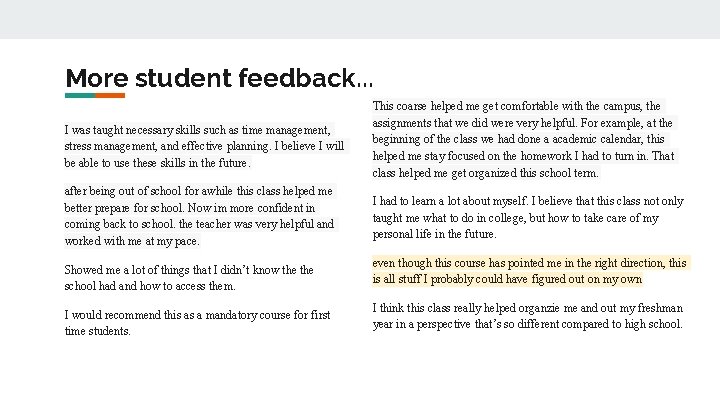
More student feedback. . . I was taught necessary skills such as time management, stress management, and effective planning. I believe I will be able to use these skills in the future. after being out of school for awhile this class helped me better prepare for school. Now im more confident in coming back to school. the teacher was very helpful and worked with me at my pace. Showed me a lot of things that I didn’t know the school had and how to access them. I would recommend this as a mandatory course for first time students. This coarse helped me get comfortable with the campus, the assignments that we did were very helpful. For example, at the beginning of the class we had done a academic calendar, this helped me stay focused on the homework I had to turn in. That class helped me get organized this school term. I had to learn a lot about myself. I believe that this class not only taught me what to do in college, but how to take care of my personal life in the future. even though this course has pointed me in the right direction, this is all stuff I probably could have figured out on my own I think this class really helped organzie me and out my freshman year in a perspective that’s so different compared to high school.
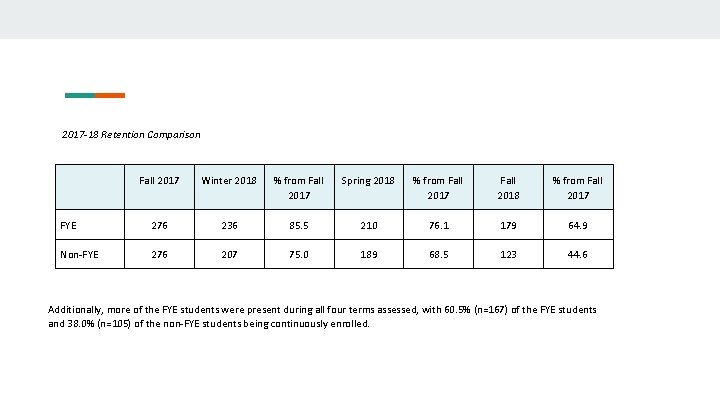
2017 -18 Retention Comparison Fall 2017 Winter 2018 % from Fall 2017 Spring 2018 % from Fall 2017 Fall 2018 % from Fall 2017 FYE 276 236 85. 5 210 76. 1 179 64. 9 Non-FYE 276 207 75. 0 189 68. 5 123 44. 6 Additionally, more of the FYE students were present during all four terms assessed, with 60. 5% (n=167) of the FYE students and 38. 0% (n=105) of the non-FYE students being continuously enrolled.
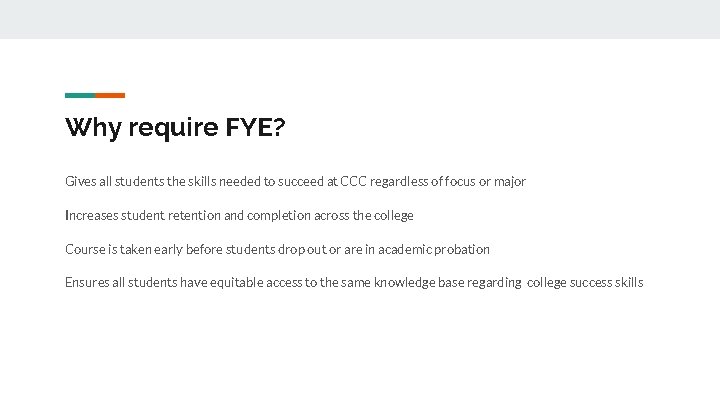
Why require FYE? Gives all students the skills needed to succeed at CCC regardless of focus or major Increases student retention and completion across the college Course is taken early before students drop out or are in academic probation Ensures all students have equitable access to the same knowledge base regarding college success skills
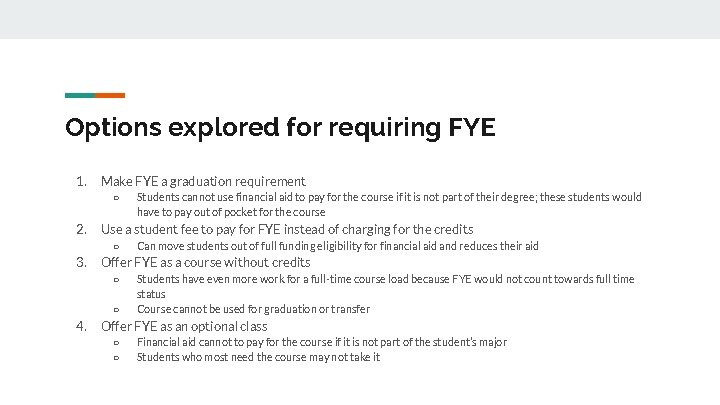
Options explored for requiring FYE 1. Make FYE a graduation requirement ○ 2. Use a student fee to pay for FYE instead of charging for the credits ○ 3. Can move students out of full funding eligibility for financial aid and reduces their aid Offer FYE as a course without credits ○ ○ 4. Students cannot use financial aid to pay for the course if it is not part of their degree; these students would have to pay out of pocket for the course Students have even more work for a full-time course load because FYE would not count towards full time status Course cannot be used for graduation or transfer Offer FYE as an optional class ○ ○ Financial aid cannot to pay for the course if it is not part of the student’s major Students who most need the course may not take it
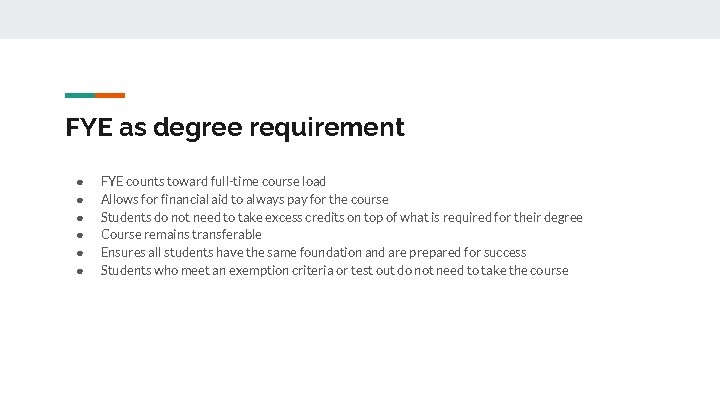
FYE as degree requirement ● ● ● FYE counts toward full-time course load Allows for financial aid to always pay for the course Students do not need to take excess credits on top of what is required for their degree Course remains transferable Ensures all students have the same foundation and are prepared for success Students who meet an exemption criteria or test out do not need to take the course
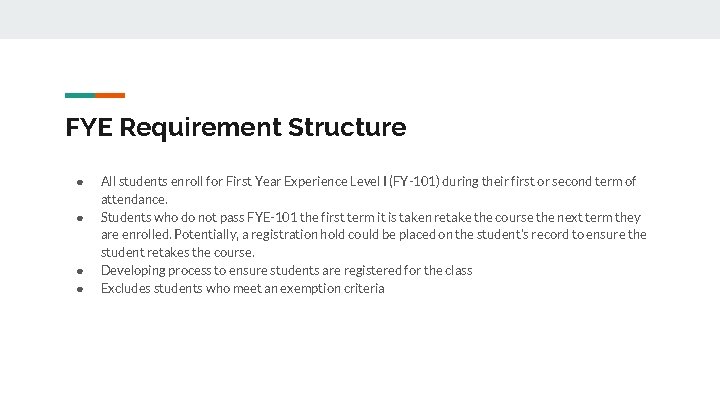
FYE Requirement Structure ● ● All students enroll for First Year Experience Level I (FY-101) during their first or second term of attendance. Students who do not pass FYE-101 the first term it is taken retake the course the next term they are enrolled. Potentially, a registration hold could be placed on the student’s record to ensure the student retakes the course. Developing process to ensure students are registered for the class Excludes students who meet an exemption criteria
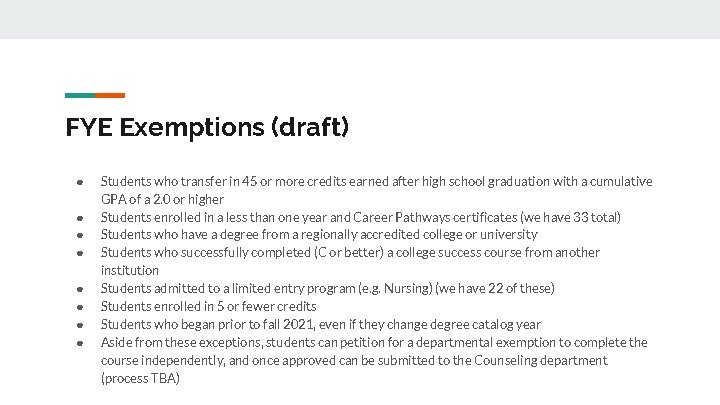
FYE Exemptions (draft) ● ● ● ● Students who transfer in 45 or more credits earned after high school graduation with a cumulative GPA of a 2. 0 or higher Students enrolled in a less than one year and Career Pathways certificates (we have 33 total) Students who have a degree from a regionally accredited college or university Students who successfully completed (C or better) a college success course from another institution Students admitted to a limited entry program (e. g. Nursing) (we have 22 of these) Students enrolled in 5 or fewer credits Students who began prior to fall 2021, even if they change degree catalog year Aside from these exceptions, students can petition for a departmental exemption to complete the course independently, and once approved can be submitted to the Counseling department (process TBA)
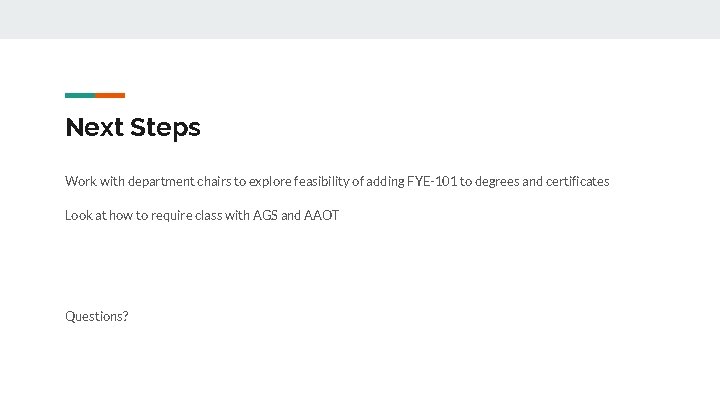
Next Steps Work with department chairs to explore feasibility of adding FYE-101 to degrees and certificates Look at how to require class with AGS and AAOT Questions?