
First Year Engineering Class Notes and Homework Workbook
First Year Engineering Class Notes and Homework Workbook
First Year Metalwork Topics to be covered • • Safety. Bench tools. Properties of Materials Metals. Drilling The Centre Lathe. Joining.
SAFETY ‘Accidents do not just happen, there is always a cause for them’
Safety in Technical Rooms • My class may not use machines without a teacher in the room. • I may not use equipment that I have not been shown how to use. • All accidents must be reported to the teacher. • Be prepared for class. • I will not be allowed to work if my behaviour puts myself or others in danger. Signed. . . .
Seven Safety Hazards • • Hair – Example: long hair should be tied back. Eye protection – Hot metal – Sharp metal and tools Clean workplace Fire Fumes -
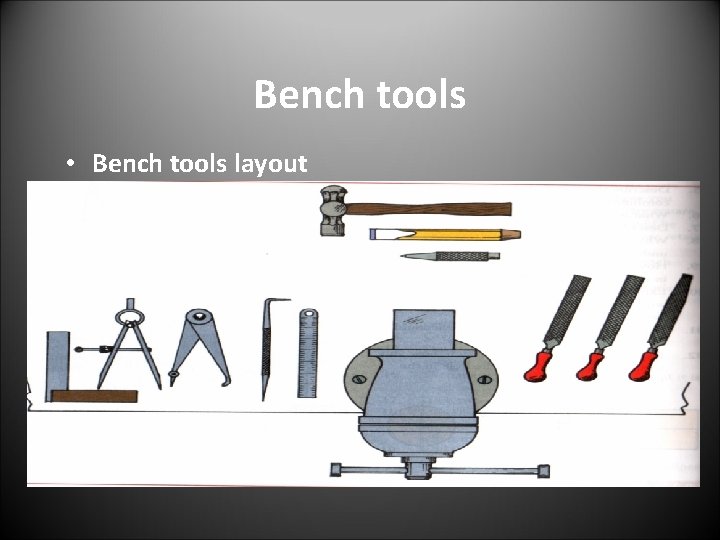
Bench tools • Bench tools layout • benct tools dia
Bench tools • Cold Chisels • • similar to punches used to cut metal • Spring dividers • • similar to a compass used to draw circles. Set radius using adjusting nut puc mark can be used to hold it on the centre • Engineers tri-square. • • • Used to mark lines at 90 degrees on materials. Used to check corners are square. Handle called stock other part called blade • Engineers rule. • • This is a steel ruler. Only millimetres are to be used
Bench tools • Cold Chisels • • similar to punches used to cut metal • Spring dividers • • similar to a compass used to draw circles. Set radius using adjusting nut puc mark can be used to hold it on the centre • Engineers tri-square. • • • Used to mark lines at 90 degrees on materials. Used to check corners are square. Handle called stock other part called blade • Engineers rule. • • This is a steel ruler. Only millimetres are to be used
Bench tools • Bench vice • • • made from cast iron bolted to the table used with vice clamps (protects the work piece) • Ball pein Hammer • name from rounded side • • used with dot punch and chisels only must be held at the end of the handle • The scriber • • used to draw lines on the metal made from carbon steel (wont wear). • The Dot / Centre punch. • • • Used to mark the centre of a hole for drilling (puc). Used to mark along a line especially steel. made from High carbon steel (hardened and tempered)
Properties of Materials In other word the characteristics of a particular metal or material. (Or how that metal/material is different to others. )
Surface properties • • Colour Transparent or Opaque Reflection Lustre (Also known as shine e. g. gold/silver )
Mechanical properties • Hardness: • resistance to scratching or indentation. Hardness can be tested by: • Brinell, • Vickers or • Rockwell hardness testers.
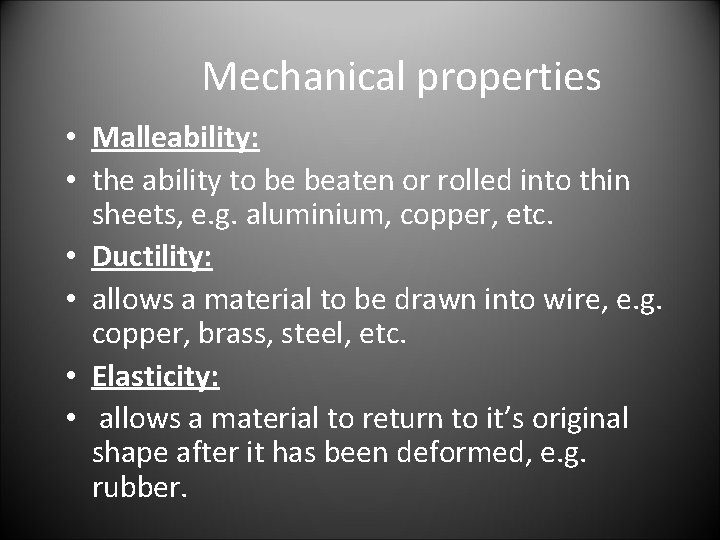
Mechanical properties • Malleability: • the ability to be beaten or rolled into thin sheets, e. g. aluminium, copper, etc. • Ductility: • allows a material to be drawn into wire, e. g. copper, brass, steel, etc. • Elasticity: • allows a material to return to it’s original shape after it has been deformed, e. g. rubber.
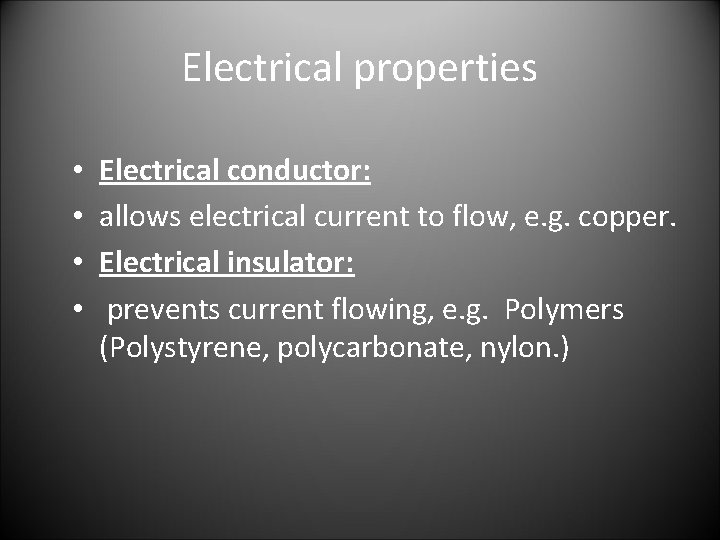
Electrical properties • • Electrical conductor: allows electrical current to flow, e. g. copper. Electrical insulator: prevents current flowing, e. g. Polymers (Polystyrene, polycarbonate, nylon. )
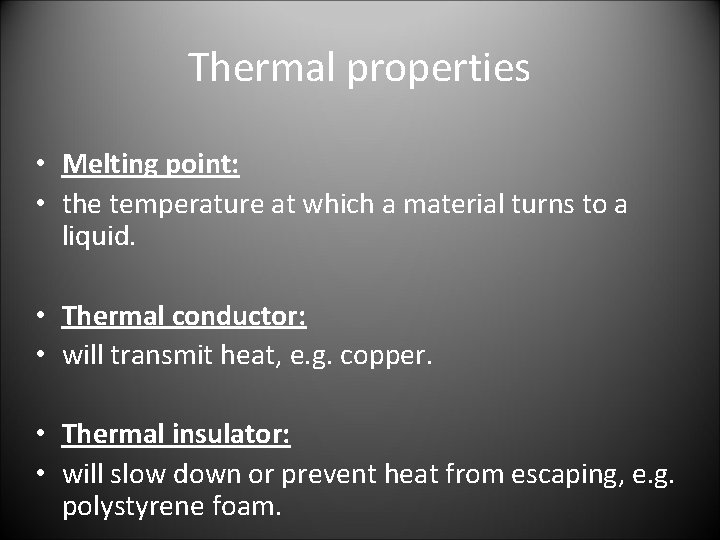
Thermal properties • Melting point: • the temperature at which a material turns to a liquid. • Thermal conductor: • will transmit heat, e. g. copper. • Thermal insulator: • will slow down or prevent heat from escaping, e. g. polystyrene foam.
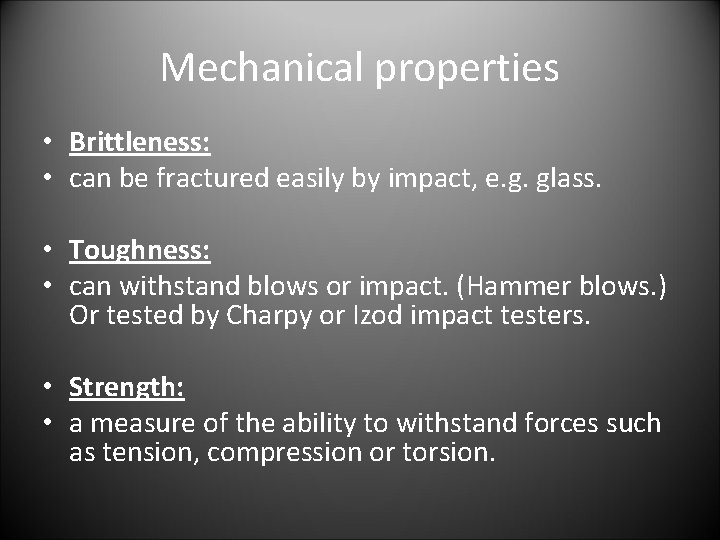
Mechanical properties • Brittleness: • can be fractured easily by impact, e. g. glass. • Toughness: • can withstand blows or impact. (Hammer blows. ) Or tested by Charpy or Izod impact testers. • Strength: • a measure of the ability to withstand forces such as tension, compression or torsion.
- Slides: 16