
First Trimester screening in Multiple pregnancy Firas Abdeljawad
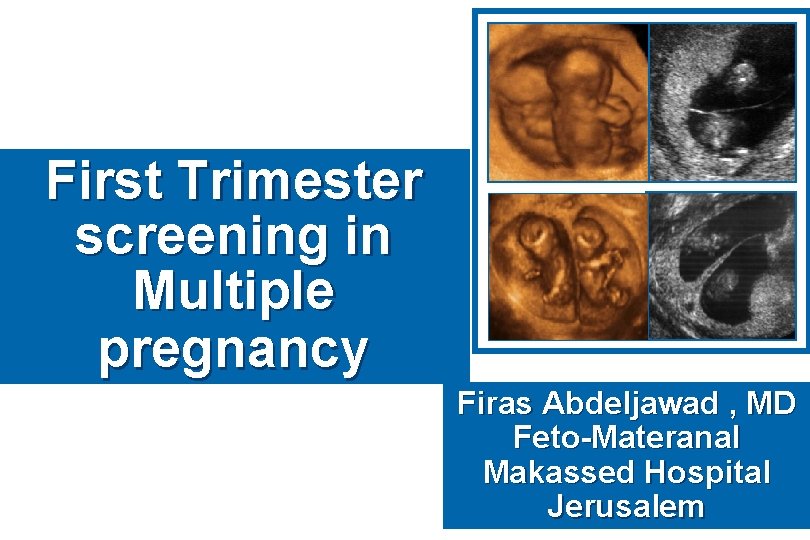
First Trimester screening in Multiple pregnancy Firas Abdeljawad , MD Feto-Materanal Makassed Hospital Jerusalem
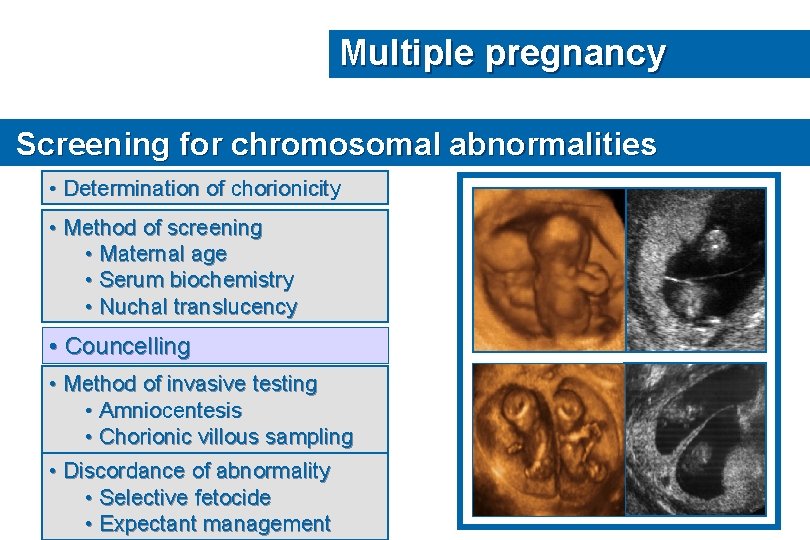
Multiple pregnancy Screening for chromosomal abnormalities • Determination of chorionicity • Method of screening • Maternal age • Serum biochemistry • Nuchal translucency • Councelling • Method of invasive testing • Amniocentesis • Chorionic villous sampling • Discordance of abnormality • Selective fetocide • Expectant management
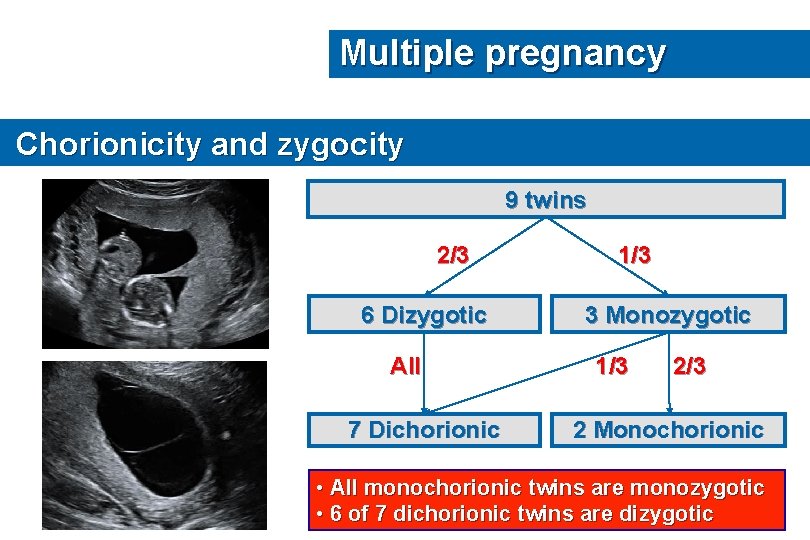
Multiple pregnancy Chorionicity and zygocity 9 twins 2/3 6 Dizygotic All 7 Dichorionic 1/3 3 Monozygotic 1/3 2 Monochorionic • All monochorionic twins are monozygotic • 6 of 7 dichorionic twins are dizygotic
Zygosity rather than chorionicity determines the of risk , and weather or not the fetuses may be concordant or discordant for chromosomal anomalies.
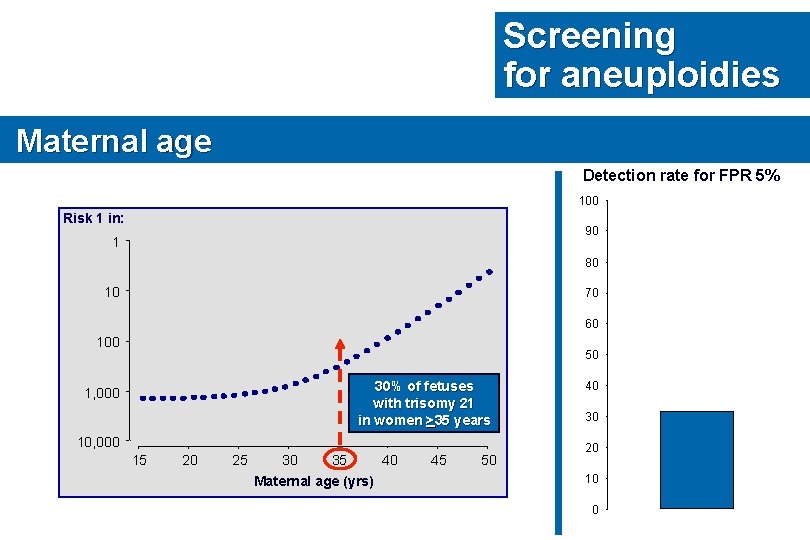
Screening for aneuploidies Maternal age Detection rate for FPR 5% 100 Risk 1 in: 90 1 80 10 70 60 100 50 30% of fetuses with trisomy 21 in women >35 years 1, 000 10, 000 15 20 25 30 35 40 Maternal age (yrs) 45 50 40 30 20 10 0
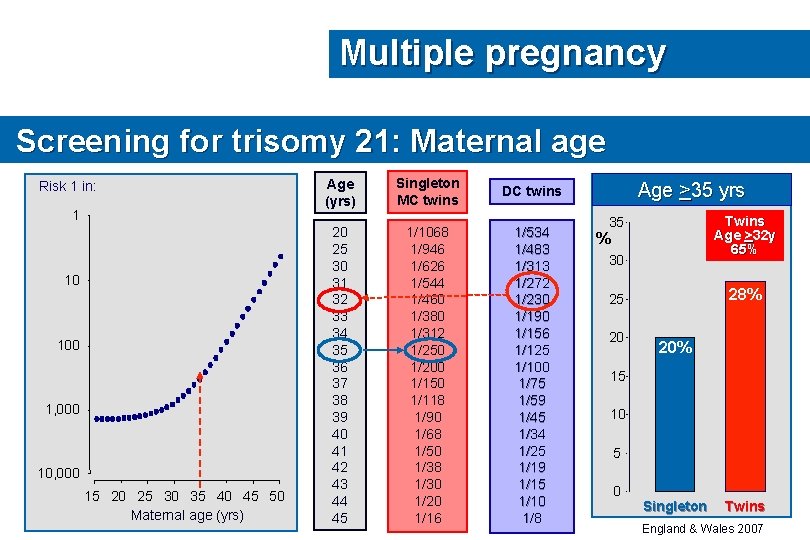
Multiple pregnancy Screening for trisomy 21: Maternal age Risk 1 in: 1 10 100 1, 000 10, 000 15 20 25 30 35 40 45 50 Maternal age (yrs) Age (yrs) Singleton MC twins DC twins 20 25 30 31 32 33 34 35 36 37 38 39 40 41 42 43 44 45 1/1068 1/946 1/626 1/544 1/460 1/380 1/312 1/250 1/200 1/150 1/118 1/90 1/68 1/50 1/38 1/30 1/20 1/16 1/534 1/483 1/313 1/272 1/230 1/190 1/156 1/125 1/100 1/75 1/59 1/45 1/34 1/25 1/19 1/15 1/10 1/8 Age >35 yrs Twins Age >32 y 65% 35 % 30 28% 25 20 20% 15 10 5 0 Singleton Twins England & Wales 2007
In Twins , Effective screening for chromosomal abnormalities is provided by a combination of maternal age and fetal NT.
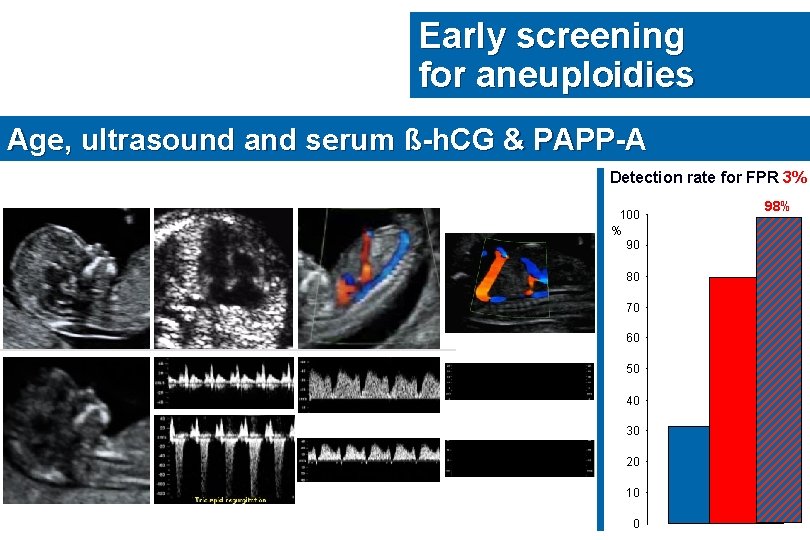
Early screening for aneuploidies Age, ultrasound and serum ß-h. CG & PAPP-A Detection rate for FPR 3% 100 % 90 80 70 60 50 40 30 20 10 0 98%
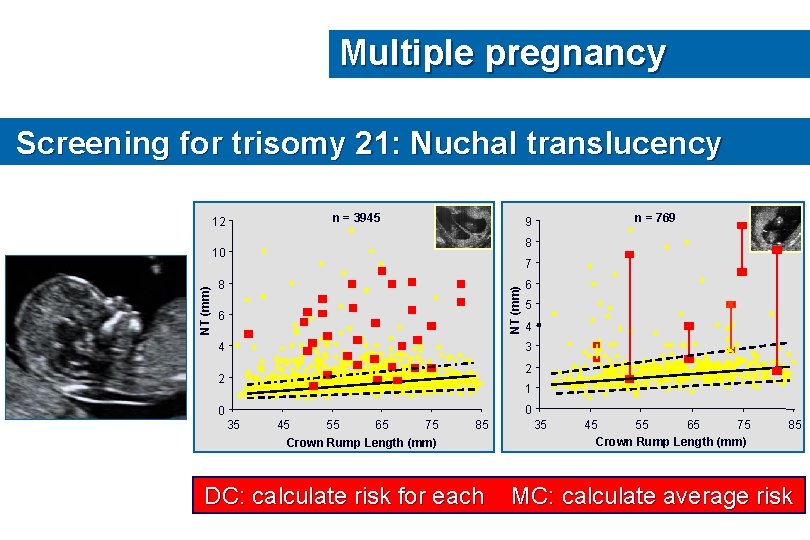
Multiple pregnancy Screening for trisomy 21: Nuchal translucency n = 3945 12 8 10 7 8 NT (mm) n = 769 9 6 4 6 5 4 3 2 2 1 0 0 35 45 55 65 75 Crown Rump Length (mm) 85 DC: calculate risk for each 35 45 55 65 75 Crown Rump Length (mm) 85 MC: calculate average risk
Although 10 % of dichorionic twins are actually monozygotic and should have their risk calculated as such , this small percentage has not been found to affect overall screening accuracy in this population.
The performance of screening can be improved by the addition of maternal serum biochemistry , but appropriate adjustment are needed for chorionicity.
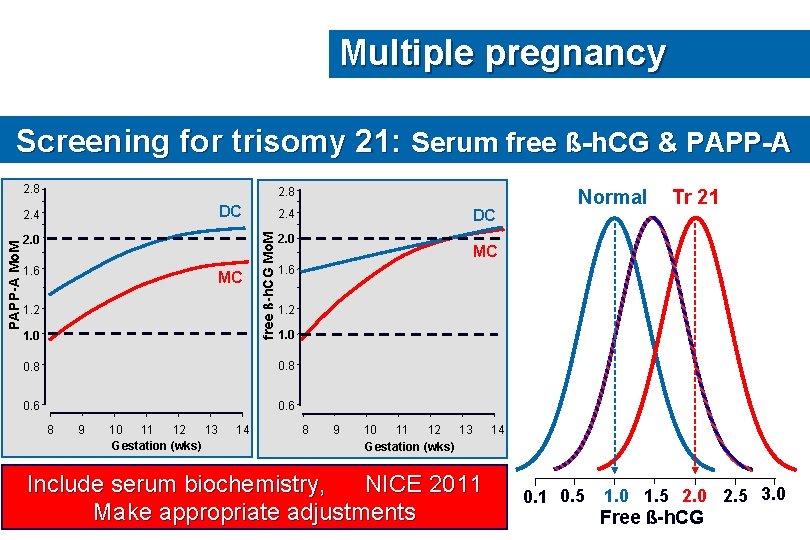
Multiple pregnancy Screening for trisomy 21: Serum free ß-h. CG & PAPP-A 2. 8 DC 2. 0 1. 6 MC 1. 2 1. 0 2. 0 0. 6 14 MC 1. 0 0. 6 10 11 12 13 Gestation (wks) Tr 21 1. 2 0. 8 9 Normal 1. 6 0. 8 8 DC 2. 4 free ß-h. CG Mo. M PAPP-A Mo. M 2. 4 8 9 10 11 12 13 Gestation (wks) Include serum biochemistry, NICE 2011 Make appropriate adjustments 14 0. 1 0. 5 1. 0 1. 5 2. 0 2. 5 3. 0 Free ß-h. CG
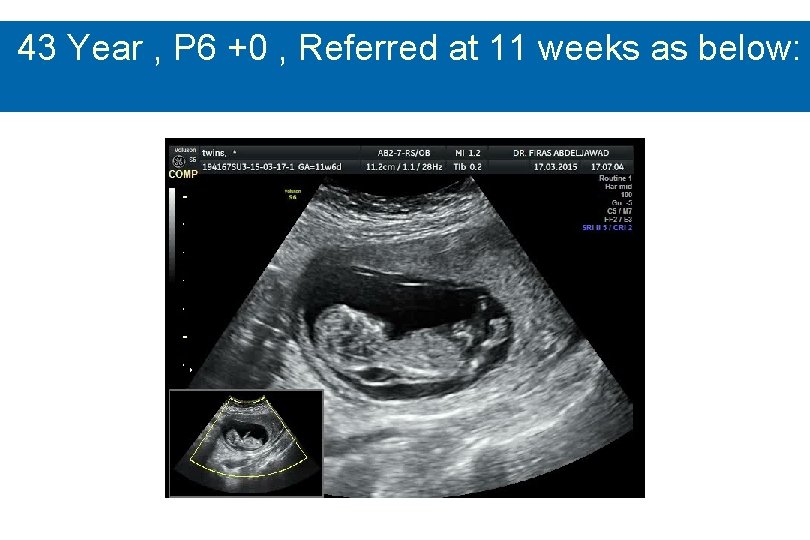
43 Year , P 6 +0 , Referred at 11 weeks as below:
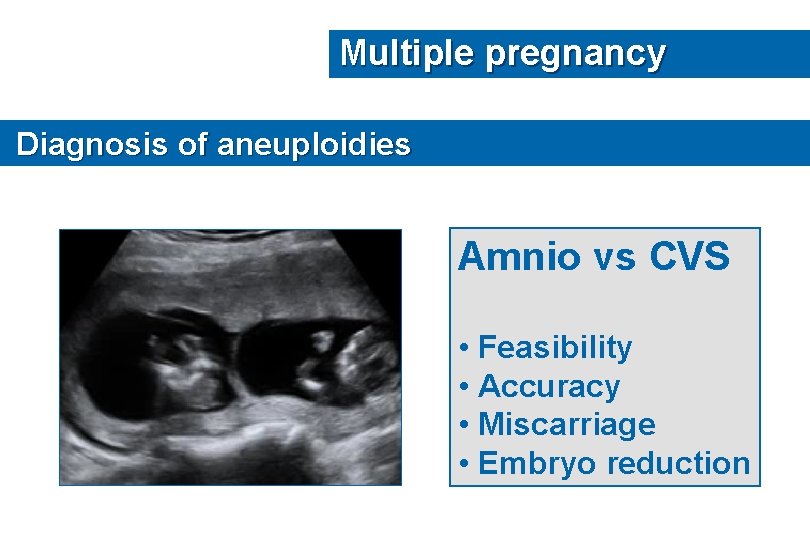
Multiple pregnancy Diagnosis of aneuploidies Amnio vs CVS • Feasibility • Accuracy • Miscarriage • Embryo reduction
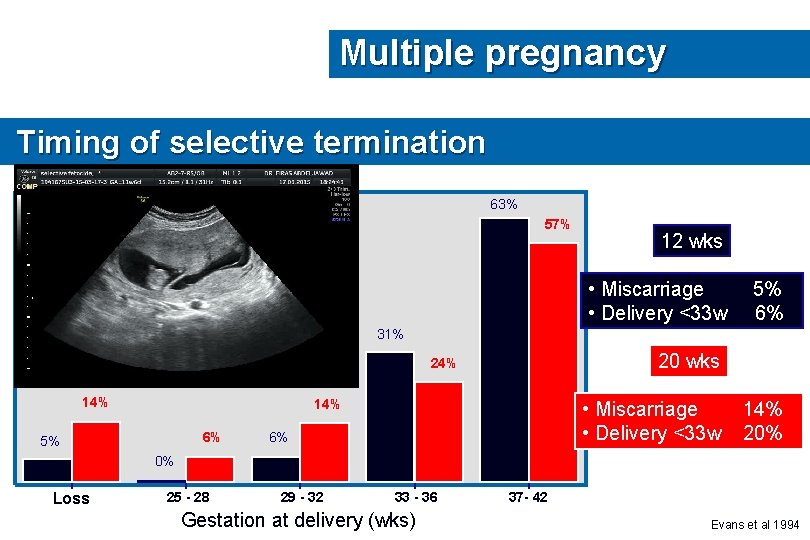
Multiple pregnancy Timing of selective termination 63% 57% <16 wks >16 wks 12 wks • Miscarriage • Delivery <33 w 5% 6% 31% 20 wks 24% 14% 6% 5% • Miscarriage • Delivery <33 w 6% 14% 20% 0% Loss 25 - 28 29 - 32 33 - 36 Gestation at delivery (wks) 37 - 42 Evans et al 1994
In monochorionic multiple pregnancies , an increased NT measurement had a high specifity and positive predictive value for adverse perinatal outcome.
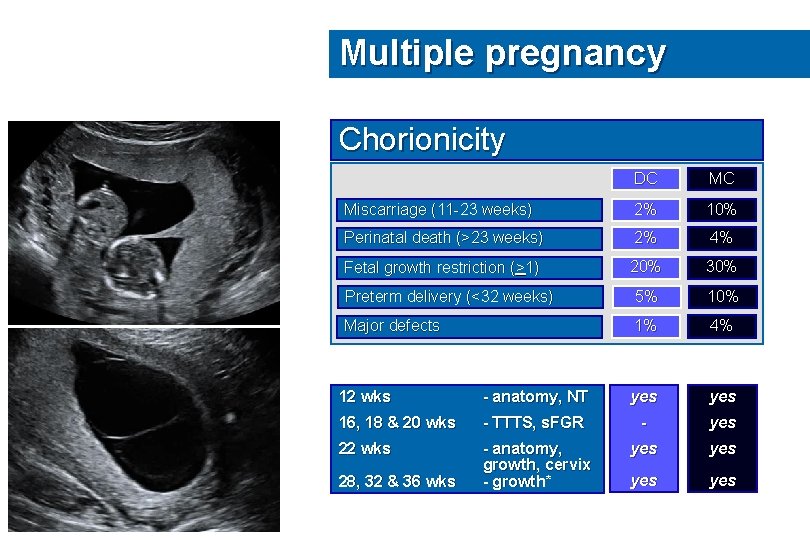
Multiple pregnancy Chorionicity DC MC Miscarriage (11 -23 weeks) 2% 10% Perinatal death (>23 weeks) 2% 4% Fetal growth restriction (>1) 20% 30% Preterm delivery (<32 weeks) 5% 10% Major defects 1% 4% 12 wks - anatomy, NT yes 16, 18 & 20 wks - TTTS, s. FGR - yes 22 wks - anatomy, growth, cervix - growth* yes yes 28, 32 & 36 wks
The prediction of pregnancy complication is an important obstetric goal because it allows the perinatal team to make a decisions regarding antenatal management , including whether intervention is required , and timing of delivery.
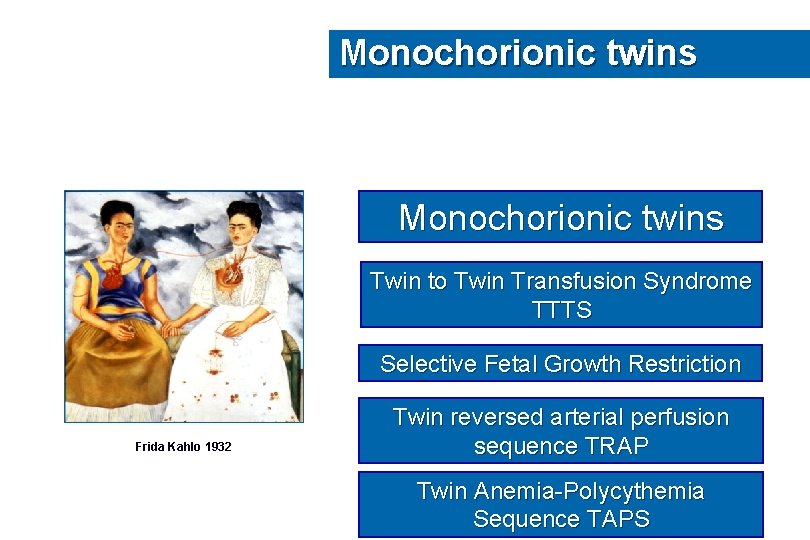
Monochorionic twins Twin to Twin Transfusion Syndrome TTTS Selective Fetal Growth Restriction Frida Kahlo 1932 Twin reversed arterial perfusion sequence TRAP Twin Anemia-Polycythemia Sequence TAPS
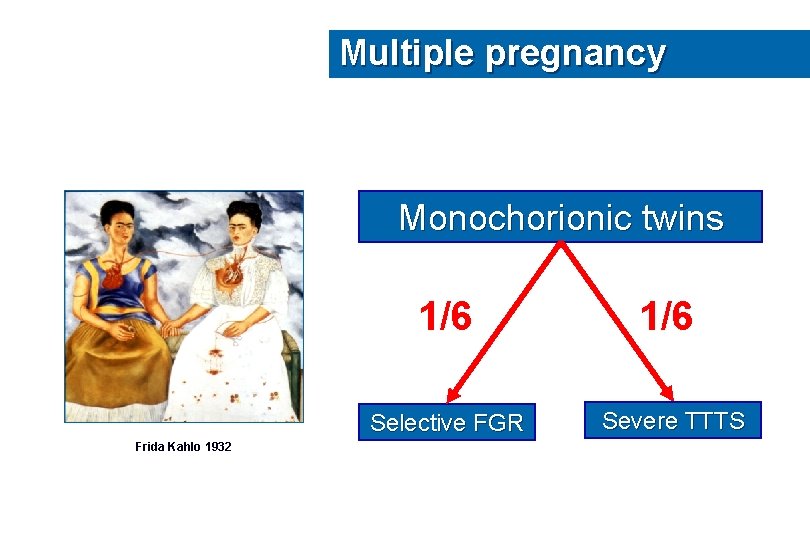
Multiple pregnancy Monochorionic twins Frida Kahlo 1932 1/6 Selective FGR Severe TTTS
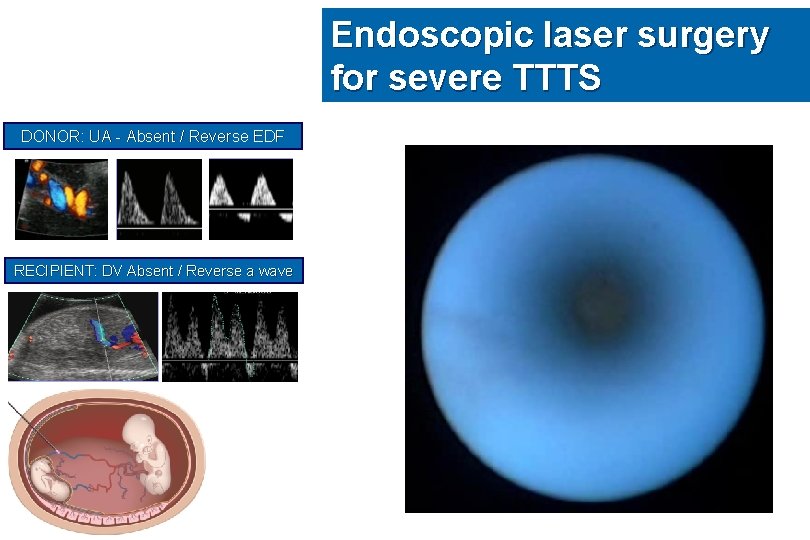
Endoscopic laser surgery for severe TTTS DONOR: UA - Absent / Reverse EDF RECIPIENT: DV Absent / Reverse a wave
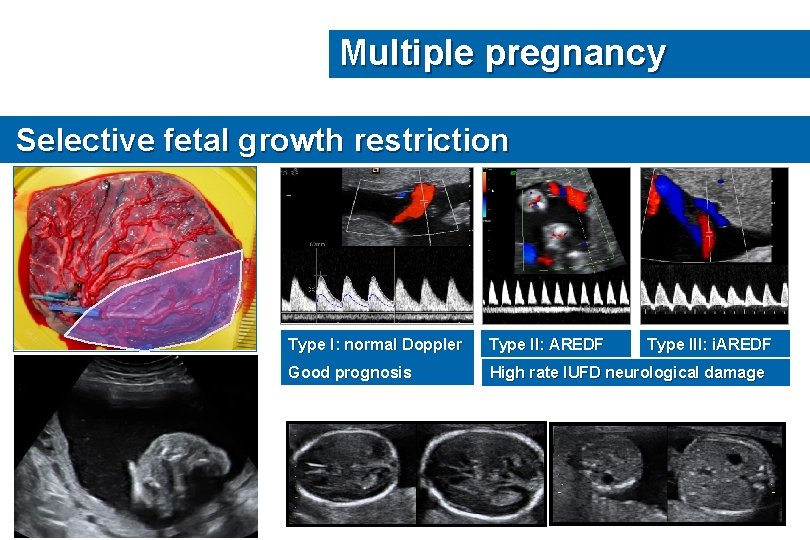
Multiple pregnancy Selective fetal growth restriction Type I: normal Doppler Type II: AREDF Type III: i. AREDF Good prognosis High rate IUFD neurological damage
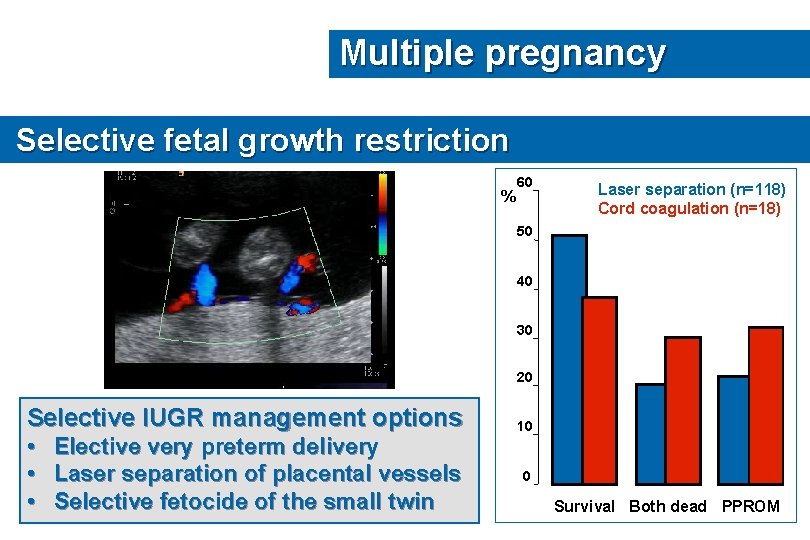
Multiple pregnancy Selective fetal growth restriction % 60 Laser separation (n=118) Cord coagulation (n=18) 50 40 30 20 Selective IUGR management options • Elective very preterm delivery • Laser separation of placental vessels • Selective fetocide of the small twin 10 0 Survival Both dead PPROM
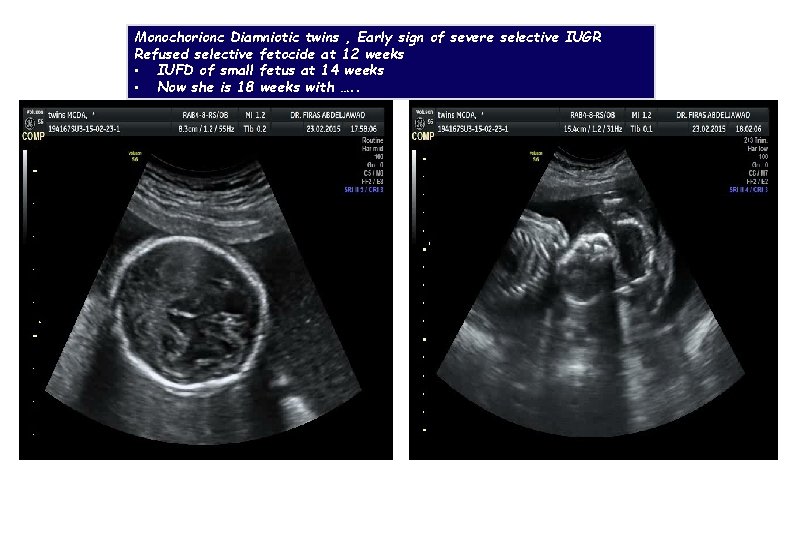
Monochorionc Diamniotic twins , Early sign of severe selective IUGR Refused selective fetocide at 12 weeks • IUFD of small fetus at 14 weeks • Now she is 18 weeks with …. .
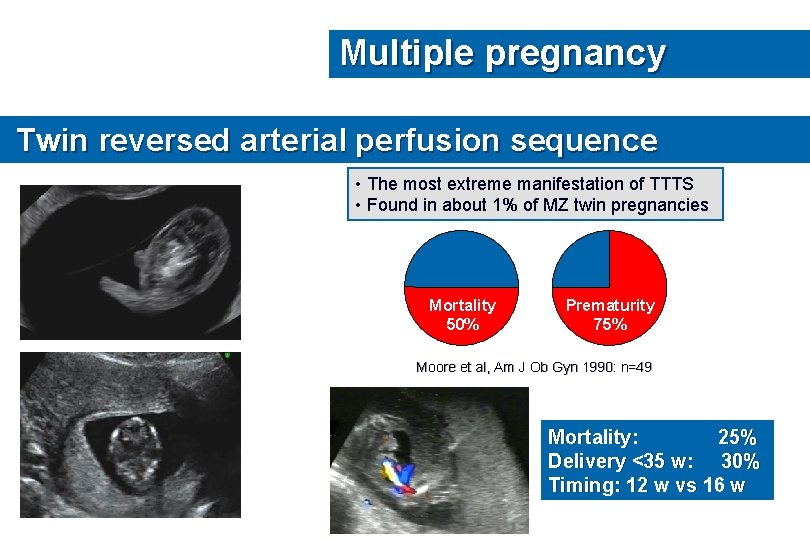
Multiple pregnancy Twin reversed arterial perfusion sequence • The most extreme manifestation of TTTS • Found in about 1% of MZ twin pregnancies Mortality 50% Prematurity 75% Moore et al, Am J Ob Gyn 1990: n=49 Mortality: 25% Delivery <35 w: 30% Timing: 12 w vs 16 w
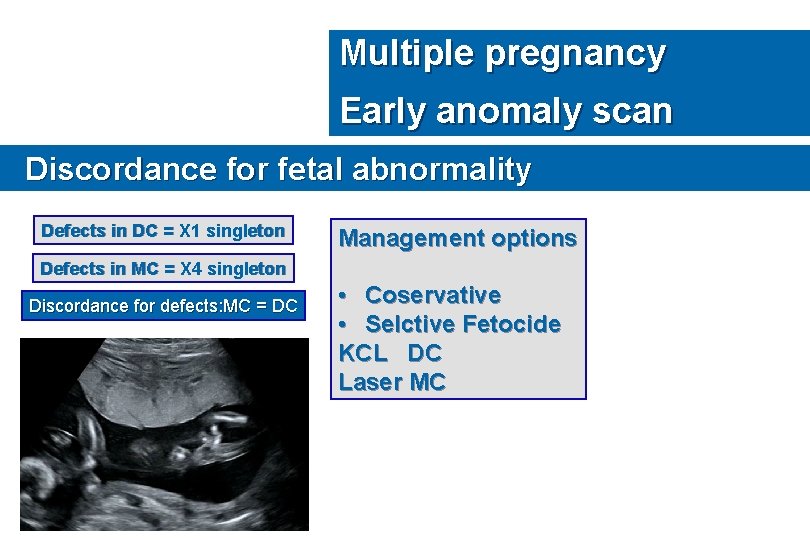
Multiple pregnancy Early anomaly scan Discordance for fetal abnormality Defects in DC = X 1 singleton Management options Defects in MC = X 4 singleton Discordance for defects: MC = DC • Coservative • Selctive Fetocide KCL DC Laser MC
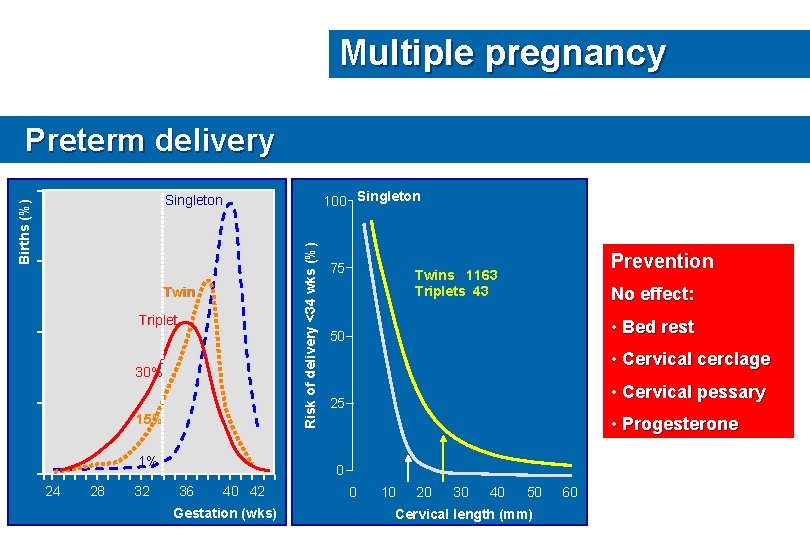
Multiple pregnancy Preterm delivery 100 Singleton Risk of delivery <34 wks (%) Births (%) Singleton Twin Triplet 30% 15% 1% 24 28 32 75 Prevention Twins 1163 Triplets 43 No effect: • Bed rest 50 • Cervical cerclage • Cervical pessary 25 • Progesterone 0 36 40 42 Gestation (wks) 0 10 20 30 40 50 Cervical length (mm) 60

Thank you ………
- Slides: 29