
First Transitions Supporting young children with the first
![Social and Emotional Aspects of Development (SEAD) [Df. CSF, 2008] Click on the document](https://slidetodoc.com/presentation_image_h2/843fdebc34383028de6c92d70df9ffef/image-23.jpg "Social and Emotional Aspects of Development (SEAD) [Df. CSF, 2008] Click on the document")

![References and web links: • www. parentingcounts. org [accessed 2. 3. 16] • Gottman,](https://slidetodoc.com/presentation_image_h2/843fdebc34383028de6c92d70df9ffef/image-37.jpg "References and web links: • www. parentingcounts. org [accessed 2. 3. 16] • Gottman,")
- Slides: 38
First Transitions Supporting young children with the first transition Home to the Early Years Setting Essex Selective Mutism Special Interest Group
This icon means that there is an audio clip available. When you see this icon throughout the presentation, please hover the icon and select play. Ensure your speakers are turned on.
“Children’s lives today are so much more hectic than ever before. Going to a setting for the first time, moving to another one, starting school or moving into a new class are seen by many people as a normal part of the lives of children. Yet transitions are milestone events for children and have a definite effect on their development. They are times of exciting change certainly and times of new opportunities and growth for every child. They can also be times of uncertainty where surroundings are not the same, expectations and procedures different and faces as yet unfamiliar. Getting transition right is vital for every child and is not a single event that merely ‘happens’. Transition should be viewed as a process rather than an event that involves children, practitioners and parents together. Transition has been described as an ongoing journey rather than a destination. ” Accessed 3/7/2016 Early Years Matters Essex Selective Mutism Special Interest Group
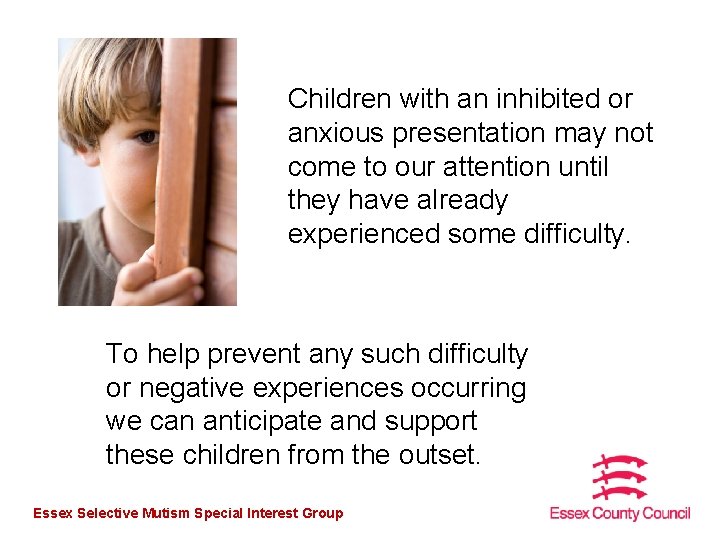
Children with an inhibited or anxious presentation may not come to our attention until they have already experienced some difficulty. To help prevent any such difficulty or negative experiences occurring we can anticipate and support these children from the outset. Essex Selective Mutism Special Interest Group
Key considerations Parent/carer feels confident that the setting will provide for their child’s needs; Setting staff show willingness to work in partnership with parent/carer - Effective Parent Partnership Key Person anticipates needs of child and parent/carer and shows willingness to adapt the provision where possible for the benefit of the child. Child feels safe and comfortable on entry to the setting. Essex Selective Mutism Special Interest Group
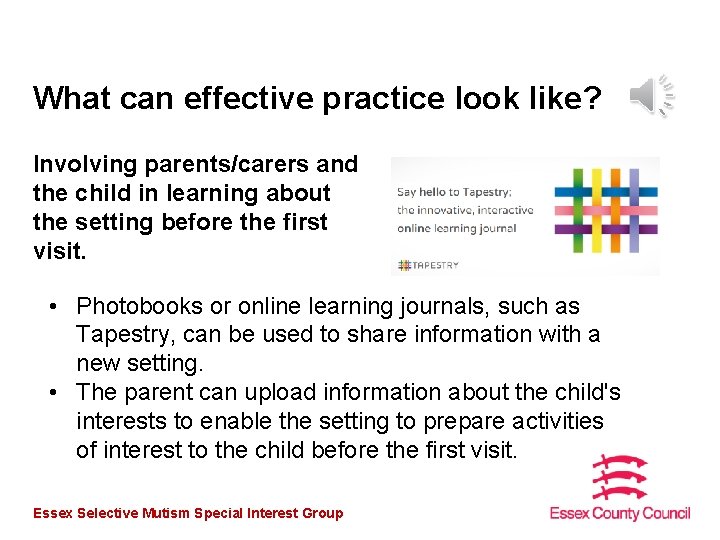
What can effective practice look like? Involving parents/carers and the child in learning about the setting before the first visit. • Photobooks or online learning journals, such as Tapestry, can be used to share information with a new setting. • The parent can upload information about the child's interests to enable the setting to prepare activities of interest to the child before the first visit. Essex Selective Mutism Special Interest Group
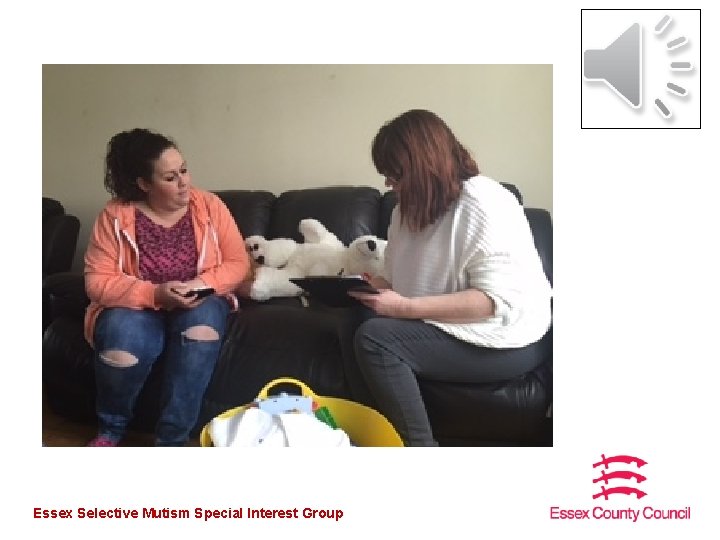
What can effective practice look like? Case Study: Little Rascals Preschool How ‘Home Visits’ support the first transition Essex Selective Mutism Special Interest Group
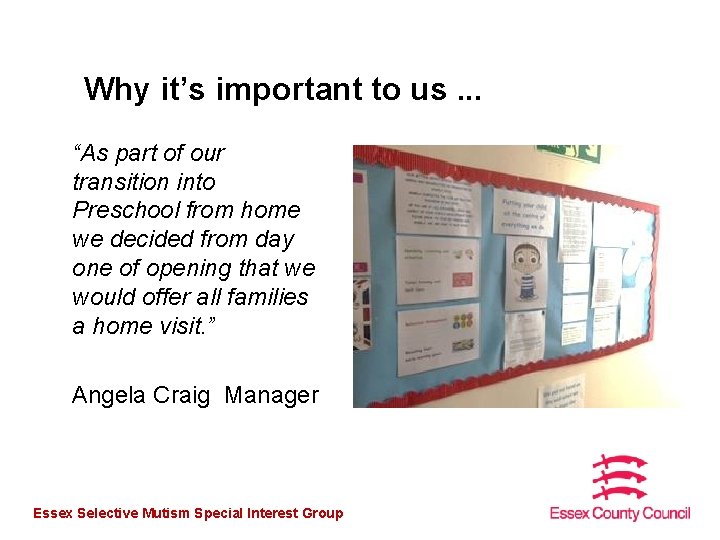
Why it’s important to us. . . “As part of our transition into Preschool from home we decided from day one of opening that we would offer all families a home visit. ” Angela Craig Manager Essex Selective Mutism Special Interest Group
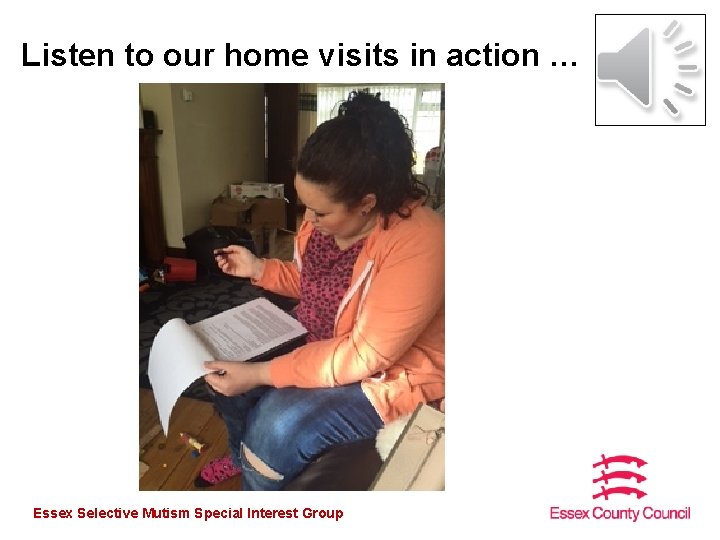
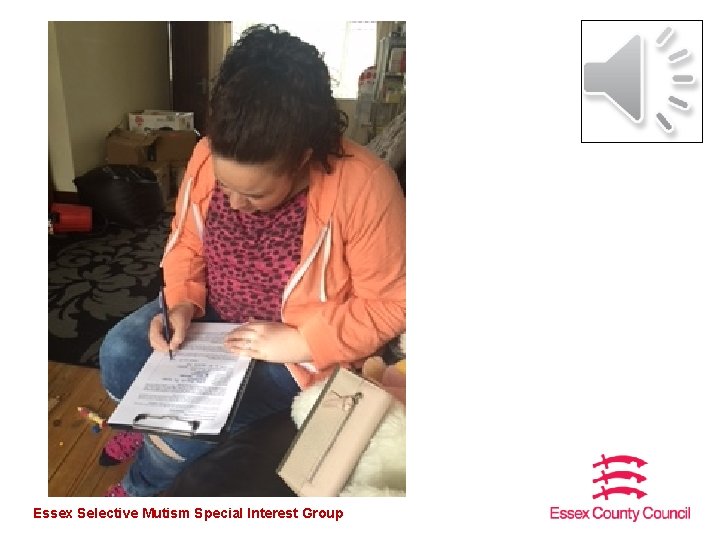
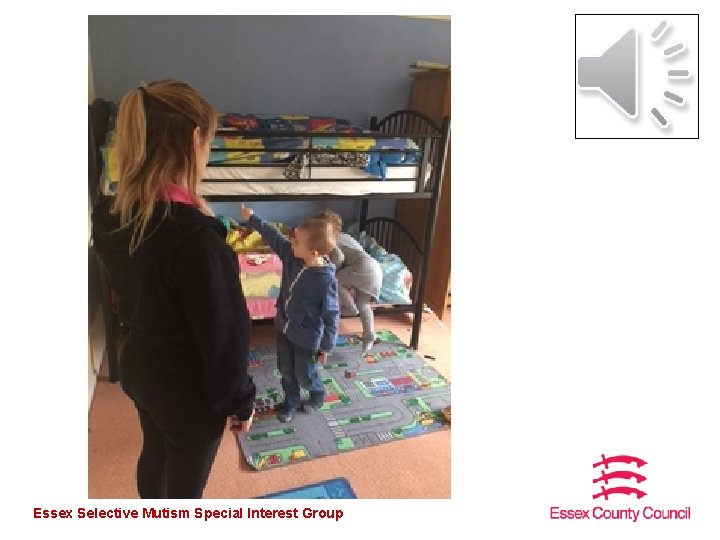
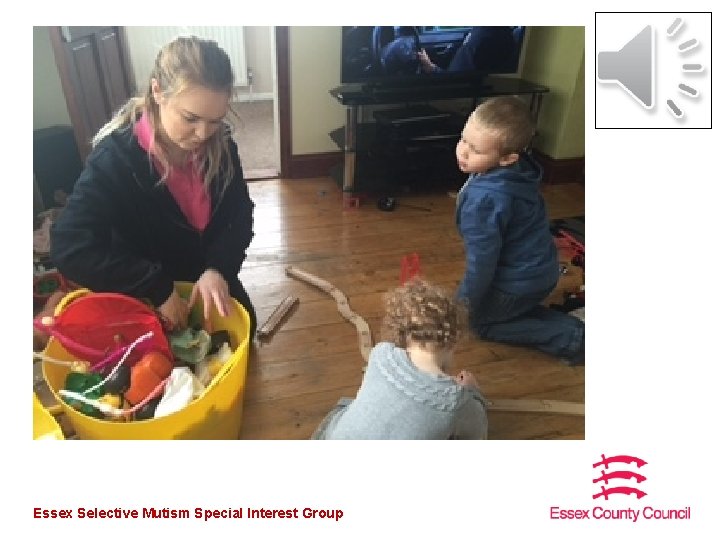
Listen to our home visits in action … Essex Selective Mutism Special Interest Group
Essex Selective Mutism Special Interest Group
Essex Selective Mutism Special Interest Group
Essex Selective Mutism Special Interest Group
Essex Selective Mutism Special Interest Group
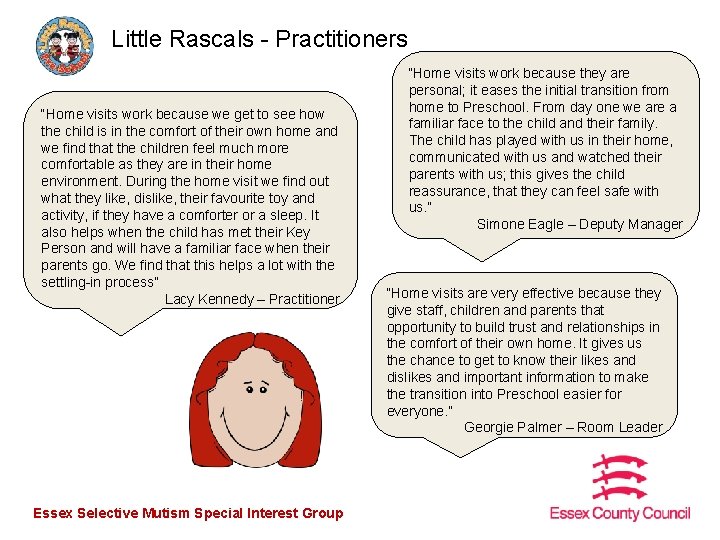
Little Rascals - Practitioners “Home visits work because we get to see how the child is in the comfort of their own home and we find that the children feel much more comfortable as they are in their home environment. During the home visit we find out what they like, dislike, their favourite toy and activity, if they have a comforter or a sleep. It also helps when the child has met their Key Person and will have a familiar face when their parents go. We find that this helps a lot with the settling-in process” Lacy Kennedy – Practitioner Essex Selective Mutism Special Interest Group “Home visits work because they are personal; it eases the initial transition from home to Preschool. From day one we are a familiar face to the child and their family. The child has played with us in their home, communicated with us and watched their parents with us; this gives the child reassurance, that they can feel safe with us. ” Simone Eagle – Deputy Manager “Home visits are very effective because they give staff, children and parents that opportunity to build trust and relationships in the comfort of their own home. It gives us the chance to get to know their likes and dislikes and important information to make the transition into Preschool easier for everyone. ” Georgie Palmer – Room Leader
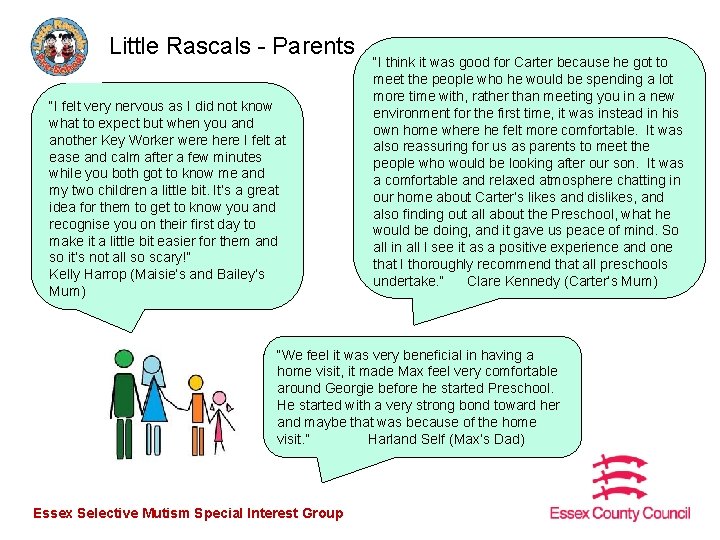
Little Rascals - Parents “I felt very nervous as I did not know what to expect but when you and another Key Worker were here I felt at ease and calm after a few minutes while you both got to know me and my two children a little bit. It’s a great idea for them to get to know you and recognise you on their first day to make it a little bit easier for them and so it’s not all so scary!” Kelly Harrop (Maisie’s and Bailey’s Mum) “I think it was good for Carter because he got to meet the people who he would be spending a lot more time with, rather than meeting you in a new environment for the first time, it was instead in his own home where he felt more comfortable. It was also reassuring for us as parents to meet the people who would be looking after our son. It was a comfortable and relaxed atmosphere chatting in our home about Carter’s likes and dislikes, and also finding out all about the Preschool, what he would be doing, and it gave us peace of mind. So all in all I see it as a positive experience and one that I thoroughly recommend that all preschools undertake. ” Clare Kennedy (Carter’s Mum) “We feel it was very beneficial in having a home visit, it made Max feel very comfortable around Georgie before he started Preschool. He started with a very strong bond toward her and maybe that was because of the home visit. ” Harland Self (Max’s Dad) Essex Selective Mutism Special Interest Group
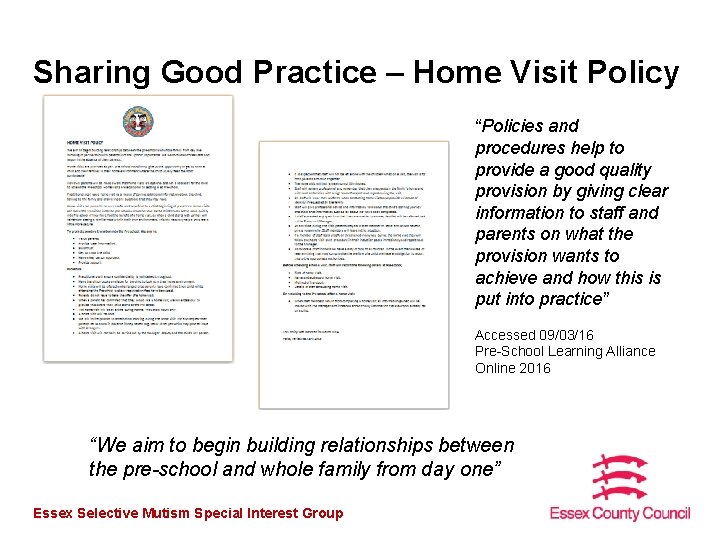
Sharing Good Practice – Home Visit Policy “Policies and procedures help to provide a good quality provision by giving clear information to staff and parents on what the provision wants to achieve and how this is put into practice” Accessed 09/03/16 Pre-School Learning Alliance Online 2016 “We aim to begin building relationships between the pre-school and whole family from day one” Essex Selective Mutism Special Interest Group
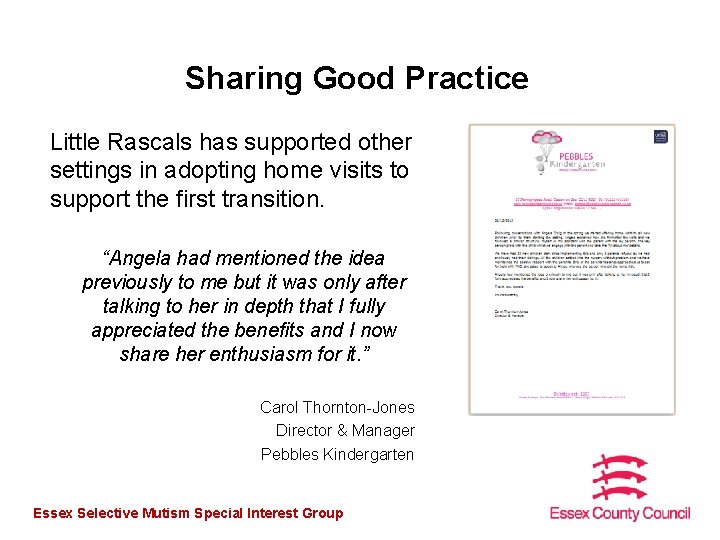
Sharing Good Practice Little Rascals has supported other settings in adopting home visits to support the first transition. “Angela had mentioned the idea previously to me but it was only after talking to her in depth that I fully appreciated the benefits and I now share her enthusiasm for it. ” Carol Thornton-Jones Director & Manager Pebbles Kindergarten Essex Selective Mutism Special Interest Group
A continuous cycle…. “These bigger changes, for many children, include moving from home to a childminder or early years setting for the first time, and a range of other transitions as they progress through the Foundation Stage and into Key Stage 1. They will respond in different ways, some with confidence, others with more apprehension, but so many adjustments are likely to have profound and long lasting effects if the importance of maintaining coherence and continuity is not well understood. Children’s confidence will be enhanced when changes happen gradually, and when time is prioritized to support these transitions with sensitive planning and preparation. ” Seamless Transitions Essex Selective Mutism Special Interest Group
Key messages for setting staff Adult interaction staff and parents/carers 1 Body language, eye contact, facial expression • Open posture, arms and legs uncrossed, sit comfortably, leaning forward from time to time, look genuinely interested, listening attentively, effective eye contact with-out staring, and remain relax. Make time to listen • Make sure the meeting is well planned and organised. Reflect on conversations • Make sure there is no misunderstanding between you and the parents: get into the habit of summarising what is said. Essex Selective Mutism Special Interest Group
Key messages for setting staff Adult interaction staff and parents/carers Be encouraging • Show the parents that you are interested in what they are saying. Encourage them to be open and honest. Ask open questions • Open questions encourage people to talk and will help ensure that parents talk about what is important to them. i. e. Is there anything you would like us to know about …? Acknowledge a parents feelings or emotions • Be aware of some of the emotions parents may go through. Essex Selective Mutism Special Interest Group 2
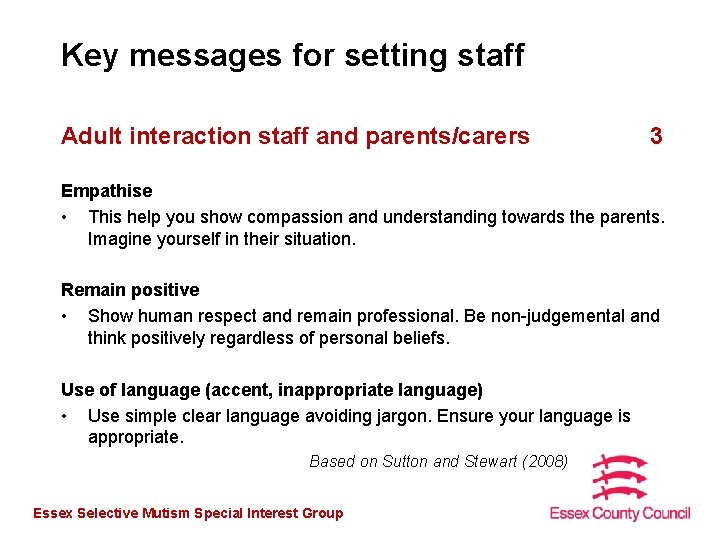
Key messages for setting staff Adult interaction staff and parents/carers 3 Empathise • This help you show compassion and understanding towards the parents. Imagine yourself in their situation. Remain positive • Show human respect and remain professional. Be non-judgemental and think positively regardless of personal beliefs. Use of language (accent, inappropriate language) • Use simple clear language avoiding jargon. Ensure your language is appropriate. Based on Sutton and Stewart (2008) Essex Selective Mutism Special Interest Group
Working with Families - Communication with families - video link here Essex Selective Mutism Special Interest Group
Social and Emotional Aspects of Development (SEAD) [Df. CSF, 2008] Click on the document link above and see Section 2 Essex Selective Mutism Special Interest Group
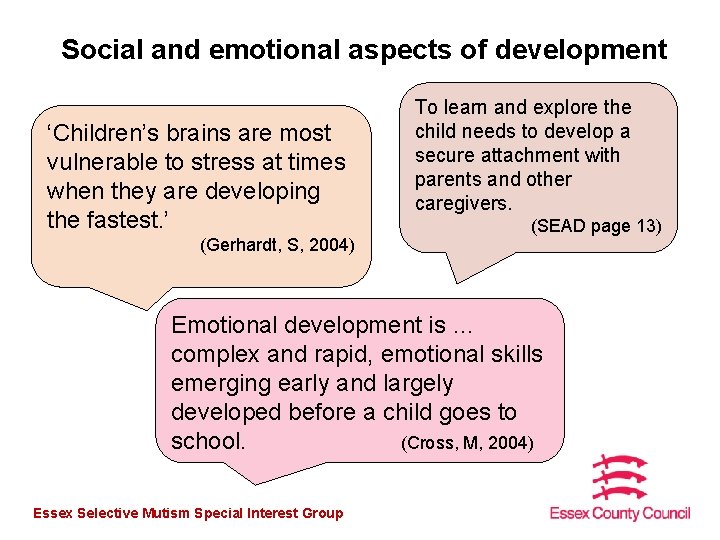
Social and emotional aspects of development ‘Children’s brains are most vulnerable to stress at times when they are developing the fastest. ’ (Gerhardt, S, 2004) To learn and explore the child needs to develop a secure attachment with parents and other caregivers. (SEAD page 13) Emotional development is … complex and rapid, emotional skills emerging early and largely developed before a child goes to school. (Cross, M, 2004) Essex Selective Mutism Special Interest Group
Adult-child interaction Consider how you act as a key attachment figure when you support the child emotionally in your relationship See SEAD document pages 17 - 19 in Section 2 Essex Selective Mutism Special Interest Group
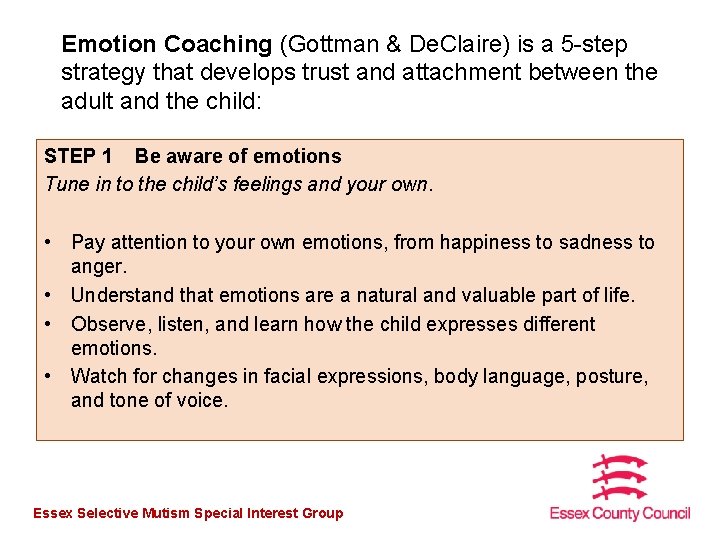
Emotion Coaching (Gottman & De. Claire) is a 5 -step strategy that develops trust and attachment between the adult and the child: STEP 1 Be aware of emotions Tune in to the child’s feelings and your own. • Pay attention to your own emotions, from happiness to sadness to anger. • Understand that emotions are a natural and valuable part of life. • Observe, listen, and learn how the child expresses different emotions. • Watch for changes in facial expressions, body language, posture, and tone of voice. Essex Selective Mutism Special Interest Group
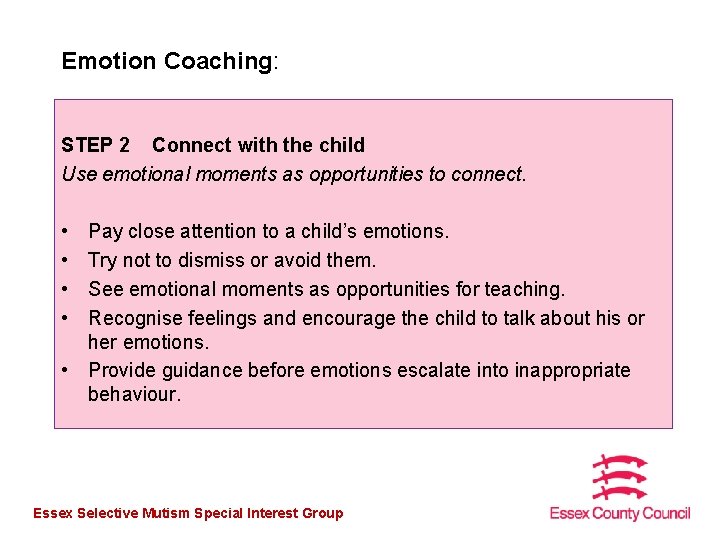
Emotion Coaching: STEP 2 Connect with the child Use emotional moments as opportunities to connect. • • Pay close attention to a child’s emotions. Try not to dismiss or avoid them. See emotional moments as opportunities for teaching. Recognise feelings and encourage the child to talk about his or her emotions. • Provide guidance before emotions escalate into inappropriate behaviour. Essex Selective Mutism Special Interest Group
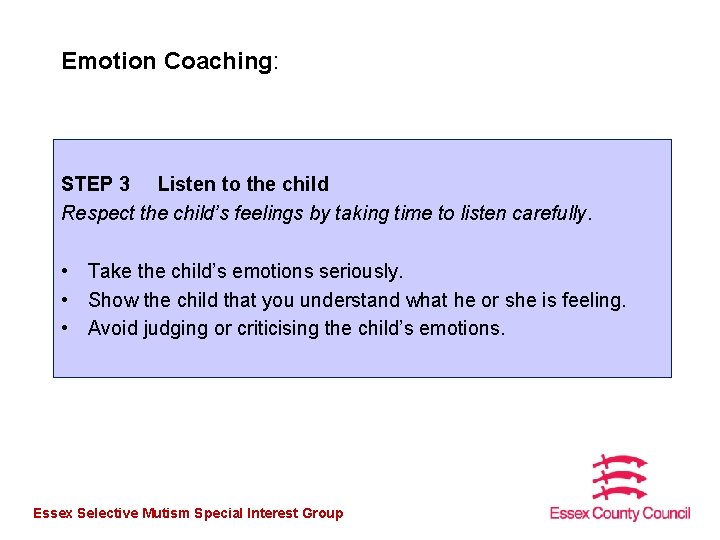
Emotion Coaching: STEP 3 Listen to the child Respect the child’s feelings by taking time to listen carefully. • Take the child’s emotions seriously. • Show the child that you understand what he or she is feeling. • Avoid judging or criticising the child’s emotions. Essex Selective Mutism Special Interest Group
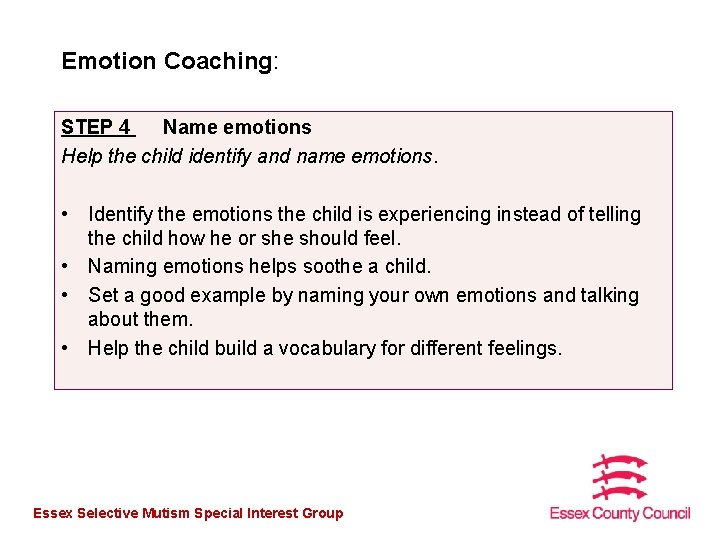
Emotion Coaching: STEP 4 Name emotions Help the child identify and name emotions. • Identify the emotions the child is experiencing instead of telling the child how he or she should feel. • Naming emotions helps soothe a child. • Set a good example by naming your own emotions and talking about them. • Help the child build a vocabulary for different feelings. Essex Selective Mutism Special Interest Group
Emotion Coaching: STEP 5 Find good solutions while setting limits Explore solutions to problems together. • Redirect children for what they do, not what they feel. • When children behave inappropriately, help them to identify their feelings and explain why their behaviour was inappropriate. • Encourage emotional expression, but set clear limits on behaviour. • Help children think through possible solutions. • Don’t expect too much too soon. • Create situations where the child can explore without hearing lots of "don't” or “no" • Catch the child making good choices and give feedback sensitively (sometimes too overtly can be hard for the child to believe about themselves). • Support collaboratively ‘Let’s do this together’. Essex Selective Mutism Special Interest Group
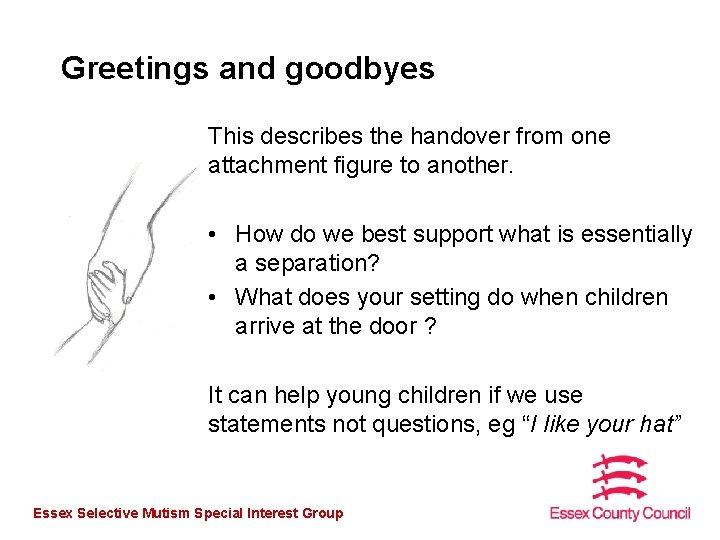
Greetings and goodbyes This describes the handover from one attachment figure to another. • How do we best support what is essentially a separation? • What does your setting do when children arrive at the door ? It can help young children if we use statements not questions, eg “I like your hat” Essex Selective Mutism Special Interest Group
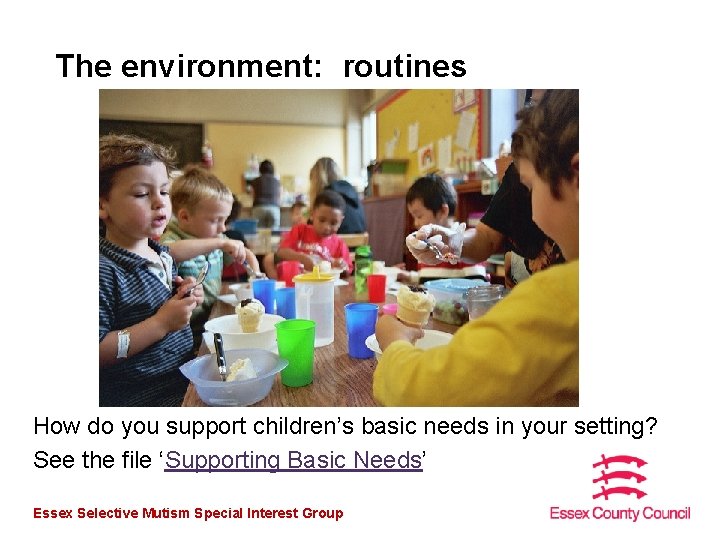
The environment: routines How do you support children’s basic needs in your setting? See the file ‘Supporting Basic Needs’ Essex Selective Mutism Special Interest Group
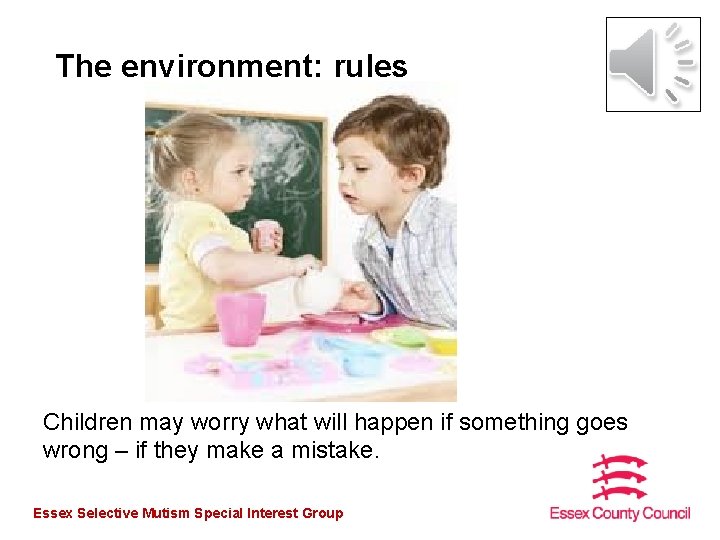
The environment: rules Children may worry what will happen if something goes wrong – if they make a mistake. Essex Selective Mutism Special Interest Group
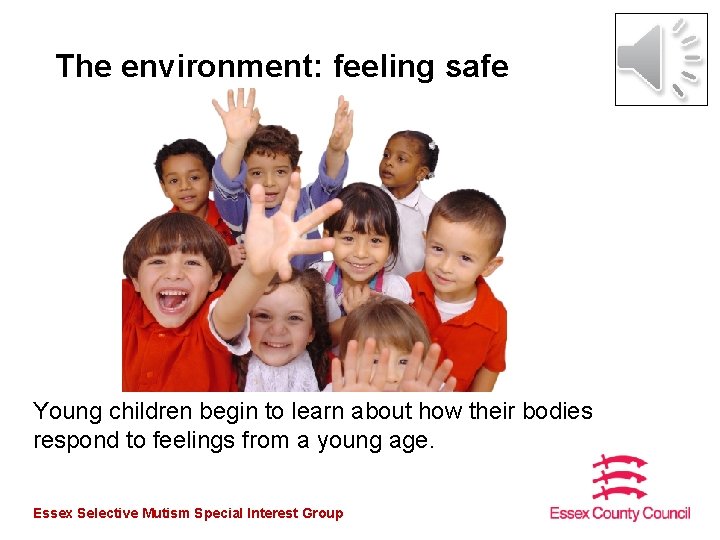
The environment: feeling safe Young children begin to learn about how their bodies respond to feelings from a young age. Essex Selective Mutism Special Interest Group
How does your setting support a child to make the transition from the home to your setting? The following files may help you to look at your provision for a child's first transition: SEN and Disability in the Early Years Toolkit | From pregnancy to children aged 5 http: //www. foundationyears. org. uk/wpcontent/uploads/2011/10/Seamless_Transition. pdf • • • Top Tips for the Early Years - Selective Mutism Supporting Basic Needs – Selective Mutism Relaxation for Children I can point to … where I hurt Emotional Support in School Essex Selective Mutism Special Interest Group
Next transition: Support for transition into school Click on this document: Are you ready for your 4 year olds? Essex Selective Mutism Special Interest Group
References and web links: • www. parentingcounts. org [accessed 2. 3. 16] • Gottman, J & De. Claire J (1997), The Heart of Parenting: Raising an Emotionally Intelligent Child, Prentice Hall Publishers • http: //dnn. essex. gov. uk/Portals/49/Documents/EYFS/Ideas%20 to%20 Develop%2 0 Effective%20 Parent%20 Partnership. pdf • http: //dnn. essex. gov. uk/Portals/49/Documents/EYFS/Nat%20 Strat%20%20 Social%20 and%20 Emotional%20 Aspects%20 of%20 Development. pdf • http: //www. foundationyears. org. uk/wpcontent/uploads/2011/10/Seamless_Transition. pdf • http: //earlyyearsmatters. co. uk/index. php/eyfs/positiverelationships/transitions/? _sm_au_=i. MVW 4 V 3 FRqm. PW 3 NP Essex Selective Mutism Special Interest Group
Thanks and acknowledgements to … • Angela Craig, her team and parents from Little Rascals in Little Clacton • Group members of the Essex Selective Mutism Interest Group Would you like to know more about Selective Mutism or the work of the group? Follow us on Pinterest : Essex Selective Mutism Interest Group on Pinterest Essex Selective Mutism Special Interest Group