
FIRST THINGS FIRST SOME LOGISTICS Register to become
FIRST THINGS FIRST… SOME LOGISTICS • Register to become an associate member of the NSP • Go to NSP. org • $60 to register • Search for Middlebury to sign up for the course • Class fee of $80 (cash or check) • Only junior-febs or younger can try out for patrol, but anyone can take the class
INTRODUCTION TO OUTDOOR EMERGENCY CARE Chapter 1
CHAPTER OVERVIEW • Minnie Dole • History • The Book • Medical-legal issues • Confidentiality • Negligence • Documentation • Consent
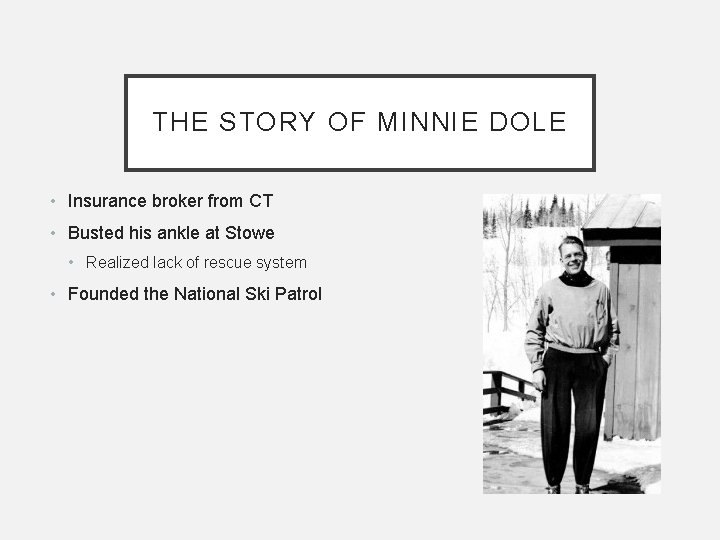
THE STORY OF MINNIE DOLE • Insurance broker from CT • Busted his ankle at Stowe • Realized lack of rescue system • Founded the National Ski Patrol

10 T H MOUNTAIN DIVISION • World War II – part of Army • NSP gathered 7, 000 people to develop “winter warfare unit” in 1943 • Engaged in combat in Italy in 1944
OEC HISTORY • Initially affiliated with the American Red Cross • Developed OEC course to deepen/legitimize patrollers’ medical capacity • New textbook includes water emergencies, etc • “Gold Standard” • Certification is necessary to patrol anywhere
BOOK OVERVIEW • Basic anatomy • How to assess patients • How to intervene in an emergency • Course Objectives are key in every chapter • While we don’t test everything in the book for the Midd exam, everything is fair game for the NSP exam
CERTIFICATION/RECERTIFICATION • Take the course (what you’re doing now) • Pass the NSP exam • Participate in refreshers every year • Standard of training
ON THE JOB • First responder • Scene manager • Caregiver • Patient advocate • Role model • Appearance, presentation, demeanor, and public action are also important • Standard of care

ETHICAL AND LEGAL ISSUES • Respect autonomy • Right to refuse care • Do no harm • Interventions should not harm patient • Benefit others • Promote health and well being of others • Be just • Balancing the rights of individuals • Be faithful
ETHICAL AND LEGAL ISSUES • Good Samaritan Laws • Protect a person from legal liability when they volunteer to perform an act to help someone else • Unless actions are “grossly negligent” • Designed to encourage help • Doctrine of Public Reliance • You have the duty to rescue someone when in uniform
ETHICAL AND LEGAL ISSUES • Abandonment (p. 17) • Not providing (or stopping) first aid care when legally required to provide it • Once you start providing service, don’t stop until: • All required care has been given • Patient transferred to equal/higher level of care • Patient specifically says they no longer want care • Patient is transferred safely to medical facility • Continued care threatens rescuer’s safety
ETHICAL AND LEGAL ISSUES • Negligence • Failure to exercise the care that a reasonable prudent person with similar training would exercise in a similar circumstance (p. 18) • Example: incorrectly splinting an arm, causing further damage • Breach of Duty • Failing to perform promised act of due care • Assumption of Risk • Skiers/riders agree that the sport is dangerous • We need solid documentation for liability purposes

DOCUMENTATION • Following every incident, regardless of magnitude • Personal info, environmental info, MOI, NOI • Detailing the injury
CONSENT • Expressed: patient directly gives permission • Implied: inferred by patient’s actions/situation • Informed: permission upon further explanation • Regarding facts, implications, future consequences • Minor: parent/guardian gives permission
CONSENT • Refusal • Patient has right to refuse first aid (document it) • Intro to Trauma Patient Assessment • Battery • Act of touching someone without their consent • Civil and criminal • Assault • Placing someone in a position where they reasonably fear that battery will occur

EMERGENCY CARE SYSTEMS Chapter 2
CHAPTER OBJECTIVES • After this presentation, you should be able to: • List 6 attributes of the emergency care system • List 4 nationally recognized pre-hospital emergency care provider levels • Compare/contrast direct vs. indirect medical oversight • Describe the purpose of quality improvement
GLOSSARY • Emergency Care System • A network of specially trained personnel, equipment, facilities, and other resources that respond to medical emergencies • If you’re hurt, this is how you get to the hospital • Has been in place forever, but has become more and more formalized • EMS • Rescue operations, prehospital care, ambulances, education, etc for treating victims of illness/injury
6 ATTRIBUTES OF EMS • See page 35 of textbook (there are 14 attributes) 1. Integration of Health Services 2. Human Resources 3. Education Systems 4. Prevention 5. Communication Systems 6. Clinical Care

LEVELS OF EMERGENCY PERSONNEL • EMR • First responder, immediate treatment, limited resources • EMT • Provide basic life support, administer meds, transport • AEMT • Same, but intermediate life support (ambulance) • Paramedic • Highest level of prehospital care, , using advanced equipment and medications (narcotics)
WHAT’S IMPORTANT IN EMS? • Commonality • Everyone on the same page • Precision • With regard to injury description • Communication • Patient transfer • Radio (alpha charlie foxtrot delta) • Transport • Documentation
MEDICAL OVERSIGHT • Direct • Licensed physician provides live oversight of patient care • Advanced care • Indirect • Prehospital providers don’t need to contact a physician before providing care • More for advanced care, but we provide O 2
QUALITY IMPROVEMENT • The goal is meet/exceed customer expectations • Prospective: preventing problems • Concurrent: taking action while tasks are being performed • Retrospective: ways to improve in the future
RESCUE BASICS Chapter 3 Mmm that meaty stuff yum
OBJECTIVES • Your safety is as important as others • Body temperature regulation • 4 mechanisms of heat exchange • Fight or flight response • 5 modes of disease transmission • PPE • Scene safety and size up • Chain of custody
ANATOMY AND PHYSIOLOGY • Homeostasis • Temperature Regulation • Conduction – the transfer of heat from a warmer object to a cooler object through direct contact • Convection – occurs when a gas or a liquid moves past the surface of an object • Radiation – when energy is transmitted in waves through space • Evaporation – occurs when a liquid converts to a gas • Fight or Flight Response • Immune Response
STRESS REACTIONS • Stage 1: Alarm • At first exposure to the stressor • Increased heart rate, pupil dilation, increased breathing, sweating… • Stage 2: Resistance • Individual adapts to stressor • Compensation occurs through coping mechanisms, pulse and blood pressure return to normal • Stage 3: Exhaustion • Prolonged exposure to same stressor exhausts the person’s adaptation energy • Signs and symptoms of the alarm stage return and are more difficult to control
WORKING OUTDOORS • Environmental Conditions • Mental Preparedness • Physical Fitness • Proper Equipment • Hydration • Prolonged Rescue Response Preparation
PROTECTING YOURSELF FROM DISEASE • Contamination • 5 ways to transmit infectious diseases • Direct, indirect, airborne, ingestion, vector borne • Common Infectious Diseases • Body Substance Isolation • Personal Protective Equipment (PPE) • Decontamination
ASSESSING EMERGENCY SITUATIONS • Scene Safety • Scene size up • Mechanism of Injury (MOI) vs. Nature of Injury (NOI) • Life threatening problems • Number of Patients and Need for Additional Resources
DEALING WITH HAZARDOUS MATERIALS • Hazardous materials (Haz. Mat) • Steer clear of them • Stay 250 feet from the dangerous scene • All dangerous materials should be clearly marked • Haz. Mat personnel
CRIME SCENES • Notify law enforcement immediately • Do not tamper with the crime scene • Chain of Custody • Examples: • Homicides, hostage situations, assault • Always respect the privacy of patients • Keep media away
DEALING WITH STRESS • Stress response: • Chest pain, rapid breathing, crying, screaming, loss of the ability to think rationally • If a rescuer cannot handle the stress of a situation they should be removed form the situation • Delayed Stress Response and Post Traumatic Stress Disorder • Stress Debriefing
PATIENT ASSESSMENT Chapter 7 (VERY Important and requires routine practice)
SCENE SIZE UP • Is it safe to enter the scene? • How will you treat and transport this patient? • What is the chief complaint? • Even if a patient looks fine, never rule anything out until you have asked what happened. • Always introduce yourself and gain permission to help first.
PATIENT ASSESSMENT • Primary Assessment • Quickly identify and correct life threatening problems • Unresponsive patient vs. responsive • ABCDs • Secondary Assessment • Taking a medical history • Performing a physical exam • Assessing vital signs
EVALUATING AN UNRESPONSIVE PATIENT • Check for response by tapping the victims shoulder and shouting • Open airway, check for breathing and check carotid pulse • If breathing normally continue primary assessment • If there is no pulse, start chest compressions (CPR) • If there is a pulse but no breathing, start rescue breathing
ABCDS • Airway: having an open and patent airway which will remain open • Breathing: being able to breathe, so oxygen gets to the body’s tissues effectively and carbon dioxide is removed • Circulation: having blood moving through the vessels to perfuse the tissues • Disability: having a normal mental status and central and peripheral neurologic function, includes having no spinal injury
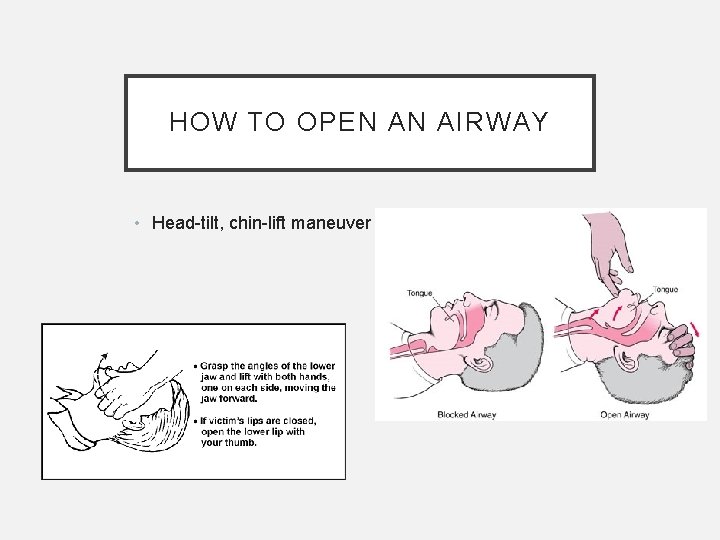
HOW TO OPEN AN AIRWAY • Head-tilt, chin-lift maneuver • Jaw-thrust maneuver
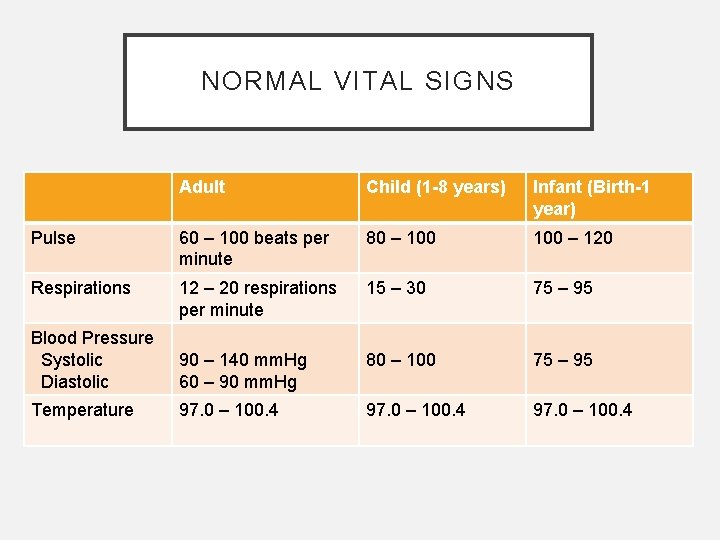
NORMAL VITAL SIGNS Adult Child (1 -8 years) Infant (Birth-1 year) Pulse 60 – 100 beats per minute 80 – 100 – 120 Respirations 12 – 20 respirations per minute 15 – 30 75 – 95 Blood Pressure Systolic Diastolic 90 – 140 mm. Hg 60 – 90 mm. Hg 80 – 100 75 – 95 Temperature 97. 0 – 100. 4
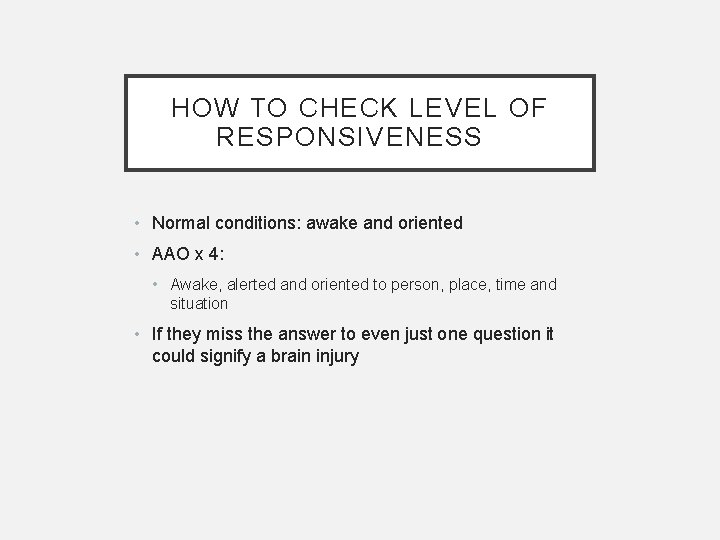
HOW TO CHECK LEVEL OF RESPONSIVENESS • Normal conditions: awake and oriented • AAO x 4: • Awake, alerted and oriented to person, place, time and situation • If they miss the answer to even just one question it could signify a brain injury
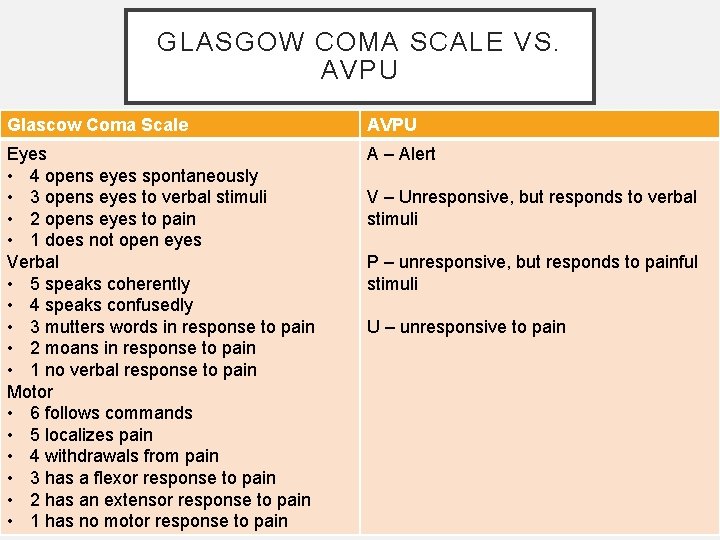
GLASGOW COMA SCALE VS. AVPU Glascow Coma Scale AVPU Eyes • 4 opens eyes spontaneously • 3 opens eyes to verbal stimuli • 2 opens eyes to pain • 1 does not open eyes Verbal • 5 speaks coherently • 4 speaks confusedly • 3 mutters words in response to pain • 2 moans in response to pain • 1 no verbal response to pain Motor • 6 follows commands • 5 localizes pain • 4 withdrawals from pain • 3 has a flexor response to pain • 2 has an extensor response to pain • 1 has no motor response to pain A – Alert V – Unresponsive, but responds to verbal stimuli P – unresponsive, but responds to painful stimuli U – unresponsive to pain
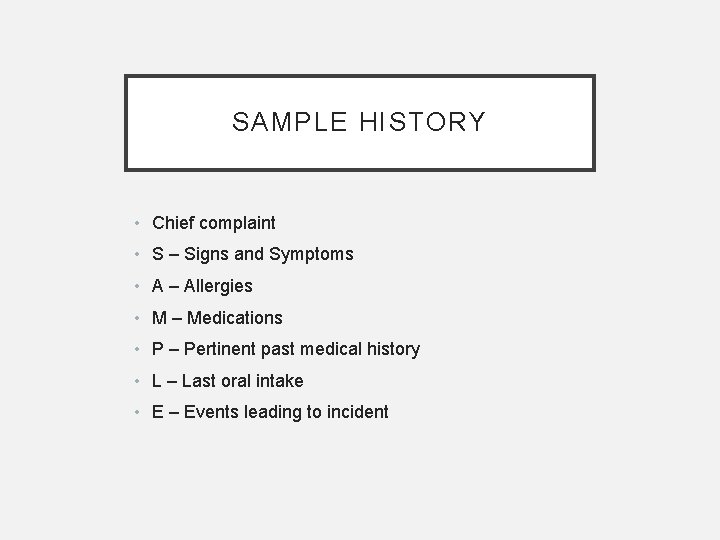
SAMPLE HISTORY • Chief complaint • S – Signs and Symptoms • A – Allergies • M – Medications • P – Pertinent past medical history • L – Last oral intake • E – Events leading to incident
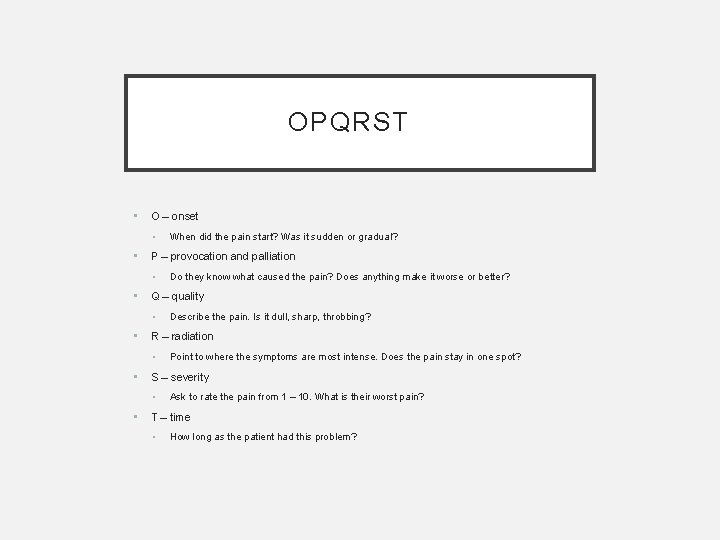
OPQRST • O – onset • • P – provocation and palliation • • Point to where the symptoms are most intense. Does the pain stay in one spot? S – severity • • Describe the pain. Is it dull, sharp, throbbing? R – radiation • • Do they know what caused the pain? Does anything make it worse or better? Q – quality • • When did the pain start? Was it sudden or gradual? Ask to rate the pain from 1 – 10. What is their worst pain? T – time • How long as the patient had this problem?
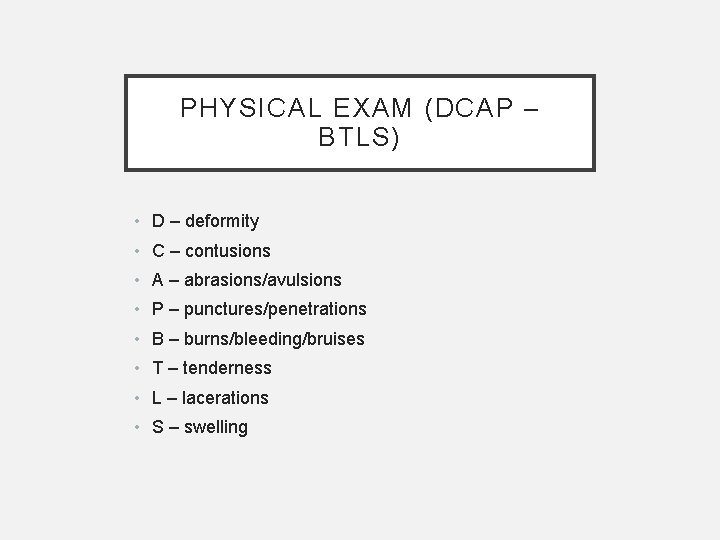
PHYSICAL EXAM (DCAP – BTLS) • D – deformity • C – contusions • A – abrasions/avulsions • P – punctures/penetrations • B – burns/bleeding/bruises • T – tenderness • L – lacerations • S – swelling
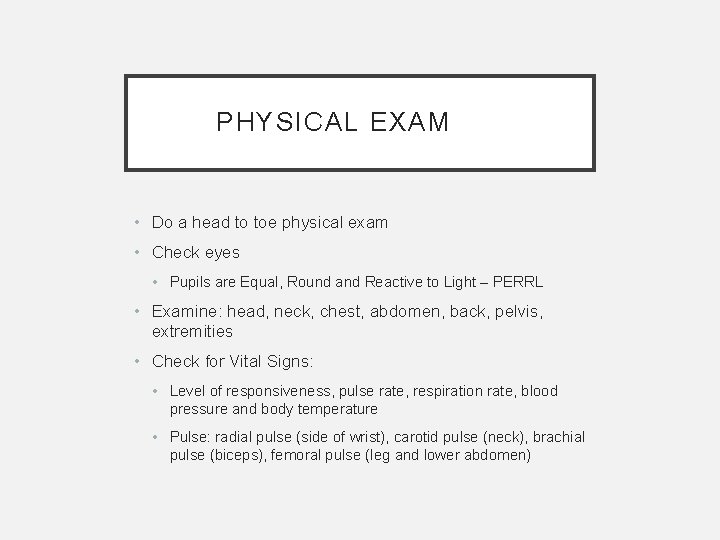
PHYSICAL EXAM • Do a head to toe physical exam • Check eyes • Pupils are Equal, Round and Reactive to Light – PERRL • Examine: head, neck, chest, abdomen, back, pelvis, extremities • Check for Vital Signs: • Level of responsiveness, pulse rate, respiration rate, blood pressure and body temperature • Pulse: radial pulse (side of wrist), carotid pulse (neck), brachial pulse (biceps), femoral pulse (leg and lower abdomen)
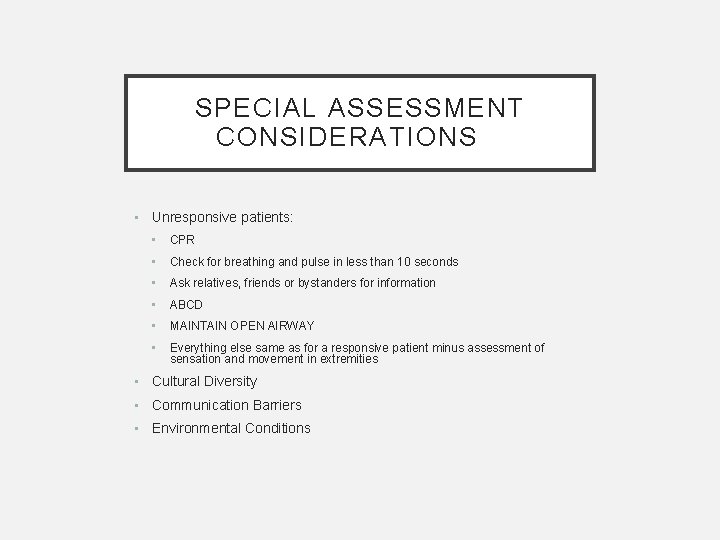
SPECIAL ASSESSMENT CONSIDERATIONS • Unresponsive patients: • CPR • Check for breathing and pulse in less than 10 seconds • Ask relatives, friends or bystanders for information • ABCD • MAINTAIN OPEN AIRWAY • Everything else same as for a responsive patient minus assessment of sensation and movement in extremities • Cultural Diversity • Communication Barriers • Environmental Conditions
CHAPTER 1 REVIEW • You learned about • Minnie Dole • History of the NSP • The Book (and how our class is gonna go) • Medical-legal issues • Confidentiality • Negligence • Documentation • Consent
CHAPTER 2 REVIEW • You Learned about • 6 attributes of the emergency care system • 4 nationally recognized pre-hospital emergency care provider levels • Direct vs. indirect medical oversight • The purpose of quality improvement
CHAPTER 3 REVIEW • Rescuer safety is #1 priority • Manage 4 mechanisms of heat exchange • BIS and PPE • Scene size up and safety • Glove removal
CHAPTER 7 REVIEW • ABCDs first • Chief complaint is patient’s primary concern • Stabilize potential threats • SAMPLE, OPQRST, DCAP-BTLS (oh dear…. . ) • Know normal values of vital signs • Reassess the patient frequently

- Slides: 58