
First Things First Creating Effective Student Assessment Screening
- Slides: 41
First Things First: Creating Effective Student Assessment & Screening Practice Elizabeth Cook, Ed. S. School Psychology Consultant, Department of Public Instruction Jen Parsons, Program Director, Connected Community Wellness Screen, Samaritan Counseling Mike Altekruse, Ph. D. Psychologist, Mental Health Coordinator, Neenah Joint School District Kim Henningsgard, LCSW. Project Director, Polk County YScreen Project Jamie Ganske , Chippewa Falls School District
The Plan for Today ▶ ▶ ▶ Quick Introductions of the Panel Considerations for effective screening Our experts share their experiences Discussion on funding and sustainability Q&A
What is Mental Health Screening Mental health screening is a process for identifying students at risk of developing emotional & behavioral problems, so interventions can be set in place to prevent such problems from developing or getting worse. Twyford, J. , Eklund, K. , Chin , J. & Dowdy, E. ( March 2010). Behavioral RTI Model: Implementing Screening for Emotional and Behavioral Problems. Minisession presented at the meeting of the National Association of School Psychologists, Chicago IL.
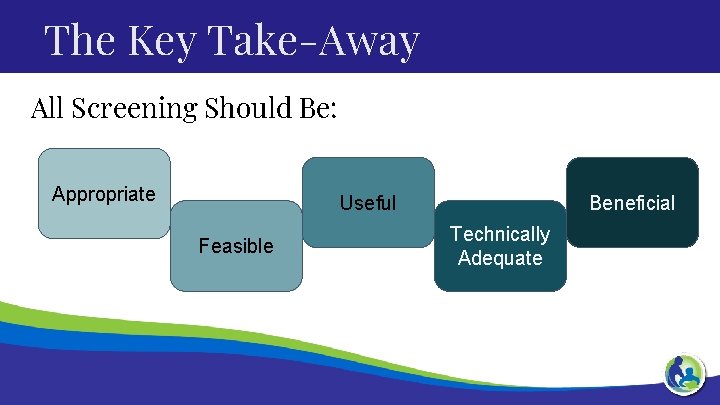
The Key Take-Away All Screening Should Be: Appropriate Useful Feasible Beneficial Technically Adequate
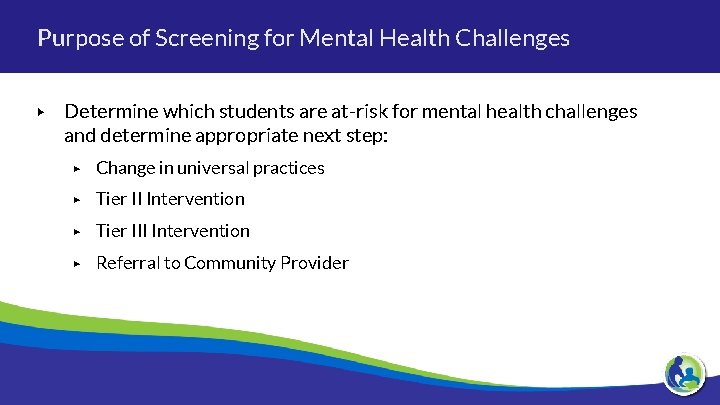
Purpose of Screening for Mental Health Challenges ▶ Determine which students are at-risk for mental health challenges and determine appropriate next step: ▶ Change in universal practices ▶ Tier II Intervention ▶ Tier III Intervention ▶ Referral to Community Provider
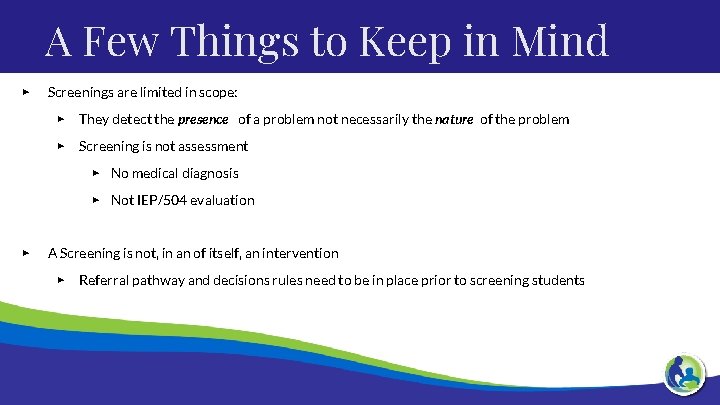
A Few Things to Keep in Mind ▶ Screenings are limited in scope: ▶ They detect the presence of a problem not necessarily the nature of the problem ▶ Screening is not assessment ▶ No medical diagnosis ▶ Not IEP/504 evaluation ▶ A Screening is not, in an of itself, an intervention ▶ Referral pathway and decisions rules need to be in place prior to screening students
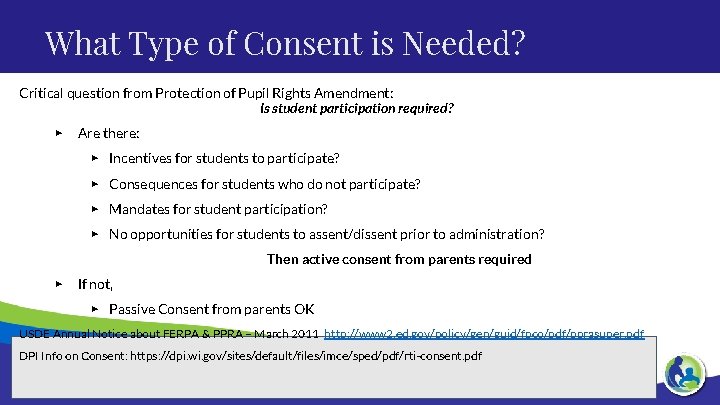
What Type of Consent is Needed? Critical question from Protection of Pupil Rights Amendment: Is student participation required? ▶ Are there: ▶ Incentives for students to participate? ▶ Consequences for students who do not participate? ▶ Mandates for student participation? ▶ No opportunities for students to assent/dissent prior to administration? Then active consent from parents required ▶ If not, ▶ Passive Consent from parents OK USDE Annual Notice about FERPA & PPRA – March 2011 http: //www 2. ed. gov/policy/gen/guid/fpco/pdf/pprasuper. pdf DPI Info on Consent: https: //dpi. wi. gov/sites/default/files/imce/sped/pdf/rti-consent. pdf
Let’s Hear from Our Experts! ▶ Polk County ▶ YScreen ▶ Neenah Joint SD ▶ Healthy Outcomes through Positive Engagement ▶ Samaritan Counseling ▶ ▶ Wellness Screen Program & PSC-Y ‘Plus’ Chippewa Falls SD ▶ Strengths & Difficulties Questionnaire
Polk County YScreen Program “Youth Screen” An Emotional Health Screening for Youth Goal: To increase the early identification of undiagnosed mental health issues in youth
Collaborations • Polk County Health Department’s Community Health Improvement Plan collaborated with the Mental Health Task Force of Polk County to address mental health issues in residents • The Mental Health Task Force of Polk County collaborated with schools to offer a screening of Freshman to increase the early identification of mental health issues in students
YScreen Timeline • Provide program information to parents at Freshman orientation • Present YScreen programming to all school staff during in service • Meet with the freshman class to present YScreen information the week before screening • Screen consenting Freshman in school
YScreen Timeline • Share individual student screening outcomes with designated school staff at the end of each screening day • Contact parents evening of screening • Stay connected with parents for 3 months to provide resource brokering around mental health options in the community
• On screening dates, the YScreen staff is in the school implementing a computer-based screening followed by individual conversations with mental health therapists • “Pediatric Symptom Checklist” is the checklist used to assess a participant’s emotional well-being • American Pediatric Society • Mental Health of America – Youth Test How the program works
• Prior to screening dates, parents give consent for their student to participate in the Yscreen program • Students will also sign an additional consent form on day of screening How the program works
• The student leaves class and confidentially checks in with YScreen staff • The student signs an assent form • The student completes the 42 question checklist about their cognitive, emotional, and behavioral well-being • Examples Include: • I think I am bad – Often/Sometimes/Never • I feel hopeless – Often/Sometimes/Never • I do not show my feelings – Often/Sometimes/Never How the program works
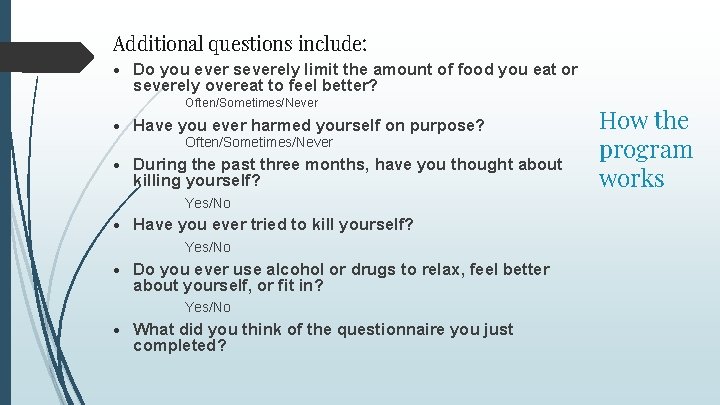
Additional questions include: • Do you ever severely limit the amount of food you eat or severely overeat to feel better? Often/Sometimes/Never • Have you ever harmed yourself on purpose? Often/Sometimes/Never • During the past three months, have you thought about killing yourself? Yes/No • Have you ever tried to kill yourself? Yes/No • Do you ever use alcohol or drugs to relax, feel better about yourself, or fit in? Yes/No • What did you think of the questionnaire you just completed? How the program works
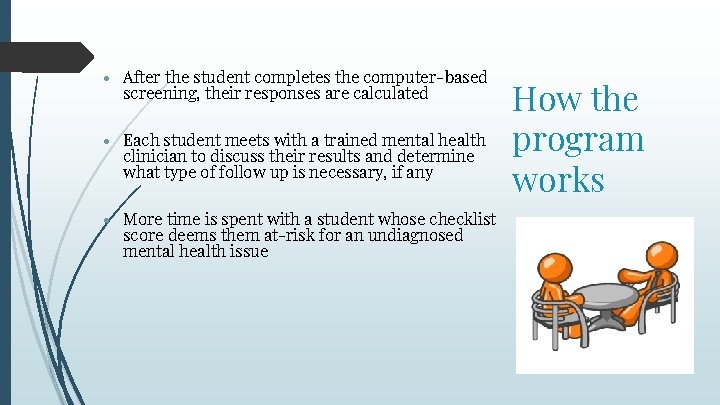
• After the student completes the computer-based screening, their responses are calculated • Each student meets with a trained mental health clinician to discuss their results and determine what type of follow up is necessary, if any • More time is spent with a student whose checklist score deems them at-risk for an undiagnosed mental health issue How the program works
Parents: • Parents of at-risk students will be notified within 24 hours of the screening • If the student is identified as at-risk, YScreen’s Case Manager assists families in finding mental health resources How the program works
Outcomes • 2017 -2018 School year • 3 rd year of screening • Offered screening in 4 schools • Total number of students who gave consent to screen: 156 ▪ Total number of families contacted: 46
Supports • Mental Health Professionals: Therapists, Psychologists, Psychiatrists • Co-facilitated support groups in schools with topics around self-esteem, learning & utilizing coping skills and emotional regulation • Future plans include establishing teacher mentoring support for students identified including a Check-in/Check-out during the school day
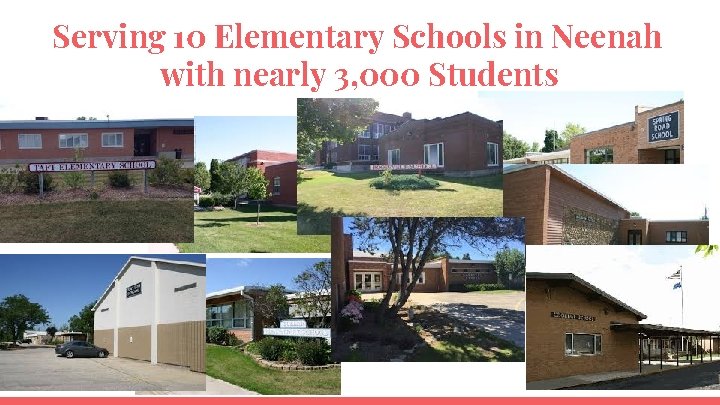
Serving 10 Elementary Schools in Neenah with nearly 3, 000 Students
Why ? ● Youth Risk Behavior Survey (YRBS) ● SOS at MS and HS ● Changing demographics ○ more diverse ○ more economically disadvantaged ● Wanted to engage families much sooner ● Opportunity to engage community partners with mental health specializations
How ● Collaboration ● School Board and Superintendent buy in ● Community grant ● Sustainability ?
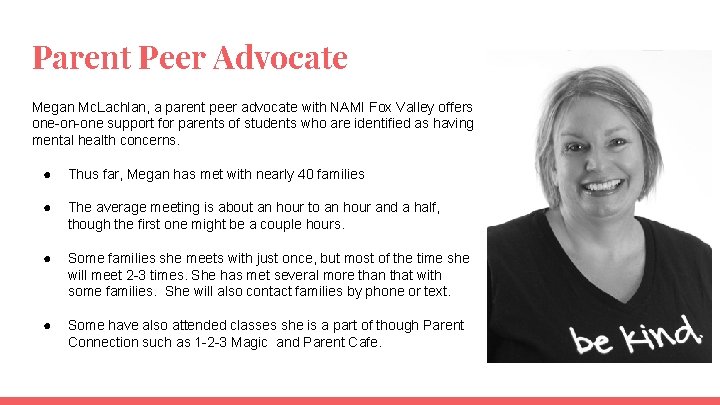
Parent Peer Advocate Megan Mc. Lachlan, a parent peer advocate with NAMI Fox Valley offers one-on-one support for parents of students who are identified as having mental health concerns. ● Thus far, Megan has met with nearly 40 families ● The average meeting is about an hour to an hour and a half, though the first one might be a couple hours. ● Some families she meets with just once, but most of the time she will meet 2 -3 times. She has met several more than that with some families. She will also contact families by phone or text. ● Some have also attended classes she is a part of though Parent Connection such as 1 -2 -3 Magic and Parent Cafe.
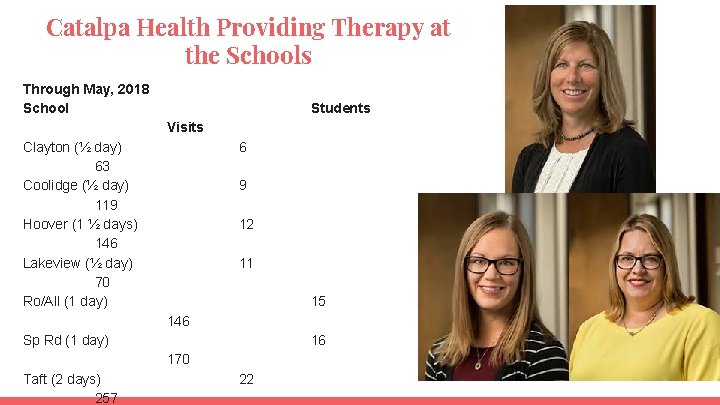
Catalpa Health Providing Therapy at the Schools Through May, 2018 School Students Visits Clayton (½ day) 63 Coolidge (½ day) 119 Hoover (1 ½ days) 146 Lakeview (½ day) 70 Ro/All (1 day) 6 9 12 11 15 146 Sp Rd (1 day) 16 170 Taft (2 days) 257 22
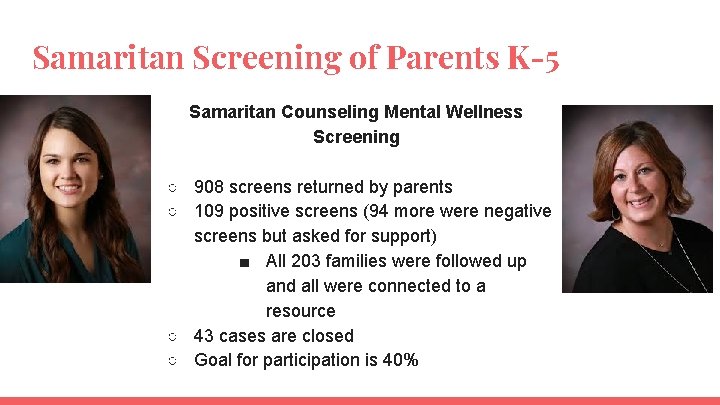
Samaritan Screening of Parents K-5 Samaritan Counseling Mental Wellness Screening ○ 908 screens returned by parents ○ 109 positive screens (94 more were negative screens but asked for support) ■ All 203 families were followed up and all were connected to a resource ○ 43 cases are closed ○ Goal for participation is 40%
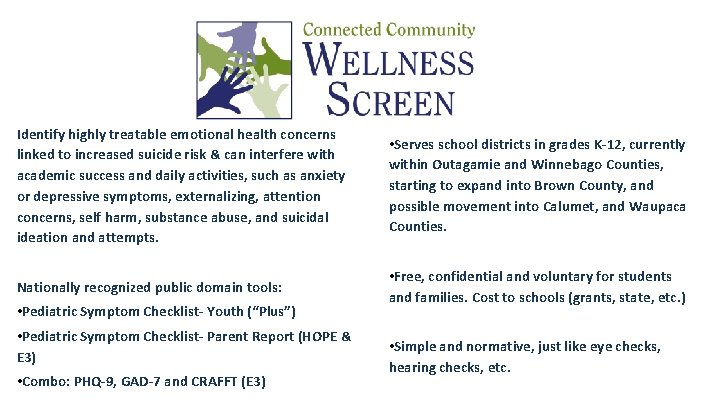
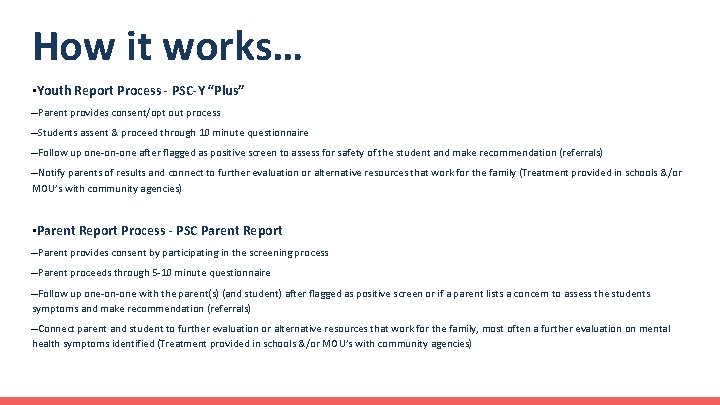
Identify highly treatable emotional health concerns linked to increased suicide risk & can interfere with academic success and daily activities, such as anxiety or depressive symptoms, externalizing, attention concerns, self harm, substance abuse, and suicidal ideation and attempts. • Serves school districts in grades K-12, currently within Outagamie and Winnebago Counties, starting to expand into Brown County, and possible movement into Calumet, and Waupaca Counties. Nationally recognized public domain tools: • Free, confidential and voluntary for students and families. Cost to schools (grants, state, etc. ) • Pediatric Symptom Checklist- Youth (“Plus”) • Pediatric Symptom Checklist- Parent Report (HOPE & E 3) • Combo: PHQ-9, GAD-7 and CRAFFT (E 3) • Simple and normative, just like eye checks, hearing checks, etc.
How it works… • Youth Report Process - PSC-Y “Plus” –Parent provides consent/opt out process –Students assent & proceed through 10 minute questionnaire –Follow up one-on-one after flagged as positive screen to assess for safety of the student and make recommendation (referrals) –Notify parents of results and connect to further evaluation or alternative resources that work for the family (Treatment provided in schools &/or MOU’s with community agencies) • Parent Report Process - PSC Parent Report –Parent provides consent by participating in the screening process –Parent proceeds through 5 -10 minute questionnaire –Follow up one-on-one with the parent(s) (and student) after flagged as positive screen or if a parent lists a concern to assess the students symptoms and make recommendation (referrals) –Connect parent and student to further evaluation or alternative resources that work for the family, most often a further evaluation on mental health symptoms identified (Treatment provided in schools &/or MOU’s with community agencies)
Strengths and Difficulties Questionnaire (SDQ) Chippewa Falls Area Unified School District Jamie Ganske
Approach Screener Committee Representation from every school Have met a minimum of once a year since establishing Started with K-8 Added 9 -12 this last school year Done twice a year *K-8 received a grant and will be using the BEST next year
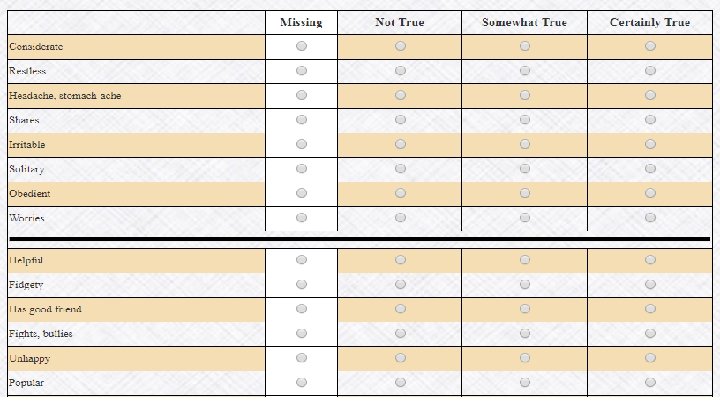
The Strengths and Difficulties Questionnaire (SDQ)
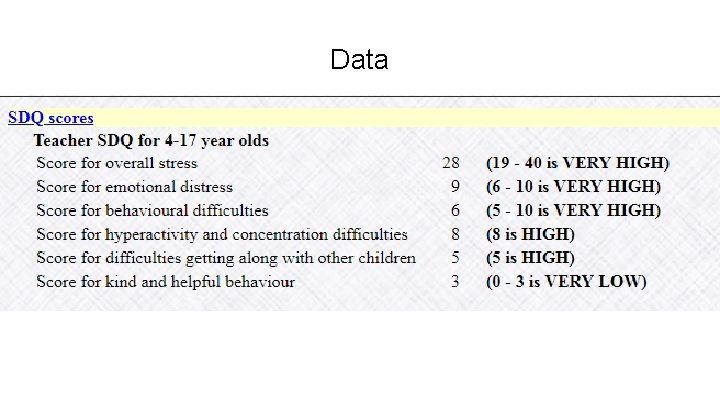
Data
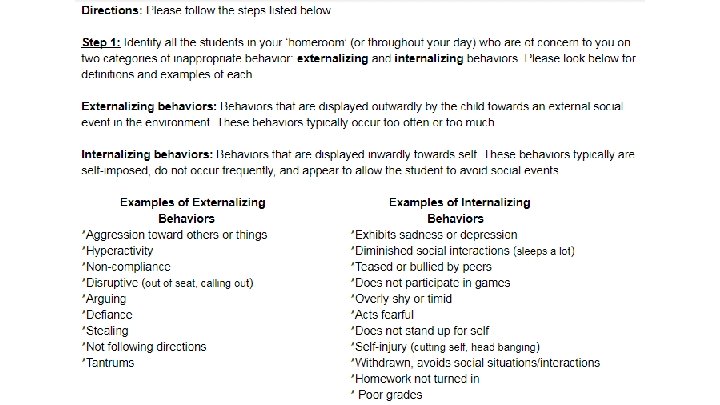
What do we do with the data? Possible options include: 1. PBIS Tier 2 intervention 2. Talk to parents about School Based Mental Health 3. Talk to teacher to come up with an alternative plan (We don’t plan for exceptions, but know that they exist) 4. If a student was an internalizing student and entered CICO, we do the SDQ again after 20 data points to check for improvements
Funding and Sustainability
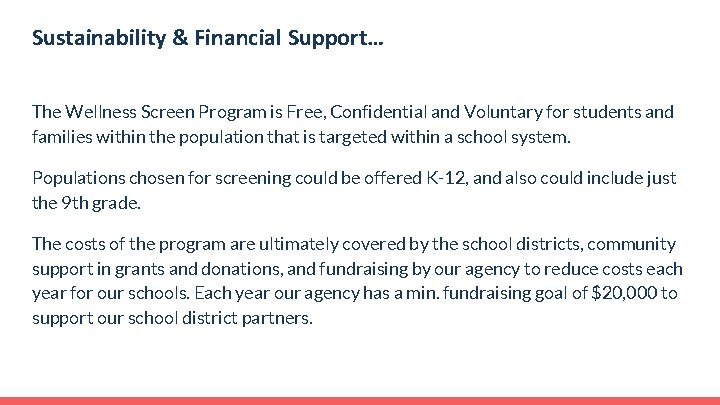
Sustainability & Financial Support… The Wellness Screen Program is Free, Confidential and Voluntary for students and families within the population that is targeted within a school system. Populations chosen for screening could be offered K-12, and also could include just the 9 th grade. The costs of the program are ultimately covered by the school districts, community support in grants and donations, and fundraising by our agency to reduce costs each year for our schools. Each year our agency has a min. fundraising goal of $20, 000 to support our school district partners.
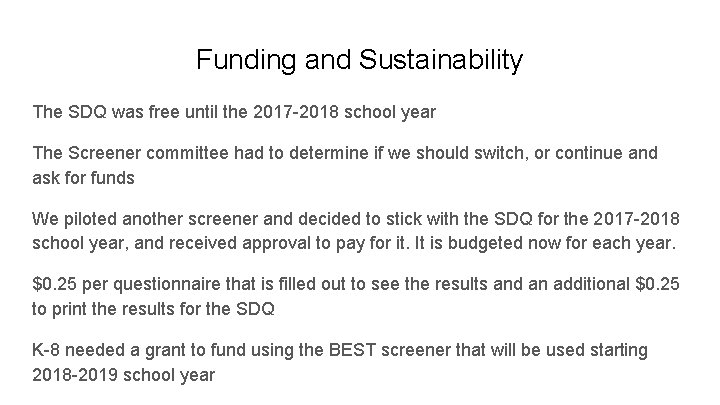
Funding and Sustainability The SDQ was free until the 2017 -2018 school year The Screener committee had to determine if we should switch, or continue and ask for funds We piloted another screener and decided to stick with the SDQ for the 2017 -2018 school year, and received approval to pay for it. It is budgeted now for each year. $0. 25 per questionnaire that is filled out to see the results and an additional $0. 25 to print the results for the SDQ K-8 needed a grant to fund using the BEST screener that will be used starting 2018 -2019 school year
Questions