
First tests of QPF verification using SAL at
- Slides: 26
First tests of QPF verification using SAL at AEMET Jose A. Garcia-Moya. AEMET. Spain. On behalf of Carlos Santos, Anna Ghelli (ECMWF) & Imanol Guerrero ECMWF & AEMET collaboration Hirlam-Aladin All Staff Meeting, Krakow. April 13 -16, 2010 Hirlam-Aladin All Staff Meeting 2010 1
Introduction • Classical problem of how to show that higher resolution models are doing better than lower resolution ones. • Even worse for mesoscale models which have much more grid points than observations. • Then: – Focus on surface parameters. Mainly precipitation. – Looking for new scores giving more importance to what we see as more useful information but from an objective point of view. • Object oriented methods may be the solution. • We start using SAL to see what we can get from it (collaboration with ECMWF). Hirlam-Aladin All Staff Meeting 2010 2
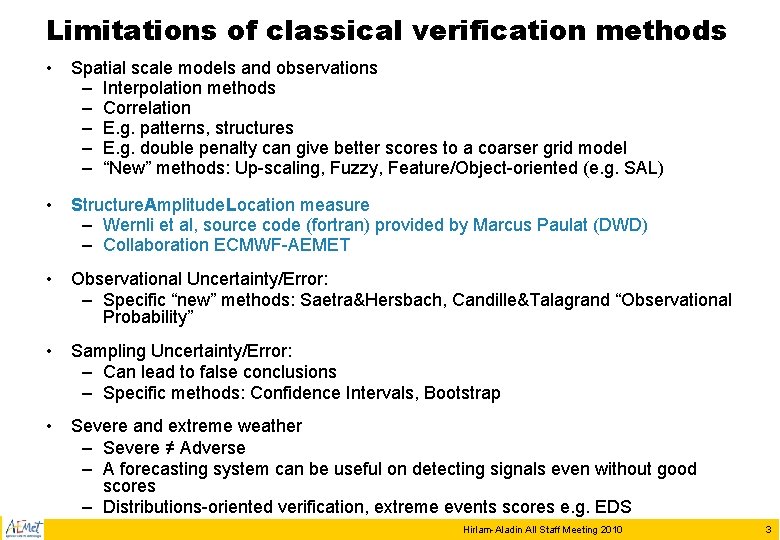
Limitations of classical verification methods • Spatial scale models and observations – Interpolation methods – Correlation – E. g. patterns, structures – E. g. double penalty can give better scores to a coarser grid model – “New” methods: Up-scaling, Fuzzy, Feature/Object-oriented (e. g. SAL) • Structure. Amplitude. Location measure – Wernli et al, source code (fortran) provided by Marcus Paulat (DWD) – Collaboration ECMWF-AEMET • Observational Uncertainty/Error: – Specific “new” methods: Saetra&Hersbach, Candille&Talagrand “Observational Probability” • Sampling Uncertainty/Error: – Can lead to false conclusions – Specific methods: Confidence Intervals, Bootstrap • Severe and extreme weather – Severe ≠ Adverse – A forecasting system can be useful on detecting signals even without good scores – Distributions-oriented verification, extreme events scores e. g. EDS Hirlam-Aladin All Staff Meeting 2010 3
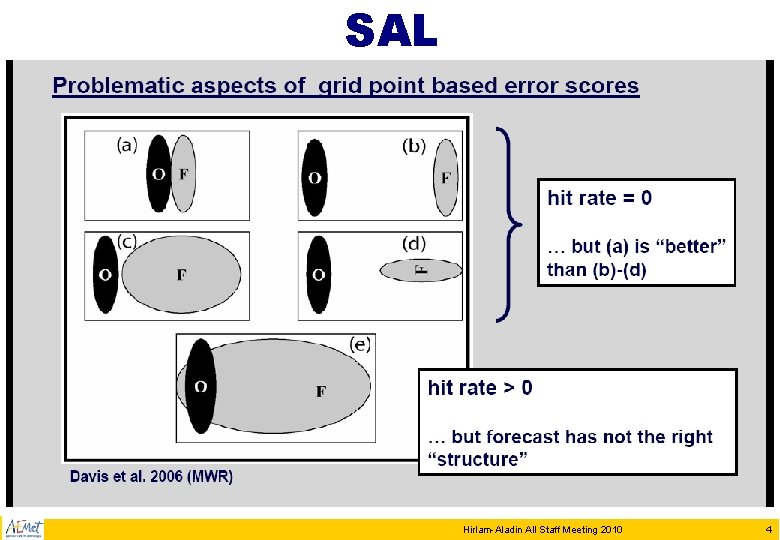
SAL Hirlam-Aladin All Staff Meeting 2010 4
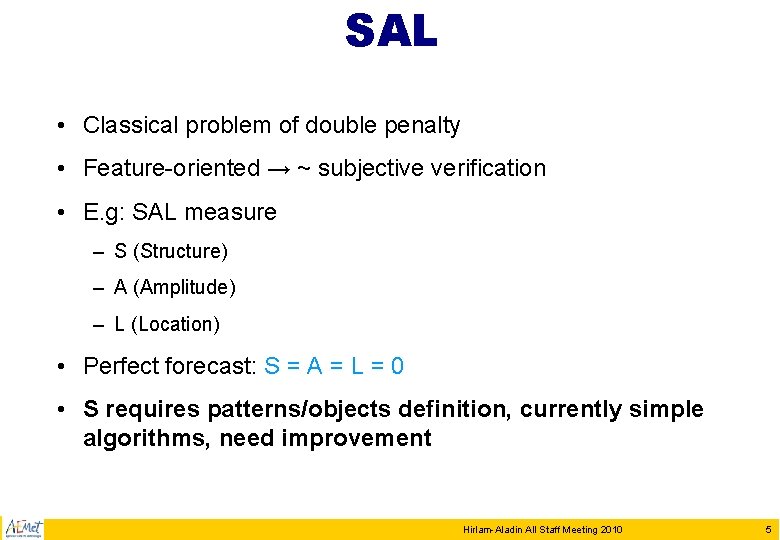
SAL • Classical problem of double penalty • Feature-oriented → ~ subjective verification • E. g: SAL measure – S (Structure) – A (Amplitude) – L (Location) • Perfect forecast: S = A = L = 0 • S requires patterns/objects definition, currently simple algorithms, need improvement Hirlam-Aladin All Staff Meeting 2010 5
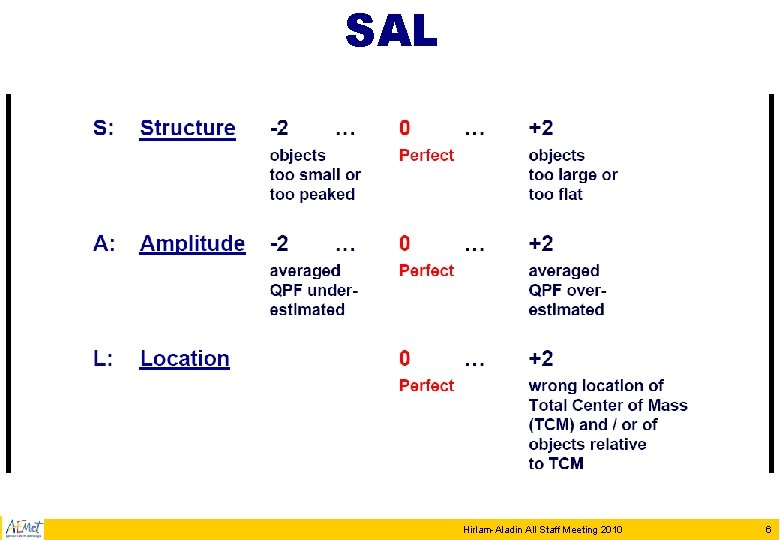
SAL Hirlam-Aladin All Staff Meeting 2010 6
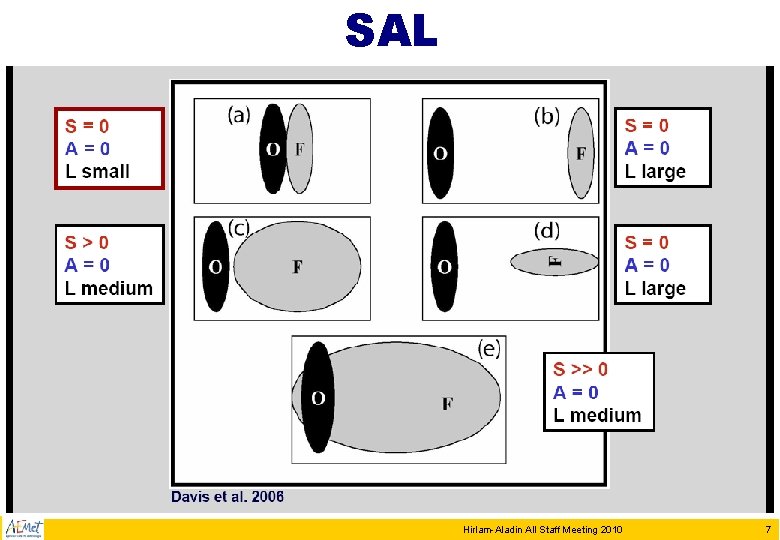
SAL Hirlam-Aladin All Staff Meeting 2010 7
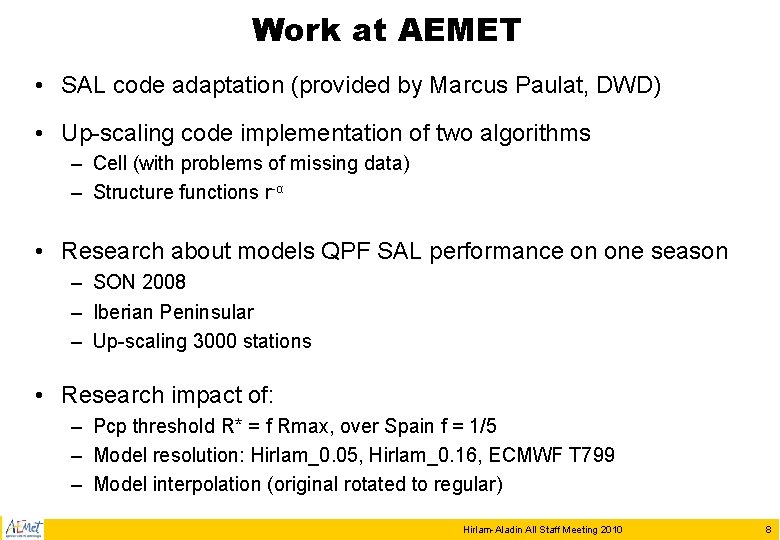
Work at AEMET • SAL code adaptation (provided by Marcus Paulat, DWD) • Up-scaling code implementation of two algorithms – Cell (with problems of missing data) – Structure functions r-α • Research about models QPF SAL performance on one season – SON 2008 – Iberian Peninsular – Up-scaling 3000 stations • Research impact of: – Pcp threshold R* = f Rmax, over Spain f = 1/5 – Model resolution: Hirlam_0. 05, Hirlam_0. 16, ECMWF T 799 – Model interpolation (original rotated to regular) Hirlam-Aladin All Staff Meeting 2010 8
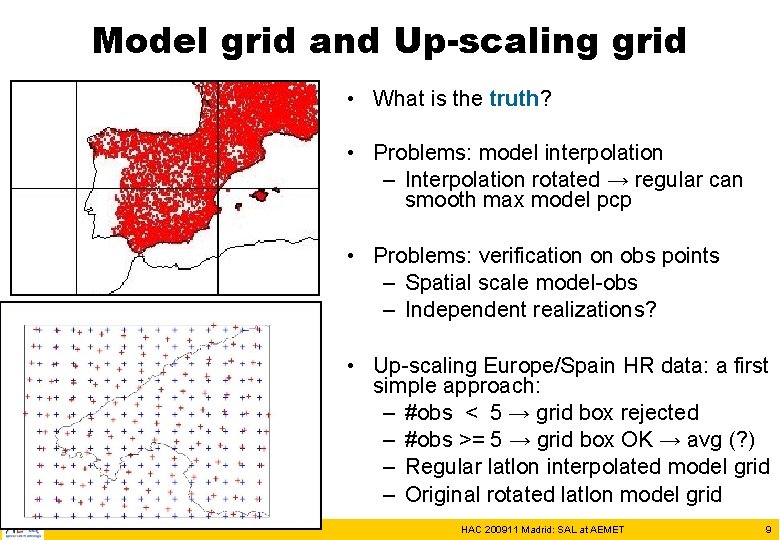
Model grid and Up-scaling grid • What is the truth? • Problems: model interpolation – Interpolation rotated → regular can smooth max model pcp • Problems: verification on obs points – Spatial scale model-obs – Independent realizations? • Up-scaling Europe/Spain HR data: a first simple approach: – #obs < 5 → grid box rejected – #obs >= 5 → grid box OK → avg (? ) – Regular latlon interpolated model grid – Original rotated latlon model grid HAC 200911 Madrid: SAL at AEMET 9
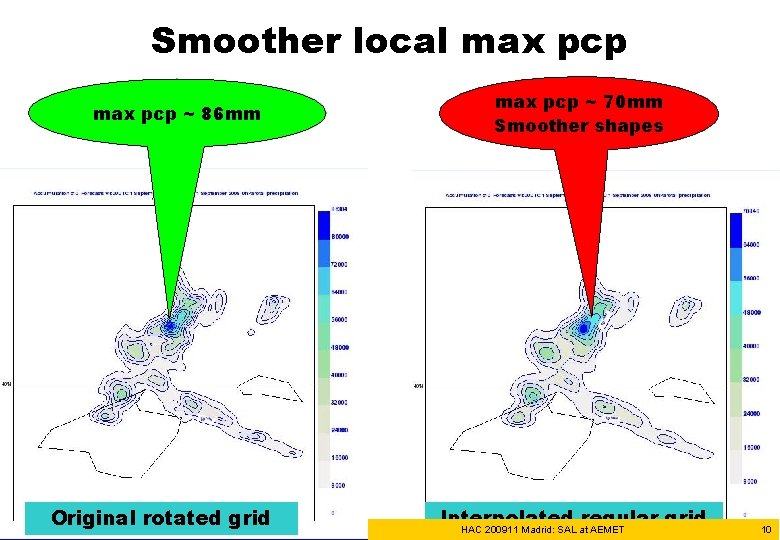
Smoother local max pcp ~ 86 mm Original rotated grid max pcp ~ 70 mm Smoother shapes Interpolated regular grid HAC 200911 Madrid: SAL at AEMET 10
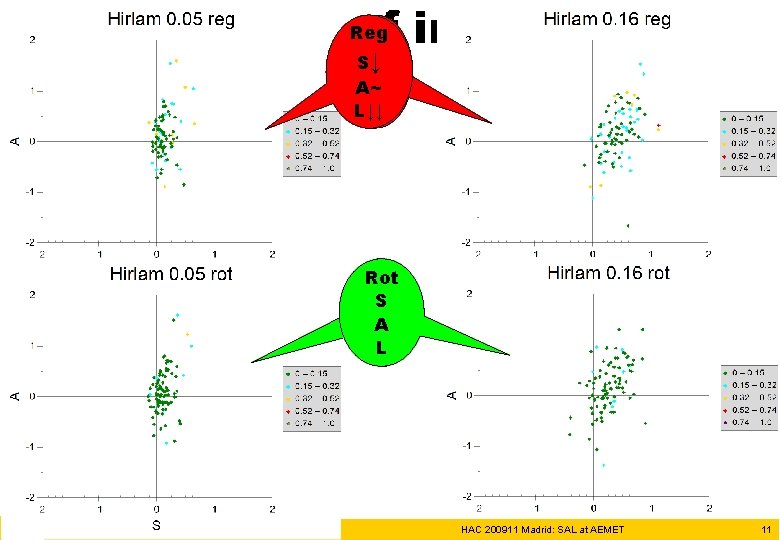
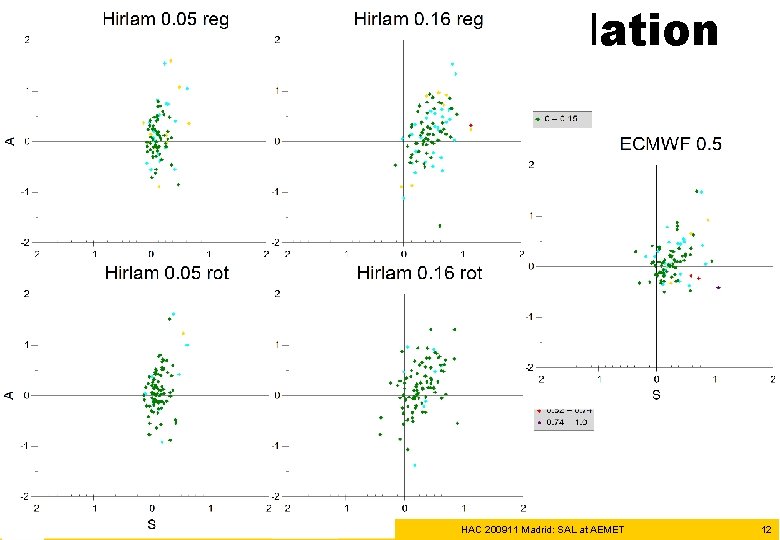
reg interpolation SAL: impact Reg of SS↓↓ A~ A~ L↓↓ Rot S A L HAC 200911 Madrid: SAL at AEMET 11
SAL: impact of interpolation HAC 200911 Madrid: SAL at AEMET 12
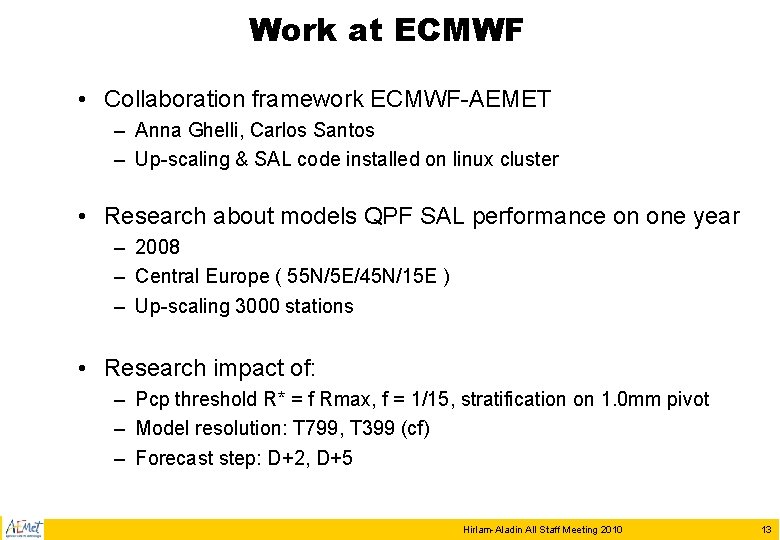
Work at ECMWF • Collaboration framework ECMWF-AEMET – Anna Ghelli, Carlos Santos – Up-scaling & SAL code installed on linux cluster • Research about models QPF SAL performance on one year – 2008 – Central Europe ( 55 N/5 E/45 N/15 E ) – Up-scaling 3000 stations • Research impact of: – Pcp threshold R* = f Rmax, f = 1/15, stratification on 1. 0 mm pivot – Model resolution: T 799, T 399 (cf) – Forecast step: D+2, D+5 Hirlam-Aladin All Staff Meeting 2010 13
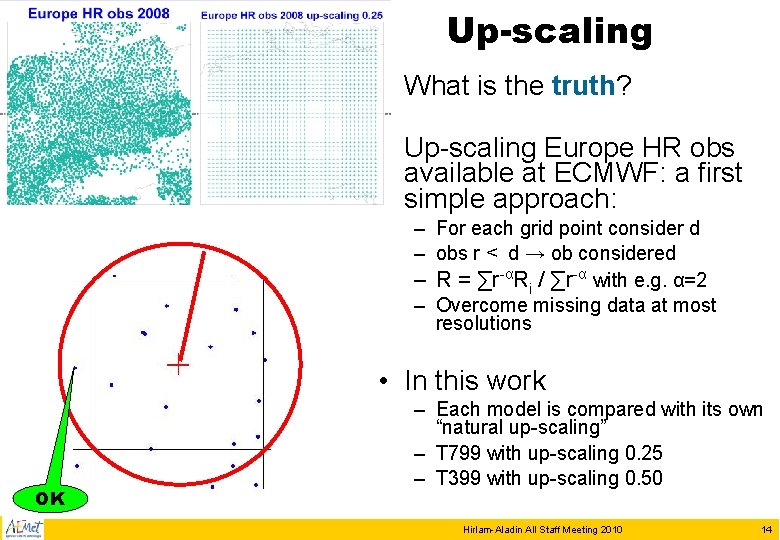
Up-scaling • What is the truth? • Up-scaling Europe HR obs available at ECMWF: a first simple approach: – For each grid point consider d – obs r < d → ob considered – R = ∑r-αRi / ∑r-α with e. g. α=2 – Overcome missing data at most resolutions • In this work OK – Each model is compared with its own “natural up-scaling” – T 799 with up-scaling 0. 25 – T 399 with up-scaling 0. 50 Hirlam-Aladin All Staff Meeting 2010 14
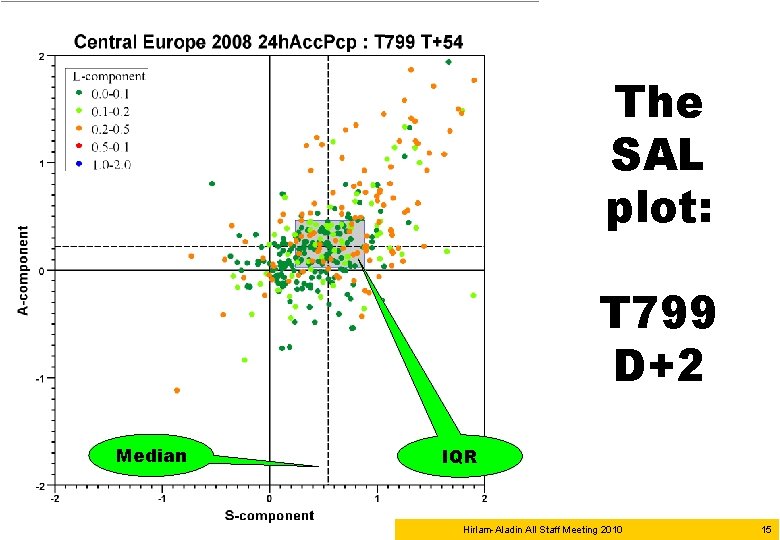
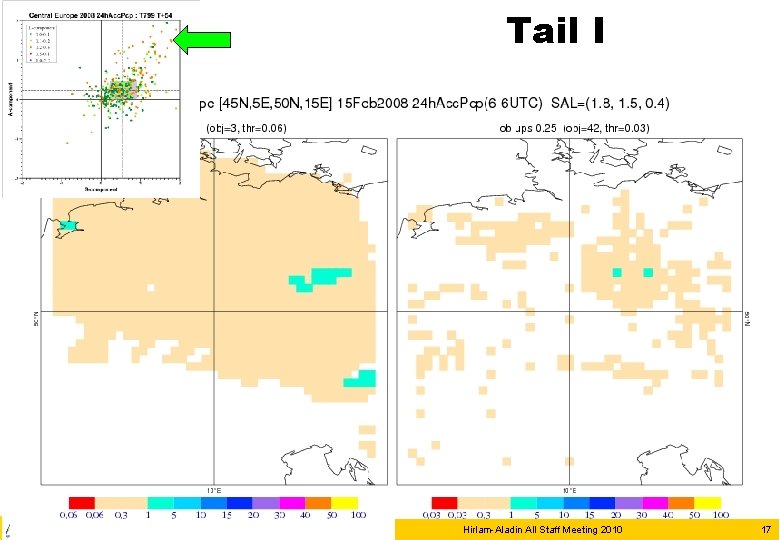
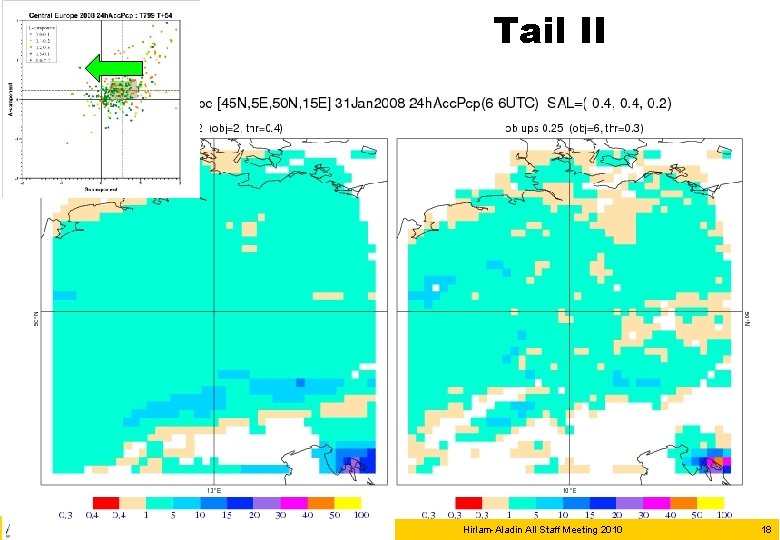
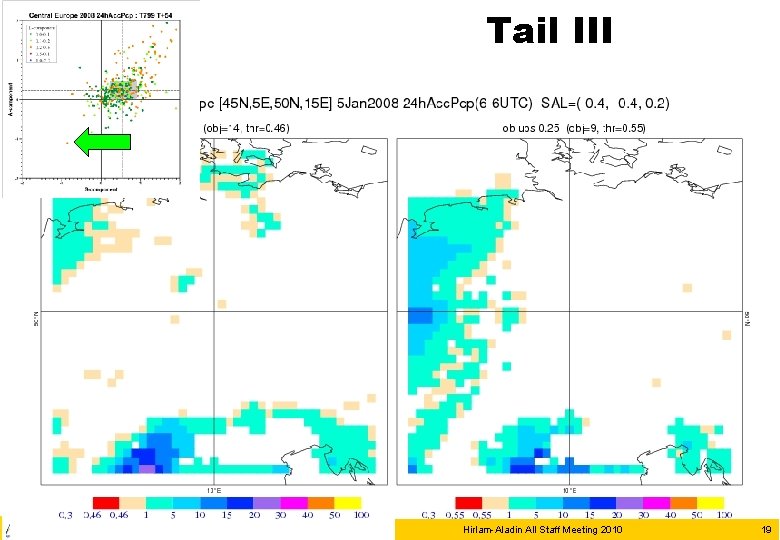
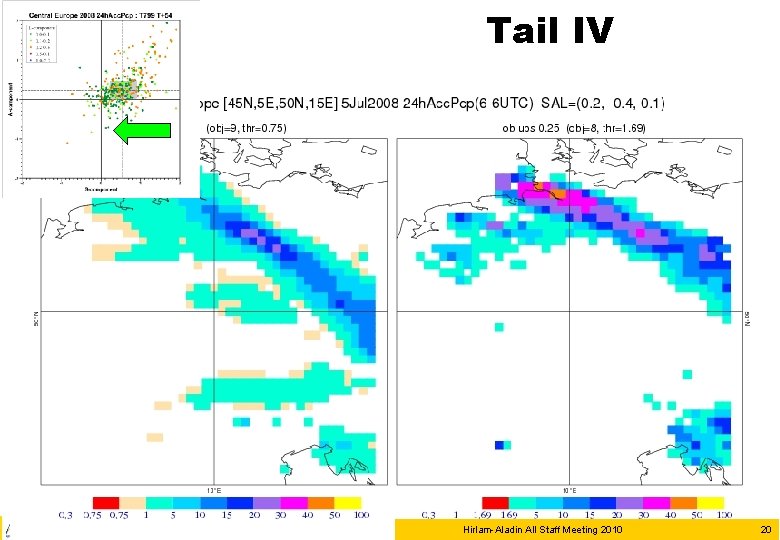
The SAL plot: T 799 D+2 Median IQR Hirlam-Aladin All Staff Meeting 2010 15
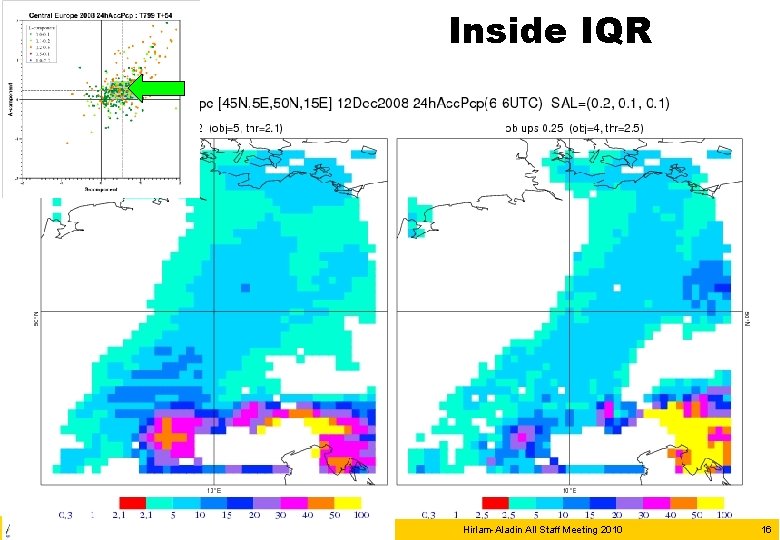
Inside IQR Hirlam-Aladin All Staff Meeting 2010 16
Tail I Hirlam-Aladin All Staff Meeting 2010 17
Tail II Hirlam-Aladin All Staff Meeting 2010 18
Tail III Hirlam-Aladin All Staff Meeting 2010 19
Tail IV Hirlam-Aladin All Staff Meeting 2010 20
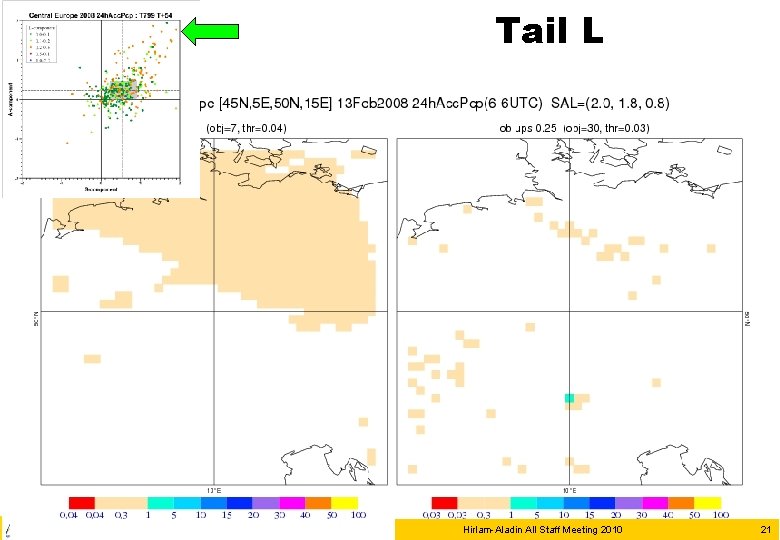
Tail L Hirlam-Aladin All Staff Meeting 2010 21
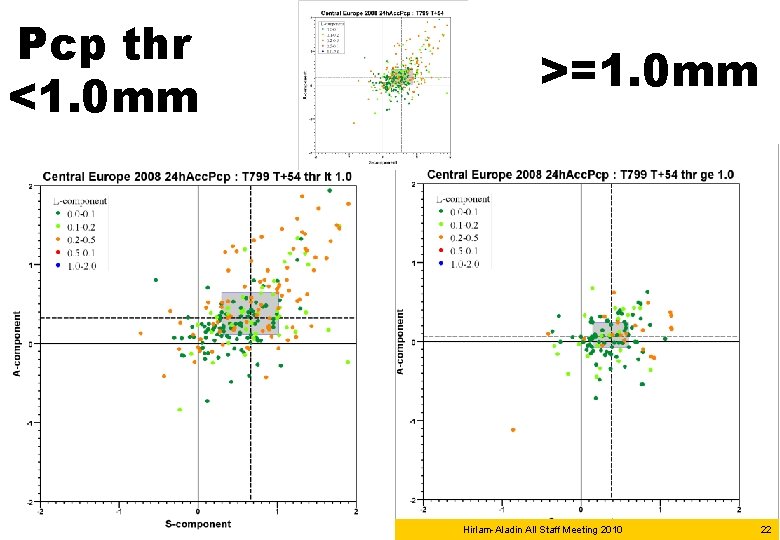
Pcp thr <1. 0 mm >=1. 0 mm Hirlam-Aladin All Staff Meeting 2010 22
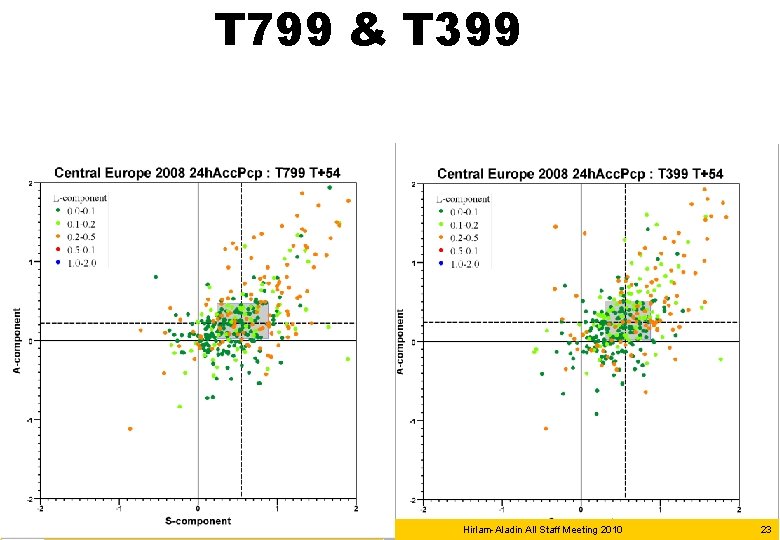
T 799 & T 399 Hirlam-Aladin All Staff Meeting 2010 23
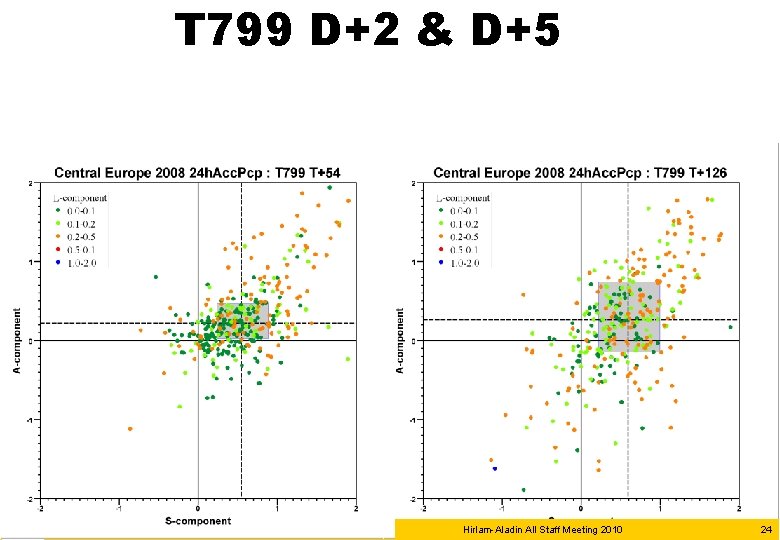
T 799 D+2 & D+5 Hirlam-Aladin All Staff Meeting 2010 24
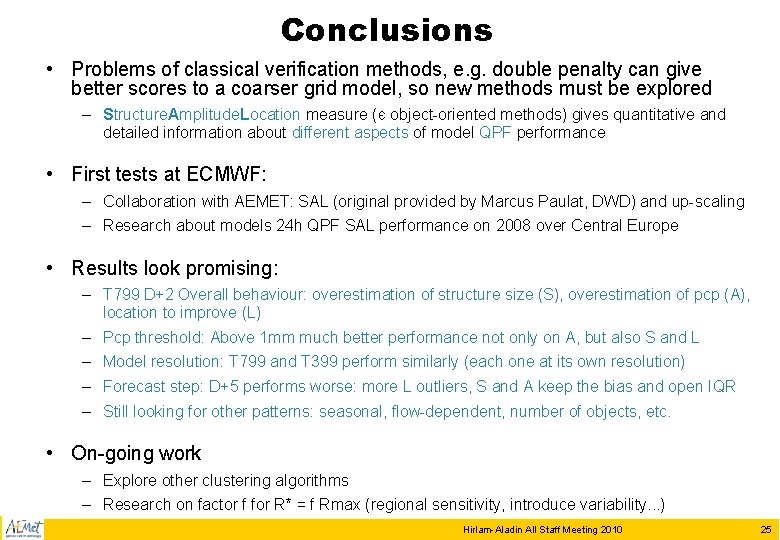
Conclusions • Problems of classical verification methods, e. g. double penalty can give better scores to a coarser grid model, so new methods must be explored – Structure. Amplitude. Location measure (є object-oriented methods) gives quantitative and detailed information about different aspects of model QPF performance • First tests at ECMWF: – Collaboration with AEMET: SAL (original provided by Marcus Paulat, DWD) and up-scaling – Research about models 24 h QPF SAL performance on 2008 over Central Europe • Results look promising: – T 799 D+2 Overall behaviour: overestimation of structure size (S), overestimation of pcp (A), location to improve (L) – Pcp threshold: Above 1 mm much better performance not only on A, but also S and L – Model resolution: T 799 and T 399 perform similarly (each one at its own resolution) – Forecast step: D+5 performs worse: more L outliers, S and A keep the bias and open IQR – Still looking for other patterns: seasonal, flow-dependent, number of objects, etc. • On-going work – Explore other clustering algorithms – Research on factor f for R* = f Rmax (regional sensitivity, introduce variability. . . ) Hirlam-Aladin All Staff Meeting 2010 25
Thanks to • Marcus Paulat (DWD), Matthias Zimmer (Univ. Mainz), Heini Wernli (Univ. Mainz) • Pertti Nurmi (FMI) • Martin Goëber (DWD) • AEMET & ECMWF computing support staff Hirlam-Aladin All Staff Meeting 2010 26