
First Step to Success An Early Intervention Program


- Slides: 92
First Step to Success An Early Intervention Program for Young Children with Challenging Behaviors Instructor: Annemieke Golly, Ph. D. , agolly@uoregon. edu (541) 344 -7784 Oregon Research Institute
Agenda • 9: 00 – 9: 30 Introductions • 9: 30 – 12: 00 Positive, proactive strategies for ALL kids • 12: 00 – 1: 00 Lunch • 1: 00 – 3: 15 First Step to Success • 3: 15 – 3: 30 Focus group and wrap-up.
What helps Mark • Organization • Clear Expectations • Adequate sleep • Regular and healthy meals • Excercise • Humor • A Hobbie (working with horses)
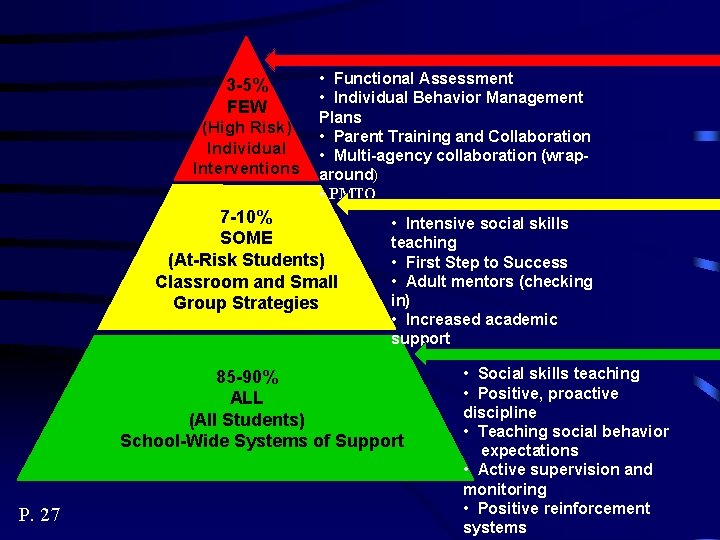
3 -5% FEW (High Risk) Individual Interventions • Functional Assessment • Individual Behavior Management Plans • Parent Training and Collaboration • Multi-agency collaboration (wraparound) • PMTO 7 -10% SOME (At-Risk Students) Classroom and Small Group Strategies • Intensive social skills teaching • First Step to Success • Adult mentors (checking in) • Increased academic support 85 -90% ALL (All Students) School-Wide Systems of Support P. 27 • Social skills teaching • Positive, proactive discipline • Teaching social behavior expectations • Active supervision and monitoring • Positive reinforcement systems
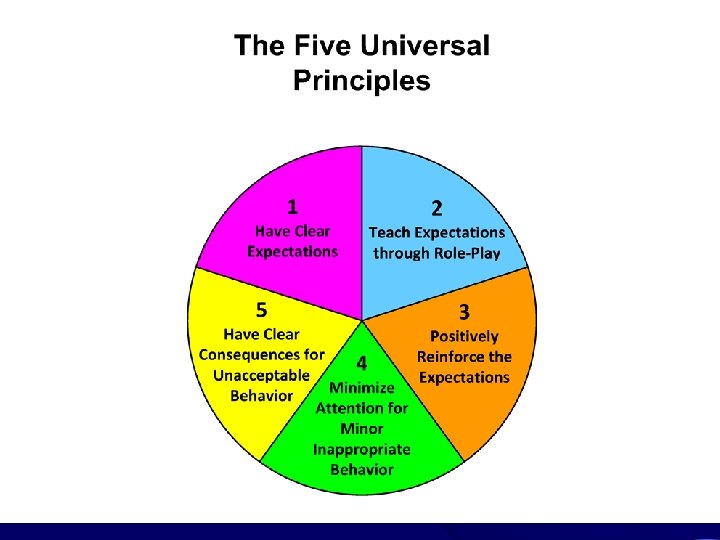
SCHOOLWIDE EXPECTATIONS • Define school rules in ALL settings • Agree on rules with ENTIRE staff • Teach expectations to ALL students • Positively reinforce students following the rules • Encourage the behavior you want • Develop consequences for not following the rules
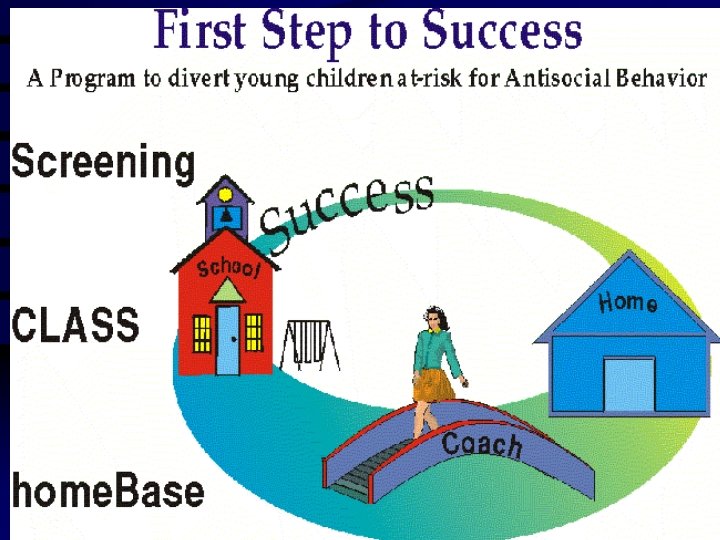
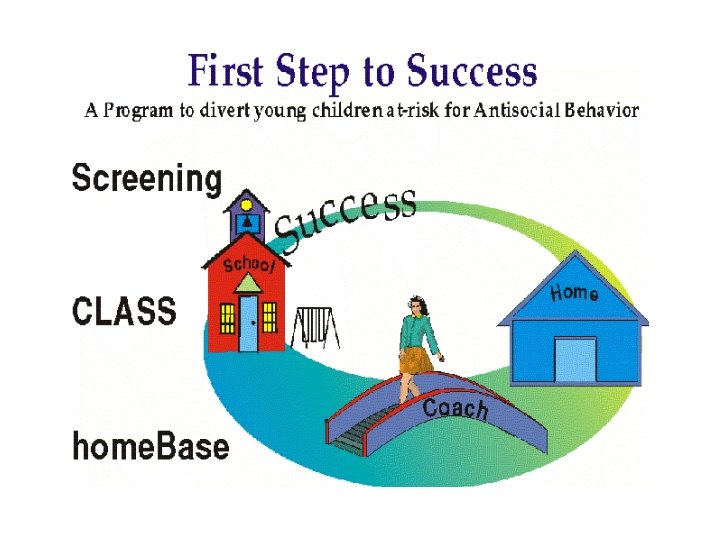
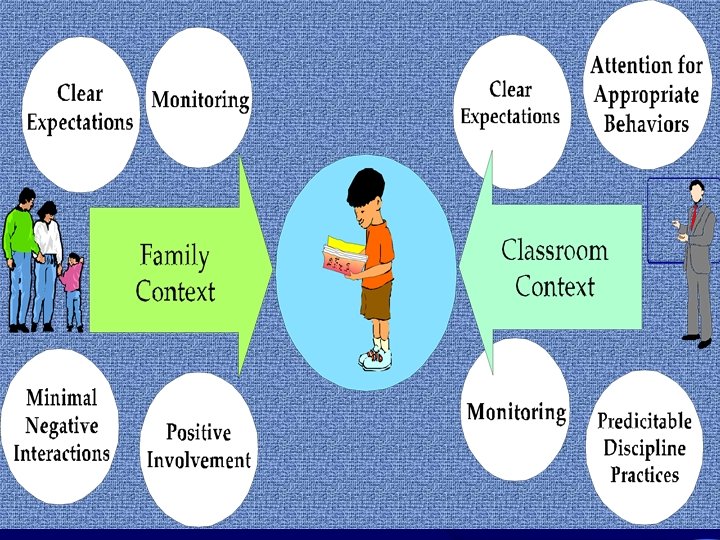
What’s First Step to Success? § Helps young students adjust to school. § Improves children’s social adjustment and school performance. § Enlists help of three most important people in the life of a child: Family Teachers Peers
Why First Step to Success? § Research shows that the earlier intervention occurs, the more likely it is that positive outcomes will be achieved. § First Step to Success is an evidence-based program shown to reduce frequency of antisocial behavior and to increase school readiness among young children.
What are its primary goals? § Teach children to get along with others at school (teachers and peers). § Teach children how to focus and complete tasks.
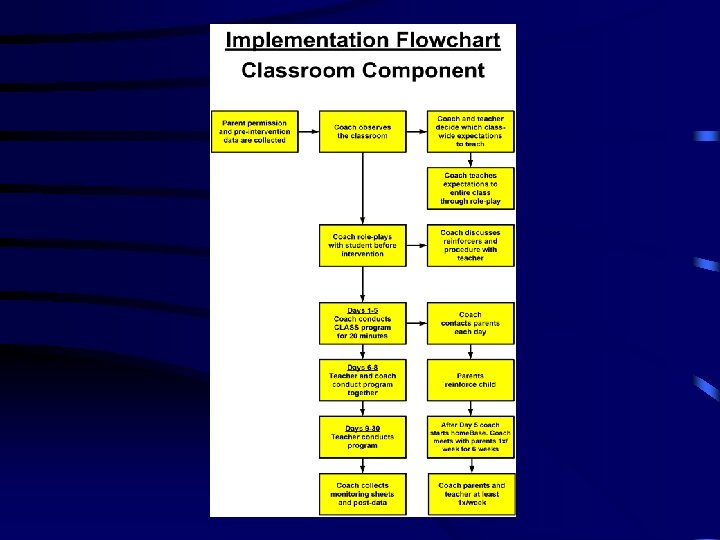
Where does it take place? § In the classroom – takes about 30 days to complete § In the home – six one-hour weekly visits
How is it done in the classroom? § First Step Coach role-plays and teaches child expected behaviors. § When child is ready, he/she “plays the Green/Red Card game” with peers. § Child earns special activities for entire class. § Parents receive daily feedback. § Teachers take over and continue the approach.
What is done in the home? § Six one-hour weekly visits by the coach. § Coach teaches family fun and supportive activities designed to help the child succeed in school. § Parents or caregivers are encouraged to do the activities a few minutes each day with the child.
How do we know it works? § Program received 20 Million Dollars Research grants during the past decade § Recognized as a model program by: § Substance Abuse and Mental Health Services Administration (SAMHSA) – § Prevention Research Center – Pennsylvania State University § University of Colorado – Center for the Study and Prevention of Violence
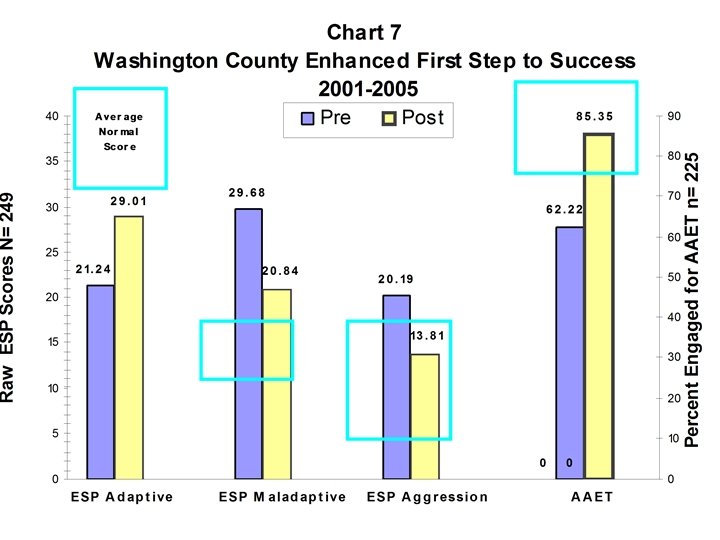
What outcomes are expected? § Improved social behaviors § Improved educational outcomes (early literacy skills) § Improved child-family interactions
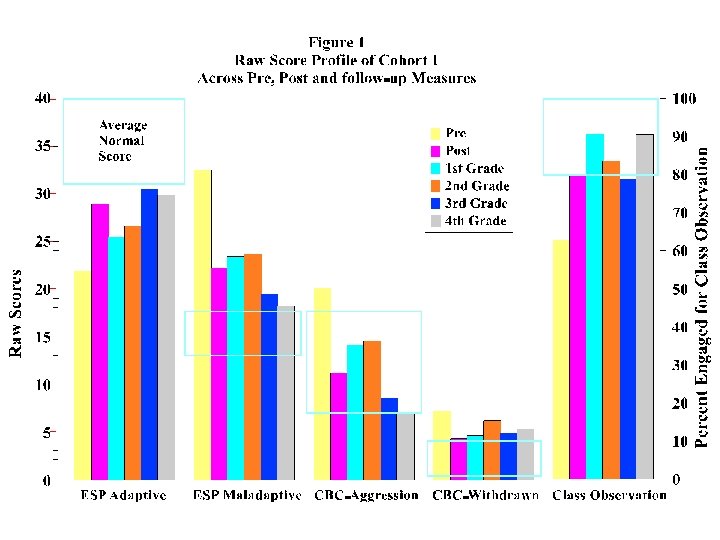
How are outcomes measured? § ESP Adaptive Behavior Scale § ESP Maladaptive Behavior Scale § Aggressive subscale of Child Behavior Checklist § AET Observations using a stop watch § Woodcock-Johnson III (growth curve analysis)
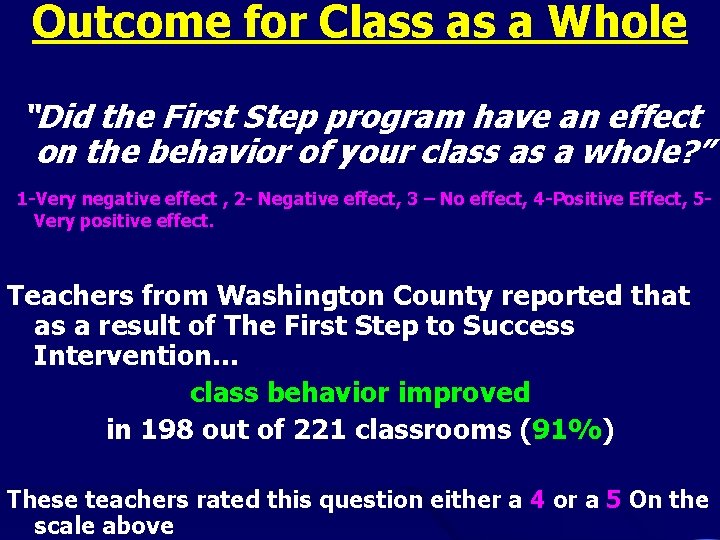
Outcome for Class as a Whole “Did the First Step program have an effect on the behavior of your class as a whole? ” 1 -Very negative effect , 2 - Negative effect, 3 – No effect, 4 -Positive Effect, 5 - Very positive effect. Teachers from Washington County reported that as a result of The First Step to Success Intervention… class behavior improved in 198 out of 221 classrooms (91%) These teachers rated this question either a 4 or a 5 On the scale above
In order for the child to change their behavior, the adults must change their interactions with the child first.
Be Consistent with Expectations • If you expect students to raise their hand quietly…Only call on students who raise their hand. Do not respond to talk outs. • If you expect students to work quietly, reinforce the students who are working quietly.
X-Activity • Pick a partner or get into groups of 4. • Identify one area in your classroom that needs improvement. • DO NOT commit ASSUMESIDE (Anita Archer)! • What do you want to see and/or hear instead? • How will you teach this expectation? • What kind of motivator will you use?
What can be done? ? • Establish Clear Expectations for the Group Imagine your ideal group. … - What do you want to see? - What do you want to hear?
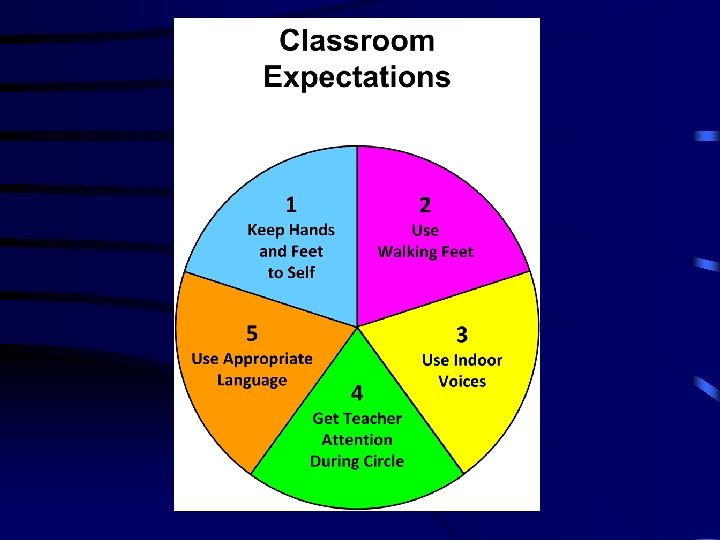
Examples of Clear Expectations: • Follow directions the first time given • Move carefully, quickly and quietly • Raise your hand for permission to speak • Keep hands, feet and objects to self
Why do most children misbehave? • Attention (adult, peer) • Avoidance (Task too hard, too easy, boring)
What Can We Do? • Motivate All Students • Provide lots of positive feedback • Minimize attention for minor inappropriate behavior • Focus on the behavior you want • Use humor, never sarcasm. • Have fun!
Activity • Think of a student who is a weak or non-responder in your classroom/group • What “need” (attention, avoidance) is maintaining the inappropriate behavior meeting for the student. • How do you typically deal with the student when unacceptable behavior occurs. • How might your behavior maintain the problem behavior?
Motivation • If the student can’t do the task, it’s a skill problem. You have to teach or re-teach! • If the student won’t do the task, it’s a motivational problem. You have to motivate! In both cases, you have to change your behavior. It is your job to help the student be as successful as possible!
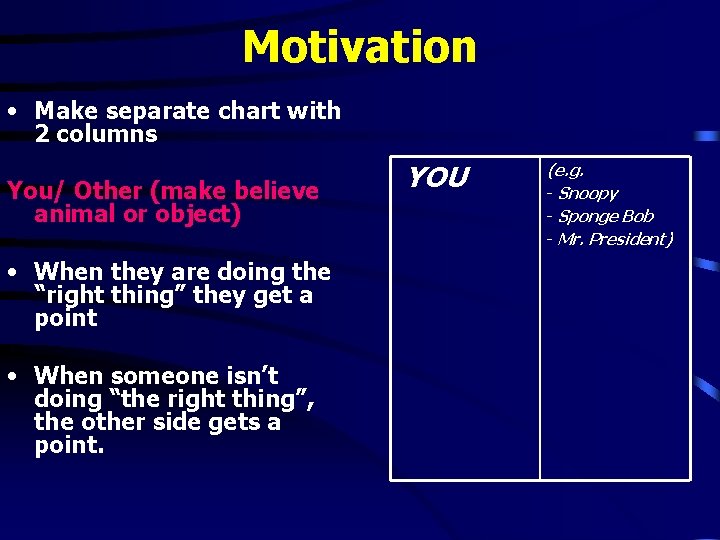
Motivation • Make separate chart with 2 columns You/ Other (make believe animal or object) • When they are doing the “right thing” they get a point • When someone isn’t doing “the right thing”, the other side gets a point. YOU (e. g. - Snoopy - Sponge Bob - Mr. President)
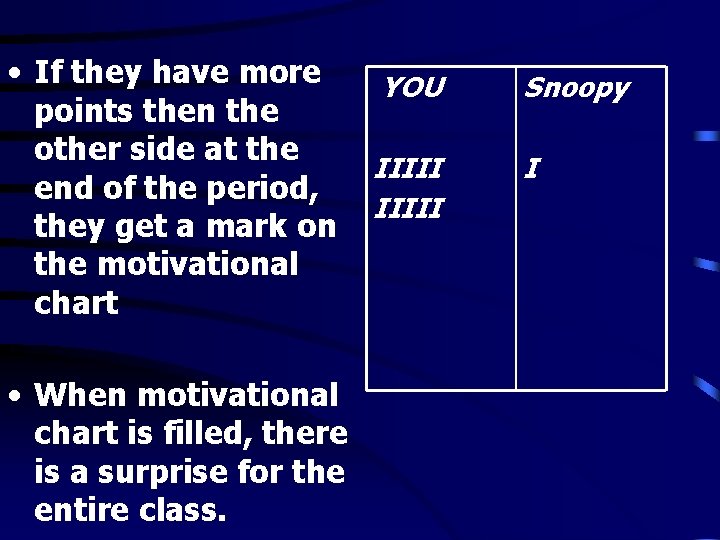
• If they have more YOU points then the other side at the IIIII end of the period, IIIII they get a mark on the motivational chart • When motivational chart is filled, there is a surprise for the entire class. Snoopy I
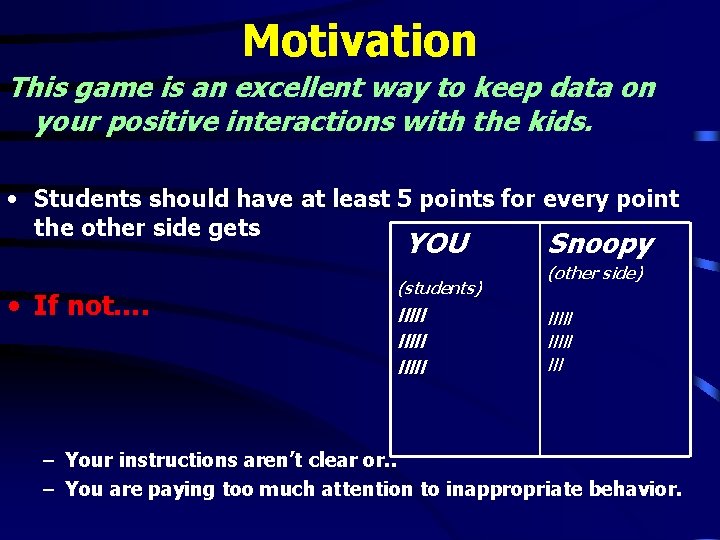
Motivation This game is an excellent way to keep data on your positive interactions with the kids. • Students should have at least 5 points for every point the other side gets YOU • If not…. (students) lllll Snoopy (other side) lllll lll – Your instructions aren’t clear or. . – You are paying too much attention to inappropriate behavior.
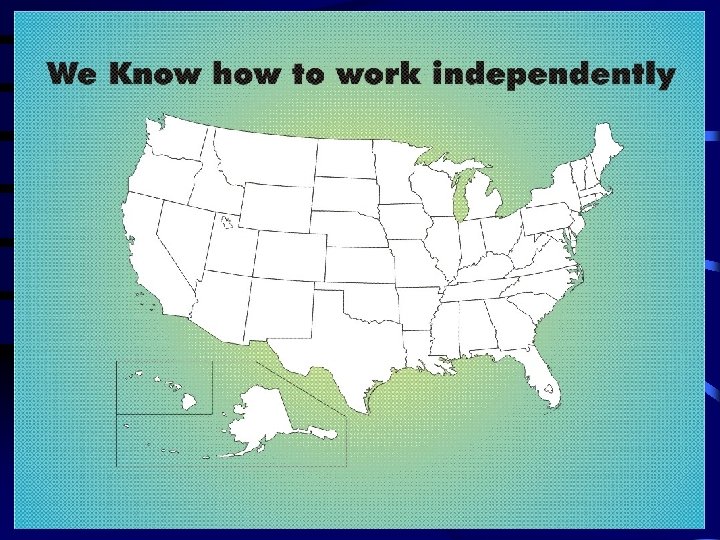
Motivation • Pick a motivational theme (e. g. , rocket, thermometer, tree, basketball, map, ladybug, butterfly) • Make a large poster with 10 -20 marks • Explain how students can earn a mark (e. g. , when they have more points than the other side) • Make it fun!
Motivation • Students can earn points for : – Following directions – Working independently – Raising their hand quietly – Lining up quickly & quietly – Cleaning up quickly & quietly – Transitioning quickly & quietly – Etc.
“We know how to be respectful!”
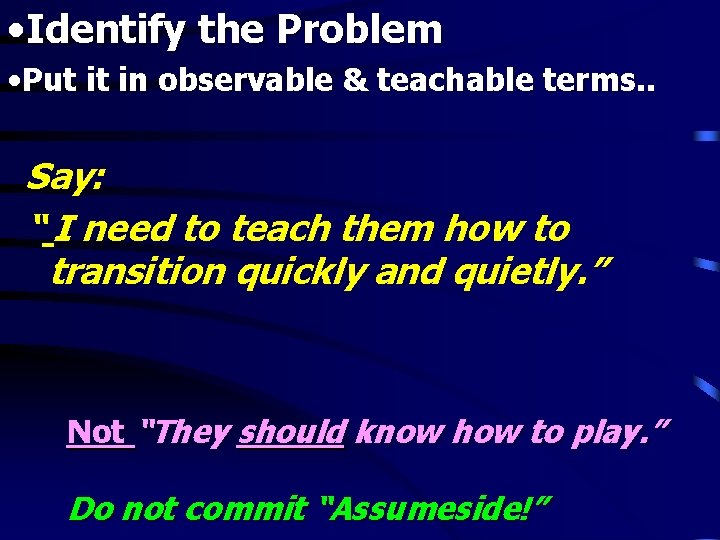
• Identify the Problem • Put it in observable & teachable terms. . Say: “ I need to teach them how to transition quickly and quietly. ” Not “They should know how to play. ” Do not commit “Assumeside!”
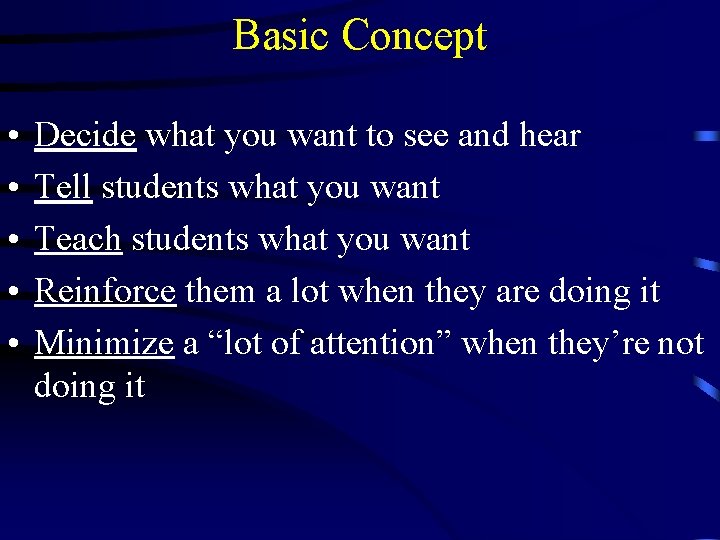
Basic Concept • • • Decide what you want to see and hear Tell students what you want Teach students what you want Reinforce them a lot when they are doing it Minimize a “lot of attention” when they’re not doing it
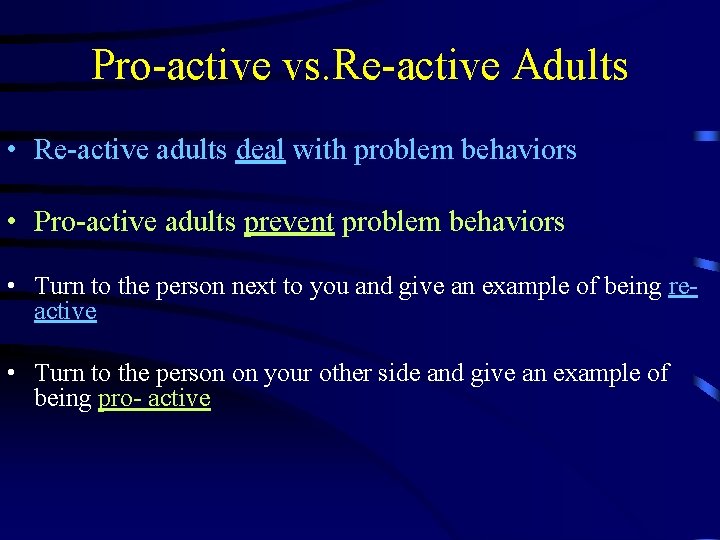
Pro-active vs. Re-active Adults • Re-active adults deal with problem behaviors • Pro-active adults prevent problem behaviors • Turn to the person next to you and give an example of being reactive • Turn to the person on your other side and give an example of being pro- active
Punish • Reduce reliance on punishment, time-out, officereferral and suspension, as a primary strategy • If the “punished” behavior occurs again and again, the punisher is reinforcing to the child. • Find out what the child is trying to get (e. g. , attention, avoidance/escape or both).
Reactive Statements – What are you doing!? – Stop that! – Sit down! – Get to work! – No! – You should know how to do that by now! Many times our reactive statements increase anger and escalate behavior.
Verbal & Non-verbal Communication Be aware of your communication style Videotape yourself and watch for: – – – Shaking finger? Hands in sides? Standing in front of the student. Looking down at the student. Being at eyelevel with the student? Giving the student a clear direction?
Pro-active/Reinforcing words: “ I noticed……” “I saw…. . ” “You are being responsible, respectful, safe when you……. ”
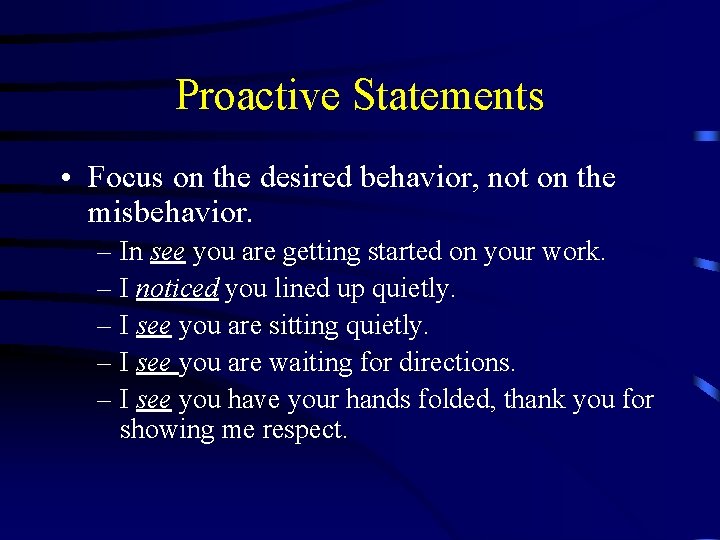
Proactive Statements • Focus on the desired behavior, not on the misbehavior. – In see you are getting started on your work. – I noticed you lined up quietly. – I see you are sitting quietly. – I see you are waiting for directions. – I see you have your hands folded, thank you for showing me respect.
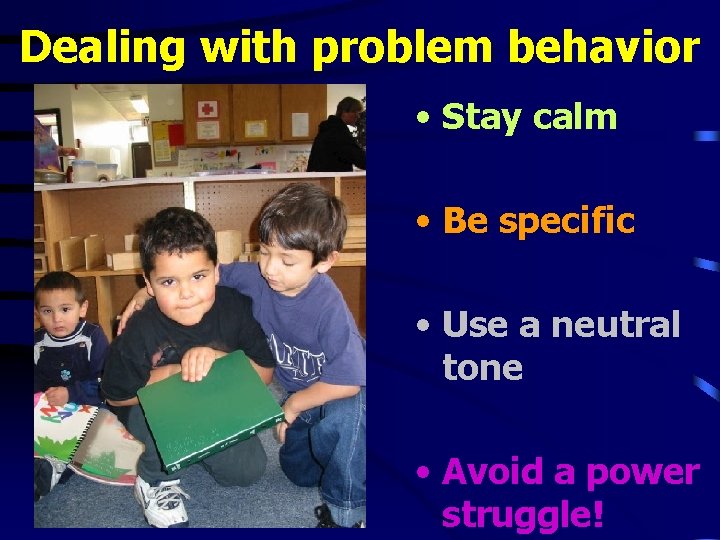
Dealing with problem behavior • Stay calm • Be specific • Use a neutral tone • Avoid a power struggle!
Helpful words: To Encourage & Reinforce: “I noticed…. . ” & “I saw…. . ” “Can I help you? ” To stay out of a power struggle: “Regardless “ “Never the Less”
What else…. . Do NOT hold a grudge! Use humor, not sarcasm • Always treat the child with respect.
What can be done? • Be organized • Set up a positive and predictable classroom environment • Develop and teach clear expectations
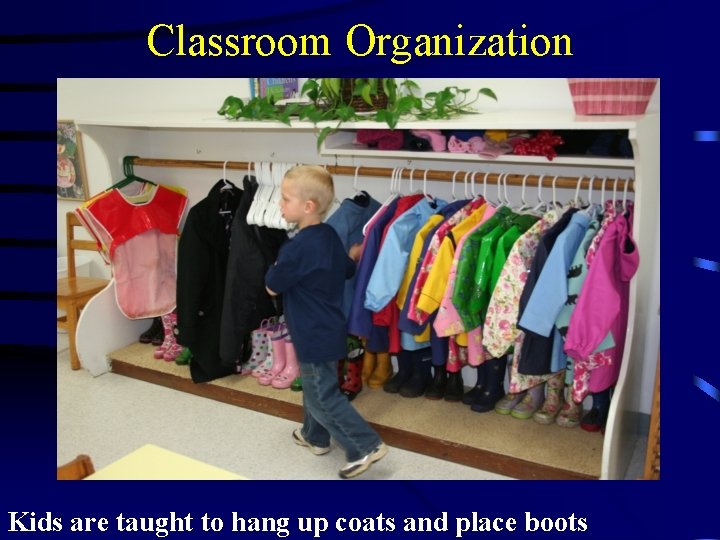
Classroom Organization Kids are taught to hang up coats and place boots
Neatness and Organization • Teach students: – respect for their space • Coats on hangers, hats off, roll up sleeves • Put materials away neatly – Personal space • Walk with personal space around you • Stand in line with personal space • Walk with a purpose
Response to Intervention • If you are doing the same thing again and the behavior doesn’t change, you must change your intervention/interaction. • The teacher always has to change first before the child will change!
Use Data-based Decisions • Keep track of repeat “offenders” – E. g. , turning card, name on board, send to office, call parents. The “punishment” actually maybe reinforcing for the student.
What can be done? Encourage the Child Recognize effort not just success Provide warmth, caring and Frequent encouragement Lots of positive feedback Minimize reprimands
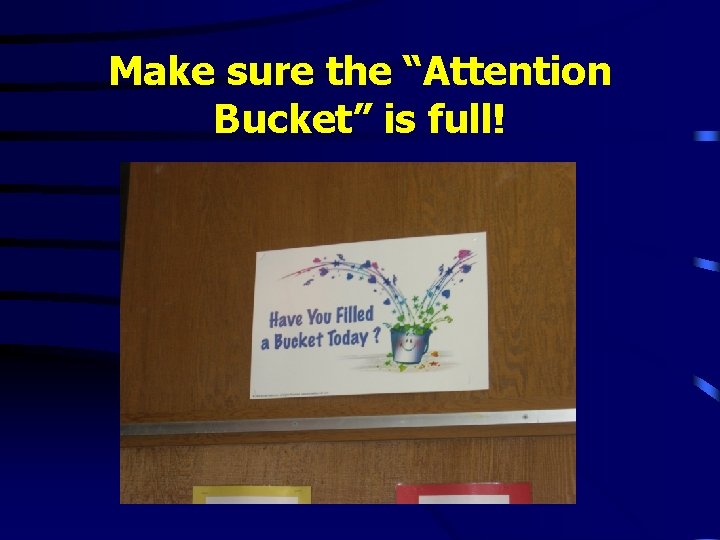
Make sure the “Attention Bucket” is full!
In spite of the best classroom management, some children need more…. First Step to Success provides more for students, teachers and parents.
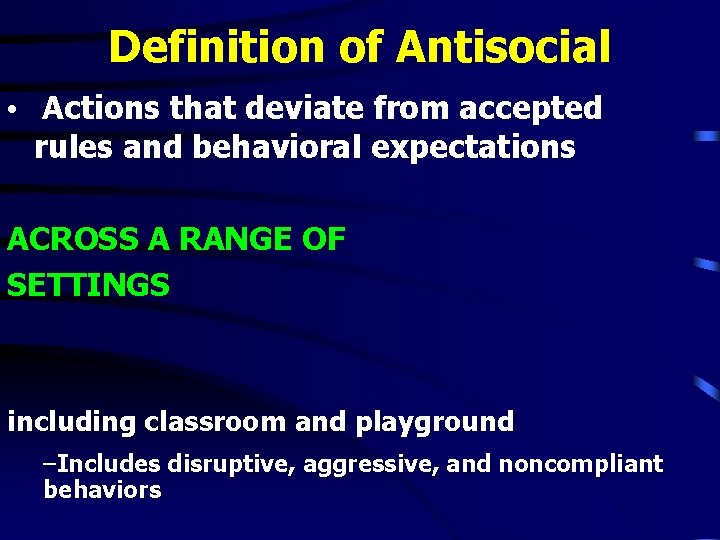
Definition of Antisocial • Actions that deviate from accepted rules and behavioral expectations ACROSS A RANGE OF SETTINGS including classroom and playground –Includes disruptive, aggressive, and noncompliant behaviors
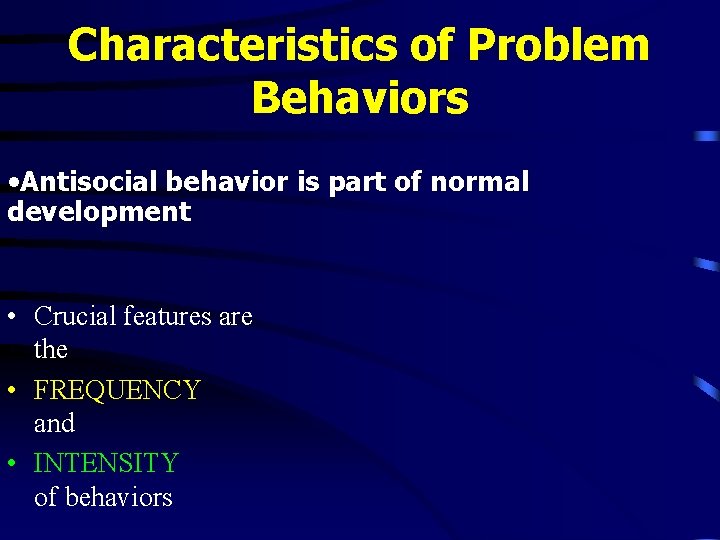
Characteristics of Problem Behaviors • Antisocial behavior is part of normal development • Crucial features are the • FREQUENCY and • INTENSITY of behaviors
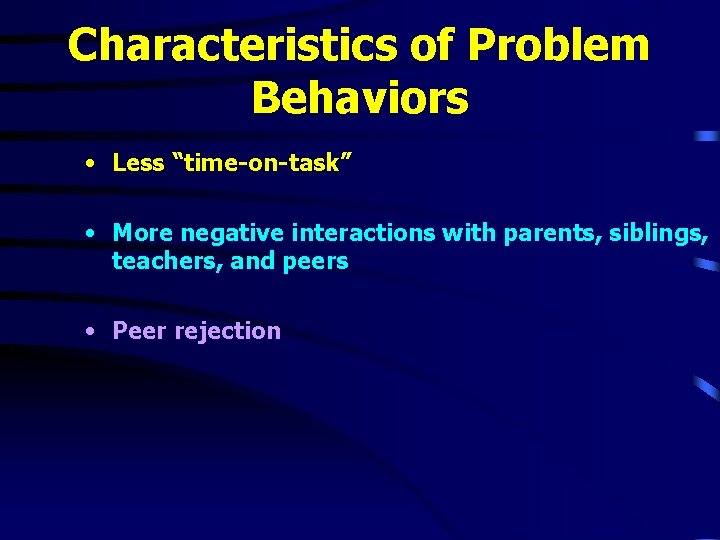
Characteristics of Problem Behaviors • Less “time-on-task” • More negative interactions with parents, siblings, teachers, and peers • Peer rejection
Characteristics of the Child • Temperamental • Oppositional • Impulsive • Attention Deficit Problems
Facts on Antisocial Behavior • Antisocial behavior by grade 4 should be treated as chronic condition like diabetes (not cured but managed) • Early intervention in school, home, and community is best hope for diverting from the path
Stressors Frequently cited reasons: Low Income Unemployment Marital Problems Emotional/Physical Abuse
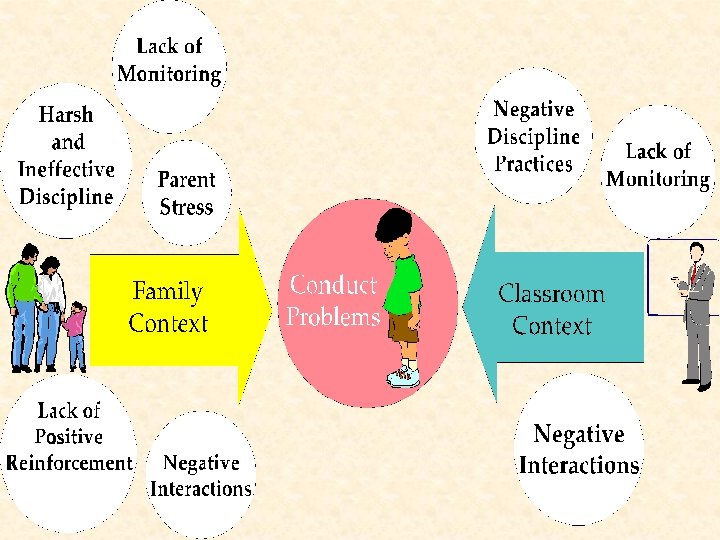
Parents/Caregivers/Teachers Reasons: • Ineffective (inconsistent) discipline • Harsh discipline • Lack of positive interactions • Lack of monitoring
CLASS INTERVENTION: • Positive behavior management program • Children learn how to: – Attend to the teacher – Get along with others – Participate in activities
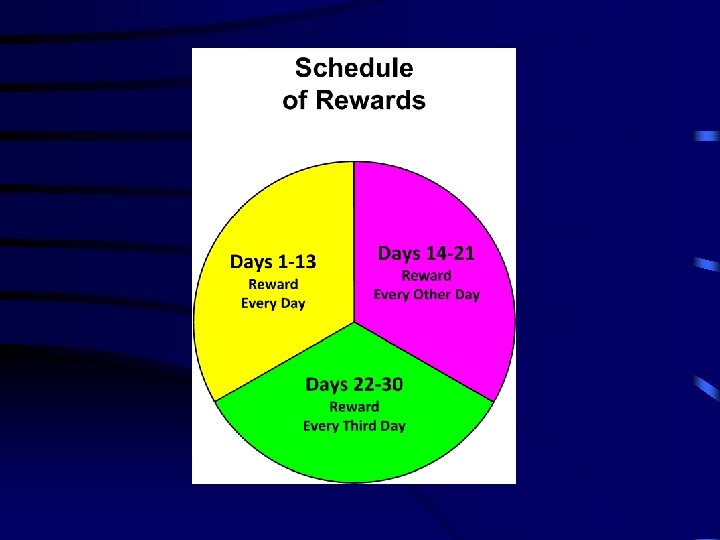
CLASS Procedures: • One student at a time plays the GREEN/RED card game • GREEN/RED card provides feedback • Stars on GREEN side earn surprise for the class
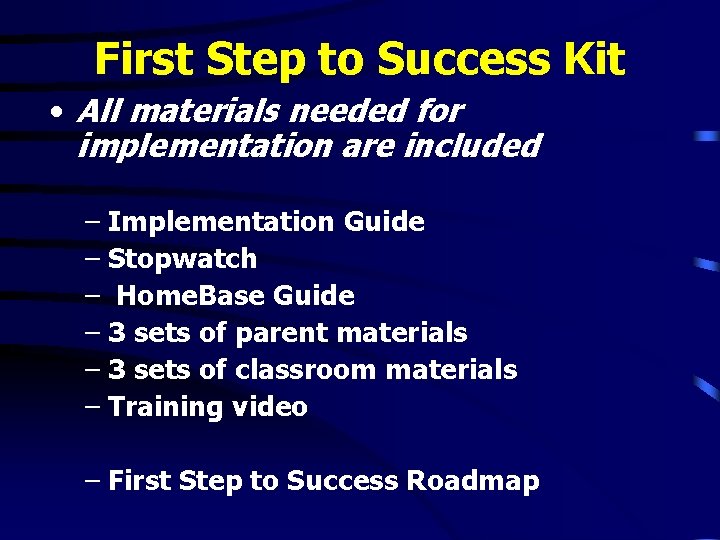
First Step to Success Kit • All materials needed for implementation are included – Implementation Guide – Stopwatch – Home. Base Guide – 3 sets of parent materials – 3 sets of classroom materials – Training video – First Step to Success Roadmap
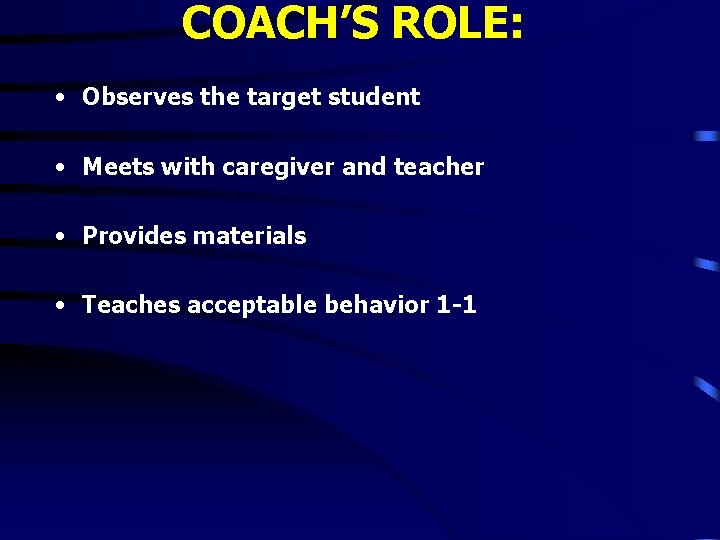
COACH’S ROLE: • Observes the target student • Meets with caregiver and teacher • Provides materials • Teaches acceptable behavior 1 -1
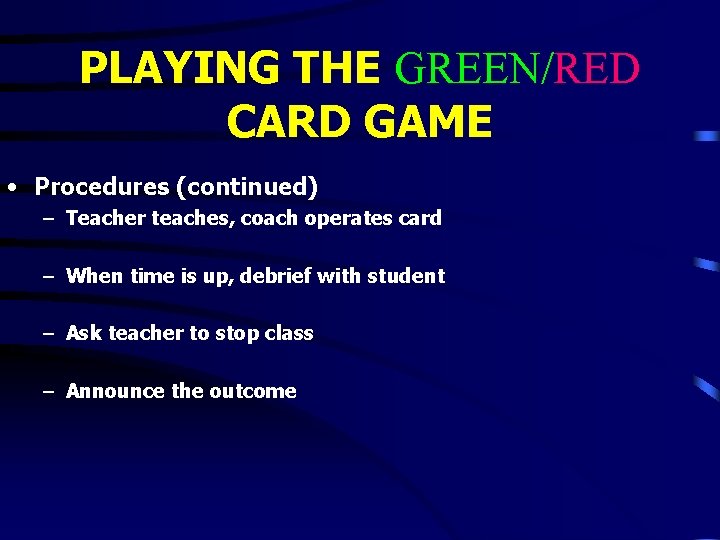
PLAYING THE GREEN/RED CARD GAME • Procedures (continued) – Teacher teaches, coach operates card – When time is up, debrief with student – Ask teacher to stop class – Announce the outcome
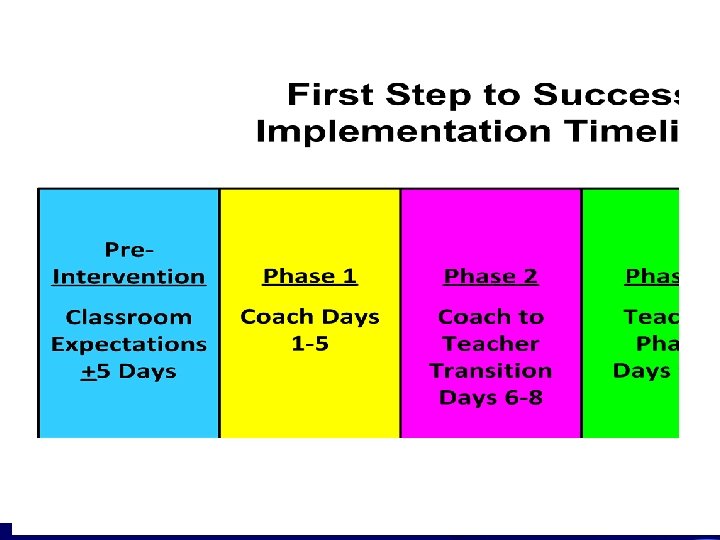
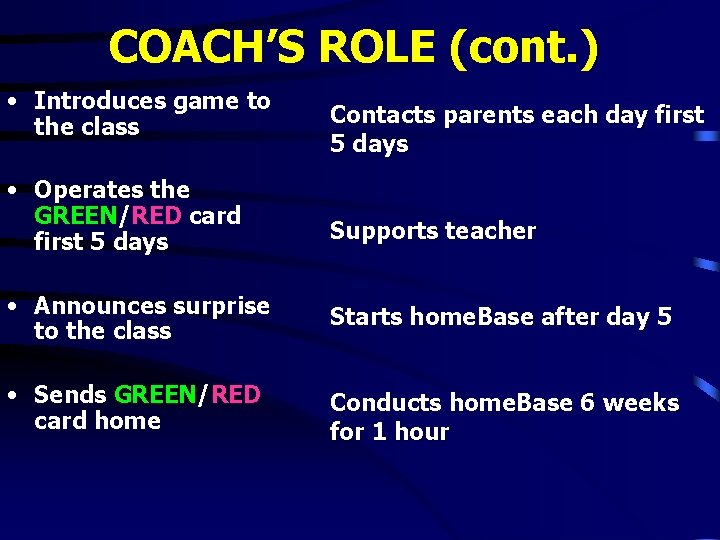
COACH’S ROLE (cont. ) • Introduces game to the class • Operates the GREEN/RED card first 5 days Contacts parents each day first 5 days Supports teacher • Announces surprise to the class Starts home. Base after day 5 • Sends GREEN/RED card home Conducts home. Base 6 weeks for 1 hour
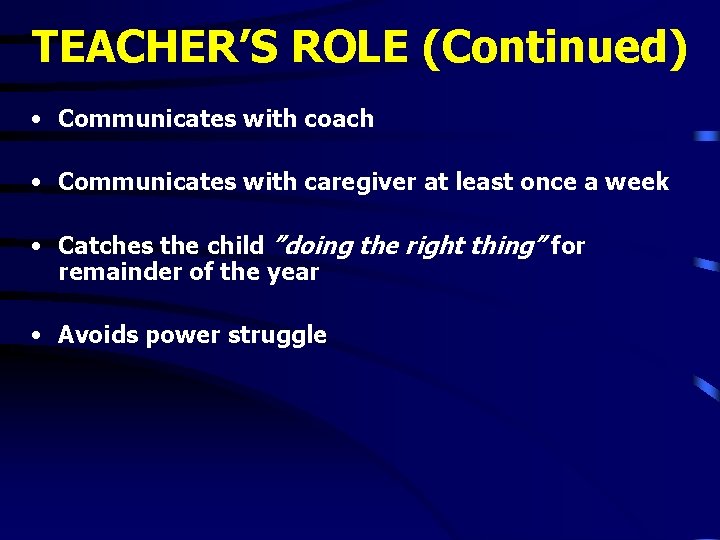
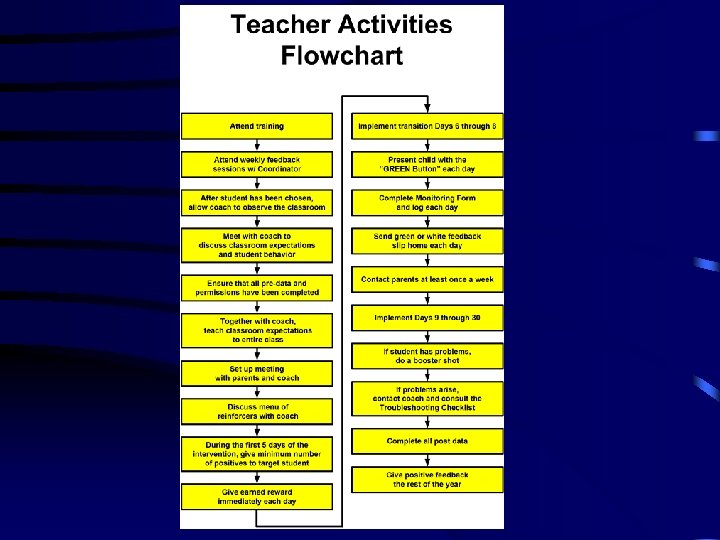
TEACHER’S ROLE (Continued) • Communicates with coach • Communicates with caregiver at least once a week • Catches the child ”doing the right thing” for remainder of the year • Avoids power struggle
CARETAKER’S ROLE: • Provides encouragement and surprises • Signs GREEN/RED card every day • Participates in weekly home. Base meetings
CARETAKER’S ROLE (Continued) • Practices home. Base parenting tips • Plays home. Base games with child for 5 minutes each day • Communicates with coach and/or teacher
CHILD’S ROLE: Agrees to participate Brings home GREEN/RED card Chooses “surprises” for the class Participates in home. Base activities
PEERS’ ROLE: Follow teacher directions Do own work Ignore minor misbehaviors Encourage target student for playing GREEN/REDcard game well Thank target student for earning a surprise for the class
ADDITIONAL SCHOOL STAFF’S ROLE: • Catch The child “doing the right thing” • Avoid excessive attention for inappropriate behaviors • Be clear and direct • Always use a neutral tone • Avoid “power struggles!” • Support the teacher • Notify teacher/caregiver when things are going well
PLAYING THE GREEN/RED CARD GAME • Procedures for first few days: – Remind all students of expected behaviors – Review expectations briefly with target student – Sit near student – Provide feedback & give points
PLAYING THE GREEN/RED CARD GAME • Procedures (continued) – Teacher teaches, coach operates card – When time is up, debrief with student – Ask teacher to stop class – Announce the outcome
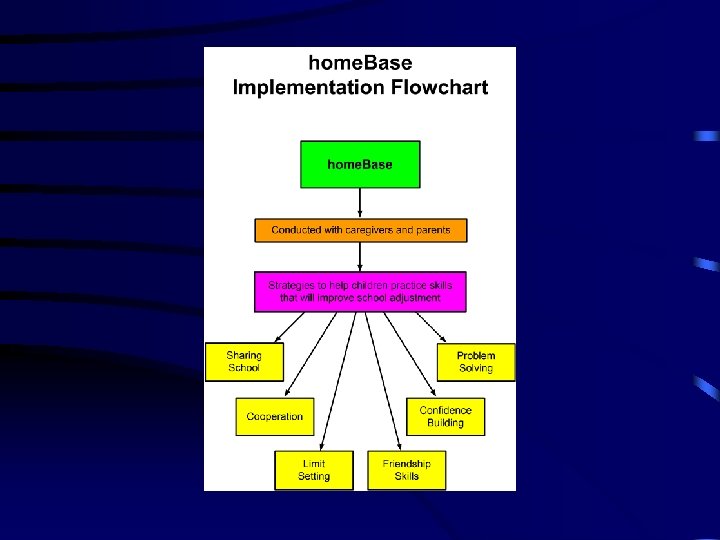
h. OMEBASE • Commitment for parents/caregivers: – Weekly meetings with First Step coach: 30 -45 minutes • Complete Check-up lists (How well do you know your child ? ) • Discuss Parent Tips (Do’s and don’ts of good parenting) • Practice Games to play with child( Focussed on school success) – Daily practice and activities with child: 5 -10 minutes
h. OMEBASE • WEEK 1: Sharing the day – Child practices giving information – Parent listens and gives encouragement – Information gives parents the power to help children be successful outside the home
h. OMEBASE • WEEK 2: Cooperation – Parent & child learn strategies – Sticker chart or chart used at home • Being cooperative allows a child opportunities to avoid problems
h. OMEBASE • WEEK 3: Limit Setting – Giving effective directions and encouragement – Time-out procedures • Teaching children to follow limits at home leads to selfcontrol and accepting limits outside of home.
h. OMEBASE • WEEK 4: Problem solving – Problem-solving: stay calm and brainstorm – Parent helps to guide, encourage, and suggest steps to goal • Children who see problems as opportunities rather than obstacles feel capable
h. OMEBASE • WEEK 5: Friendship skills – Initiation skills – Empathy and self-control – Cooperation • Learning friendship skills now provides a base for friendship throughout life
h. OMEBASE • WEEK 6: Confidence building – Confidence building • Self-confidence developed at home provides a foundation for success outside the home.