
First Results from the Online Radiation Dose Monitoring
- Slides: 18
First Results from the Online Radiation Dose Monitoring System in ATLAS Experiment I. Mandića, V. Cindroa, I. Dolenca, M. Deliyergiyeva, A. Gorišeka, G. Krambergera, M. Mikuža, b, J. Hartertc, S. Franzd Stefan Institute, Jamova 39, Ljubljana, Slovenia of Mathematics and Physics, University of Ljubljana, Jadranska 19, Ljubljana, Slovenia c. Physikalisches Institut Universität Freiburg, Hermann-Herder-Str. 3, Freiburg, Germany d. CERN, Geneva, Switzerland b. Faculty a. Jožef FLUKA simulations by: I. Dawson, L. Nicolas, P. Miyagawa et al. , University of Sheffield, UK Lot of work with radiation sensors (characterization, selection, calibration, annealing studies etc. . . ) was done by F. Ravotti, M. Glaser, M. Moll et al. from the CERN RADMON team http: //lhc-expt-radmon. web. cern. ch/lhc-expt-radmon/ ___________________________________________________ I. Mandić, 19 th RD 50 Workshop, CERN, 21 – 23 November 2011 1
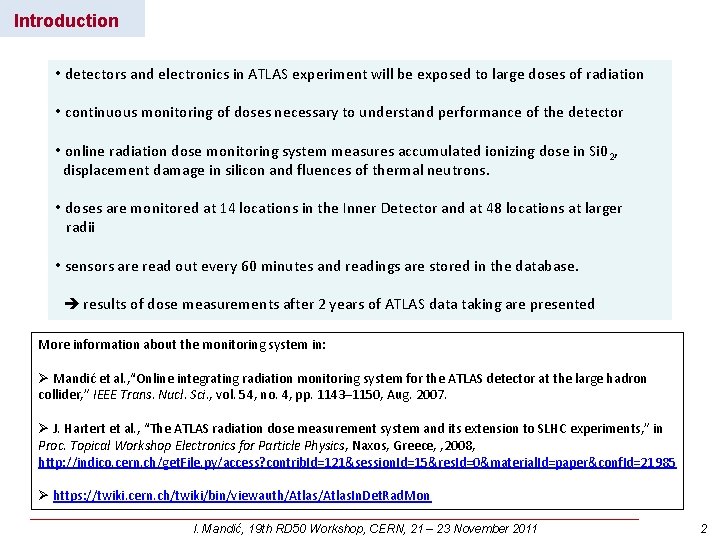
Introduction • detectors and electronics in ATLAS experiment will be exposed to large doses of radiation • continuous monitoring of doses necessary to understand performance of the detector • online radiation dose monitoring system measures accumulated ionizing dose in Si 02, displacement damage in silicon and fluences of thermal neutrons. • doses are monitored at 14 locations in the Inner Detector and at 48 locations at larger radii • sensors are read out every 60 minutes and readings are stored in the database. results of dose measurements after 2 years of ATLAS data taking are presented More information about the monitoring system in: Ø Mandić et al. , “Online integrating radiation monitoring system for the ATLAS detector at the large hadron collider, ” IEEE Trans. Nucl. Sci. , vol. 54, no. 4, pp. 1143– 1150, Aug. 2007. Ø J. Hartert et al. , “The ATLAS radiation dose measurement system and its extension to SLHC experiments, ” in Proc. Topical Workshop Electronics for Particle Physics, Naxos, Greece, , 2008, http: //indico. cern. ch/get. File. py/access? contrib. Id=121&session. Id=15&res. Id=0&material. Id=paper&conf. Id=21985 Ø https: //twiki. cern. ch/twiki/bin/viewauth/Atlas. In. Det. Rad. Mon ___________________________________________________ I. Mandić, 19 th RD 50 Workshop, CERN, 21 – 23 November 2011 2
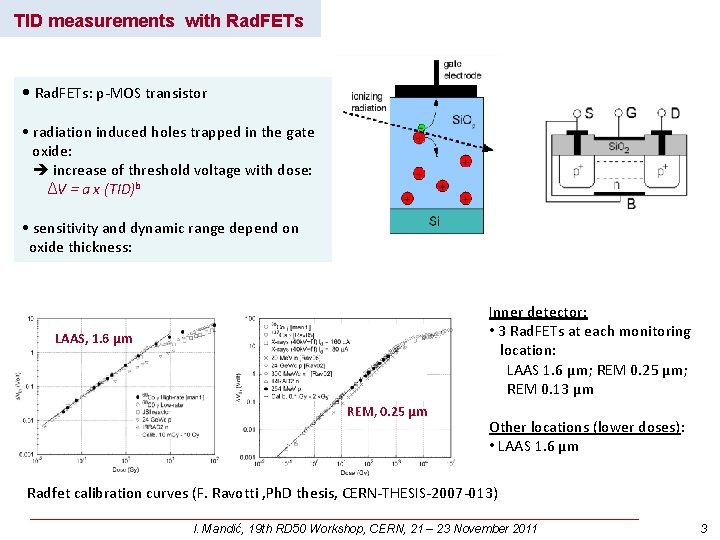
TID measurements with Rad. FETs • Rad. FETs: p-MOS transistor • radiation induced holes trapped in the gate oxide: increase of threshold voltage with dose: ΔV = a x (TID)b • sensitivity and dynamic range depend on oxide thickness: Inner detector: • 3 Rad. FETs at each monitoring location: LAAS 1. 6 µm; REM 0. 25 µm; REM 0. 13 µm LAAS, 1. 6 µm REM, 0. 25 µm Other locations (lower doses): • LAAS 1. 6 µm Radfet calibration curves (F. Ravotti , Ph. D thesis, CERN-THESIS-2007 -013) ___________________________________________________ I. Mandić, 19 th RD 50 Workshop, CERN, 21 – 23 November 2011 3
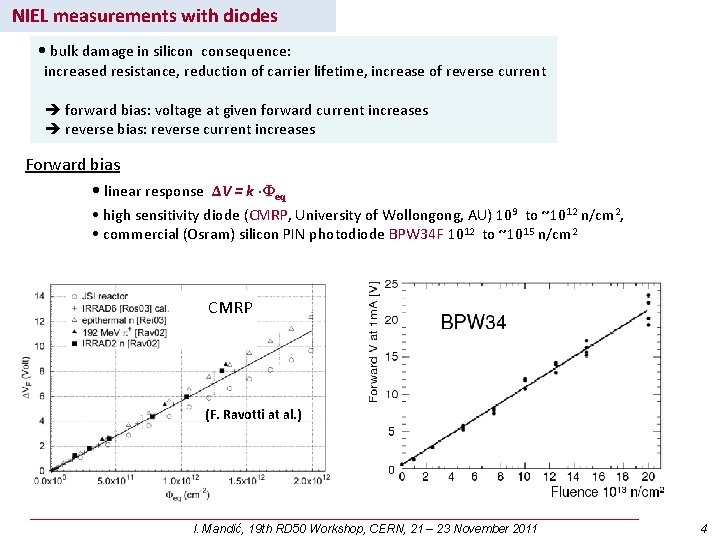
NIEL measurements with diodes • bulk damage in silicon consequence: increased resistance, reduction of carrier lifetime, increase of reverse current forward bias: voltage at given forward current increases reverse bias: reverse current increases Forward bias • linear response ΔV = k ·Φeq • high sensitivity diode (CMRP, University of Wollongong, AU) 109 to ~1012 n/cm 2, • commercial (Osram) silicon PIN photodiode BPW 34 F 1012 to ~1015 n/cm 2 CMRP (F. Ravotti at al. ) ___________________________________________________ I. Mandić, 19 th RD 50 Workshop, CERN, 21 – 23 November 2011 4
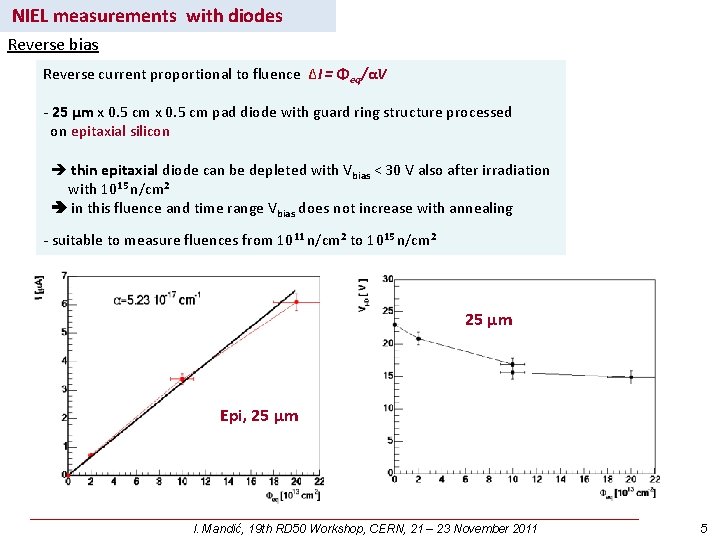
NIEL measurements with diodes Reverse bias Reverse current proportional to fluence ΔI = Φeq/αV - 25 µm x 0. 5 cm pad diode with guard ring structure processed on epitaxial silicon thin epitaxial diode can be depleted with Vbias < 30 V also after irradiation with 1015 n/cm 2 in this fluence and time range Vbias does not increase with annealing - suitable to measure fluences from 1011 n/cm 2 to 1015 n/cm 2 25 µm Epi, 25 µm ___________________________________________________ I. Mandić, 19 th RD 50 Workshop, CERN, 21 – 23 November 2011 5
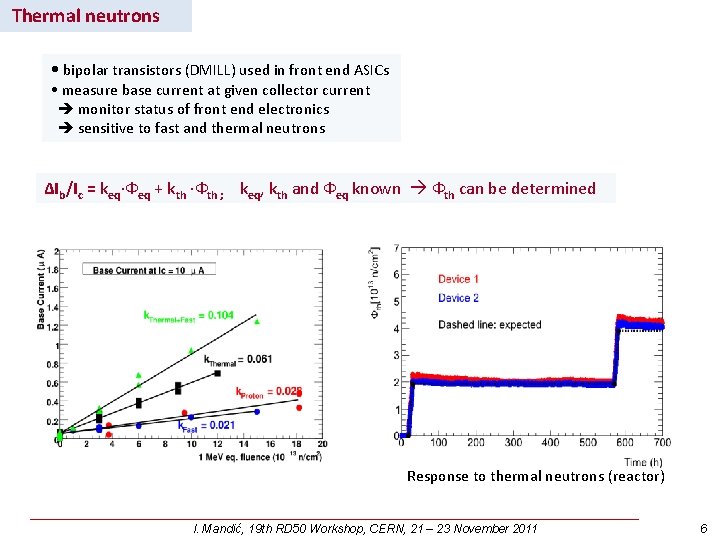
Thermal neutrons • bipolar transistors (DMILL) used in front end ASICs • measure base current at given collector current monitor status of front end electronics sensitive to fast and thermal neutrons ΔIb/Ic = keq·Фeq + kth ·Фth ; keq, kth and Фeq known Фth can be determined Response to thermal neutrons (reactor) ___________________________________________________ I. Mandić, 19 th RD 50 Workshop, CERN, 21 – 23 November 2011 6
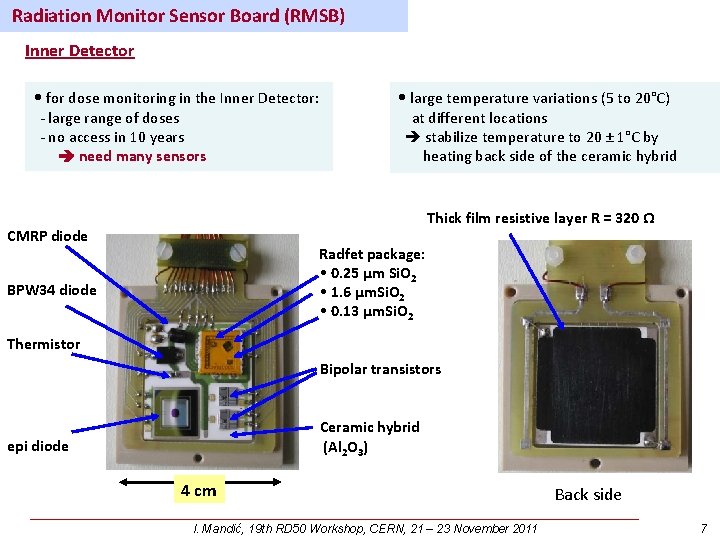
Radiation Monitor Sensor Board (RMSB) Inner Detector • for dose monitoring in the Inner Detector: - large range of doses - no access in 10 years need many sensors • large temperature variations (5 to 20°C) at different locations stabilize temperature to 20 ± 1°C by heating back side of the ceramic hybrid Thick film resistive layer R = 320 Ω CMRP diode Radfet package: • 0. 25 µm Si. O 2 • 1. 6 µm. Si. O 2 • 0. 13 µm. Si. O 2 BPW 34 diode Thermistor Bipolar transistors Ceramic hybrid (Al 2 O 3) epi diode 4 cm Back side ___________________________________________________ I. Mandić, 19 th RD 50 Workshop, CERN, 21 – 23 November 2011 7
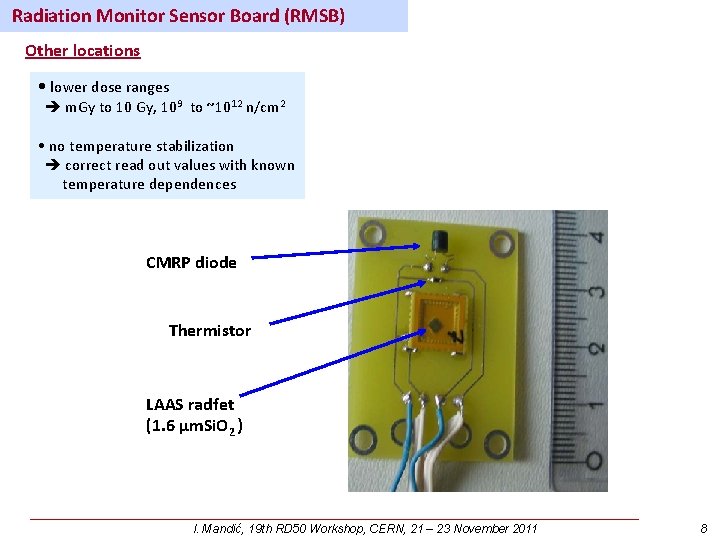
Radiation Monitor Sensor Board (RMSB) Other locations • lower dose ranges m. Gy to 10 Gy, 109 to ~1012 n/cm 2 • no temperature stabilization correct read out values with known temperature dependences CMRP diode Thermistor LAAS radfet (1. 6 µm. Si. O 2 ) ___________________________________________________ I. Mandić, 19 th RD 50 Workshop, CERN, 21 – 23 November 2011 8
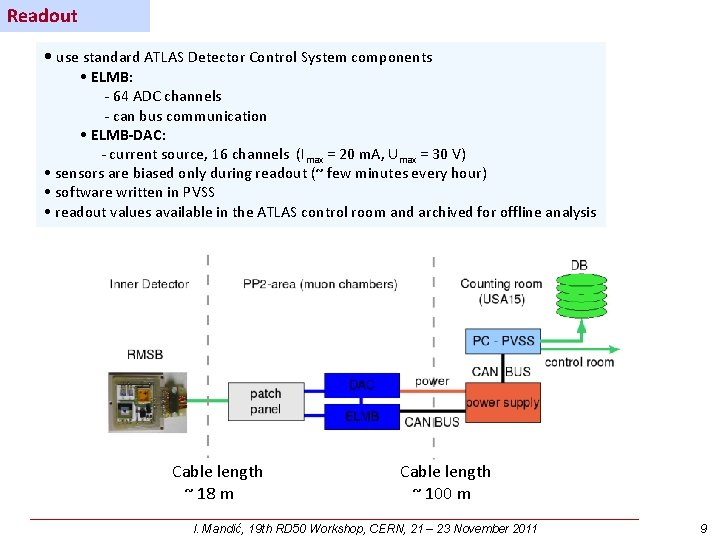
Readout • use standard ATLAS Detector Control System components • ELMB: - 64 ADC channels - can bus communication • ELMB-DAC: - current source, 16 channels (Imax = 20 m. A, Umax = 30 V) • sensors are biased only during readout (~ few minutes every hour) • software written in PVSS • readout values available in the ATLAS control room and archived for offline analysis Cable length ~ 18 m Cable length ~ 100 m ___________________________________________________ I. Mandić, 19 th RD 50 Workshop, CERN, 21 – 23 November 2011 9
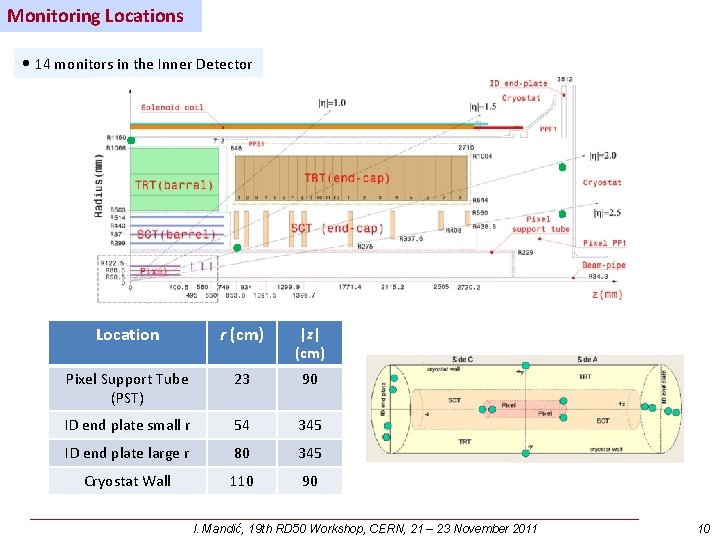
Monitoring Locations • 14 monitors in the Inner Detector Location r (cm) |z| (cm) Pixel Support Tube (PST) 23 90 ID end plate small r 54 345 ID end plate large r 80 345 Cryostat Wall 110 90 ___________________________________________________ I. Mandić, 19 th RD 50 Workshop, CERN, 21 – 23 November 2011 10
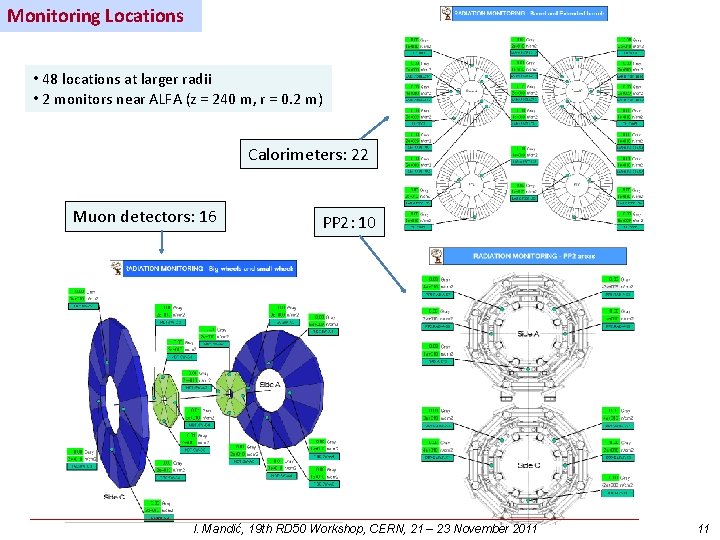
Monitoring Locations • 48 locations at larger radii • 2 monitors near ALFA (z = 240 m, r = 0. 2 m) Calorimeters: 22 Muon detectors: 16 PP 2: 10 ___________________________________________________ I. Mandić, 19 th RD 50 Workshop, CERN, 21 – 23 November 2011 11
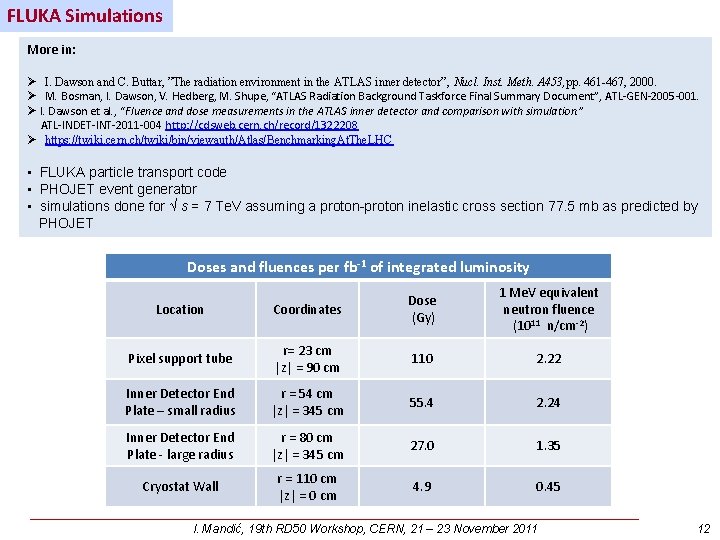
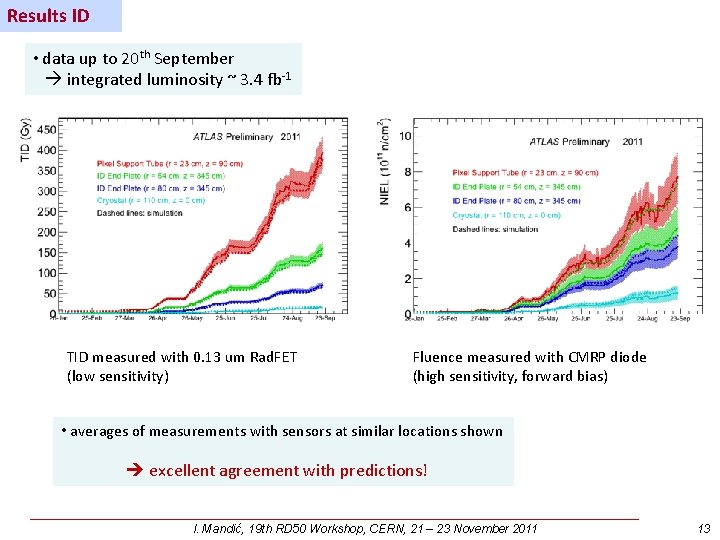
FLUKA Simulations More in: Ø I. Dawson and C. Buttar, ”The radiation environment in the ATLAS inner detector”, Nucl. Inst. Meth. A 453, pp. 461 -467, 2000. Ø M. Bosman, I. Dawson, V. Hedberg, M. Shupe, “ATLAS Radiation Background Taskforce Final Summary Document”, ATL-GEN-2005 -001. Ø I. Dawson et al. , “Fluence and dose measurements in the ATLAS inner detector and comparison with simulation. ” ATL-INDET-INT-2011 -004 http: //cdsweb. cern. ch/record/1322208 Ø https: //twiki. cern. ch/twiki/bin/viewauth/Atlas/Benchmarking. At. The. LHC • FLUKA particle transport code • PHOJET event generator • simulations done for √ s = 7 Te. V assuming a proton-proton inelastic cross section 77. 5 mb as predicted by PHOJET Doses and fluences per fb-1 of integrated luminosity 1 Me. V equivalent neutron fluence (1011 n/cm-2) Location Coordinates Dose (Gy) Pixel support tube r= 23 cm |z| = 90 cm 110 2. 22 Inner Detector End Plate – small radius r = 54 cm |z| = 345 cm 55. 4 2. 24 Inner Detector End Plate - large radius r = 80 cm |z| = 345 cm 27. 0 1. 35 Cryostat Wall r = 110 cm |z| = 0 cm 4. 9 0. 45 ___________________________________________________ I. Mandić, 19 th RD 50 Workshop, CERN, 21 – 23 November 2011 12
Results ID • data up to 20 th September integrated luminosity ~ 3. 4 fb-1 TID measured with 0. 13 um Rad. FET (low sensitivity) Fluence measured with CMRP diode (high sensitivity, forward bias) • averages of measurements with sensors at similar locations shown excellent agreement with predictions! ___________________________________________________ I. Mandić, 19 th RD 50 Workshop, CERN, 21 – 23 November 2011 13
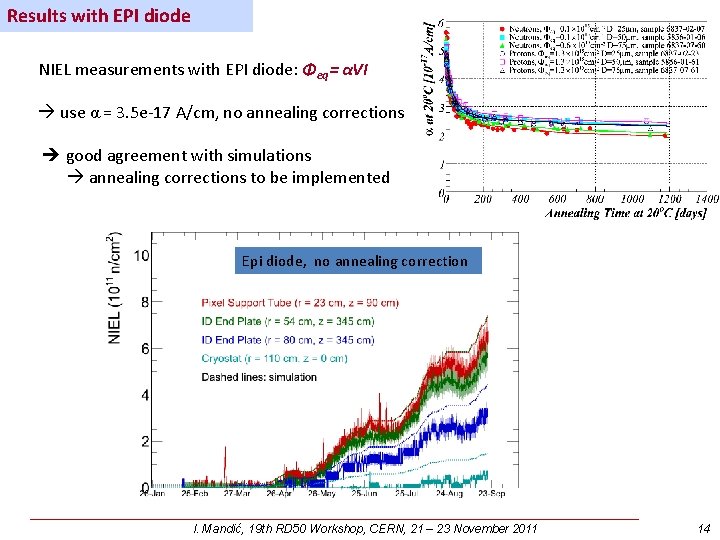
Results with EPI diode NIEL measurements with EPI diode: Φeq= αVI use α = 3. 5 e-17 A/cm, no annealing corrections good agreement with simulations annealing corrections to be implemented Epi diode, no annealing correction ___________________________________________________ I. Mandić, 19 th RD 50 Workshop, CERN, 21 – 23 November 2011 14
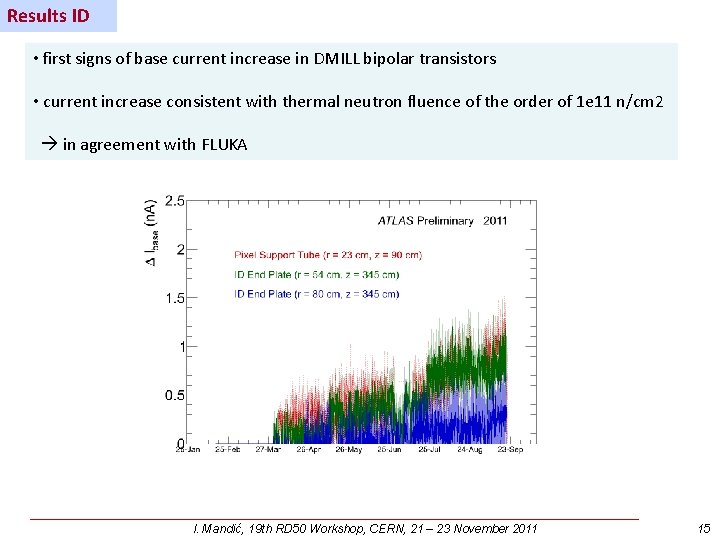
Results ID • first signs of base current increase in DMILL bipolar transistors • current increase consistent with thermal neutron fluence of the order of 1 e 11 n/cm 2 in agreement with FLUKA ___________________________________________________ I. Mandić, 19 th RD 50 Workshop, CERN, 21 – 23 November 2011 15
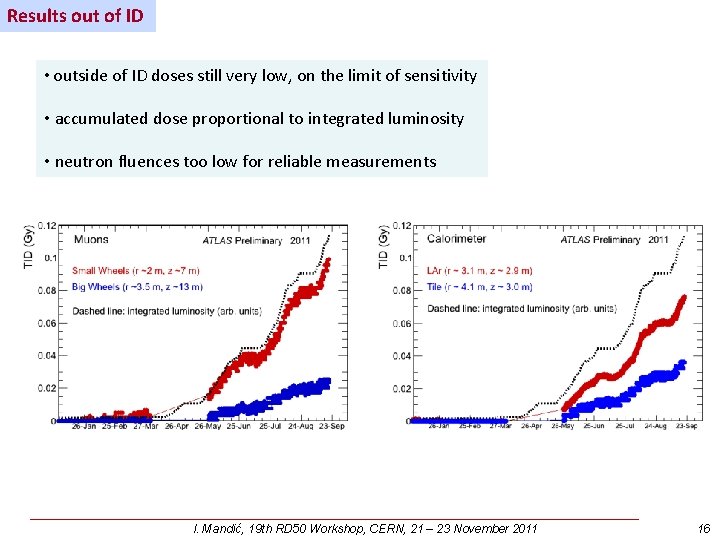
Results out of ID • outside of ID doses still very low, on the limit of sensitivity • accumulated dose proportional to integrated luminosity • neutron fluences too low for reliable measurements ___________________________________________________ I. Mandić, 19 th RD 50 Workshop, CERN, 21 – 23 November 2011 16
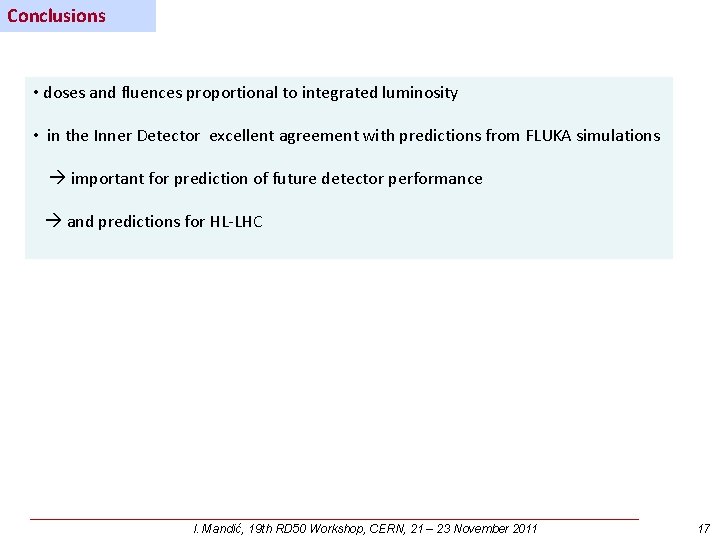
Conclusions • doses and fluences proportional to integrated luminosity • in the Inner Detector excellent agreement with predictions from FLUKA simulations important for prediction of future detector performance and predictions for HL-LHC ___________________________________________________ I. Mandić, 19 th RD 50 Workshop, CERN, 21 – 23 November 2011 17
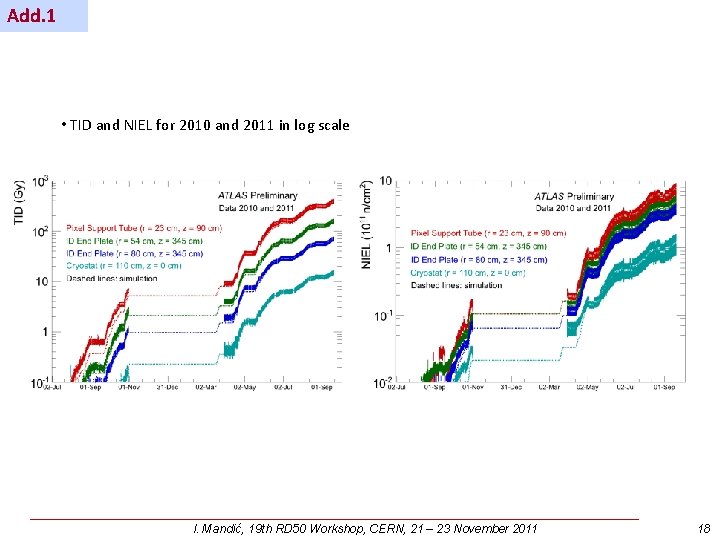
Add. 1 • TID and NIEL for 2010 and 2011 in log scale ___________________________________________________ I. Mandić, 19 th RD 50 Workshop, CERN, 21 – 23 November 2011 18