
FIRST RESPONSE FIRE SAFETY Training Outline At the





- Slides: 31
FIRST RESPONSE FIRE SAFETY
Training Outline At the completion of this session participants will be able to demonstrate knowledge about: • Fire speed and spread, heat transfer • Fire principles and classes of fire • Fire extinguisher types and usage • Fire warning and management systems • Evacuation principles
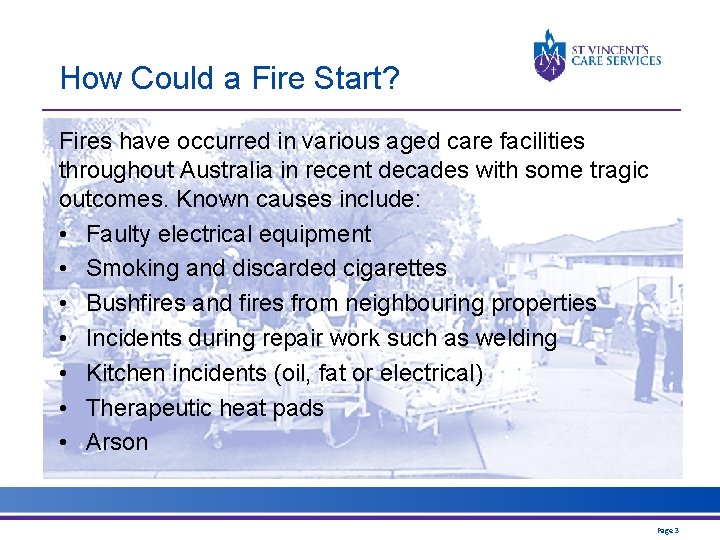
How Could a Fire Start? Fires have occurred in various aged care facilities throughout Australia in recent decades with some tragic outcomes. Known causes include: • Faulty electrical equipment • Smoking and discarded cigarettes • Bushfires and fires from neighbouring properties • Incidents during repair work such as welding • Kitchen incidents (oil, fat or electrical) • Therapeutic heat pads • Arson Page 3
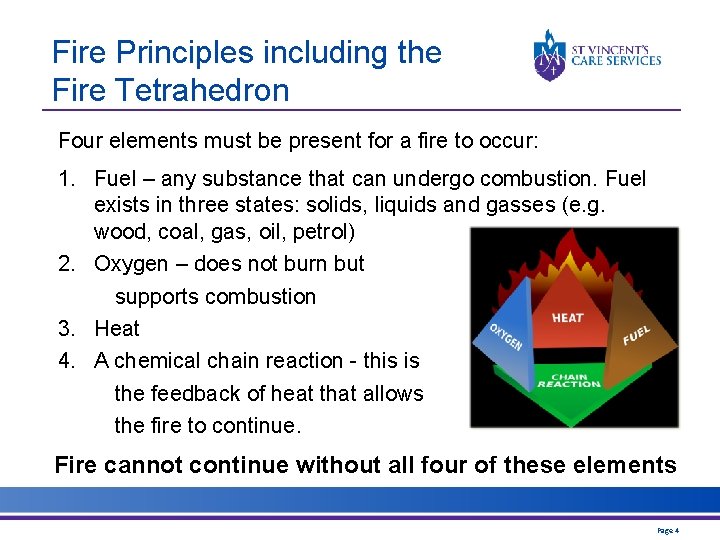
Fire Principles including the Fire Tetrahedron Four elements must be present for a fire to occur: 1. Fuel – any substance that can undergo combustion. Fuel exists in three states: solids, liquids and gasses (e. g. wood, coal, gas, oil, petrol) 2. Oxygen – does not burn but supports combustion 3. Heat 4. A chemical chain reaction - this is the feedback of heat that allows the fire to continue. Fire cannot continue without all four of these elements Page 4
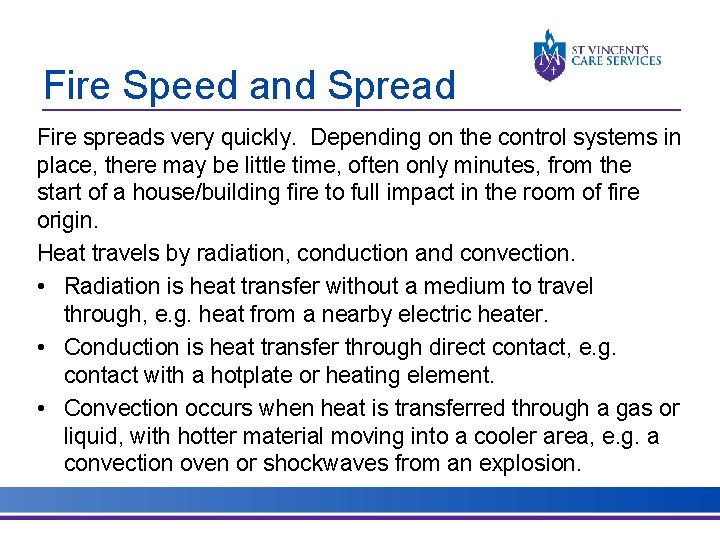
Fire Speed and Spread Fire spreads very quickly. Depending on the control systems in place, there may be little time, often only minutes, from the start of a house/building fire to full impact in the room of fire origin. Heat travels by radiation, conduction and convection. • Radiation is heat transfer without a medium to travel through, e. g. heat from a nearby electric heater. • Conduction is heat transfer through direct contact, e. g. contact with a hotplate or heating element. • Convection occurs when heat is transferred through a gas or liquid, with hotter material moving into a cooler area, e. g. a convection oven or shockwaves from an explosion.
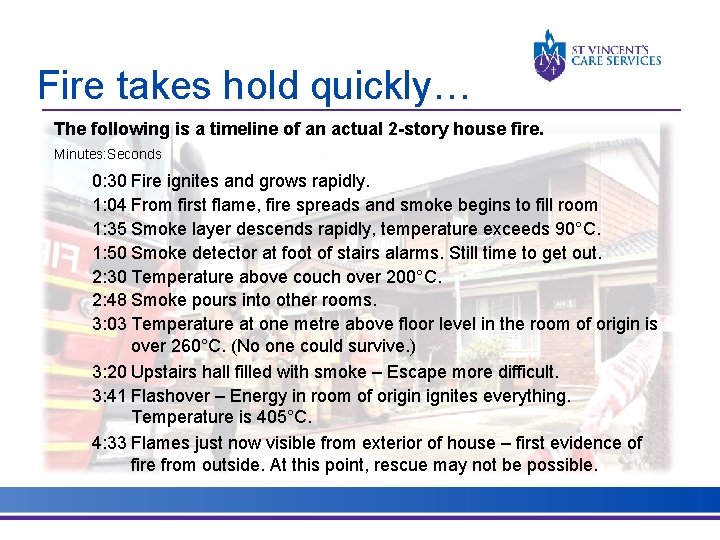
Fire takes hold quickly… The following is a timeline of an actual 2 -story house fire. Minutes: Seconds 0: 30 Fire ignites and grows rapidly. 1: 04 From first flame, fire spreads and smoke begins to fill room 1: 35 Smoke layer descends rapidly, temperature exceeds 90°C. 1: 50 Smoke detector at foot of stairs alarms. Still time to get out. 2: 30 Temperature above couch over 200°C. 2: 48 Smoke pours into other rooms. 3: 03 Temperature at one metre above floor level in the room of origin is over 260°C. (No one could survive. ) 3: 20 Upstairs hall filled with smoke – Escape more difficult. 3: 41 Flashover – Energy in room of origin ignites everything. Temperature is 405°C. 4: 33 Flames just now visible from exterior of house – first evidence of fire from outside. At this point, rescue may not be possible.
Dangerous Goods Every business or home will have a range of chemicals, cleaning products, petrol in a shed, garage, storage area etc. Dangerous goods are substance that may be corrosive, flammable, explosive, spontaneously combustible, toxic, oxidising or water-reactive: • Flammable liquids (petrol, ethanol, methylated spirits, paint thinners, kerosene, acetone etc. ) • Combustible liquids (heating oils, engine oil, vegetable oil) • Gases (flammable, toxic) These goods can be deadly and can seriously damage property and the environment. Therefore it is important that they are stored and handled safely.
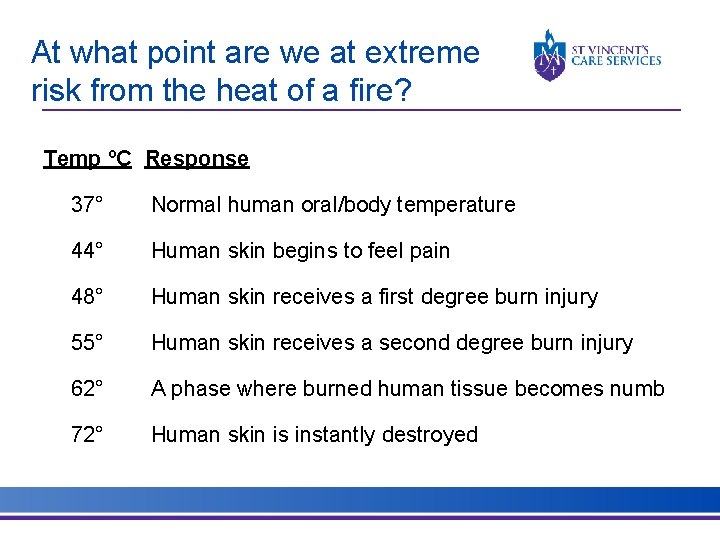
At what point are we at extreme risk from the heat of a fire? Temp ºC Response 37° Normal human oral/body temperature 44° Human skin begins to feel pain 48° Human skin receives a first degree burn injury 55° Human skin receives a second degree burn injury 62° A phase where burned human tissue becomes numb 72° Human skin is instantly destroyed
Smoke • Smoke inhalation is the leading cause of death from fires. • It produces injury through several mechanisms, including thermal injury to the upper airway, irritation or chemical injury to the airways from soot, asphyxiation, and toxicity from carbon monoxide and other gases such as cyanide. • Carbon Monoxide is lighter than air so rises close to where you are breathing. This is a serious during fires, and the reason people are told to drop or stay low when escaping a fire.
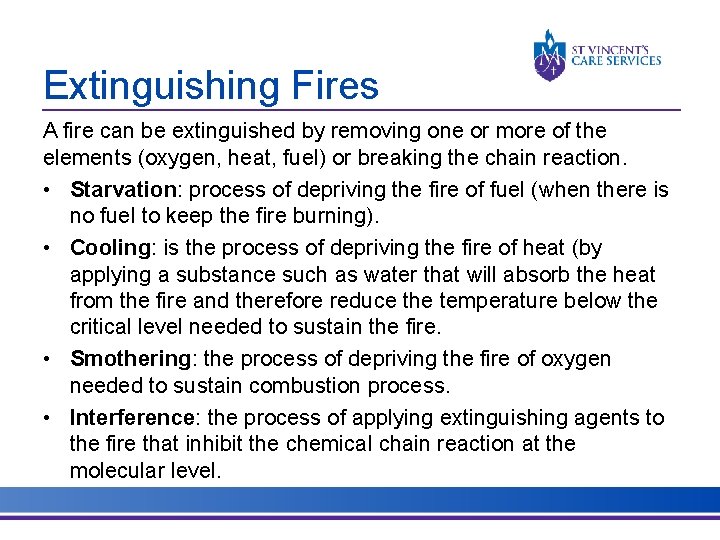
Extinguishing Fires A fire can be extinguished by removing one or more of the elements (oxygen, heat, fuel) or breaking the chain reaction. • Starvation: process of depriving the fire of fuel (when there is no fuel to keep the fire burning). • Cooling: is the process of depriving the fire of heat (by applying a substance such as water that will absorb the heat from the fire and therefore reduce the temperature below the critical level needed to sustain the fire. • Smothering: the process of depriving the fire of oxygen needed to sustain combustion process. • Interference: the process of applying extinguishing agents to the fire that inhibit the chemical chain reaction at the molecular level.
Fire Extinguishers • If a fire is caught soon enough, a fire extinguisher may be enough to put it out and save property and lives. • However, using the wrong type of extinguisher or not knowing how to use an extinguisher correctly may result in the situation rapidly escalating out of control. • The following slides explain which extinguisher to use on certain types of fire, and a few other important points. Page 11
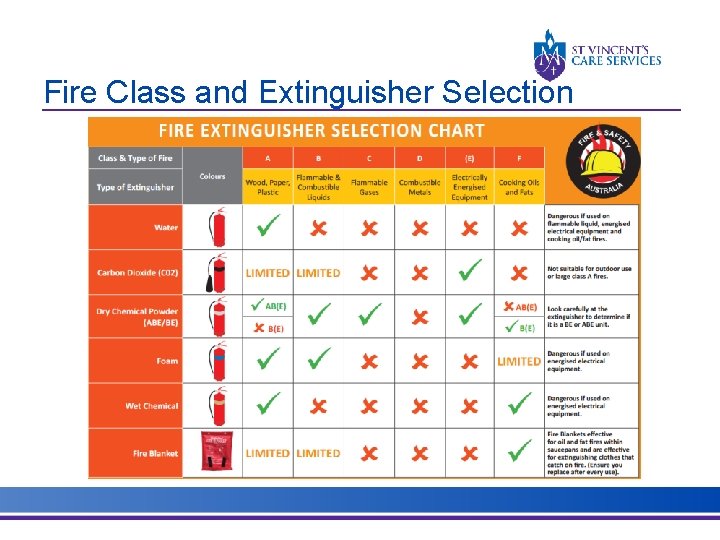
Fire Class and Extinguisher Selection
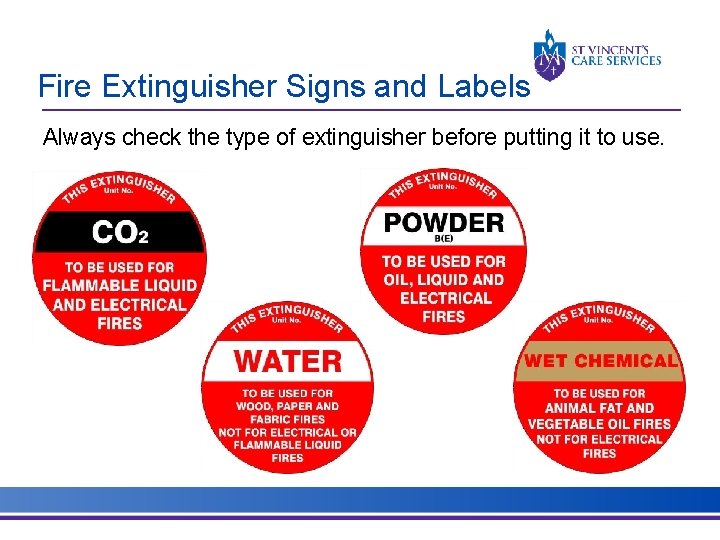
Fire Extinguisher Signs and Labels Always check the type of extinguisher before putting it to use.
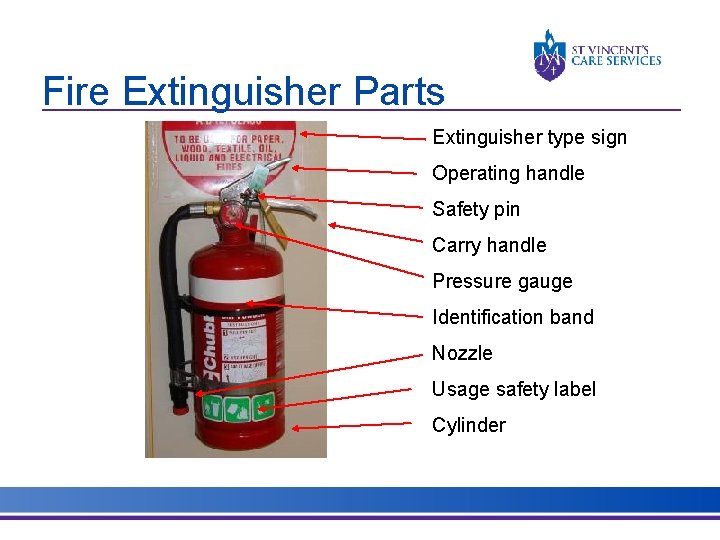
Fire Extinguisher Parts Extinguisher type sign Operating handle Safety pin Carry handle Pressure gauge Identification band Nozzle Usage safety label Cylinder
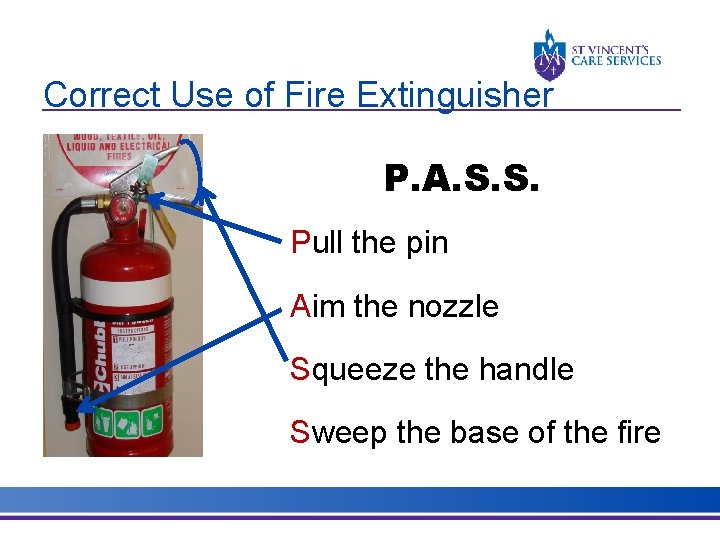
Correct Use of Fire Extinguisher P. A. S. S. Pull the pin Aim the nozzle Squeeze the handle Sweep the base of the fire
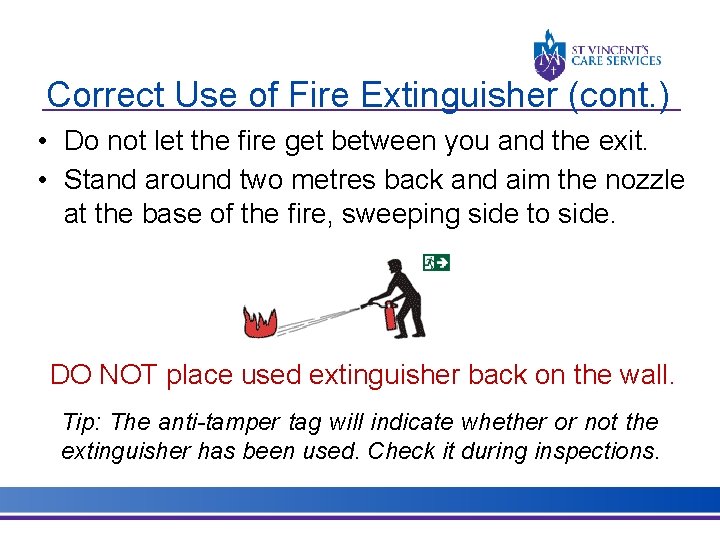
Correct Use of Fire Extinguisher (cont. ) • Do not let the fire get between you and the exit. • Stand around two metres back and aim the nozzle at the base of the fire, sweeping side to side. DO NOT place used extinguisher back on the wall. Tip: The anti-tamper tag will indicate whether or not the extinguisher has been used. Check it during inspections.
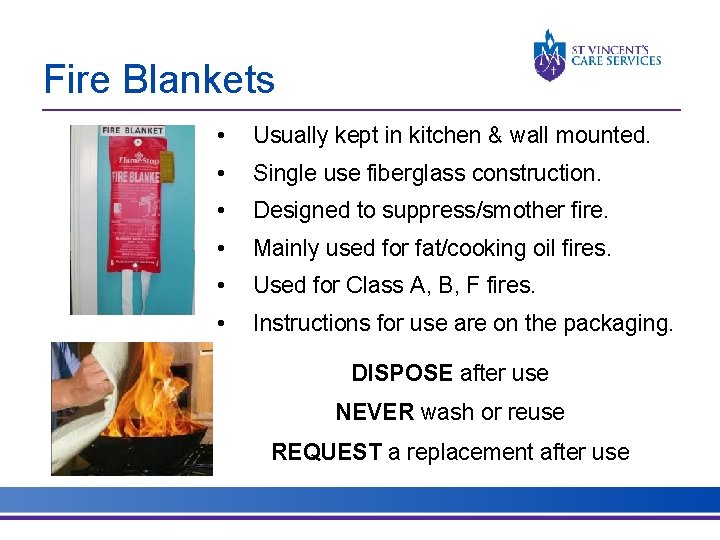
Fire Blankets • Usually kept in kitchen & wall mounted. • Single use fiberglass construction. • Designed to suppress/smother fire. • Mainly used for fat/cooking oil fires. • Used for Class A, B, F fires. • Instructions for use are on the packaging. DISPOSE after use NEVER wash or reuse REQUEST a replacement after use
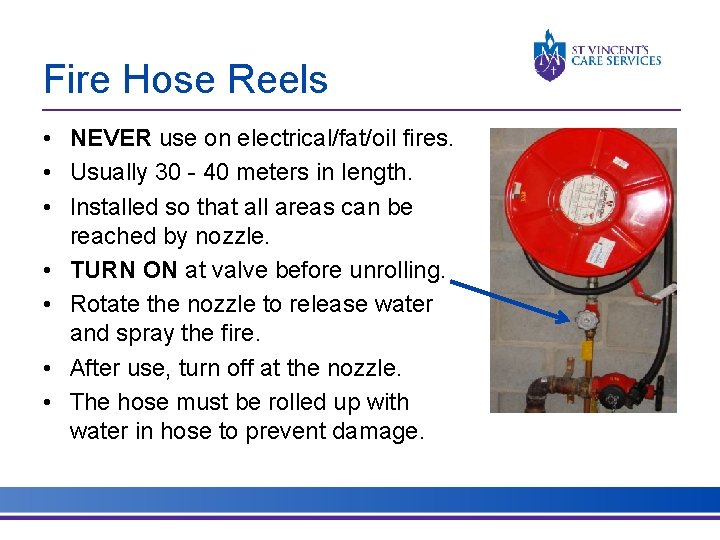
Fire Hose Reels • NEVER use on electrical/fat/oil fires. • Usually 30 - 40 meters in length. • Installed so that all areas can be reached by nozzle. • TURN ON at valve before unrolling. • Rotate the nozzle to release water and spray the fire. • After use, turn off at the nozzle. • The hose must be rolled up with water in hose to prevent damage.
Compartmentation Fire/Smoke Doors • • • Located in corridors and designed to restrict fire/smoke spread. Provides a safe area past the doors. Held open by magnetic devices which release with alarm. If opening is necessary, run hand over surface to check if hot. Smoke doors are rated e. g. 120/120 (fire, heat & smoke cannot penetrate for 120 minutes). Fire Walls • Building divided into fire/smoke compartments. • Also in roof void areas, e. g. duplex unit.
Automatic Alarms and Sprinklers Installed to detect fire/smoke in early stages • Smoke Detectors – Activates alarm when smoke is present. • Thermal Detector – activates alarm when environment is dangerously hot. • Sprinkler systems - activated by the presence of fire so they don’t provide an early response to fire.
Alert & Evacuation Alarms and Public Address System • Most workplaces have a two-stage alarm/alert system, first the alert signal and then the evacuation signal. • The alert tone is a series of 2 - 3 second beeps which runs for around 30 seconds or longer • The evacuation tone is series of whoop, whoop sounds that usually continues until it is manually stopped. • Further alerts and instructions may be given. • These are programmed differently at each site. Local arrangements should be confirmed during orientation and annual evacuation practice. Footnote to go here Page 21
Actions on Alert Activation • On hearing the alert signal (beep, beep), staff should check their areas for fire, smoke or other abnormal situations and then proceed to the Fire Indicator Panel to await instructions (note: local arrangements may differ – e. g. instructions may be broadcast over a public address system if installed). • On hearing the evacuation signal (whoop, whoop), staff should prepare to evacuate and proceed to do so when given instructions. Remember to confirm local arrangements at your site on actions required when alarms are activated. Footnote to go here Page 22
Other Ways of Alerting People of Fire In the event that alarms have not activated, call out: “Code Red, Code Red” or “Fire, Fire” Please be mindful that the calling out of “Fire” may cause panic amongst others. “Code Red” is more discrete and the preferred option. If your colleagues don’t understand or aren’t responding, then call “Fire”. Page 23
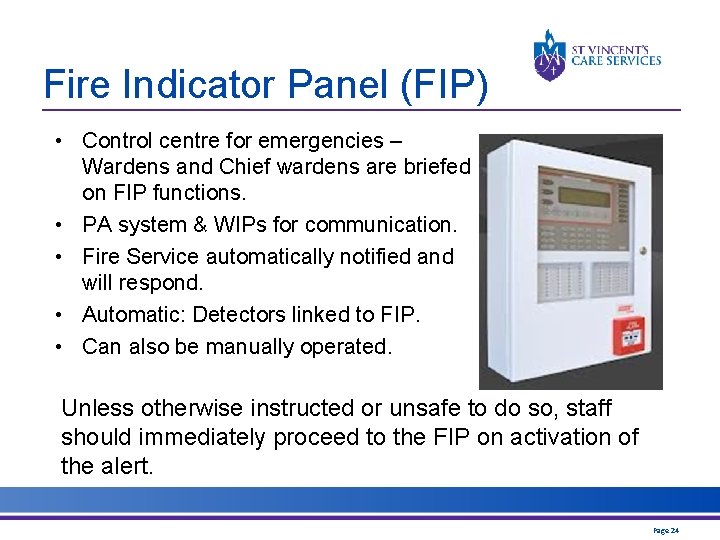
Fire Indicator Panel (FIP) • Control centre for emergencies – Wardens and Chief wardens are briefed on FIP functions. • PA system & WIPs for communication. • Fire Service automatically notified and will respond. • Automatic: Detectors linked to FIP. • Can also be manually operated. Unless otherwise instructed or unsafe to do so, staff should immediately proceed to the FIP on activation of the alert. Page 24
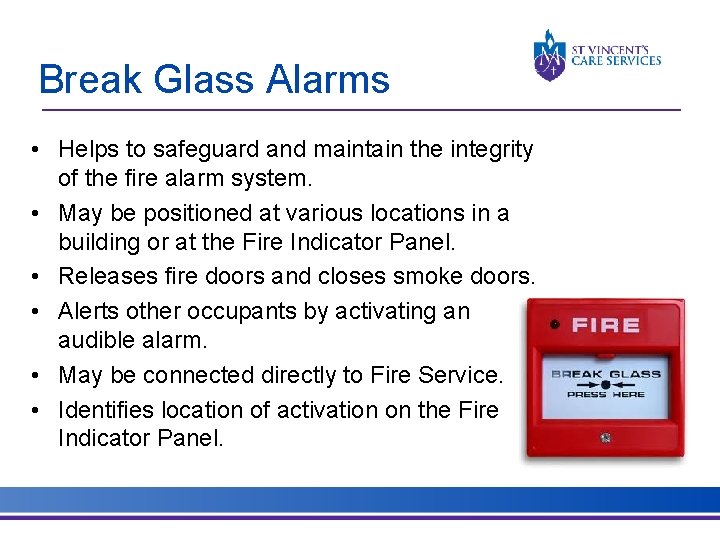
Break Glass Alarms • Helps to safeguard and maintain the integrity of the fire alarm system. • May be positioned at various locations in a building or at the Fire Indicator Panel. • Releases fire doors and closes smoke doors. • Alerts other occupants by activating an audible alarm. • May be connected directly to Fire Service. • Identifies location of activation on the Fire Indicator Panel.
Notifying Emergency Authorities in the event of a Fire Warning System Failure • Fire service authorities are automatically notified when the fire alarms are activated. • If there is a fire and the alarms have not / will not activate, the fire authorities need to be advised by phone immediately. If there is a failure in the automatic fire warning system, the fire service authorities must be contacted immediately by phoning 000 (remember it may be necessary to dial for a line out first if calling from a landline). Page 26
Safety Procedures in the Event of a Fire= R. A. C. E. • Remove (persons from immediate danger if safe to do so) • Alert (inform occupants and alert fire service authorities if necessary) • Confine (the fire and smoke by closing all doors if safe to do so on exit) • Evacuate (to the assembly area)
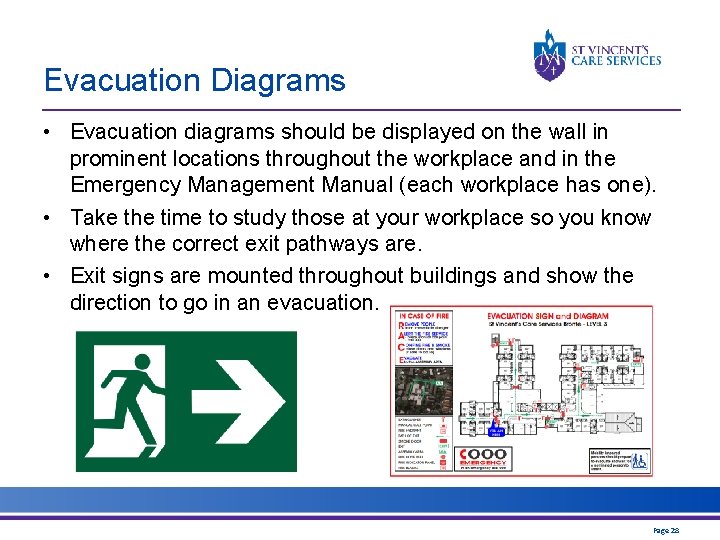
Evacuation Diagrams • Evacuation diagrams should be displayed on the wall in prominent locations throughout the workplace and in the Emergency Management Manual (each workplace has one). • Take the time to study those at your workplace so you know where the correct exit pathways are. • Exit signs are mounted throughout buildings and show the direction to go in an evacuation. Page 28
Evacuation Process Summary (part 1) The Warden or Chief Warden in charge may deem it necessary to undertake a partial of full evacuation of the building to ensure the safety of all occupants. It is essential that everyone cooperates. • Do not carry anything or collect any belongings unless instructed to do so by the Warden or Chief Warden. • Exit the building via the closest safe emergency exit, unless otherwise instructed by Warden or Chief Warden. • Remain calm and encourage others to do so, and do not run. • Ensure other occupants are aware of the alarm. • Guide all visitors not involved in assisting with the evacuation to the designated Evacuation Assembly Point and instruct them to remain there until advised otherwise by the Chief Warden or Fire Officer. Page 29
Evacuation Process Summary (part 2) Assisting with the Evacuation of other building occupants Evacuation of building occupants should be carried out in the following order unless otherwise instructed by the Warden or Chief Warden: 1. Evacuate people in immediate danger 2. Evacuate people who are ambulant 3. Evacuate people who are semi-ambulant 4. Evacuate people who are non-ambulant • Close doors and windows after areas have been checked and evacuate if safe to do so. Mark checked areas with an ‘X’ on the door or place a towel/pillow in front of the door) to show the room is clear. 1. Inform the Warden or Chief Warden to verify status of building occupants and any issues that arose, e. g. persons unable to be evacuated, refusals to evacuate etc. , and their location. Page 30
What You Do Now • Identify the types of fire extinguishers and the location of the fire safety equipment in your workplace. • Identify the exit routes, exit doors and emergency assembly points (check the diagrams posted on the walls). • Confirm with your supervisor, local Fire Warden or Chief Warden what your role is when the alarm is activated. • Complete the assessment.