
First Performance Results of the ALICE TPC RCU

- Slides: 21
First Performance Results of the ALICE TPC RCU 2 Chengxin Zhao University of Oslo, Norway On behalf of the ALICE TPC collaboration Chengxin Zhao TWEPP 2015 - 30 September - Lisbon, Portugal 1
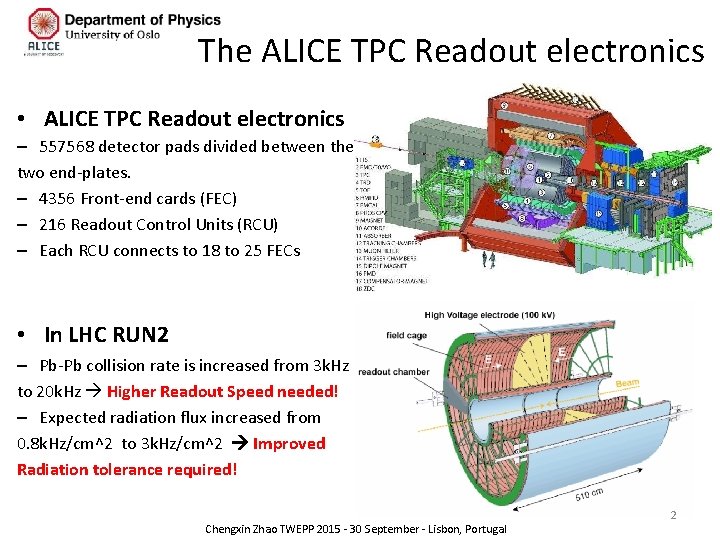
The ALICE TPC Readout electronics • ALICE TPC Readout electronics – 557568 detector pads divided between the two end-plates. – 4356 Front-end cards (FEC) – 216 Readout Control Units (RCU) – Each RCU connects to 18 to 25 FECs • In LHC RUN 2 – Pb-Pb collision rate is increased from 3 k. Hz to 20 k. Hz Higher Readout Speed needed! – Expected radiation flux increased from 0. 8 k. Hz/cm^2 to 3 k. Hz/cm^2 Improved Radiation tolerance required! Chengxin Zhao TWEPP 2015 - 30 September - Lisbon, Portugal 2
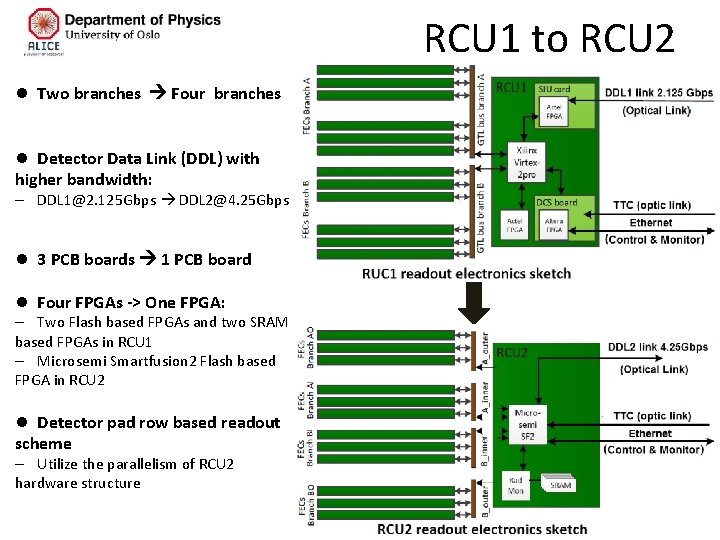
RCU 1 to RCU 2 l Two branches Four branches l Detector Data Link (DDL) with higher bandwidth: – DDL 1@2. 125 Gbps DDL 2@4. 25 Gbps l 3 PCB boards 1 PCB board l Four FPGAs -> One FPGA: – Two Flash based FPGAs and two SRAM based FPGAs in RCU 1 – Microsemi Smartfusion 2 Flash based FPGA in RCU 2 l Detector pad row based readout scheme – Utilize the parallelism of RCU 2 hardware structure 3
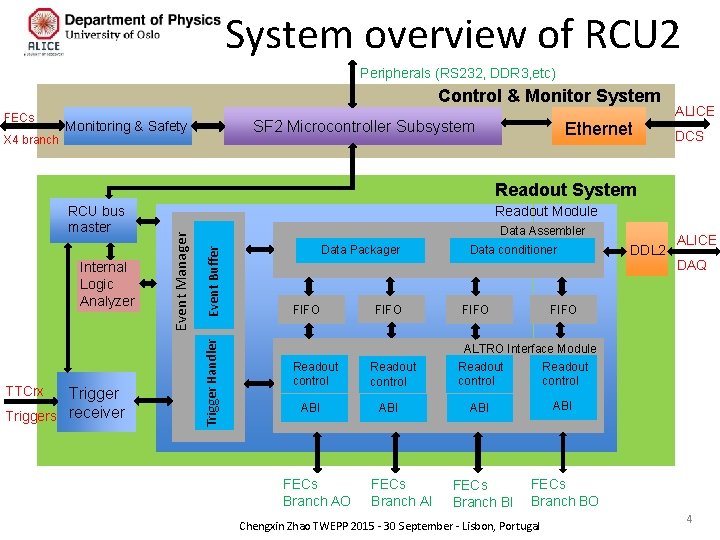
System overview of RCU 2 Peripherals (RS 232, DDR 3, etc) Control & Monitor System FECs X 4 branch SF 2 Microcontroller Subsystem Monitoring & Safety Ethernet ALICE DCS Readout System TTCrx Triggers receiver Event Buffer Data Assembler Trigger Handler Internal Logic Analyzer Readout Module Event Manager RCU bus master Data Packager FIFO Readout control ABI FECs Branch AO S FIFO Readout control ABI FECs Branch AI Data conditioner DDL 2 ALICE DAQ FIFO ALTRO Interface Module Readout control ABI FECs Branch BO Chengxin Zhao TWEPP 2015 - 30 September - Lisbon, Portugal 4
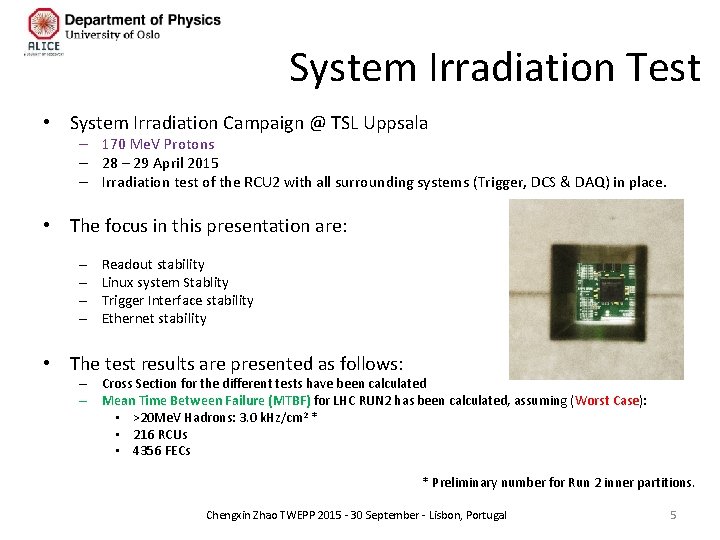
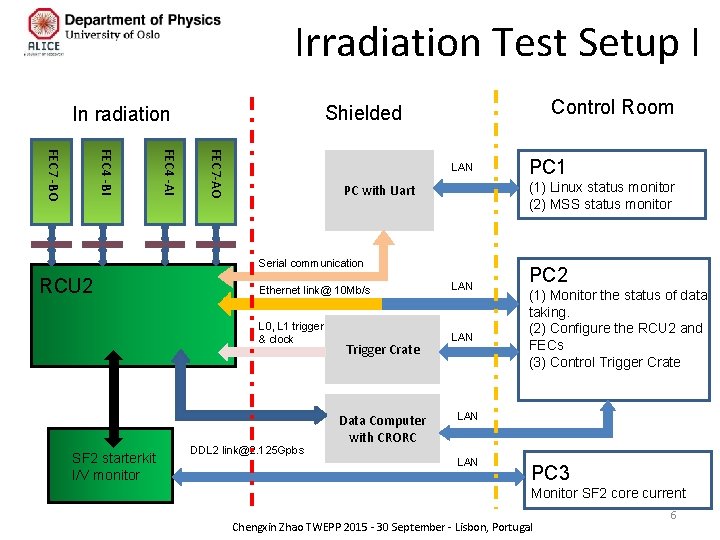
System Irradiation Test • System Irradiation Campaign @ TSL Uppsala – 170 Me. V Protons – 28 – 29 April 2015 – Irradiation test of the RCU 2 with all surrounding systems (Trigger, DCS & DAQ) in place. • The focus in this presentation are: – – Readout stability Linux system Stablity Trigger Interface stability Ethernet stability • The test results are presented as follows: – Cross Section for the different tests have been calculated – Mean Time Between Failure (MTBF) for LHC RUN 2 has been calculated, assuming (Worst Case): • >20 Me. V Hadrons: 3. 0 k. Hz/cm 2 * • 216 RCUs • 4356 FECs * Preliminary number for Run 2 inner partitions. Chengxin Zhao TWEPP 2015 - 30 September - Lisbon, Portugal 5
Irradiation Test Setup I Control Room Shielded In radiation FEC 7 -AO FEC 4 -AI FEC 4 -BI FEC 7 -BO LAN (1) Linux status monitor (2) MSS status monitor PC with Uart Serial communication RCU 2 SF 2 starterkit I/V monitor Ethernet link@ 10 Mb/s LAN L 0, L 1 trigger & clock LAN DDL 2 link@2. 125 Gpbs Trigger Crate Data Computer with CRORC PC 1 PC 2 (1) Monitor the status of data taking. (2) Configure the RCU 2 and FECs (3) Control Trigger Crate LAN PC 3 Monitor SF 2 core current Chengxin Zhao TWEPP 2015 - 30 September - Lisbon, Portugal 6
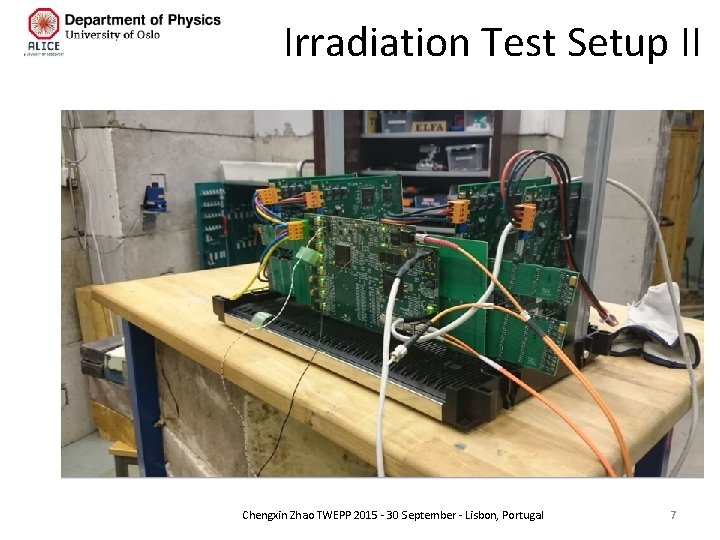
Irradiation Test Setup II Chengxin Zhao TWEPP 2015 - 30 September - Lisbon, Portugal 7
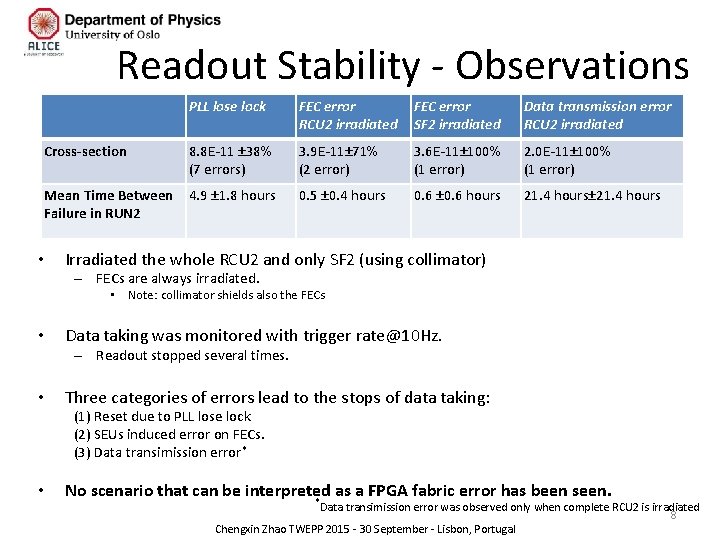
Readout Stability - Observations PLL lose lock FEC error RCU 2 irradiated FEC error SF 2 irradiated Data transmission error RCU 2 irradiated Cross-section 8. 8 E-11 ± 38% (7 errors) 3. 9 E-11± 71% (2 error) 3. 6 E-11± 100% (1 error) 2. 0 E-11± 100% (1 error) Mean Time Between Failure in RUN 2 4. 9 ± 1. 8 hours 0. 5 ± 0. 4 hours 0. 6 ± 0. 6 hours 21. 4 hours± 21. 4 hours • Irradiated the whole RCU 2 and only SF 2 (using collimator) – FECs are always irradiated. • Note: collimator shields also the FECs • Data taking was monitored with trigger rate@10 Hz. – Readout stopped several times. • Three categories of errors lead to the stops of data taking: (1) Reset due to PLL lose lock (2) SEUs induced error on FECs. (3) Data transimission error* • No scenario that can be interpreted as a FPGA fabric error has been seen. *Data transimission error was observed only when complete RCU 2 is irradiated Chengxin Zhao TWEPP 2015 - 30 September - Lisbon, Portugal 8
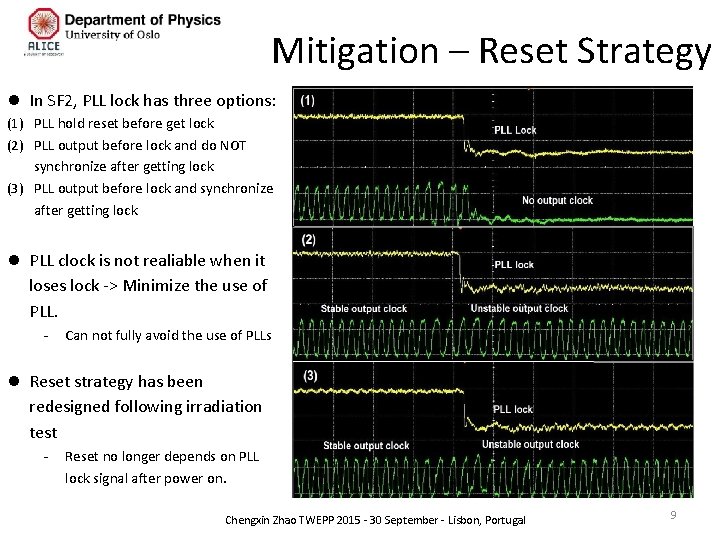
Mitigation – Reset Strategy l In SF 2, PLL lock has three options: (1) PLL hold reset before get lock (2) PLL output before lock and do NOT synchronize after getting lock (3) PLL output before lock and synchronize after getting lock l PLL clock is not realiable when it loses lock -> Minimize the use of PLL. - Can not fully avoid the use of PLLs l Reset strategy has been redesigned following irradiation test - Reset no longer depends on PLL lock signal after power on. Chengxin Zhao TWEPP 2015 - 30 September - Lisbon, Portugal 9
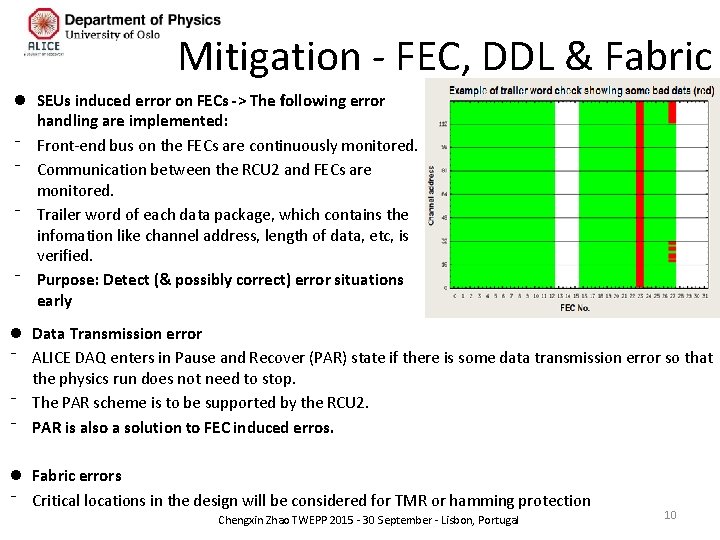
Mitigation - FEC, DDL & Fabric l SEUs induced error on FECs -> The following error handling are implemented: ⁻ Front-end bus on the FECs are continuously monitored. ⁻ Communication between the RCU 2 and FECs are monitored. ⁻ Trailer word of each data package, which contains the infomation like channel address, length of data, etc, is verified. ⁻ Purpose: Detect (& possibly correct) error situations early l Data Transmission error ⁻ ALICE DAQ enters in Pause and Recover (PAR) state if there is some data transmission error so that the physics run does not need to stop. ⁻ The PAR scheme is to be supported by the RCU 2. ⁻ PAR is also a solution to FEC induced erros. l Fabric errors ⁻ Critical locations in the design will be considered for TMR or hamming protection Chengxin Zhao TWEPP 2015 - 30 September - Lisbon, Portugal 10
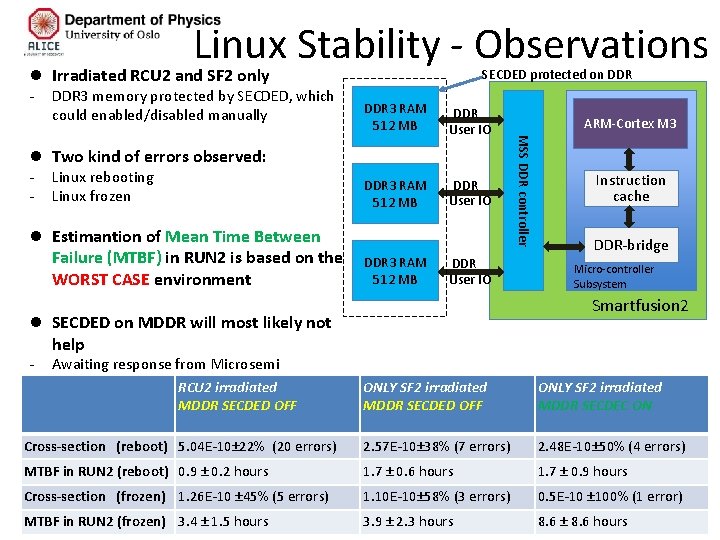
Linux Stability - Observations l Irradiated RCU 2 and SF 2 only - DDR 3 memory protected by SECDED, which could enabled/disabled manually SECDED protected on DDR User IO DDR 3 RAM 512 MB DDR User IO l Two kind of errors observed: - Linux rebooting Linux frozen l Estimantion of Mean Time Between Failure (MTBF) in RUN 2 is based on the WORST CASE environment DDR 3 RAM 512 MB DDR User IO Instruction cache DDR-bridge Micro-controller Subsystem Smartfusion 2 l SECDED on MDDR will most likely not help - ARM-Cortex M 3 MSS DDR controller DDR 3 RAM 512 MB Awaiting response from Microsemi RCU 2 irradiated MDDR SECDED OFF ONLY SF 2 irradiated MDDR SECDEC ON Cross-section (reboot) 5. 04 E-10± 22% (20 errors) 2. 57 E-10± 38% (7 errors) 2. 48 E-10± 50% (4 errors) MTBF in RUN 2 (reboot) 0. 9 ± 0. 2 hours 1. 7 ± 0. 6 hours 1. 7 ± 0. 9 hours Cross-section (frozen) 1. 26 E-10 ± 45% (5 errors) 1. 10 E-10± 58% (3 errors) 0. 5 E-10 ± 100% (1 error) MTBF in RUN 2 (frozen) 3. 4 ± 1. 5 hours 3. 9 ± 2. 3 hours 8. 6 ± 8. 6 hours 11
Linux Stability - Mitigation l Possible reasons of Linux reboots and Linux freeze: - Single-event upsets (SEUs) and multi-bit upsets (MBUs) in the DDR memories which leads to Linux Kernel panic - SEUs (and MBUs) in the ARM processor l Actions taken to improve RCU 2 stability: - Stand-alone module for DDL 2 SERDES initalizing. - Default is initializion by MSS on System boot-up - Configuration of the FECs/ALTROs via the DDL 2 - Ongoing: (1) Exploring Linux replacement - free. RTOS that ONLY resides on the internal e. SRAM in the SF 2 (2) Exploring the proper use of SECDED on MDDR Chengxin Zhao TWEPP 2015 - 30 September - Lisbon, Portugal 12
Some Other Observations • Trigger Reception (TTCrx) is stable: no error was seen • Monitoring and Safety Module is stable: no error seen on RCU 2 side • Ethernet is stable - Two errors observed cross-section = 2. 52 E-11 ± 71%. - Mean Time Between Failure (MTBF) in RUN 2 is 17. 0± 12. 1 hours Chengxin Zhao TWEPP 2015 - 30 September - Lisbon, Portugal 13
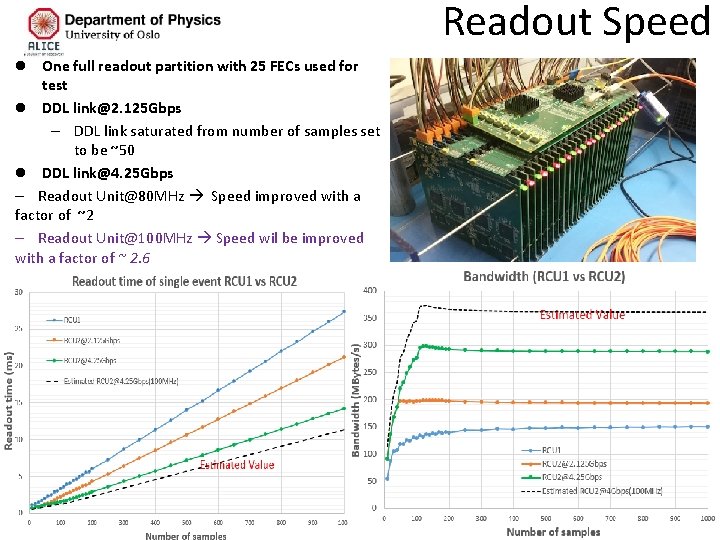
Readout Speed l One full readout partition with 25 FECs used for test l DDL link@2. 125 Gbps – DDL link saturated from number of samples set to be ~50 l DDL link@4. 25 Gbps – Readout Unit@80 MHz Speed improved with a factor of ~2 – Readout Unit@100 MHz Speed wil be improved with a factor of ~ 2. 6 14
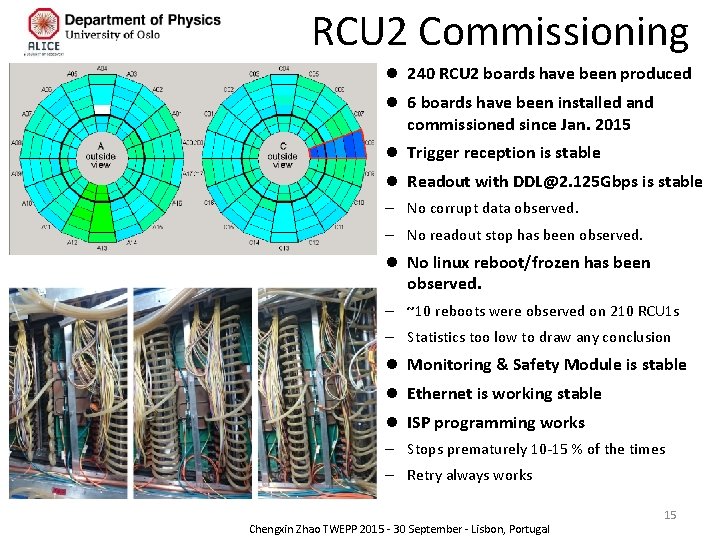
RCU 2 Commissioning l 240 RCU 2 boards have been produced l 6 boards have been installed and commissioned since Jan. 2015 l Trigger reception is stable l Readout with DDL@2. 125 Gbps is stable – No corrupt data observed. – No readout stop has been observed. l No linux reboot/frozen has been observed. – ~10 reboots were observed on 210 RCU 1 s – Statistics too low to draw any conclusion l Monitoring & Safety Module is stable l Ethernet is working stable l ISP programming works – Stops prematurely 10 -15 % of the times – Retry always works Chengxin Zhao TWEPP 2015 - 30 September - Lisbon, Portugal 15
RCU 2 FPGA Design Ongoing l Readout system plans: - Integration and verification of DDL@4. 25 Gbps - Increase the sys clock frequency from 80 MHz to 100 MHz - External Oscillator is 100 MHz – avoid use of PLLs. - Implement data sorting algorithm (for High Level Trigger) - Implement handling of triggers for Multi-Event-Buffering. l Test & benchmark: - Additional benchmark counters and pattern generators at various points in the firmware. Chengxin Zhao TWEPP 2015 - 30 September - Lisbon, Portugal 16
Conclusions • RCU 2 System irradiation campaigns have been performed – It revealed some stability issues, especially regarding Linux and Readout – All the radiation related problems have so far been solved or planned with mitigation actions. • With the DDL 2@4. 25 Gbps and System Clock @100 Mhz, the readout speed will be improved with a factor of ~2. 6 compared to the RCU 1. • The RCU 2 with DDL 2@2. 125 Gbps has been verified to be working stable at TPC. – integration and verificaion of DDL 2@4. 25 Gbps is onging • FPGA Fabric Design is in finalizing phase • Installation is scheduled for the Winter Break (Dec 2015 – March 2016) Chengxin Zhao TWEPP 2015 - 30 September - Lisbon, Portugal 17
Thanks for Listening • RCU 2 team (no particular order): Chengxin Zhao (chengxin. zhao@fys. uio. no ) – University of Oslo, Norway Johan Alme – Bergen University College, Norway Harald Appelshäuser, Torsten Alt, Stefan Kirsch – Goethe University Frankfurt, Germany Lars Bratrud, Jørgen Lien, Rune Langøy – Vestfold University College, Norway Fillipo Costa – CERN, Switzerland Taku Gunji, Yuko Sekiguchi – University of Tokyo, Japan Tivadar Kiss, Ernö David – Cerntech, Budapest, Hungary Christian Lippmann– GSI Darmstadt, Germany Anders Oskarsson, Lennart Osterman – University of Lund, Sweden Ketil Røed – University of Oslo, Norway Attiq Ur Rehman, Kjetil Ullaland, Dieter Röhrich, Shiming Yang, Arild Velure – University of Bergen, Norway Meghan Stuart, Andrew Castro – University of Tennesse Chengxin Zhao TWEPP 2015 - 30 September - Lisbon, Portugal 18
• Backup Slides Chengxin Zhao TWEPP 2015 - 30 September - Lisbon, Portugal 19
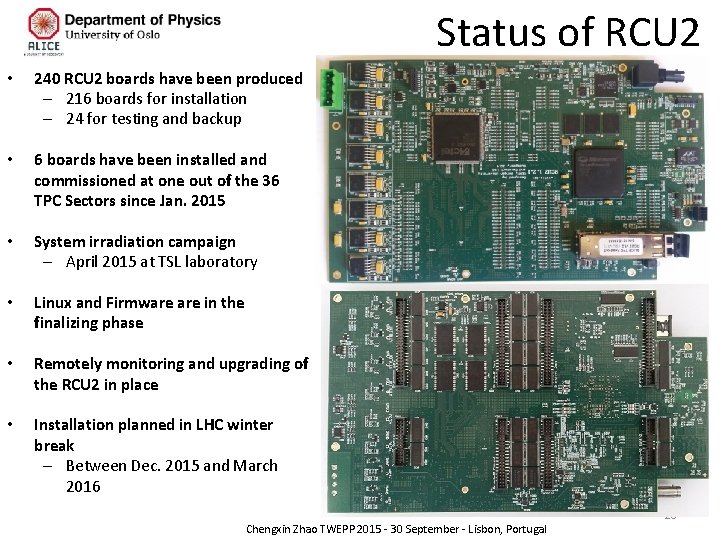
Status of RCU 2 • 240 RCU 2 boards have been produced – 216 boards for installation – 24 for testing and backup • 6 boards have been installed and commissioned at one out of the 36 TPC Sectors since Jan. 2015 • System irradiation campaign – April 2015 at TSL laboratory • Linux and Firmware in the finalizing phase • Remotely monitoring and upgrading of the RCU 2 in place • Installation planned in LHC winter break – Between Dec. 2015 and March 2016 Chengxin Zhao TWEPP 2015 - 30 September - Lisbon, Portugal 20
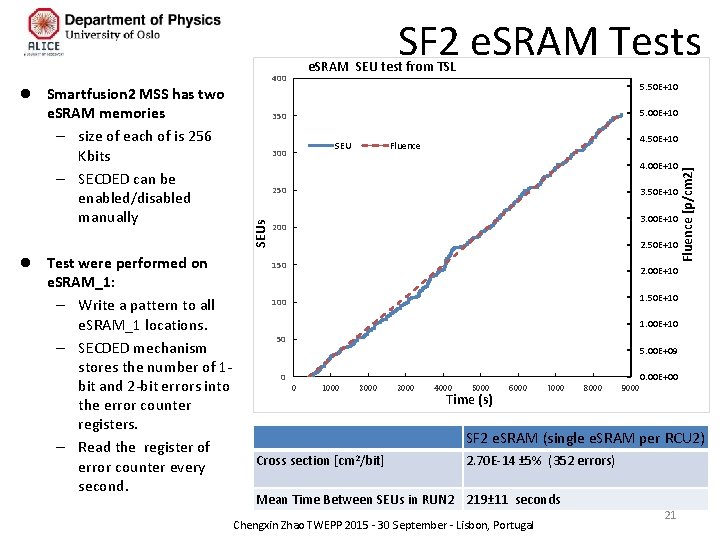
l Test were performed on e. SRAM_1: – Write a pattern to all e. SRAM_1 locations. – SECDED mechanism stores the number of 1 bit and 2 -bit errors into the error counter registers. – Read the register of error counter every second. SEUs l Smartfusion 2 MSS has two e. SRAM memories – size of each of is 256 Kbits – SECDED can be enabled/disabled manually Fluence [p/cm 2] SF 2 e. SRAM Tests Time (s)