
First observation of multigroundwater level responses to the
First observation of multi-groundwater level responses to the strongest worldwide seismicity in Central Apennines (Central Italy). Marino Domenico Barberio 1, Francesca Gori 1, Maurizio Barbieri 1, Andrea Billi 2, Stefania Franchini 1, Marco Petitta 1, and Carlo Doglioni 1, 3 1 Earth Sciences Department, University of Rome “La Sapienza”, P. le Aldo Moro 5, 00185, Rome, Italy 2 IGAG-CNR, Institute for Environmental Geology and Geoengineering, National Research Council, Rome, Italy 3 National Institute of Geophysics and Volcanology, Rome, Italy
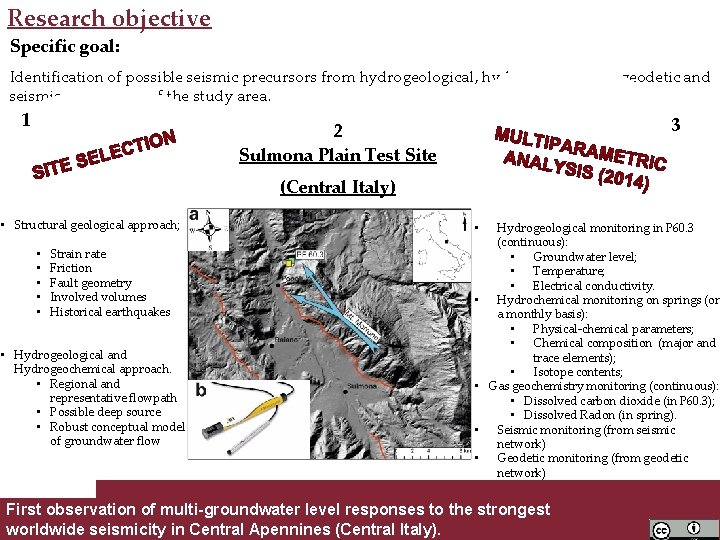
Research objective Specific goal: Identification of possible seismic precursors from hydrogeological, hydrogeochemical, geodetic and seismic monitoring of the study area. 1 3 2 Sulmona Plain Test Site (Central Italy) • Structural geological approach; • • • Strain rate Friction Fault geometry Involved volumes Historical earthquakes • Hydrogeological and Hydrogeochemical approach. • Regional and representative flowpath • Possible deep source • Robust conceptual model of groundwater flow • • • Hydrogeological monitoring in P 60. 3 (continuous): • Groundwater level; • Temperature; • Electrical conductivity. Hydrochemical monitoring on springs (on a monthly basis): • Physical-chemical parameters; • Chemical composition (major and trace elements); • Isotope contents; Gas geochemistry monitoring (continuous): • Dissolved carbon dioxide (in P 60. 3); • Dissolved Radon (in spring). Seismic monitoring (from seismic network) Geodetic monitoring (from geodetic network) First observation of multi-groundwater level responses to the strongest worldwide seismicity in Central Apennines (Central Italy).
Results in: • Barbieri, M. , Boschetti, T. , Barberio, M. D. , Billi, A. , Franchini, S. , Iacumin, P. , . . . & Petitta, M. (2020). Tracing deep fluid source contribution to groundwater in an active seismic area (central Italy): A combined geothermometric and isotopic (δ 13 C) perspective. Journal of Hydrology, 582, 124495. • Boschetti, T. , Barbieri, M. , Barberio, M. D. , Billi, A. , Franchini, S. , & Petitta, M. (2019). CO 2 Inflow and Elements Desorption Prior to a Seismic Sequence, Amatrice‐Norcia 2016, Italy. Geochemistry, Geophysics, Geosystems, 20(5), 2303 -2317. • Barberio, M. , Gori, F. , Barbieri, M. , Billi, A. , Devoti, R. , Doglioni, C. , . . . & Rusi, S. (2018). Diurnal and Semidiurnal Cyclicity of Radon (222 Rn) in Groundwater, Giardino Spring, Central Apennines, Italy. Water, 10(9), 1276. • Petitta, M. ; Mastrorillo, L. ; Preziosi, E. ; Banzato, F. ; Barberio, M. D. ; Billi, A. ; Cambi, C. ; De Luca, G. ; Di Carlo, G. ; Di Curzio, D. ; et al. Water‐table and discharge changes associated with the 2016– 2017 seismic sequence in central Italy: Hydrogeological data and a conceptual model for fractured carbonate aquifers. Hydrogeol. J. 2018, 26, 1– 18. • Barberio, M. D. , Barbieri, M. , Billi, A. , Doglioni, C. , Petitta, M. , 2017. Hydrogeochemical changes before and during the 2016 Amatrice‐Norcia seismic sequence (central Italy). Scientific Reports 7. doi: 10. 1038/s 41598017 -11990 -8 • Barberio MD, Billi A, Doglioni C, Lacchini A, Marinelli V, Petitta M (2016) Hydrogeological monitoring to assess possible pre‐seismic correlations of groundwater changes with seismic activity in central Italy. Rend Online Soc Geol It 41: 338– 341. https: //doi. org/10. 3301/ ROL. 2016. 162 First observation of multi-groundwater level responses to the strongest worldwide seismicity in Central Apennines (Central Italy).
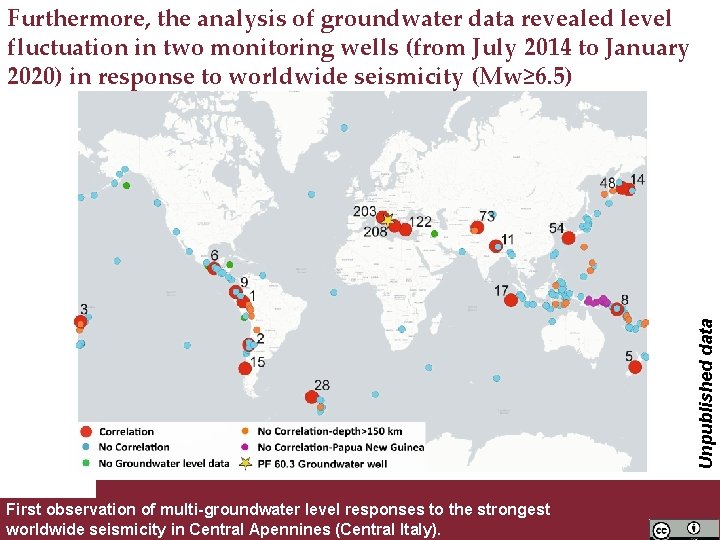
Unpublished data Furthermore, the analysis of groundwater data revealed level fluctuation in two monitoring wells (from July 2014 to January 2020) in response to worldwide seismicity (Mw≥ 6. 5) First observation of multi-groundwater level responses to the strongest worldwide seismicity in Central Apennines (Central Italy).
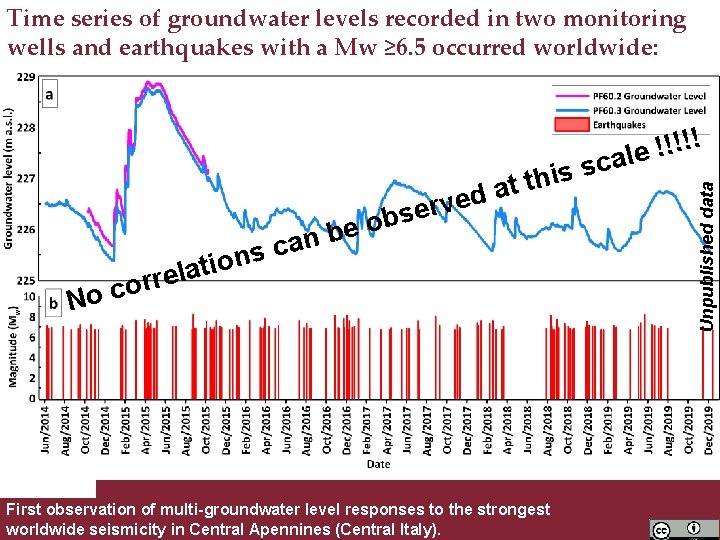
Time series of groundwater levels recorded in two monitoring wells and earthquakes with a Mw ≥ 6. 5 occurred worldwide: l e r r o oc N First observation of multi-groundwater level responses to the strongest worldwide seismicity in Central Apennines (Central Italy). Unpublished data e b n ca s n atio d e v r obse c s s i at th ! ! ! ale
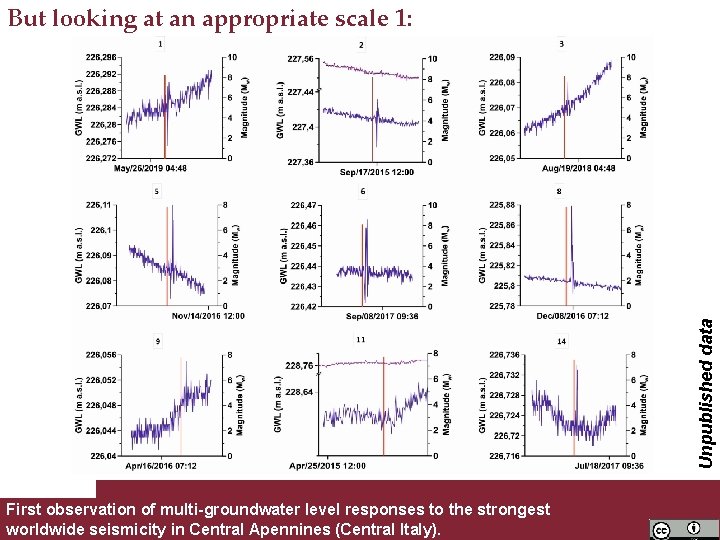
Unpublished data But looking at an appropriate scale 1: First observation of multi-groundwater level responses to the strongest worldwide seismicity in Central Apennines (Central Italy).
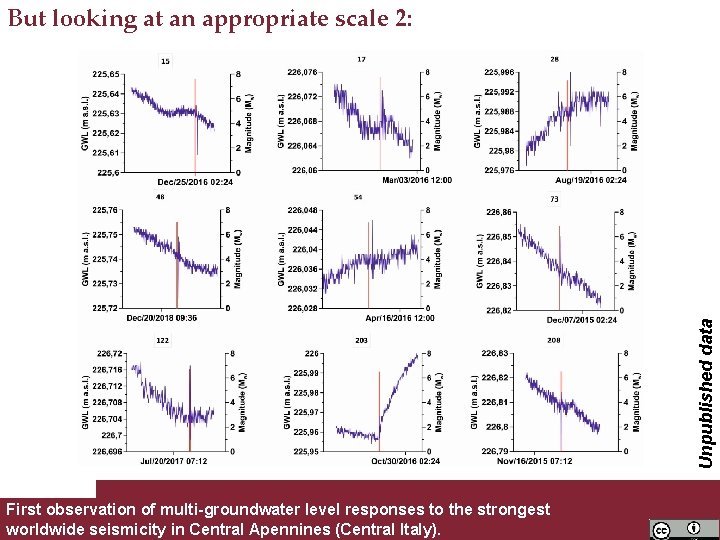
Unpublished data But looking at an appropriate scale 2: First observation of multi-groundwater level responses to the strongest worldwide seismicity in Central Apennines (Central Italy).
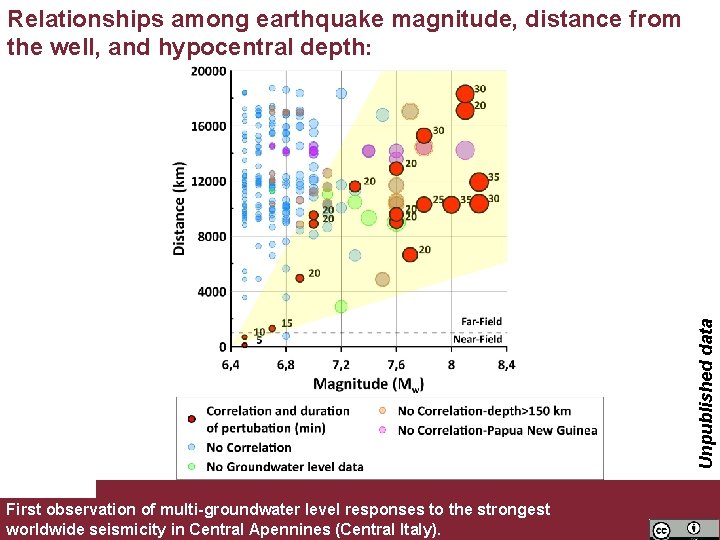
Unpublished data Relationships among earthquake magnitude, distance from the well, and hypocentral depth: First observation of multi-groundwater level responses to the strongest worldwide seismicity in Central Apennines (Central Italy).
Conclusions: The PF 60. 3 monitoring well allowed us to identify groundwater level fluctuations related to the passage of Rayleigh seismic waves deriving from 18 distant earthquakes; Oscillations induced by teleseismic waves are clearly recognizable respect with classical water table changes correlated with the hydrogeological cycle and/or human induced changes; Peculiar responses of the monitoring well PF 60. 3 highlight for the umpteenth time the potential sensitivity of the fractured aquifers to the strain variation in pre-selected hydrogeological conditions. The characterization and identification of teleseism effects on these monitoring stations are a pre-requisite for a correct recognition of near-field seismic effects. This recognition is possible due to a typical impulsive peaklike response of the groundwater level to strong teleseisms that is markedly different from that driven by near-field earthquakes. First observation of multi-groundwater level responses to the strongest worldwide seismicity in Central Apennines (Central Italy).
- Slides: 9