
First observation of induction acceleration in the KEK
First observation of induction acceleration in the KEK Proton Synchrotron November 8 -11, 2004 CARE HHH 2004, CERN Ken Takayama Accelerator Laboratory, KEK with many thanks for contributions from K. Koseki, K. Torikai, E. Nakamura, Y. Shimosaki, Y. Arakida, T. Kono, D. Arakawa, S. Igarashi, T. Iwashita, S. Ninomiya, H. Sato, M. Shirakata, T. Sueno, T. Toyama, M. Wake, and I. Yamane, KEK A. Tokuchi and A. Kawasaki, Nichicon (Kusatsu) J. Kishiro, M. Watanabe, and M. Shiho, JAERI K. Horioka and M. Nakajima, Tokyo Institute of Technology (TIT) A. Tokuchi and A. Kawasaki, Nichicon (Kusatsu) Co. M. Sakuda, Okayama University
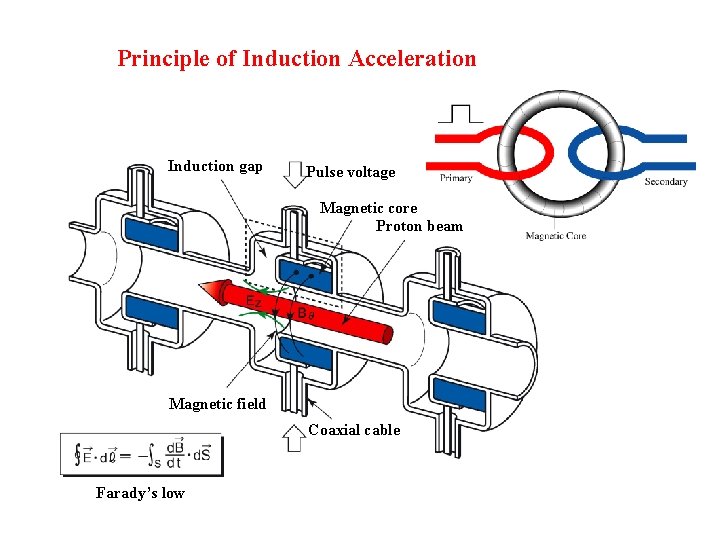
Principle of Induction Acceleration Induction gap Pulse voltage Magnetic core Proton beam Magnetic field Coaxial cable ファラデ イーの誘導法則 Farady’s low
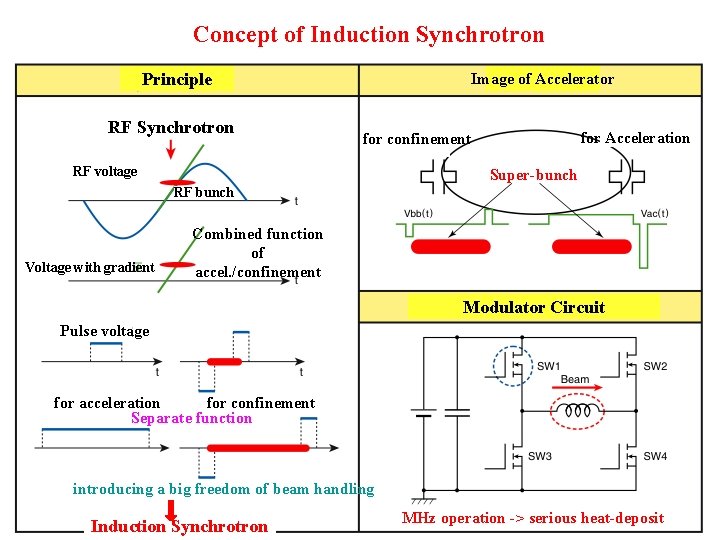
Concept of Induction Synchrotron Principle RF Synchrotron Image of Accelerator for Acceleration for confinement RF voltage Super-bunch RF bunch Voltage with gradient Combined function of accel. /confinement Modulator Circuit Pulse voltage for acceleration for confinement Separate function introducing a big freedom of beam handling Induction Synchrotron MHz operation -> serious heat-deposit
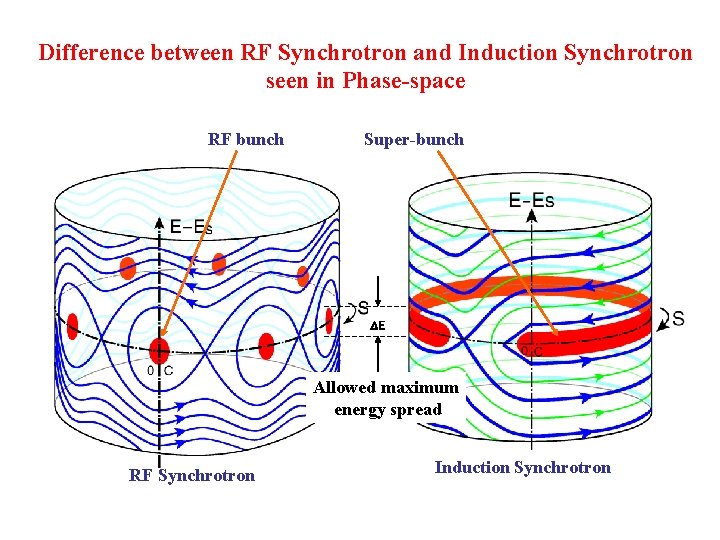
Difference between RF Synchrotron and Induction Synchrotron seen in Phase-space RF bunch Super-bunch DE Allowed maximum energy spread RF Synchrotron Induction Synchrotron
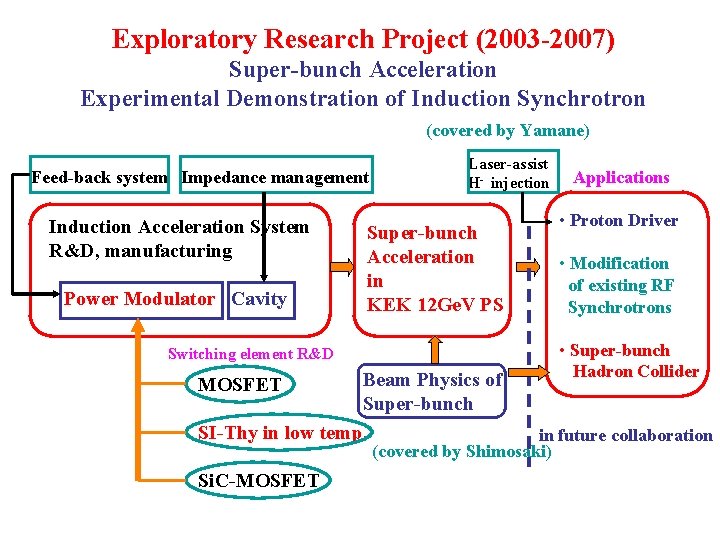
Exploratory Research Project (2003 -2007) Super-bunch Acceleration Experimental Demonstration of Induction Synchrotron (covered by Yamane) Feed-back system Impedance management Induction Acceleration System R&D, manufacturing Power Modulator Cavity Laser-assist H- injection Super-bunch Acceleration in KEK 12 Ge. V PS Switching element R&D Beam Physics of Super-bunch SI-Thy in low temp. MOSFET Applications • Proton Driver • Modification of existing RF Synchrotrons • Super-bunch Hadron Collider in future collaboration (covered by Shimosaki) Si. C-MOSFET

Funding Outline K$ Including Postdoc/technician’s salary but does not include salary of staffs
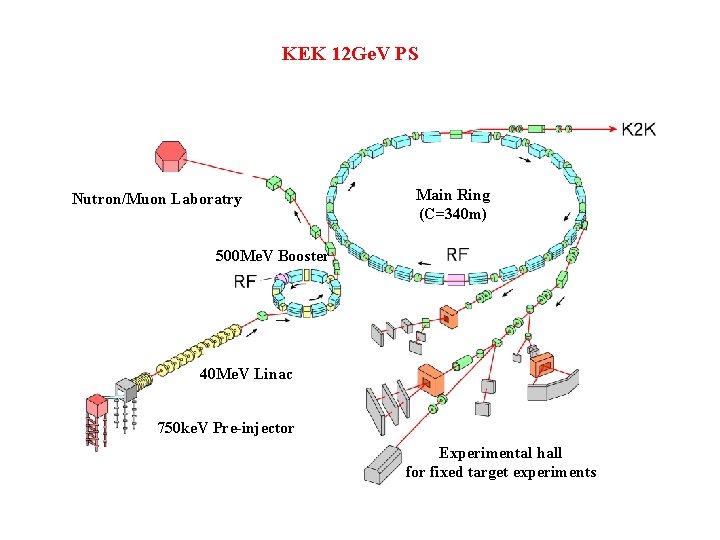
KEK 12 Ge. V PS Nutron/Muon Laboratry Main Ring (C=340 m) 500 Me. V Booster 40 Me. V Linac 750 ke. V Pre-injector Experimental hall for fixed target experiments
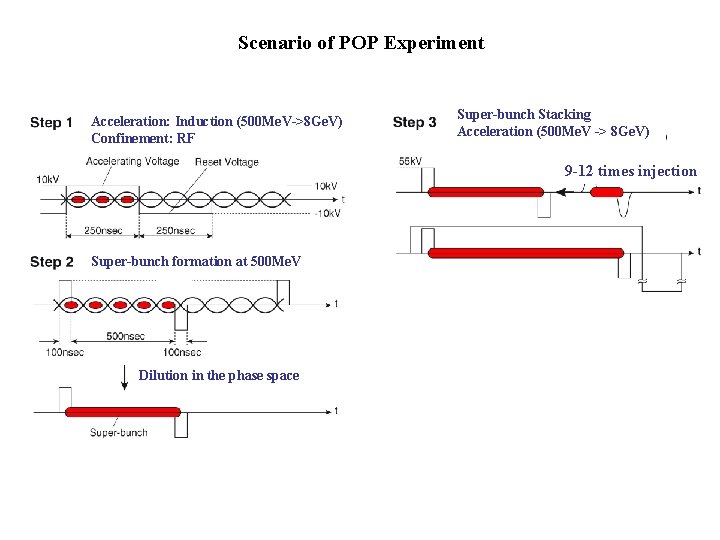
Scenario of POP Experiment Acceleration: Induction (500 Me. V->8 Ge. V) Confinement: RF Super-bunch Stacking Acceleration (500 Me. V -> 8 Ge. V) 9 -12 times injection Super-bunch formation at 500 Me. V Dilution in the phase space
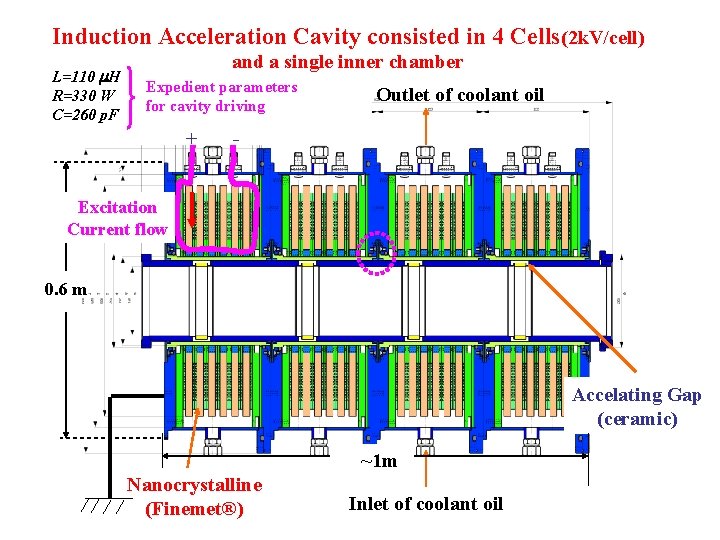
Induction Acceleration Cavity consisted in 4 Cells(2 k. V/cell) L=110 m. H R=330 W C=260 p. F and a single inner chamber Expedient parameters for cavity driving + Outlet of coolant oil - Excitation Current flow 0. 6 m Accelating Gap (ceramic) ~1 m Nanocrystalline (Finemet®) Inlet of coolant oil
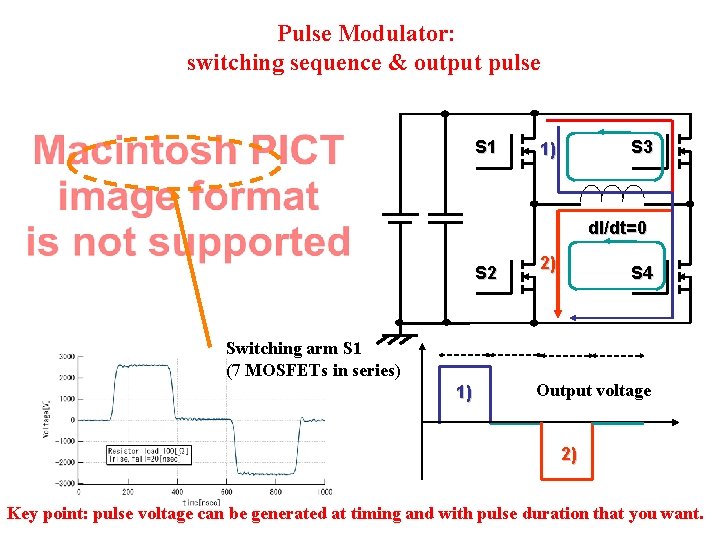
Pulse Modulator: switching sequence & output pulse S 1 S 3 1) d. I/dt=0 S 2 2) S 4 Switching arm S 1 (7 MOSFETs in series) 1) Output voltage 2) Key point: pulse voltage can be generated at timing and with pulse duration that you want.
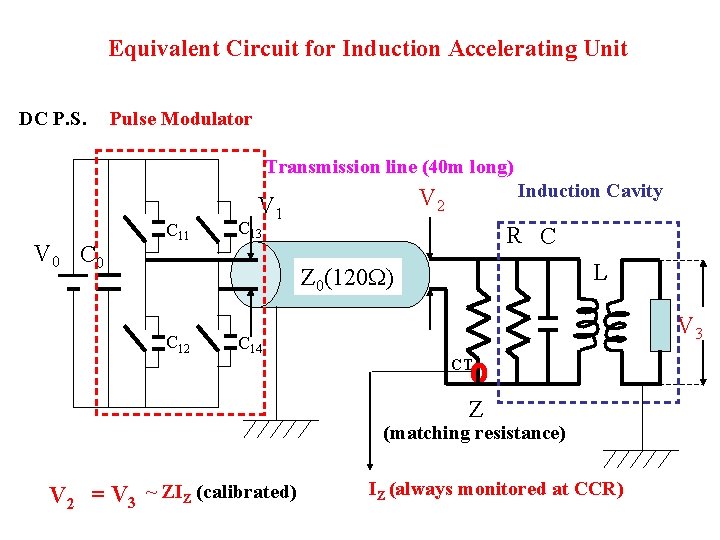
Equivalent Circuit for Induction Accelerating Unit DC P. S. Pulse Modulator Transmission line (40 m long) V 0 C 11 Induction Cavity V 2 V 1 C 13 R C L Z 0(120 W) C 12 C 14 V 3 CT Z (matching resistance) V 2 = V 3 ~ ZIZ (calibrated) IZ (always monitored at CCR)

KEK PS Accelerator Complex & Induction Accelerating System Pulse Modulator Main Trigger Generator at CCR Induction Cavity (3 cells) Induction Cavity 12 Ge. V PS MR 500 Me. V Booster 40 Me. V Linac DC power Supply
Induction Accelerating Voltages of 3 cells at CW 1 MHz operation (1) 10 msec
Induction Accelerating Voltages of 3 cells at CW 1 MHz operation (2) 1 msec 250 nsec for acceleration
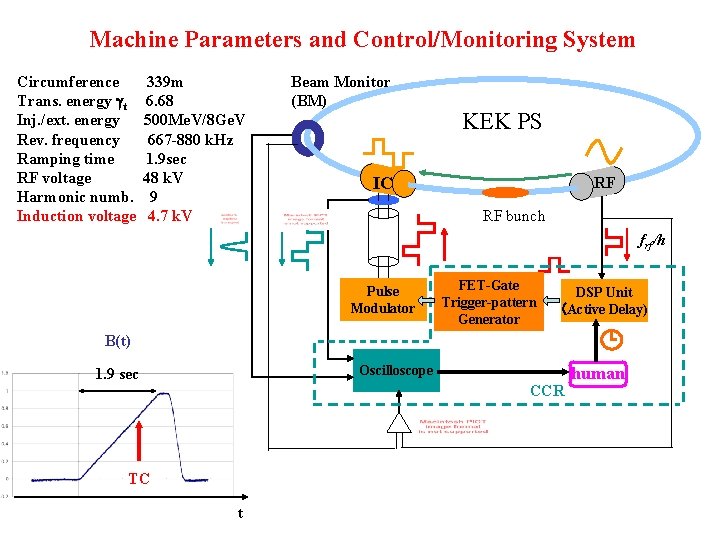
Machine Parameters and Control/Monitoring System Circumference Trans. energy gt Inj. /ext. energy Rev. frequency Ramping time RF voltage Harmonic numb. Induction voltage 339 m 6. 68 500 Me. V/8 Ge. V 667 -880 k. Hz 1. 9 sec 48 k. V 9 4. 7 k. V Beam Monitor (BM) KEK PS IC RF RF bunch frf/h Pulse Modulator FET-Gate Trigger-pattern Generator DSP Unit (Active Delay) B(t) Oscilloscope 1. 9 sec CCR TC t human
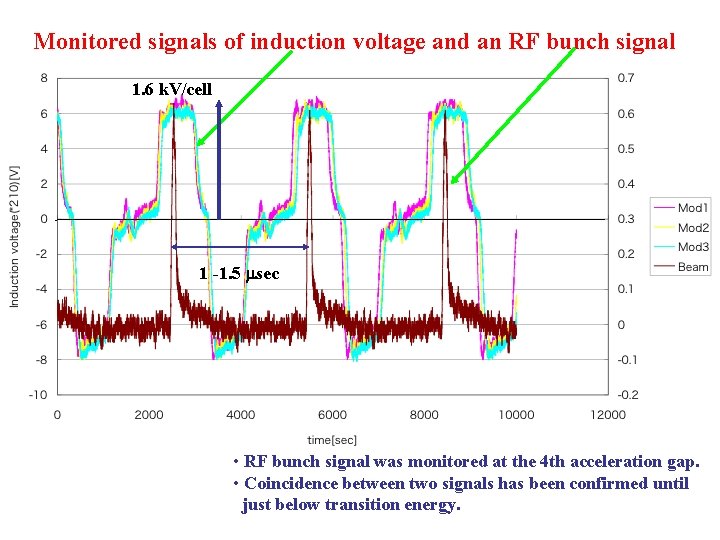
Monitored signals of induction voltage and an RF bunch signal 1. 6 k. V/cell 1 -1. 5 msec • RF bunch signal was monitored at the 4 th acceleration gap. • Coincidence between two signals has been confirmed until just below transition energy.
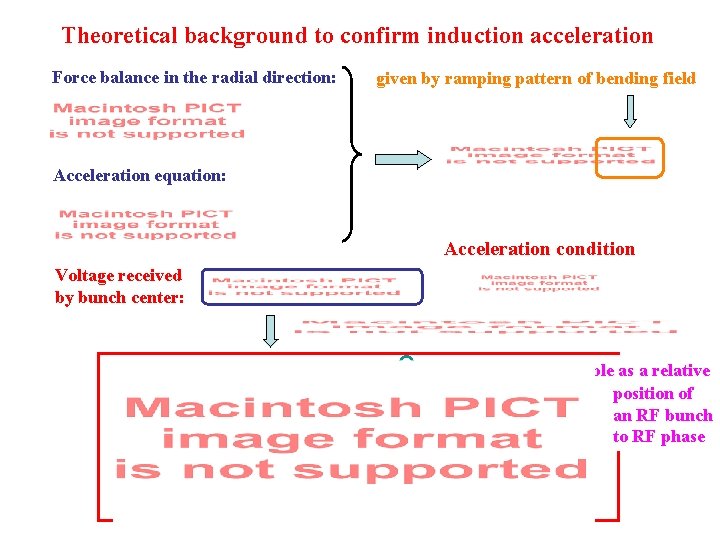
Theoretical background to confirm induction acceleration Force balance in the radial direction: given by ramping pattern of bending field Acceleration equation: Acceleration condition Voltage received by bunch center: observable as a relative position of an RF bunch to RF phase
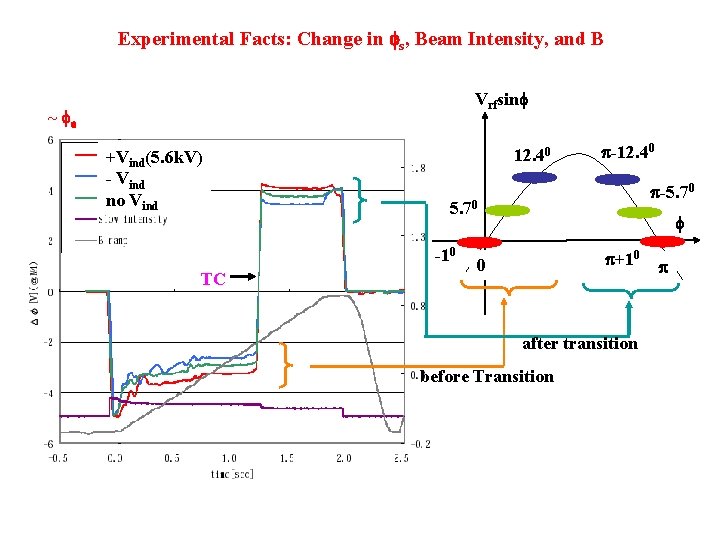
Experimental Facts: Change in fs, Beam Intensity, and B Vrfsinf ~ fs +Vind(5. 6 k. V) - Vind no Vind 12. 40 p-5. 70 -10 TC p-12. 40 f p+10 0 after transition before Transition p

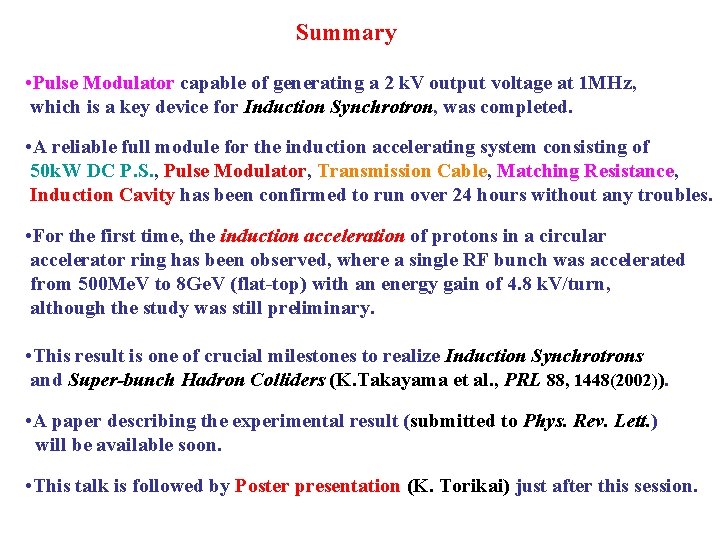
Summary • Pulse Modulator capable of generating a 2 k. V output voltage at 1 MHz, which is a key device for Induction Synchrotron, was completed. • A reliable full module for the induction accelerating system consisting of 50 k. W DC P. S. , Pulse Modulator, Transmission Cable, Matching Resistance, Induction Cavity has been confirmed to run over 24 hours without any troubles. • For the first time, the induction acceleration of protons in a circular accelerator ring has been observed, where a single RF bunch was accelerated from 500 Me. V to 8 Ge. V (flat-top) with an energy gain of 4. 8 k. V/turn, although the study was still preliminary. • This result is one of crucial milestones to realize Induction Synchrotrons and Super-bunch Hadron Colliders (K. Takayama et al. , PRL 88, 1448(2002)). • A paper describing the experimental result (submitted to Phys. Rev. Lett. ) will be available soon. • This talk is followed by Poster presentation (K. Torikai) just after this session.

Appendix
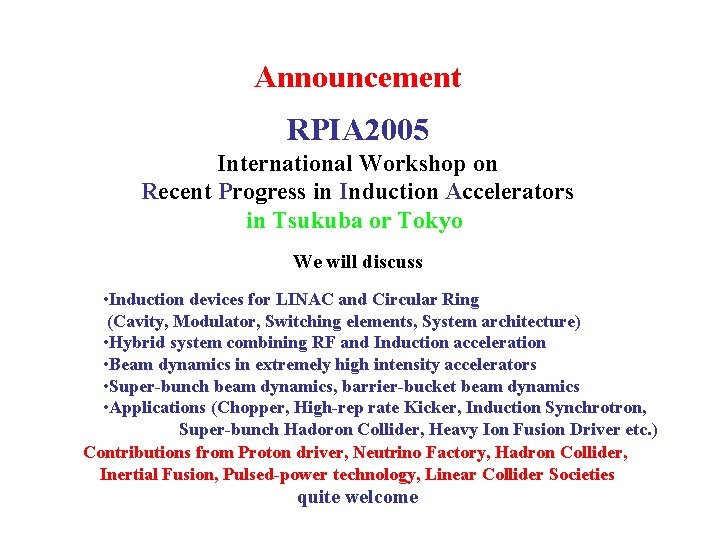
Announcement RPIA 2005 International Workshop on Recent Progress in Induction Accelerators in Tsukuba or Tokyo We will discuss • Induction devices for LINAC and Circular Ring (Cavity, Modulator, Switching elements, System architecture) • Hybrid system combining RF and Induction acceleration • Beam dynamics in extremely high intensity accelerators • Super-bunch beam dynamics, barrier-bucket beam dynamics • Applications (Chopper, High-rep rate Kicker, Induction Synchrotron, Super-bunch Hadoron Collider, Heavy Ion Fusion Driver etc. ) Contributions from Proton driver, Neutrino Factory, Hadron Collider, Inertial Fusion, Pulsed-power technology, Linear Collider Societies quite welcome
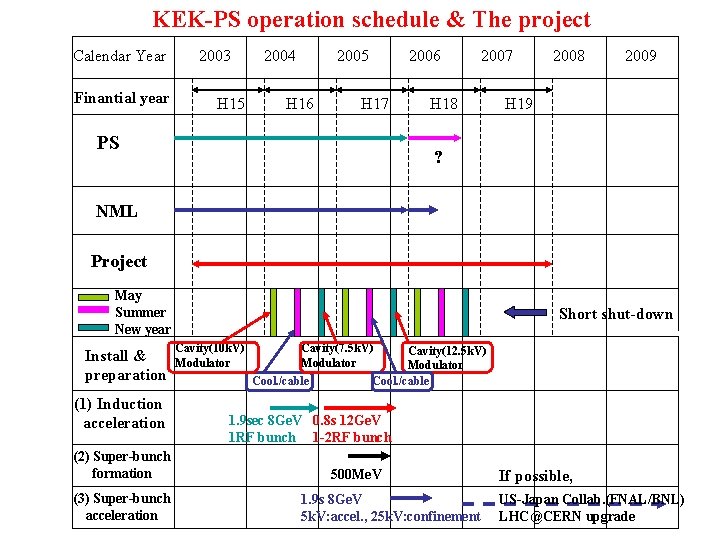
KEK-PS operation schedule & The project Calendar Year Finantial year 2003 H 15 2004 2005 H 16 H 17 PS 2006 2007 H 18 2009 H 19 ? NML Project May Summer New year Install & preparation (1) Induction acceleration (2) Super-bunch formation (3) Super-bunch acceleration Short shut-down Cavity(10 k. V) Modulator Cavity(7. 5 k. V) Cavity(12. 5 k. V) Modulator Cool. /cable 1. 9 sec 8 Ge. V 0. 8 s 12 Ge. V 1 RF bunch 1 -2 RF bunch 500 Me. V 1. 9 s 8 Ge. V 5 k. V: accel. , 25 k. V: confinement If possible, US-Japan Collab. (FNAL/BNL) LHC@CERN upgrade
- Slides: 23