
First Nations Municipal Community Economic Development Initiative CEDI

- Slides: 22
First Nations – Municipal Community Economic Development Initiative (CEDI) Presentation to Community Gathering A Joint Initiative of April 30 th 2015
Implementing Organizations • • • National voice of municipal governments in Canada since 1901 2, 000 municipalities are members > 90% of Canadian population Mandate to convene, listen, unite National and international programs including First Nations – Municipal Community Infrastructure Partnership Program (CIPP) Priorities include Infrastructure, CED, Housing, Env Sustainability Based in Ottawa, ON • Council for the Advancement of Native Development Officers • National, membership-based, nonprofit Aboriginal organization and voice of Aboriginal community economic development • Trains, certifies and provides support services and resources to Economic Development Officers working in Aboriginal communities across Canada • Based in Edmonton, AB 2
FCM-Cando First Nations – Municipal Programming Community Economic Development Initiative (CEDI) • Jointly implemented by FCM and Cando • Builds capacity for First Nations and adjacent municipalities to engage in joint CED planning and projects • Pilot phase 2013 -2016 • 6 pilot partnerships: 9 municipalities, 7 First Nations • Toolkit under development (Summer 2015) Community Infrastructure Partnership Program (CIPP) • Implemented by FCM • Focus on relationship building & development of joint First Nation – municipal water and sewage service agreements • Phase I & II 2010 -2014 one- off workshops • Phase III 2014 -2016 working intensely with 6 community pairs • Service Agreement Toolkit online at fcm. ca/cipp 3
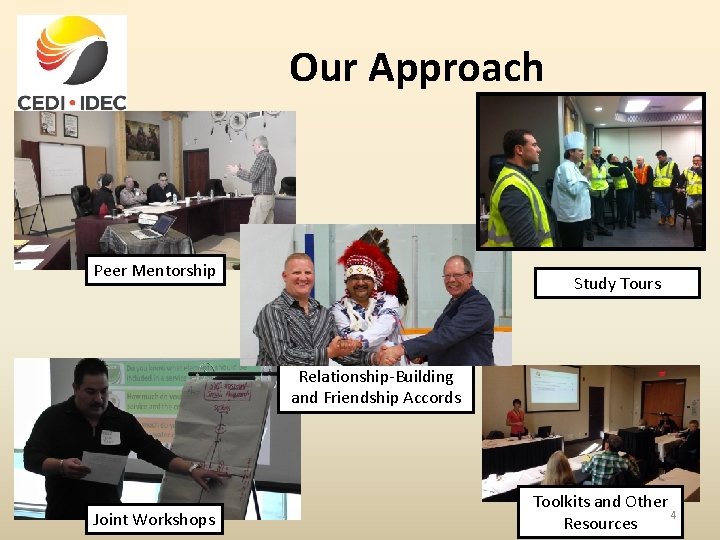
Our Approach Peer Mentorship Study Tours Relationship-Building and Friendship Accords Joint Workshops Toolkits and Other 4 Resources
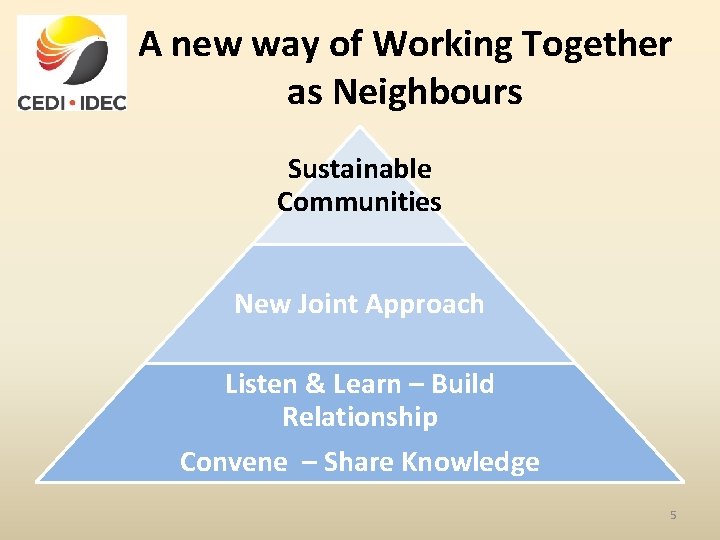
A new way of Working Together as Neighbours Sustainable Communities New Joint Approach Listen & Learn – Build Relationship Convene – Share Knowledge 5
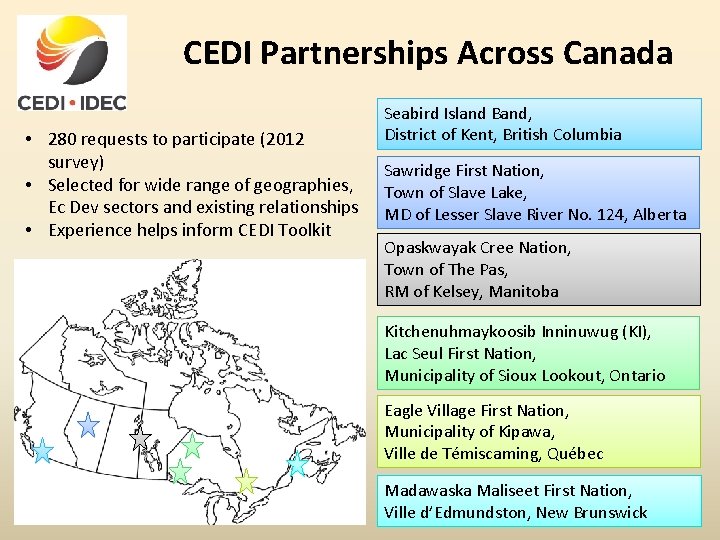
CEDI Partnerships Across Canada • 280 requests to participate (2012 survey) • Selected for wide range of geographies, Ec Dev sectors and existing relationships • Experience helps inform CEDI Toolkit Seabird Island Band, District of Kent, British Columbia Sawridge First Nation, Town of Slave Lake, MD of Lesser Slave River No. 124, Alberta Opaskwayak Cree Nation, Town of The Pas, RM of Kelsey, Manitoba Kitchenuhmaykoosib Inninuwug (KI), Lac Seul First Nation, Municipality of Sioux Lookout, Ontario Eagle Village First Nation, Municipality of Kipawa, Ville de Témiscaming, Québec Madawaska Maliseet First Nation, Ville d’Edmundston, New Brunswick
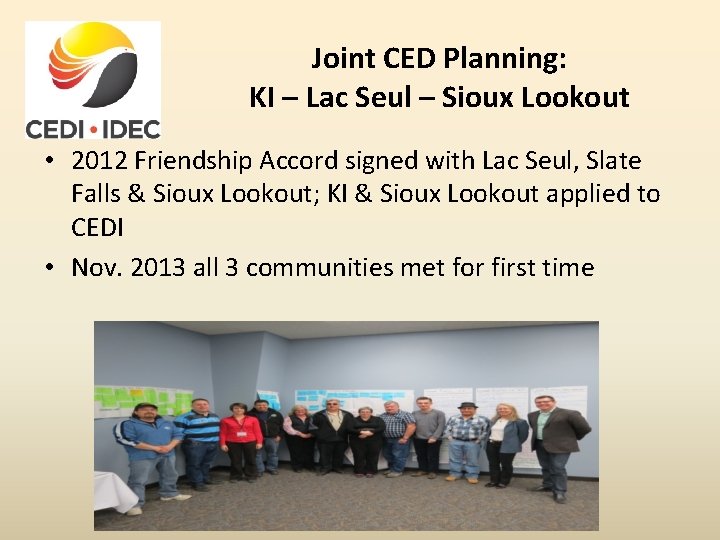
Joint CED Planning: KI – Lac Seul – Sioux Lookout • 2012 Friendship Accord signed with Lac Seul, Slate Falls & Sioux Lookout; KI & Sioux Lookout applied to CEDI • Nov. 2013 all 3 communities met for first time
Joint CED Planning: KI – Lac Seul – Sioux Lookout • January 2014 – all 3 councils passed resolutions and formed joint working group with elected officials and ec-dev staff from each of 3 communities to move initiative forward • April 2014 – CEDI planning workshop - decided on joint project of RDC • May 2014 – EDOs set-up monthly meetings to move project forward and prepare joint proposal • June 2014 – Mayor of SL and Chief of LS speak at FCM conference about the relationship they have built and their joint initiative with KI
Joint CED Planning: KI – Lac Seul – Sioux Lookout • September 2014 – developed joint terms of reference for the project team (EDOs, elected officials and key stakeholders) and joint proposal developed and submitted to funders • September 2014 – joint FN –Muni ec-dev conference ‘Ke-ondaatiziying’ conference’ signed CEDI contribution agreement ; • October 2014 – joint study tour to Sysco Food Systems in Winnipeg for learning on food distribution • December 2014 – joint rfp and tors created and circulated for feasibility study and coordinator
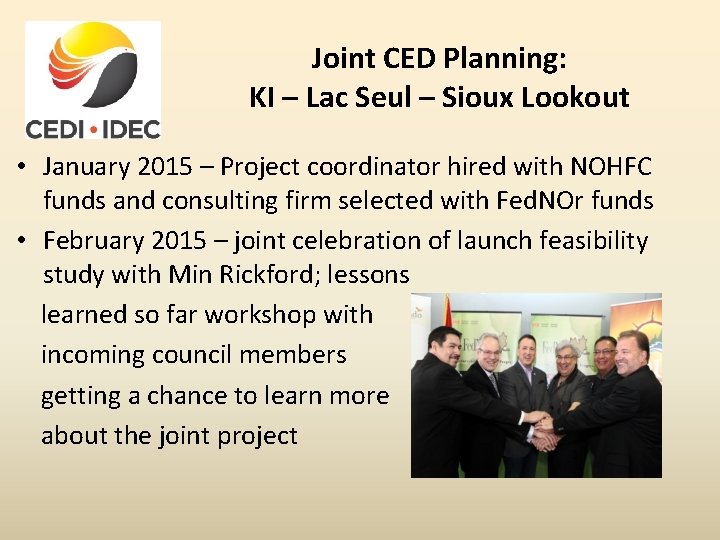
Joint CED Planning: KI – Lac Seul – Sioux Lookout • January 2015 – Project coordinator hired with NOHFC funds and consulting firm selected with Fed. NOr funds • February 2015 – joint celebration of launch feasibility study with Min Rickford; lessons learned so far workshop with incoming council members getting a chance to learn more about the joint project
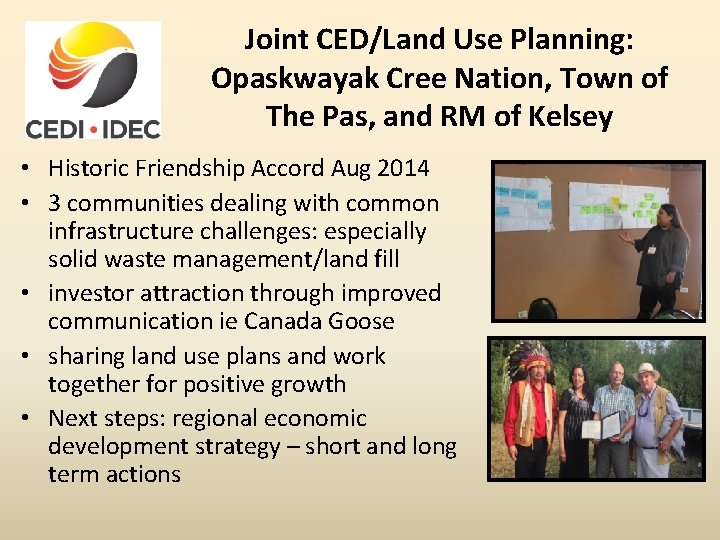
Joint CED/Land Use Planning: Opaskwayak Cree Nation, Town of The Pas, and RM of Kelsey • Historic Friendship Accord Aug 2014 • 3 communities dealing with common infrastructure challenges: especially solid waste management/land fill • investor attraction through improved communication ie Canada Goose • sharing land use plans and work together for positive growth • Next steps: regional economic development strategy – short and long term actions
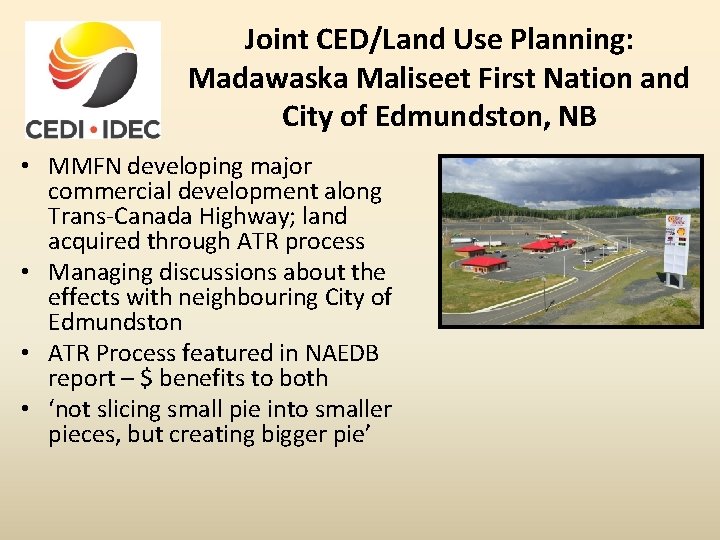
Joint CED/Land Use Planning: Madawaska Maliseet First Nation and City of Edmundston, NB • MMFN developing major commercial development along Trans-Canada Highway; land acquired through ATR process • Managing discussions about the effects with neighbouring City of Edmundston • ATR Process featured in NAEDB report – $ benefits to both • ‘not slicing small pie into smaller pieces, but creating bigger pie’
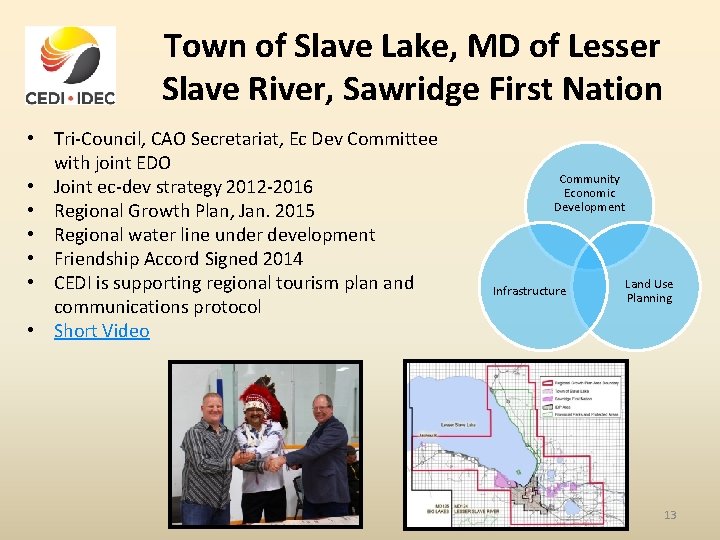
Town of Slave Lake, MD of Lesser Slave River, Sawridge First Nation • Tri-Council, CAO Secretariat, Ec Dev Committee with joint EDO • Joint ec-dev strategy 2012 -2016 • Regional Growth Plan, Jan. 2015 • Regional water line under development • Friendship Accord Signed 2014 • CEDI is supporting regional tourism plan and communications protocol • Short Video Community Economic Development Infrastructure Land Use Planning 13
CEDI Results to Date: Highlights • All 6 partnerships have a relationship agreement in place • Relationship agreements have led to investor attraction / awareness • 2 partnerships have leveraged provincial/federal funding • Each partnership has identified a joint CED project / strategy • Partnerships now have processe mechanisms in place for long term collaboration
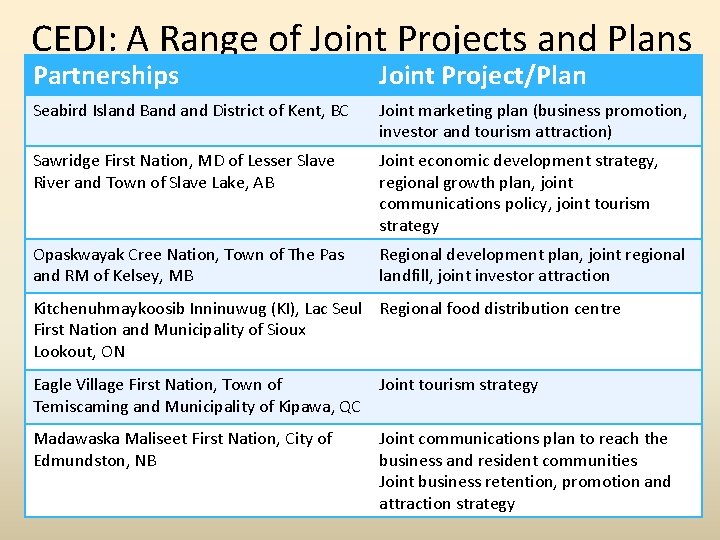
CEDI: A Range of Joint Projects and Plans Partnerships Joint Project/Plan Seabird Island Band District of Kent, BC Joint marketing plan (business promotion, investor and tourism attraction) Sawridge First Nation, MD of Lesser Slave River and Town of Slave Lake, AB Joint economic development strategy, regional growth plan, joint communications policy, joint tourism strategy Opaskwayak Cree Nation, Town of The Pas and RM of Kelsey, MB Regional development plan, joint regional landfill, joint investor attraction Kitchenuhmaykoosib Inninuwug (KI), Lac Seul Regional food distribution centre First Nation and Municipality of Sioux Lookout, ON Eagle Village First Nation, Town of Temiscaming and Municipality of Kipawa, QC Joint tourism strategy Madawaska Maliseet First Nation, City of Edmundston, NB Joint communications plan to reach the business and resident communities Joint business retention, promotion and attraction strategy
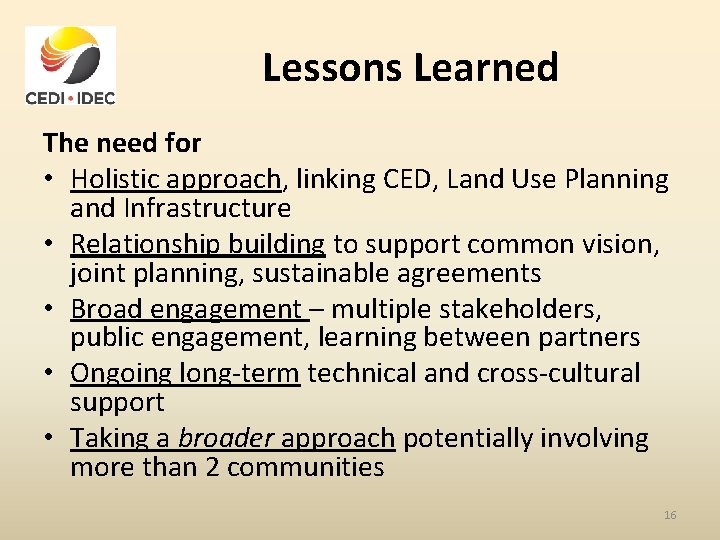
Lessons Learned The need for • Holistic approach, linking CED, Land Use Planning and Infrastructure • Relationship building to support common vision, joint planning, sustainable agreements • Broad engagement – multiple stakeholders, public engagement, learning between partners • Ongoing long-term technical and cross-cultural support • Taking a broader approach potentially involving more than 2 communities 16
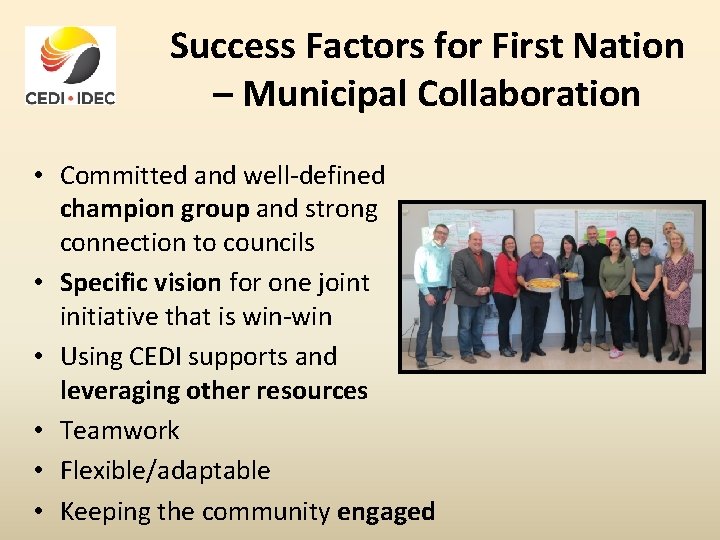
Success Factors for First Nation – Municipal Collaboration • Committed and well-defined champion group and strong connection to councils • Specific vision for one joint initiative that is win-win • Using CEDI supports and leveraging other resources • Teamwork • Flexible/adaptable • Keeping the community engaged
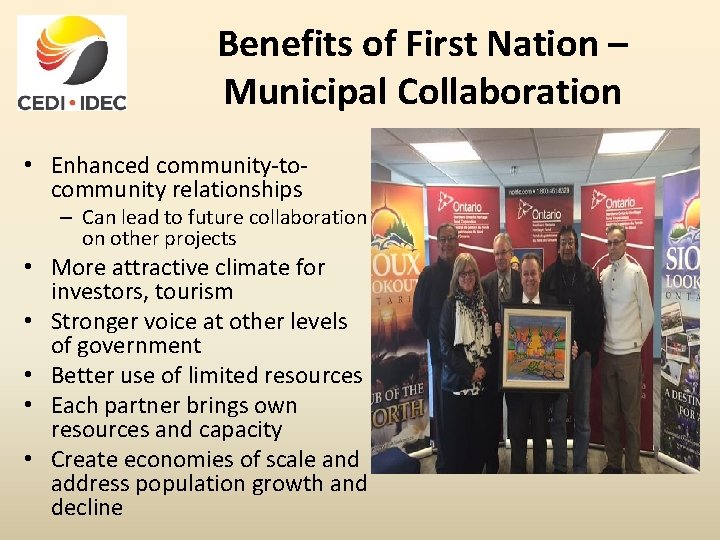
Benefits of First Nation – Municipal Collaboration • Enhanced community-tocommunity relationships – Can lead to future collaboration on other projects • More attractive climate for investors, tourism • Stronger voice at other levels of government • Better use of limited resources • Each partner brings own resources and capacity • Create economies of scale and address population growth and decline
Benefits of First Nation – Municipal Collaboration National Aboriginal Economic Development Board Study on mutual benefits to First Nations and Municipalities of Urban Additions to Reserve • “When First Nations reserves gain land not only can they economically benefit but everyone else in the region can too…. So not only does this report say don't go all NIMBY when you hear the local reserve is growing, but it says do so at your own peril. You may risk losing a share of the spoils. ” – Source: (The London Free Press, Oct 15, 2014) To view the study, visit http: //www. naedb-cndea. com
Next Steps • Aboriginal – Municipal Partnerships Panel at FCM Annual Conference in Edmonton, June 6 • CEDI Toolkit launch Summer 2015 • • Best practices based on community experiences tools, templates and case studies Accessible: available online at no cost Targeted toward FN and Muni elected officials and EDOs • Current phase ends March 2016 20
Synergies, ways to get involved and questions • Visit our website at www. fcm. ca/cedi – access our pilot community pages (early May) – Join our First Nations – Municipal Community of Practice and receive an invite to join our Linked. In group, newsletters and information about the Toolkit release • Support with Toolkit dissemination? • Questions for us? 21
For more information Helen Patterson CEDI Program Manager Federation of Canadian Municipalities (FCM) hpatterson@fcm. ca (613) 907 -6320 Morgan Bamford CEDI Program Coordinator Cando Morgan. Bamford@edo. ca O: (780) 990 -0303 C: (587) 873 -1627 22