
First Nations Alcohol Use COVID 19 Drug and
- Slides: 30
First Nations Alcohol Use & COVID 19
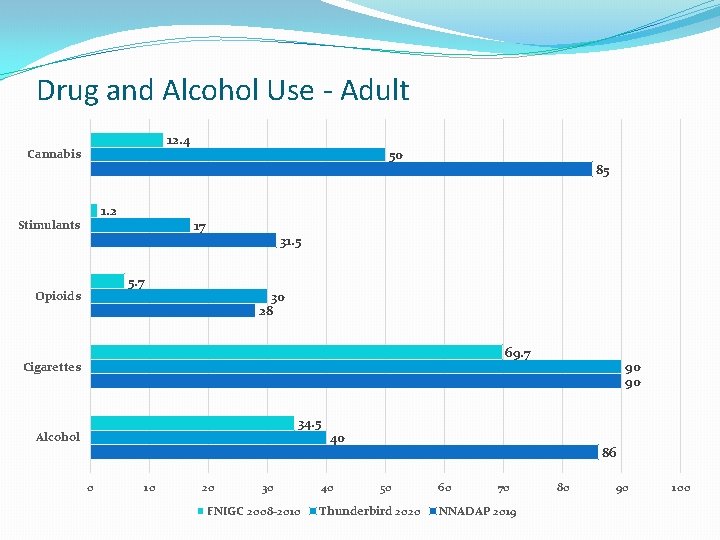
Drug and Alcohol Use - Adult 12. 4 Cannabis 1. 2 Stimulants 50 17 31. 5 5. 7 Opioids 85 30 28 69. 7 Cigarettes 34. 5 Alcohol 0 10 20 30 FNIGC 2008 -2010 90 90 40 40 86 50 Thunderbird 2020 60 70 NNADAP 2019 80 90 100
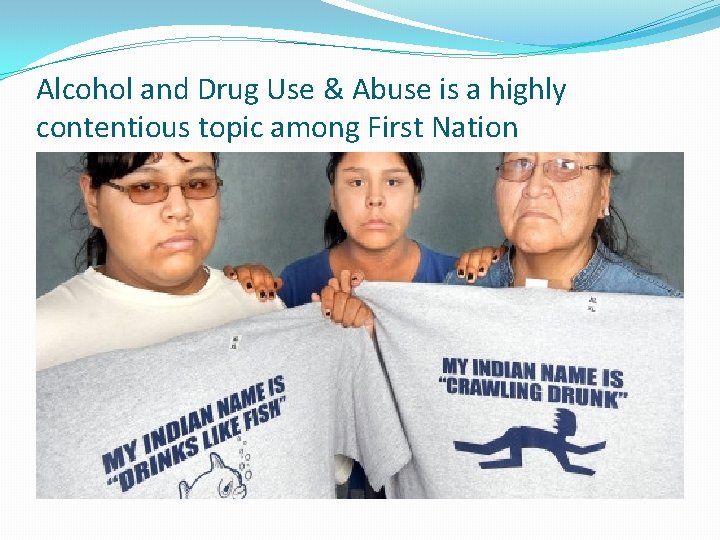
Alcohol and Drug Use & Abuse is a highly contentious topic among First Nation
Intoxicant by-laws on First Nation reserves �In 2013, there were 239 intoxicant by-laws for 615 First Nation communities �Some First Nation communities passed by-laws banning all alcohol or have become “dry” communities �Some communities set limits on availability and consumption of alcohol through bans on selling and importing �Certain reserves enacted by-laws limiting the amount of alcohol that can brought into the community �Some communities ban alcohol use among its members, but allow hotel guest to consume alcohol
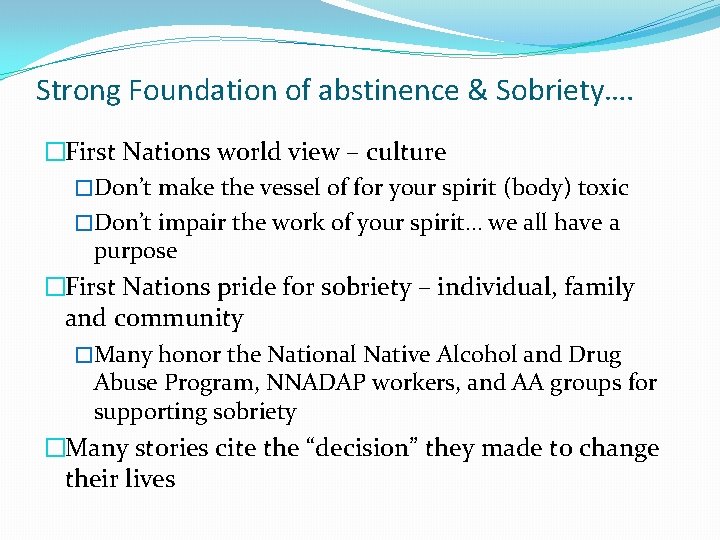
Strong Foundation of abstinence & Sobriety…. �First Nations world view – culture �Don’t make the vessel of for your spirit (body) toxic �Don’t impair the work of your spirit… we all have a purpose �First Nations pride for sobriety – individual, family and community �Many honor the National Native Alcohol and Drug Abuse Program, NNADAP workers, and AA groups for supporting sobriety �Many stories cite the “decision” they made to change their lives
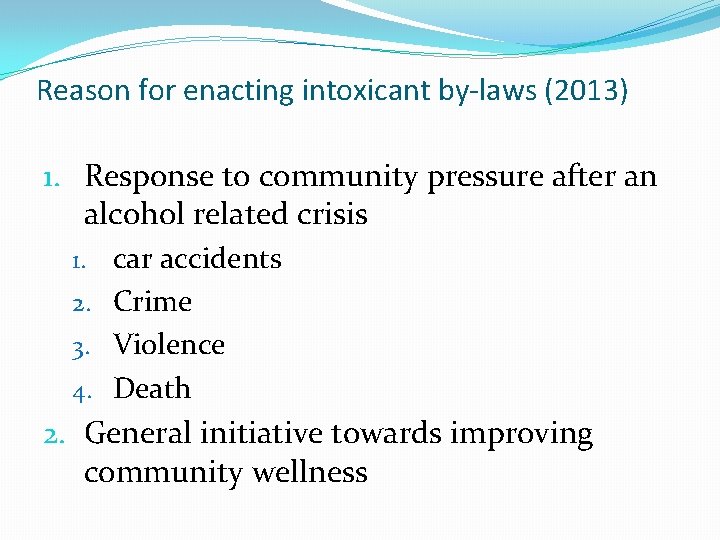
Reason for enacting intoxicant by-laws (2013) 1. Response to community pressure after an alcohol related crisis 1. car accidents 2. Crime 3. Violence 4. Death 2. General initiative towards improving community wellness
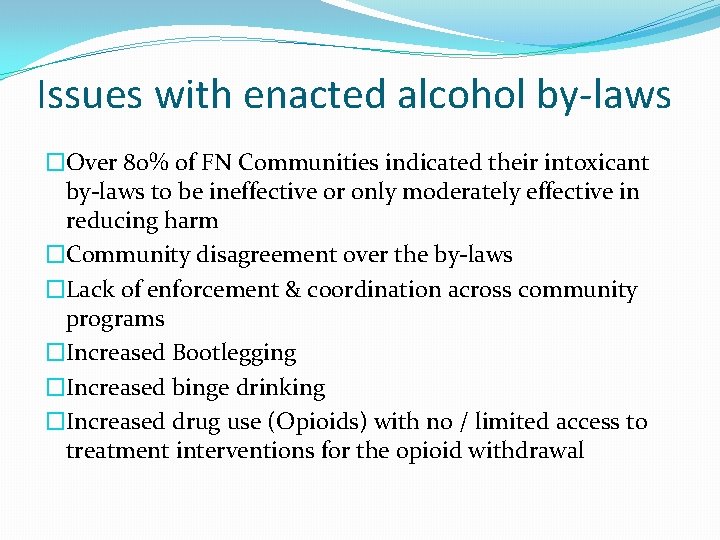
Issues with enacted alcohol by-laws �Over 80% of FN Communities indicated their intoxicant by-laws to be ineffective or only moderately effective in reducing harm �Community disagreement over the by-laws �Lack of enforcement & coordination across community programs �Increased Bootlegging �Increased binge drinking �Increased drug use (Opioids) with no / limited access to treatment interventions for the opioid withdrawal
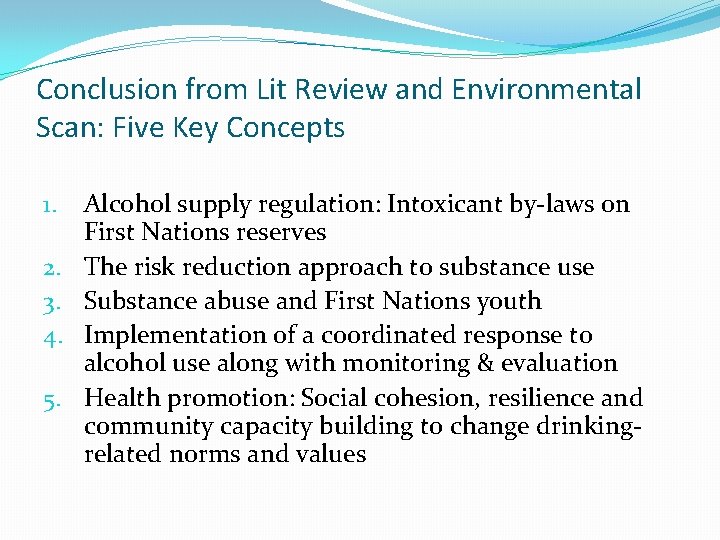
Conclusion from Lit Review and Environmental Scan: Five Key Concepts 1. 2. 3. 4. 5. Alcohol supply regulation: Intoxicant by-laws on First Nations reserves The risk reduction approach to substance use Substance abuse and First Nations youth Implementation of a coordinated response to alcohol use along with monitoring & evaluation Health promotion: Social cohesion, resilience and community capacity building to change drinkingrelated norms and values
2. The risk reduction approach to substance use
2. Safe supply to reduce harms – COVID-19 �Goals for safe supply focused on preventing: � death or worsening health using accessible products not meant for human consumption � increased violence � maintain or stabilize in current health status �Coping with stress & boredom of the COVID-19 Crisis �Compassion for existing– mental health & chronic health �Limited access and availability of resources to support recovery – connectivity, device, data/plan, finances �Prevention of secondary crisis on an overburdened system that is focused on COVID-19 Call 911 if someone has: sudden chest pain, shortness of breath, or difficult breathing, OR If you are in severe withdrawal (shaking and sweating a lot) and have a history of seizures.
Community Example: 1 �First Nations citizens can access alcohol in controlled amounts within their community: � Chief and Council established an agreement with Liquor Control Board of Ontario to be in the community for one hour to deliver pre-ordered limited supply of alcohol. �The community also provides a brochure about safe alcohol use during COVID-19 �This is also a Community who has long-standing community-based treatment for opioids
Community Example: 2 �First Nations citizens with Chronic Health Issues: � Chief and Council have approved home and community care staff to go to the liquor store to make the purchase for seniors (at the senior's cost) �The personal support worker (PSW) also provides education to the senior about safe alcohol use during COVID-19 �The PSW can also support the seni 0 r in monitoring the alcohol intake �This is also a Community who has long-standing community-based treatment for opioids
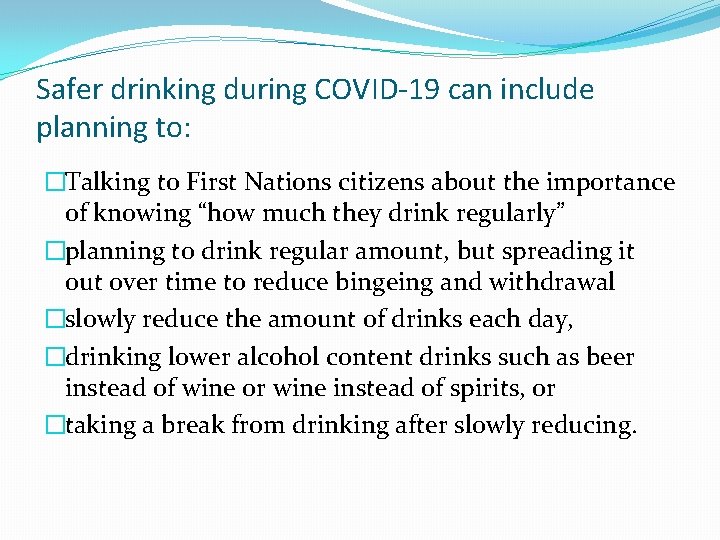
Safer drinking during COVID-19 can include planning to: �Talking to First Nations citizens about the importance of knowing “how much they drink regularly” �planning to drink regular amount, but spreading it out over time to reduce bingeing and withdrawal �slowly reduce the amount of drinks each day, �drinking lower alcohol content drinks such as beer instead of wine or wine instead of spirits, or �taking a break from drinking after slowly reducing.
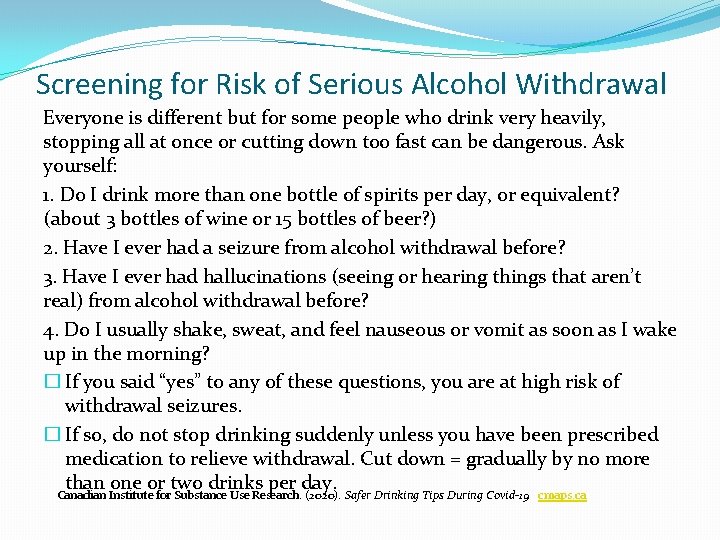
Screening for Risk of Serious Alcohol Withdrawal Everyone is different but for some people who drink very heavily, stopping all at once or cutting down too fast can be dangerous. Ask yourself: 1. Do I drink more than one bottle of spirits per day, or equivalent? (about 3 bottles of wine or 15 bottles of beer? ) 2. Have I ever had a seizure from alcohol withdrawal before? 3. Have I ever had hallucinations (seeing or hearing things that aren’t real) from alcohol withdrawal before? 4. Do I usually shake, sweat, and feel nauseous or vomit as soon as I wake up in the morning? � If you said “yes” to any of these questions, you are at high risk of withdrawal seizures. � If so, do not stop drinking suddenly unless you have been prescribed medication to relieve withdrawal. Cut down = gradually by no more than one or two drinks per day. Canadian Institute for Substance Use Research. (2020). Safer Drinking Tips During Covid-19 cmaps. ca
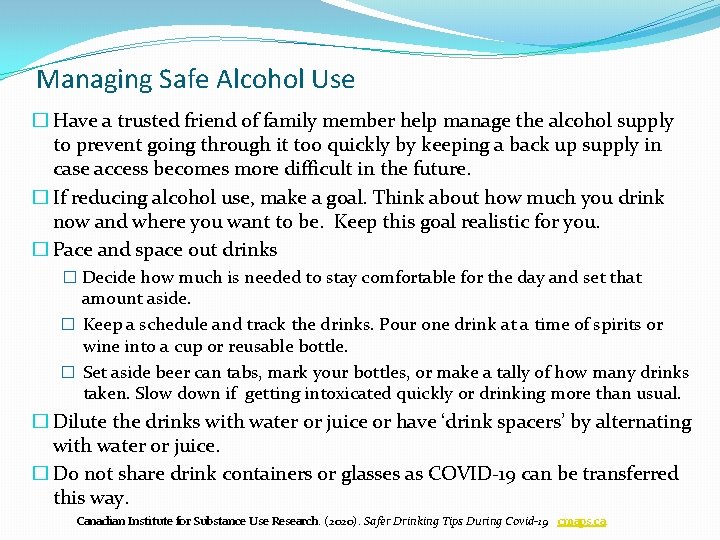
Managing Safe Alcohol Use � Have a trusted friend of family member help manage the alcohol supply to prevent going through it too quickly by keeping a back up supply in case access becomes more difficult in the future. � If reducing alcohol use, make a goal. Think about how much you drink now and where you want to be. Keep this goal realistic for you. � Pace and space out drinks � Decide how much is needed to stay comfortable for the day and set that amount aside. � Keep a schedule and track the drinks. Pour one drink at a time of spirits or wine into a cup or reusable bottle. � Set aside beer can tabs, mark your bottles, or make a tally of how many drinks taken. Slow down if getting intoxicated quickly or drinking more than usual. � Dilute the drinks with water or juice or have ‘drink spacers’ by alternating with water or juice. � Do not share drink containers or glasses as COVID-19 can be transferred this way. Canadian Institute for Substance Use Research. (2020). Safer Drinking Tips During Covid-19 cmaps. ca
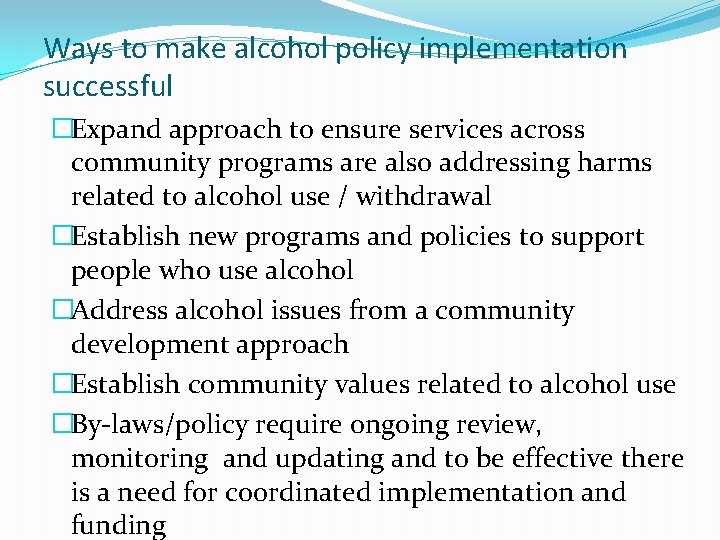
Ways to make alcohol policy implementation successful �Expand approach to ensure services across community programs are also addressing harms related to alcohol use / withdrawal �Establish new programs and policies to support people who use alcohol �Address alcohol issues from a community development approach �Establish community values related to alcohol use �By-laws/policy require ongoing review, monitoring and updating and to be effective there is a need for coordinated implementation and funding
Risk reduction policies �Risk reduction is ensuring that factors associated with alcohol use are addressed to reduce the harms to self and others �Do not make a commitment to “Abstinence” a requirement to getting help.
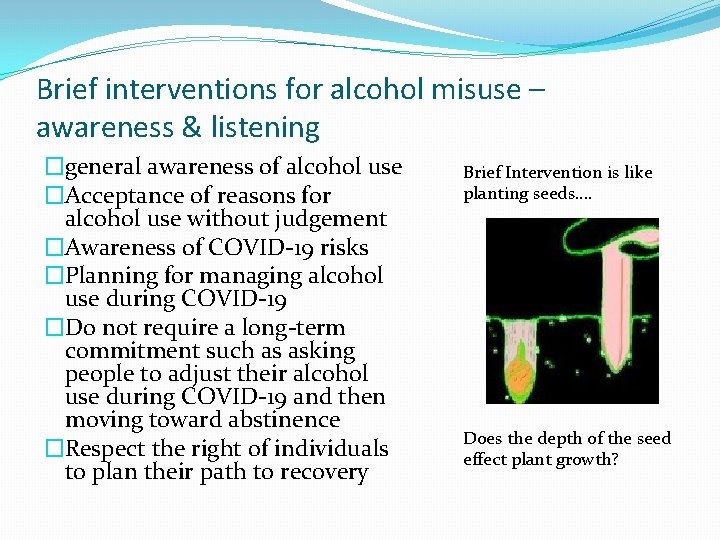
Brief interventions for alcohol misuse – awareness & listening �general awareness of alcohol use �Acceptance of reasons for alcohol use without judgement �Awareness of COVID-19 risks �Planning for managing alcohol use during COVID-19 �Do not require a long-term commitment such as asking people to adjust their alcohol use during COVID-19 and then moving toward abstinence �Respect the right of individuals to plan their path to recovery Brief Intervention is like planting seeds…. Does the depth of the seed effect plant growth?
Problems and solutions to risk reduction �Prohibition of alcohol leads to bootlegging �Prohibition of alcohol leads to the use of other, more harmful substances – alcohol-based cleaning & , cosmetic products, or the use of other drugs �People will continue to use alcohol and other drugs �Violence is likely with and without alcohol �Risk reduction approaches must include First Nation models of handling addictions and healing �Risk reduction must respect intergenerational trauma
Medication to manage withdrawal � non-benzodiazepine medications, such as gabapentin, carbamazepine, orclonidine, for managing low risk of severe complications of alcohol withdrawal at home � inpatient facility (i. e. , withdrawal management facility or hospital) for high risk of severe complications of withdrawal where they can receive a benzodiazepine treatment regimen under close observation, and emergency care can be administered immediately if needed � Adult patients with moderate to severe AUD should be offered naltrexone or acamprosate as a first-line pharmacotherapy to support achievement of patient-identified treatment goals � Naltrexone is recommended for patients who have a treatment goal of either abstinence or a reduction in alcohol consumption � Acamprosate is recommended for patients who have a treatment goal of abstinence https: //www. bccsu. ca/wp-content/uploads/2019/12/AUD-Recommendations. pdf
3. Alcohol and First Nations youth
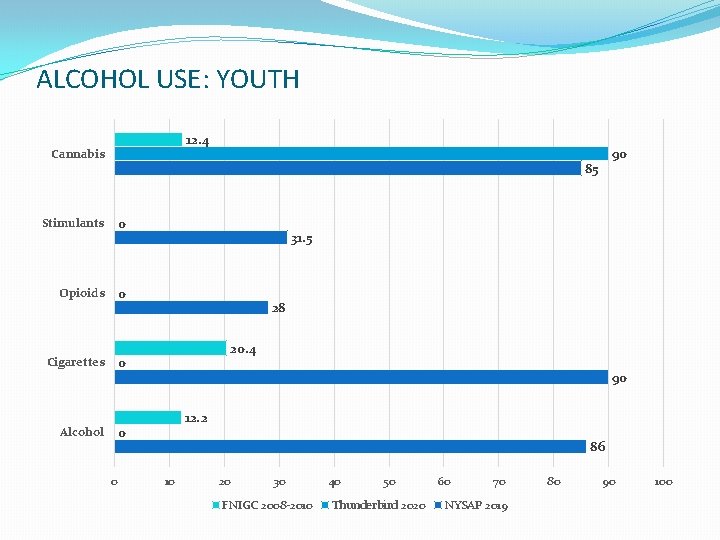
ALCOHOL USE: YOUTH 12. 4 Cannabis 90 85 Stimulants 0 Opioids 0 Cigarettes 0 31. 5 28 20. 4 90 12. 2 0 Alcohol 0 86 10 20 30 FNIGC 2008 -2010 40 50 Thunderbird 2020 60 70 NYSAP 2019 80 90 100
3. Substance abuse and aboriginal youth �Must understand unique needs of youth �Need to understand connection between substance abuse and impacts of intergenerational trauma �Address lack of awareness of colonization and displacement of culture
Causes and solutions to youth substance abuse � 42% of First Nations youth admit to excessive drinking and indicated that they suffer from hopelessness and depression �Hopelessness causes depression, which in turn increases risk for youth to start drinking heavily �Relationship with someone who consistently provides love, culture, school, sports, employment are all factors that prevent substance use �Youth say they choose not to use substances because: �Relationship with someone who consistently provides love, �Safe home �culture, �school, �sports, �Employment
4. Implementation and program evaluation
4. Implementation and program evaluation Three methods that reduce risks related to alcohol use in any given community are: 1. Effective controls on alcohol 2. Supportive environments 3. Inclusive decision-making 4. Need to understand the current use
5. Health promotion: Social cohesion, resilience and community capacity building to change drinking-related patterns and values
5. Social cohesion & resilience �There are four factors that need to be addressed in order to understand social cohesion 1. 2. 3. 4. That it is a shared and inclusive conversation Seeks to understand everyone's needs Community values Attempts to work toward a resolution
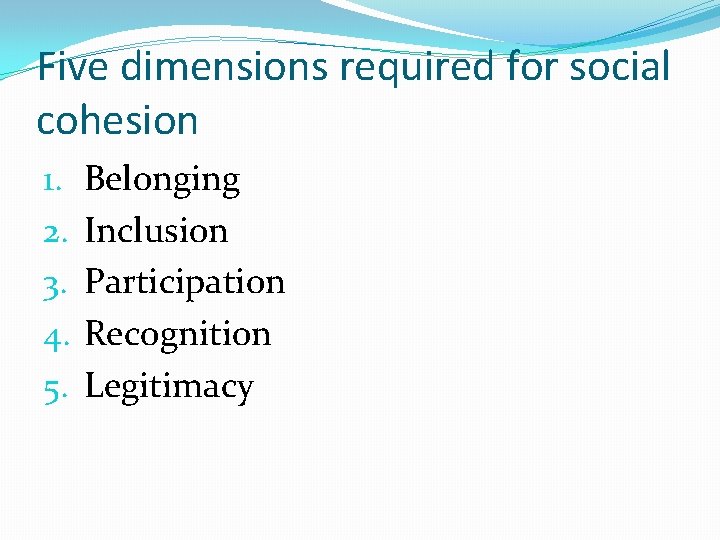
Five dimensions required for social cohesion 1. 2. 3. 4. 5. Belonging Inclusion Participation Recognition Legitimacy
References 1. 2. 3. 4. 5. 6. 7. BC Center on Substance Misuse. (2019) A Guideline for the Clinical Management of High-Risk Drinking and Alcohol Use Disorder. https: //www. bccsu. ca/wp-content/uploads/2019/12/AUDRecommendations. pdf Canadian Institute for Substance Use Research. (2020). Safer Drinking Tips During Covid-19 cmaps. ca FNIGC Data Online. (2008 -2010). Regional Health Survey 2008 -2010. https: //fnigc. ca/dataonline/chartslist? term_node_tid_depth_1=7&term_node_tid_depth=14&keys= National Native Addition Partnership Foundation. (2013) Literature Review, First Nations Alcohol Policies. Thunderbird Partnership Foundation. (2019) Annual Report Thunderbird Partnership Foundation (2019). National Cannabis Report Thunderbird Partnership Foundation. (2020) Treatment Guidelines for Opioids and Crystal Meth and Opioid Surveillance: Update Jan 2019