
First law of thermodynamics change in the total
- Slides: 16
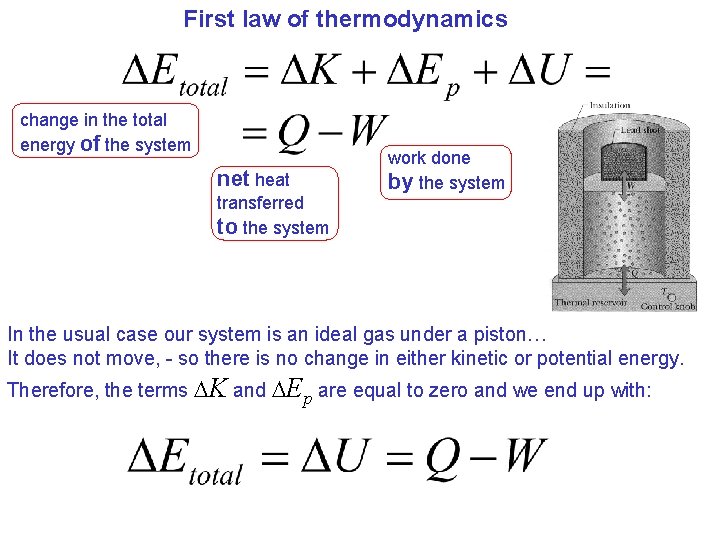
First law of thermodynamics change in the total energy of the system net heat transferred to the system work done by the system In the usual case our system is an ideal gas under a piston… It does not move, - so there is no change in either kinetic or potential energy. Therefore, the terms DK and DEp are equal to zero and we end up with:
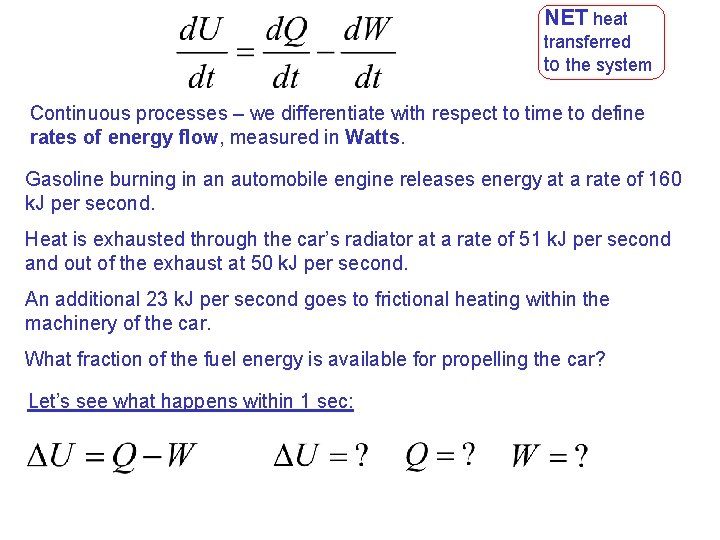
NET heat transferred to the system Continuous processes – we differentiate with respect to time to define rates of energy flow, measured in Watts. Gasoline burning in an automobile engine releases energy at a rate of 160 k. J per second. Heat is exhausted through the car’s radiator at a rate of 51 k. J per second and out of the exhaust at 50 k. J per second. An additional 23 k. J per second goes to frictional heating within the machinery of the car. What fraction of the fuel energy is available for propelling the car? Let’s see what happens within 1 sec:
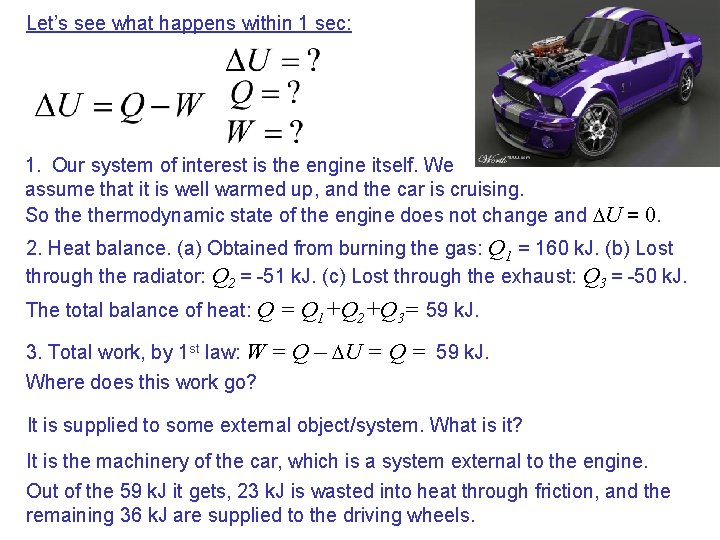
Let’s see what happens within 1 sec: 1. Our system of interest is the engine itself. We assume that it is well warmed up, and the car is cruising. So thermodynamic state of the engine does not change and DU = 0. 2. Heat balance. (a) Obtained from burning the gas: Q 1 = 160 k. J. (b) Lost through the radiator: Q 2 = -51 k. J. (c) Lost through the exhaust: Q 3 = -50 k. J. The total balance of heat: Q = Q 1+Q 2+Q 3= 59 k. J. 3. Total work, by 1 st law: W = Q – DU = Q = 59 k. J. Where does this work go? It is supplied to some external object/system. What is it? It is the machinery of the car, which is a system external to the engine. Out of the 59 k. J it gets, 23 k. J is wasted into heat through friction, and the remaining 36 k. J are supplied to the driving wheels.
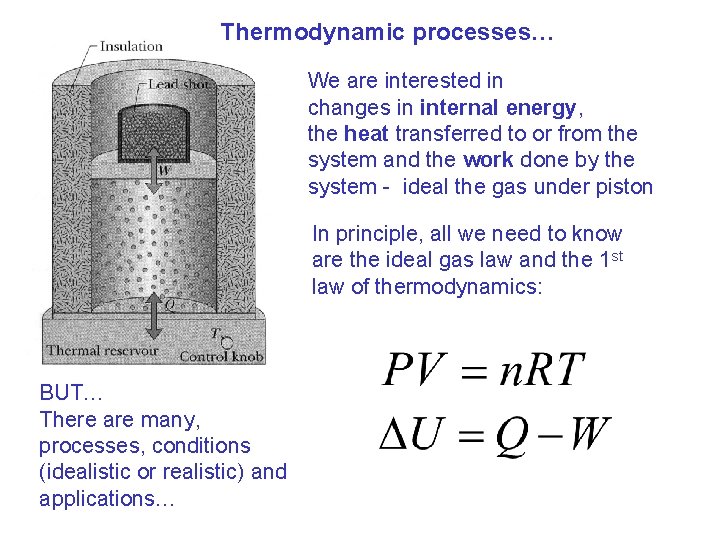
Thermodynamic processes… We are interested in changes in internal energy, the heat transferred to or from the system and the work done by the system - ideal the gas under piston In principle, all we need to know are the ideal gas law and the 1 st law of thermodynamics: BUT… There are many, processes, conditions (idealistic or realistic) and applications…
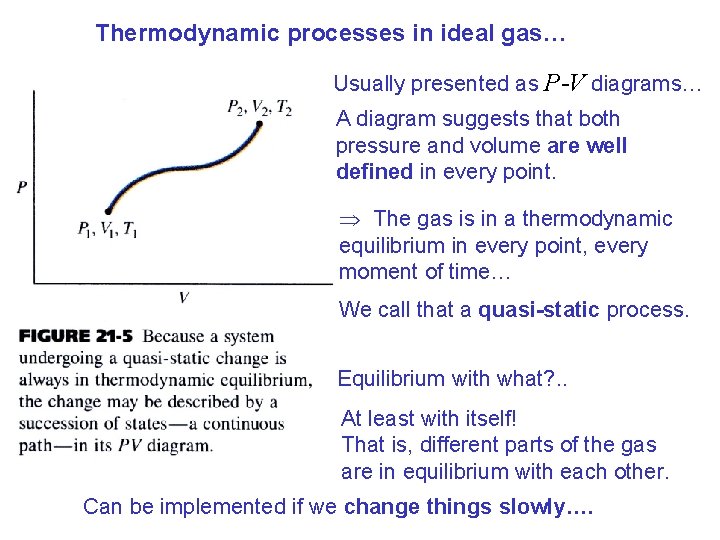
Thermodynamic processes in ideal gas… Usually presented as P-V diagrams… A diagram suggests that both pressure and volume are well defined in every point. Þ The gas is in a thermodynamic equilibrium in every point, every moment of time… We call that a quasi-static process. Equilibrium with what? . . At least with itself! That is, different parts of the gas are in equilibrium with each other. Can be implemented if we change things slowly….
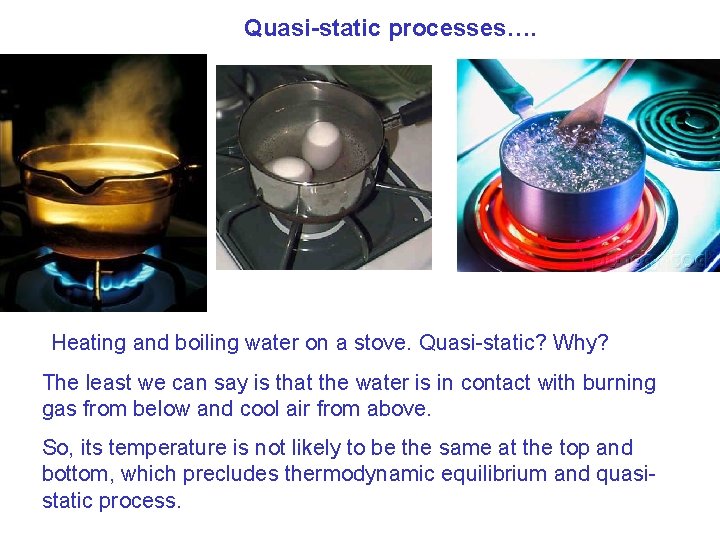
Quasi-static processes…. Heating and boiling water on a stove. Quasi-static? Why? The least we can say is that the water is in contact with burning gas from below and cool air from above. So, its temperature is not likely to be the same at the top and bottom, which precludes thermodynamic equilibrium and quasistatic process.
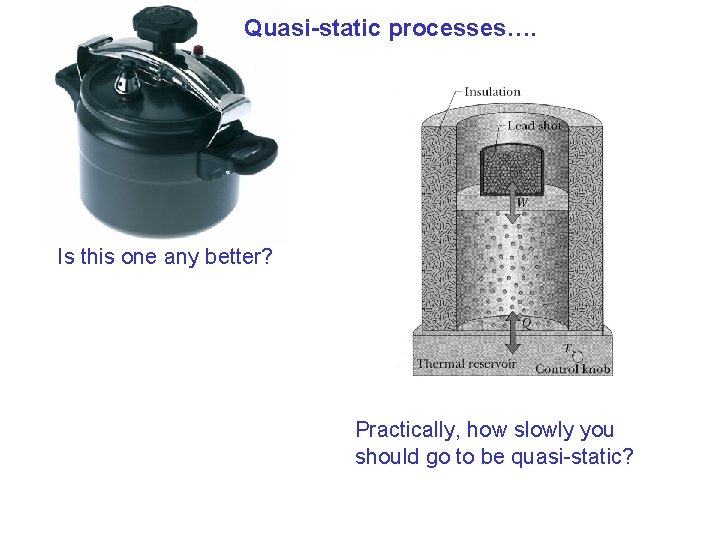
Quasi-static processes…. Is this one any better? Practically, how slowly you should go to be quasi-static?
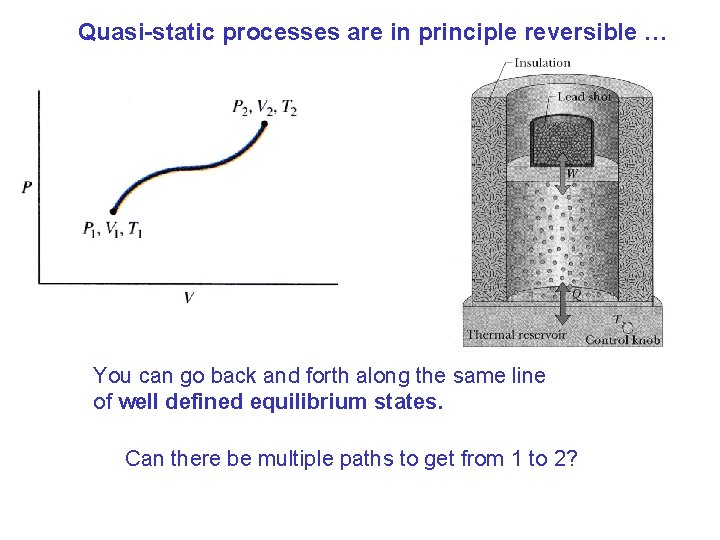
Quasi-static processes are in principle reversible … You can go back and forth along the same line of well defined equilibrium states. Can there be multiple paths to get from 1 to 2?
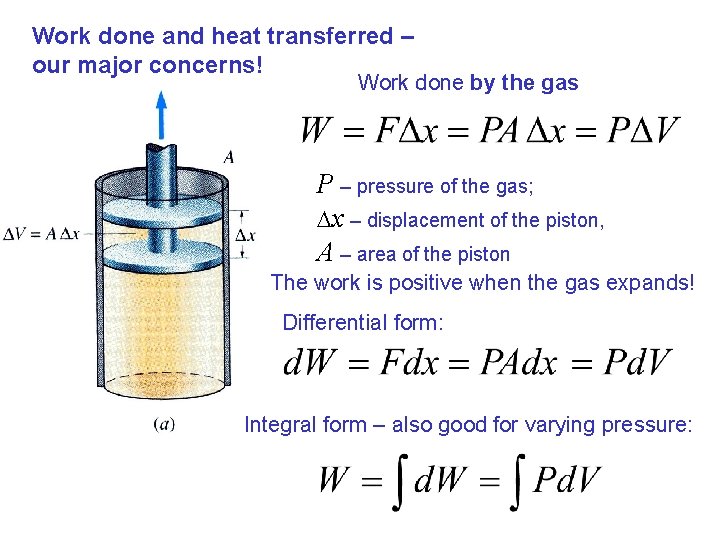
Work done and heat transferred – our major concerns! Work done by the gas P – pressure of the gas; Dx – displacement of the piston, A – area of the piston The work is positive when the gas expands! Differential form: Integral form – also good for varying pressure:
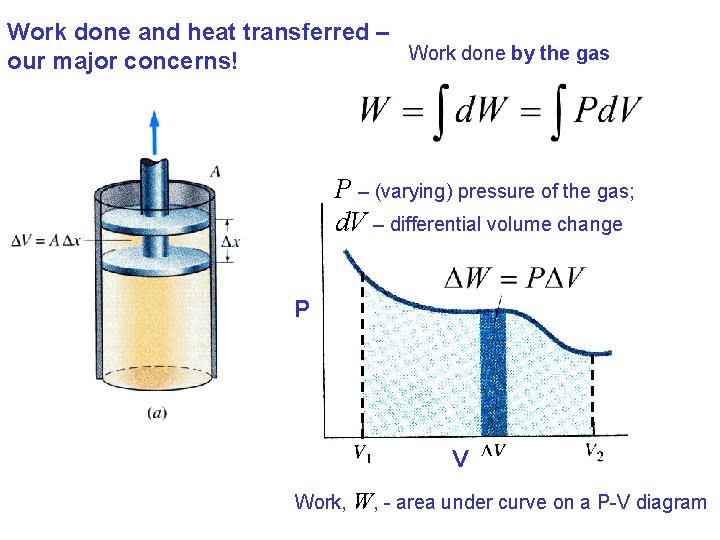
Work done and heat transferred – Work done by the gas our major concerns! P – (varying) pressure of the gas; d. V – differential volume change P V Work, W, - area under curve on a P-V diagram
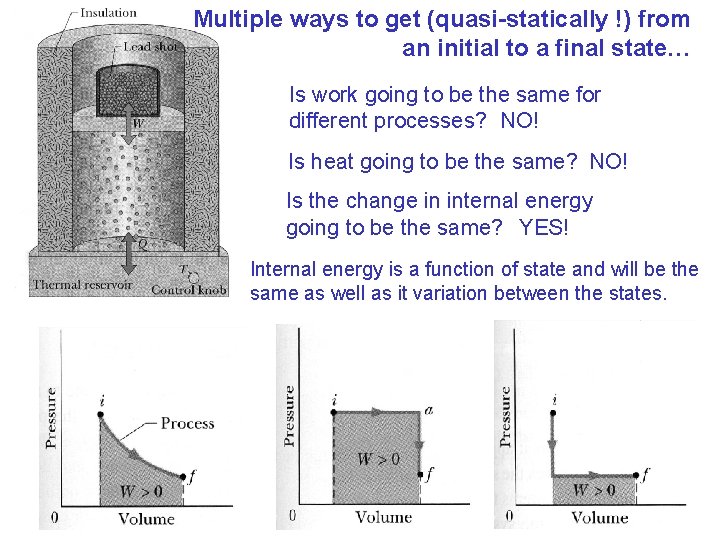
Multiple ways to get (quasi-statically !) from an initial to a final state… Is work going to be the same for different processes? NO! Is heat going to be the same? NO! Is the change in internal energy going to be the same? YES! Internal energy is a function of state and will be the same as well as it variation between the states.
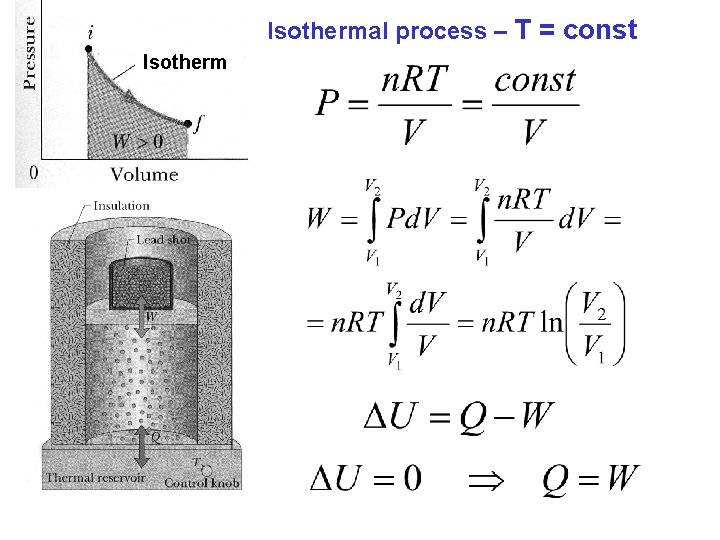
Isothermal process – T = const Isotherm
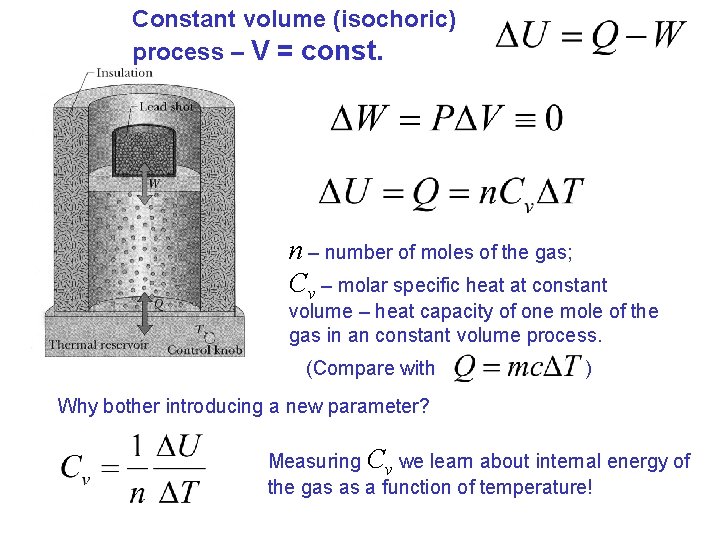
Constant volume (isochoric) process – V = const. n – number of moles of the gas; Cv – molar specific heat at constant volume – heat capacity of one mole of the gas in an constant volume process. (Compare with ) Why bother introducing a new parameter? Measuring Cv we learn about internal energy of the gas as a function of temperature!
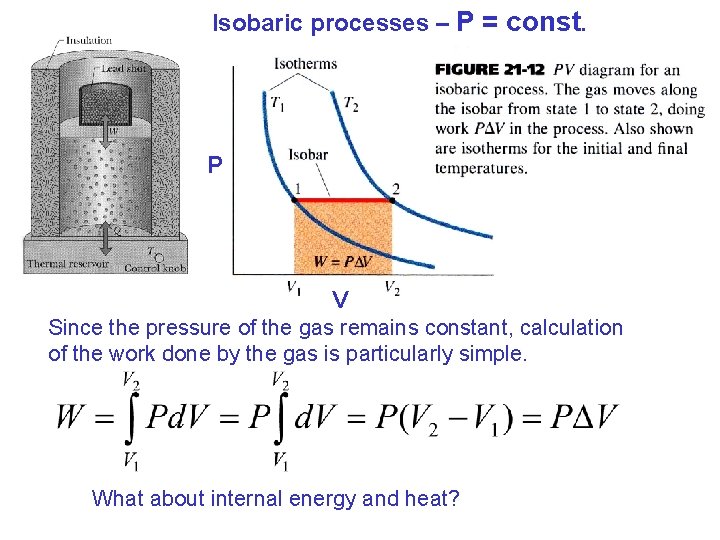
Isobaric processes – P = const. P V Since the pressure of the gas remains constant, calculation of the work done by the gas is particularly simple. What about internal energy and heat?
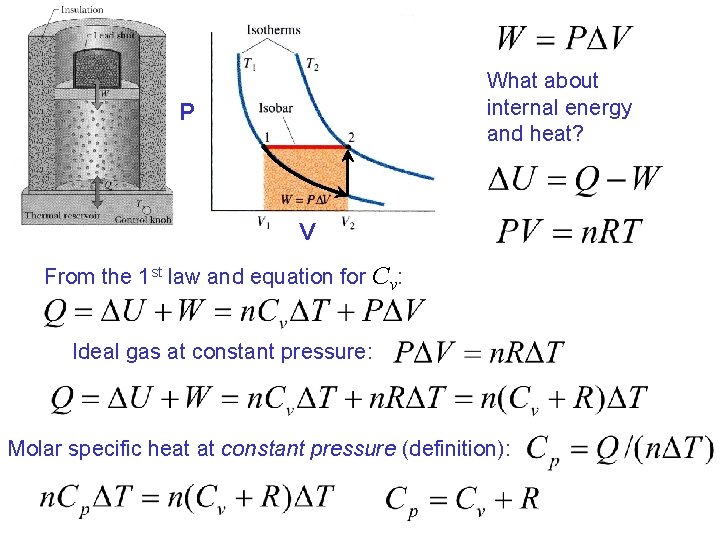
What about internal energy and heat? P V From the 1 st law and equation for Cv: Ideal gas at constant pressure: Molar specific heat at constant pressure (definition):
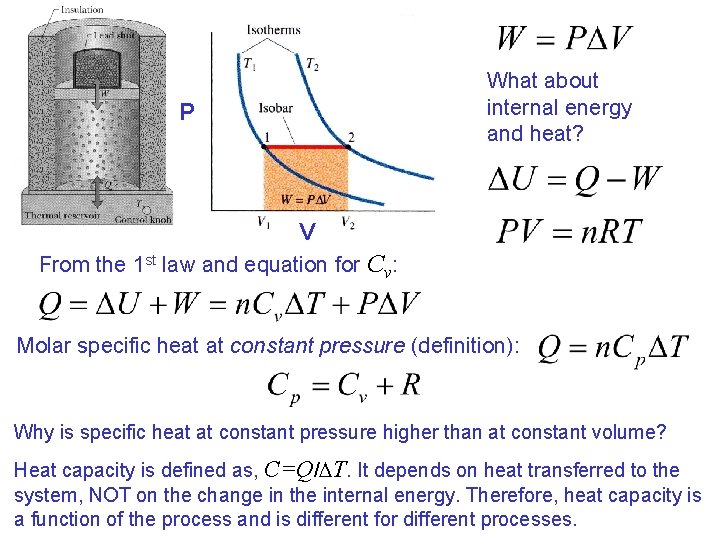
What about internal energy and heat? P V From the 1 st law and equation for Cv: Molar specific heat at constant pressure (definition): Why is specific heat at constant pressure higher than at constant volume? Heat capacity is defined as, C=Q/DT. It depends on heat transferred to the system, NOT on the change in the internal energy. Therefore, heat capacity is a function of the process and is different for different processes.