
First Law Analysis for Reacting System Consider a
- Slides: 8
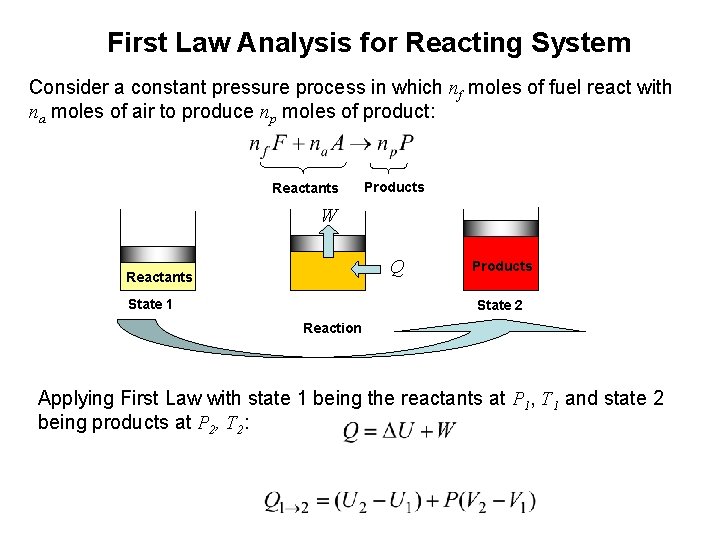
First Law Analysis for Reacting System Consider a constant pressure process in which nf moles of fuel react with na moles of air to produce np moles of product: Reactants Products W Q Reactants State 1 Products State 2 Reaction Applying First Law with state 1 being the reactants at P 1, T 1 and state 2 being products at P 2, T 2:
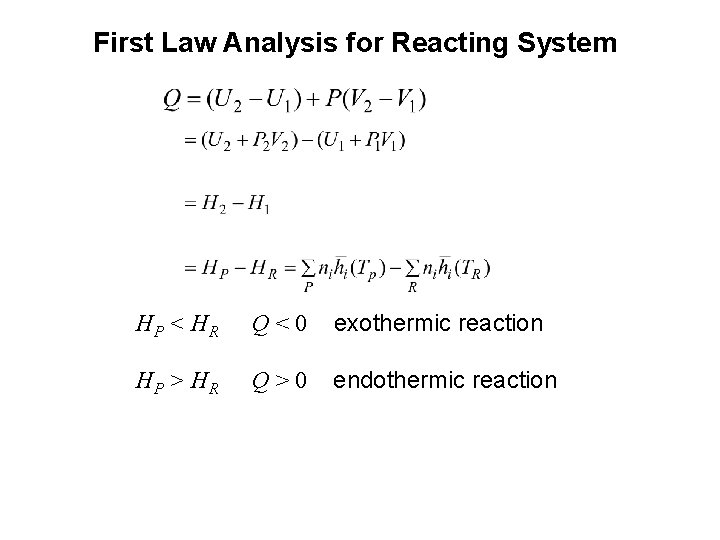
First Law Analysis for Reacting System HP < H R Q<0 exothermic reaction HP > H R Q>0 endothermic reaction
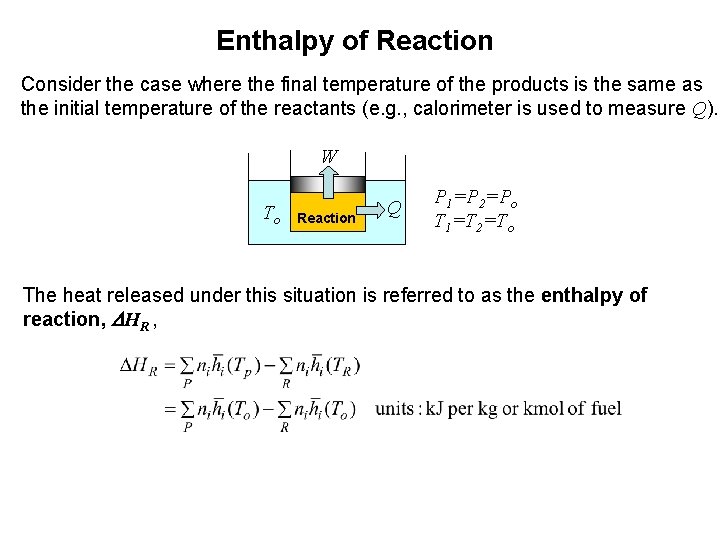
Enthalpy of Reaction Consider the case where the final temperature of the products is the same as the initial temperature of the reactants (e. g. , calorimeter is used to measure Q). W To Reaction Q P 1=P 2=Po T 1=T 2=To The heat released under this situation is referred to as the enthalpy of reaction, DHR ,
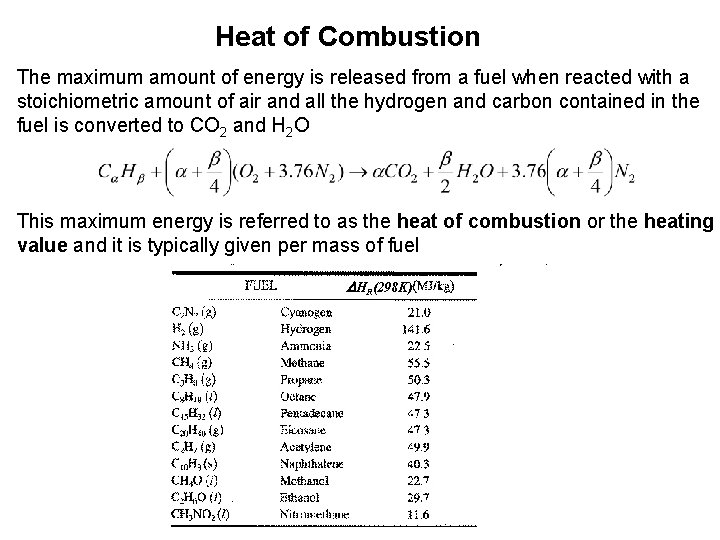
Heat of Combustion The maximum amount of energy is released from a fuel when reacted with a stoichiometric amount of air and all the hydrogen and carbon contained in the fuel is converted to CO 2 and H 2 O This maximum energy is referred to as the heat of combustion or the heating value and it is typically given per mass of fuel DHR(298 K)
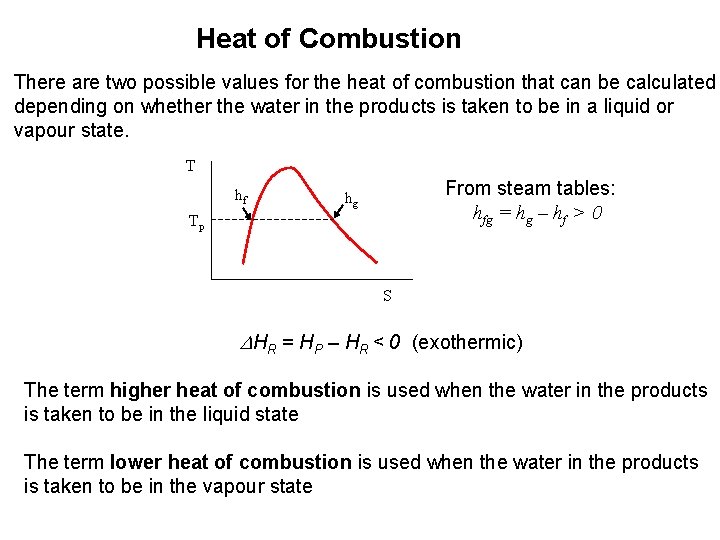
Heat of Combustion There are two possible values for the heat of combustion that can be calculated depending on whether the water in the products is taken to be in a liquid or vapour state. T hf From steam tables: hfg = hg – hf > 0 hg Tp S DHR = HP – HR < 0 (exothermic) The term higher heat of combustion is used when the water in the products is taken to be in the liquid state The term lower heat of combustion is used when the water in the products is taken to be in the vapour state
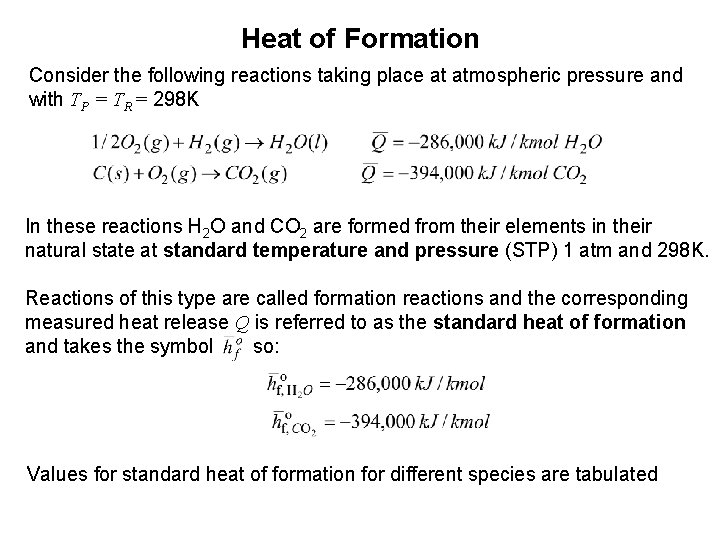
Heat of Formation Consider the following reactions taking place at atmospheric pressure and with TP = TR = 298 K In these reactions H 2 O and CO 2 are formed from their elements in their natural state at standard temperature and pressure (STP) 1 atm and 298 K. Reactions of this type are called formation reactions and the corresponding measured heat release Q is referred to as the standard heat of formation and takes the symbol so: Values for standard heat of formation for different species are tabulated
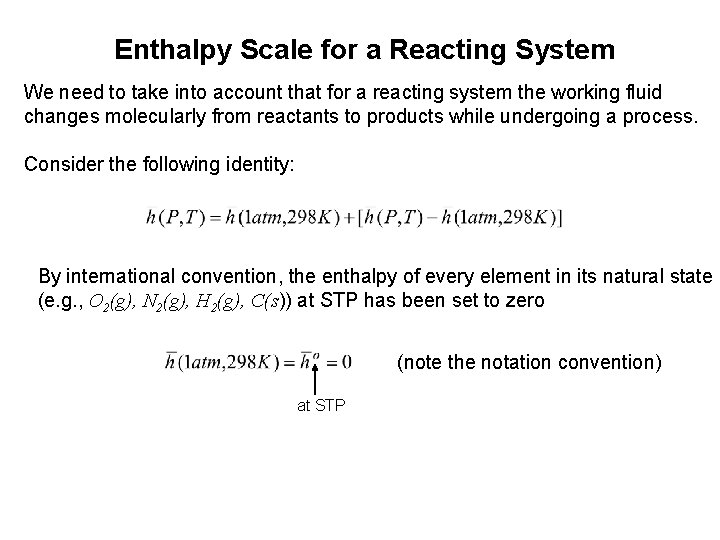
Enthalpy Scale for a Reacting System We need to take into account that for a reacting system the working fluid changes molecularly from reactants to products while undergoing a process. Consider the following identity: By international convention, the enthalpy of every element in its natural state (e. g. , O 2(g), N 2(g), H 2(g), C(s)) at STP has been set to zero (note the notation convention) at STP
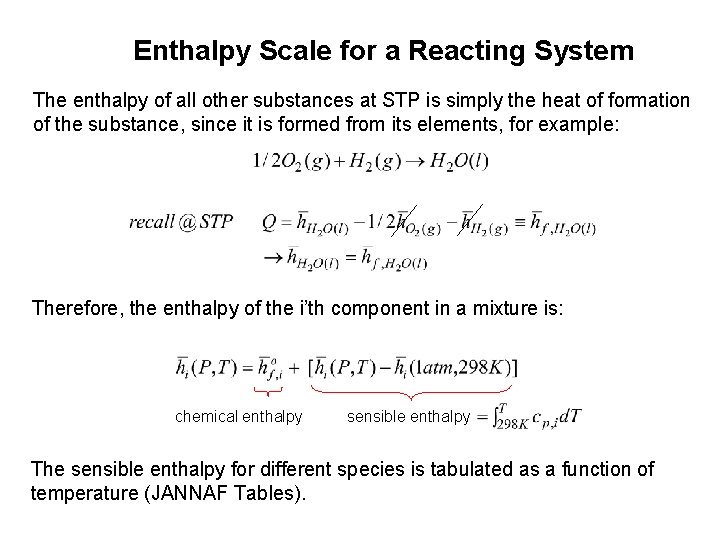
Enthalpy Scale for a Reacting System The enthalpy of all other substances at STP is simply the heat of formation of the substance, since it is formed from its elements, for example: Therefore, the enthalpy of the i’th component in a mixture is: chemical enthalpy sensible enthalpy The sensible enthalpy for different species is tabulated as a function of temperature (JANNAF Tables).