
First Language Acquisition Ling 400 First language L

![Eva, 27 months • • • [The] Baby lemon [does] not work. Unuh. Yeah.](https://slidetodoc.com/presentation_image_h2/7b7a87fa3913fc41f6d77d5fa4e4e8db/image-23.jpg "Eva, 27 months • • • [The] Baby lemon [does] not work. Unuh. Yeah.")
![Eva, 27 months • • JJ play[s] [the] violin. Mommy, play [the] violin. Play](https://slidetodoc.com/presentation_image_h2/7b7a87fa3913fc41f6d77d5fa4e4e8db/image-25.jpg "Eva, 27 months • • JJ play[s] [the] violin. Mommy, play [the] violin. Play")
![My own children (examples) sound substitution • Substitution of hard stop consonants (like [k])](https://slidetodoc.com/presentation_image_h2/7b7a87fa3913fc41f6d77d5fa4e4e8db/image-26.jpg "My own children (examples) sound substitution • Substitution of hard stop consonants (like [k])")
- Slides: 30
First Language Acquisition Ling 400
First language (L 1) acquisition • Crucial questions regarding language acquisition • Theories of language acquisition – The imitation theory – The reinforcement theory – The active-construction-of-a-grammar theory
Language acquisition theories • Imitation: Children imitate adults • Reinforcement: Children are negatively reinforced for errors and positively reinforced for correct usage • Active construction of a grammar: Children are genetically programmed to acquire L 1 (driven by Universal Grammar according to Chomsky)
The Innateness Hypothesis • The process of first language acquisition cannot be fully explained by an imitation or reinforcement theory. (We will see some examples later. ) • Almost all people acquire 1 st language successfully despite the fact that the data they are exposed to is often defective. • Conclusion: We are born with a Language Acquisition Device (= Universal Grammar).
Lenneberg: characteristics of biologically controlled behaviors 1. 2. 3. 4. 5. 6. Emerges before it is necessary Not the result of a conscious decision Not triggered by external events No training needed A regular sequence of “milestones” There is a “critical period”
UG and Lg Acquisition • If Chomsky is right, studying first language acquisition is extremely important because this allows us to see “UG in action”.
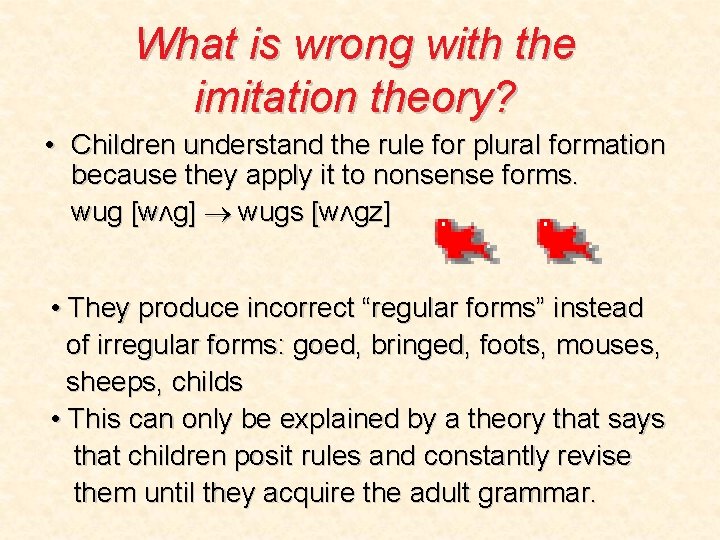
What is wrong with the imitation theory? • Children understand the rule for plural formation because they apply it to nonsense forms. wug [wʌg] wugs [wʌgz] • They produce incorrect “regular forms” instead of irregular forms: goed, bringed, foots, mouses, sheeps, childs • This can only be explained by a theory that says that children posit rules and constantly revise them until they acquire the adult grammar.
Evidence for internalized syntactic/semantic rules • Children seem to know complex syntactic/semantic rules that cannot be taught directly. “When did the boy say he hurt himself? ” [ambiguous] “When did the boy say how he hurt himself? ” [not ambiguous]
Evidence for internalized syntactic/semantic rules • Some errors in syntax made by children are not errors in a different language/dialect • “What do you think what’s in here? ” for “What do you think is in here? ” • This is a grammatical question in a German dialect.
The Innateness Hypothesis • Chomsky argues that a child is born with an innate grammar (Universal Grammar) that has some basic rules and principles. • The only thing that the linguistic input does is to set some parameters. This accounts for the idiosyncracies among the world’s languages.
The Innateness Hypothesis • Chomsky also points to the fact that L 1 acquisition follows a set of well-defined developmental stages. So he thinks that this is like the ability to walk: we are genetically predisposed to acquire a language just as we are genetically predisposed to walk.
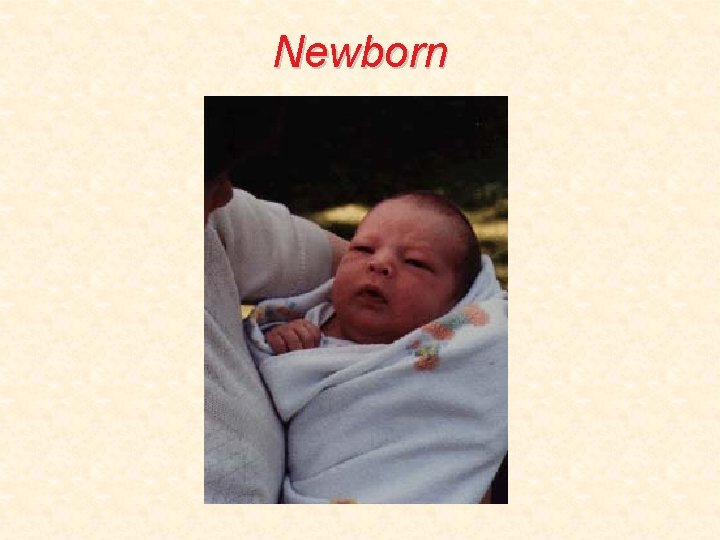
Newborn
L 1 acquisition, stages • Stage I babbling (0 -9 mos. ) • A large variety of sounds are produced many of which are not sounds used in L 1.
12 months
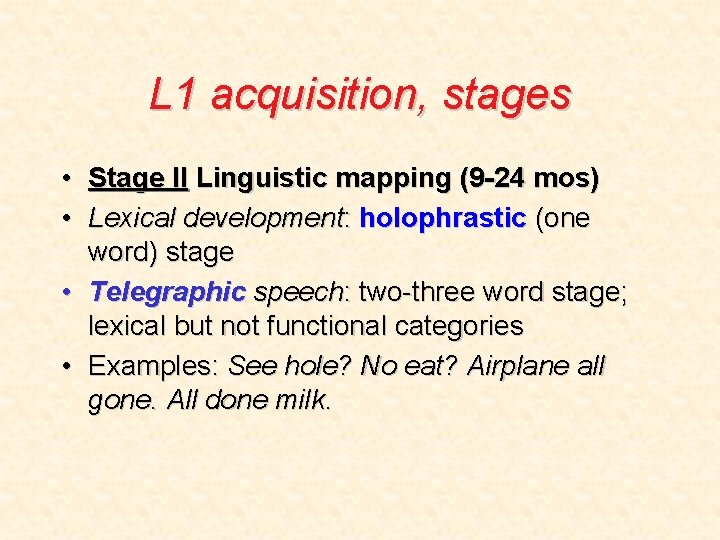
L 1 acquisition, stages • Stage II Linguistic mapping (9 -24 mos) • Lexical development: holophrastic (one word) stage • Telegraphic speech: two-three word stage; lexical but not functional categories • Examples: See hole? No eat? Airplane all gone. All done milk.
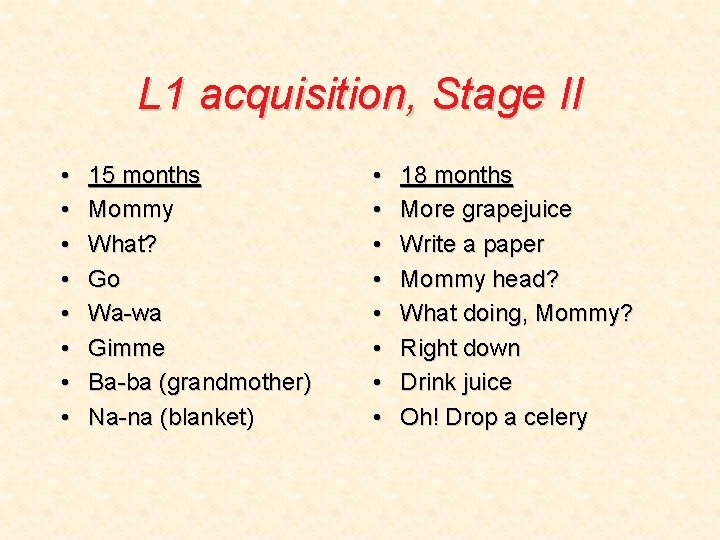
L 1 acquisition, Stage II • • 15 months Mommy What? Go Wa-wa Gimme Ba-ba (grandmother) Na-na (blanket) • • 18 months More grapejuice Write a paper Mommy head? What doing, Mommy? Right down Drink juice Oh! Drop a celery
24 months
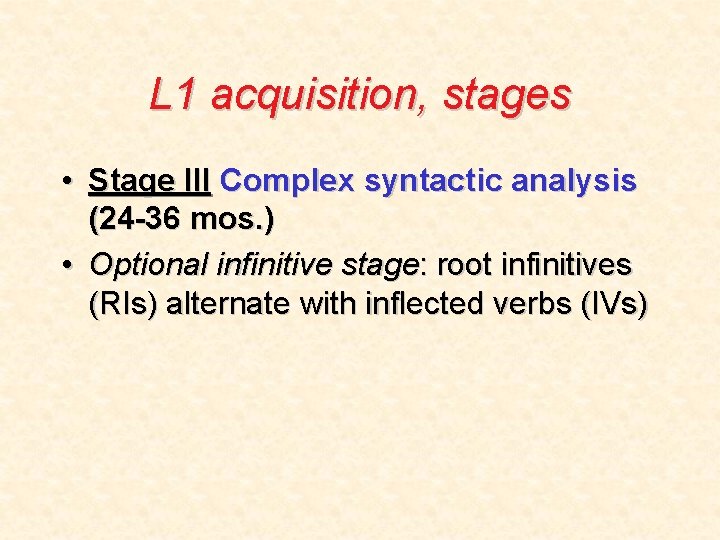
L 1 acquisition, stages • Stage III Complex syntactic analysis (24 -36 mos. ) • Optional infinitive stage: root infinitives (RIs) alternate with inflected verbs (IVs)
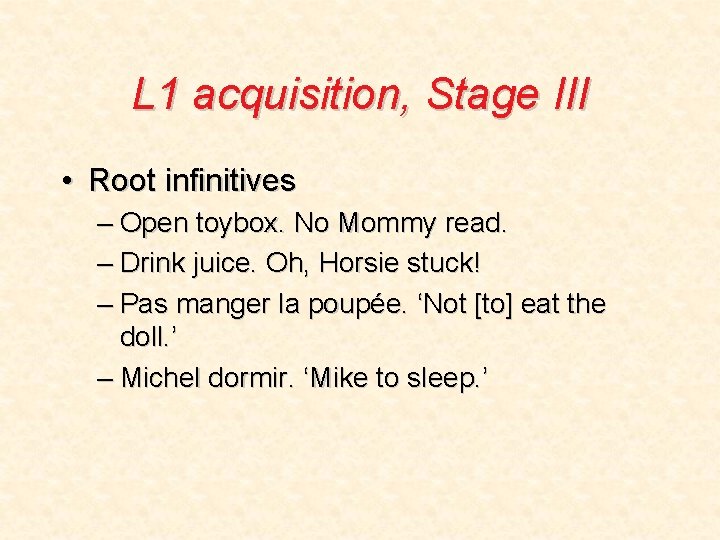
L 1 acquisition, Stage III • Root infinitives – Open toybox. No Mommy read. – Drink juice. Oh, Horsie stuck! – Pas manger la poupée. ‘Not [to] eat the doll. ’ – Michel dormir. ‘Mike to sleep. ’
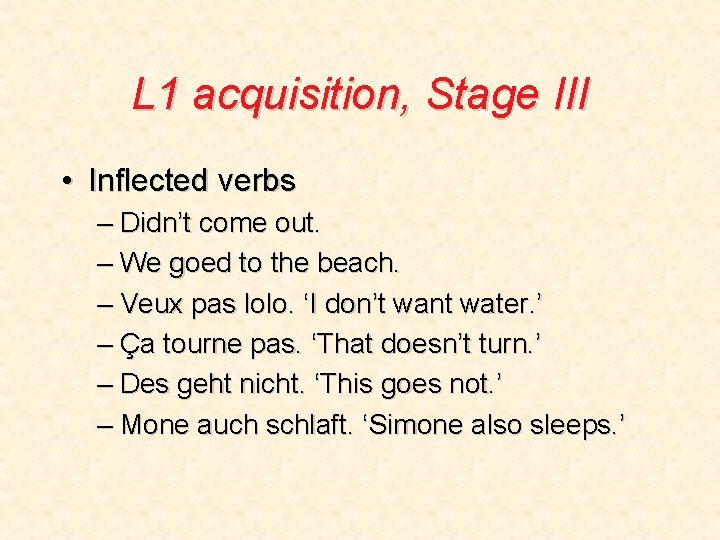
L 1 acquisition, Stage III • Inflected verbs – Didn’t come out. – We goed to the beach. – Veux pas lolo. ‘I don’t want water. ’ – Ça tourne pas. ‘That doesn’t turn. ’ – Des geht nicht. ‘This goes not. ’ – Mone auch schlaft. ‘Simone also sleeps. ’
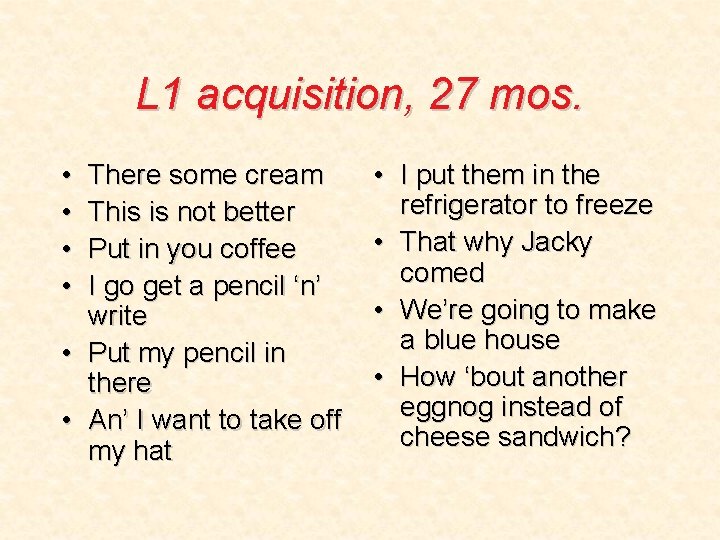
L 1 acquisition, 27 mos. • • There some cream This is not better Put in you coffee I go get a pencil ‘n’ write • Put my pencil in there • An’ I want to take off my hat • I put them in the refrigerator to freeze • That why Jacky comed • We’re going to make a blue house • How ‘bout another eggnog instead of cheese sandwich?
Eva, 27 months • • • Baby lemon. Not work. Baby lemon not work. Unuh. Yeah. Mommy, seeds in there. No. Spit it out.
Eva, 27 months • • • [The] Baby lemon [does] not work. Unuh. Yeah. Mommy, [null] seeds [are] in there. No. [null] spit it out.
Eva, 27 months • • JJ play violin. Mommy, play violin. Play that. Yeah. Me get big play violin. Mommy, my hand do it. Bandaid. Me need bandaid. Owie. Fall. Fell. Me huggin’ baby. Me on bottom, me on top.
Eva, 27 months • • JJ play[s] [the] violin. Mommy, play [the] violin. Play that. Yeah. Me get big, [null] [will] play violin. Mommy, my hand do[es] it. Bandaid. Me need [a] bandaid. Owie. [null] Fall. [null] Fell. Me huggin’ baby. Me [was] on [the] bottom, me on [the] top.
My own children (examples) sound substitution • Substitution of hard stop consonants (like [k]) • baikin (bacteria) --> baichin • mikan (mandarin orange) --> mitan
metathesis • kojichuu (under construction) --> kojuchi • aisukuriimu (ice cream) --> aisukuruumi (note that two vowels are switched) • onigiri (rice ball) --> ogini (ri is dropped) sarada (salad) --> sadara (note that two syllables are switched)
overextension • neko (‘cat’) --> uma (‘horse’)
How adults talk to children • It is obvious that children need utterances in the target language to acquire it. But it is not clear if they need special input. • Is child-directed speech needed for them to acquire a language? • Questions about “Motherese” • Making corrections -- any effect?
second language acquisition • It is fair to say that one needs explicit instruction to supplement what one can do “naturally” if one is to learn a new language as an adult (anyone after puberty).