
First Investment Forum on OIC Plan of Action
- Slides: 40
First Investment Forum on OIC Plan of Action for Cooperation with Central Asia – SMIIC General Secretariat 27 -28 October 2014 Dushanbe, Republic of Tajikistan 1
SMIIC, OIC/SMIIC HALAL STANDARDS and increase of intra-OIC trade. 2
OUTLINE � OIC � SMIIC � STANDARDIZATION � ACCREDITATION � SMIIC AND HALAL � CONCLUSION 3
OIC 4
Organization of Islamic Cooperation (OIC) � The second largest inter-governmental organization after the United Nations. � Established in September 1969. � 57 Member States spread over four continents. � Collective voice of the Muslim world and ensuring to safeguard and protect the interests of the Muslim world. OIC 5
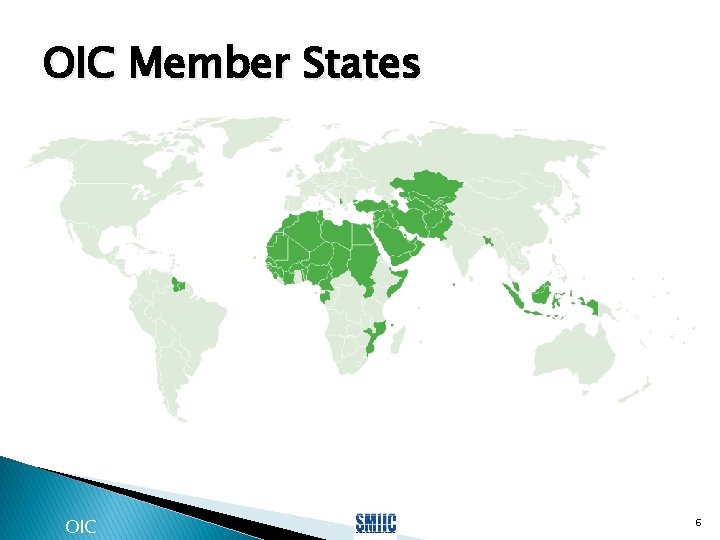
OIC Member States OIC 6
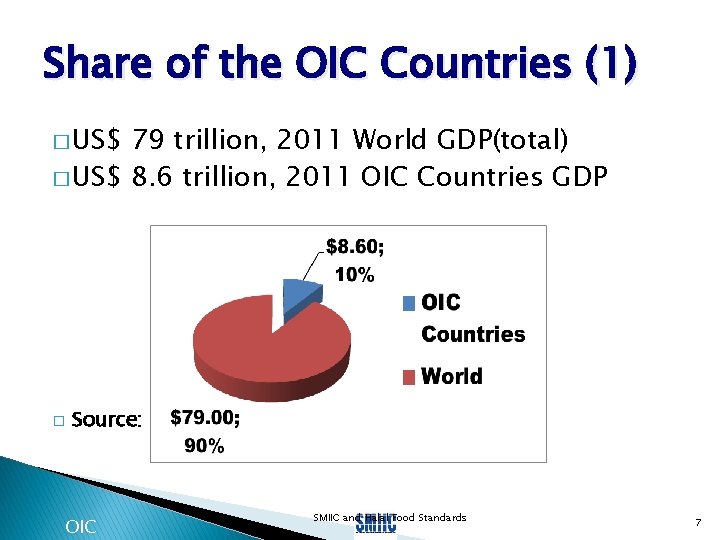
Share of the OIC Countries (1) � US$ 79 trillion, 2011 World GDP(total) � US$ 8. 6 trillion, 2011 OIC Countries GDP � Source: SESRIC 2012 Annual Economic Report OIC SMIIC and Halal Food Standards 7
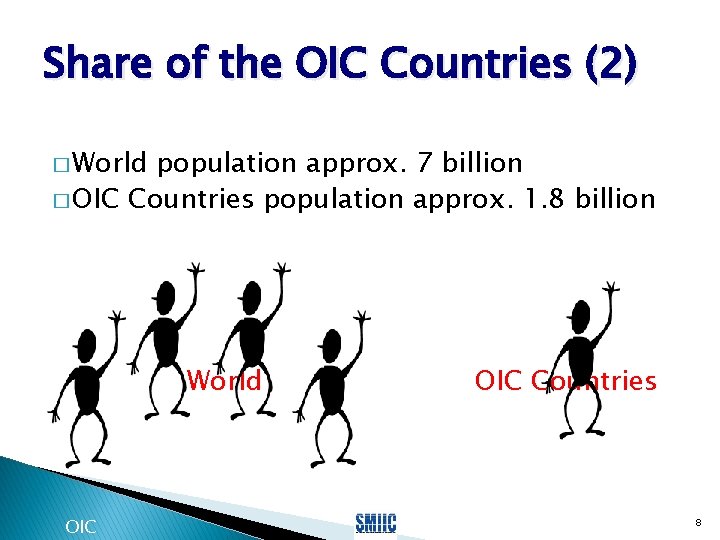
Share of the OIC Countries (2) � World population approx. 7 billion � OIC Countries population approx. 1. 8 billion World OIC Countries 8
Share of the OIC Countries (3) � This picture is not fair � A quarter(25%) population with %10 share of world economy � OIC Countries do not deserve this. So; � SOLUTION / ACTION: Trade should be increased ØBy removing the technical barriers to trade OIC 9
SMIIC 10
What is SMIIC? � SMIIC is an affiliated organ to the OIC (The Organisation of Islamic Cooperation). � Has its own budget. � Established in August 2010. � Headquarters SMIIC located in Istanbul, Turkey. 11
Main Objectives OF SMIIC 1) To develop harmonized standards 2) To prepare OIC/SMIIC standards 3) To achieve uniformity in metrology, laboratory testing and standardization 4) To provide technical assistance to the Member States who do not possess such standard bodies. 5) To establish an Accreditation Scheme SMIIC 12
SMIIC MEMBERS - All OIC Member States through their National Standardization, Metrology and Accreditation Bodies can be a member. - SMIIC has 29 Member States to date. http: //www. smiic. org/smiic-members SMIIC and Halal Food Standards 13
STANDARDIZATION 14
WHAT IS A STANDARD? � � � A document established by CONSENSUS, Approved by a recognized body, Contributed by its stakeholders, For common and repeated use, Voluntary. A DOCUMENT WHICH DEFINES THE MUSTS OF A PRODUCT OR SERVICE OR A PROCESS STANDARDIZATION 15
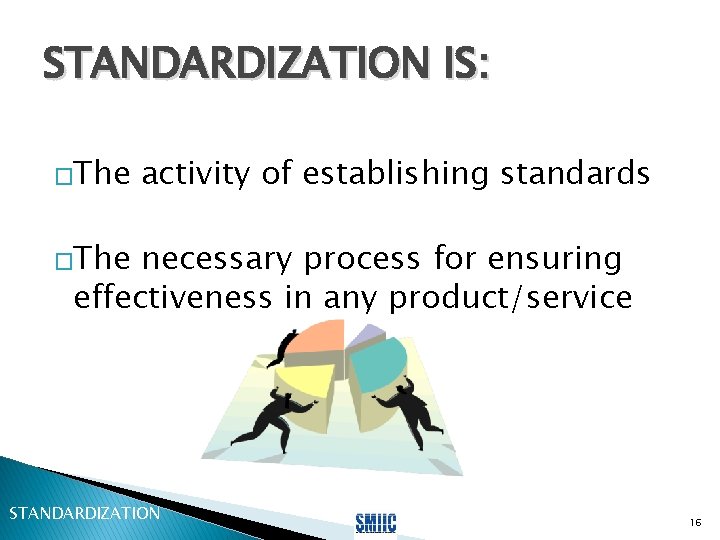
STANDARDIZATION IS: �The activity of establishing standards �The necessary process for ensuring effectiveness in any product/service STANDARDIZATION 16
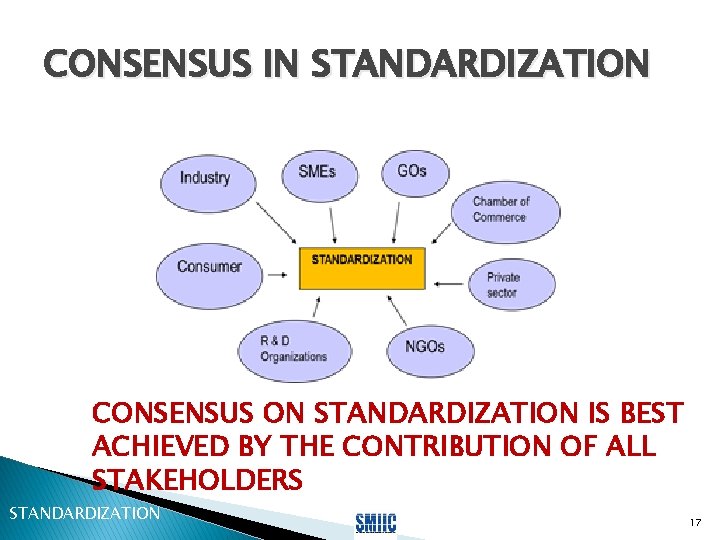
CONSENSUS IN STANDARDIZATION CONSENSUS ON STANDARDIZATION IS BEST ACHIEVED BY THE CONTRIBUTION OF ALL STAKEHOLDERS STANDARDIZATION 17
TECHNICAL COMMITTEES � Standards are not developed by the standardization organization itself. � Standardization is handled by various TECHNICAL COMMITTEES (TCs). 18
TECHNICAL COMITTEES are: � key bodies that drive the standardization process � comprise of experts from the member organizations �a completely voluntary effort TCs ARE THE KEY BODIES IN THE STANDARDIZATION PROCESS Technical Committees 19
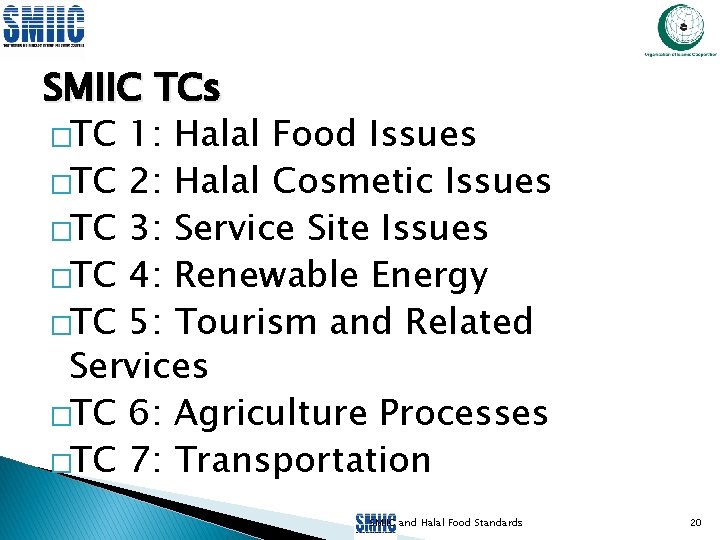
SMIIC TCs �TC 1: Halal Food Issues �TC 2: Halal Cosmetic Issues �TC 3: Service Site Issues �TC 4: Renewable Energy �TC 5: Tourism and Related Services �TC 6: Agriculture Processes �TC 7: Transportation SMIIC and Halal Food Standards 20
Accreditation �Accreditation is the internationally accepted procedure that recognizes the competence of testing and calibration laboratories, product certification bodies, quality system certification bodies and inspection bodies. SMIIC and Halal Food Standards 21
Accreditation (1) �Accreditation schemes minimize the duplication of re -testing and re-certification, reduces cost and eliminates non-tariff barriers to trade and market access delays. 22
SMIIC Accreditation Committee � It is the unit assigned the task of; • Coordination of OIC Member States accreditation organizations to implement the OIC/SMIIC 3: 2011 “Guidelines for the Halal Accreditation Body accrediting Halal Certification Bodies” standard. � All national accreditation organizations of OIC Member States are eligible to be a member of it. SMIIC and Halal Food Standards 23
SMIIC Metrology Committee � SMIIC Metrology Committee (MC) is SMIIC’s operational structure for cooperation between metrology institutes from Islamic Countries. � 26 Members States. � facilitate and harmonize the activities of metrology services in Member Countries 24
HALAL AND SMIIC 25
The need of a Global Halal Food Std. n Differing Halal standards not only between countries but also within each country, cause confusion, extra costs and technical barriers. 26
� In fact, all sectors recognize the need for one global Halal standard that is recognized by all importing countries. � Different Halal authorities follow different Islamic rulings regarding issues such as gelatine, some additives, slaughtering type and stunning of animals. 27
Solution ? must be a common platform where all the parties come together to define the minimum requirements of a Halal Standard � There platform is nothing but SMIIC which is the technically competent body on Halal Issues. � This SMIIC and Halal Food Standards 28
OIC/SMIIC Standards on Halal Food � OIC/SMIIC Halal Food 1: 2011, General Guidelines on � OIC/SMIIC 2: 2011, Guidelines for Bodies Providing Halal Certification � OIC/SMIIC 3: 2011, Guidelines for the Halal Accreditation Body Accrediting Halal Certification Bodies SMIIC and Halal Food Standards 29
Certification and Accreditation Mechanism in Brief �Production in compliance with OIC/SMIIC 1 �Certification of producers according to OIC/SMIIC 1 by the certifiers in compliance with OIC/SMIIC 2. �Accreditation of certifiers according to OIC/SMIIC 2 by the accreditation body in compliance with OIC/SMIIC 3. 30
Briefly the mechanism is, Control of the competency of Halal Certification Bodies that implement OIC/SMIIC standard, through a common Accreditation Scheme established by the SMIIC Accreditation Committee amongst Members. 31
The Result, �Increase of consumer trust on Halal, �Tracebility, �Mutual Recognition of certificates through accreditation �Diminishing technical barriers to trade with mutual recogniton 32
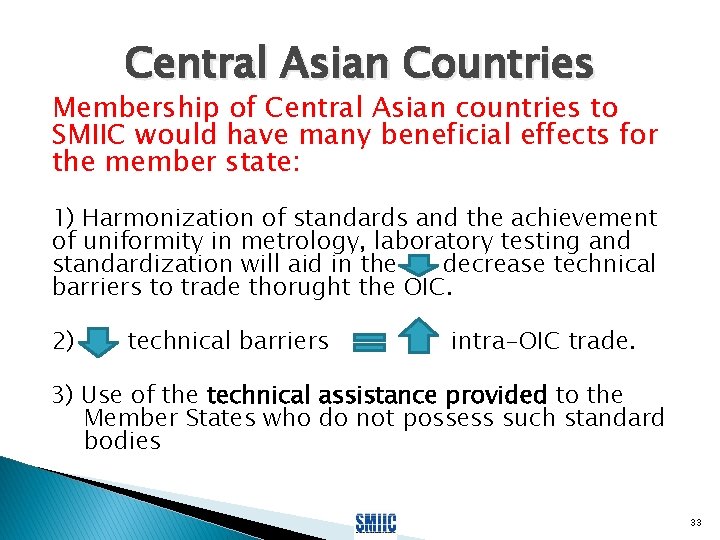
Central Asian Countries Membership of Central Asian countries to SMIIC would have many beneficial effects for the member state: 1) Harmonization of standards and the achievement of uniformity in metrology, laboratory testing and standardization will aid in the decrease technical barriers to trade thorught the OIC. 2) technical barriers intra-OIC trade. 3) Use of the technical assistance provided to the Member States who do not possess such standard bodies 33
� Membership of SMIIC, would give the possibility to voice and represent the needs of the National Standards, Metrology and/or Accreditation body and country. � Membership of SMIIC allows for members to come together in a platform(SMIIC Technical Committees) where standards are being harmonized and a common standard is being developed for the purpose and use of all SMIIC Members. 34
� Coming together in SMIIC meetings or any other congresses, forums, allows for SMIIC Members to network, have one-on-one meetings, work collaboratively to aid in the further development of infrastructure of members. � National Metrology bodies can become members of the SMIIC Metrology Committee. � National Accreditation Bodies can become members of the SMIIC Accreditation Committee and be involved with its activities, developments and network. 35
CONCLUSION 36
1. OIC/SMIIC Halal Standards are the result of a common study of OIC Members and Institutions through Technical Committees. COMMON Platform to make Common Standards: SMIIC 37
2. Adoption and Implementation of Halal Standards by the related parties is of vital importance �OIC/SMIIC 1 for production and certification �OIC/SMIIC 2 for certification and accreditation �OIC/SMIIC 3 for Accreditation 38
- One standard, - One test, - One mark (wherever possible). SMIIC and Halal Food Standards 39
THANKS 40