
First Grade Title 1 Night March 18 th


- Slides: 13
First Grade Title 1 Night March 18 th 5: 30 - 6: 30
Reading • Students will read challenging texts and will be asked questions that require them to refer back to the book they have read. • Reading stories and showing they understand the lesson or moral of the story. • Asking and answering questions about a story, including characters, settings, and major events • Comparing and contrasting the experiences of different characters • Comparing and contrasting different texts • Explaining differences between fiction and nonfiction • Learning and using new words • Participating in class discussions by listening, responding to what others are saying, and asking questions
Writing ● Learning basic rules of spoken and written English ● Writing to describe an event, give information on a topic, or share an opinion using details and transitional words. ● Use correct letter formation, spacing, punctuation and capitalization. ● Writing in first grade: narratives, nonfiction writing, how-to books, opinion writing, poems
Spanish ● Learning basic rules of spoken and written Spanish. ● Recognition of the different syllables in the Language. ● Recognition of the High Frequency words. ● Writing to describe an event, give information on a topic, or share an opinion using details. ● Use correct letter formation, spacing, punctuation and capitalization. ● Writing in first grade: narratives, nonfiction writing, how-to books, opinion writing.
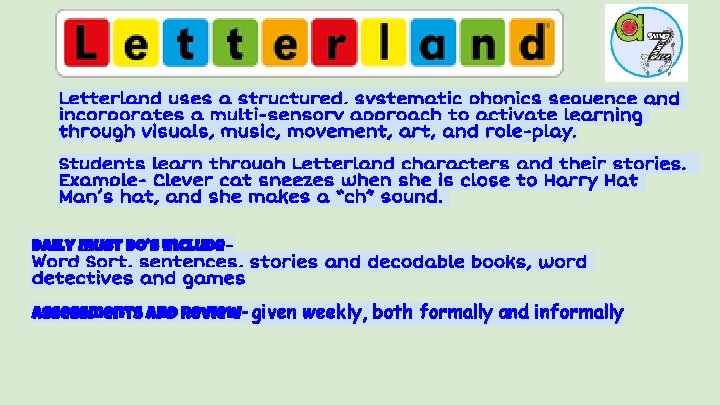
Letterland uses a structured, systematic phonics sequence and incorporates a multi-sensory approach to activate learning through visuals, music, movement, art, and role-play. Students learn through Letterland characters and their stories. Example- Clever cat sneezes when she is close to Harry Hat Man’s hat, and she makes a “ch” sound. Daily must do’s include. Word Sort, sentences, stories and decodable books, word detectives and games Assessments and review- given weekly, both formally and informally
Math • In grade one, students will work with whole numbers to 150 and place value— • • including grouping numbers into tens and ones as they learn to add and subtract up through 20. Activities in these areas will include: Quickly and accurately adding numbers together that total up to 10 or less and subtracting from numbers up through 10 Understanding the rules of addition and subtraction (for example, 5+2=2+5) Understanding the meaning of the equal sign (=) and determining if statements involving addition and subtraction are true or false (for example, which of the following statements are true? 3+3=6, 4+1=5+2) Adding and subtracting multiples of ten Solving word problems that involve adding or subtracting numbers up through 20 with an unknown AND AN EQUATION THAT MATCHES.
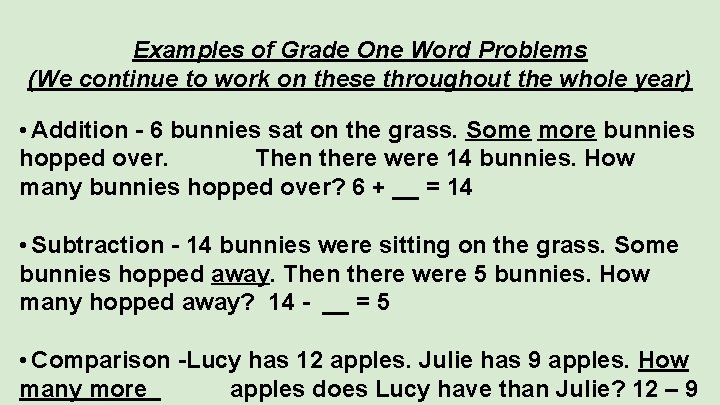
Examples of Grade One Word Problems (We continue to work on these throughout the whole year) • Addition - 6 bunnies sat on the grass. Some more bunnies hopped over. Then there were 14 bunnies. How many bunnies hopped over? 6 + __ = 14 • Subtraction - 14 bunnies were sitting on the grass. Some bunnies hopped away. Then there were 5 bunnies. How many hopped away? 14 - __ = 5 • Comparison -Lucy has 12 apples. Julie has 9 apples. How many more apples does Lucy have than Julie? 12 – 9
• Comparing two-digit numbers using the symbols > (more than), = (equal to) , and < (less than) • Adding one and two-digit numbers together using a variety of strategies besides counting all. • Measuring the lengths of objects using a shorter object as a unit of length • Putting objects in order from longest to shortest or shortest to longest • Dividing shapes into halves and quarters/fourths
5 Essential Elements of IB PYP. Knowledge: What we want our students to know. Key Concepts: 7 ideas to help students have a better understanding. Form, Function, Causation, Connection, Perspective, Responsibility, Change. Approaches to Learning: Helps student learn how to learn. Social Skills, Research Skill, Thinking Skills, Communication Skills, Self-Management Skills. Learner Profile: We strive to be -Open-minded, Risk-takers, Caring, Balanced, Principled, Knowledgeable, Inquirers, Thinkers, Communicators, Reflective.
Inquiry: IB • Social Studies & Science become 5 cohesive units 1. Who We Are 2. How we Express Ourselves 3. How the World Works 4. Where we are in Place and Time 5. Sharing the Planet • Inquiry objectives are worked into all subject Units (Ex: Nonfiction Reading Unit
What went home and how do I use it? ● Math flash cards: ○ Show child and allow time to answer. ○ Have your child find two problems that are equal. ● 150 chart: ○ Use to help them practice counting to 150. ○ Call out a number and have them point to it. ○ Practice counting by 10 s starting at any number. ○ Use to help solve addition and subtraction problems or flash cards.
● Sight word flash cards: ○ Show child and allow time to answer. Have child also spell the word and use in a sentence. ○ PIck a few and put around the house. Child has to read it every time they pass it. ○ Speed read them. ● Word family cards: ○ Have your child read the word under the picture. ○ Then see what other words they can come up with that rhyme with it. ○ Turn the card over and practice reading the list of words.
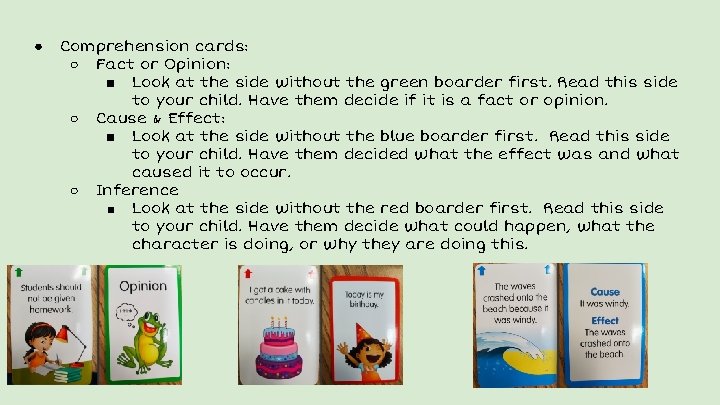
● Comprehension cards: ○ Fact or Opinion: ■ Look at the side without the green boarder first. Read this side to your child. Have them decide if it is a fact or opinion. ○ Cause & Effect: ■ Look at the side without the blue boarder first. Read this side to your child. Have them decided what the effect was and what caused it to occur. ○ Inference ■ Look at the side without the red boarder first. Read this side to your child. Have them decide what could happen, what the character is doing, or why they are doing this.