
First Generation Computers 1940 1956 Second Generation Computers


- Slides: 11
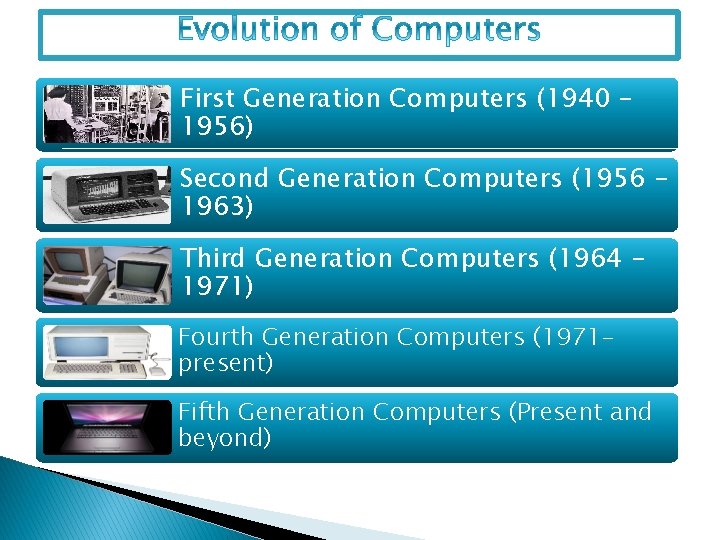
First Generation Computers (1940 – 1956) Second Generation Computers (1956 1963) Third Generation Computers (1964 1971) Fourth Generation Computers (1971 present) Fifth Generation Computers (Present and beyond)
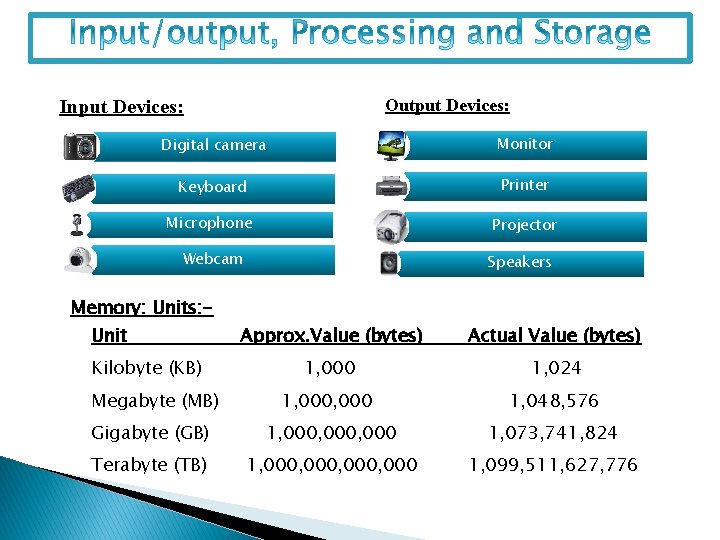
Output Devices: Input Devices: Digital camera Monitor Keyboard Printer Microphone Projector Webcam Speakers Memory: Units: Unit Approx. Value (bytes) Actual Value (bytes) 1, 000 1, 024 Megabyte (MB) 1, 000 1, 048, 576 Gigabyte (GB) 1, 000, 000 1, 073, 741, 824 Terabyte (TB) 1, 000, 000 1, 099, 511, 627, 776 Kilobyte (KB)
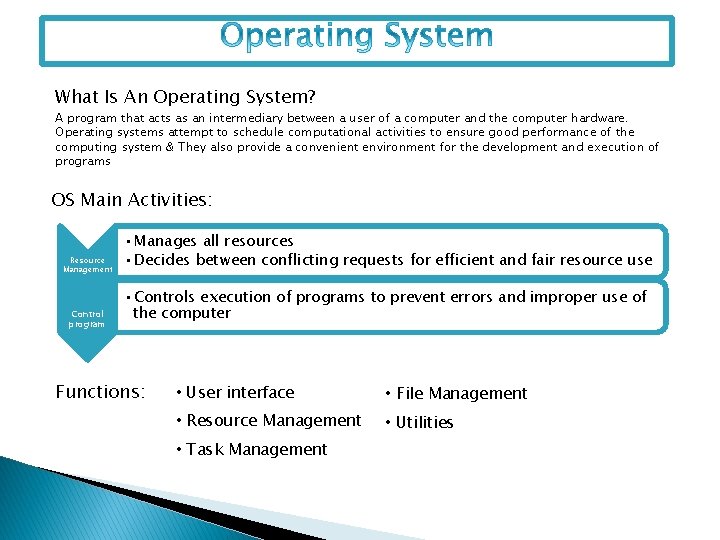
What Is An Operating System? A program that acts as an intermediary between a user of a computer and the computer hardware. Operating systems attempt to schedule computational activities to ensure good performance of the computing system & They also provide a convenient environment for the development and execution of programs OS Main Activities: Resource Management Control program • Manages all resources • Decides between conflicting requests for efficient and fair resource use • Controls execution of programs to prevent errors and improper use of the computer Functions: • User interface • File Management • Resource Management • Utilities • Task Management
Definition of Information System (IS): Information system is an integrated set of components for collecting, storing, processing, and communicating information. Definition on Management Information System (MIS): Management Information System on the other hand is an information system, usually electronic, designed to collect, store and transmit data to aid management in planning and directing the operations of an organization. Basic Functions Of Information System Ø Information Processing and Usability Function. Ø User Education and Learning Function. Ø Information Systems Development Function Ø Management and Control Function. Ø Information Strategic Functions.
What Is System Development Methodology? The systems development life cycle (SDLC) is a conceptual model or methodology used in project management that describes the stages involved in an information system development project, from an initial feasibility study through maintenance of the completed application. Waterfall Model:
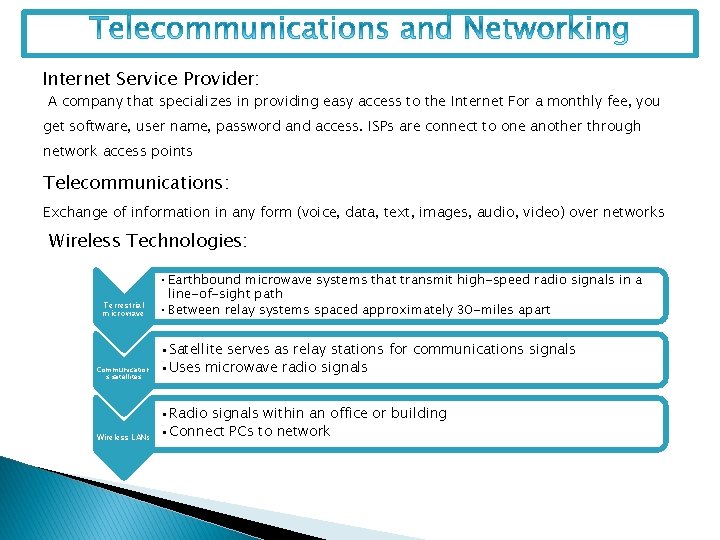
Internet Service Provider: A company that specializes in providing easy access to the Internet For a monthly fee, you get software, user name, password and access. ISPs are connect to one another through network access points Telecommunications: Exchange of information in any form (voice, data, text, images, audio, video) over networks Wireless Technologies: Terrestrial microwave Communication s satellites Wireless LANs • Earthbound microwave systems that transmit high-speed radio signals in a line-of-sight path • Between relay systems spaced approximately 30 -miles apart • Satellite serves as relay stations for communications signals • Uses microwave radio signals • Radio signals within an office or building • Connect PCs to network
What is ERP(Enterprise Resource Planning)? ERP is package software solution that addresses the enterprise needs of an organization by tightly integrating the various functions of an organization using a process view of the organization. Benefits Of ERP: Ø A single system to support rather than several small and different systems. Ø A single applications architecture with limited interfaces. Ø Access to management information unavailable across a mix of Applications. Ø Access to best practice systems and procedures. Ø More integration hence lower costs. Ø More "automation" of tasks Generic Costs and Impacts.
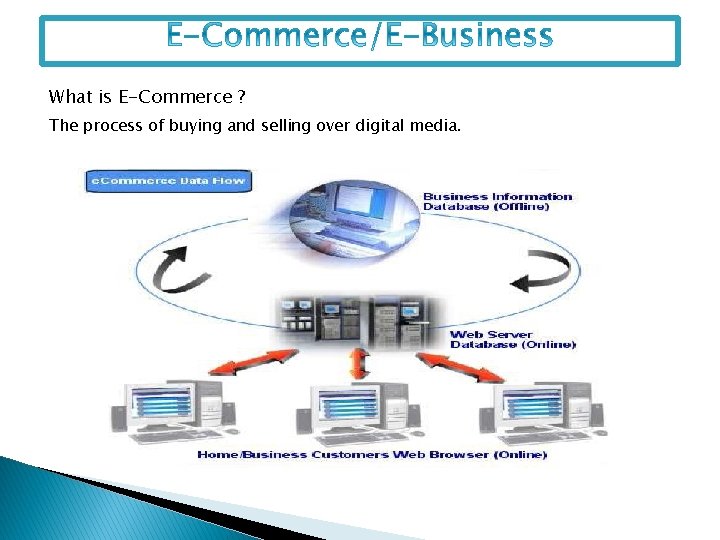
What is E-Commerce ? The process of buying and selling over digital media.
M-Commerce: M-commerce (mobile commerce) is the buying and selling of goods and services through wireless handheld devices such as cellular telephone and personal digital assistants (PDAs). Usability Of AI, ES, NN: I. Artificial Intelligence: AI is characterized by its ability to deal with incomplete and imprecise information and to accumulate knowledge. II. Expert System: Expert systems, building on standard computing techniques, depend heavily on the domain experts and knowledge engineers that have programmed them to represent the real world. III. Neural Networks: Neural networks are intended to emulate the pattern recognition and parallel processing capabilities of the human brain and are taught rather than programmed.
THE END Produce By :