
FIRST FOR SCHOOLS SPEAKING PART DO Make sure




- Slides: 17
FIRST FOR SCHOOLS
SPEAKING PART
DO • Make sure you are familiar with what happens, and what skills you need to show, in each part of the test. • Practise speaking English as much as possible in groups and in pairs, both inside and outside the classroom. • Listen carefully to the instructions and questions during the test and respond appropriately. • Speak clearly, so that both the interlocutor and assessor can hear you.
• Use all the opportunities you are given to speak in the test, and extend your responses whenever possible. • Ask for clarification of instructions or a question if you’re not sure. • Initiate discussion as well as responding to what your partner says. • Make full use of the time so that the examiner who is listening hears plenty of your English.
DON’T • Don’t prepare long answers in advance, or learn and practice speeches. • Don’t dominate your partner or interrupt them abruptly during the Speaking test. • Don’t leave long or frequent pauses. • Don’t worry about being interrupted by the examiner. This shows you have spoken enough. The tests have to keep to the time limit for administrative reasons.
READING
DO • Read the sources, titles and subtitles of the texts where given; they are there to help you. • Read each text carefully before you answer the questions to get an overall impression and understanding of it. This includes Part 3, the multiple-matching task. • Check the words around the gap carefully (Part 2). The missing word(s) may be forming part of an idiom, fixed phrase or collocation. • Check that the completed paragraph makes sense in the passage as a whole (Part 2). The missing sentence must fit the overall context. • Keep the development of the text in mind. • Read the questions carefully and check each option against the text before rejecting it. (Part 2)
DON'T • Don’t try to answer any questions without referring carefully to the text. • Don’t spend too much time on any one part of the paper. • Don’t forget to record your answers on the separate answer sheet. • Don’t assume that if the same word appears in the text as well as in an option, this means you have located the answer.
WRITING
DO • Read the whole question thoroughly and underline important parts. • Make a plan for each answer, including ALL points. • Expand the points in Part 1 if you can, using relevant ideas and information. • Write in paragraphs, whenever appropriate. • Use a range of vocabulary, even if you are unsure of the correct spelling. • Check tense endings, plural forms and word order in sentences. • Check irregular past tenses and question formation. • Use language that is appropriately formal or informal for the task. • Choose a Part 2 question that you feel confident you can write about. • Write clearly, so that the examiner can read your answer.
DON’T • Don’t misspell key words which appear on the question paper. • Don’t use the exact words from the question paper too much. • Don’t mix formal and informal language. • Don’t use formal linkers in an informal letter. • Don’t waste time writing addresses for a letter. They are not required. • Don’t answer Question 5 if you haven’t read one of the books. • Don’t worry if you run slightly over the word limit.
USE OF ENGLISH
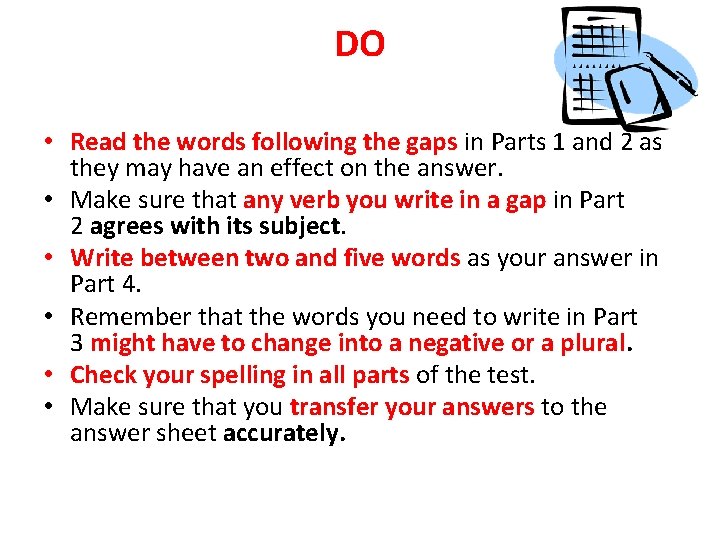
DO • Read the words following the gaps in Parts 1 and 2 as they may have an effect on the answer. • Make sure that any verb you write in a gap in Part 2 agrees with its subject. • Write between two and five words as your answer in Part 4. • Remember that the words you need to write in Part 3 might have to change into a negative or a plural. • Check your spelling in all parts of the test. • Make sure that you transfer your answers to the answer sheet accurately.
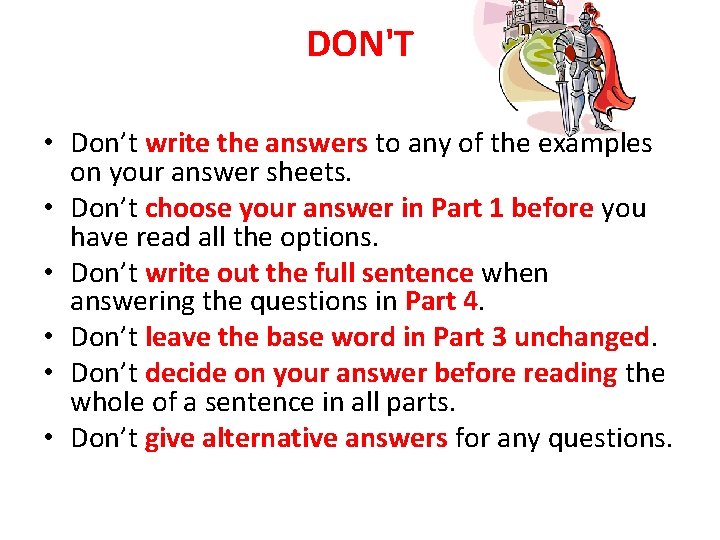
DON'T • Don’t write the answers to any of the examples on your answer sheets. • Don’t choose your answer in Part 1 before you have read all the options. • Don’t write out the full sentence when answering the questions in Part 4. • Don’t leave the base word in Part 3 unchanged. • Don’t decide on your answer before reading the whole of a sentence in all parts. • Don’t give alternative answers for any questions.
LISTENING
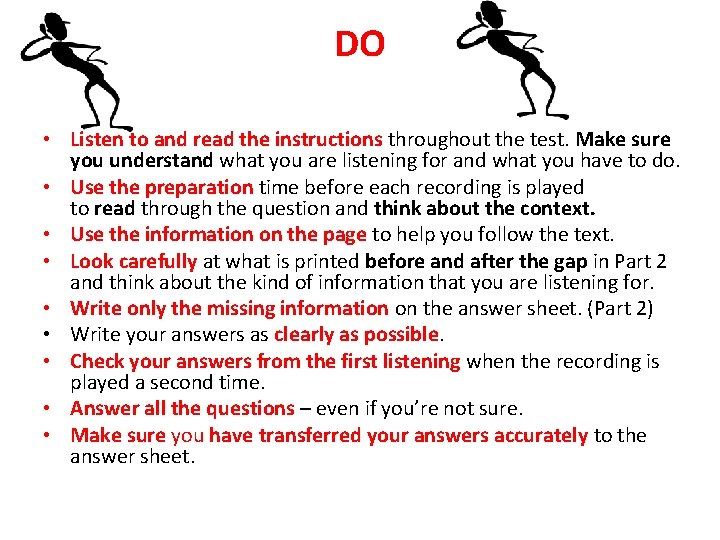
DO • Listen to and read the instructions throughout the test. Make sure you understand what you are listening for and what you have to do. • Use the preparation time before each recording is played to read through the question and think about the context. • Use the information on the page to help you follow the text. • Look carefully at what is printed before and after the gap in Part 2 and think about the kind of information that you are listening for. • Write only the missing information on the answer sheet. (Part 2) • Write your answers as clearly as possible. • Check your answers from the first listening when the recording is played a second time. • Answer all the questions – even if you’re not sure. • Make sure you have transferred your answers accurately to the answer sheet.
DON'T • Don’t rephrase what you hear in Part 2; write down the exact word(s) or figure(s) that you hear on the recording. • Don’t complicate your answer by writing extra, irrelevant information. (Part 2) • Don’t spend too much time on a question you are having difficulty with as you may miss the next question. • Don’t rush to choose an answer just because you hear one word or phrase – concentrate on the overall meaning. (Parts 1, 3 and 4)