
First estimates of energy deposition for the new
- Slides: 23
First estimates of energy deposition for the new inner triplet F. Cerutti, L. S. Esposito on behalf of CERN FLUKA team
• • Outline Description of the physics case Geometric model Basic shielding options Power deposition estimates • Variations respect to baseline scenario (optics conditions, experimental vacuum chamber) A (realistic) shielding proposal Benchmark versus 2011 BLM data for IR 5 Conclusions and outlook 7 June 2012, joint WP 2, WP 3, and WP 10 meeting 2
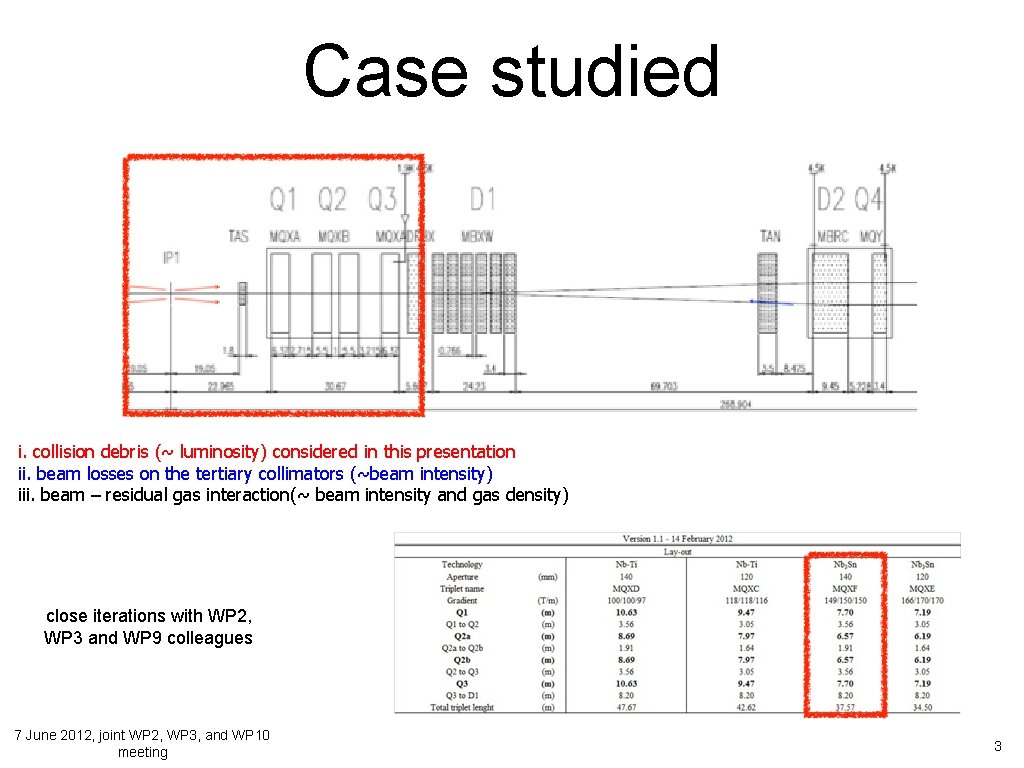
Case studied i. collision debris (~ luminosity) considered in this presentation ii. beam losses on the tertiary collimators (~beam intensity) iii. beam – residual gas interaction(~ beam intensity and gas density) close iterations with WP 2, WP 3 and WP 9 colleagues 7 June 2012, joint WP 2, WP 3, and WP 10 meeting 3
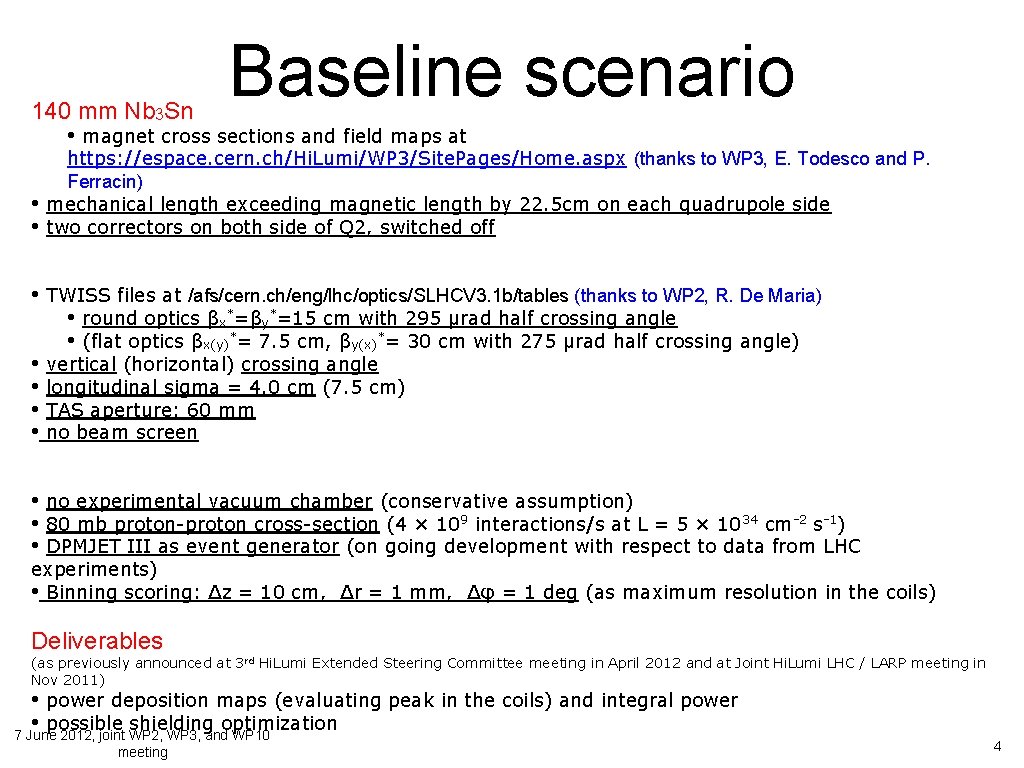
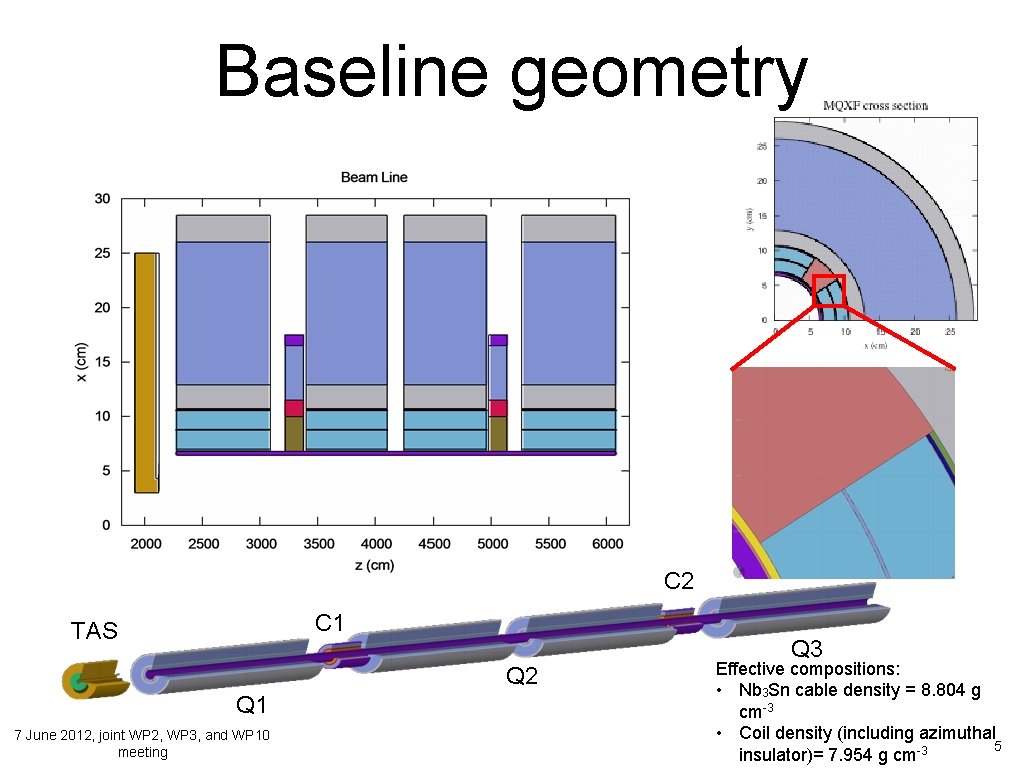
Baseline scenario 140 mm Nb 3 Sn • magnet cross sections and field maps at • • https: //espace. cern. ch/Hi. Lumi/WP 3/Site. Pages/Home. aspx (thanks to WP 3, E. Todesco and P. Ferracin) mechanical length exceeding magnetic length by 22. 5 cm on each quadrupole side two correctors on both side of Q 2, switched off • TWISS files at /afs/cern. ch/eng/lhc/optics/SLHCV 3. 1 b/tables (thanks to WP 2, R. De Maria) • round optics βx*=βy*=15 cm with 295 μrad half crossing angle • (flat optics βx(y)*= 7. 5 cm, βy(x)*= 30 cm with 275 μrad half crossing angle) • vertical (horizontal) crossing angle • longitudinal sigma = 4. 0 cm (7. 5 cm) • TAS aperture: 60 mm • no beam screen • no experimental vacuum chamber (conservative assumption) • 80 mb proton-proton cross-section (4 × 10⁹ interactions/s at L = 5 × 1034 cm-2 s-1) • DPMJET III as event generator (on going development with respect to data from LHC experiments) • Binning scoring: ∆z = 10 cm, ∆r = 1 mm, ∆φ = 1 deg (as maximum resolution in the coils) Deliverables (as previously announced at 3 rd Hi. Lumi Extended Steering Committee meeting in April 2012 and at Joint Hi. Lumi LHC / LARP meeting in Nov 2011) • power deposition maps (evaluating peak in the coils) and integral power • possible shielding optimization 7 June 2012, joint WP 2, WP 3, and WP 10 meeting 4
Baseline geometry C 2 C 1 TAS Q 3 Q 2 Q 1 7 June 2012, joint WP 2, WP 3, and WP 10 meeting Effective compositions: • Nb 3 Sn cable density = 8. 804 g cm-3 • Coil density (including azimuthal 5 insulator)= 7. 954 g cm-3
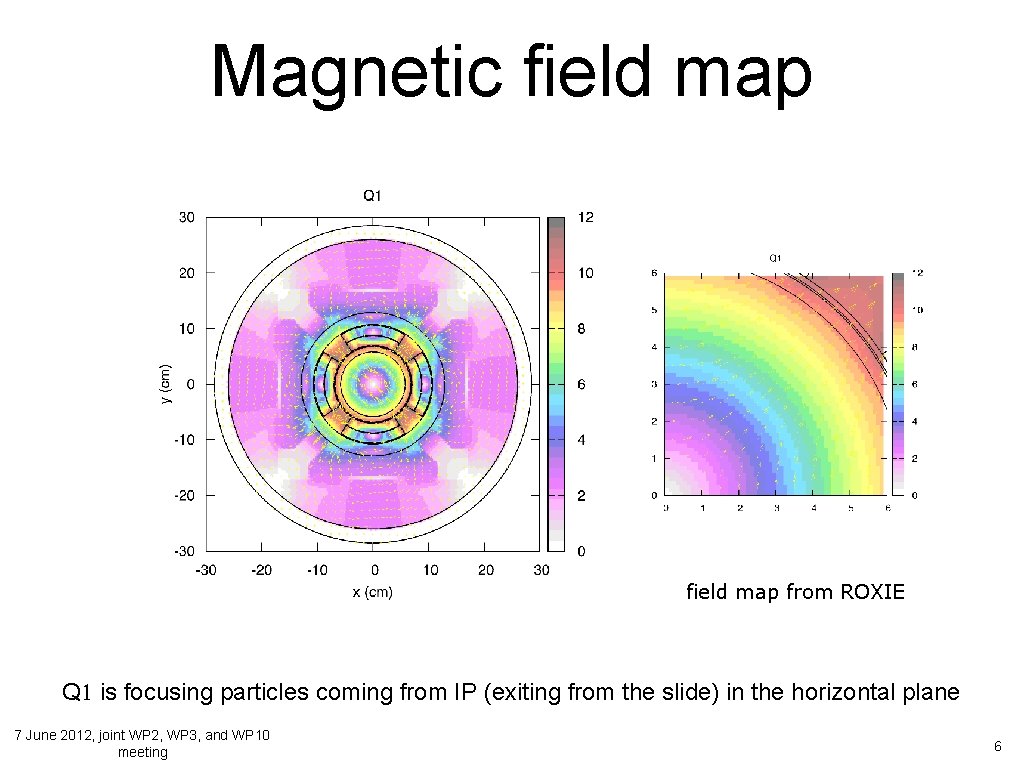
Magnetic field map from ROXIE Q 1 is focusing particles coming from IP (exiting from the slide) in the horizontal plane 7 June 2012, joint WP 2, WP 3, and WP 10 meeting 6
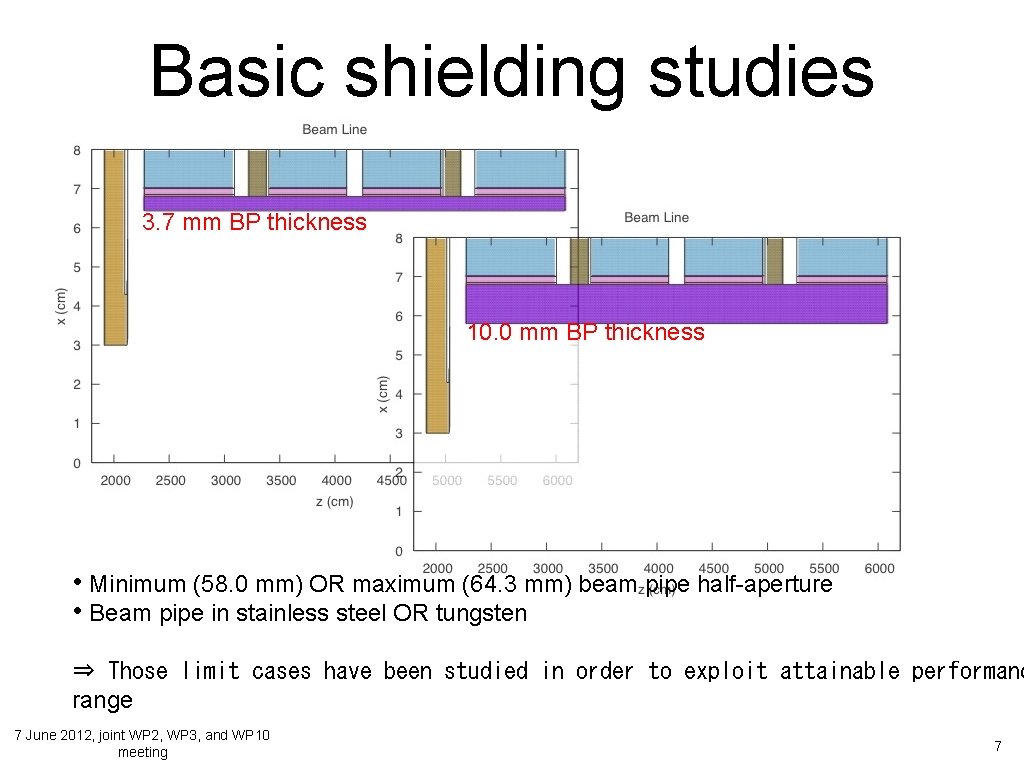
Basic shielding studies 3. 7 mm BP thickness 10. 0 mm BP thickness • Minimum (58. 0 mm) OR maximum (64. 3 mm) beam pipe half-aperture • Beam pipe in stainless steel OR tungsten ⇒ Those limit cases have been studied in order to exploit attainable performanc range 7 June 2012, joint WP 2, WP 3, and WP 10 meeting 7
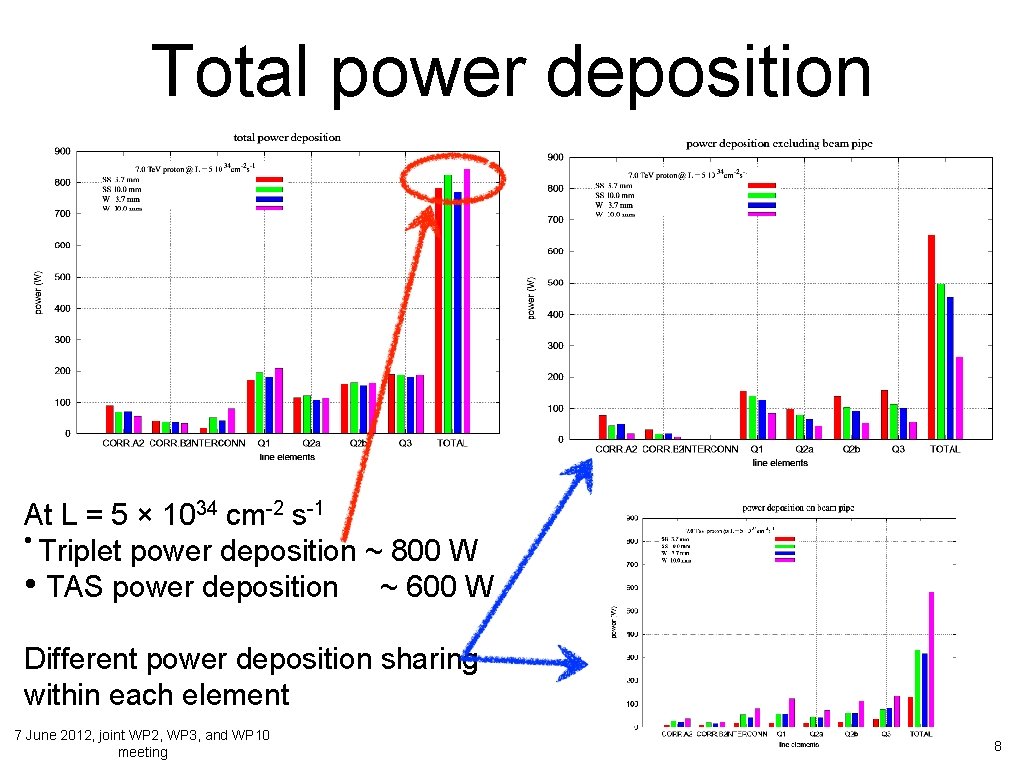
Total power deposition At L = 5 × 1034 cm-2 s-1 • Triplet power deposition ~ 800 W • TAS power deposition ~ 600 W Different power deposition sharing within each element 7 June 2012, joint WP 2, WP 3, and WP 10 meeting 8
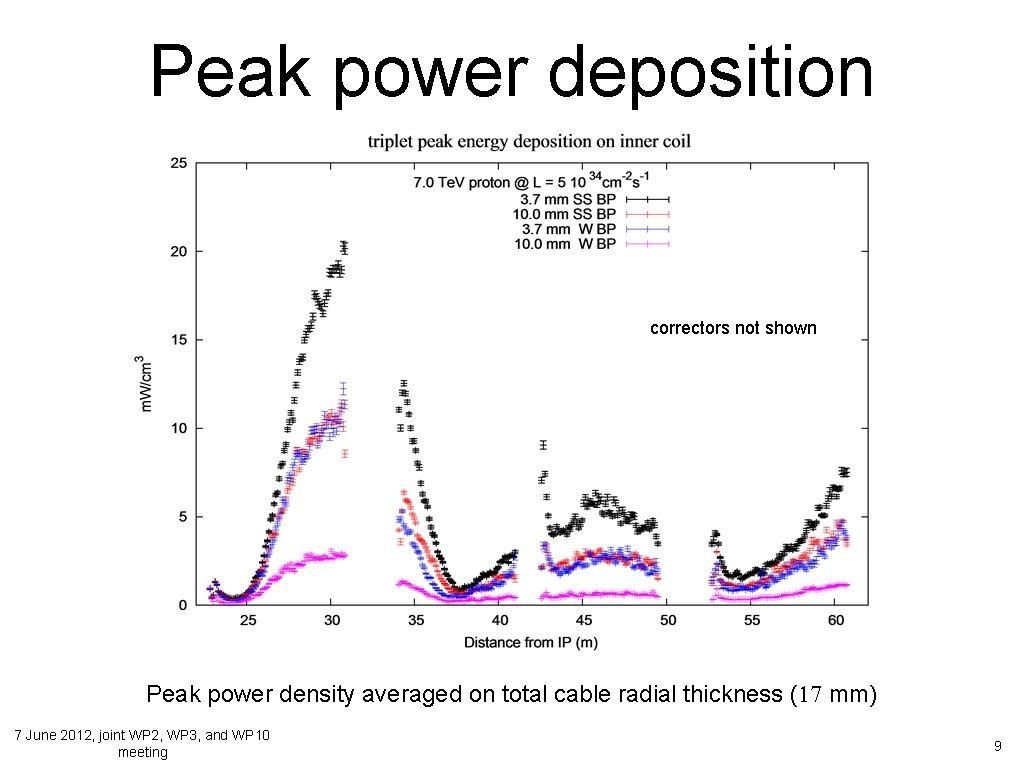
Peak power deposition correctors not shown Peak power density averaged on total cable radial thickness (17 mm) 7 June 2012, joint WP 2, WP 3, and WP 10 meeting 9
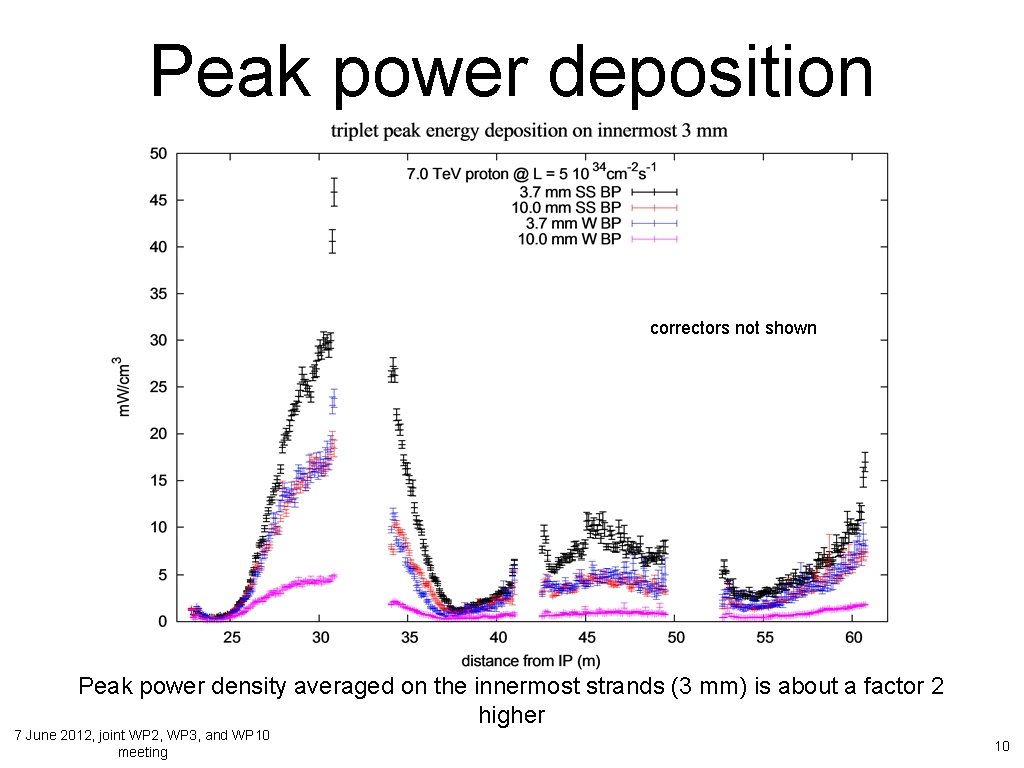
Peak power deposition correctors not shown Peak power density averaged on the innermost strands (3 mm) is about a factor 2 higher 7 June 2012, joint WP 2, WP 3, and WP 10 meeting 10
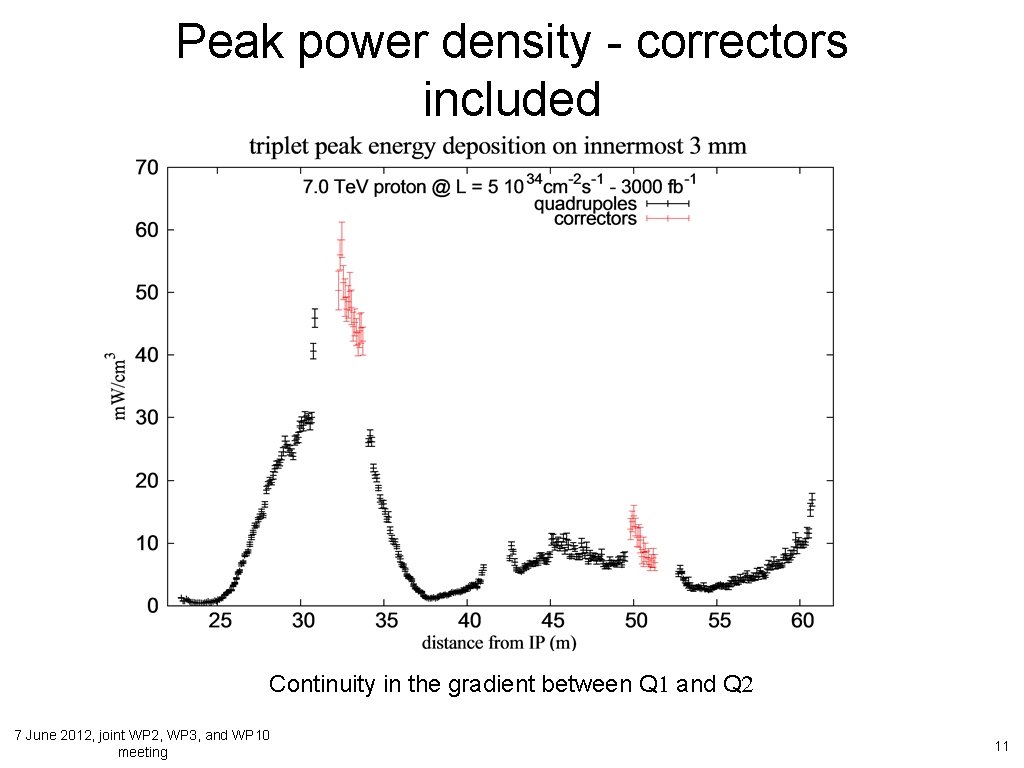
Peak power density - correctors included Continuity in the gradient between Q 1 and Q 2 7 June 2012, joint WP 2, WP 3, and WP 10 meeting 11
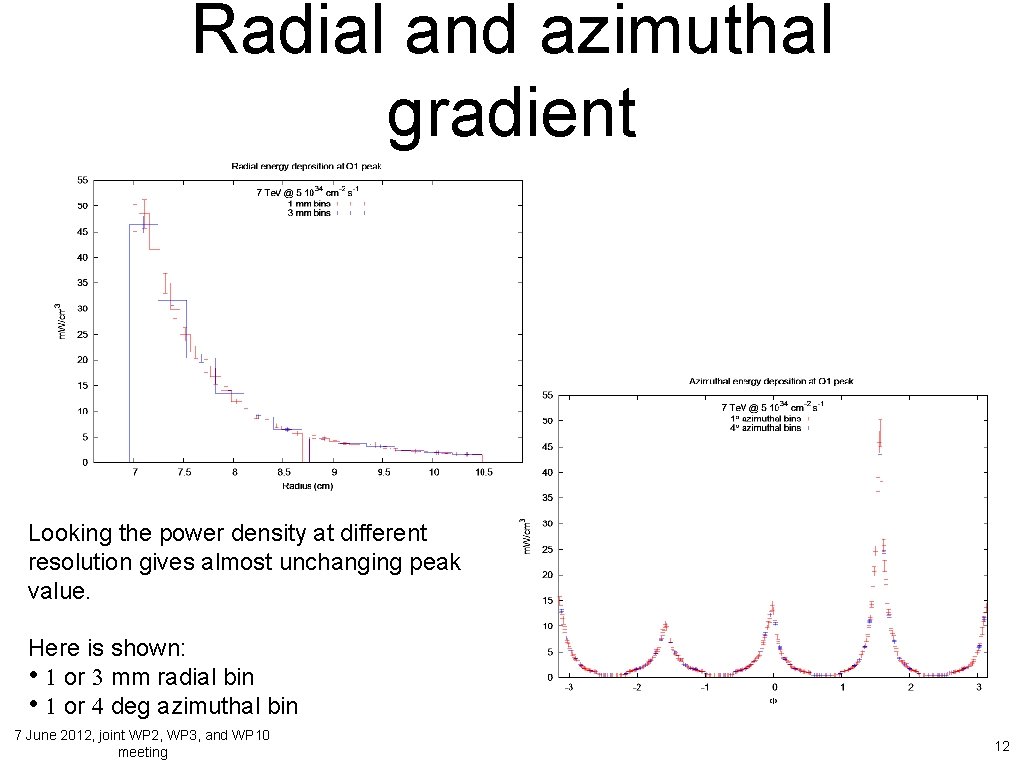
Radial and azimuthal gradient Looking the power density at different resolution gives almost unchanging peak value. Here is shown: • 1 or 3 mm radial bin • 1 or 4 deg azimuthal bin 7 June 2012, joint WP 2, WP 3, and WP 10 meeting 12
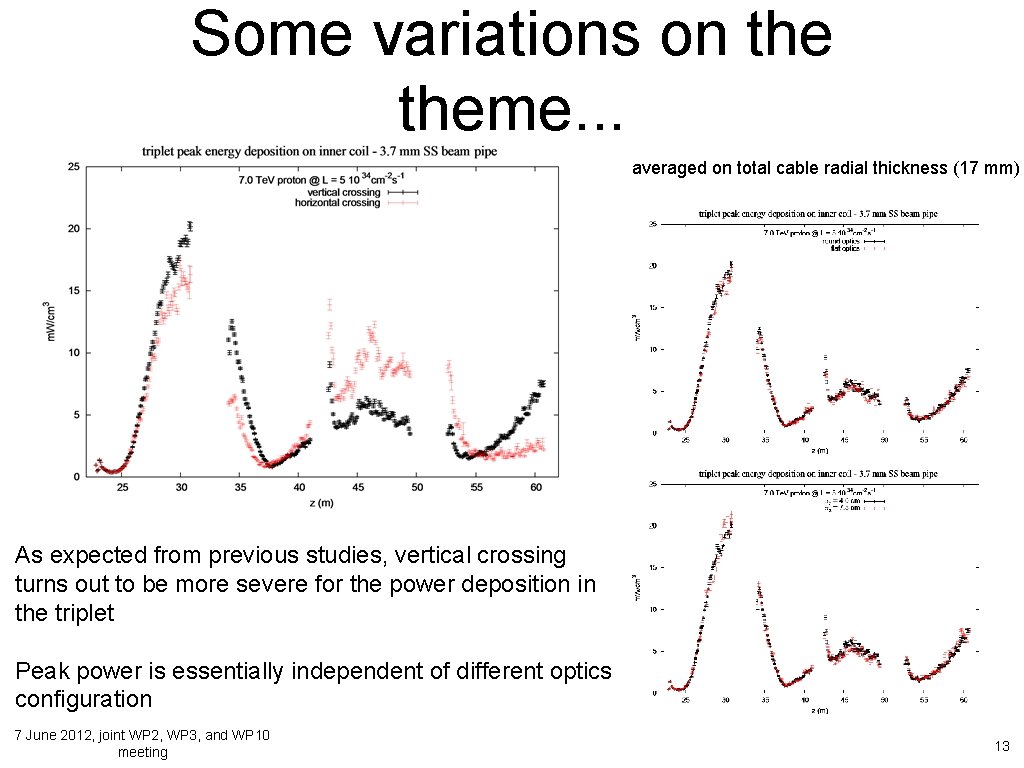
Some variations on theme. . . averaged on total cable radial thickness (17 mm) As expected from previous studies, vertical crossing turns out to be more severe for the power deposition in the triplet Peak power is essentially independent of different optics configuration 7 June 2012, joint WP 2, WP 3, and WP 10 meeting 13
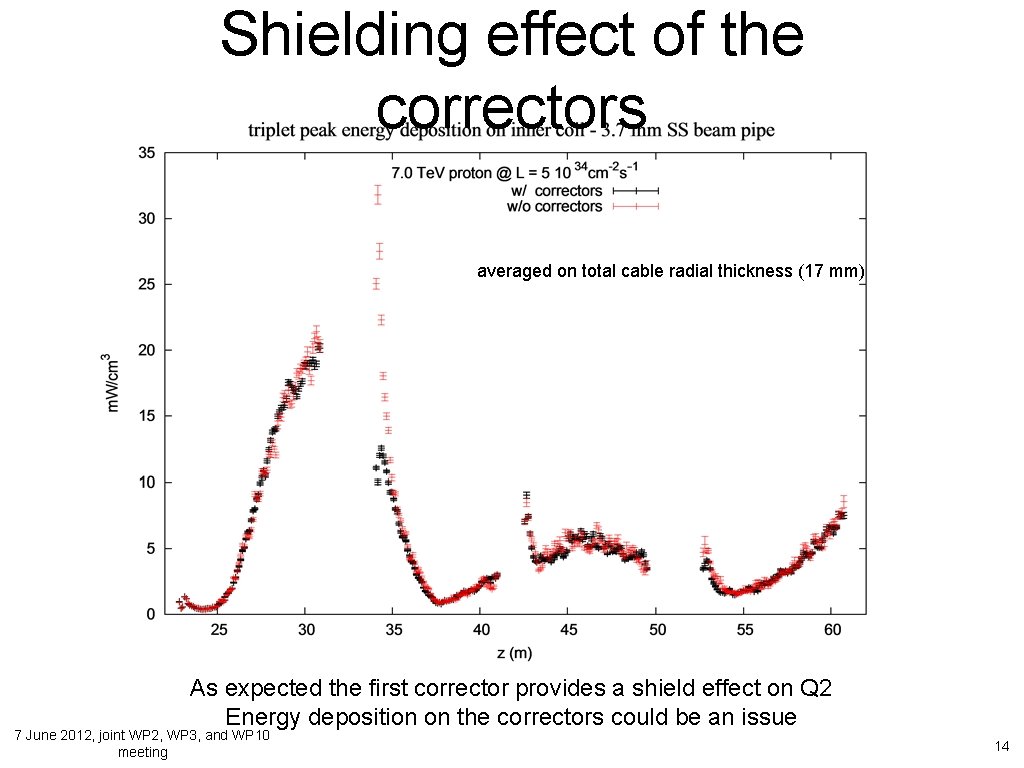
Shielding effect of the correctors averaged on total cable radial thickness (17 mm) As expected the first corrector provides a shield effect on Q 2 Energy deposition on the correctors could be an issue 7 June 2012, joint WP 2, WP 3, and WP 10 meeting 14
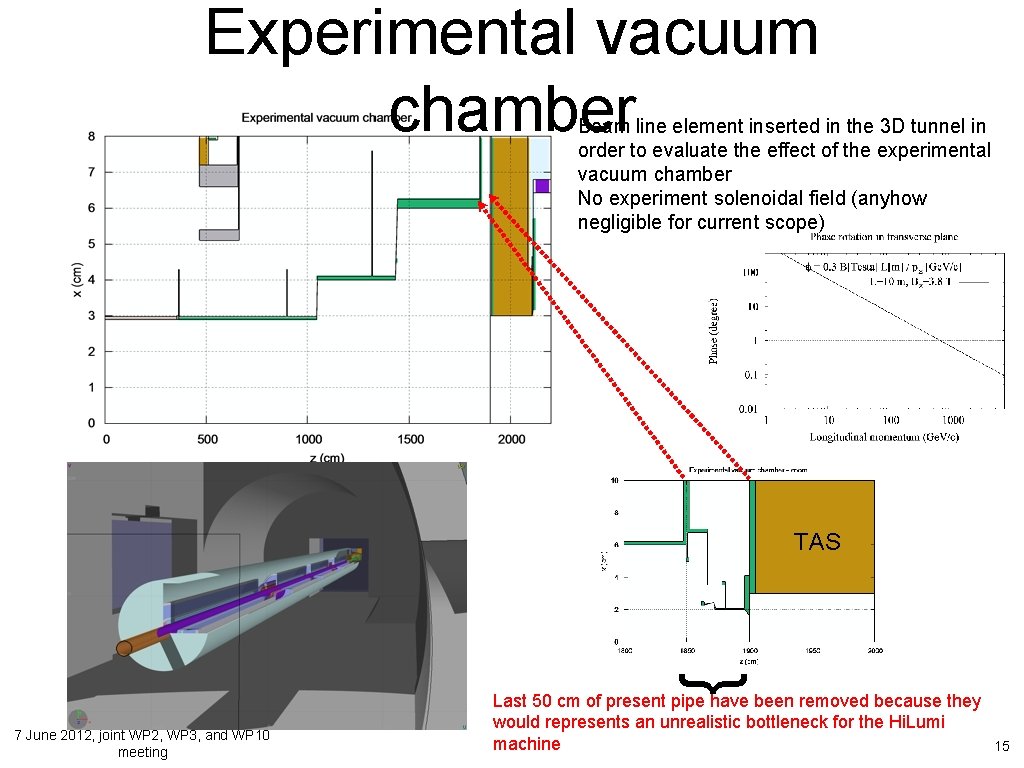
Experimental vacuum chamber Beam line element inserted in the 3 D tunnel in order to evaluate the effect of the experimental vacuum chamber No experiment solenoidal field (anyhow negligible for current scope) TAS } 7 June 2012, joint WP 2, WP 3, and WP 10 meeting Last 50 cm of present pipe have been removed because they would represents an unrealistic bottleneck for the Hi. Lumi machine 15
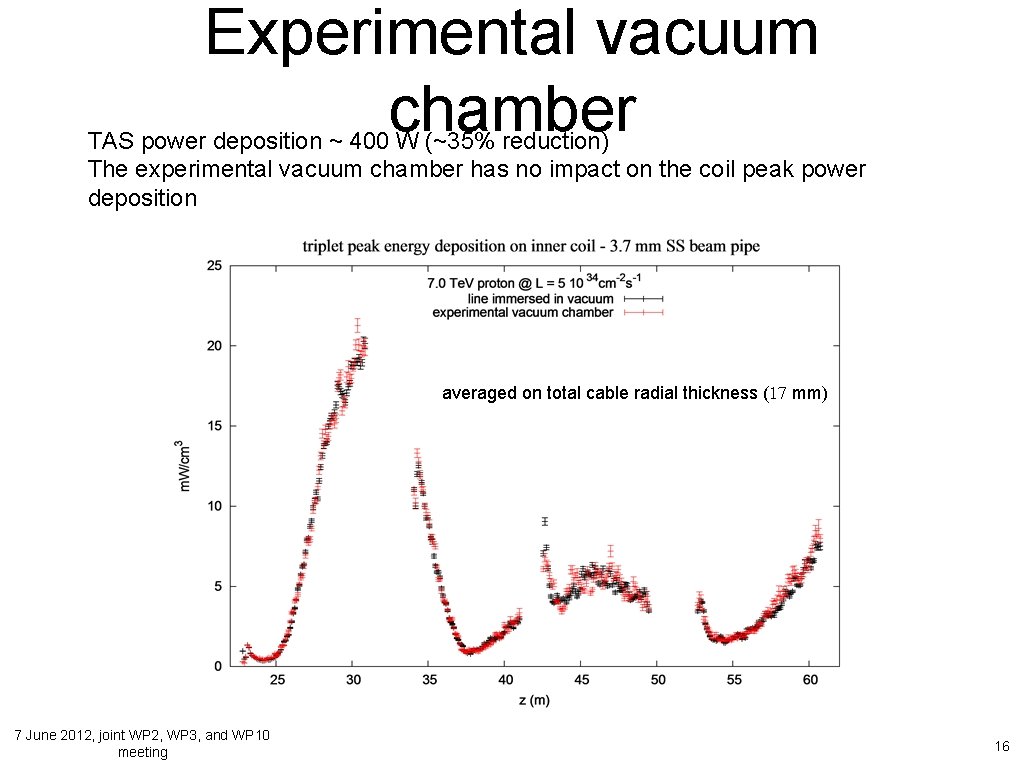
Experimental vacuum chamber TAS power deposition ~ 400 W (~35% reduction) The experimental vacuum chamber has no impact on the coil peak power deposition averaged on total cable radial thickness (17 mm) 7 June 2012, joint WP 2, WP 3, and WP 10 meeting 16
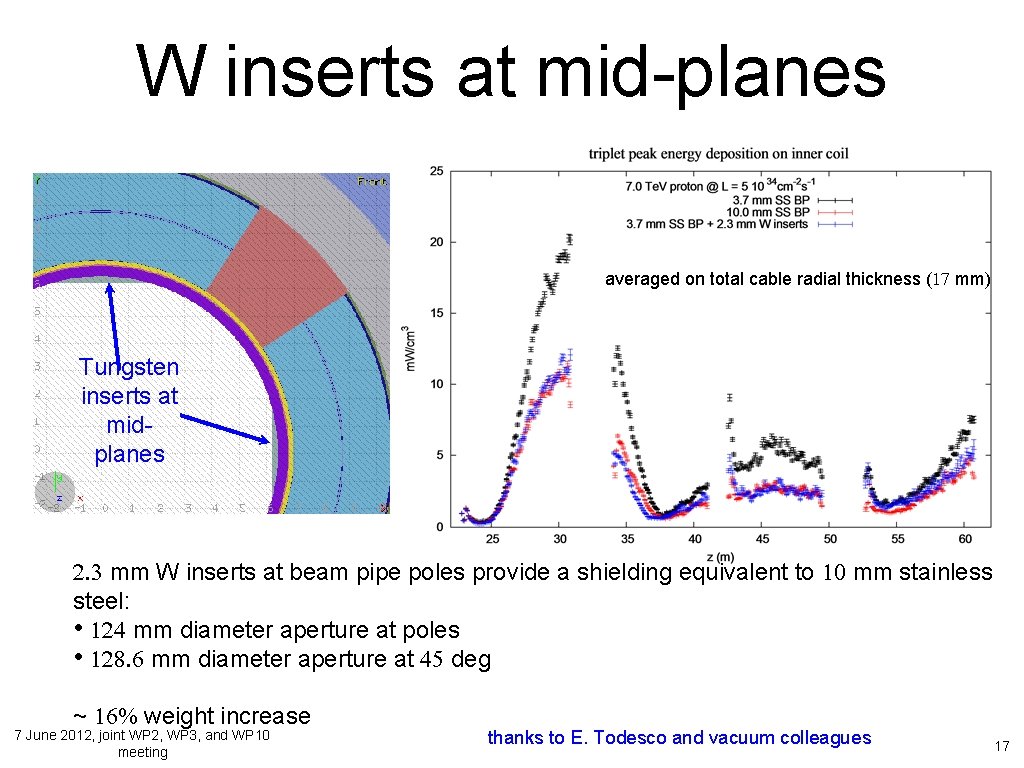
W inserts at mid-planes averaged on total cable radial thickness (17 mm) Tungsten inserts at midplanes 2. 3 mm W inserts at beam pipe poles provide a shielding equivalent to 10 mm stainless steel: • 124 mm diameter aperture at poles • 128. 6 mm diameter aperture at 45 deg ~ 16% weight increase 7 June 2012, joint WP 2, WP 3, and WP 10 meeting thanks to E. Todesco and vacuum colleagues 17
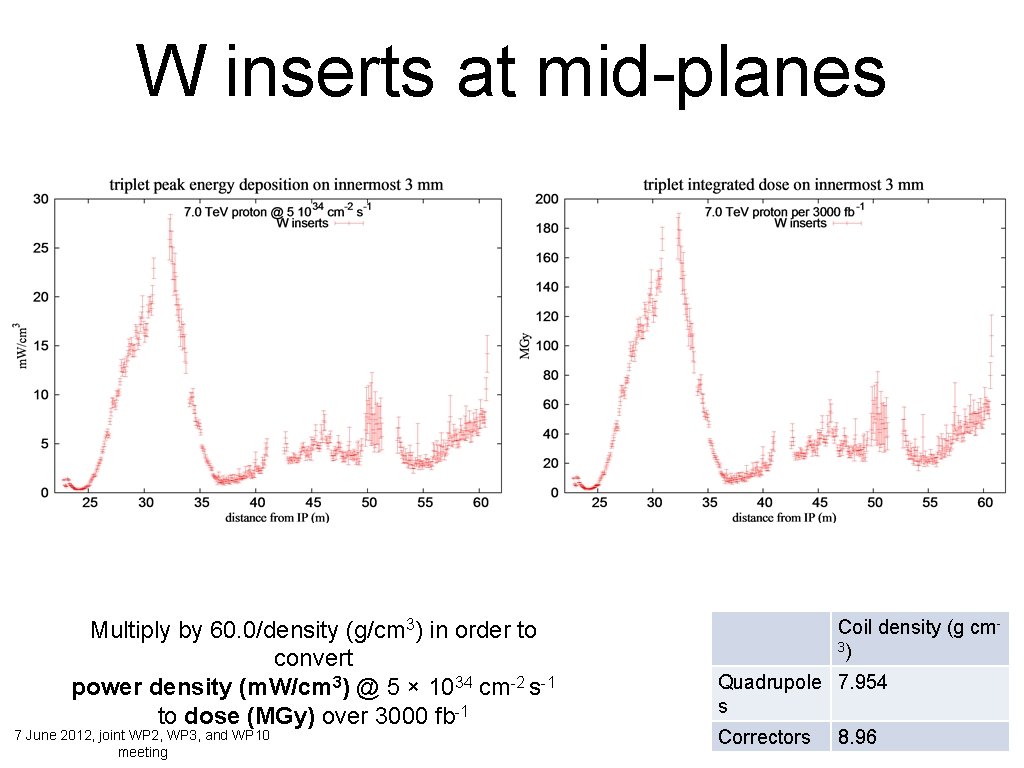
W inserts at mid-planes Multiply by 60. 0/density (g/cm 3) in order to convert power density (m. W/cm 3) @ 5 × 1034 cm-2 s-1 to dose (MGy) over 3000 fb-1 7 June 2012, joint WP 2, WP 3, and WP 10 meeting Coil density (g cm 3) Quadrupole 7. 954 s Correctors 8. 96 18
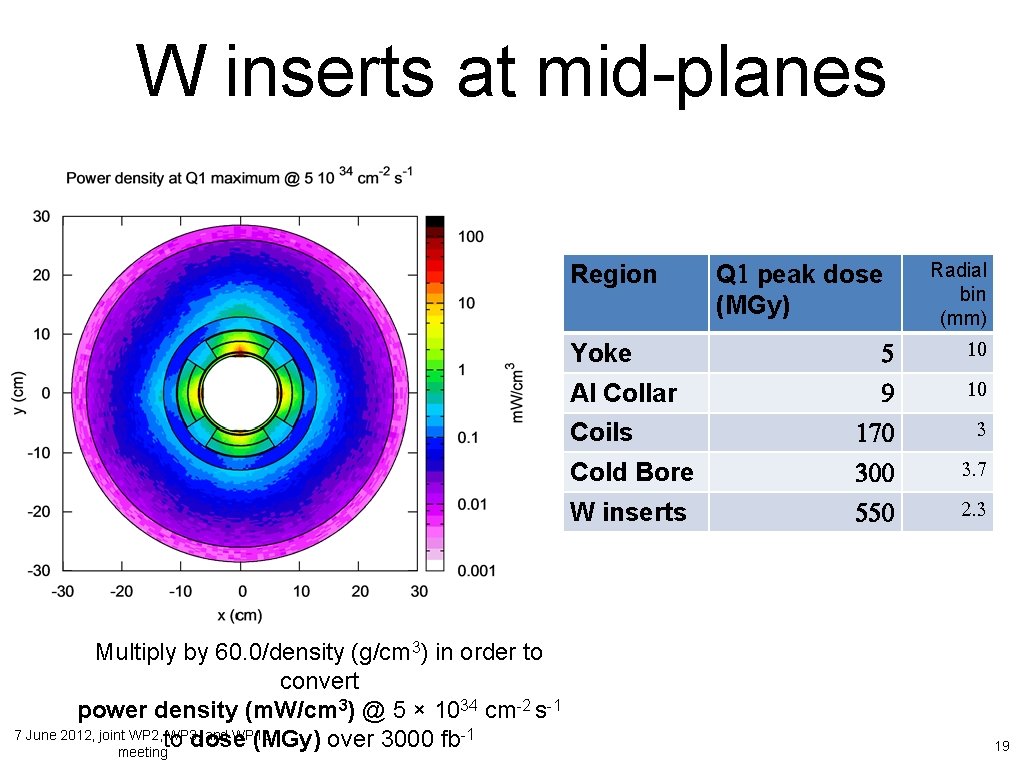
W inserts at mid-planes Region Multiply by 60. 0/density (g/cm 3) in order to convert power density (m. W/cm 3) @ 5 × 1034 cm-2 s-1 -1 7 June 2012, joint WP 2, to WP 3, and WP 10 dose (MGy) over 3000 fb meeting Q 1 peak dose (MGy) Radial bin (mm) Yoke 5 10 Al Collar 9 10 Coils 170 3 Cold Bore 300 3. 7 W inserts 550 2. 3 19
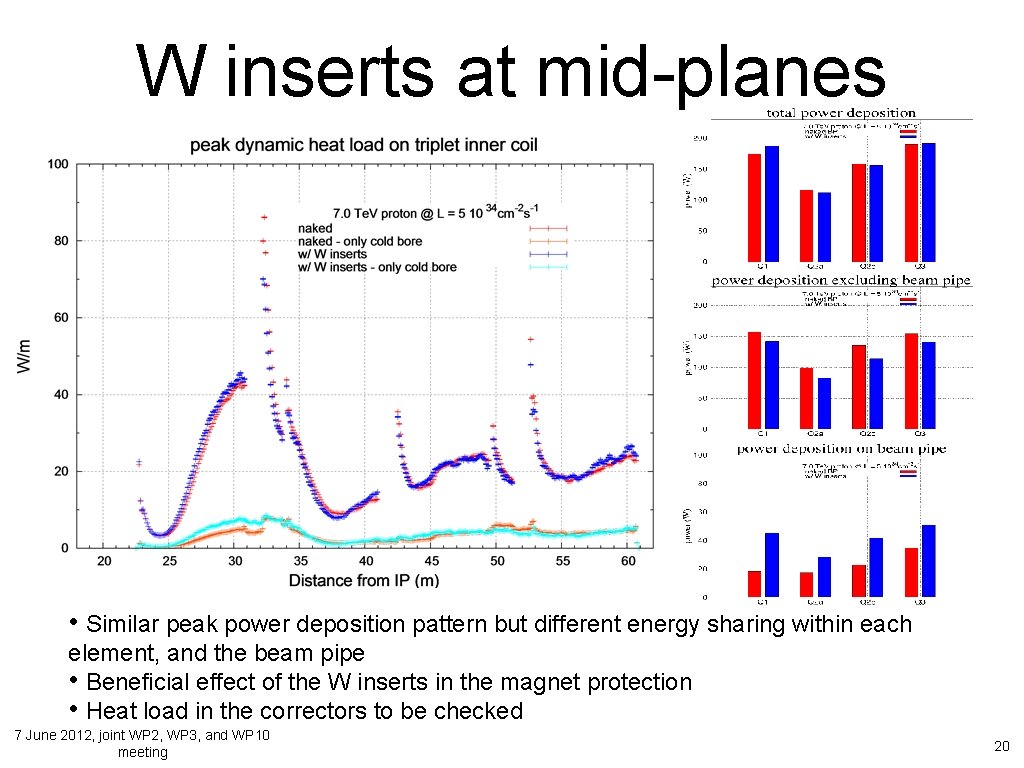
W inserts at mid-planes • Similar peak power deposition pattern but different energy sharing within each element, and the beam pipe • Beneficial effect of the W inserts in the magnet protection • Heat load in the correctors to be checked 7 June 2012, joint WP 2, WP 3, and WP 10 meeting 20
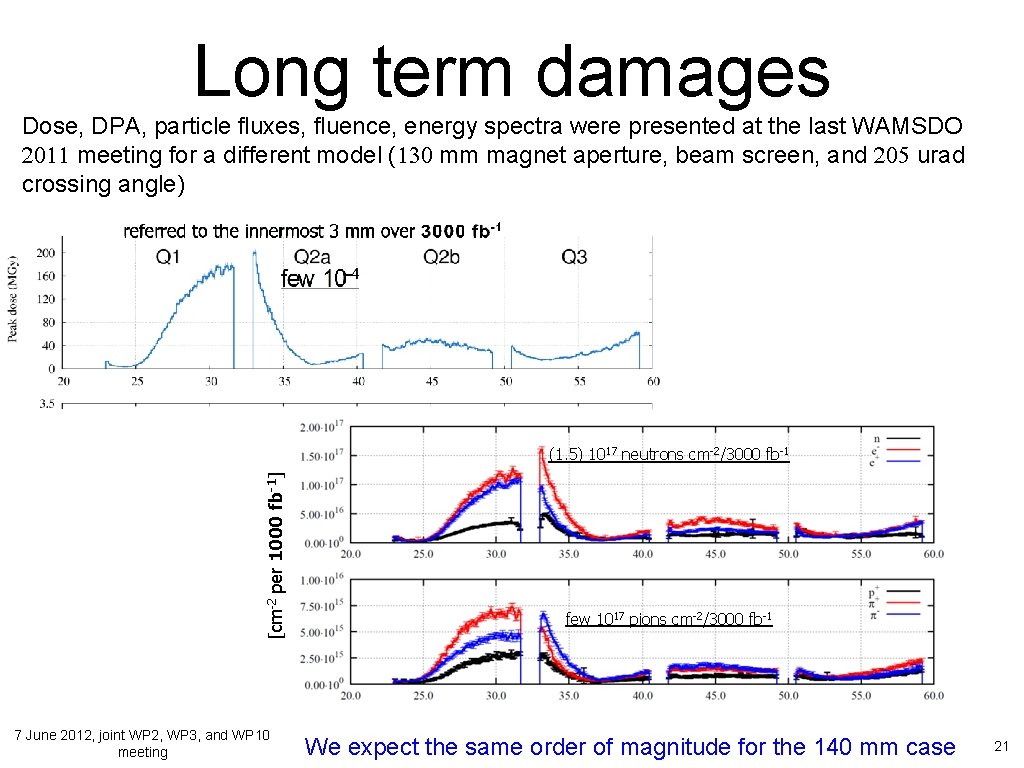
Long term damages Dose, DPA, particle fluxes, fluence, energy spectra were presented at the last WAMSDO 2011 meeting for a different model (130 mm magnet aperture, beam screen, and 205 urad crossing angle) [cm-2 per 1000 fb-1] (1. 5) 1017 neutrons cm-2/3000 fb-1 7 June 2012, joint WP 2, WP 3, and WP 10 meeting few 1017 pions cm-2/3000 fb-1 We expect the same order of magnitude for the 140 mm case 21
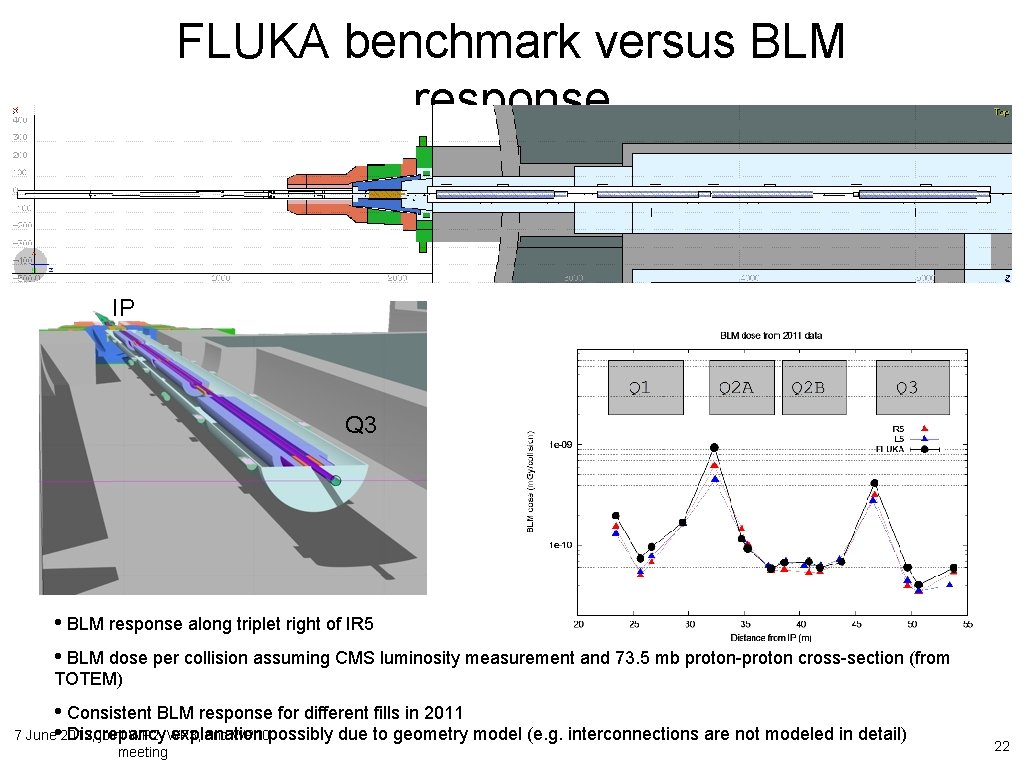
FLUKA benchmark versus BLM response IP Q 3 • BLM response along triplet right of IR 5 • BLM dose per collision assuming CMS luminosity measurement and 73. 5 mb proton-proton cross-section (from TOTEM) • Consistent BLM response for different fills in 2011 7 June • 2012, joint WP 2, WP 3, and WP 10 possibly due to geometry model (e. g. interconnections are not modeled in detail) Discrepancy explanation meeting 22
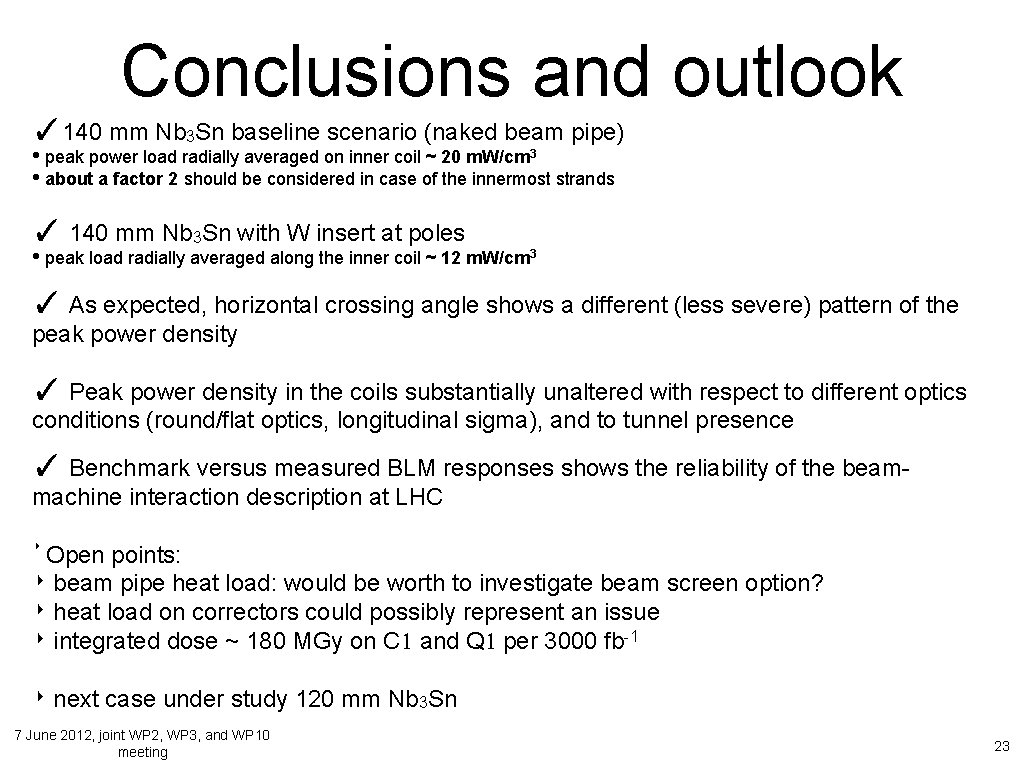
Conclusions and outlook ✓ 140 mm Nb 3 Sn baseline scenario (naked beam pipe) • peak power load radially averaged on inner coil ~ 20 m. W/cm 3 • about a factor 2 should be considered in case of the innermost strands ✓ 140 mm Nb 3 Sn with W insert at poles • peak load radially averaged along the inner coil ~ 12 m. W/cm 3 ✓ As expected, horizontal crossing angle shows a different (less severe) pattern of the peak power density ✓ Peak power density in the coils substantially unaltered with respect to different optics conditions (round/flat optics, longitudinal sigma), and to tunnel presence ✓ Benchmark versus measured BLM responses shows the reliability of the beammachine interaction description at LHC ‣ Open points: ‣ beam pipe heat load: would be worth to investigate beam screen option? ‣ heat load on correctors could possibly represent an issue ‣ integrated dose ~ 180 MGy on C 1 and Q 1 per 3000 fb-1 ‣ next case under study 120 mm Nb 3 Sn 7 June 2012, joint WP 2, WP 3, and WP 10 meeting 23