
First episode Rapid Early intervention for Eating Disorders

- Slides: 26
First episode Rapid Early intervention for Eating Disorders (FREED) An innovative, evidence-based treatment approach for 16 to 25 year olds with an eating 201 disorder of up to 3 years duration 6 Karina Allen Senior Clinical Psychologist, Eating Disorders Service, Maudsley Hospital
Overview • • • What FREED is Why we need FREED Evidence base and cost-benefits Who is currently involved Where we are headed
Overview • • • What FREED is Why we need FREED Evidence base and cost-benefits Who is currently involved Where we are headed
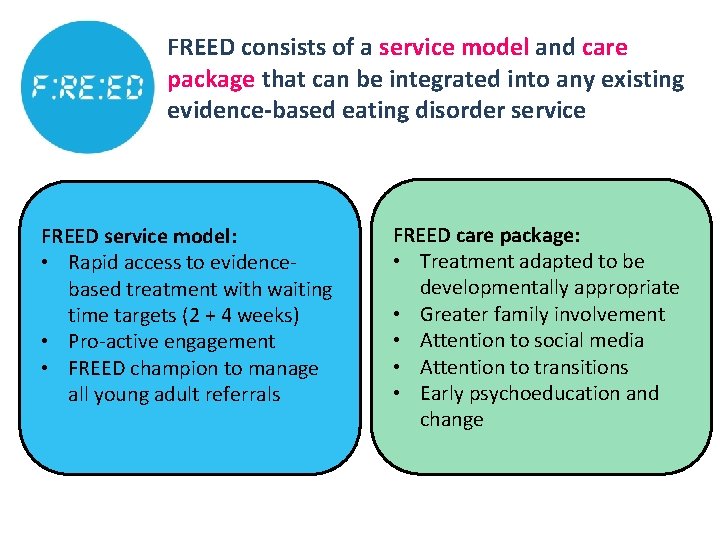
FREED consists of a service model and care package that can be integrated into any existing evidence-based eating disorder service FREED service model: • Rapid access to evidencebased treatment with waiting time targets (2 + 4 weeks) • Pro-active engagement • FREED champion to manage all young adult referrals FREED care package: • Treatment adapted to be developmentally appropriate • Greater family involvement • Attention to social media • Attention to transitions • Early psychoeducation and change
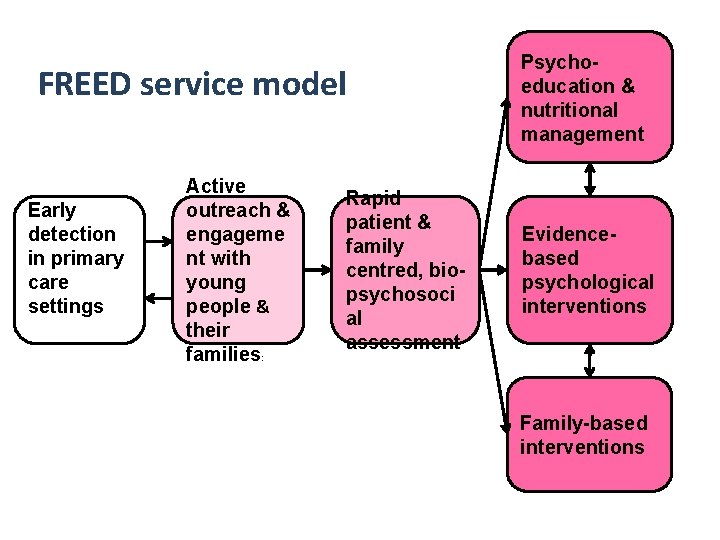
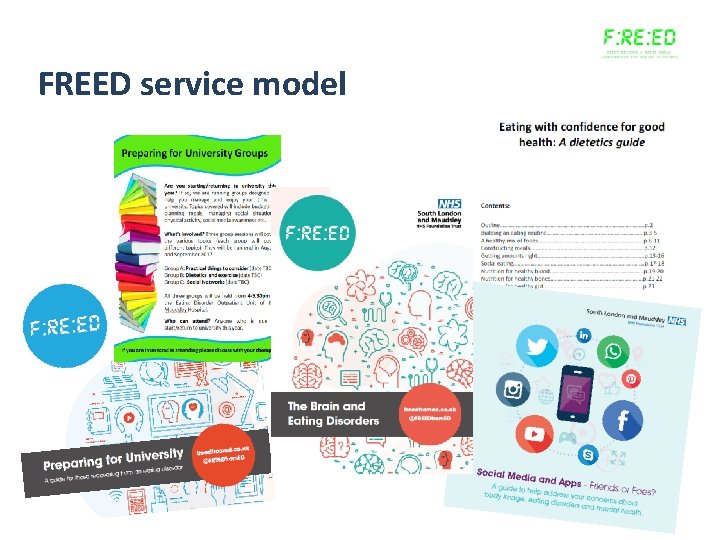
FREED service model Early detection in primary care settings Active outreach & engageme nt with young people & their families: Rapid patient & family centred, biopsychosoci al assessment Psychoeducation & nutritional management Evidencebased psychological interventions Family-based interventions
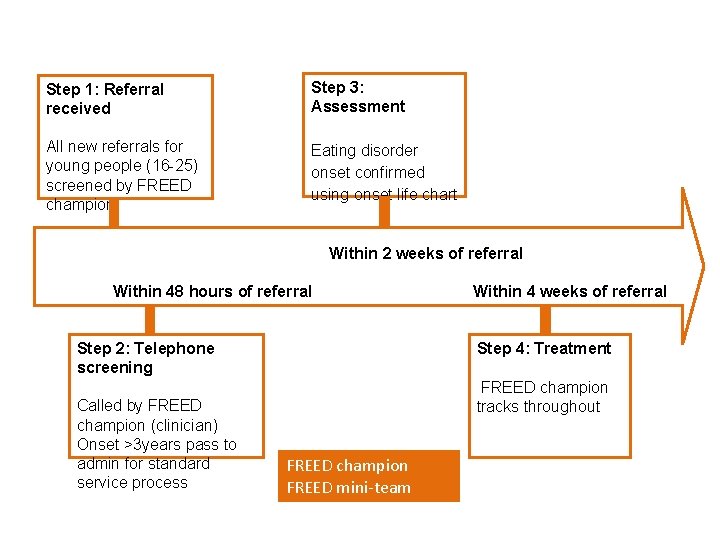
Step 1: Referral received Step 3: Assessment All new referrals for young people (16 -25) screened by FREED champion Eating disorder onset confirmed using onset life chart Within 2 weeks of referral Within 48 hours of referral Step 2: Telephone screening Called by FREED champion (clinician) Onset >3 years pass to admin for standard service process Within 4 weeks of referral Step 4: Treatment FREED champion tracks throughout FREED champion FREED mini-team
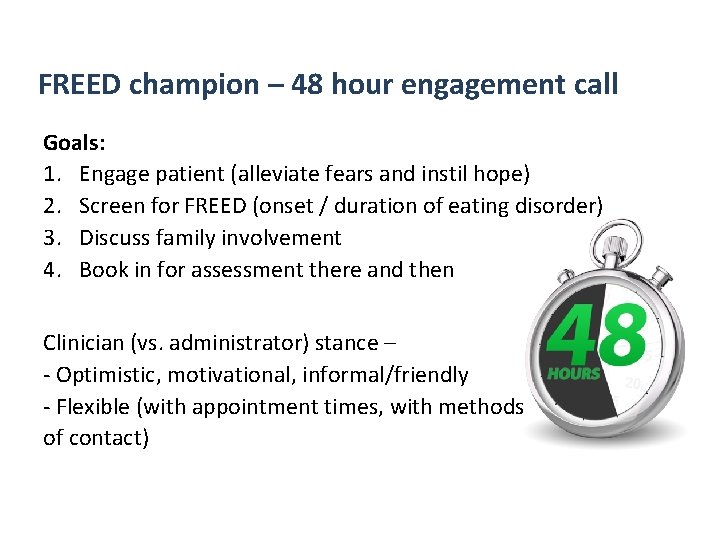
FREED champion – 48 hour engagement call Goals: 1. Engage patient (alleviate fears and instil hope) 2. Screen for FREED (onset / duration of eating disorder) 3. Discuss family involvement 4. Book in for assessment there and then Clinician (vs. administrator) stance – - Optimistic, motivational, informal/friendly - Flexible (with appointment times, with methods of contact)
FREED service model
Overview • • • What FREED is Why we need FREED Evidence base and cost-benefits Who is currently involved Where we are headed
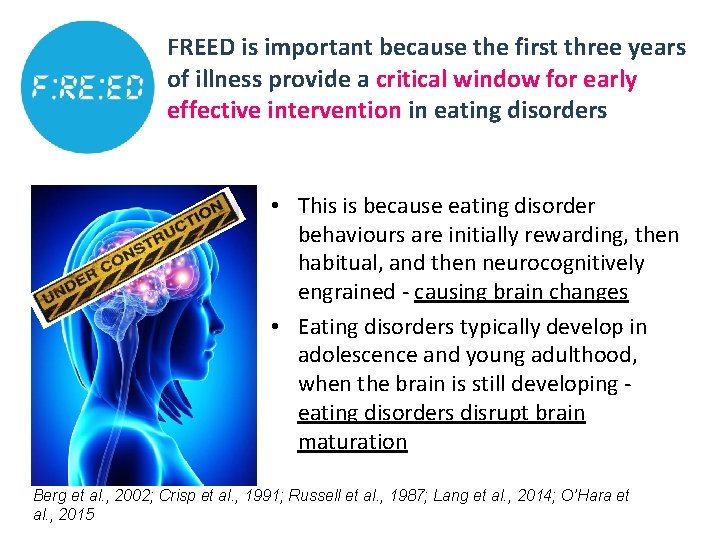
FREED is important because the first three years of illness provide a critical window for early effective intervention in eating disorders • This is because eating disorder behaviours are initially rewarding, then habitual, and then neurocognitively engrained - causing brain changes • Eating disorders typically develop in adolescence and young adulthood, when the brain is still developing eating disorders disrupt brain maturation Berg et al. , 2002; Crisp et al. , 1991; Russell et al. , 1987; Lang et al. , 2014; O’Hara et al. , 2015
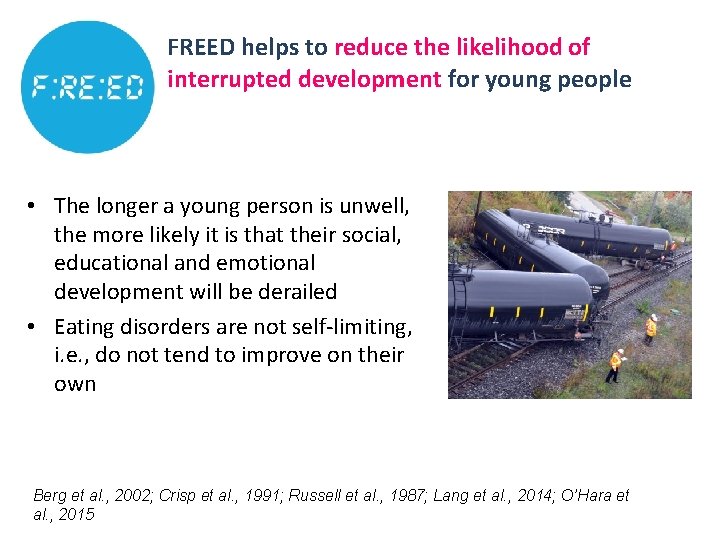
FREED helps to reduce the likelihood of interrupted development for young people • The longer a young person is unwell, the more likely it is that their social, educational and emotional development will be derailed • Eating disorders are not self-limiting, i. e. , do not tend to improve on their own Berg et al. , 2002; Crisp et al. , 1991; Russell et al. , 1987; Lang et al. , 2014; O’Hara et al. , 2015
FREED is needed to address current long waits for eating disorder treatment • In 2013, 30% of young people had to wait >18 weeks after being referred for eating disorder treatment and an additional 34% had to wait >6 months (Beat) – 74% said their eating disorder got worse while waiting • In 2015, eating disorders were estimated to incur £ 3. 9 -4. 6 billion in direct NHS treatment costs, £ 6. 8 -8 billion in lost income and £ 2. 6 -3. 1 billion in carer-related costs per year
Overview • • • What FREED is Why we need FREED Evidence base and cost-benefits Who is currently involved Where we are headed
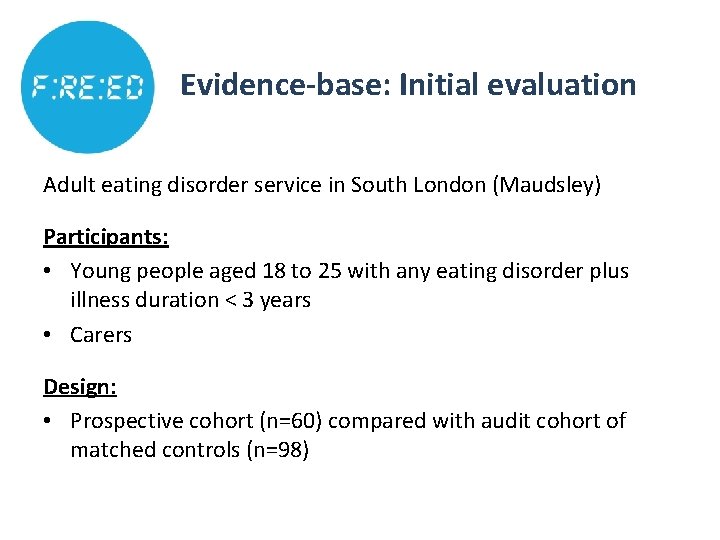
Evidence-base: Initial evaluation Setting: Adult eating disorder service in South London (Maudsley) Participants: • Young people aged 18 to 25 with any eating disorder plus illness duration < 3 years • Carers Design: • Prospective cohort (n=60) compared with audit cohort of matched controls (n=98)
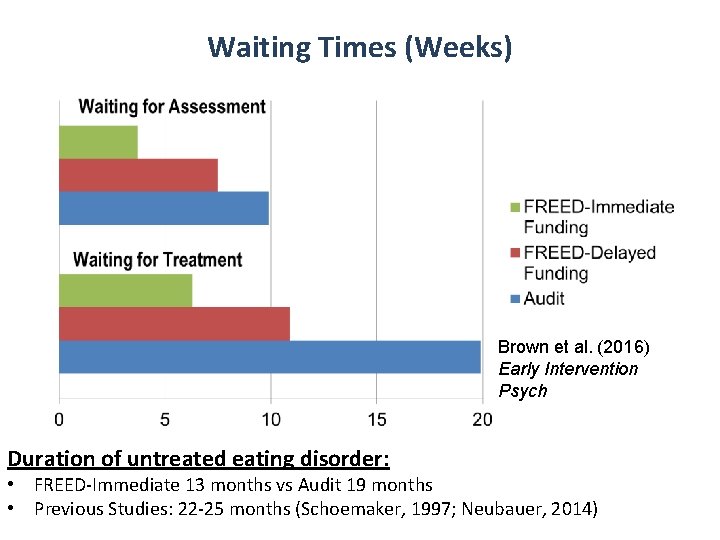
Waiting Times (Weeks) Brown et al. (2016) Early Intervention Psych Duration of untreated eating disorder: • FREED-Immediate 13 months vs Audit 19 months • Previous Studies: 22 -25 months (Schoemaker, 1997; Neubauer, 2014)
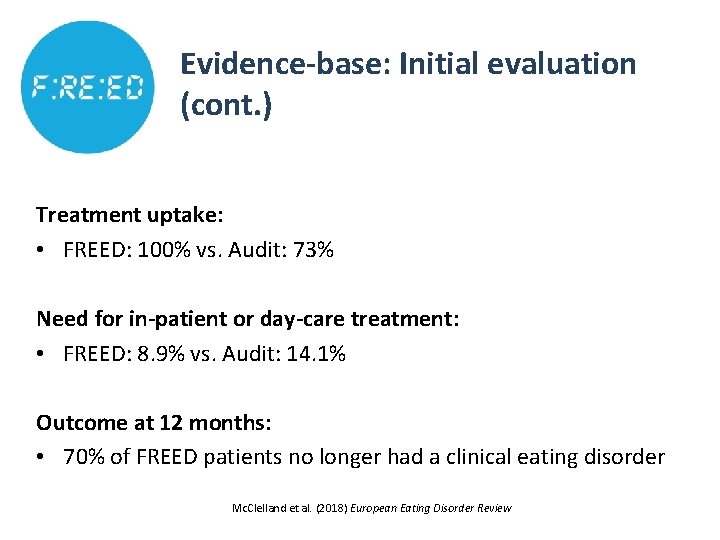
Evidence-base: Initial evaluation (cont. ) Treatment uptake: • FREED: 100% vs. Audit: 73% Need for in-patient or day-care treatment: • FREED: 8. 9% vs. Audit: 14. 1% Outcome at 12 months: • 70% of FREED patients no longer had a clinical eating disorder Mc. Clelland et al. (2018) European Eating Disorder Review
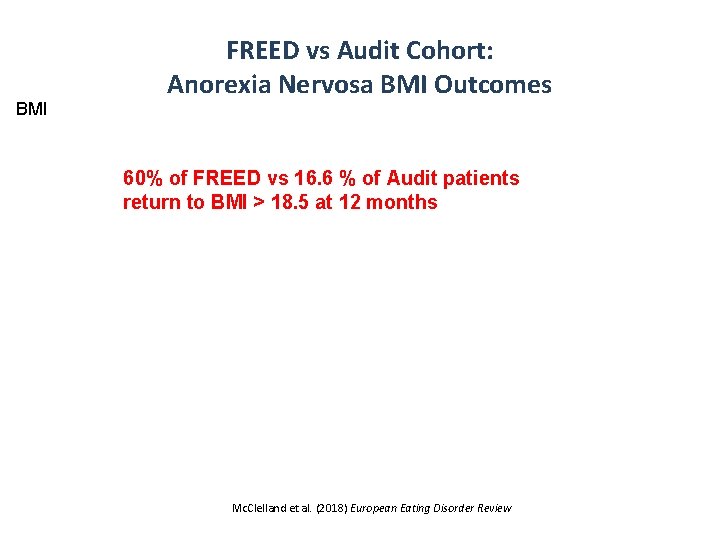
BMI FREED vs Audit Cohort: Anorexia Nervosa BMI Outcomes 60% of FREED vs 16. 6 % of Audit patients return to BMI > 18. 5 at 12 months Mc. Clelland et al. (2018) European Eating Disorder Review
Evidence-base: Scaling • FREED has scaled to three other eating disorder services (FREED-Up): Central and North West London NHS Foundation Trust, North East London NHS Foundation Trust, and Leeds and Yorkshire Partnership NHS Foundation Trust • Data collection is ongoing but each service has been able to implement FREED successfully with reductions in waiting times and good adherence to waiting time targets • Leeds service is now scaling across Yorkshire
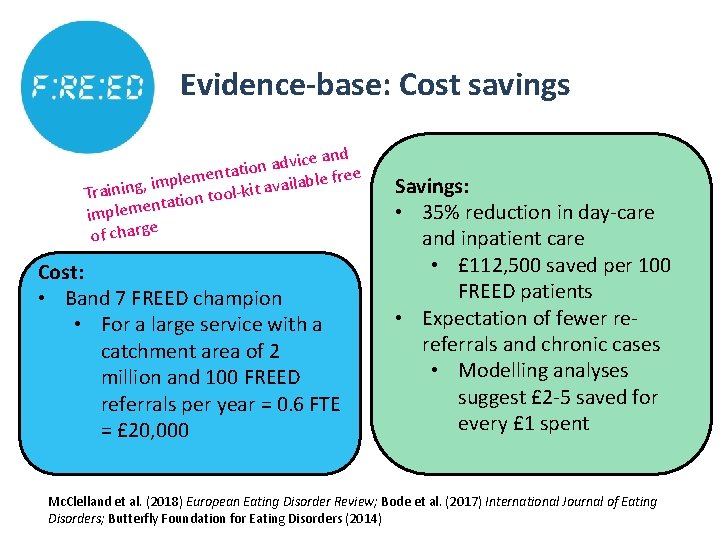
Evidence-base: Cost savings and e c i v d a ntation e free m e e l l p b a m l i i , a g v l-kit a Trainin o o t n o i t nta impleme e of charg Cost: • Band 7 FREED champion • For a large service with a catchment area of 2 million and 100 FREED referrals per year = 0. 6 FTE = £ 20, 000 Savings: • 35% reduction in day-care and inpatient care • £ 112, 500 saved per 100 FREED patients • Expectation of fewer rereferrals and chronic cases • Modelling analyses suggest £ 2 -5 saved for every £ 1 spent Mc. Clelland et al. (2018) European Eating Disorder Review; Bode et al. (2017) International Journal of Eating Disorders; Butterfly Foundation for Eating Disorders (2014)
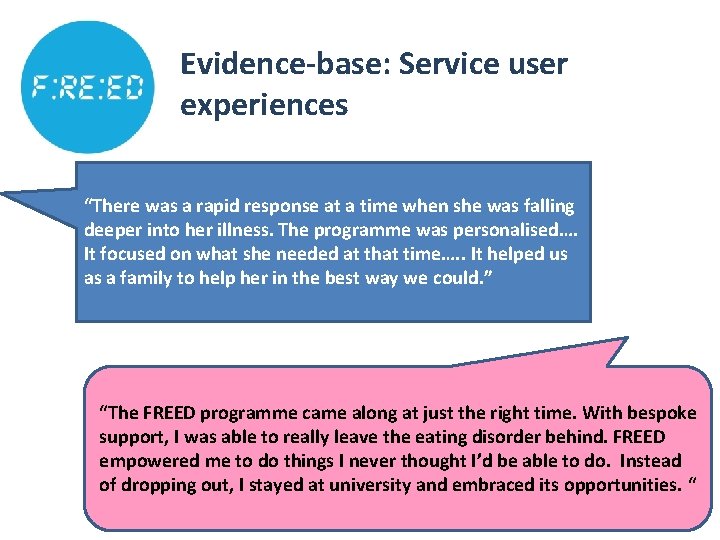
Evidence-base: Service user experiences • FREED was co-designed with service users and service users/carers have provided input at all stages of scaling and to all FREED resources • Feedback has been universally positive and we have a group of ‘FREED ambassadors’ who provide ongoing input and have provided testimonials
Evidence-base: Service user experiences “There was a rapid response at a time when she was falling deeper into her illness. The programme was personalised…. It focused on what she needed at that time…. . It helped us as a family to help her in the best way we could. ” “The FREED programme came along at just the right time. With bespoke support, I was able to really leave the eating disorder behind. FREED empowered me to do things I never thought I’d be able to do. Instead of dropping out, I stayed at university and embraced its opportunities. “
Overview • • • What FREED is Why we need FREED Evidence base and cost-benefits Who is currently involved Where we are headed
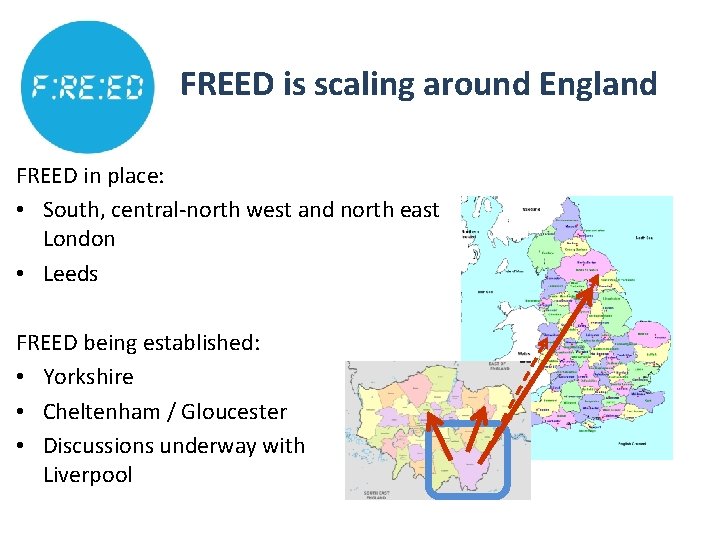
FREED is scaling around England FREED in place: • South, central-north west and north east London • Leeds FREED being established: • Yorkshire • Cheltenham / Gloucester • Discussions underway with Liverpool
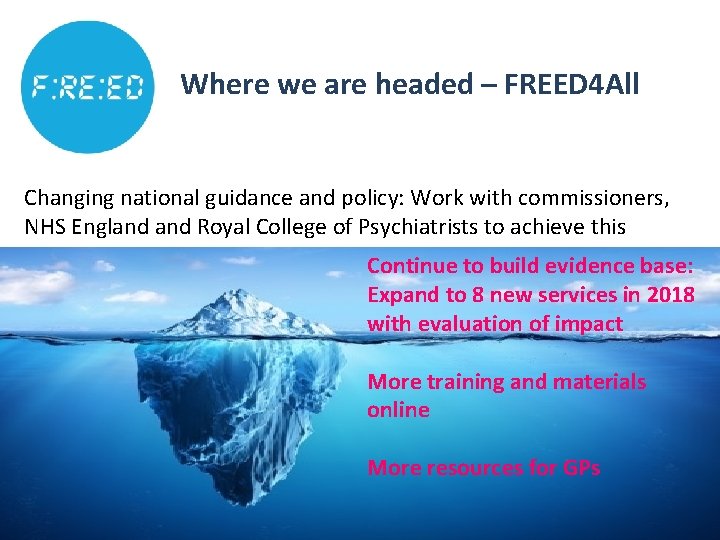
Where we are headed – FREED 4 All Changing national guidance and policy: Work with commissioners, NHS England Royal College of Psychiatrists to achieve this Continue to build evidence base: Expand to 8 new services in 2018 with evaluation of impact More training and materials online More resources for GPs
Questions? Comments? Interest? Many thanks Karina. allen@slam. nhs. uk www. freedfromed. co. uk