
First discussion on an updated REBCO roadmap for
First discussion on an updated REBCO roadmap for the next 3 – 5 years Xiaorong Wang, Ramesh Gupta, Vadim Kashikhin, Vito Lombardo U. S. Magnet Development Program MDP weekly meeting, 10/23/2019
REBCO effort is developing a new magnet technology based on multi-tape REBCO cables moving towards the MDP 5 T goal • Develop dipole magnets with increasing fields and complexities o C 1, 1. 2 T at 2017. Demonstrated initial concept o C 2, 2. 9 T at 2019. Demonstrated metal mandrel o C 3, target 5 T at 2020. Demonstrate magnet technology towards higher fields • Strongly coupled magnet/conductor work provides effective feedback to conductor development based on magnet performance • Collaboration within MDP and the community through MDP REBCO roadmap discussion, 10/23/2019, version 11/4/2019 2
Questions to think about • What goals should we set for the REBCO effort in the next 3 – 5 years to generate a high impact for the accelerator magnet technology and user communities? • How to facilitate the collaboration among the programs to advance the U. S. leadership in REBCO magnet technology? • How to help and leverage the REBCO fusion magnet technology development? • Anything else? REBCO roadmap discussion, 10/23/2019, version 11/4/2019 3
A 20 T dipole field is a good target for MDP – how can REBCO help on this? • Develop REBCO inserts and test them in background fields (the hybrid approach) o Currently the shortest path towards 20 T o Probe REBCO conductor and magnet performances under Lorentz load • Develop stand-alone REBCO dipole magnets o A different approach with a strong impact in the long term • Improve conductors based on actual magnet performance Understanding the magnet and conductor behavior is the key to a successful technology development REBCO roadmap discussion, 10/23/2019, version 11/4/2019 4
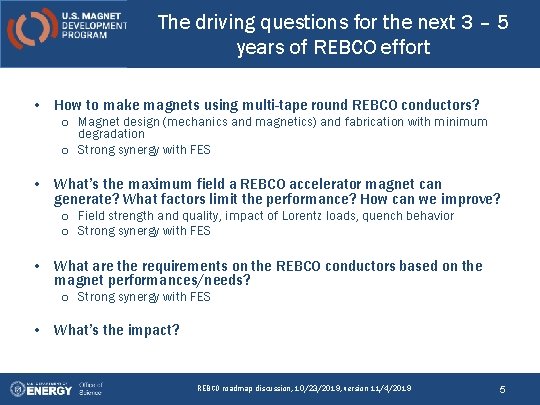
The driving questions for the next 3 – 5 years of REBCO effort • How to make magnets using multi-tape round REBCO conductors? o Magnet design (mechanics and magnetics) and fabrication with minimum degradation o Strong synergy with FES • What’s the maximum field a REBCO accelerator magnet can generate? What factors limit the performance? How can we improve? o Field strength and quality, impact of Lorentz loads, quench behavior o Strong synergy with FES • What are the requirements on the REBCO conductors based on the magnet performances/needs? o Strong synergy with FES • What’s the impact? REBCO roadmap discussion, 10/23/2019, version 11/4/2019 5
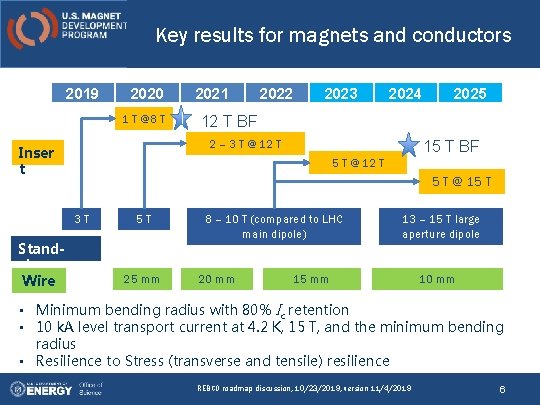
Key results for magnets and conductors 2019 2020 1 T @8 T 2022 2023 2024 2025 12 T BF 2 – 3 T @ 12 T Inser t 15 T BF 5 T @ 12 T 5 T @ 15 T 3 T Standalone Wire 2021 5 T 25 mm 8 – 10 T (compared to LHC main dipole) 20 mm 13 – 15 T large aperture dipole 15 mm 10 mm • Minimum bending radius with 80% Ic retention • 10 k. A level transport current at 4. 2 K, 15 T, and the minimum bending radius • Resilience to Stress (transverse and tensile) resilience REBCO roadmap discussion, 10/23/2019, version 11/4/2019 6
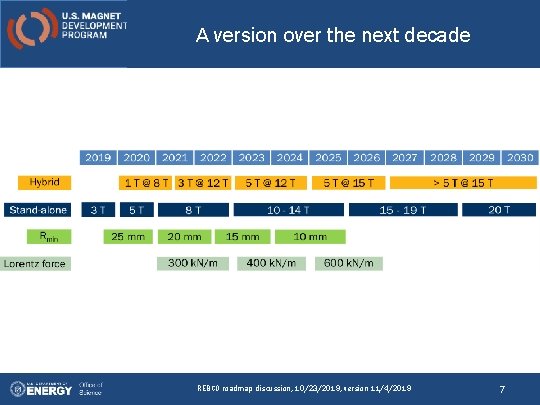
A version over the next decade REBCO roadmap discussion, 10/23/2019, version 11/4/2019 7
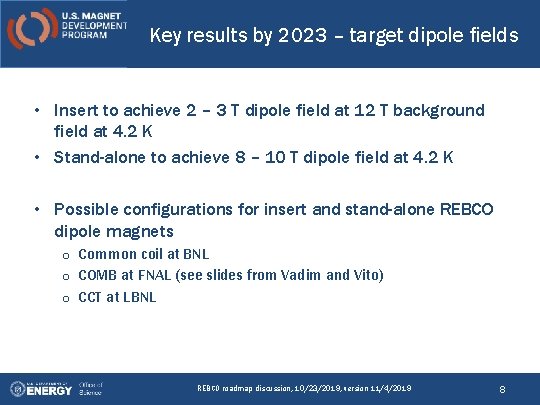
Key results by 2023 – target dipole fields • Insert to achieve 2 – 3 T dipole field at 12 T background field at 4. 2 K • Stand-alone to achieve 8 – 10 T dipole field at 4. 2 K • Possible configurations for insert and stand-alone REBCO dipole magnets o Common coil at BNL o COMB at FNAL (see slides from Vadim and Vito) o CCT at LBNL REBCO roadmap discussion, 10/23/2019, version 11/4/2019 8
We need to develop infrastructures now to deliver the results for the hybrid approach • Existing medium-field magnets o 8 T CCT 5 at LBNL o 10 T common coil magnet at BNL • 12 T Nb 3 Sn magnet with 120 mm aperture o The outer two layers from the FNAL 15 T demonstrator magnet that can be available since late 2020 o CCT 6? • 15 T test facility at FNAL by 2025 • Mechanical interface between the HTS and LTS to facilitate the test of HTS inserts REBCO roadmap discussion, 10/23/2019, version 11/4/2019 9

Critical development to deliver the key results, in addition to the conductor development (1) 1. Winding: develop technique with minimum handling risk to conductors 2. Impregnation: demonstrate technique without degrading conductors (radiation hardness as a next step) 3. Quench detection: develop techniques to pinpoint normal zone and applicable to long magnet and electromagnetic interference 4. Develop joints with low resistance (1 nΩ) REBCO roadmap discussion, 10/23/2019, version 11/4/2019 10
Critical development to deliver the key results, in addition to the conductor development (2) 5. Understand the impact of cycling Lorentz force and thermal cycles and possible mitigations 6. Understand the impact of Rc on current sharing and dynamic field quality and develop methods to control it 7. Develop method to fabricate mandrels that can be scaled to 10 – 20 m length 8. Develop non-destructive method to measure the performance along cables (100 – 1000 m) REBCO roadmap discussion, 10/23/2019, version 11/4/2019 11
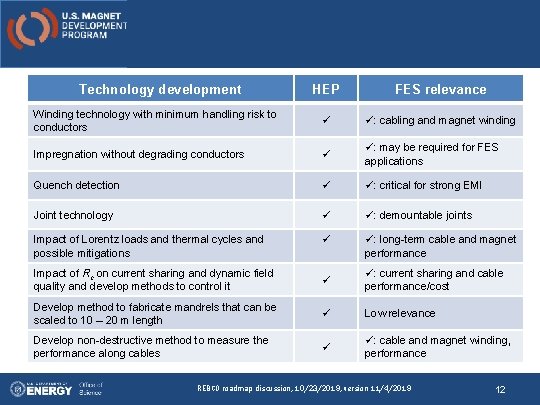
Technology development HEP FES relevance Winding technology with minimum handling risk to conductors : cabling and magnet winding Impregnation without degrading conductors : may be required for FES applications Quench detection : critical for strong EMI Joint technology : demountable joints Impact of Lorentz loads and thermal cycles and possible mitigations : long-term cable and magnet performance Impact of Rc on current sharing and dynamic field quality and develop methods to control it : current sharing and cable performance/cost Develop method to fabricate mandrels that can be scaled to 10 – 20 m length Low relevance Develop non-destructive method to measure the performance along cables : cable and magnet winding, performance REBCO roadmap discussion, 10/23/2019, version 11/4/2019 12
Opportunities to leverage university and SBIR programs • Improve performance of REBCO tape and round wires: o University of Houston (Selva), University of Colorado (van der Laan) o SBIR (ACT, AMPeers, Super. Power) • Understand magnetization: OSU (Sumption) • Develop new quench detection technique: SBIR • Alternative/stand-alone magnet concept: SBIR REBCO roadmap discussion, 10/23/2019, version 11/4/2019 13
US MDP plans on HTS coil development and test in COMB structure Vadim Kashikhin, Vito Lombardo October 9, 2019
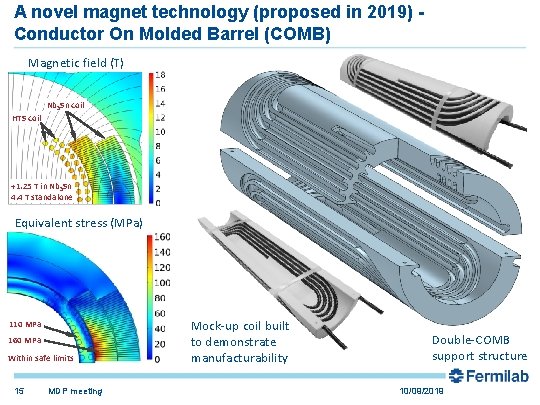
A novel magnet technology (proposed in 2019) Conductor On Molded Barrel (COMB) Magnetic field (T) Nb 3 Sn coil HTS coil +1. 25 T in Nb 3 Sn 4. 4 T standalone Equivalent stress (MPa) 110 MPa 160 MPa Within safe limits 15 MDP meeting Mock-up coil built to demonstrate manufacturability Double-COMB support structure 10/09/2019
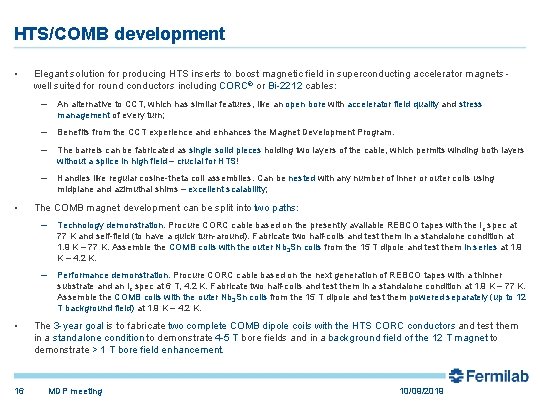
HTS/COMB development • • • 16 Elegant solution for producing HTS inserts to boost magnetic field in superconducting accelerator magnets well suited for round conductors including CORC® or Bi-2212 cables: – An alternative to CCT, which has similar features, like an open bore with accelerator field quality and stress management of every turn; – Benefits from the CCT experience and enhances the Magnet Development Program. – The barrels can be fabricated as single solid pieces holding two layers of the cable, which permits winding both layers without a splice in high field – crucial for HTS! – Handles like regular cosine-theta coil assemblies. Can be nested with any number of inner or outer coils using midplane and azimuthal shims – excellent scalability; The COMB magnet development can be split into two paths: – Technology demonstration. Procure CORC cable based on the presently available REBCO tapes with the Ic spec at 77 K and self-field (to have a quick turn-around). Fabricate two half-coils and test them in a standalone condition at 1. 9 K – 77 K. Assemble the COMB coils with the outer Nb 3 Sn coils from the 15 T dipole and test them in series at 1. 9 K – 4. 2 K. – Performance demonstration. Procure CORC cable based on the next generation of REBCO tapes with a thinner substrate and an Ic spec at 6 T, 4. 2 K. Fabricate two half-coils and test them in a standalone condition at 1. 9 K – 77 K. Assemble the COMB coils with the outer Nb 3 Sn coils from the 15 T dipole and test them powered separately (up to 12 T background field) at 1. 9 K – 4. 2 K. The 3 -year goal is to fabricate two complete COMB dipole coils with the HTS CORC conductors and test them in a standalone condition to demonstrate 4 -5 T bore fields and in a background field of the 12 T magnet to demonstrate > 1 T bore field enhancement. MDP meeting 10/09/2019
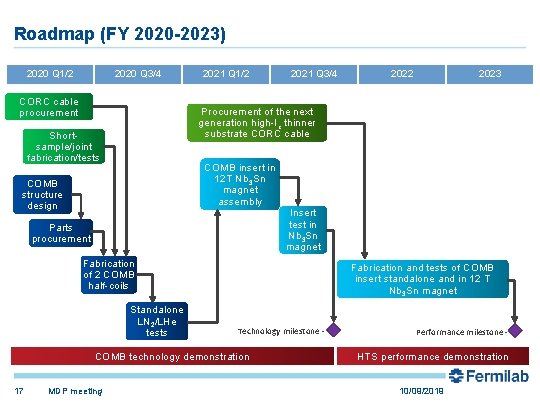
Roadmap (FY 2020 -2023) 2020 Q 1/2 2020 Q 3/4 CORC cable procurement 2021 Q 1/2 2021 Q 3/4 2023 Procurement of the next generation high-I c thinner substrate CORC cable Shortsample/joint fabrication/tests COMB insert in 12 T Nb 3 Sn magnet assembly COMB structure design Insert test in Nb 3 Sn magnet Parts procurement Fabrication of 2 COMB half-coils Standalone LN 2/LHe tests Fabrication and tests of COMB insert standalone and in 12 T Nb 3 Sn magnet Technology milestone - COMB technology demonstration 17 2022 MDP meeting Performance milestone - HTS performance demonstration 10/09/2019
Next steps • Continue the discussion among programs and conductor vendors • Produce a solid roadmap next month as an input for the December workshop • Approve the roadmap at the next MDP collaboration meeting (February 2020) REBCO roadmap discussion, 10/23/2019, version 11/4/2019 18
- Slides: 18