
First Day Why Study History Why study history
- Slides: 34
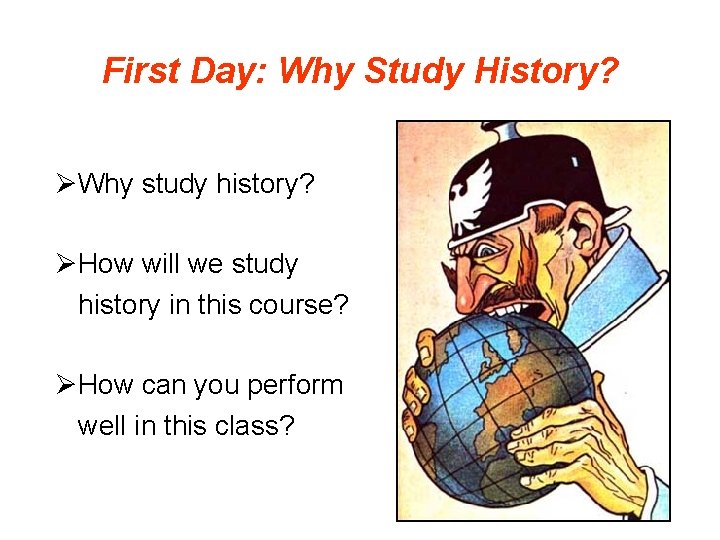
First Day: Why Study History? ØWhy study history? ØHow will we study history in this course? ØHow can you perform well in this class?
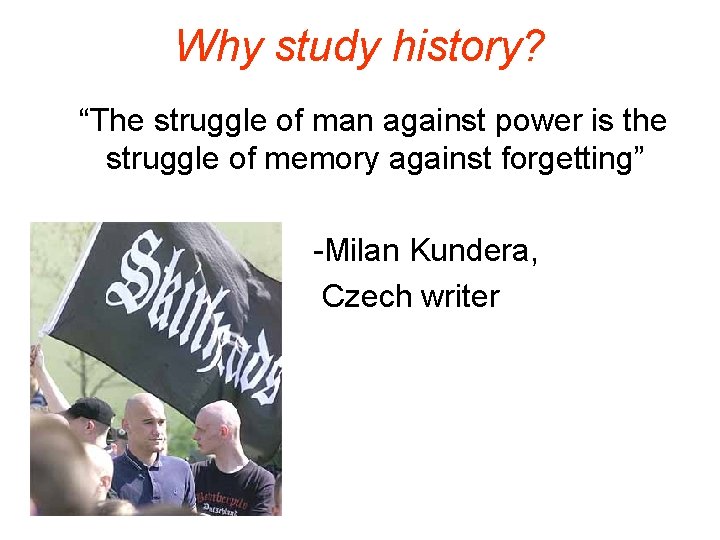
Why study history? “The struggle of man against power is the struggle of memory against forgetting” -Milan Kundera, Czech writer
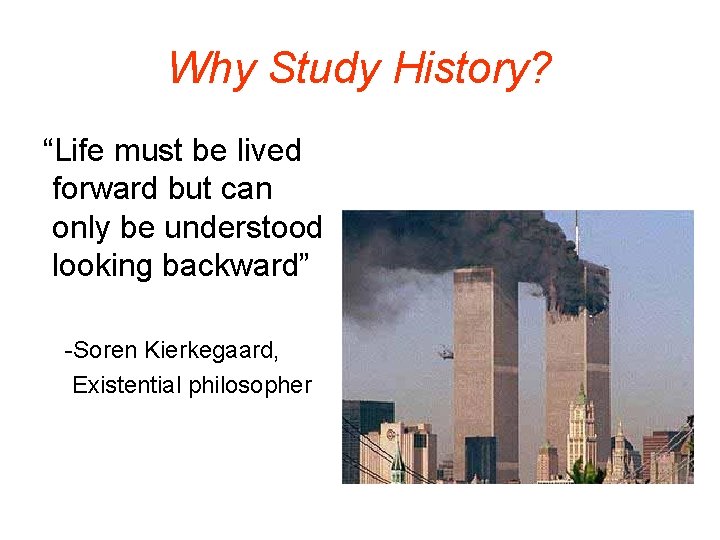
Why Study History? “Life must be lived forward but can only be understood looking backward” -Soren Kierkegaard, Existential philosopher
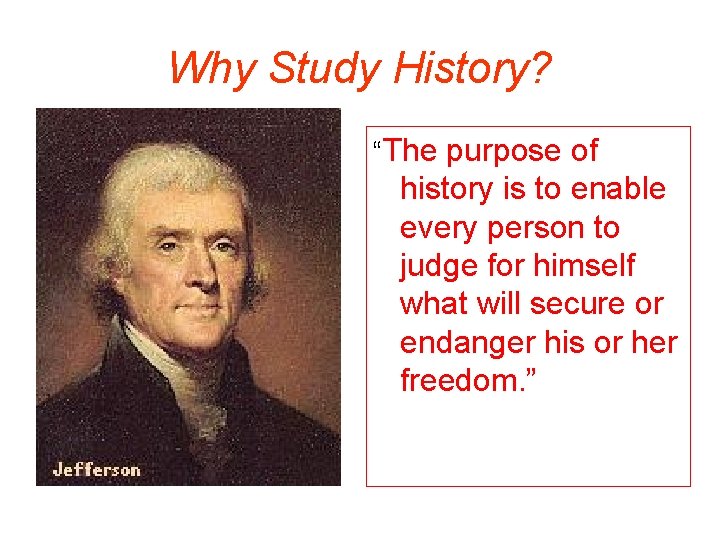
Why Study History? “The purpose of history is to enable every person to judge for himself what will secure or endanger his or her freedom. ”
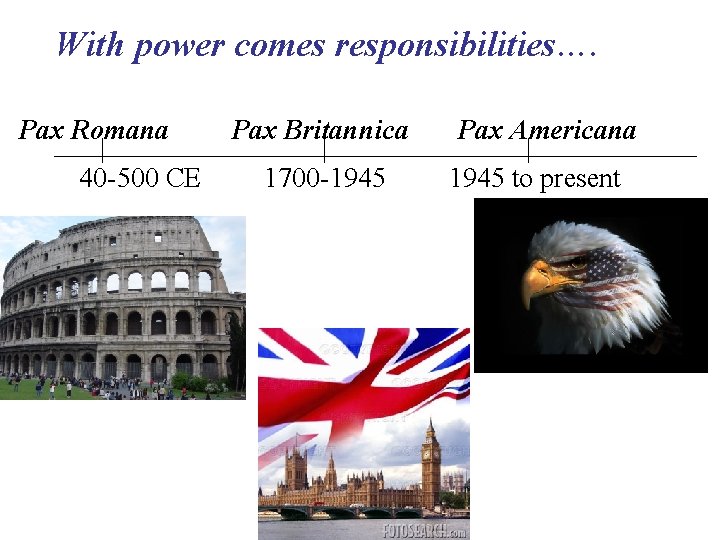
With power comes responsibilities…. Pax Romana 40 -500 CE Pax Britannica 1700 -1945 Pax Americana 1945 to present
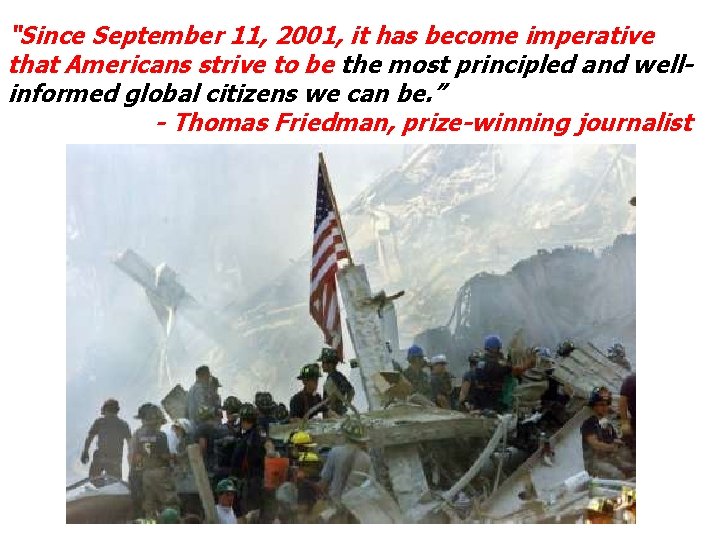
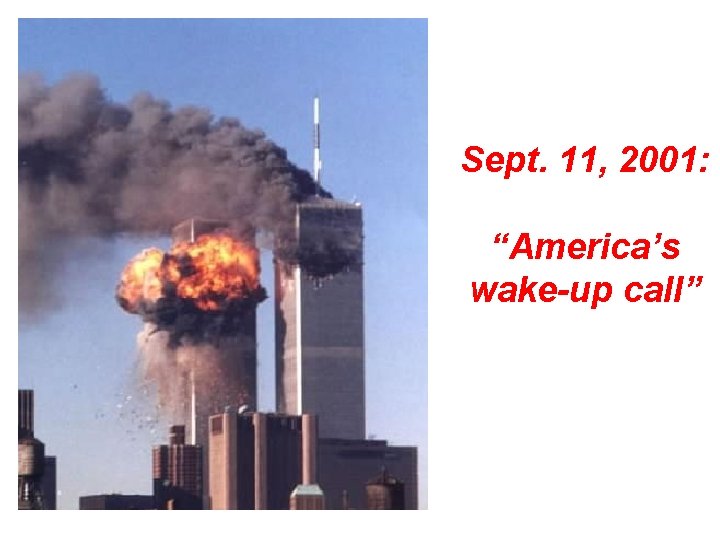
“Since September 11, 2001, it has become imperative that Americans strive to be the most principled and wellinformed global citizens we can be. ” - Thomas Friedman, prize-winning journalist
Why Study History? “History is the mother of all disciplines. ”
“SPICE FACTORS” • Society • Politics & leadership • Intellectual Innovations • Culture: Art, music, creativity • Economics and trade
How will we study history in this course? 1. Identify the “ 3 I’s”: Individuals, Ideas, Innovations of modern European history (1450 to present) 2. Interpret Big Ideas & Themes that explain Europe’s global significance 3. Engage in Civic Discourse: Effective Communication in Writing & Speaking 4. A. P. Exam Prep : DBQ, Free Response Essays, Multiple Choice 5. Use “History Habits of Mind” to arrive at deep meaning.
Six History Habits of Mind (the “ 6 C’s”): Chronology: There is an order of events that narrates the past; Complexity: Multiple factors explain why things happen in history ex. , SPICE factors Continuity & Change: Some things change, some endure or persist. Careful thinking will slowly reveal continuity and change. Context: the surrounding circumstances and background; the “temper of the times” that must be understood to interpret an event, document, idea, motives; Contingency: the different options people faced when making decisions in the past; often disproves “inevitability” Causality: Events have long and short term causes and effects, and some causes are more important than others;
Course goals…. • Sharpen your ability to interpret history, using evidence from diverse sources of information and diverse points of view; • Acquire a historic perspective on the lives of people both past and present; • Develop an appreciation for the struggles of others to overcome hardship and create a better world.
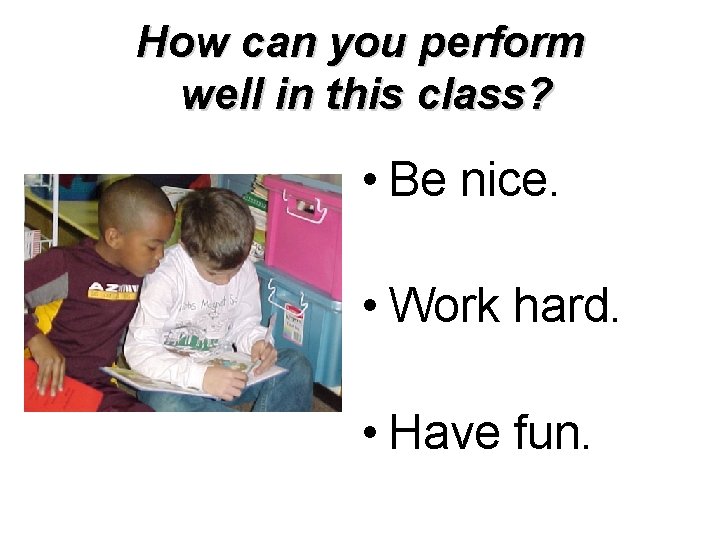
How can you perform well in this class? • Be nice. • Work hard. • Have fun.
How can you perform well in this class? • Cultivate your mind by being curious and by seeking meaning. Ask, “well, how did we get here? ” • Effort creates achievement. Each day offers a chance for improvement. Persevere despite setbacks or challenges. Practice makes better. • Practice civic discourse: engage in discussion actively and courteously and work to improve your communication skills, in writing and in discussion • Strive for excellence: expect the best from yourself daily, and exercise mental stamina and self-control.
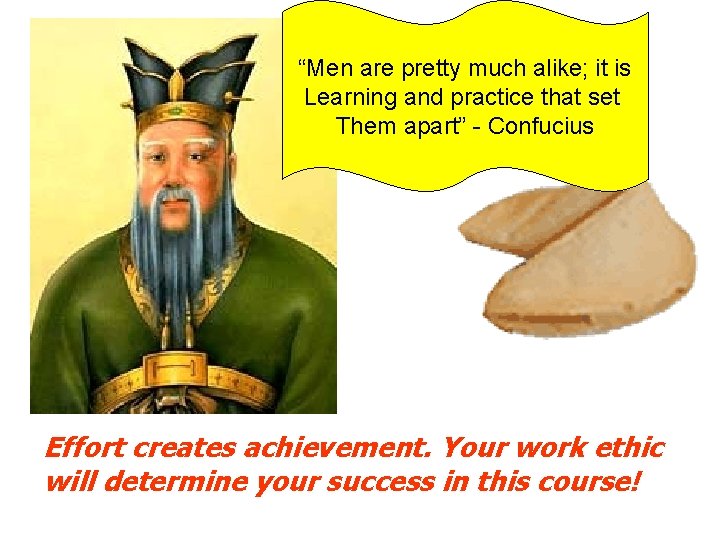
“Men are pretty much alike; it is Learning and practice that set Them apart” - Confucius Effort creates achievement. Your work ethic will determine your success in this course!
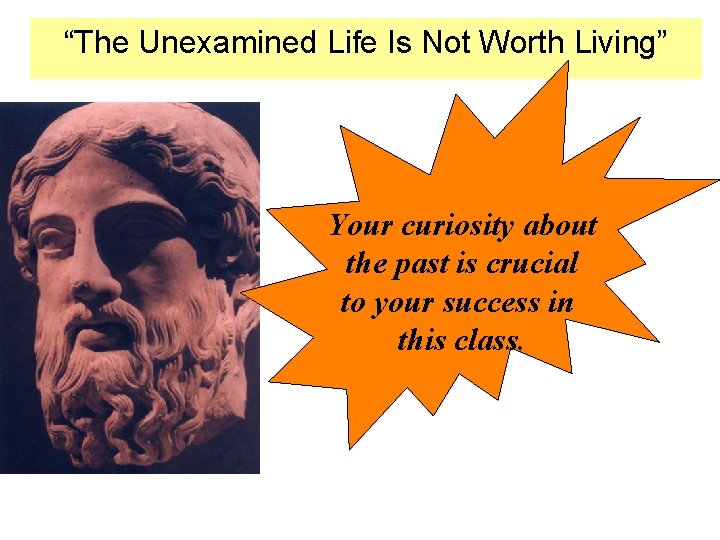
“The Unexamined Life Is Not Worth Living” Your curiosity about the past is crucial to your success in this class.
Sept. 11, 2001: “America’s wake-up call”
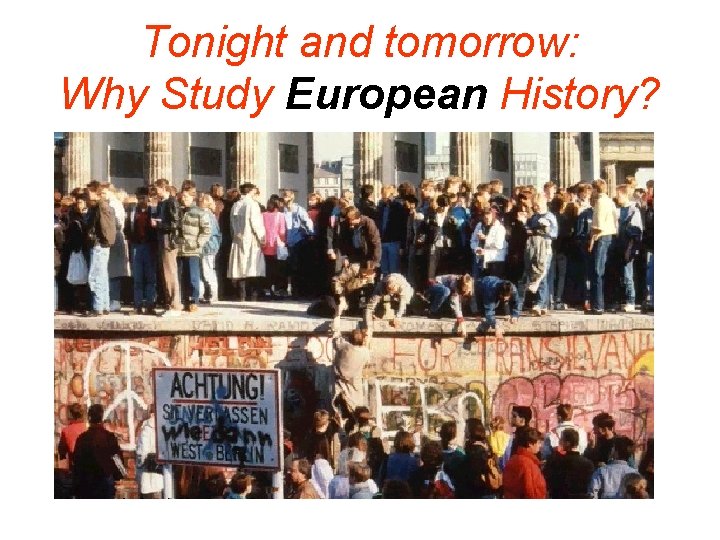
Tonight and tomorrow: Why Study European History?
Homework: 1. Using the text book, identify the authors’ thesis about why it is important to study European history. 2. Identify and be prepared to discuss how the authors support their thesis : “the indexes of modernity”.
What is thesis of this course? Well, first of all, do you remember what IS a THESIS?
What is thesis? A historian’s interpretation of the main causes, effects and significance of a historical event, based on an analysis of the evidence. Some theses are more reasonable or plausible than others.
What is thesis? “The world of the historian, like the world of the scientist, is not a photographic copy of the real world, but rather a working model which enables him more or less effectively to understand it and to master it. The historian distils from the experience of the past rummaging through the ragbag of observed ‘facts’, selecting the relevant, rejecting the irrelevant, until what is sewn together is a logical and rational quilt of ‘knowledge’ …” E. H. Carr, What is History?
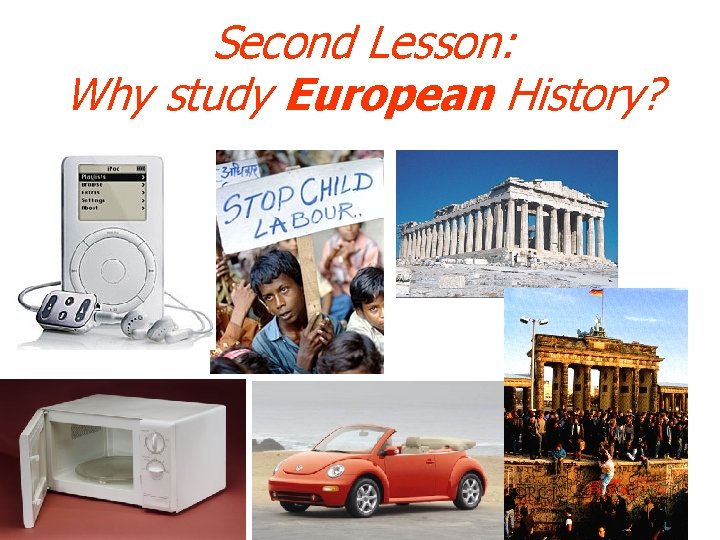
Second Lesson: Why study European History?
Why study European History? ü Recap from yesterday: How will we study history in this course? ü Why study European History? ü Unit Essential Question: Does Europe Still Matter?
The Six C’s of History: WWI Chronology: Complexity: Causality: Continuity & Change: Context: Contingency:
Expectations: • Read nightly from among several college level texts, both secondary and primary sources. • Improve your ability to engage in civic discourse by actively practicing public speaking skills and leadership in class; • Cultivate your ability to research, analyze and interpret history; • Strive to make meaning by consciously using the 6 “C”s of history
“Adolescents entering the adult world in the 21 st century will read and write more than at any other time in human history. They will need advanced levels of literacy to perform their jobs, run their households, act as citizens , and conduct their personal lives”. -Richard Vacca
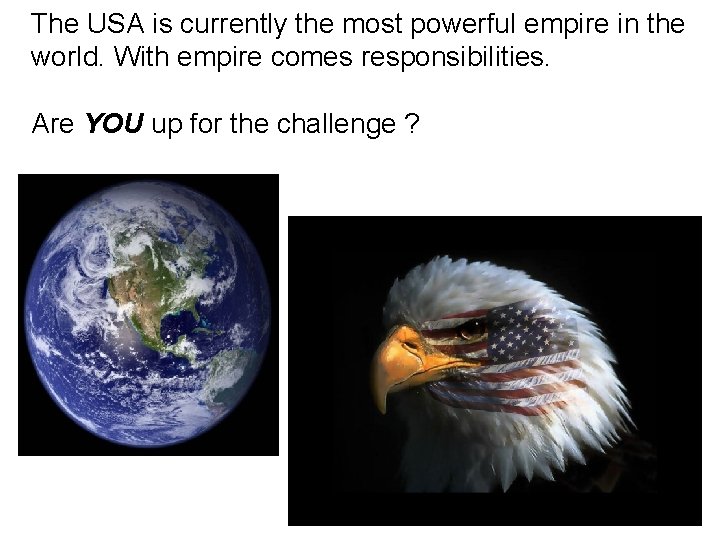
The USA is currently the most powerful empire in the world. With empire comes responsibilities. Are YOU up for the challenge ?
What is thesis of this course?
Homework: 1. Using the text book, identify the authors’ thesis about why it is important to study European history. 2. Identify and be prepared to discuss how the authors support their thesis (“the indexes of modernity”)
What is thesis of this course? “To understand the modern world, it is necessary to begin by looking at Europe” -Palmer & Colton, A History of the Modern World
What are the indexes of modernity? • Pressures for increased democracy • Loosening of old customs • Questioning of ancestral religions; increased secularization • Demands for individual liberation • Expectation of a higher standard of living • Drive for more equality (gender, race, class, religious, nationalities) • Elaborate means of transportation and communication • Advanced science, medicine, hygiene, agriculture • Sophisticated means for fighting or negotiating peace • Complex networks of finance and trade
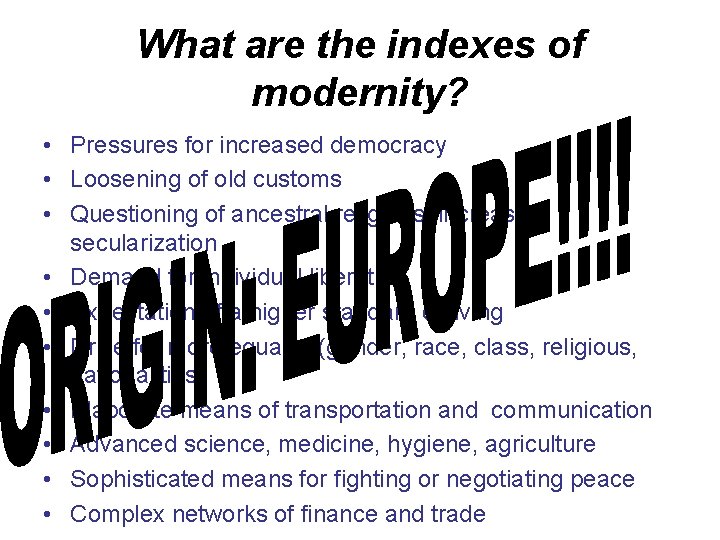
What are the indexes of modernity? • Pressures for increased democracy • Loosening of old customs • Questioning of ancestral religions; increased secularization • Demand for individual liberation • Expectation of a higher standard of living • Drive for more equality (gender, race, class, religious, nationalities) • Elaborate means of transportation and communication • Advanced science, medicine, hygiene, agriculture • Sophisticated means for fighting or negotiating peace • Complex networks of finance and trade
What is thesis of this course? “To understand the modern world, it is necessary to begin by looking at Europe” -Palmer & Colton, A History of the Modern World PROBLEMATIC? CONTROVERSIAL?
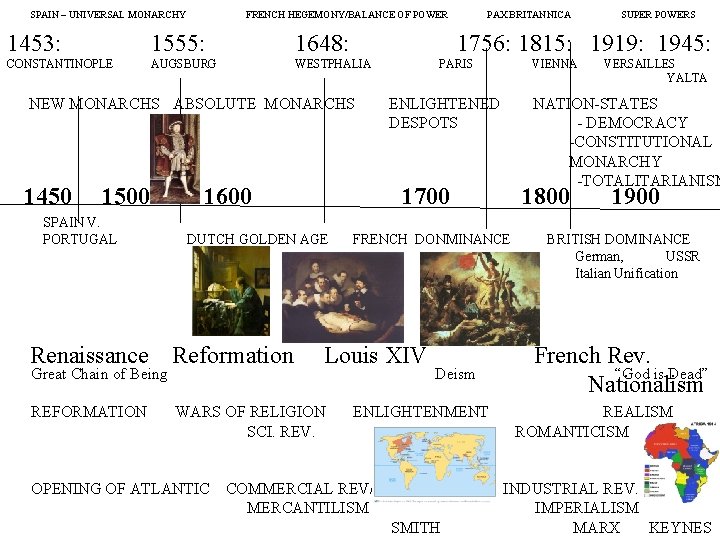
SPAIN – UNIVERSAL MONARCHY FRENCH HEGEMONY/BALANCE OF POWER 1453: 1555: 1648: CONSTANTINOPLE AUGSBURG WESTPHALIA 1500 SPAIN V. PORTUGAL 1600 Renaissance Reformation REFORMATION WARS OF RELIGION SCI. REV. Great Chain of Being OPENING OF ATLANTIC PARIS VIENNA ENLIGHTENED DESPOTS 1800 FRENCH DONMINANCE Louis XIV Deism ENLIGHTENMENT COMMERCIAL REV/ MERCANTILISM SMITH VERSAILLES YALTA NATION-STATES - DEMOCRACY -CONSTITUTIONAL MONARCHY -TOTALITARIANISM 1700 DUTCH GOLDEN AGE SUPER POWERS 1756: 1815: 1919: 1945: NEW MONARCHS ABSOLUTE MONARCHS 1450 PAX BRITANNICA 1900 BRITISH DOMINANCE German, USSR Italian Unification French Rev. “God is Dead” Nationalism REALISM ROMANTICISM INDUSTRIAL REV. IMPERIALISM MARX KEYNES