
First Classical Theory of Heat Capacity too simple









- Slides: 62
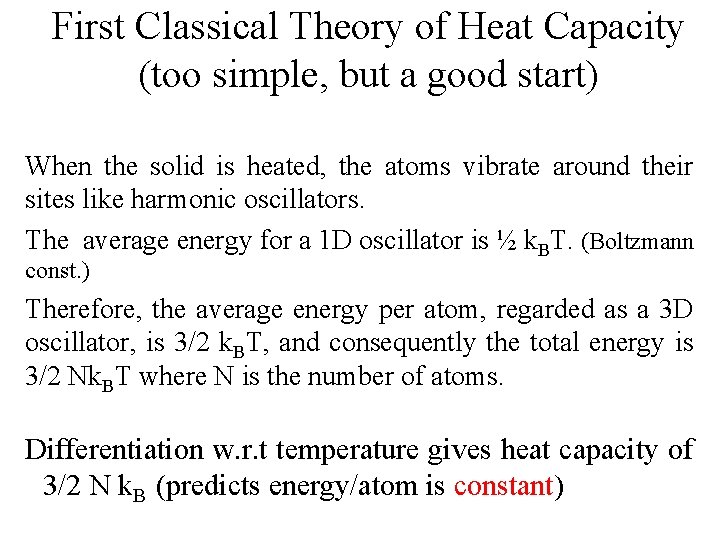
First Classical Theory of Heat Capacity (too simple, but a good start) When the solid is heated, the atoms vibrate around their sites like harmonic oscillators. The average energy for a 1 D oscillator is ½ k. BT. (Boltzmann const. ) Therefore, the average energy per atom, regarded as a 3 D oscillator, is 3/2 k. BT, and consequently the total energy is 3/2 Nk. BT where N is the number of atoms. Differentiation w. r. t temperature gives heat capacity of 3/2 N k. B (predicts energy/atom is constant)
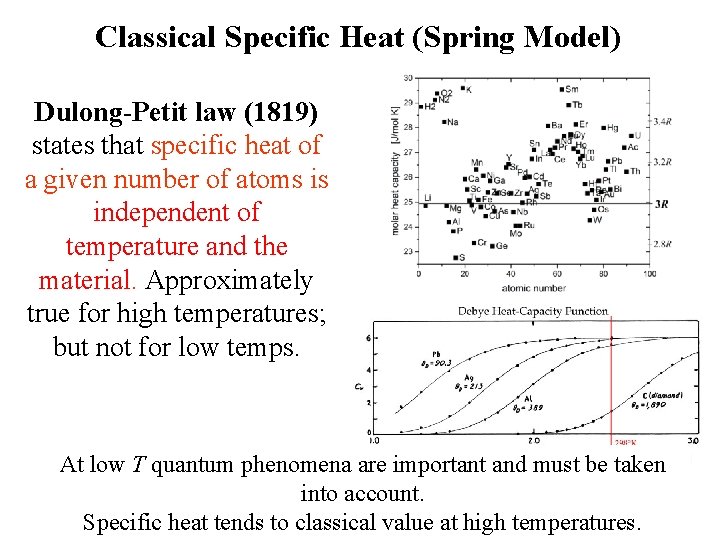
Classical Specific Heat (Spring Model) Dulong-Petit law (1819) states that specific heat of a given number of atoms is independent of temperature and the material. Approximately true for high temperatures; but not for low temps. At low T quantum phenomena are important and must be taken into account. Specific heat tends to classical value at high temperatures.
Two types of specific heat: Cp vs Cv • Specific heat under constant pressure or volume
Two types of specific heat: Cp vs Cv • Specific heat under constant pressure or volume • Which variable are you more likely to control?
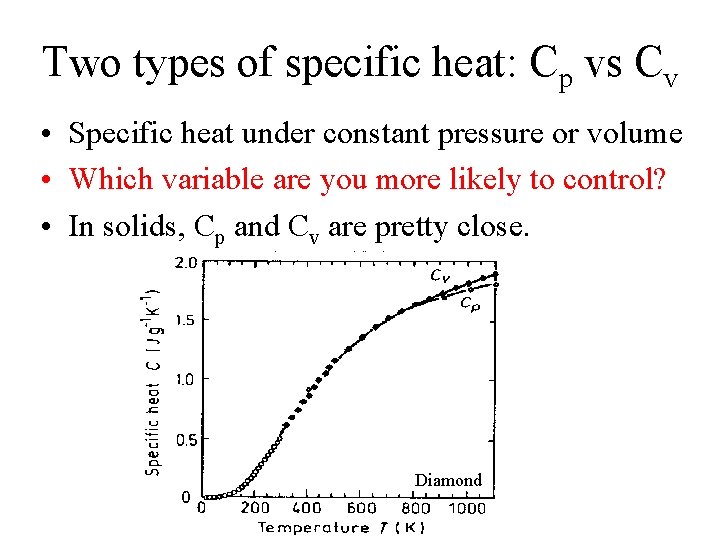
Two types of specific heat: Cp vs Cv • Specific heat under constant pressure or volume • Which variable are you more likely to control? • In solids, Cp and Cv are pretty close. Diamond
To be thorough need to find the total energy of the phonons U, then take d. U/d. T to find C. How to find U?
To be thorough need to find the total energy of the phonons U, then take d. U/d. T to find C. How to find U? Let’s learn how to get these!
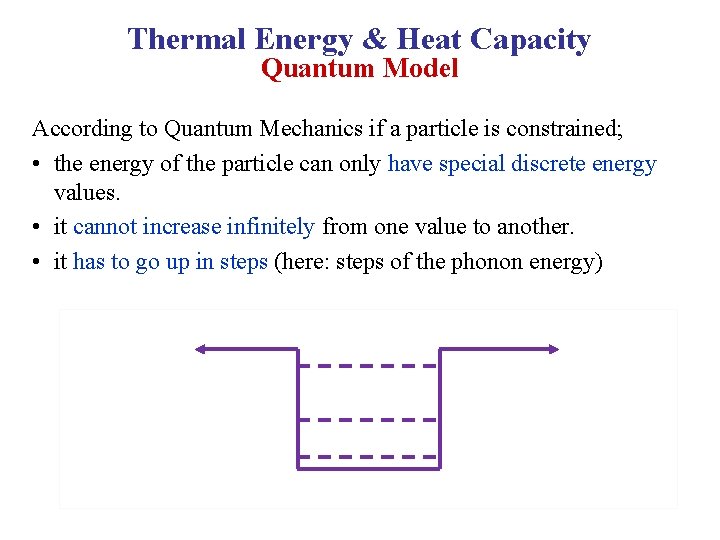
Thermal Energy & Heat Capacity Quantum Model According to Quantum Mechanics if a particle is constrained; • the energy of the particle can only have special discrete energy values. • it cannot increase infinitely from one value to another. • it has to go up in steps (here: steps of the phonon energy)
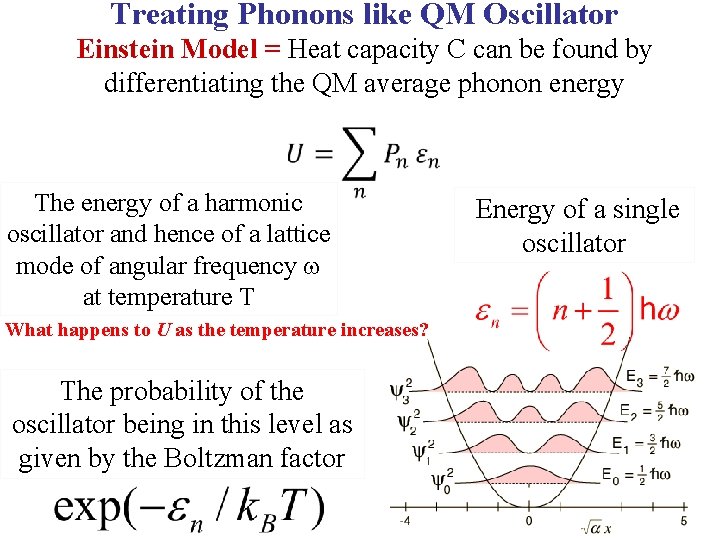
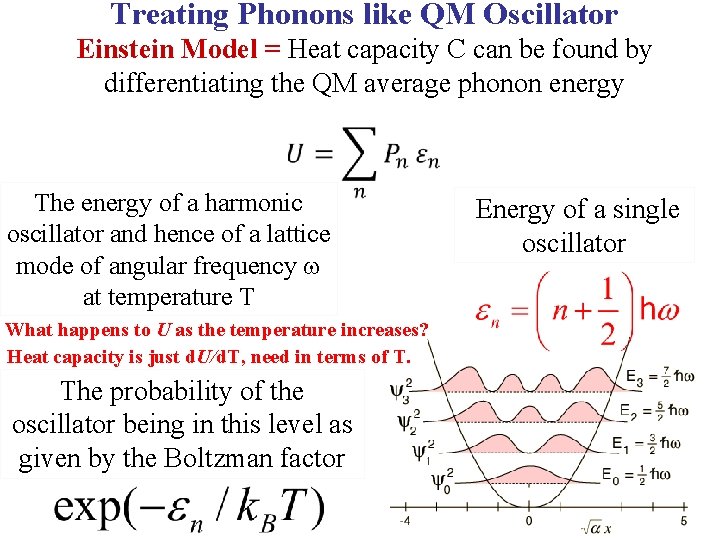
Treating Phonons like QM Oscillator Einstein Model = Heat capacity C can be found by differentiating the QM average phonon energy
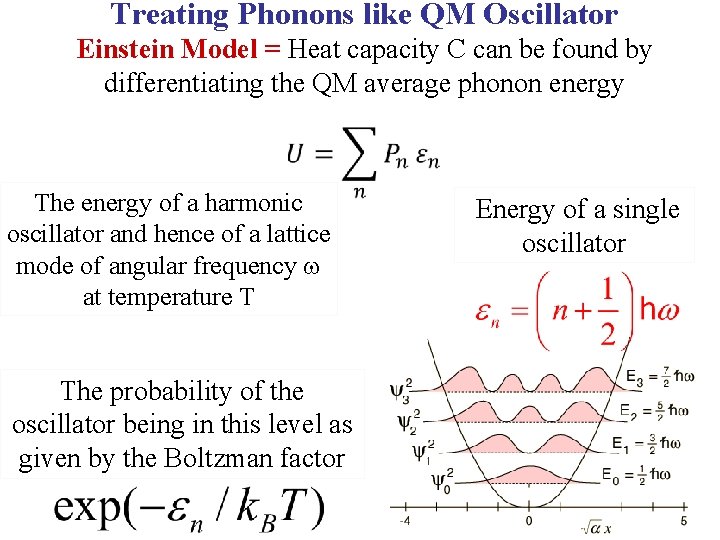
Treating Phonons like QM Oscillator Einstein Model = Heat capacity C can be found by differentiating the QM average phonon energy The energy of a harmonic oscillator and hence of a lattice mode of angular frequency at temperature T Energy of a single oscillator
Treating Phonons like QM Oscillator Einstein Model = Heat capacity C can be found by differentiating the QM average phonon energy The energy of a harmonic oscillator and hence of a lattice mode of angular frequency at temperature T The probability of the oscillator being in this level as given by the Boltzman factor Energy of a single oscillator
Treating Phonons like QM Oscillator Einstein Model = Heat capacity C can be found by differentiating the QM average phonon energy The energy of a harmonic oscillator and hence of a lattice mode of angular frequency at temperature T What happens to U as the temperature increases? The probability of the oscillator being in this level as given by the Boltzman factor Energy of a single oscillator
Treating Phonons like QM Oscillator Einstein Model = Heat capacity C can be found by differentiating the QM average phonon energy The energy of a harmonic oscillator and hence of a lattice mode of angular frequency at temperature T What happens to U as the temperature increases? Heat capacity is just d. U/d. T, need in terms of T. The probability of the oscillator being in this level as given by the Boltzman factor Energy of a single oscillator
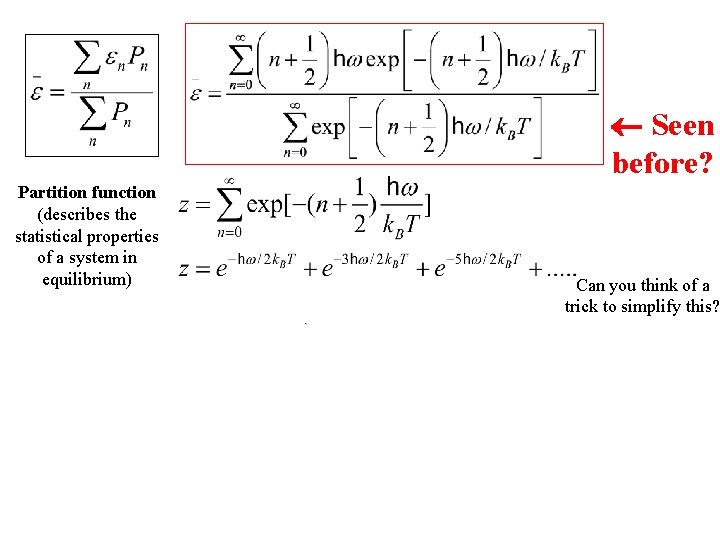
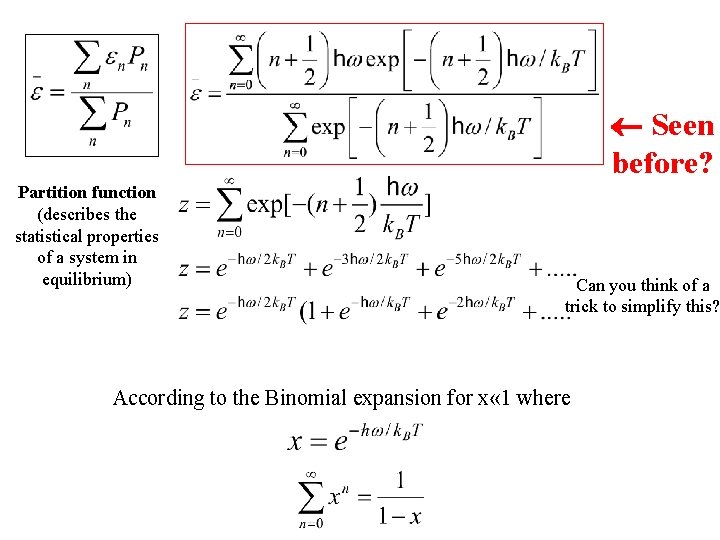
Seen before?
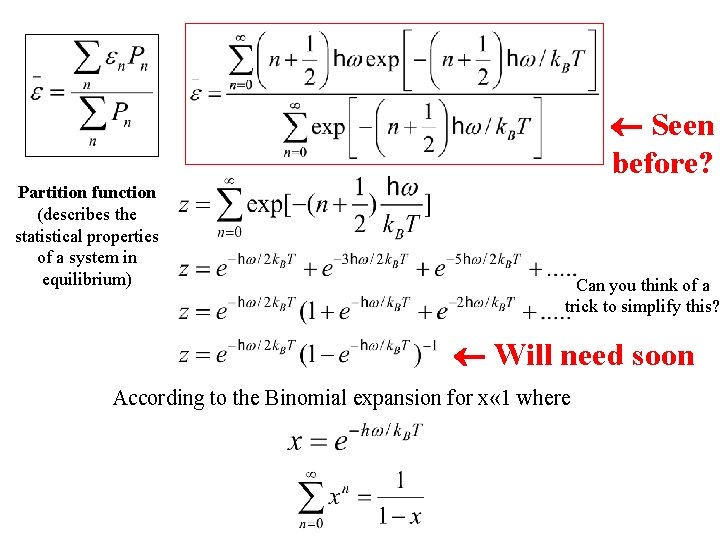
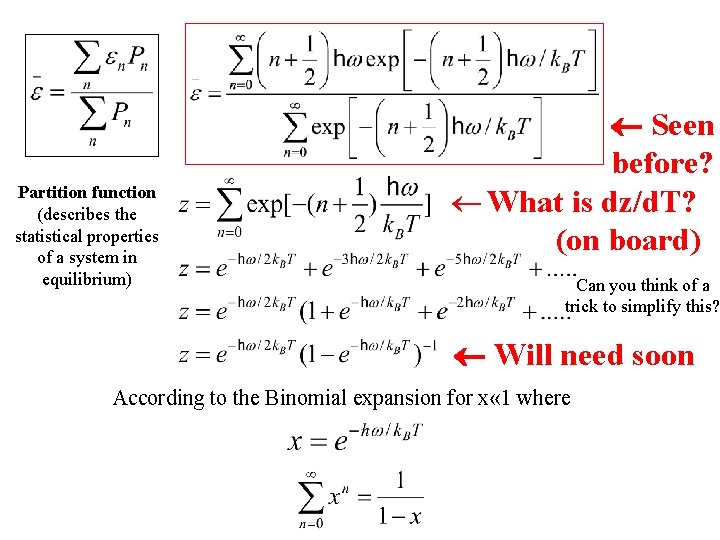
Seen before? Partition function (describes the statistical properties of a system in equilibrium) Can you think of a trick to simplify this?
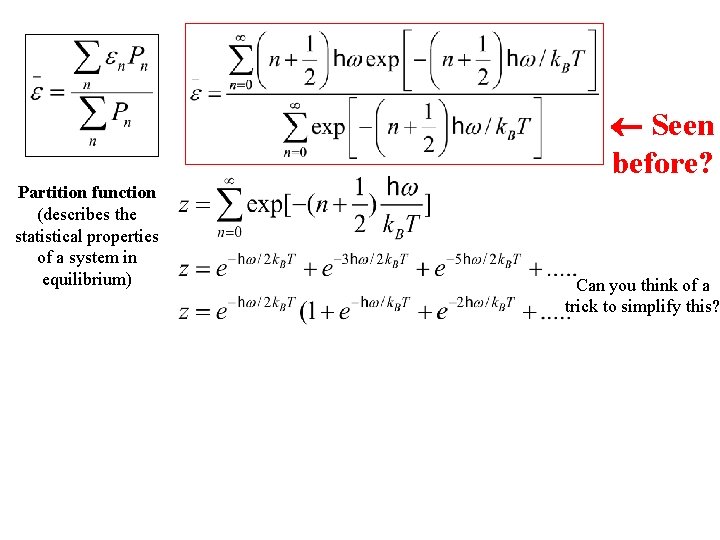
Seen before? Partition function (describes the statistical properties of a system in equilibrium) Can you think of a trick to simplify this?
Seen before? Partition function (describes the statistical properties of a system in equilibrium) Can you think of a trick to simplify this? According to the Binomial expansion for x « 1 where
Seen before? Partition function (describes the statistical properties of a system in equilibrium) Can you think of a trick to simplify this? Will need soon According to the Binomial expansion for x « 1 where
Partition function (describes the statistical properties of a system in equilibrium) Seen before? ¬ What is dz/d. T? (on board) Can you think of a trick to simplify this? Will need soon According to the Binomial expansion for x « 1 where
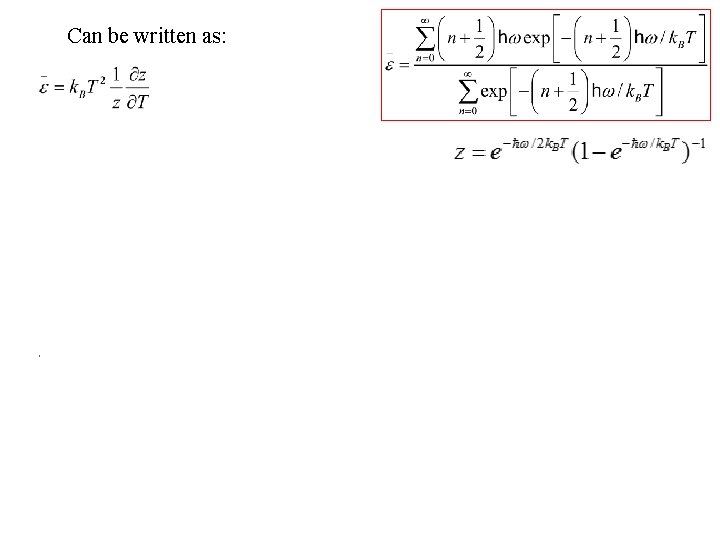
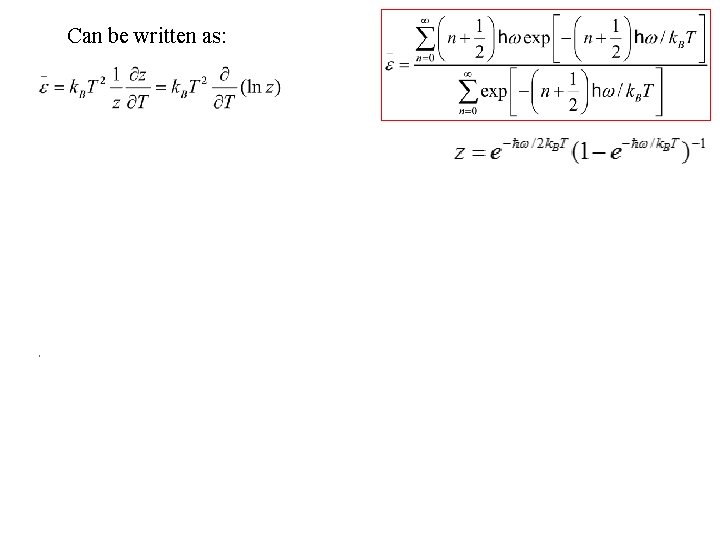
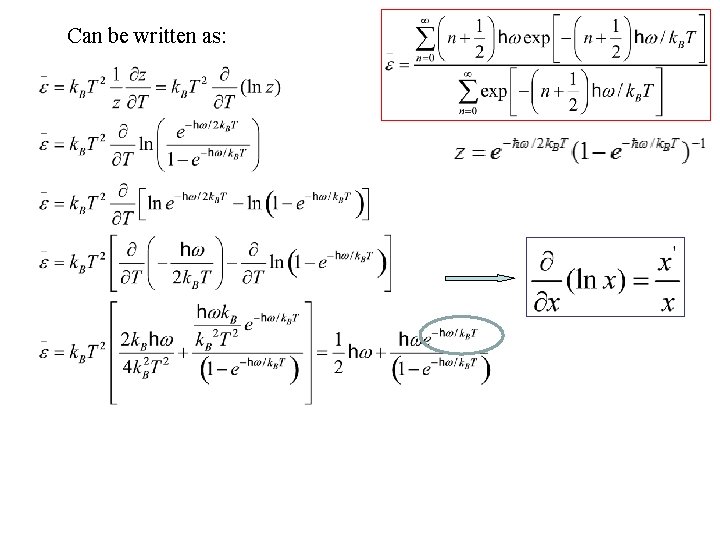
Can be written as:
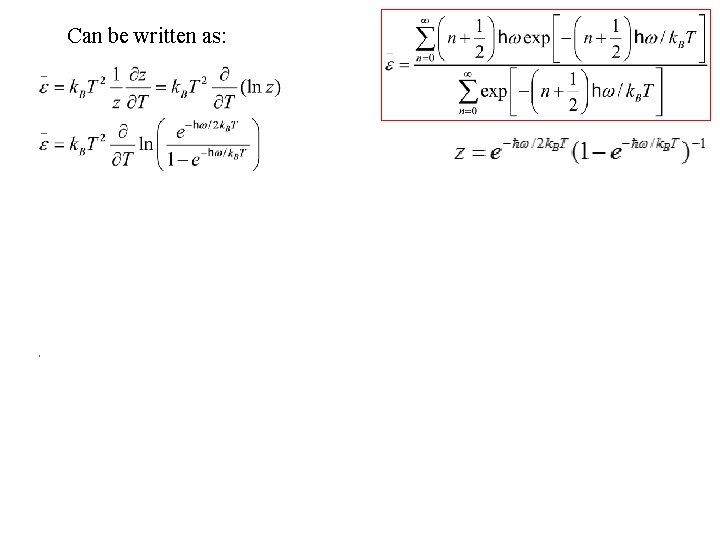
Can be written as:
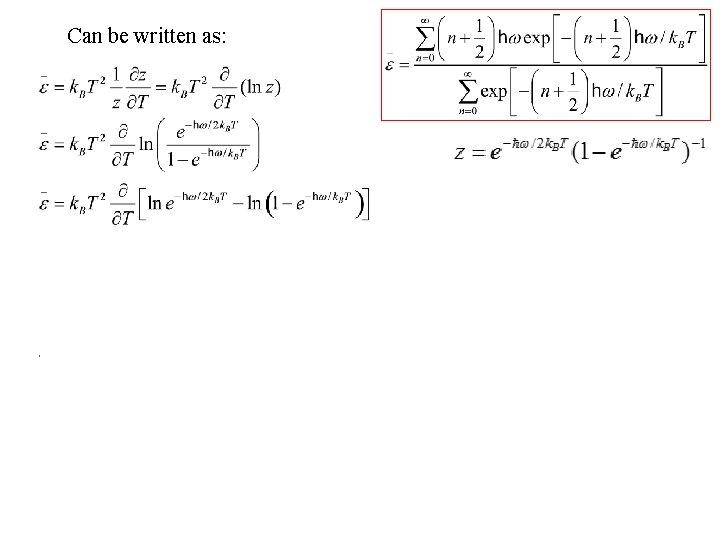
Can be written as:
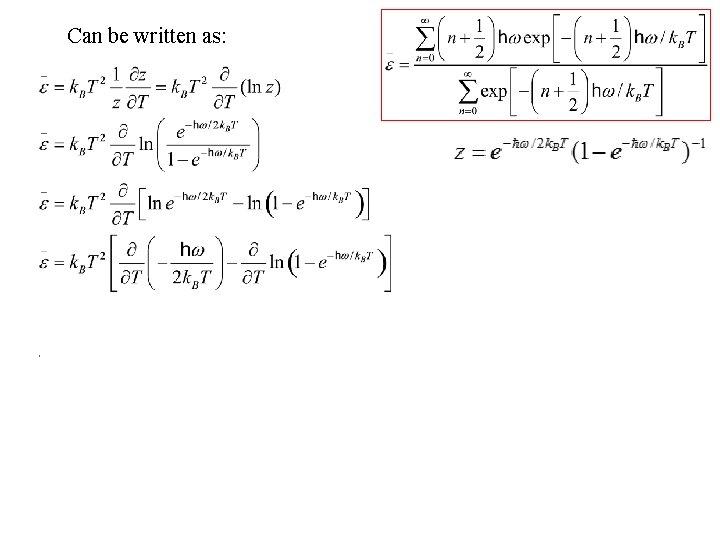
Can be written as:
Can be written as:
Can be written as:
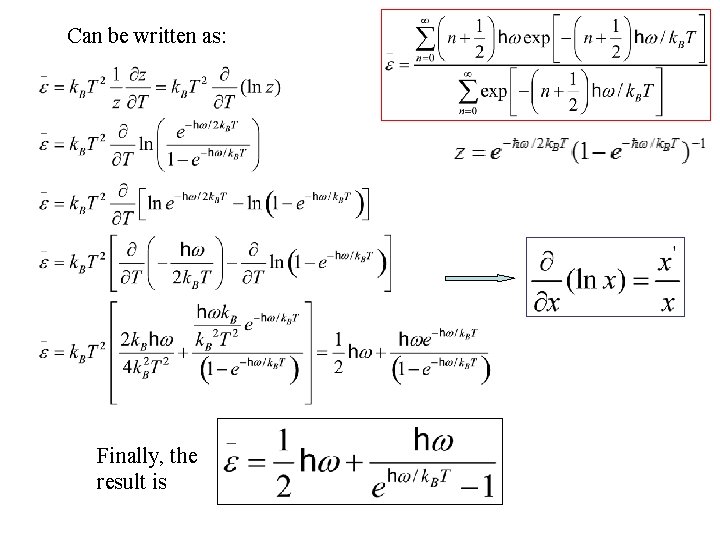
Can be written as: Finally, the result is
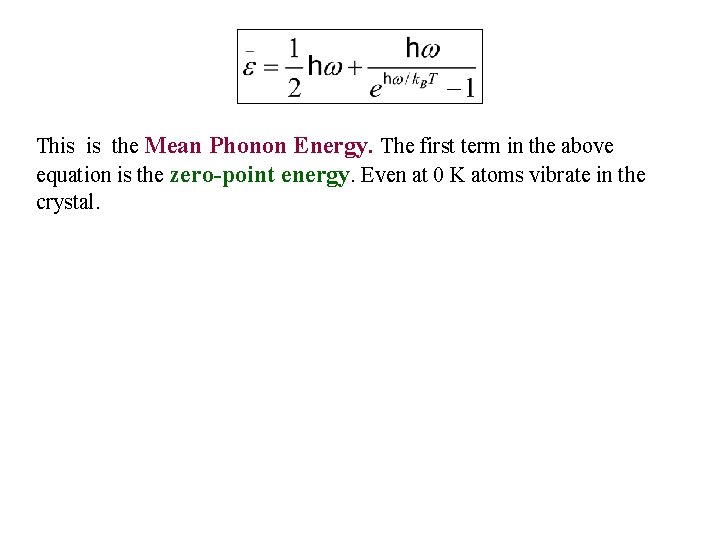
This is the Mean Phonon Energy. The first term in the above equation is the zero-point energy. Even at 0 K atoms vibrate in the crystal.
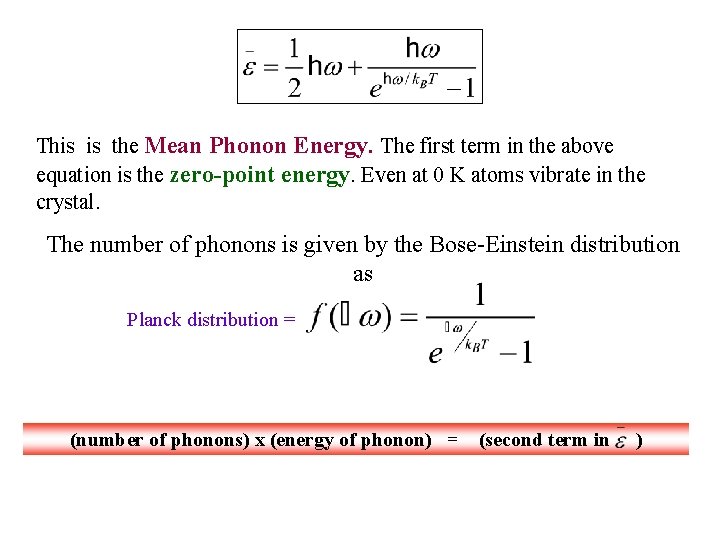
This is the Mean Phonon Energy. The first term in the above equation is the zero-point energy. Even at 0 K atoms vibrate in the crystal. The number of phonons is given by the Bose-Einstein distribution as Planck distribution = (number of phonons) x (energy of phonon) = (second term in )
This is the Mean Phonon Energy. The first term in the above equation is the zero-point energy. Even at 0 K atoms vibrate in the crystal. The number of phonons is given by the Bose-Einstein distribution as Planck distribution = (number of phonons) x (energy of phonon) = (second term in ) The second term in the mean energy is the phonon contribution to thermal energy (since constant goes away with derivative).
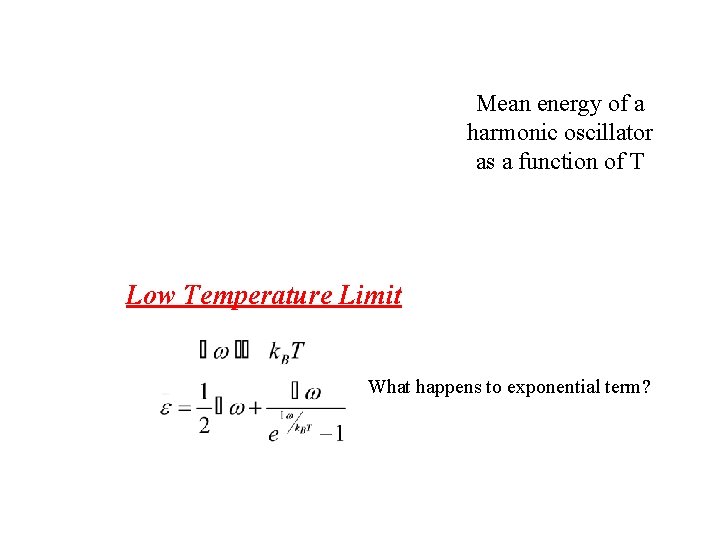
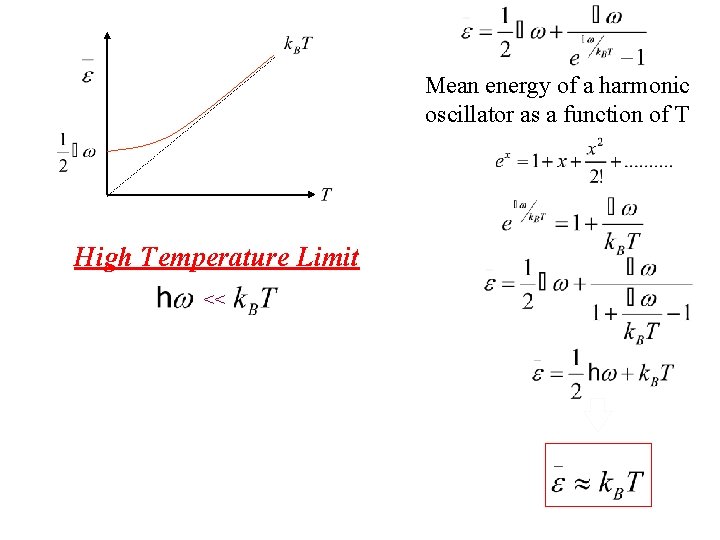
Mean energy of a harmonic oscillator as a function of T Low Temperature Limit What happens to exponential term?
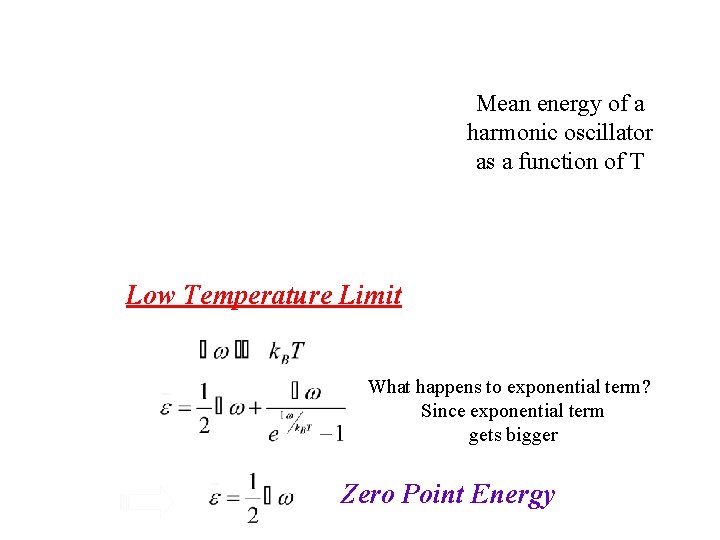
Mean energy of a harmonic oscillator as a function of T Low Temperature Limit What happens to exponential term? Since exponential term gets bigger Zero Point Energy
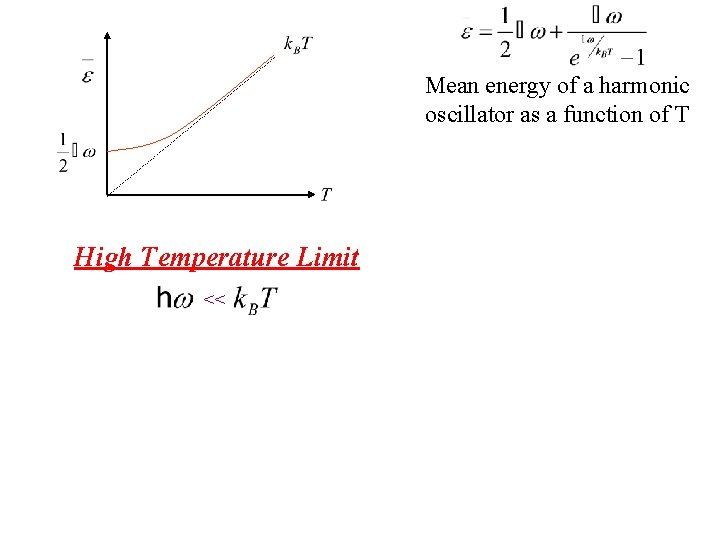
Mean energy of a harmonic oscillator as a function of T High Temperature Limit <<
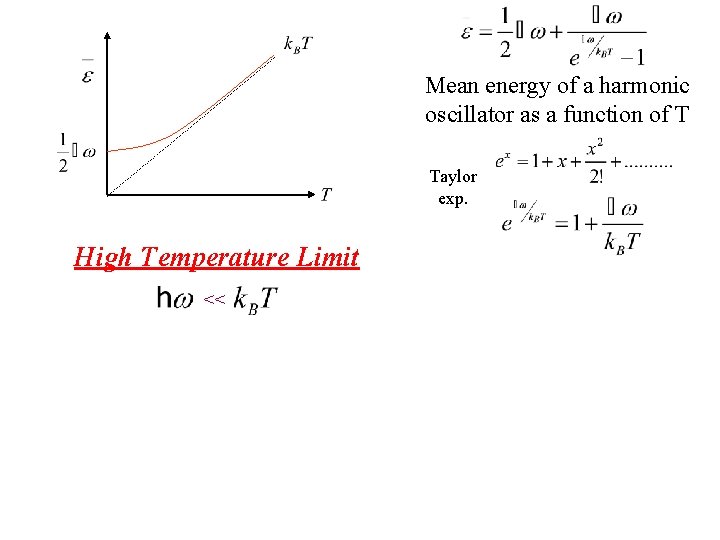
Mean energy of a harmonic oscillator as a function of T Taylor exp. High Temperature Limit <<
Mean energy of a harmonic oscillator as a function of T High Temperature Limit <<
Mean energy of a harmonic oscillator as a function of T High Temperature Limit <<
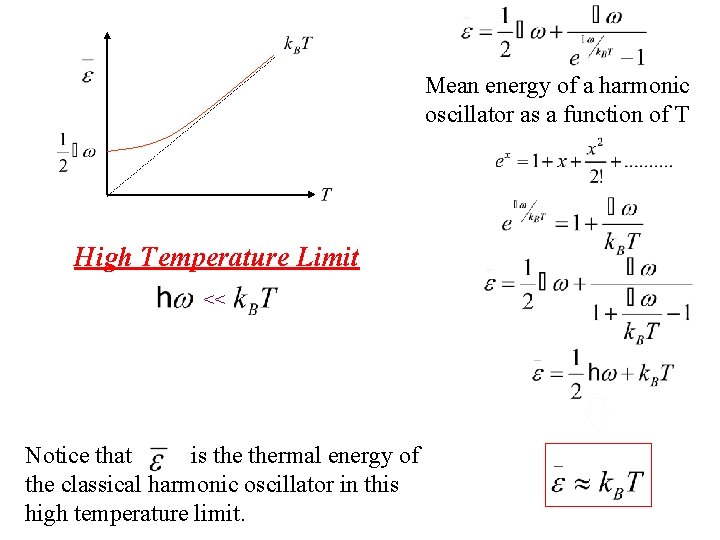
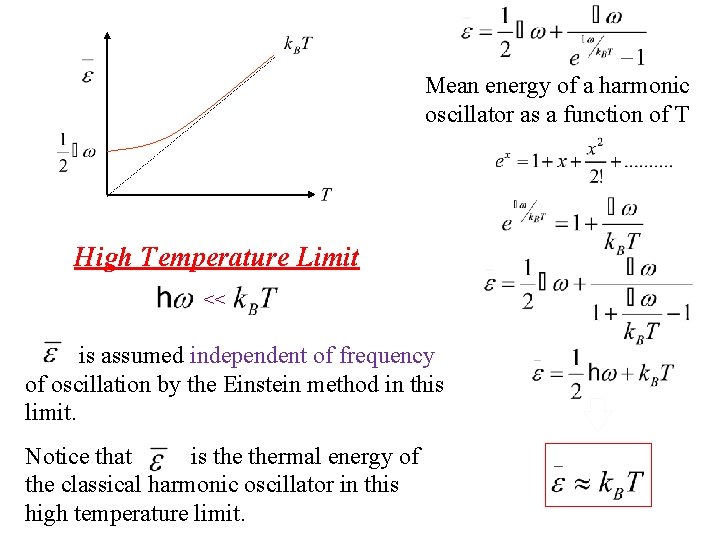
Mean energy of a harmonic oscillator as a function of T High Temperature Limit << Notice that is thermal energy of the classical harmonic oscillator in this high temperature limit.
Mean energy of a harmonic oscillator as a function of T High Temperature Limit << is assumed independent of frequency of oscillation by the Einstein method in this limit. Notice that is thermal energy of the classical harmonic oscillator in this high temperature limit.
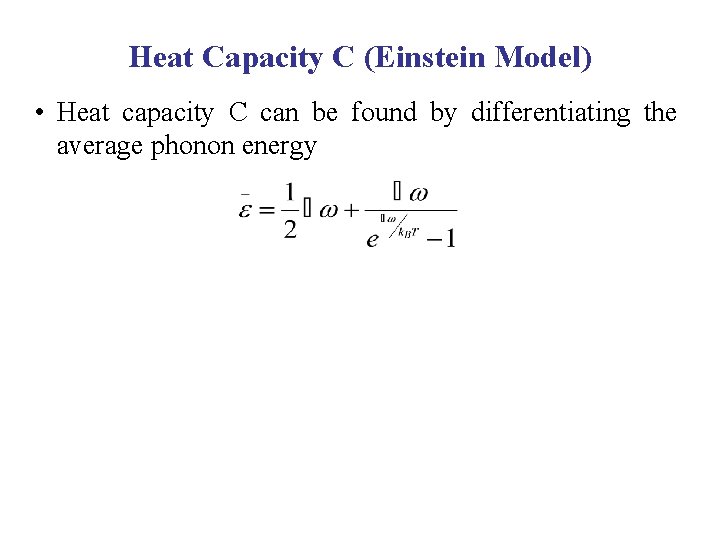
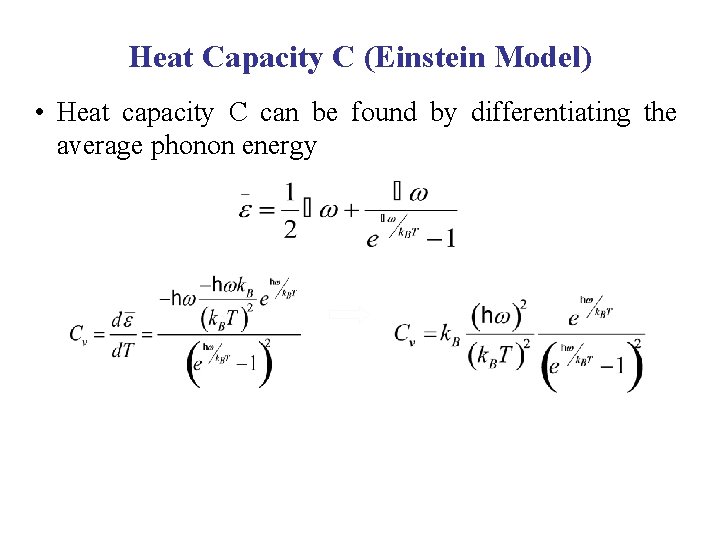
Heat Capacity C (Einstein Model) • Heat capacity C can be found by differentiating the average phonon energy
Heat Capacity C (Einstein Model) • Heat capacity C can be found by differentiating the average phonon energy
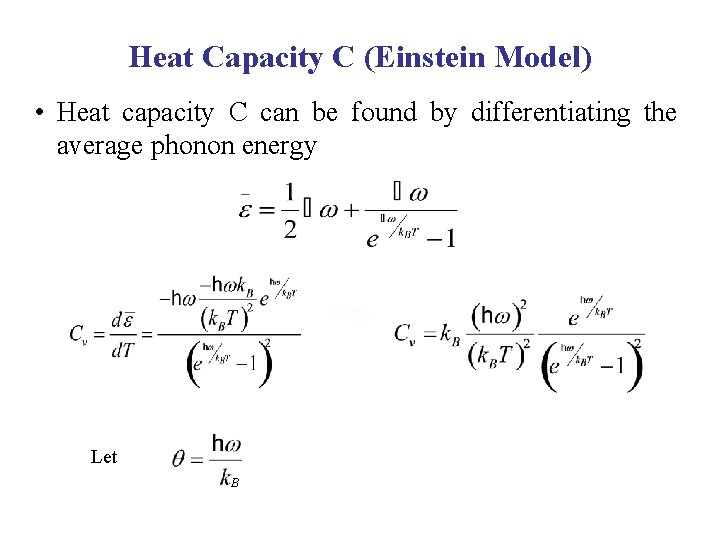
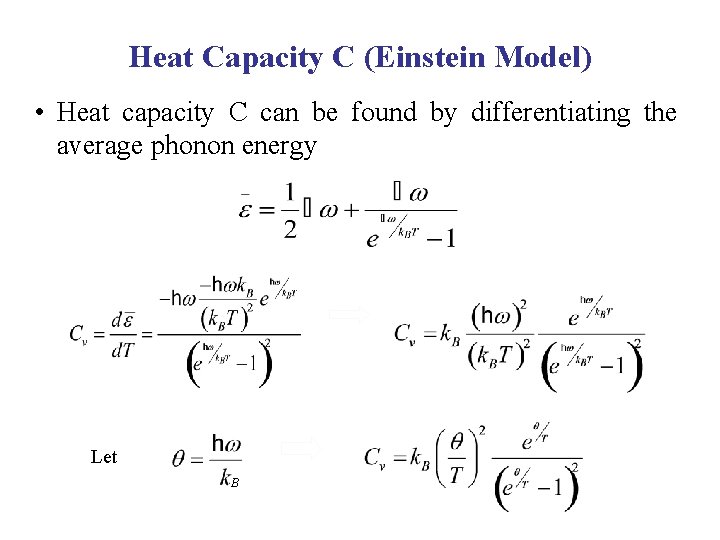
Heat Capacity C (Einstein Model) • Heat capacity C can be found by differentiating the average phonon energy Let B
Heat Capacity C (Einstein Model) • Heat capacity C can be found by differentiating the average phonon energy Let B
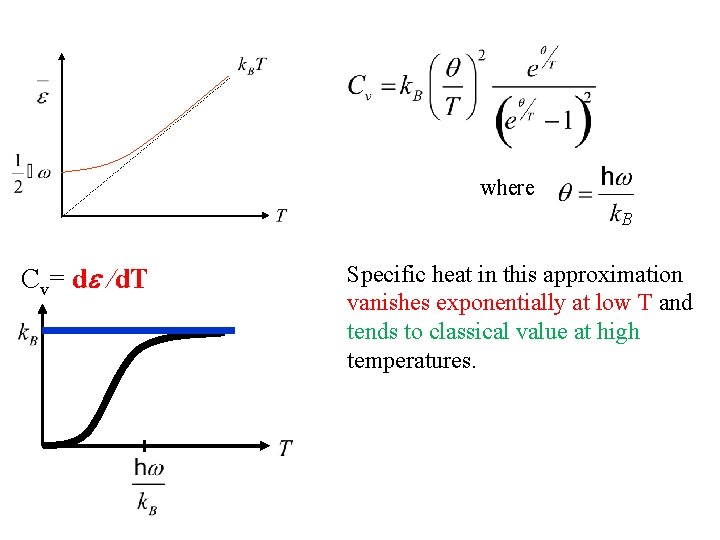
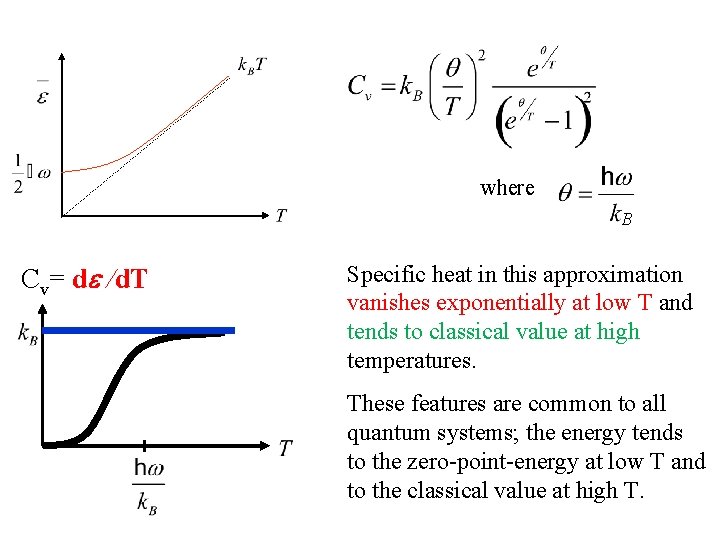
where B Cv= d /d. T Specific heat in this approximation vanishes exponentially at low T and tends to classical value at high temperatures.
where B Cv= d /d. T Specific heat in this approximation vanishes exponentially at low T and tends to classical value at high temperatures. These features are common to all quantum systems; the energy tends to the zero-point-energy at low T and to the classical value at high T.
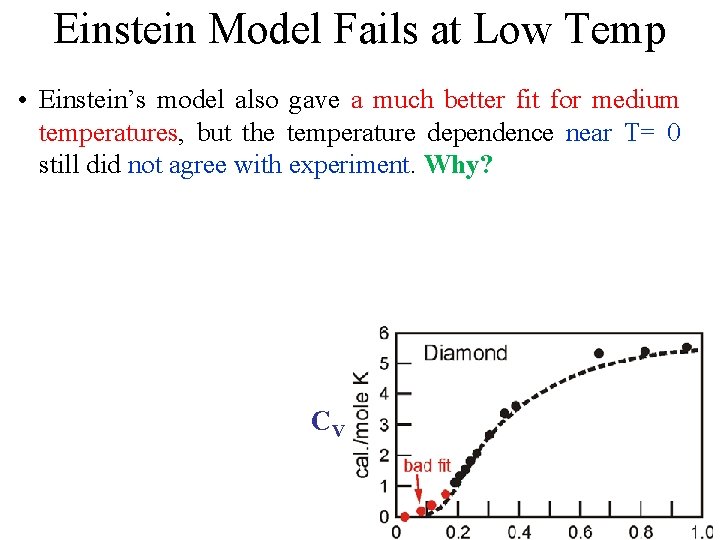
Einstein Model Fails at Low Temp • Einstein’s model also gave a much better fit for medium temperatures, but the temperature dependence near T= 0 still did not agree with experiment. Why? CV
Einstein Model Fails at Low Temp • Einstein’s model also gave a much better fit for medium temperatures, but the temperature dependence near T= 0 still did not agree with experiment. Why? • Taking into account the actual distribution of vibration frequencies in a solid this discrepancy can be accounted for CV
Einstein Model Fails at Low Temp • Einstein’s model also gave a much better fit for medium temperatures, but the temperature dependence near T= 0 still did not agree with experiment. Why? • Taking into account the actual distribution of vibration frequencies in a solid this discrepancy can be accounted for Einstein was aware that getting the frequency of the actual oscillations would be different. He proposed this theory CV because it was a simple demonstration that QM could solve the specific heat problem.
Incorporating the phonon distribution • Specific heat is still the temperature derivative of energy Cv= d. U /d. T
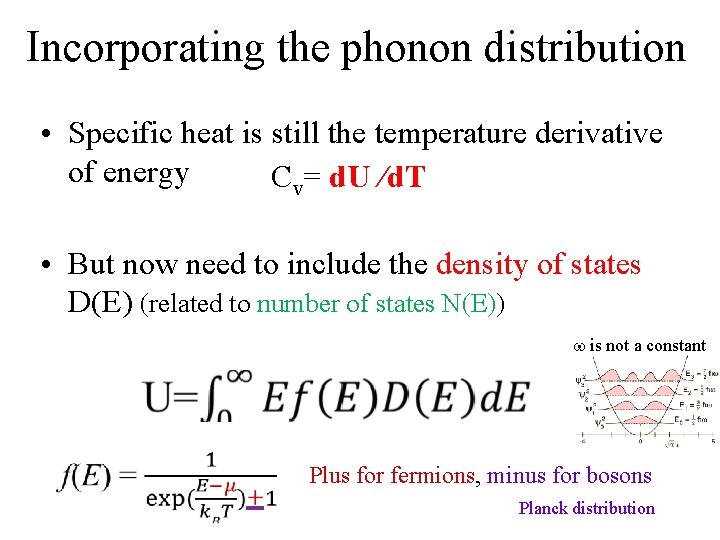
Incorporating the phonon distribution • Specific heat is still the temperature derivative of energy Cv= d. U /d. T • But now need to include the density of states D(E) (related to number of states N(E)) is not a constant Plus for fermions, minus for bosons Planck distribution
Density of Levels/States (confusing at first, read p. 108 -112) It’s ok if this doesn’t make sense by the end of today. It normally takes some practice before it becomes clear. That’s what homework and tests are for.
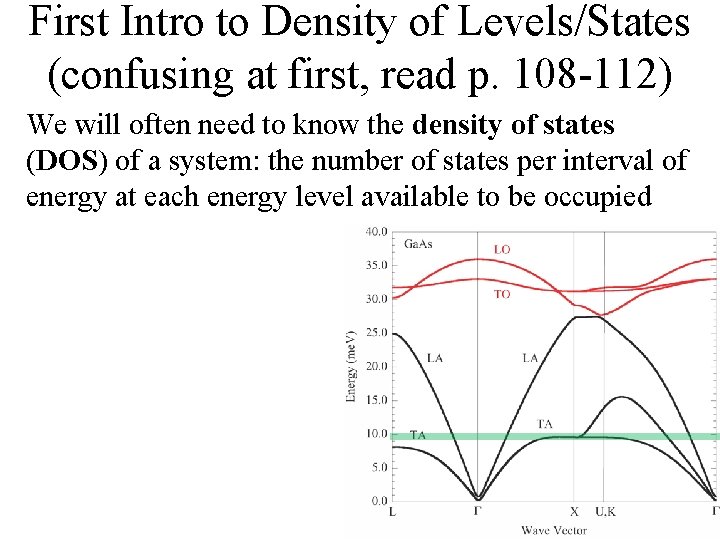
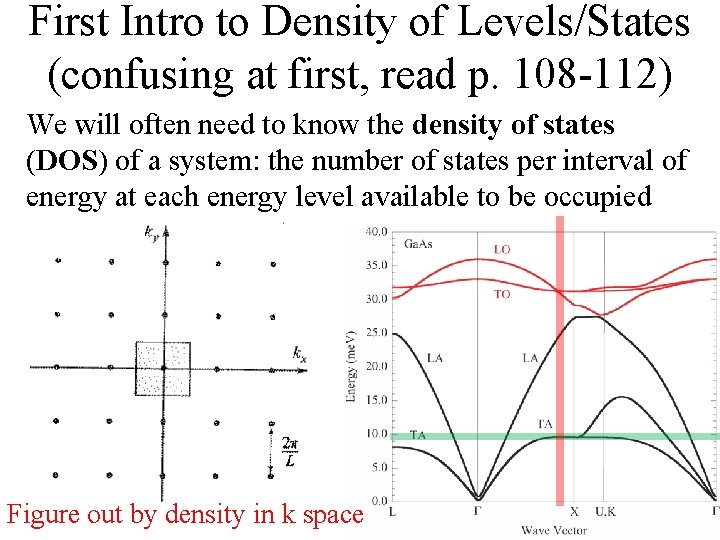
Density of Levels/States (confusing at first, read p. 108 -112) We will often need to know the density of states (DOS) of a system: the number of states per interval of energy at each energy level available to be occupied
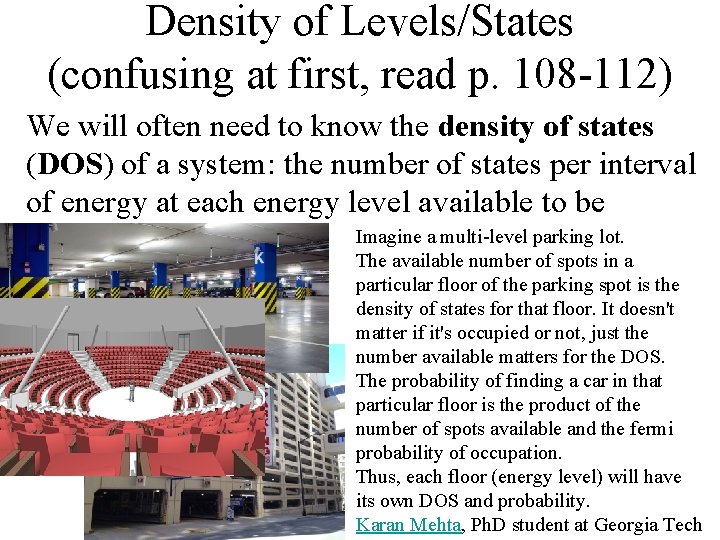
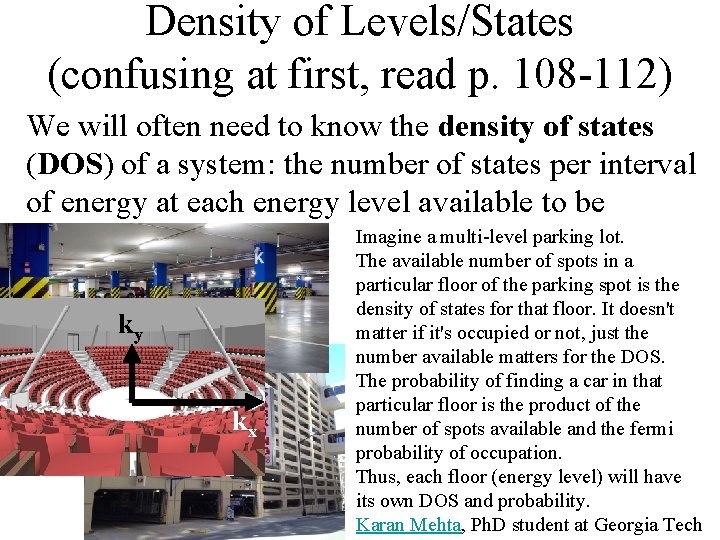
Density of Levels/States (confusing at first, read p. 108 -112) We will often need to know the density of states (DOS) of a system: the number of states per interval of energy at each energy level available to be Imagine a multi-level parking lot. occupied The available number of spots in a particular floor of the parking spot is the density of states for that floor. It doesn't matter if it's occupied or not, just the number available matters for the DOS. The probability of finding a car in that particular floor is the product of the number of spots available and the fermi probability of occupation. Thus, each floor (energy level) will have its own DOS and probability. Karan Mehta, Ph. D student at Georgia Tech
Density of Levels/States (confusing at first, read p. 108 -112) We will often need to know the density of states (DOS) of a system: the number of states per interval of energy at each energy level available to be Imagine a multi-level parking lot. occupied The available number of spots in a particular floor of the parking spot is the density of states for that floor. It doesn't matter if it's occupied or not, just the number available matters for the DOS. The probability of finding a car in that particular floor is the product of the number of spots available and the fermi probability of occupation. Thus, each floor (energy level) will have its own DOS and probability. Karan Mehta, Ph. D student at Georgia Tech
Density of Levels/States (confusing at first, read p. 108 -112) We will often need to know the density of states (DOS) of a system: the number of states per interval of energy at each energy level available to be Imagine a multi-level parking lot. occupied ky kx The available number of spots in a particular floor of the parking spot is the density of states for that floor. It doesn't matter if it's occupied or not, just the number available matters for the DOS. The probability of finding a car in that particular floor is the product of the number of spots available and the fermi probability of occupation. Thus, each floor (energy level) will have its own DOS and probability. Karan Mehta, Ph. D student at Georgia Tech
First Intro to Density of Levels/States (confusing at first, read p. 108 -112) We will often need to know the density of states (DOS) of a system: the number of states per interval of energy at each energy level available to be occupied
First Intro to Density of Levels/States (confusing at first, read p. 108 -112) We will often need to know the density of states (DOS) of a system: the number of states per interval of energy at each energy level available to be occupied Figure out by density in k space
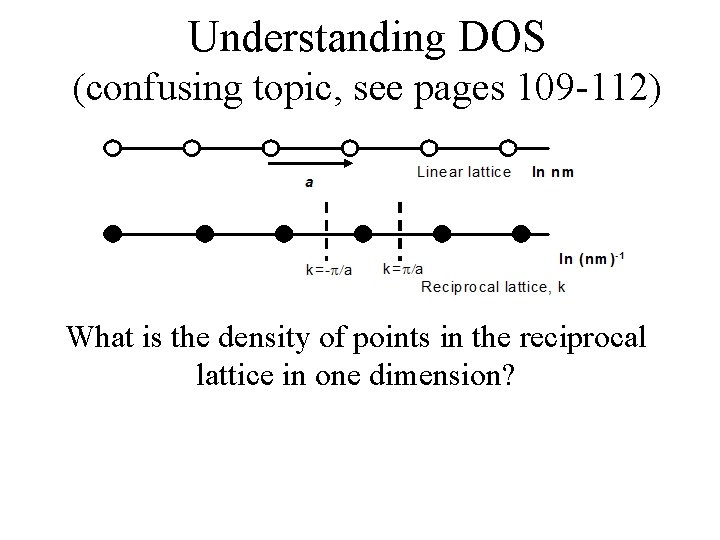
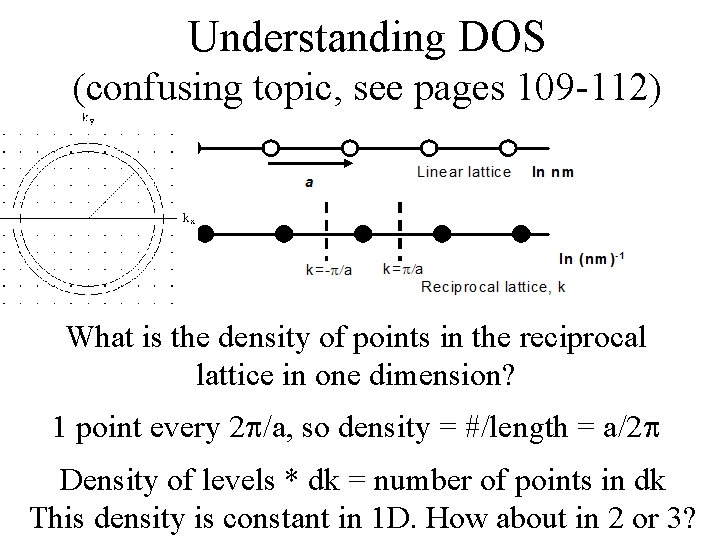
Understanding DOS (confusing topic, see pages 109 -112) What is the density of points in the reciprocal lattice in one dimension?
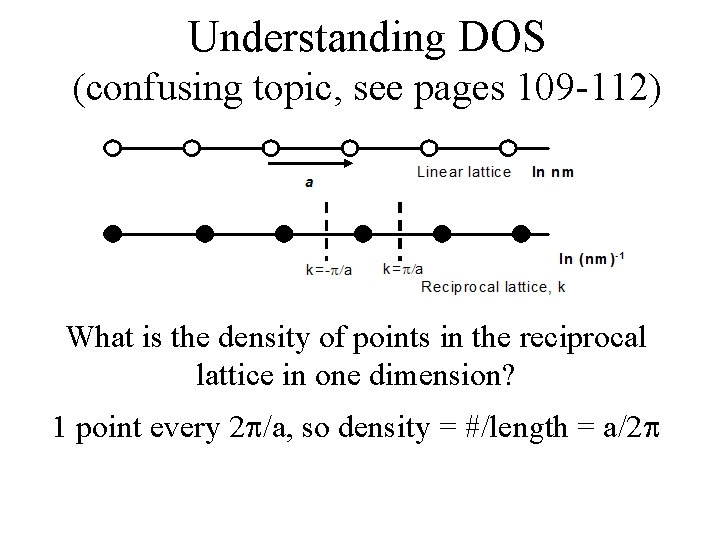
Understanding DOS (confusing topic, see pages 109 -112) What is the density of points in the reciprocal lattice in one dimension? 1 point every 2 /a, so density = #/length = a/2
Understanding DOS (confusing topic, see pages 109 -112) What is the density of points in the reciprocal lattice in one dimension? 1 point every 2 /a, so density = #/length = a/2 Density of levels * dk = number of points in dk This density is constant in 1 D. How about in 2 or 3?
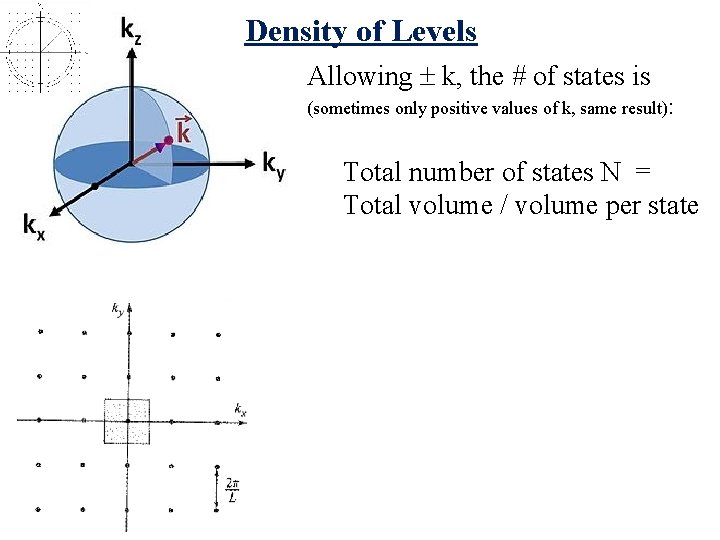
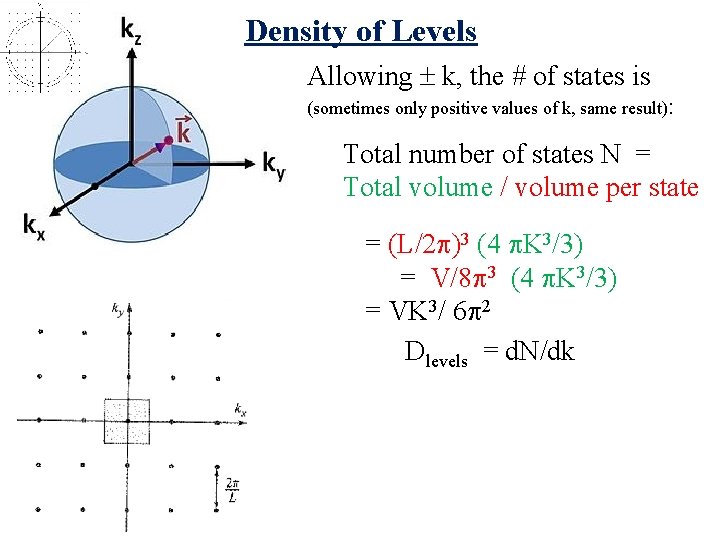
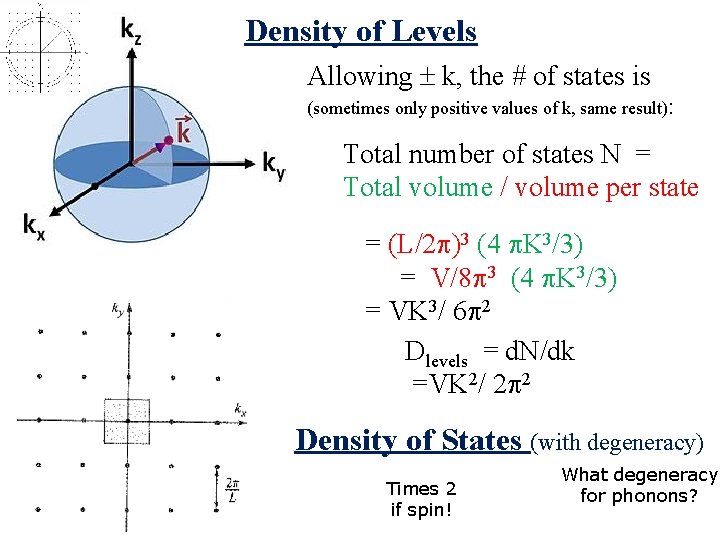
Density of Levels Allowing k, the # of states is (sometimes only positive values of k, same result): Total number of states N = Total volume / volume per state
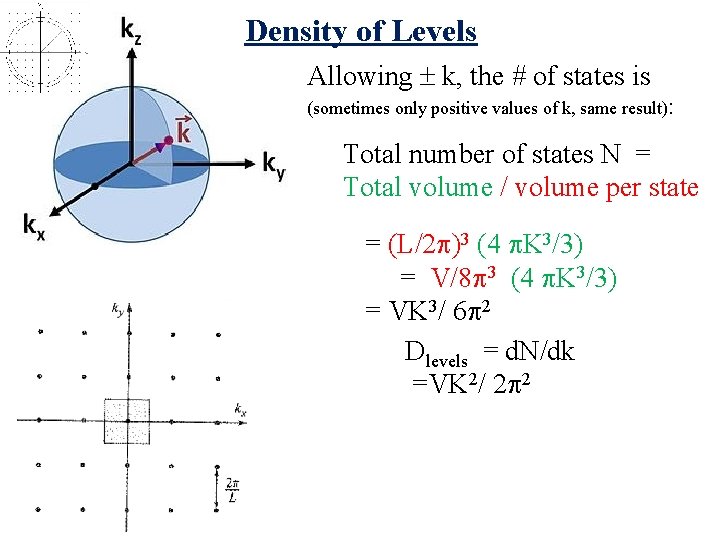
Density of Levels Allowing k, the # of states is (sometimes only positive values of k, same result): Total number of states N = Total volume / volume per state = (L/2 )3 (4 K 3/3) = V/8 3 (4 K 3/3) = VK 3/ 6 2 Dlevels = d. N/dk
Density of Levels Allowing k, the # of states is (sometimes only positive values of k, same result): Total number of states N = Total volume / volume per state = (L/2 )3 (4 K 3/3) = V/8 3 (4 K 3/3) = VK 3/ 6 2 Dlevels = d. N/dk =VK 2/ 2 2
Density of Levels Allowing k, the # of states is (sometimes only positive values of k, same result): Total number of states N = Total volume / volume per state = (L/2 )3 (4 K 3/3) = V/8 3 (4 K 3/3) = VK 3/ 6 2 Dlevels = d. N/dk =VK 2/ 2 2 Density of States (with degeneracy) Times 2 if spin! What degeneracy for phonons?