
First aid test Duke of Edinburgh Award Expedition
First aid test Duke of Edinburgh Award Expedition Training
Q 1. How might you know whether someone is in shock? (Identify all the possible signs and symptoms. ) a. b. c. d. Sweating Pale, cold or clammy skin Severe bleeding Fast, shallow breathing

Q 2. What does DR ABC stand for? (Identify the ONE correct answer. ) 1. Danger, Ring, Airway, Breathing, Circulation 2. Danger, Response, Alert, Breathing, Circulation 3. Danger, Response, Airway, Breathing, Circulation 4. Danger, Response, Airway, Breaks, Circulation
Q 3. How would you treat a cut or graze? (Identify all possible treatment. ) a. b. c. d. Clean and dry the skin Splinter the wound Apply direct pressure Raise up the wound
Q 4. If you have been bitten by a tick, what might suggest you have caught Lyme’s disease? (Identify all the possible signs and symptoms. ) a. b. c. d. Circular red rash on your skin Muscle and joint pains Numbness or tingly feeling Headaches
Q 5. How might you know if someone is having an allergic reaction? (Identify all the possible signs and symptoms. ) a. b. c. d. Complaining of a migraine Skin appears blotchy or is itchy Itchy red eyes or nose Swelling of hands or feet
Q 6. How do you treat a casualty who is having an asthma attack? (Identify all possible treatment. ) a. b. c. d. Reassure the casualty Help them take their inhaler Put their head between their legs Help them breathe slowly and deeply
Q 7. How can you prevent blisters on your feet? (Identify all possible preventable actions. ) a. b. c. d. Wear two pairs of socks (a liner pair) Turn your socks inside out Keep socks (and feet) dry Apply tape or plastics to 'hotspots'
Q 8. When would you apply indirect pressure to a wound that is severely bleeding? (Identify the ONE correct answer. ) 1. 2. 3. 4. When there is an embedded object After removing an embedded object Indirect pressure should never be applied When a wound is above a casualty's heart
Q 9. How is heatstroke different from heat exhaustion? (Identify all the correct differences. ) a. b. c. d. Heatstroke happens quickly A casualty can become unresponsive There is little warning A casualty's the brain is no longer regulating the body's temperate
Q 10. When treating a strain or sprain, what does RICE stand for? (Identify the ONE correct answer. ) 1. Rest, Ice, Compression and Ease 2. Rest, Ice, Compression and Elevation 3. Rest, Indirect pressure, Compression and Elevation 4. Response, Ice, Compression and Elevation
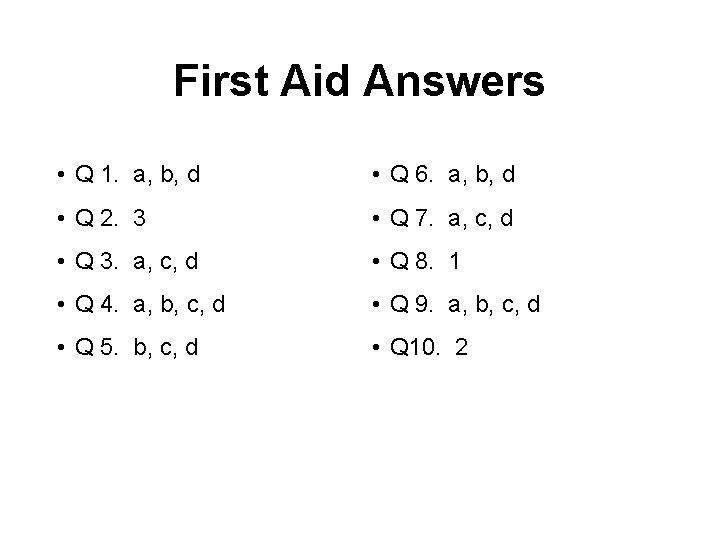
First Aid Answers • Q 1. a, b, d • Q 6. a, b, d • Q 2. 3 • Q 7. a, c, d • Q 3. a, c, d • Q 8. 1 • Q 4. a, b, c, d • Q 9. a, b, c, d • Q 5. b, c, d • Q 10. 2
- Slides: 12