
FIRST AID PE 10 SHOCKFAINTINGREVIEW WHAT IS SHOCK
- Slides: 17
FIRST AID PE 10 SHOCK/FAINTING/REVIEW
WHAT IS SHOCK? Any injury or illness can be accompanied by shock. Shock is a circulation problem where the body’s tissues do not get enough blood. (Medical Shock… Not Electric shock) Depending on the severity, shock can lead to unconsciousness and even death There is often shock in a emergency situation. Always check for shock
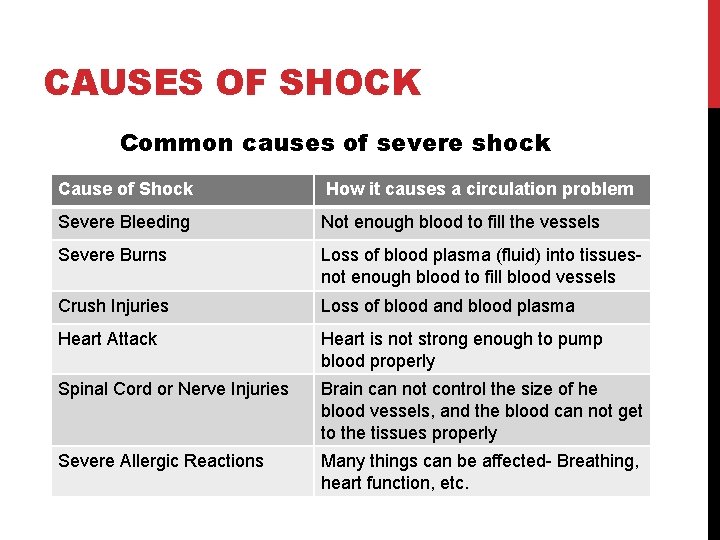
CAUSES OF SHOCK Common causes of severe shock Cause of Shock How it causes a circulation problem Severe Bleeding Not enough blood to fill the vessels Severe Burns Loss of blood plasma (fluid) into tissuesnot enough blood to fill blood vessels Crush Injuries Loss of blood and blood plasma Heart Attack Heart is not strong enough to pump blood properly Spinal Cord or Nerve Injuries Brain can not control the size of he blood vessels, and the blood can not get to the tissues properly Severe Allergic Reactions Many things can be affected- Breathing, heart function, etc.
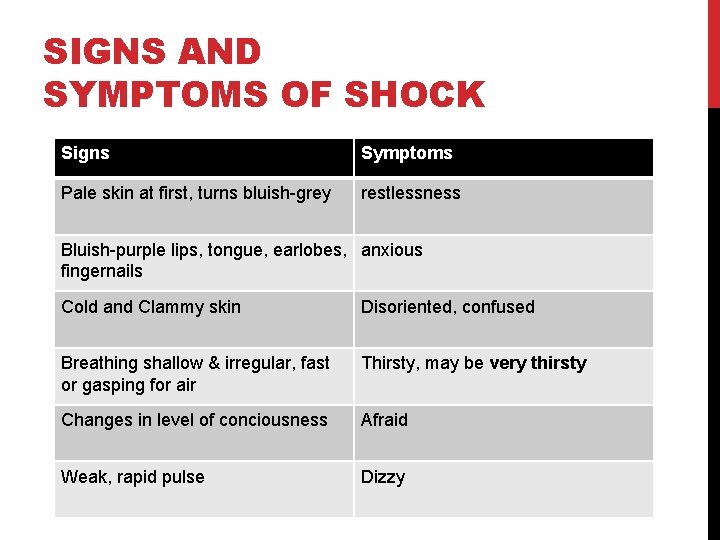
SIGNS AND SYMPTOMS OF SHOCK Signs Symptoms Pale skin at first, turns bluish-grey restlessness Bluish-purple lips, tongue, earlobes, anxious fingernails Cold and Clammy skin Disoriented, confused Breathing shallow & irregular, fast or gasping for air Thirsty, may be very thirsty Changes in level of conciousness Afraid Weak, rapid pulse Dizzy
HOW TO MINIMIZE SHOCK 1) Give First Aid for the injury or illness that caused the shock 2) Reassure the casualty often 3) Minimize pain by handling the casualty gently 4) Loosen tight clothing at the neck, chest and waist 5) Keep casualty warm, by do not over heat- use jackets, coats, blankets if you have them 6) Moisten the lips if the causality complains of thirst (medical help can be delayed due to fluids or foods given) Always make note of what was given and when 7) Place the casualty in the best position for their condition 8) Continue ongoing casualty care until hand over
POSITIONING A CASUALTY IN SHOCK No suspected head/spinal injury (conscious) -Place casualty on their back with feet and legs raised- this position is often called the shock position No suspected head/spinal injury (less than fully conscious) -Place casualty in recovery position (airway and breathing are priority) Suspected head/Spinal Injury -Steady and support the casualty in the position found and monitor ABC’s As Injuries permit - the casualty's injuries may not permit you to move them, so make them as comfortable as possible in the position that is safest to prevent further injury.
RECOVERY POSITION https: //www. youtube. com/watch? v=xh. R 9 Jo. X-_-0 1) Place near arm straight out. Place far arm with the back of the hand over the near cheek 2) Bend and grab the far knee 3) Protect the casualty’s head during roll 4) Adjust the hand under the head so the next is extended 5) Continue ongoing casualty care Shock Overview https: //www. youtube. com/watch? v=4 -c. Pu. Xa. ZACg
FAINTING Fainting is a loss of consciousness that lasts a very short timeno more than a few minutes It is caused by a temporary shortage of oxygenated blood to the brain. Some common reasons people faint: -Fear or anxiety -Severe pain, injury, or illness -underlying medical problems -long periods of standing or sitting -lack of fresh air -sight of blood -fatigue or hunger
FAINTING A person losing consciousness is always a medical emergency. If you think there might be a serious reason a person feels faint, has fainted, get medical help Sometimes when a person is about to faint, there are warning signs, such as -pale -sweating -feels sick, nauseous, dizzy, and unsteady
FIRST AID FOR IMPENDING FAINT (ABOUT TO HAPPEN) 1) Lay the casualty down with the feet raised about 12 inches (one ruler length) 2) Ensure a supply of fresh air (open a window or door) 3) Loosen tight clothing at the neck, chest, and waist 4) Stay with the casualty until fully recovered
FIRST AID FOR FAINTING 1) Start ESM (scene survey, “you in the plaid shirt call 911”) 2) Check ABC’s 3) Secondary Survey if necessary and give first aid 4) Turn the casualty into the recovery position (if injuries permit) 5) Ensure a supply of fresh air and loosen tight clothing at the neck, chest, and waist 6) Make casualty comfortable until consciousness returns. Keep them laying down for 10 -15 minutes. (Recovery from a faint should be quick, if not get medical help) https: //www. youtube. com/watch? v=a 9 l. R 6 Z 4 gzw. Q
GENERAL FIRST AID REVIEW Objective of First Aid is to : 3 P’s- Preserve, Prevent, Promote ESM 4 Steps 1) Scene Survey 2) Primary Survey 3) Secondary Survey 4) Ongoing casualty care
CPR REVIEW Cardiopulmonary Resuscitation (CPR) Chest Compressions (30) Ventilations (2) CPR Steps: Step 1: Survey the Scene Step 2: Primary Survey Step 3: Position the Casualty Step 4: Compressions Step 5: Ventilations Step 6: Continue CPR
CHOKING REVIEW A person chokes when the airway is partly or completely blocked and airflow to the lungs is reduced or cut off Abdominal Thrusts= J Motion (In and Up) J-Hook motion to search in the mouth foreign objects Hipbone and across or above belly button to locate where to place hands
SHOCK REVIEW Any injury or illness can be accompanied by shock Shock is a circulation problem where the body’s tissues do not get enough blood Loosen tight clothing, keep casualty warm Recovery Position (less than fully conscious)
FAINTING REVIEW A person losing consciousness is always a medical emergency Lay the casualty down, get them fresh air, loosen tight clothing, and stay with the casualty
FIRST AID QUIZ Please put everything away (off your desk), except for a pencil/pen. NO CELL PHONES! You will live without it for 20 Minutes. If you have a question raise your hand GOOD LUCK!