
First Aid Health Science Protecting Yourself Good Samaritan
- Slides: 27
First Aid Health Science
Protecting Yourself Good Samaritan Laws n Obtaining Consent n Preventing Disease Transmission n
Good Samaritan Laws Enacted to give legal protection to people who willingly provide emergency care without accepting anything in return n Required to use common sense and not exceed scope of individual’s training n Vary from state to state n
Obtaining Consent You MUST first get consent from the victim to give care n Once consent is given, give appropriate care n If consent is denied, call 9 -1 -1 but do not help the victim n If victim is unconscious, consent is implied n
Preventing Disease Transmission Risk of getting a disease while giving first aid is extremely rare n The following can reduce risk more: n n Avoid contact with blood and other body fluids Use protective equipment, ie gloves/breathing barriers Thoroughly was hands with soap and water after giving care
Cleaning up a blood spill Clean spill ASAP n Use protective equipment when cleaning spills n Wipe up spill with absorbent material n Use ¼ bleach to 1 gallon water solution to disinfect area n Dispose of contaminated material in a biohazard container n
Before Providing Care n Things to consider n n n Moving the victim When to call 9 -1 -1 Emergency Information for Emergency Call Safety of Scene
Moving the Victim n Move only if – n n n The scene becomes unsafe You have to reach another victim who may be more seriously injured/ill You need to provide proper care (someone needs CPR but is lying on an unsafe surface)
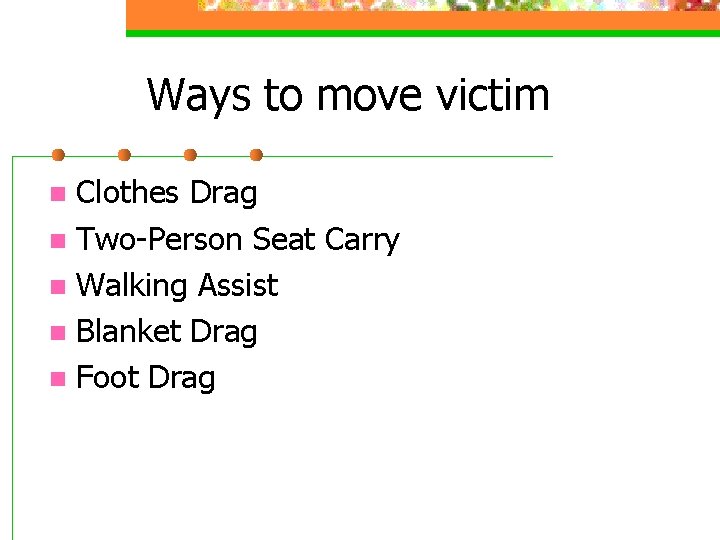
Ways to move victim Clothes Drag n Two-Person Seat Carry n Walking Assist n Blanket Drag n Foot Drag n
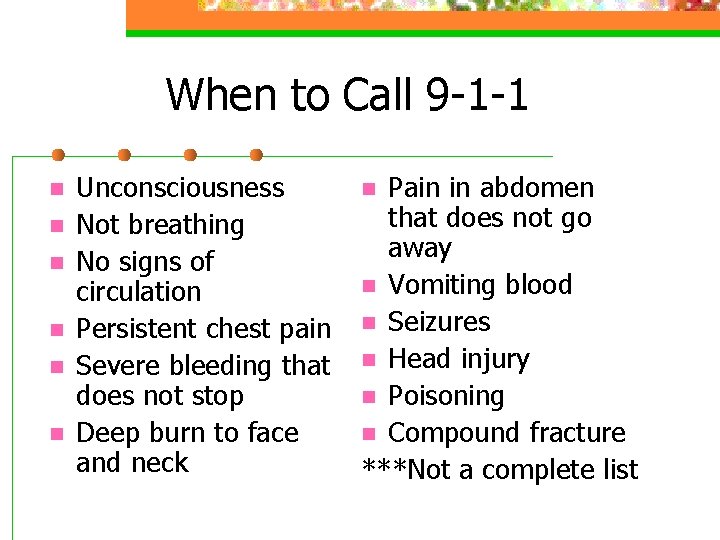
When to Call 9 -1 -1 n n n Unconsciousness Not breathing No signs of circulation Persistent chest pain Severe bleeding that does not stop Deep burn to face and neck Pain in abdomen that does not go away n Vomiting blood n Seizures n Head injury n Poisoning n Compound fracture ***Not a complete list n
Emergency Information Best to have emergency cards if working with or at a school, team, and especially children n Emergency numbers you should call should be posted and predetermined n
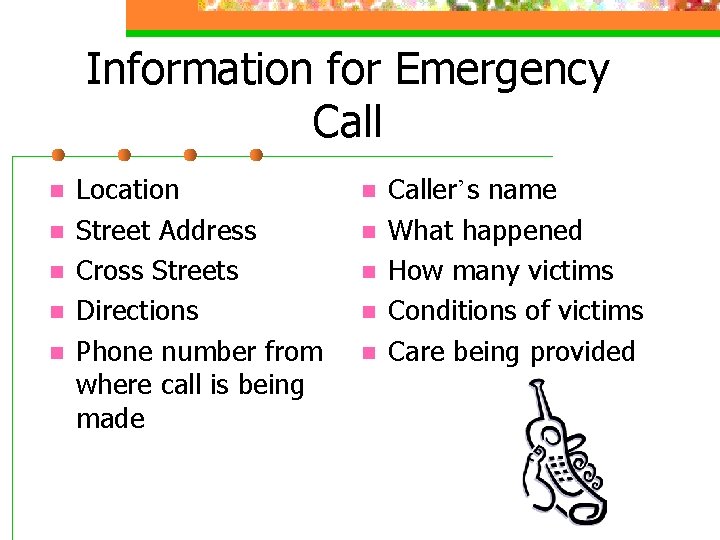
Information for Emergency Call n n n Location Street Address Cross Streets Directions Phone number from where call is being made n n n Caller’s name What happened How many victims Conditions of victims Care being provided
Scene Safety Check the scene for safety n Unsafe scenes include: n n n Fire Thunderstorm Open electrical cords Move the victim if scene is unsafe
Prioritizing Care Ask the Victim n Check Victim n Care for Shock n
Ask The Victim n n n What happened? Do you feel pain anywhere? Do you feel numbness or loss of sensation? Do you have any allergies? Do you have any medical conditions or on any medication? When did you last eat or drink something?
Check the Victim Check from head to toe n Note color of skin, face, and lips n Notice how skin feels n Watch victim for signals of pain n Watch for changes in consciousness and breathing n
Caring for shock n The signals of shock n n n Restlessness or irritability Nausea and vomiting Altered level of consciousness Pale or ashen, cool, moist skin Blue tinge to lips and nailbeds Rapid breathing and rapid pulse
Unconscious Victim n n n Check the scene for safety Tap victims shoulder to see if they respond Call 9 -1 -1 if no response Look, listen, and feel for breathing for about 5 seconds If unconscious but breathing but move to recovery position If not breathing, begin rescue breathing
Wound Care n n n n Eye Injuries Teeth and mouth injuries Abdomen injuries Nosebleeds Severed body parts Animal bites Embedded objects Compound fractures
Eye Injuries Place victim in comfortable position n Do not attempt to remove any object embedded n Place sterile dressing around object n Stabilize object as best you can n Apply a bandage n n Never put direct pressure on the eyeball
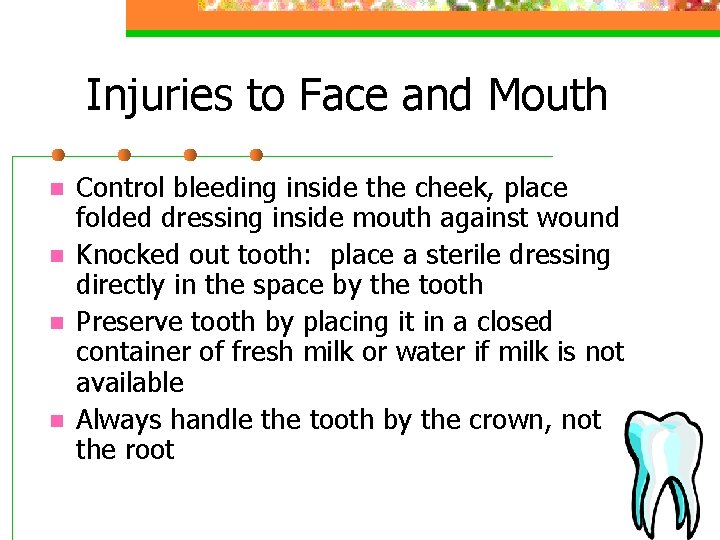
Injuries to Face and Mouth n n Control bleeding inside the cheek, place folded dressing inside mouth against wound Knocked out tooth: place a sterile dressing directly in the space by the tooth Preserve tooth by placing it in a closed container of fresh milk or water if milk is not available Always handle the tooth by the crown, not the root
Injuries to the Abdomen Wounds that break through the abdominal wall can cause organs to push out n Cover organs with a moist, sterile dressing and cover the dressing with plastic wrap n Place a towel over the dressings for warmth n Care for shock n
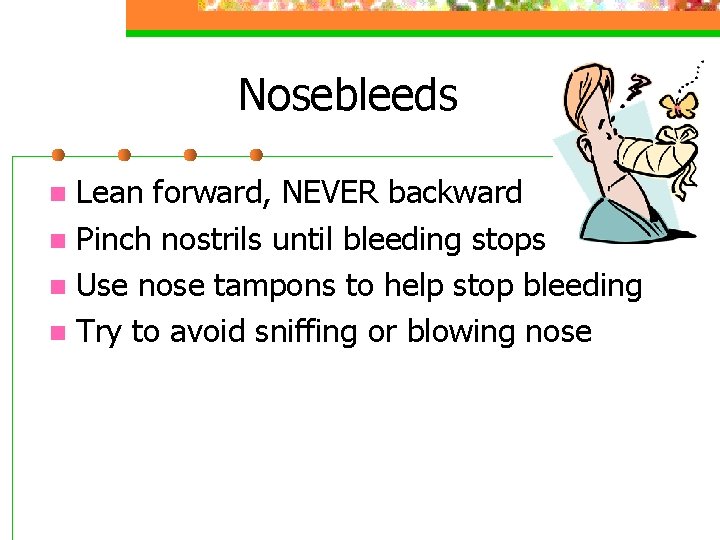
Nosebleeds Lean forward, NEVER backward n Pinch nostrils until bleeding stops n Use nose tampons to help stop bleeding n Try to avoid sniffing or blowing nose n
Severed Body Parts Control bleeding n Wrap severed body parts in gauze and put in a plastic bag and put on ice n Care for shock n Make sure body part is taken to the hospital with the victim n
Animal Bites n If bleeding is minor— n n Wash the wound with soap and water Control bleeding Cover with a sterile bandage Call 9 -1 -1 if bleeding is not minor or animal is suspected to have rabies
Embedded Objects Place several dressings around the object to keep it from moving n Bandage the dressings in place around the object n n Do Not Remove the Object
Final Thoughts n Ultimately, in an emergency: CHECK CALL CARE