
FIRST AID FOR RESPIRATORY EMERGENCIES Berna GUVEN Ph
FIRST AID FOR RESPIRATORY EMERGENCIES Berna GUVEN, Ph. D
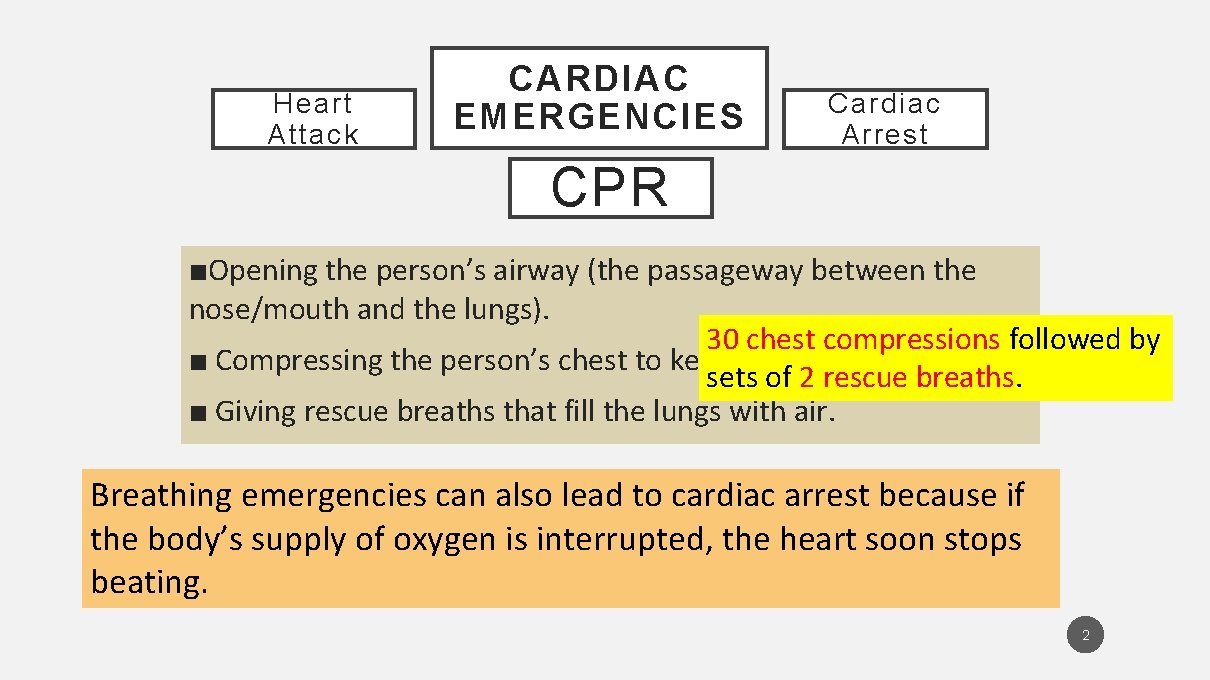
Heart Attack CARDIAC EMERGENCIES Cardiac Arrest CPR ■Opening the person’s airway (the passageway between the nose/mouth and the lungs). 30 chest compressions followed by ■ Compressing the person’s chest to keep the blood circulating. sets of 2 rescue breaths. ■ Giving rescue breaths that fill the lungs with air. Breathing emergencies can also lead to cardiac arrest because if the body’s supply of oxygen is interrupted, the heart soon stops beating. 2
How Can I Tell Whether CPR Is Needed? If the person is conscious but cannot talk and appears to be choking, CPR is not appropriate. Instead, follow the instructions for CHOKING 3
Do not attempt to carry out a rescue if it is likely to put your own life at risk !!! 4

CONTENTS 1. The Respiratory System 2. Hypoxia 3. Airway Obstruction: • Choking Adult • Choking Child • Choking Infant 4. Hanging And Strangulation 5. Inhalation Of Fumes 6. Drowning 7. Hyperventilation 5
OBJECTIVES § assess condition, § identify the problem, § provide fresh air, § maintain an open airway, § check breathing, § obtain medical help if necessary. 112 6
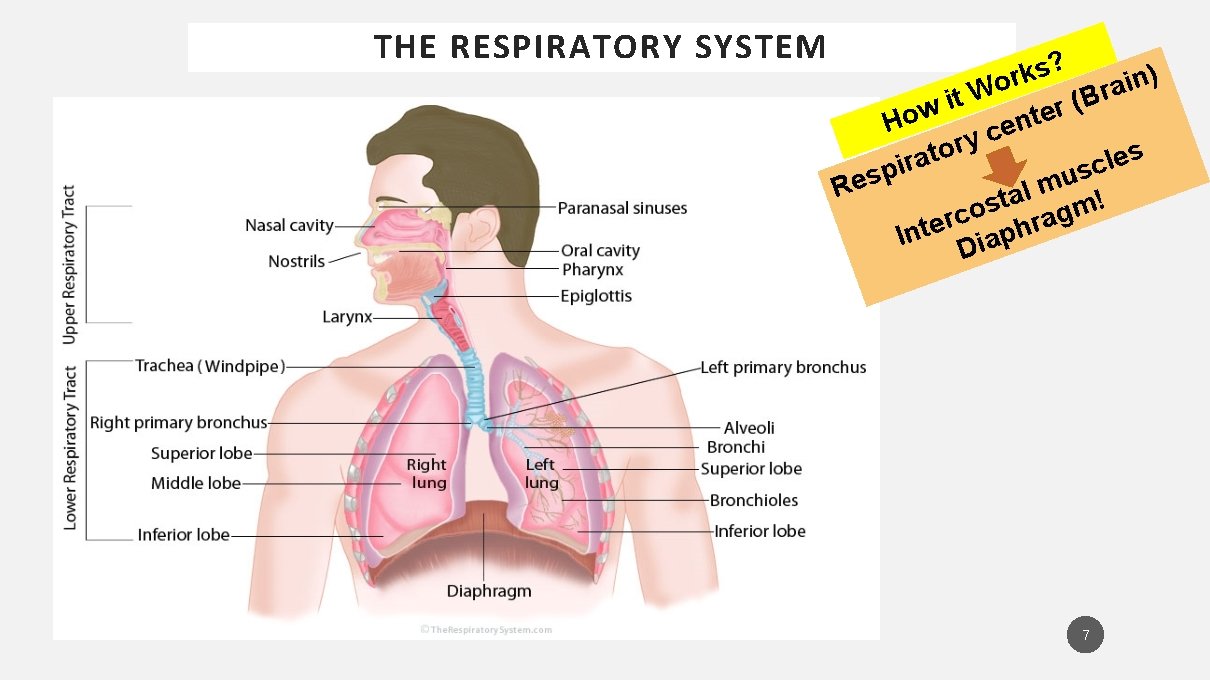
THE RESPIRATORY SYSTEM s? ) k r n i o ra W t B i ( r w e t o n H e c ry o s t e a l r i c p s s u e m R al t ! s m o rc ag r e t h In Diap 7
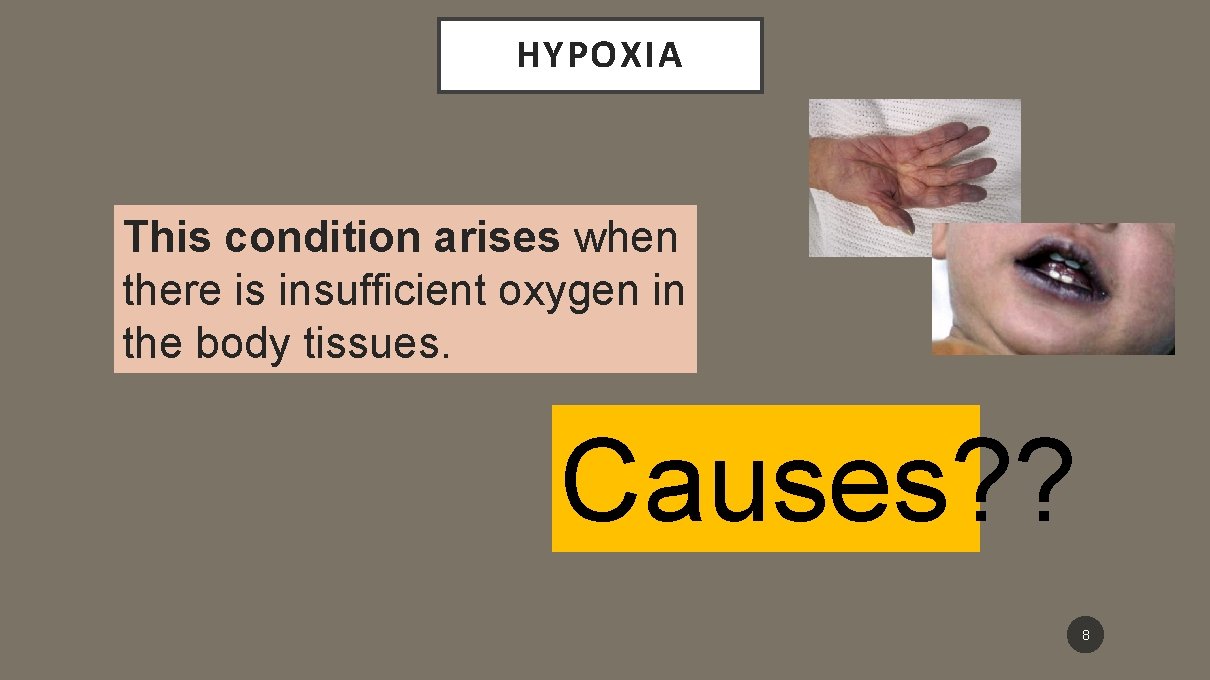
HYPOXIA This condition arises when there is insufficient oxygen in the body tissues. Causes? ? 8
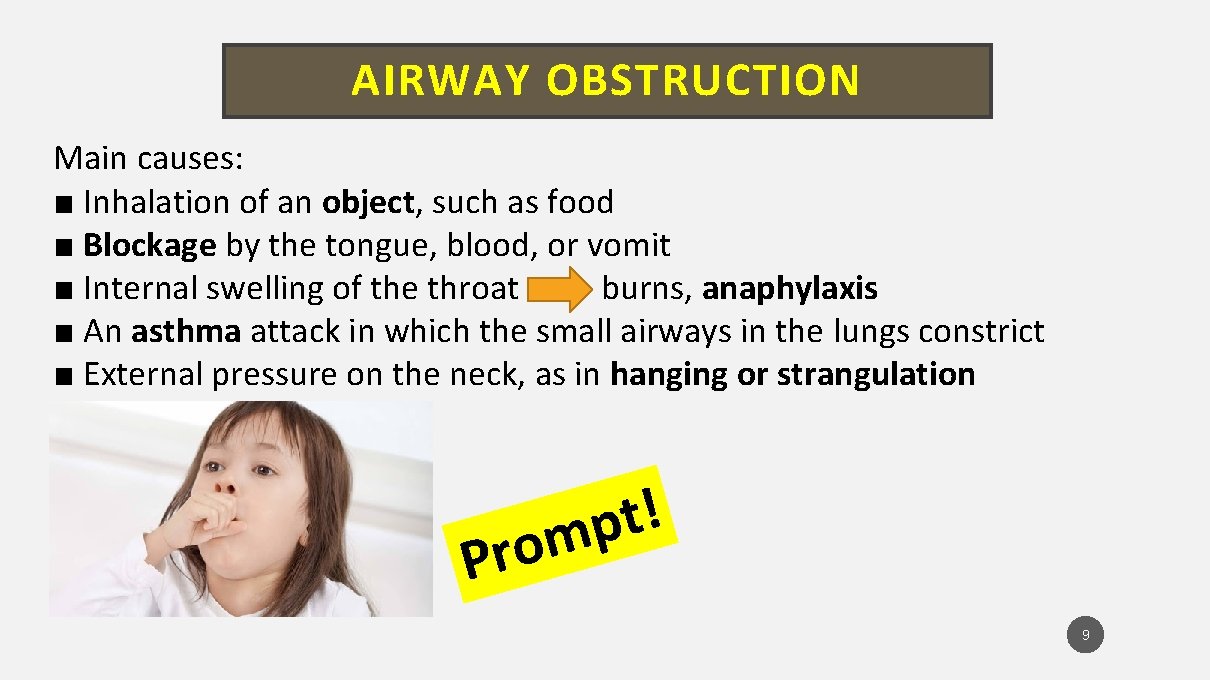
AIRWAY OBSTRUCTION Main causes: ■ Inhalation of an object, such as food ■ Blockage by the tongue, blood, or vomit ■ Internal swelling of the throat burns, anaphylaxis ■ An asthma attack in which the small airways in the lungs constrict ■ External pressure on the neck, as in hanging or strangulation ! t mp o r P 9
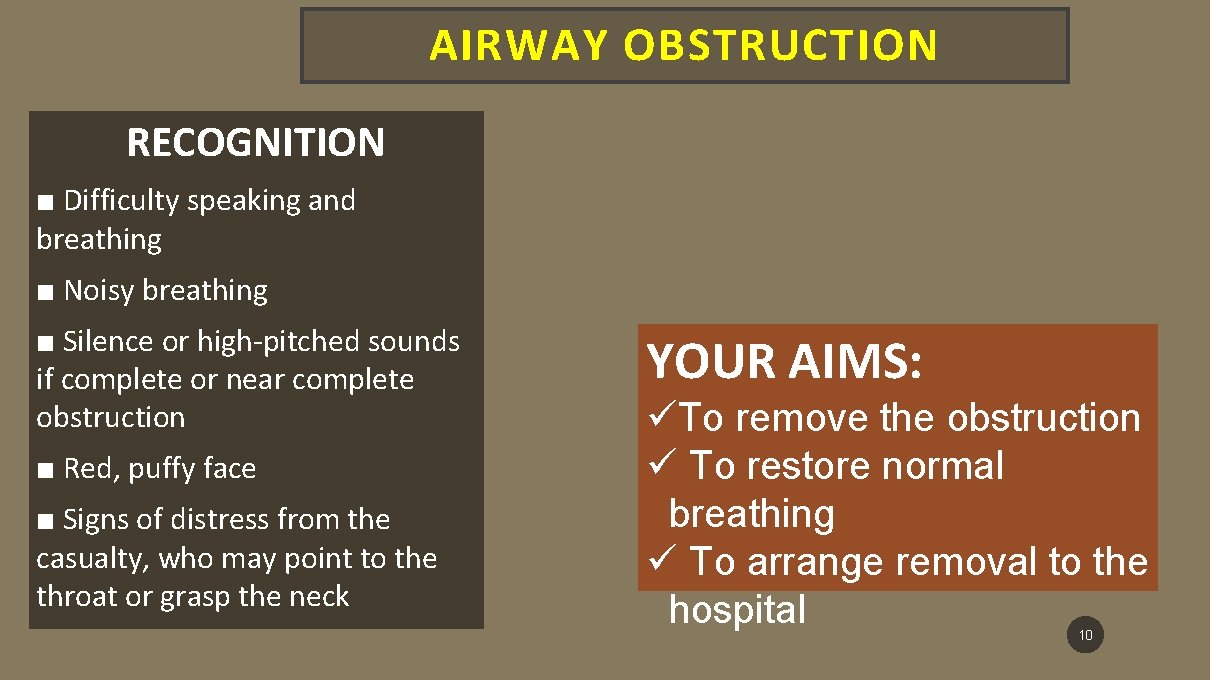
AIRWAY OBSTRUCTION RECOGNITION ■ Difficulty speaking and breathing ■ Noisy breathing ■ Silence or high-pitched sounds if complete or near complete obstruction ■ Red, puffy face ■ Signs of distress from the casualty, who may point to the throat or grasp the neck YOUR AIMS: üTo remove the obstruction ü To restore normal breathing ü To arrange removal to the hospital 10
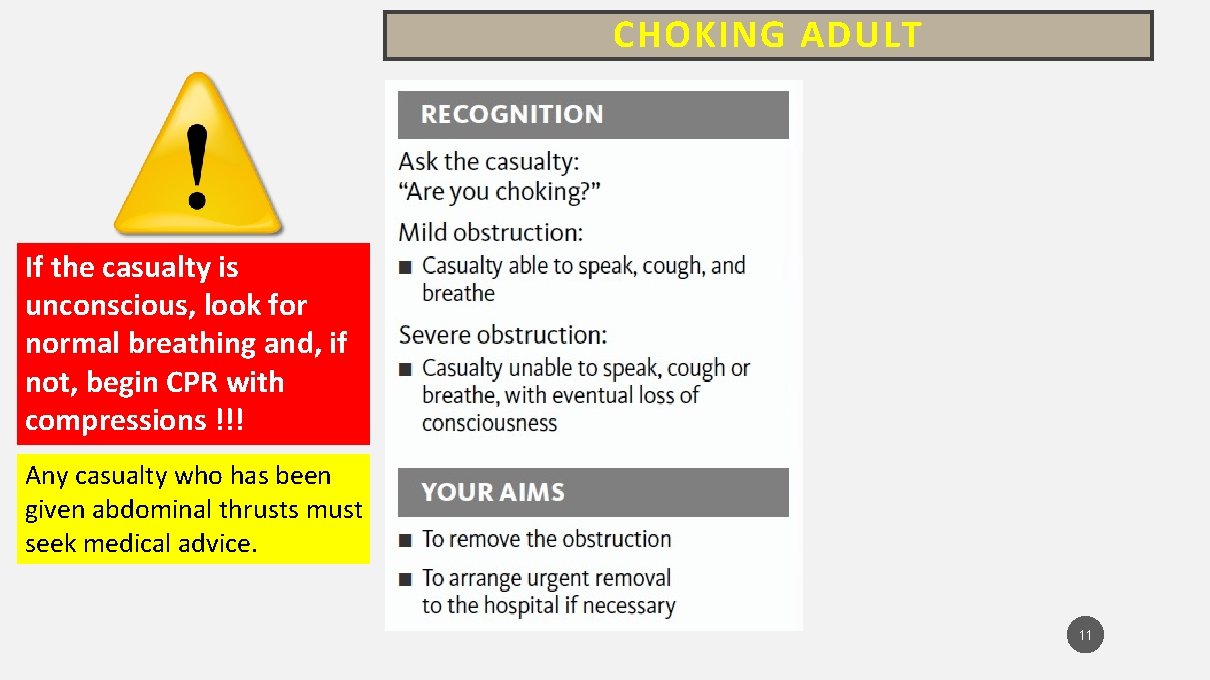
CHOKING ADULT If the casualty is unconscious, look for normal breathing and, if not, begin CPR with compressions !!! Any casualty who has been given abdominal thrusts must seek medical advice. 11
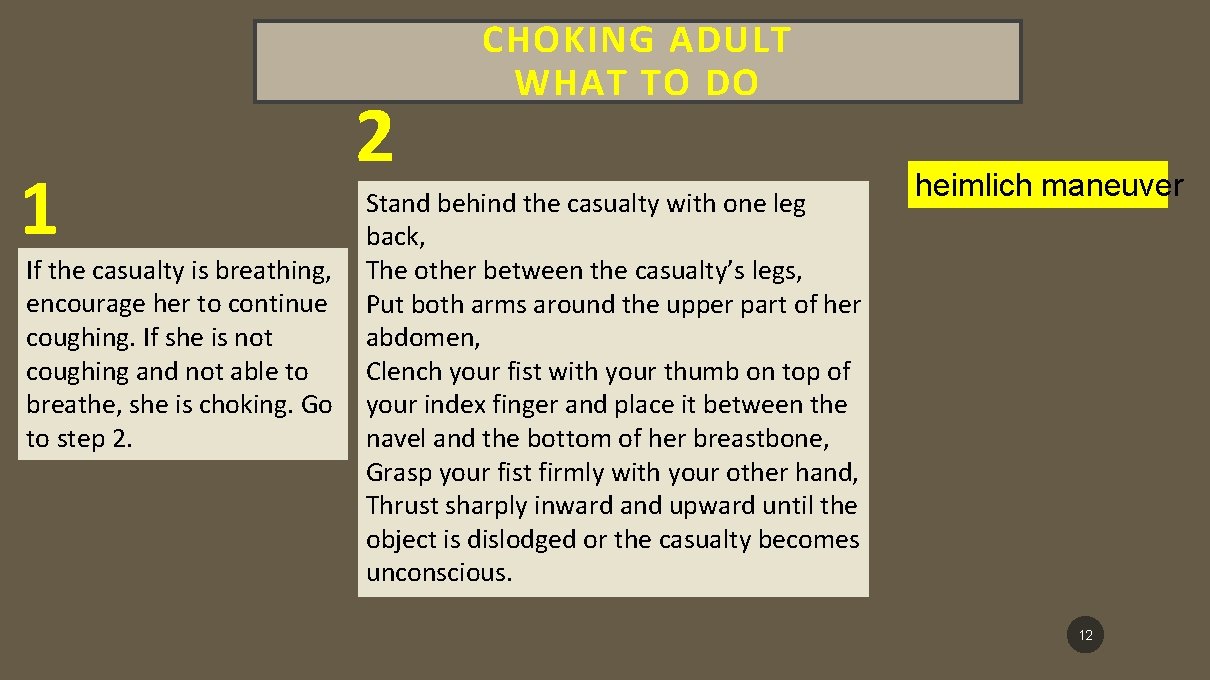
1 If the casualty is breathing, encourage her to continue coughing. If she is not coughing and not able to breathe, she is choking. Go to step 2. 2 CHOKING ADULT WHAT TO DO Stand behind the casualty with one leg back, The other between the casualty’s legs, Put both arms around the upper part of her abdomen, Clench your fist with your thumb on top of your index finger and place it between the navel and the bottom of her breastbone, Grasp your fist firmly with your other hand, Thrust sharply inward and upward until the object is dislodged or the casualty becomes unconscious. heimlich maneuver 12
3 CHOKING ADULT WHAT TO DO If the casualty loses consciousness, carefully support her to the floor, immediately call 112 for emergency help, Begin CPR with chest compressions. Each time the airway is opened during CPR, look for an object in the casualty's mouth and, if seen, remove it. 4 If the obstruction still has not cleared, continue CPR until help arrives. 13
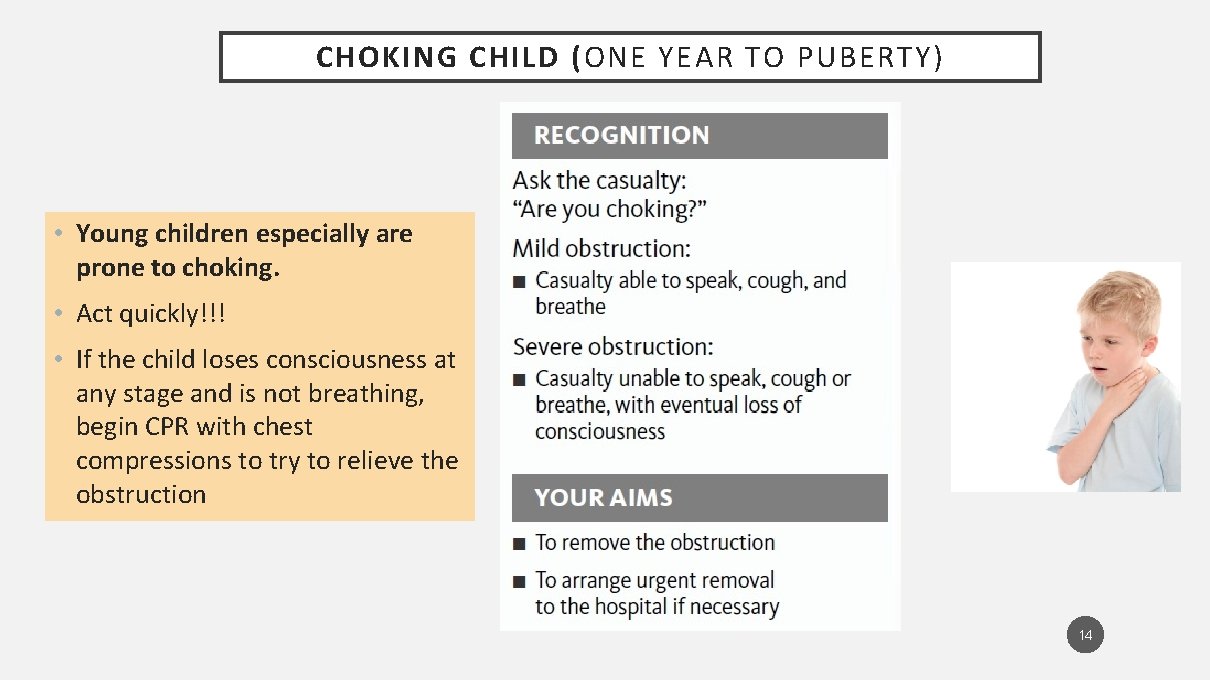
CHOKING CHILD (ONE YEAR TO PUBERTY) • Young children especially are prone to choking. • Act quickly!!! • If the child loses consciousness at any stage and is not breathing, begin CPR with chest compressions to try to relieve the obstruction 14
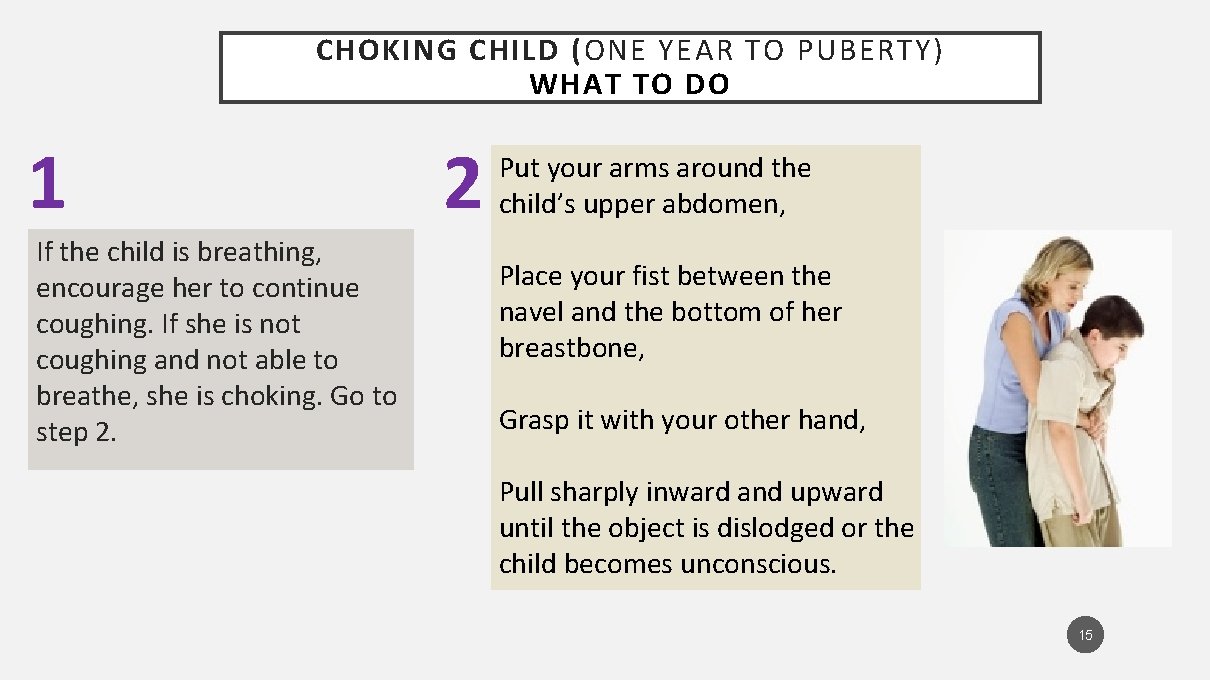
CHOKING CHILD (ONE YEAR TO PUBERTY) WHAT TO DO 1 If the child is breathing, encourage her to continue coughing. If she is not coughing and not able to breathe, she is choking. Go to step 2. 2 Put your arms around the child’s upper abdomen, Place your fist between the navel and the bottom of her breastbone, Grasp it with your other hand, Pull sharply inward and upward until the object is dislodged or the child becomes unconscious. 15
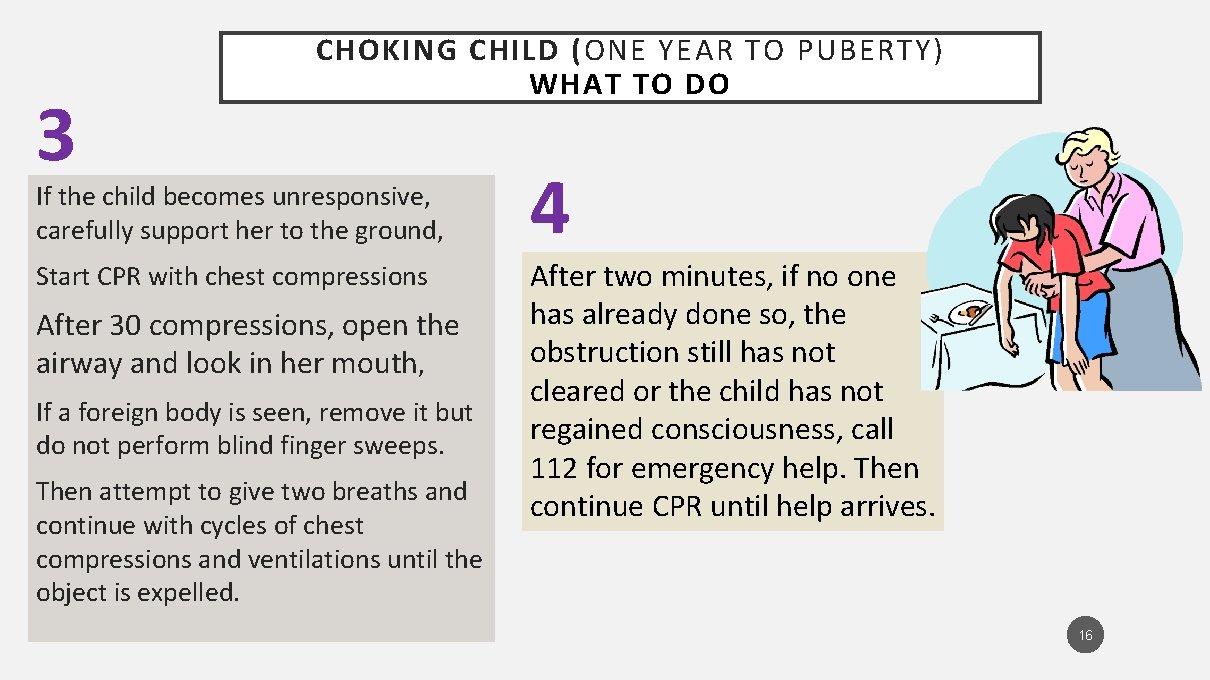
3 CHOKING CHILD (ONE YEAR TO PUBERTY) WHAT TO DO If the child becomes unresponsive, carefully support her to the ground, Start CPR with chest compressions After 30 compressions, open the airway and look in her mouth, If a foreign body is seen, remove it but do not perform blind finger sweeps. Then attempt to give two breaths and continue with cycles of chest compressions and ventilations until the object is expelled. 4 After two minutes, if no one has already done so, the obstruction still has not cleared or the child has not regained consciousness, call 112 for emergency help. Then continue CPR until help arrives. 16
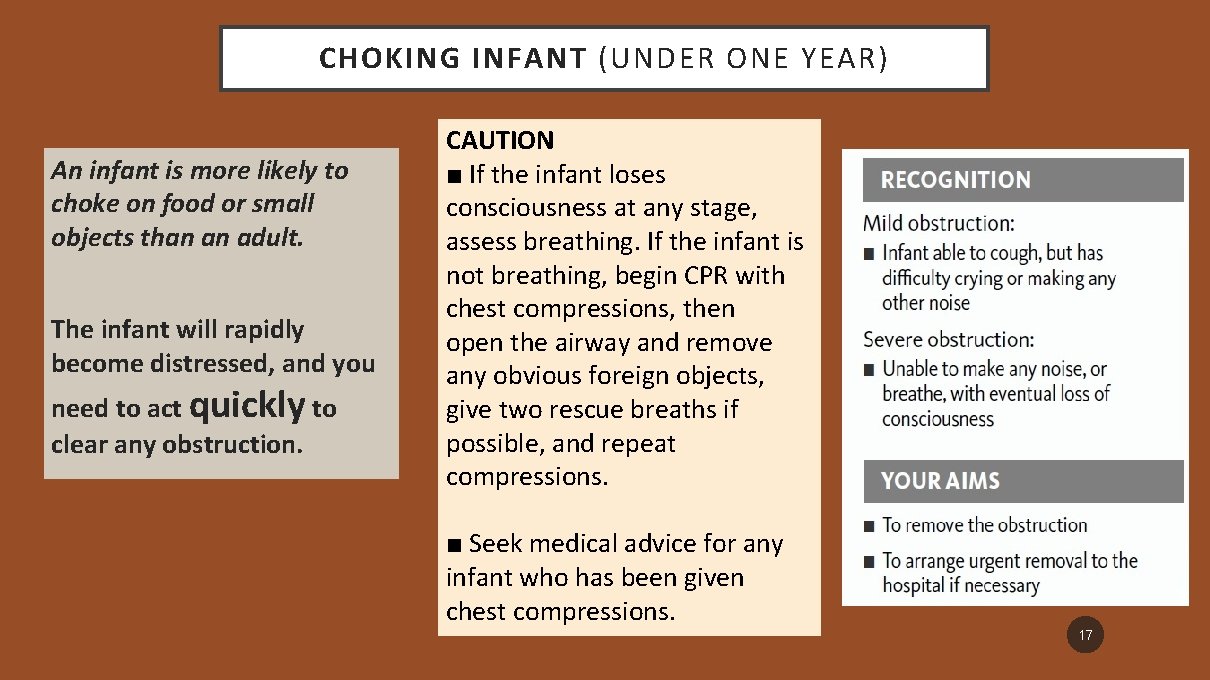
CHOKING INFANT (UNDER ONE YEAR) An infant is more likely to choke on food or small objects than an adult. The infant will rapidly become distressed, and you need to act quickly to clear any obstruction. CAUTION ■ If the infant loses consciousness at any stage, assess breathing. If the infant is not breathing, begin CPR with chest compressions, then open the airway and remove any obvious foreign objects, give two rescue breaths if possible, and repeat compressions. ■ Seek medical advice for any infant who has been given chest compressions. 17
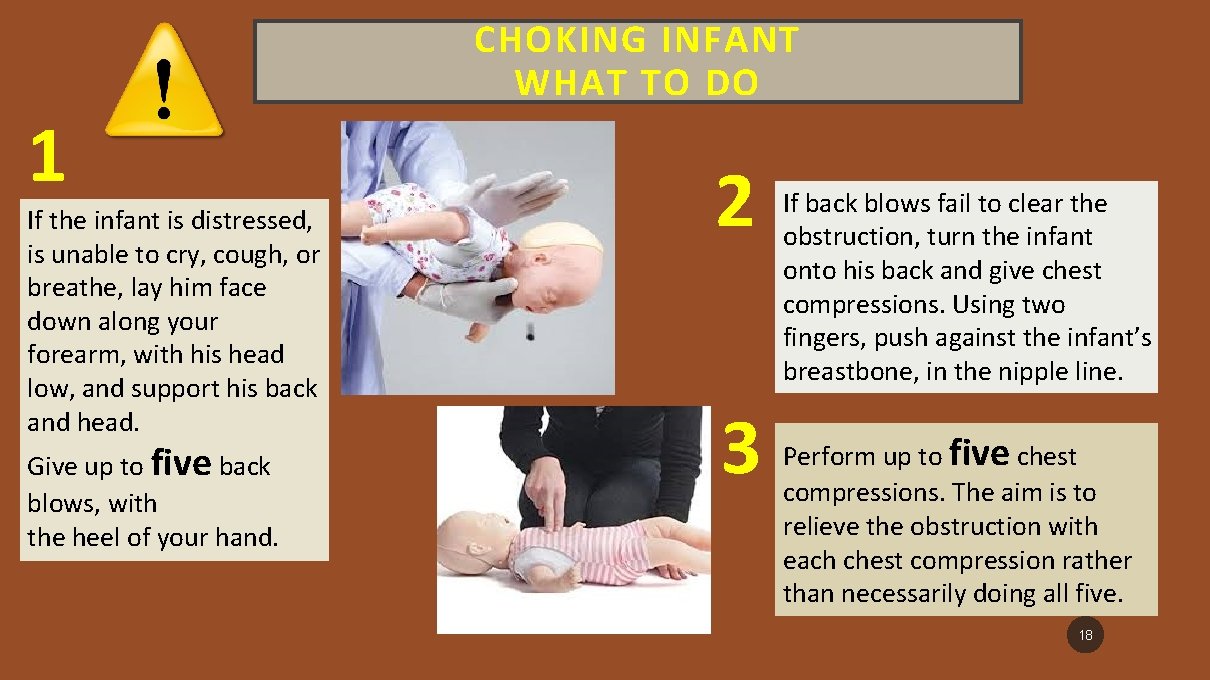
1 If the infant is distressed, is unable to cry, cough, or breathe, lay him face down along your forearm, with his head low, and support his back and head. Give up to five back blows, with the heel of your hand. CHOKING INFANT WHAT TO DO 2 3 If back blows fail to clear the obstruction, turn the infant onto his back and give chest compressions. Using two fingers, push against the infant’s breastbone, in the nipple line. Perform up to five chest compressions. The aim is to relieve the obstruction with each chest compression rather than necessarily doing all five. 18
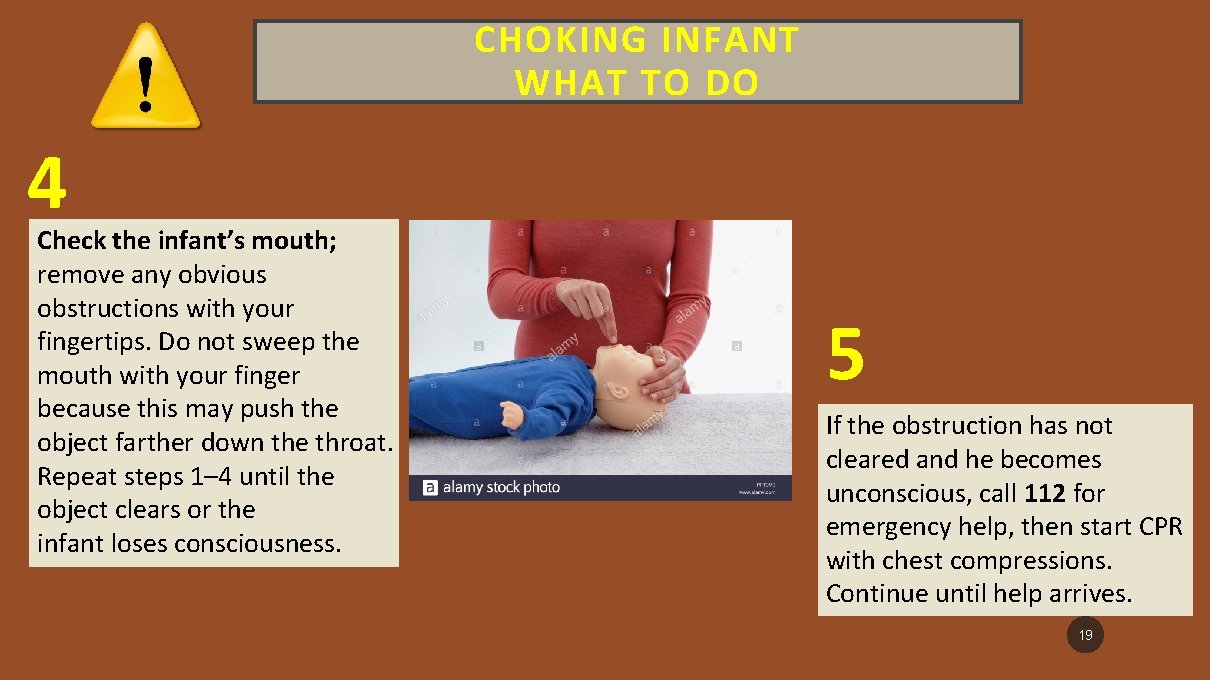
CHOKING INFANT WHAT TO DO 4 Check the infant’s mouth; remove any obvious obstructions with your fingertips. Do not sweep the mouth with your finger because this may push the object farther down the throat. Repeat steps 1– 4 until the object clears or the infant loses consciousness. 5 If the obstruction has not cleared and he becomes unconscious, call 112 for emergency help, then start CPR with chest compressions. Continue until help arrives. 19
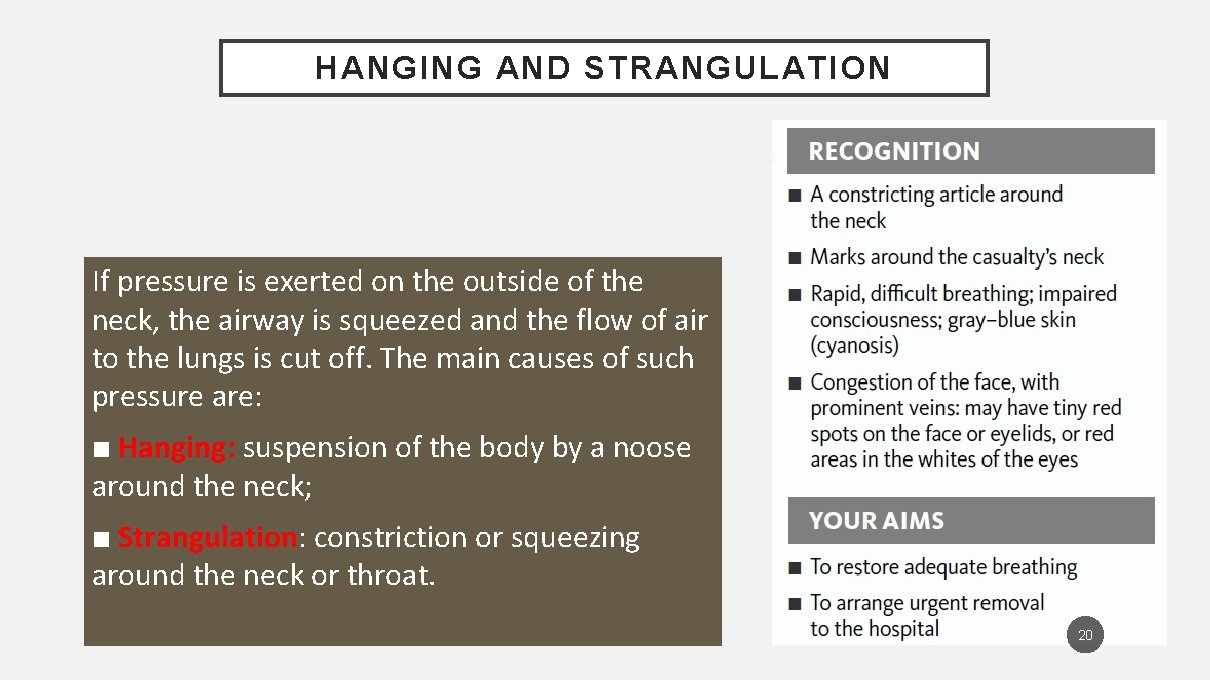
HANGING AND STRANGULATION If pressure is exerted on the outside of the neck, the airway is squeezed and the flow of air to the lungs is cut off. The main causes of such pressure are: ■ Hanging: suspension of the body by a noose around the neck; ■ Strangulation: constriction or squeezing around the neck or throat. 20
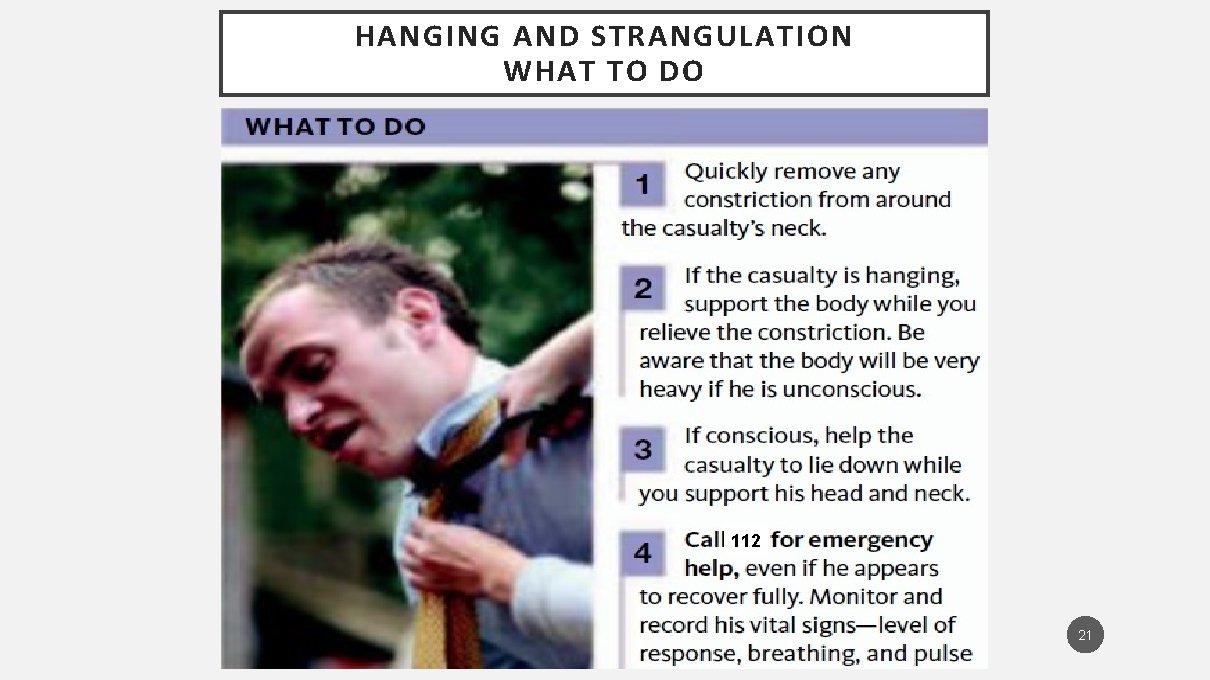
HANGING AND STRANGULATION WHAT TO DO 112 21
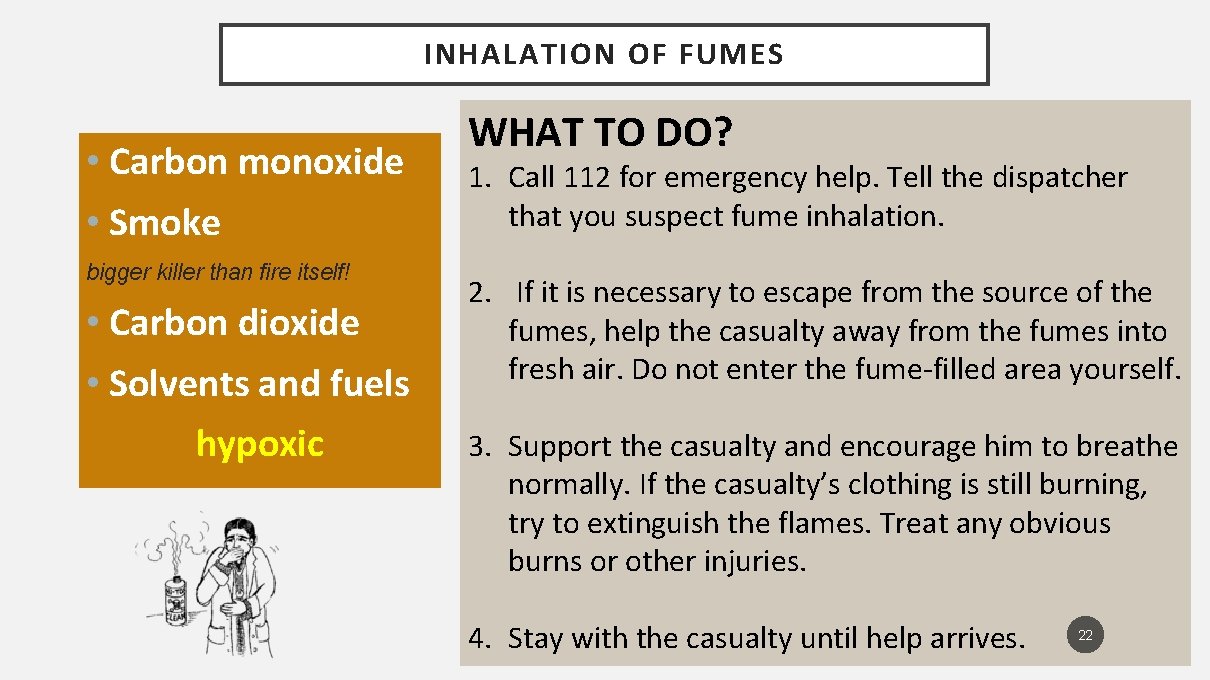
INHALATION OF FUMES • Carbon monoxide • Smoke bigger killer than fire itself! • Carbon dioxide • Solvents and fuels hypoxic WHAT TO DO? 1. Call 112 for emergency help. Tell the dispatcher that you suspect fume inhalation. 2. If it is necessary to escape from the source of the fumes, help the casualty away from the fumes into fresh air. Do not enter the fume-filled area yourself. 3. Support the casualty and encourage him to breathe normally. If the casualty’s clothing is still burning, try to extinguish the flames. Treat any obvious burns or other injuries. 4. Stay with the casualty until help arrives. 22
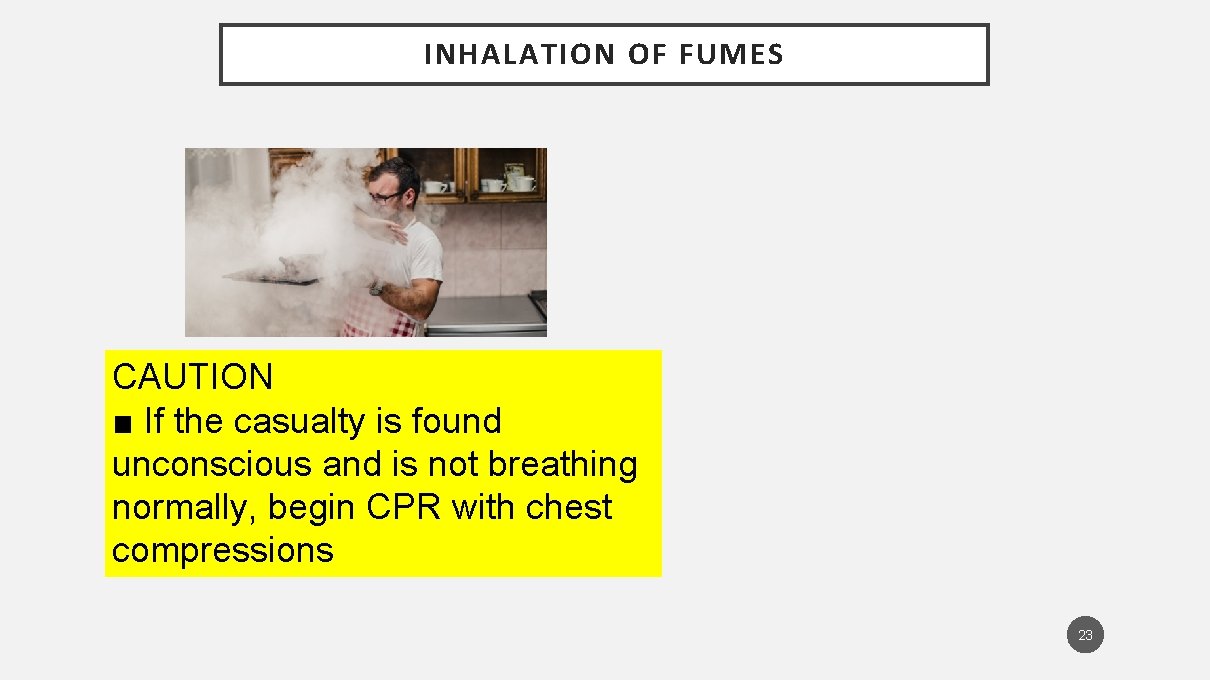
INHALATION OF FUMES CAUTION ■ If the casualty is found unconscious and is not breathing normally, begin CPR with chest compressions 23
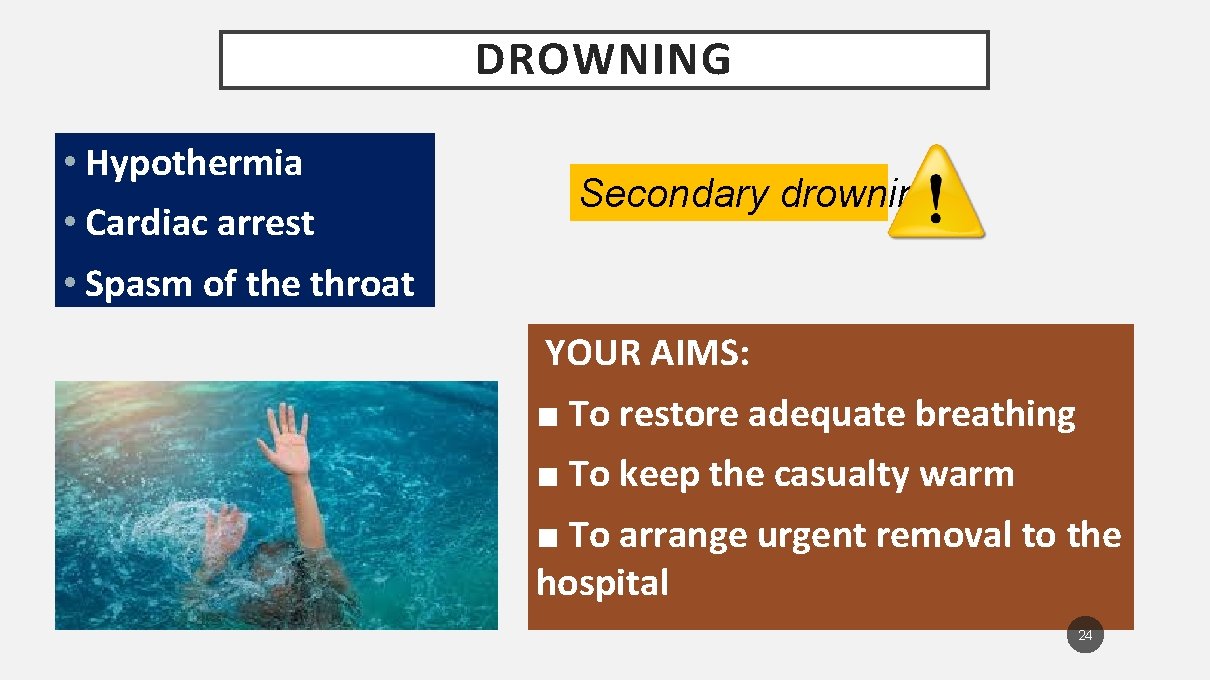
DROWNING • Hypothermia • Cardiac arrest • Spasm of the throat Secondary drowning YOUR AIMS: ■ To restore adequate breathing ■ To keep the casualty warm ■ To arrange urgent removal to the hospital 24
DROWNING WHAT TO DO 1 If you have rescued the casualty from the water, help him lie down on a rug or coat with his head lower than the rest of the body so that water can drain from his mouth. This reduces the risk of inhaling water 2 Treat the casualty for hypothermia; replace wet clothing with dry clothes if possible and cover him with dry blankets or coats. If the casualty is fully conscious, give him a warm drink. 3 Call 112 for emergency help even if he appears to recover fully because of the risk of secondary drowning. 25
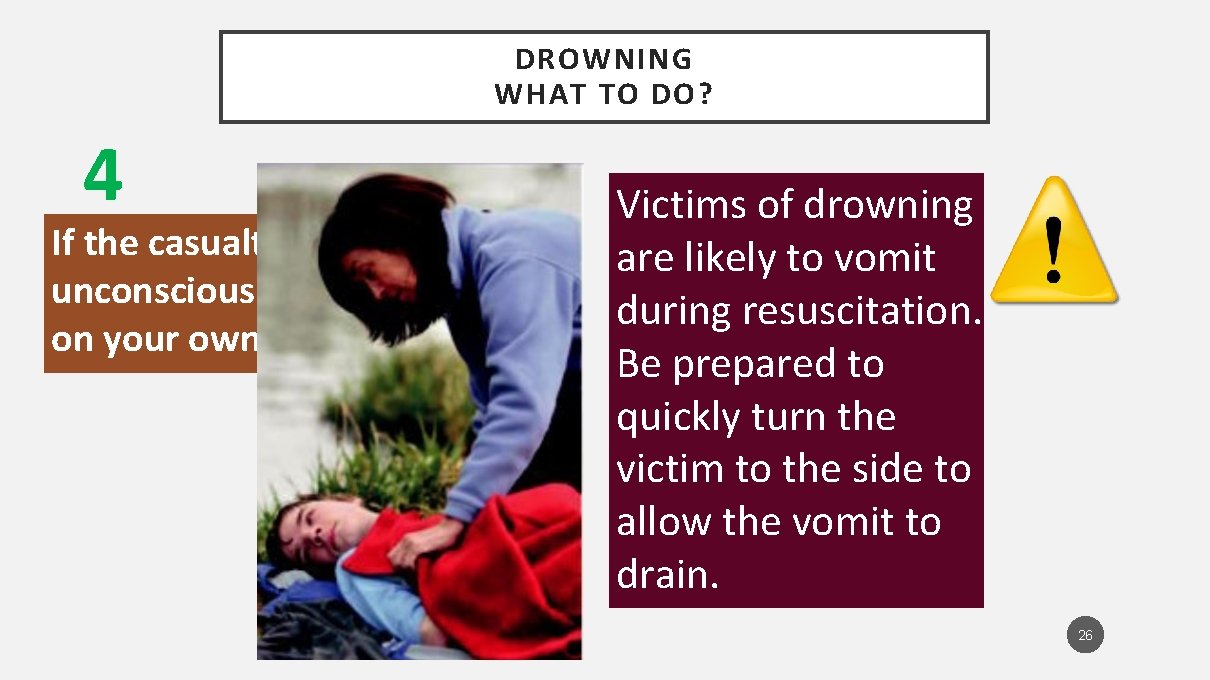
DROWNING WHAT TO DO? 4 If the casualty is unconscious and you are on your own, give CPR Victims of drowning are likely to vomit during resuscitation. Be prepared to quickly turn the victim to the side to allow the vomit to drain. 26
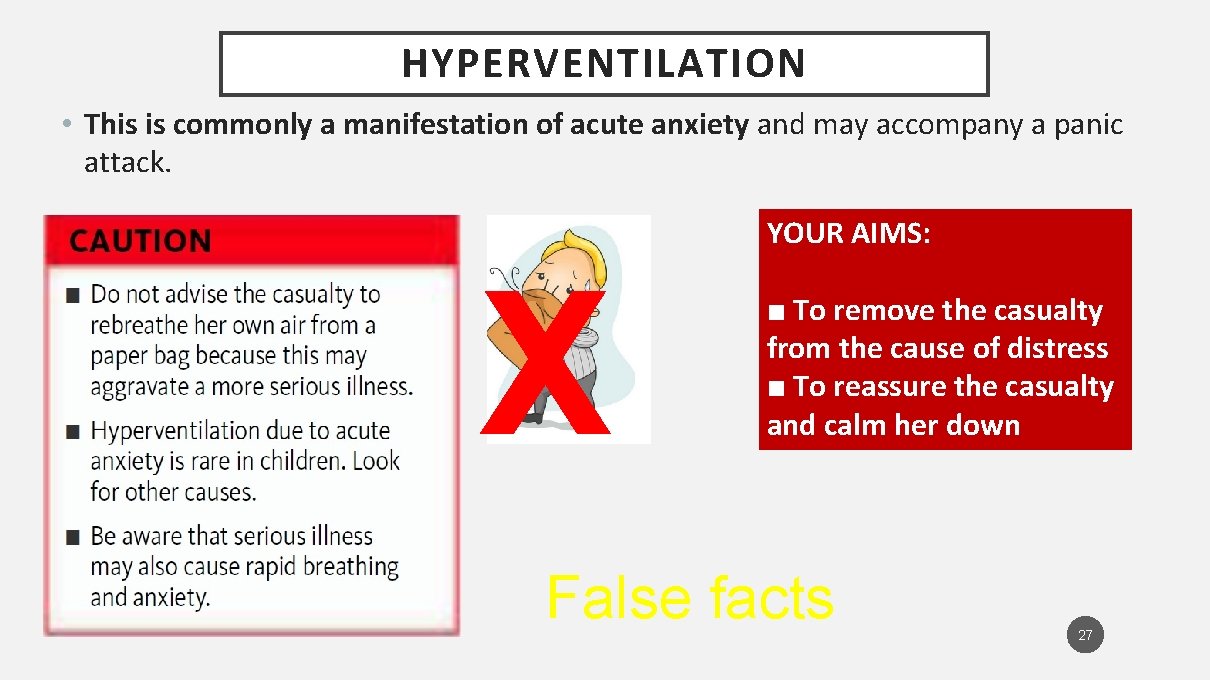
HYPERVENTILATION • This is commonly a manifestation of acute anxiety and may accompany a panic attack. YOUR AIMS: X ■ To remove the casualty from the cause of distress ■ To reassure the casualty and calm her down False facts 27
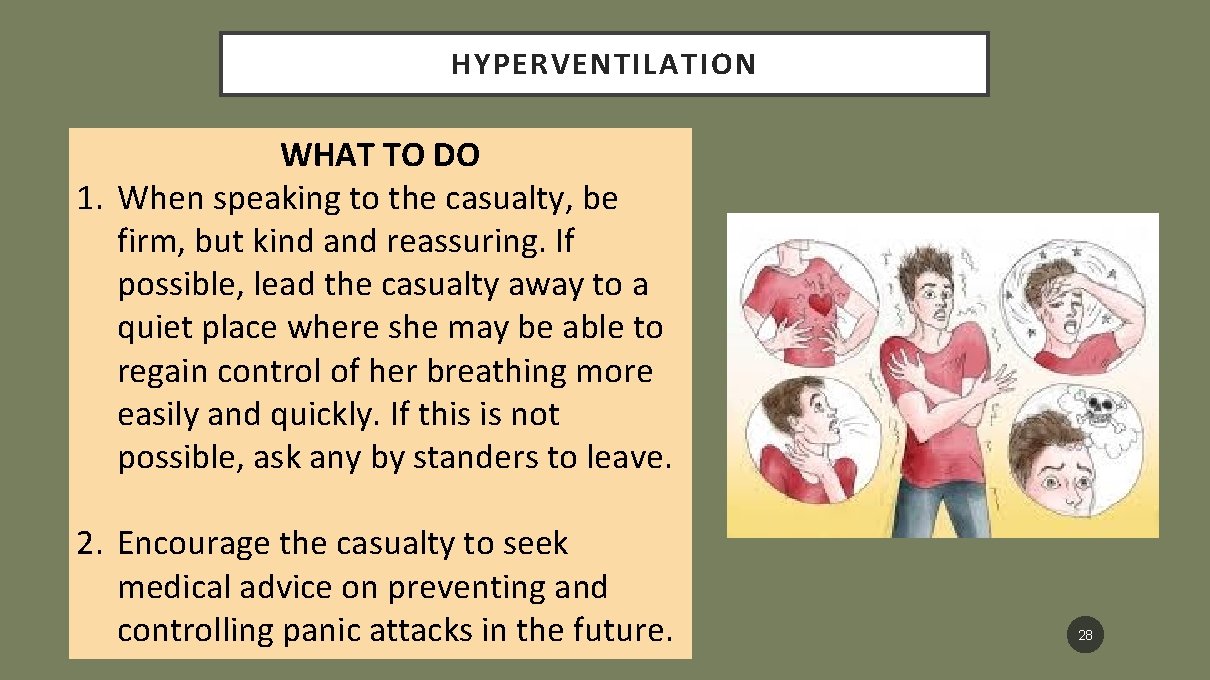
HYPERVENTILATION WHAT TO DO 1. When speaking to the casualty, be firm, but kind and reassuring. If possible, lead the casualty away to a quiet place where she may be able to regain control of her breathing more easily and quickly. If this is not possible, ask any by standers to leave. 2. Encourage the casualty to seek medical advice on preventing and controlling panic attacks in the future. 28
REFERENCES • The American College Of Emergency Physıcıans (Acep)-First Aid Manuel 5 th Edition The Everything First Aid Book 29
- Slides: 29