
First Aid CPR Recognizing Responding to Emergencies Emergency


- Slides: 29
First Aid & CPR Recognizing & Responding to Emergencies Emergency Action Steps
Bell Work n n n Grab note taker and bell work log on front table Wait patiently as I hand back your rubric from your elevator pitch Be prepared to listen to classmate(s) elevator pitches
A 1. 2. 3. 4. 5. 6. 7. First Aid & CPR Bell Work Elbow contusion Conscious choking Shoulder hurts Not breathing Bloody nose Severe burn Thigh cramp 1. 2. 3. 4. 5. 6. 7. B Chest pain Cut lip Back pain Open fx Sprained ankle Victim has fever Vomiting blood
Objectives n Students will be able to: n Understand & use the Check, Call, Care process n Understand when & why to prioritize care n Practice checking an unconscious person
Terminology n n Check, Call, Care n Steps to follow in any emergency situation Signs of Life n Any physical sign that would lead a first responder to believe a person has an airway, is breathing & has blood circulation n Body movements or sounds
Terminology n n EMS n Emergency Medical Service (911) Life threatening conditions n Conditions from which a person could die
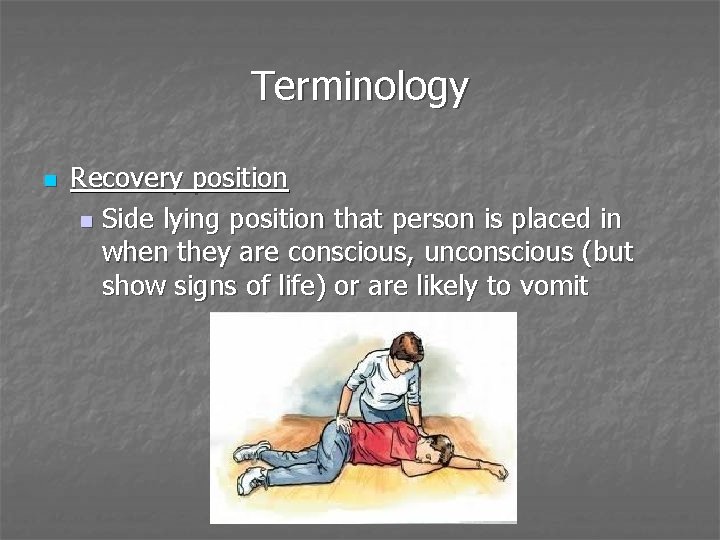
Terminology n Recovery position n Side lying position that person is placed in when they are conscious, unconscious (but show signs of life) or are likely to vomit
Emergency Action Steps n What is the methodical process that the first responder should follow in providing care? n CHECK-CALL-CARE
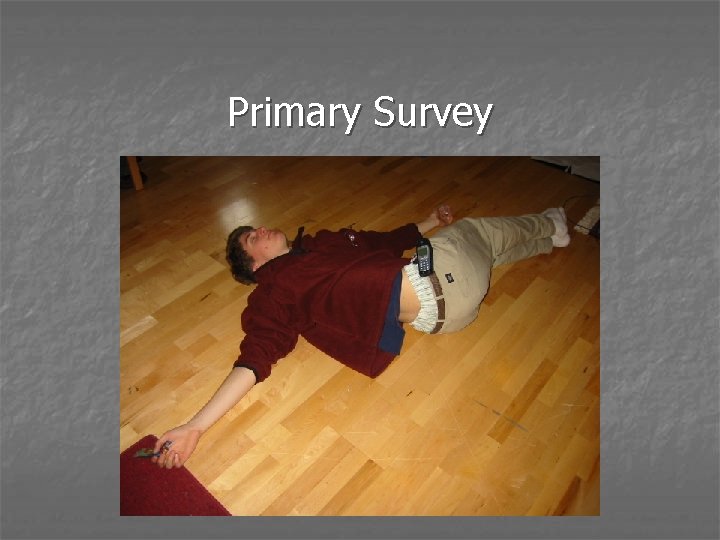
Primary Survey
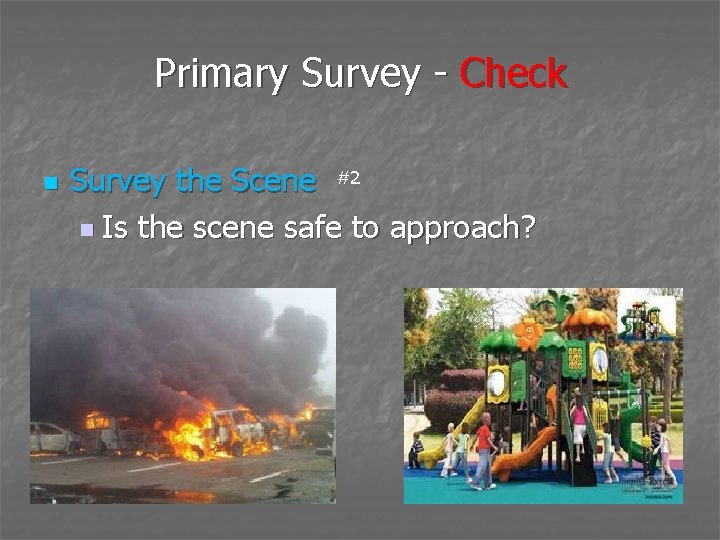
Primary Survey - Check n Survey the Scene #2 n Is the scene safe to approach?
Primary Survey - Check Scene n What should we be checking for at the scene? n Safe vs unsafe
Primary Survey - Check Scene n Anything unsafe n Traffic n Fire n Smoke n Chemical spill n Escaping steam n Poisonous gas n Downed electrical lines n Extreme weather n Collapsed structures n Explosive areas n Gasoline spill n Any others?
Primary Survey - Check Victims n n n Check Consciousness “Hey, are you okay? ” If answer, check level of orientation n Person, Place, Time No answer, check level of responsiveness n Pinch arm #2 #3 #4
Primary Survey - Check Victims n #5 Check for life threatening/non life threatening injury or illness
Primary Survey - Check Victims n Life threatening conditions n Unconsciousness n Breathing (absent or difficult) n Poisoning n n n n Choking No signs of life Persistent chest pain Severe bleeding Severe burns Shock Stroke #6
Primary Survey - Call n n Call 911 (EMS) Often the most important action you can take to help #3
Primary Survey - Call n n n n n Give your name Address/Location What has happened Number of Victims Any Life Threatening situations Victims apparent condition What has been done Hang up last Send someone out to direct ambulance to scene
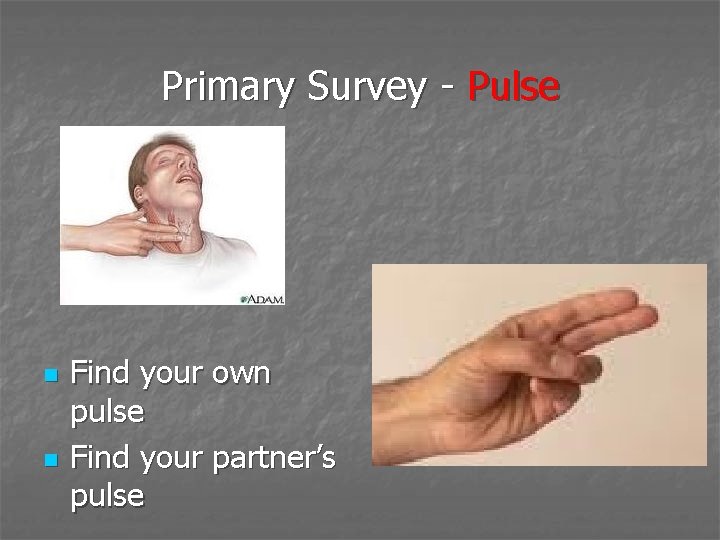
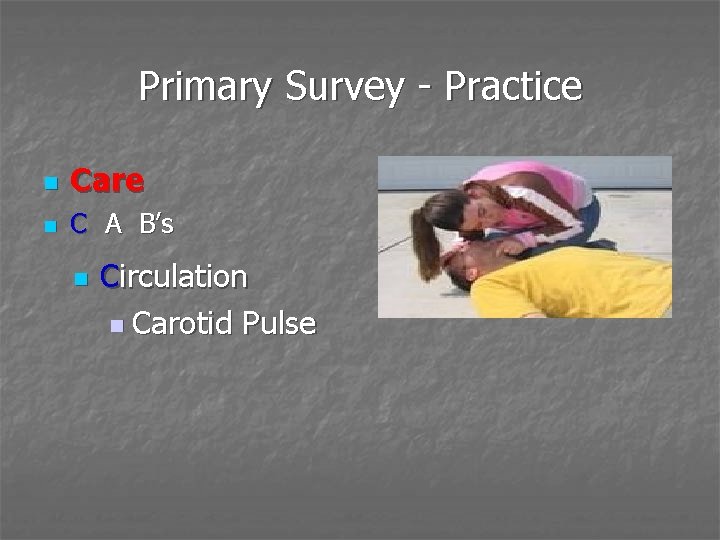
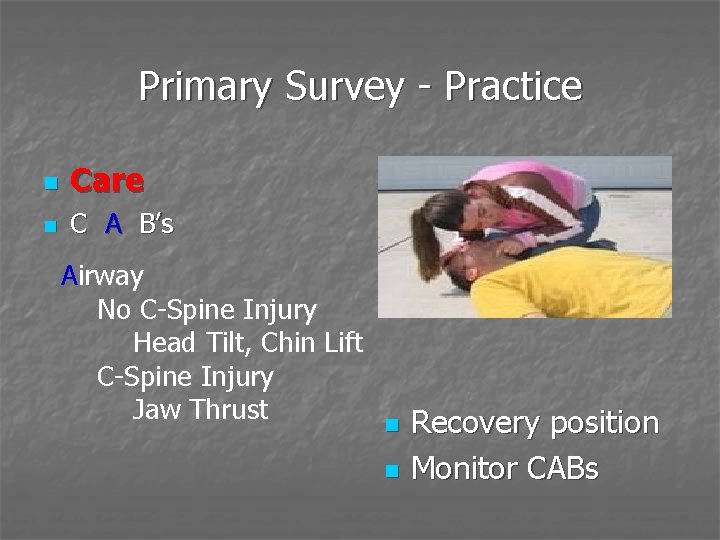
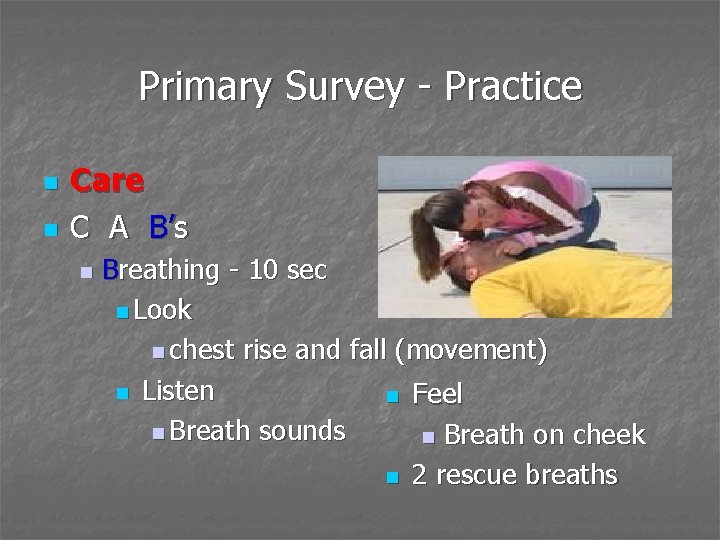
Primary Survey - Care n n Care CAB n Circulation Carotid Pulse #8 n Airway Head Tilt, Chin Lift (Jaw Thrust) #7 n Breathing Rise and fall of chest Breath sounds/feel breath n n Check CAB for 5 -10 seconds #8 Monitor CABs & consciousness Provide specific care as necessary Until help arrives or situation resolved #8
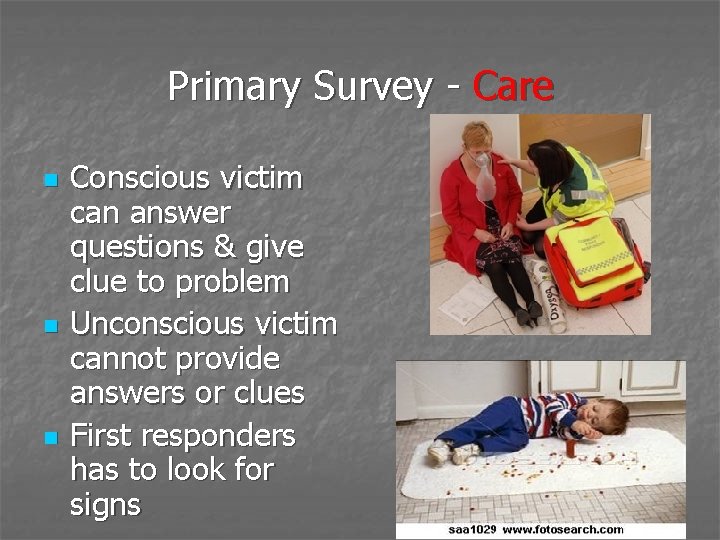
Primary Survey - Care n n n Conscious victim can answer questions & give clue to problem Unconscious victim cannot provide answers or clues First responders has to look for signs
Primary Survey - Pulse n n Find your own pulse Find your partner’s pulse
Primary Survey Practice n n Check Scene n Safe – Unsafe – Unusual Check Victim n Consciousness – Life Threatening – Non. Life Threatening Call n 911 Care n CAB
Primary Survey Practice n n Get in groups of 3 Practice the Primary Survey - Unconscious 1 person victim n 1 person First Responder n 1 person Coach n
Primary Survey - Practice n Care n C A B’s n Circulation n Carotid Pulse
Primary Survey - Practice n Care n C A B’s Airway No C-Spine Injury Head Tilt, Chin Lift C-Spine Injury Jaw Thrust n n Recovery position Monitor CABs
Primary Survey - Practice n n Care C A B’s n Breathing - 10 sec n Look n chest rise and fall (movement) n Listen n Feel n Breath sounds n Breath on cheek n 2 rescue breaths
Primary Survey - Prioritizing Care n n n Imagine that you come upon an accident scene, you were the only responder & there are 3 injured people. A. conscious woman – bloody, broken arm B. unconscious man C. conscious child – minor scrapes & cuts Who should be treated first? Thumbs Up or Down
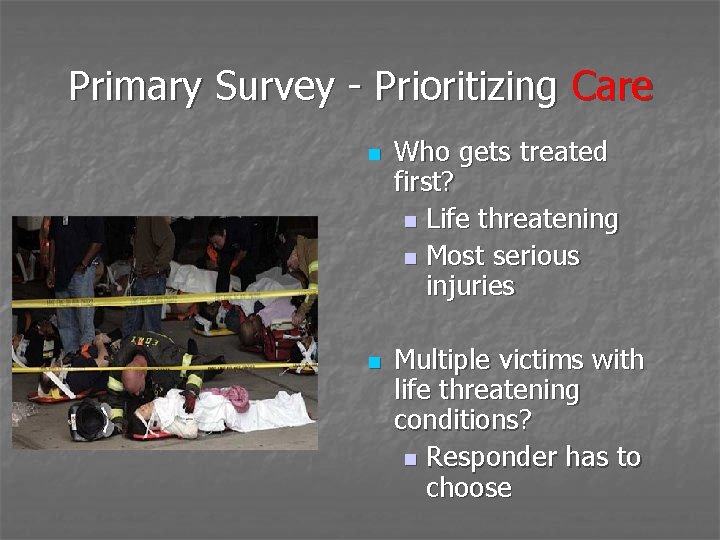
Primary Survey - Prioritizing Care n n Who gets treated first? n Life threatening n Most serious injuries Multiple victims with life threatening conditions? n Responder has to choose
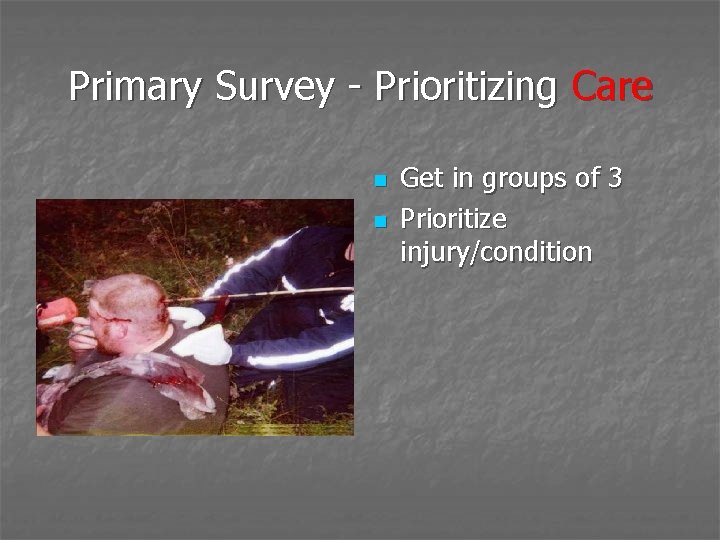
Primary Survey - Prioritizing Care n n Get in groups of 3 Prioritize injury/condition
Closure n n What is the method used when arriving on scene of an injury/accident? Who gets care first? Baby with elbow laceration n Older man with breathing difficulty n Pregnant woman with a suspected ankle fx n