
First Aid CPR Emergency Evacuation Flash Report Accident
- Slides: 16
First Aid CPR Emergency Evacuation Flash Report Accident Investigation
Are you prepared for an emergency? Do you know how to help a person who is injured? Do you know how to file a Flash Report? Do you know how to report an injury to the client? Do you know where to go in the event of an evacuation? At a client site? In your office?
In Summary • The last several biweekly safety training subjects we covered: – Injury Case Management – Accident Investigation – Emergency Evacuation – Each office held an evacuation drill
Highlights • The subject of this training is to highlight these more recent training sessions and provide you with additional information and resources covering: – First Aid / CPR • Safety Minutes on the signs and symptoms of a heart attack and stroke – How and when to file a Flash Report – Responding to an emergency
Flash Reports – Why • The following are some examples of situations that require a ‘Flash Report’: – First Aid – Injury – Near Miss – Interruption to client’s processes – Any damage to company or client’s assets – Vehicle damage, accidents, and citations
Flash Report – When and Who • File as soon as possible, and no more than 24 hours from the time of the event. • Send the report to your supervisor or PM, the Safety Department, your Regional Directors, and the Managing Directors. • File a client specific report when an event occurs on a client site.
Flash Report - How • The Flash Report forms are found on the ADP Portal and the Google Safety – Emergency Response sites. • Document on the report what you know at the time you file it. • The Safety Department will work with you to complete the report and ensure action items are completed.
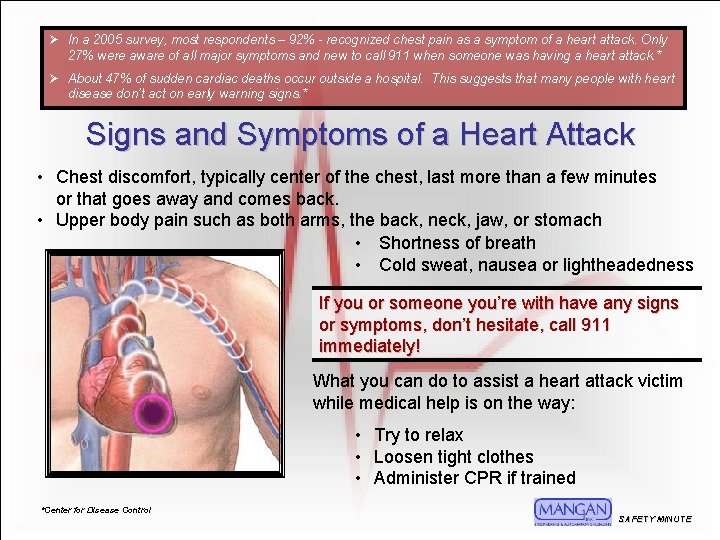
Ø In a 2005 survey, most respondents – 92% - recognized chest pain as a symptom of a heart attack. Only 27% were aware of all major symptoms and new to call 911 when someone was having a heart attack. * Ø About 47% of sudden cardiac deaths occur outside a hospital. This suggests that many people with heart disease don’t act on early warning signs. * Signs and Symptoms of a Heart Attack • Chest discomfort, typically center of the chest, last more than a few minutes or that goes away and comes back. • Upper body pain such as both arms, the back, neck, jaw, or stomach • Shortness of breath • Cold sweat, nausea or lightheadedness If you or someone you’re with have any signs or symptoms, don’t hesitate, call 911 immediately! What you can do to assist a heart attack victim while medical help is on the way: • Try to relax • Loosen tight clothes • Administer CPR if trained *Center for Disease Control SAFETY MINUTE
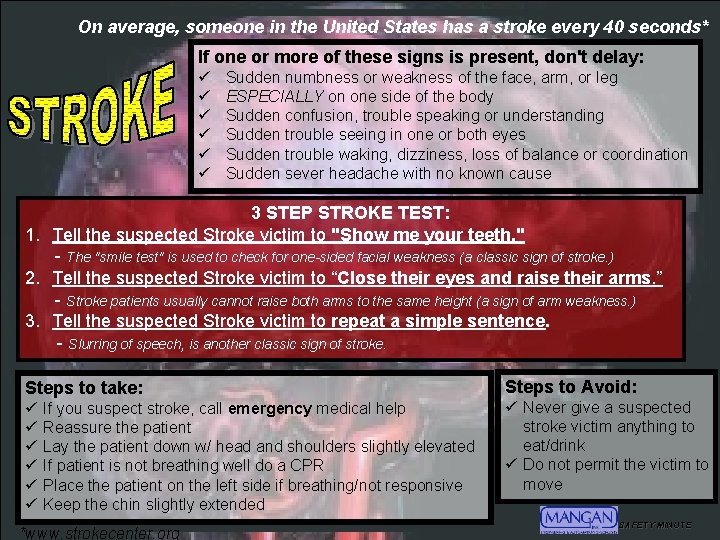
On average, someone in the United States has a stroke every 40 seconds* If one or more of these signs is present, don't delay: ü ü ü Sudden numbness or weakness of the face, arm, or leg ESPECIALLY on one side of the body Sudden confusion, trouble speaking or understanding Sudden trouble seeing in one or both eyes Sudden trouble waking, dizziness, loss of balance or coordination Sudden sever headache with no known cause 3 STEP STROKE TEST: 1. Tell the suspected Stroke victim to "Show me your teeth. " - The "smile test" is used to check for one-sided facial weakness (a classic sign of stroke. ) 2. Tell the suspected Stroke victim to “Close their eyes and raise their arms. ” - Stroke patients usually cannot raise both arms to the same height (a sign of arm weakness. ) 3. Tell the suspected Stroke victim to repeat a simple sentence. - Slurring of speech, is another classic sign of stroke. Steps to take: ü ü ü If you suspect stroke, call emergency medical help Reassure the patient Lay the patient down w/ head and shoulders slightly elevated If patient is not breathing well do a CPR Place the patient on the left side if breathing/not responsive Keep the chin slightly extended *www. strokecenter. org Steps to Avoid: ü Never give a suspected stroke victim anything to eat/drink ü Do not permit the victim to move SAFETY MINUTE
First Aid / CPR • Office hosted or sponsored CPR / First Aid classes will be available soon. • Look for an office correspondence announcing the opportunities to become CPR / First Aid certified.
Evacuation and Emergency Response Tips • Carry your Emergency Information Card and follow the instructions for responding to an emergency. • Alert your First Responder in the event of an injury or incident. • Follow the client’s procedure for responding to an emergency when on their site.
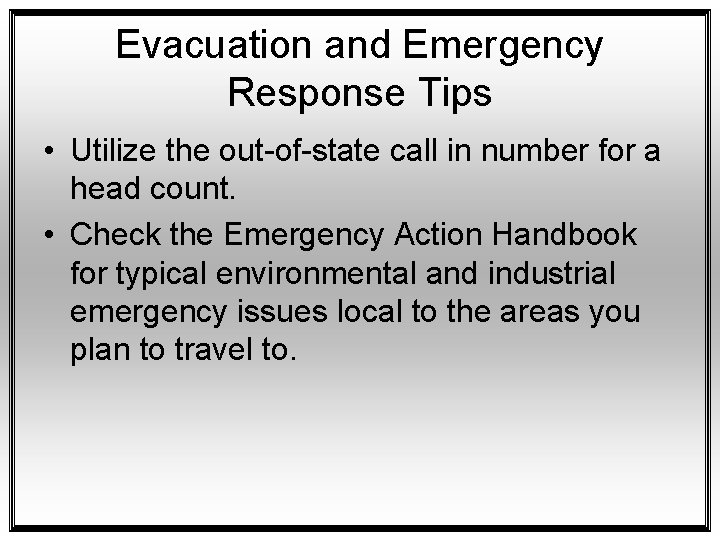
Evacuation and Emergency Response Tips • Utilize the out-of-state call in number for a head count. • Check the Emergency Action Handbook for typical environmental and industrial emergency issues local to the areas you plan to travel to.
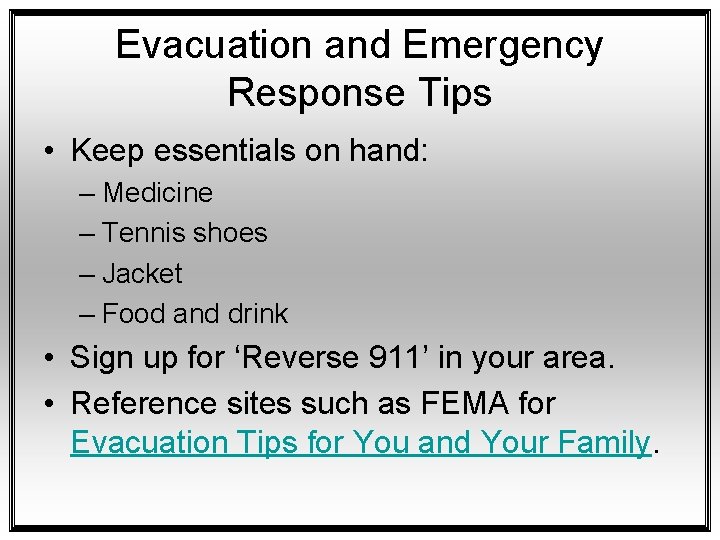
Evacuation and Emergency Response Tips • Keep essentials on hand: – Medicine – Tennis shoes – Jacket – Food and drink • Sign up for ‘Reverse 911’ in your area. • Reference sites such as FEMA for Evacuation Tips for You and Your Family.
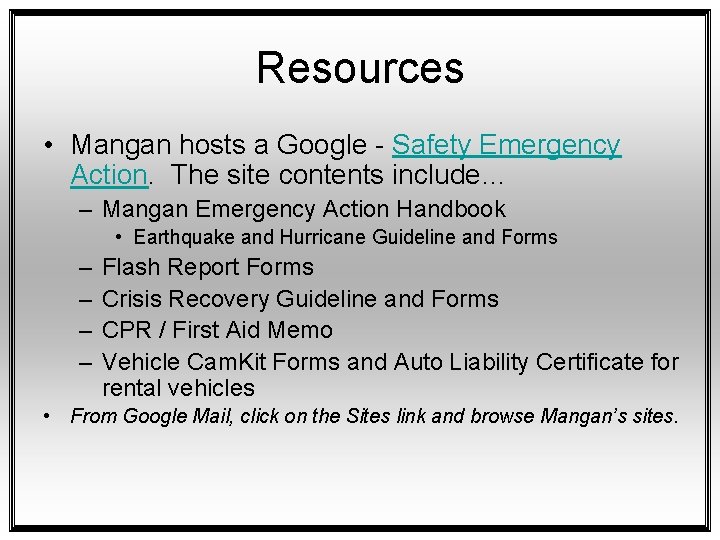
Resources • Mangan hosts a Google - Safety Emergency Action. The site contents include… – Mangan Emergency Action Handbook • Earthquake and Hurricane Guideline and Forms – – Flash Report Forms Crisis Recovery Guideline and Forms CPR / First Aid Memo Vehicle Cam. Kit Forms and Auto Liability Certificate for rental vehicles • From Google Mail, click on the Sites link and browse Mangan’s sites.
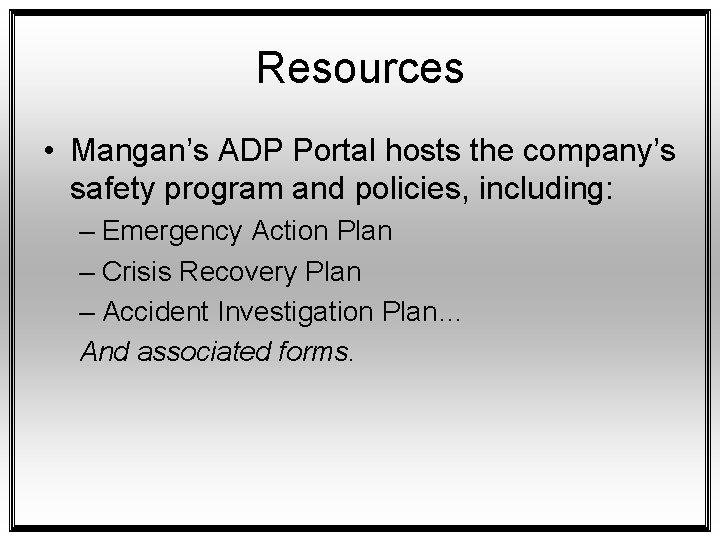
Resources • Mangan’s ADP Portal hosts the company’s safety program and policies, including: – Emergency Action Plan – Crisis Recovery Plan – Accident Investigation Plan… And associated forms.