
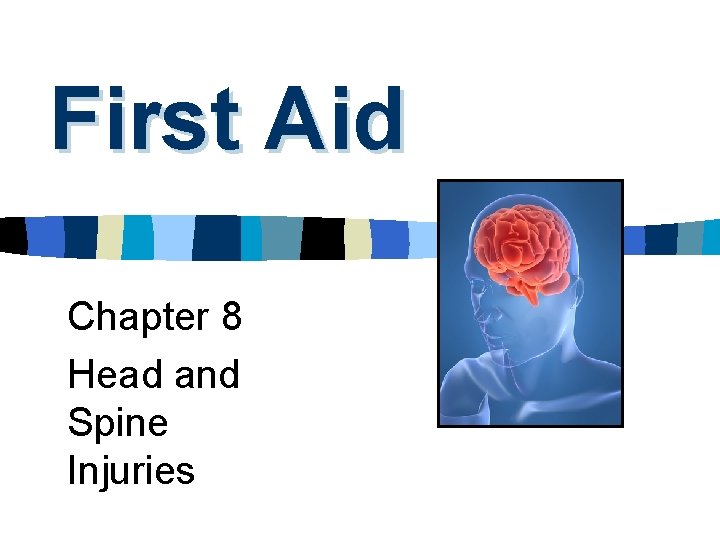
First Aid Chapter 8 Head and Spine Injuries





- Slides: 65
First Aid Chapter 8 Head and Spine Injuries
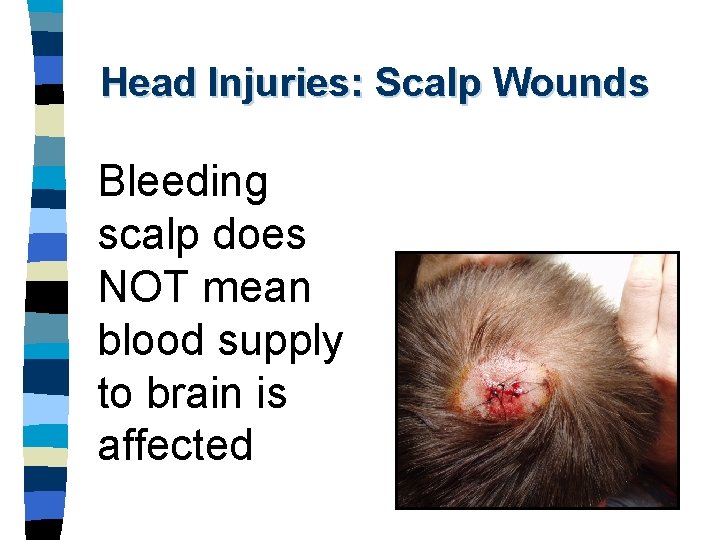
Head Injuries: Scalp Wounds Bleeding scalp does NOT mean blood supply to brain is affected
Head Injuries: Scalp Wounds What to Do: Control bleeding n If you suspect a skull fx, apply pressure around wound n Keep head and shoulders elevated n
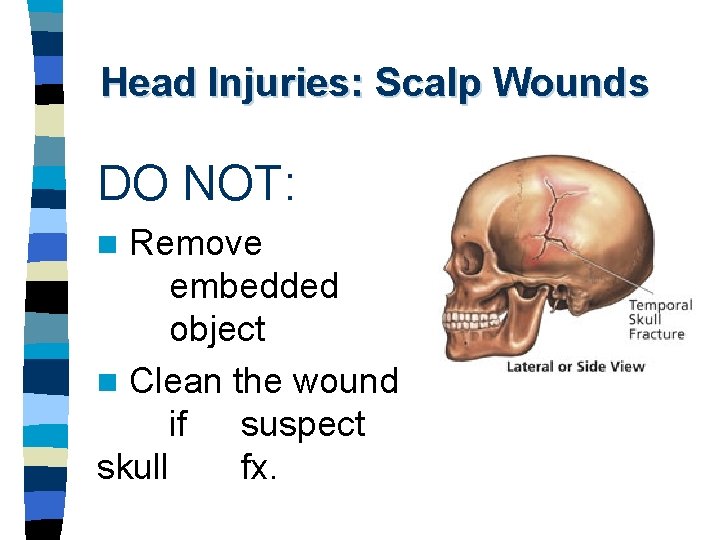
Head Injuries: Scalp Wounds DO NOT: Remove embedded object n Clean the wound if suspect skull fx. n
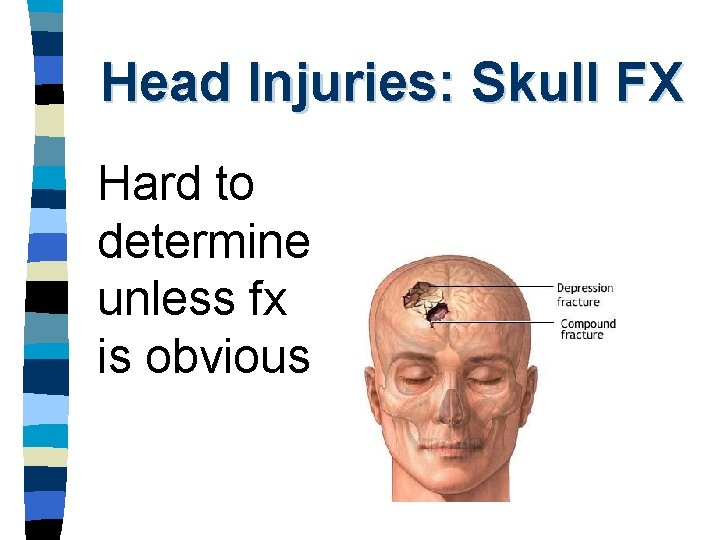
Head Injuries: Skull FX Hard to determine unless fx is obvious
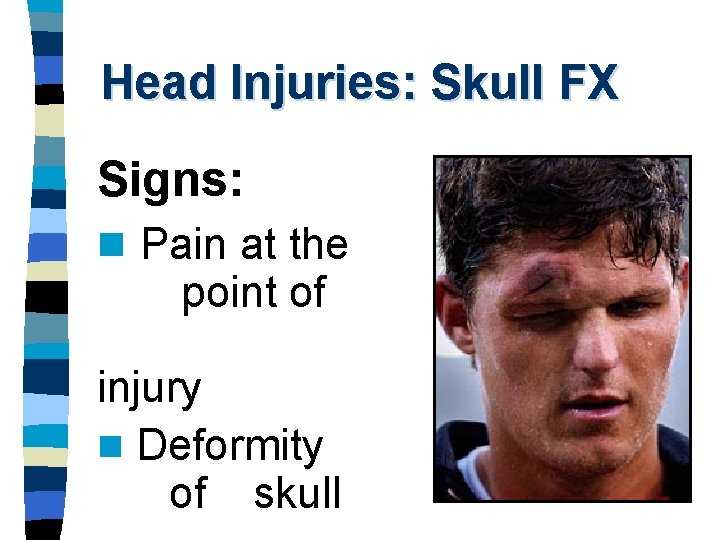
Head Injuries: Skull FX Signs: n Pain at the point of injury n Deformity of skull
Head Injuries: Skull FX Signs: n Bleeding from ears or nose
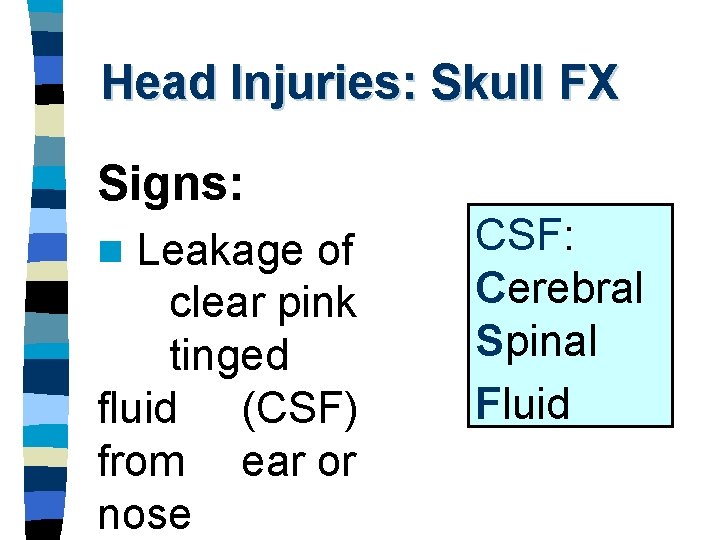
Head Injuries: Skull FX Signs: Leakage of clear pink tinged fluid (CSF) from ear or nose n CSF: Cerebral Spinal Fluid
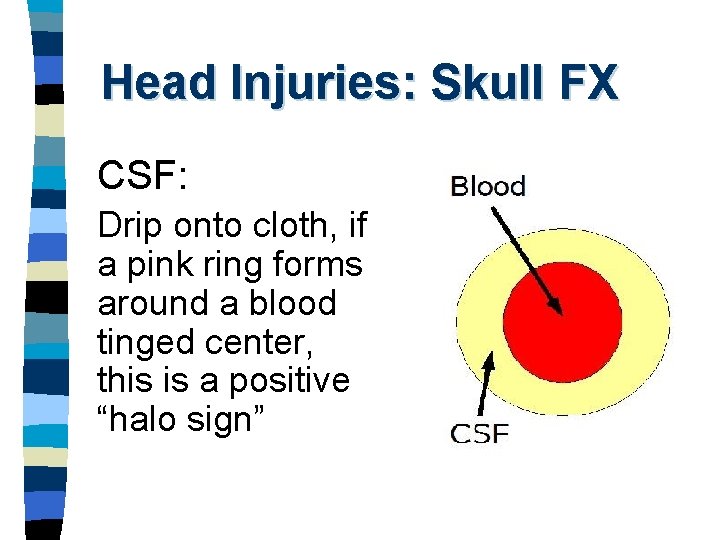
Head Injuries: Skull FX CSF: Drip onto cloth, if a pink ring forms around a blood tinged center, this is a positive “halo sign”
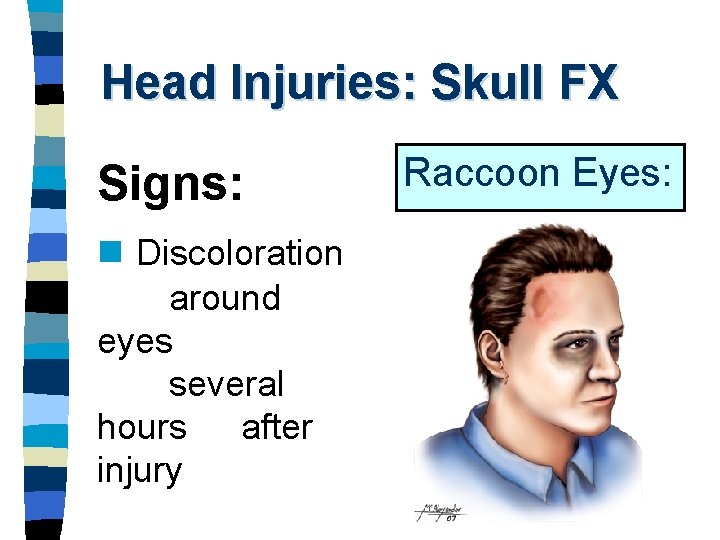
Head Injuries: Skull FX Signs: n Discoloration around eyes several hours after injury Raccoon Eyes:
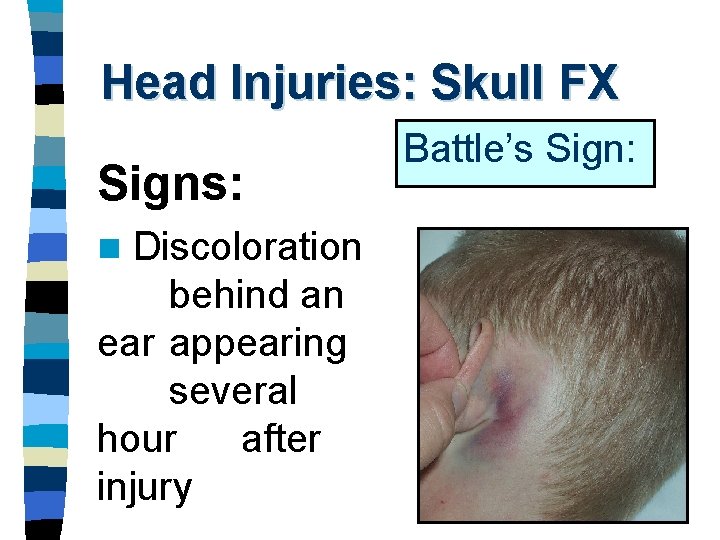
Head Injuries: Skull FX Signs: Discoloration behind an ear appearing several hour after injury n Battle’s Sign:
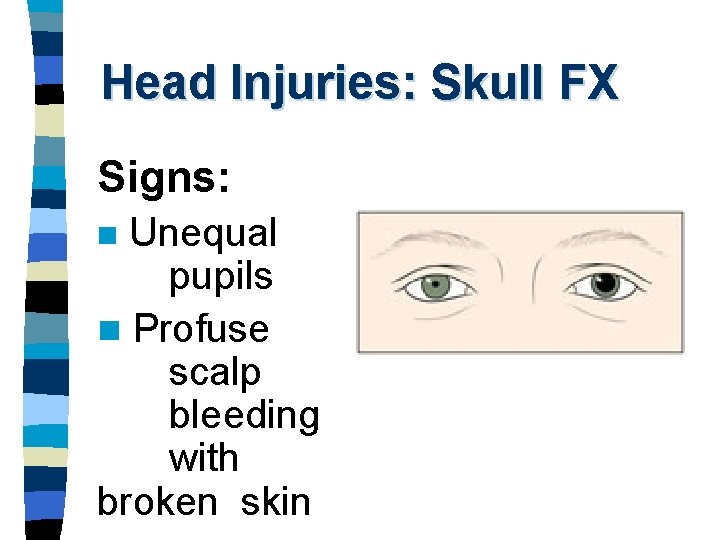
Head Injuries: Skull FX Signs: Unequal pupils n Profuse scalp bleeding with broken skin n
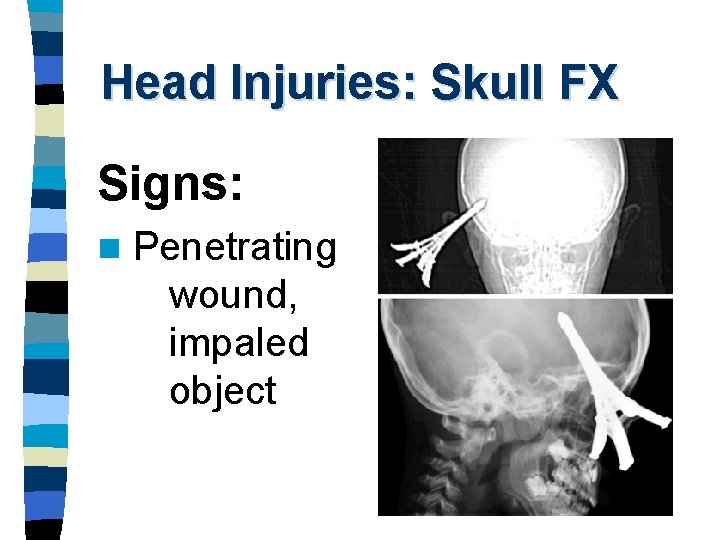
Head Injuries: Skull FX Signs: n Penetrating wound, impaled object
Head Injuries: Skull FX DO NOT Stop the flow of blood or CSF from an ear or nose. Increases pressure within the skull
Head Injuries: Skull FX DO NOT Remove an impaled object Stabilize object with bulky dressings
Head Injuries: Skull FX DO NOT Clean an open skull fx wound Can cause infection of the brain
Head Injuries: Skull FX What to Do: Monitor ABCs Cover wound with sterile dressing Stabilize neck against movement Elevate head and shoulders Apply pressure around wound edges.
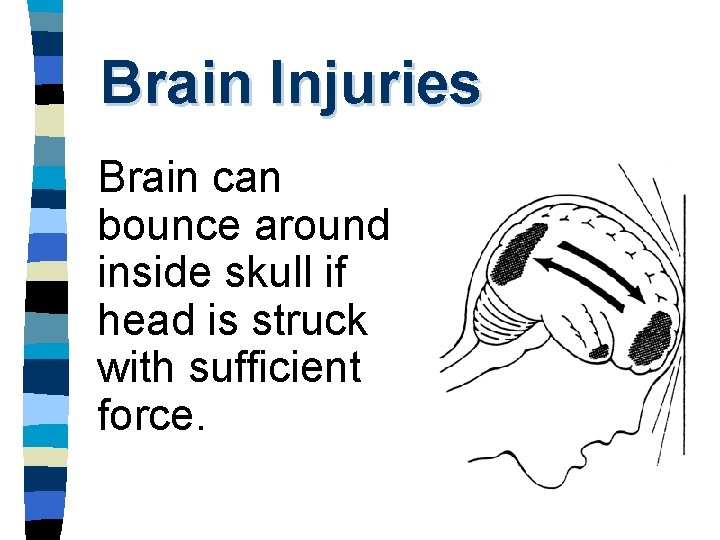
Brain Injuries Brain can bounce around inside skull if head is struck with sufficient force.
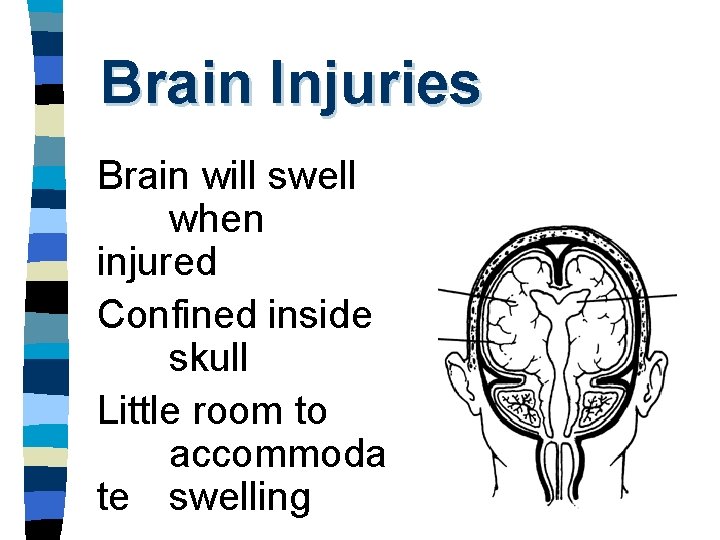
Brain Injuries Brain will swell when injured Confined inside skull Little room to accommoda te swelling
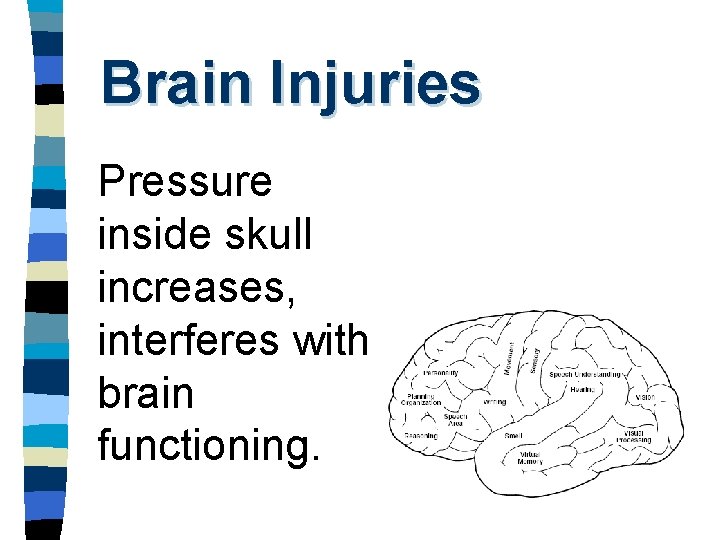
Brain Injuries Pressure inside skull increases, interferes with brain functioning.
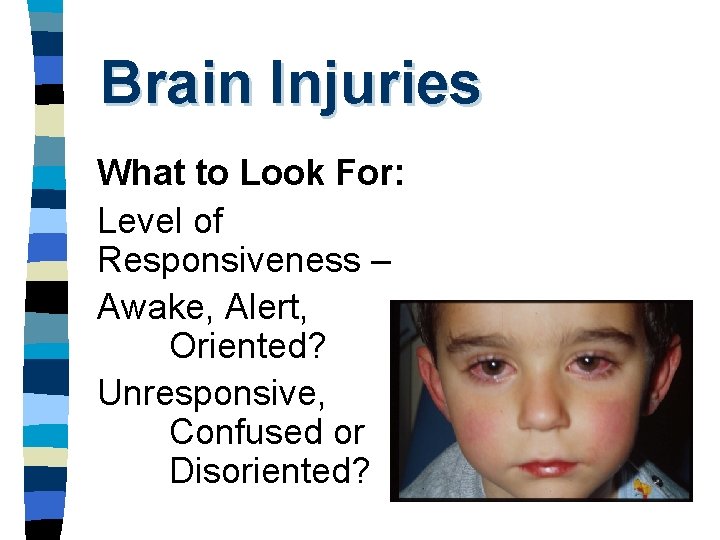
Brain Injuries What to Look For: Level of Responsiveness – Awake, Alert, Oriented? Unresponsive, Confused or Disoriented?
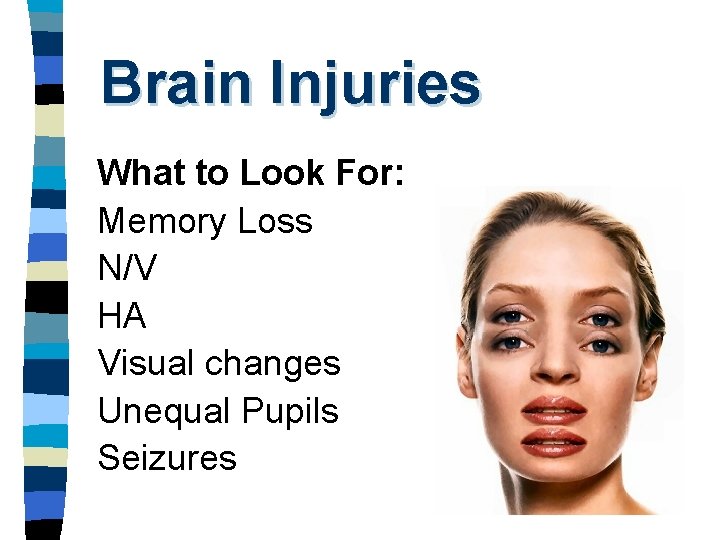
Brain Injuries What to Look For: Memory Loss N/V HA Visual changes Unequal Pupils Seizures
Brain Injuries What to Look For: Paralysis, weakness or loss balance Blood or CSF from ears or nose Combativeness
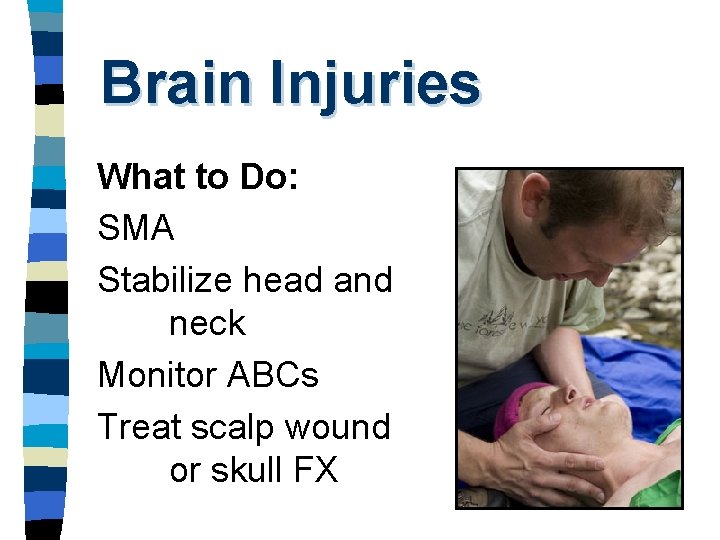
Brain Injuries What to Do: SMA Stabilize head and neck Monitor ABCs Treat scalp wound or skull FX
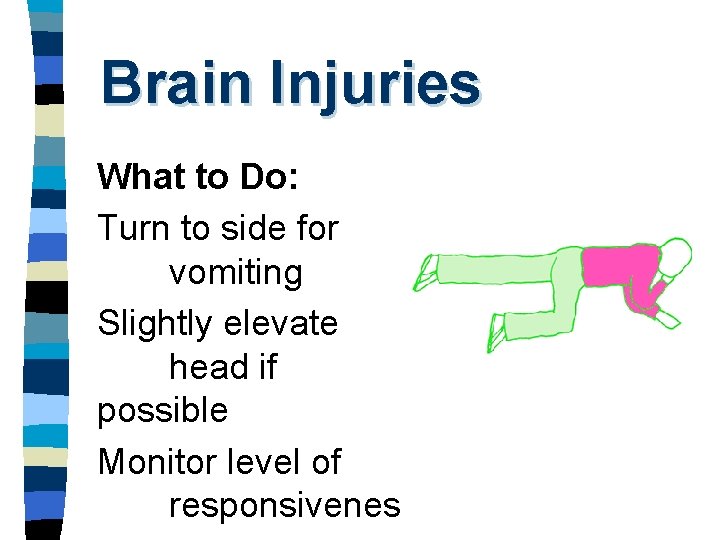
Brain Injuries What to Do: Turn to side for vomiting Slightly elevate head if possible Monitor level of responsivenes
Brain Injuries DO NOT Stop flow of CSF Elevate legs Clean open skull Fx wound Elevating legs increases intra-cranial pressure
Brain Injuries NOT SURE? Seek Medical Attention if the following signs appear within 48 hours after head injury:
Brain Injuries SMA if: Increase severity of headache N/V lasting more than 2 hours Drowsiness, confusion Vision problems Cannot use arms or legs Slurred speech Seizures
EYE Injuries What to Do For Penetrating injuries: SMA Protect injured eye Cover both eyes
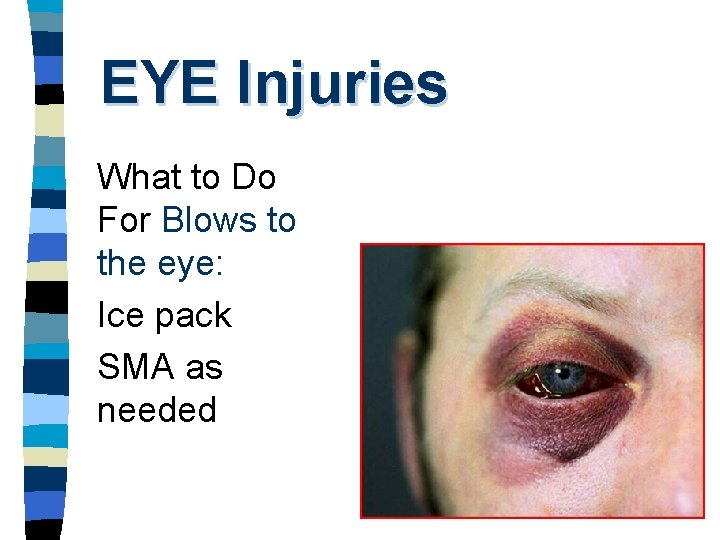
EYE Injuries What to Do For Blows to the eye: Ice pack SMA as needed
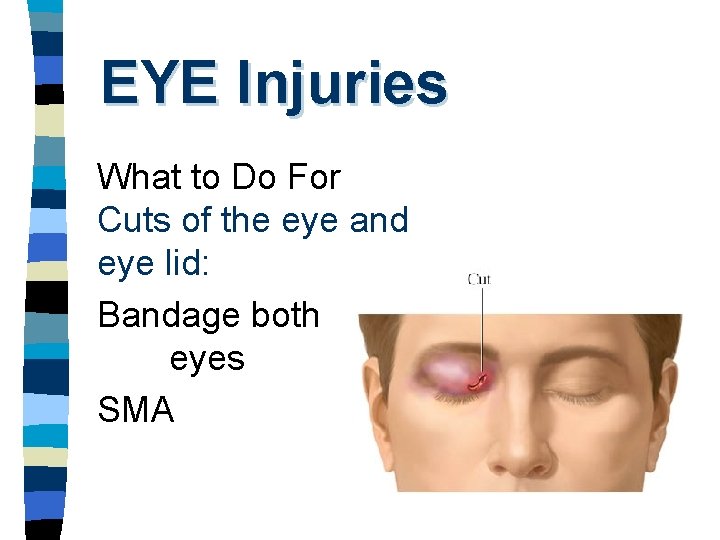
EYE Injuries What to Do For Cuts of the eye and eye lid: Bandage both eyes SMA
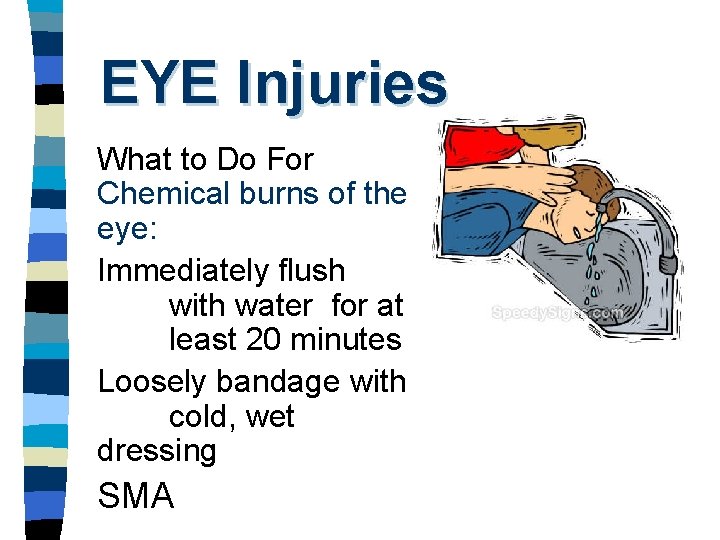
EYE Injuries What to Do For Chemical burns of the eye: Immediately flush with water for at least 20 minutes Loosely bandage with cold, wet dressing SMA
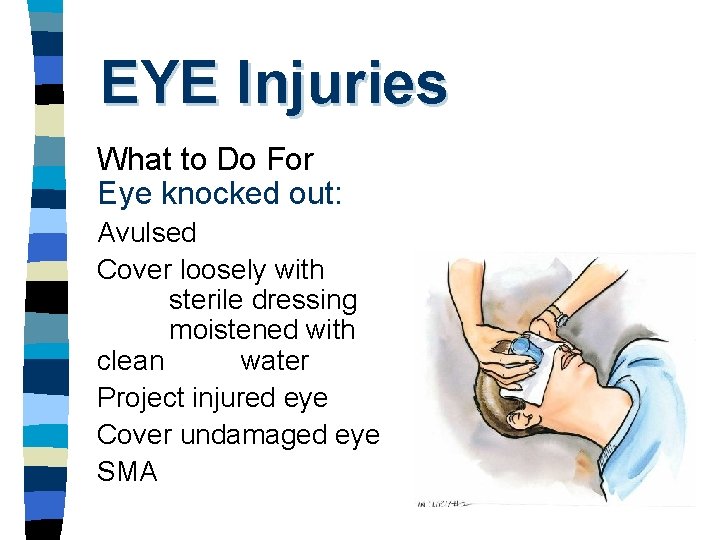
EYE Injuries What to Do For Eye knocked out: Avulsed Cover loosely with sterile dressing moistened with clean water Project injured eye Cover undamaged eye SMA
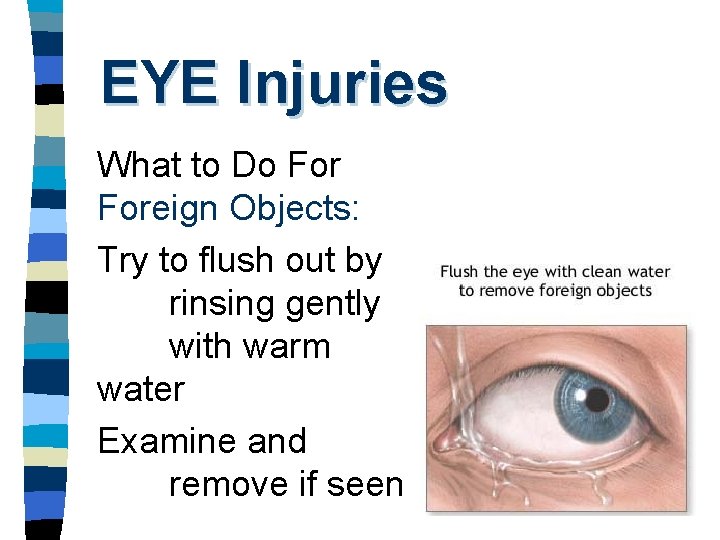
EYE Injuries What to Do Foreign Objects: Try to flush out by rinsing gently with warm water Examine and remove if seen
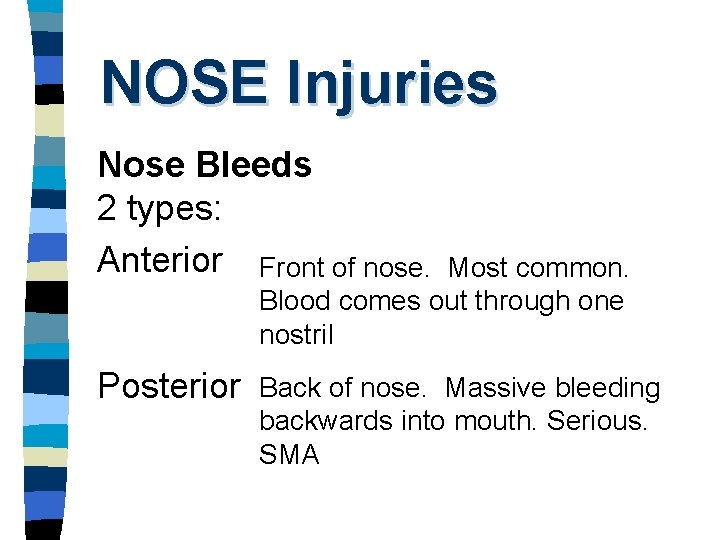
NOSE Injuries Nose Bleeds 2 types: Anterior Front of nose. Most common. Blood comes out through one nostril Posterior Back of nose. Massive bleeding backwards into mouth. Serious. SMA
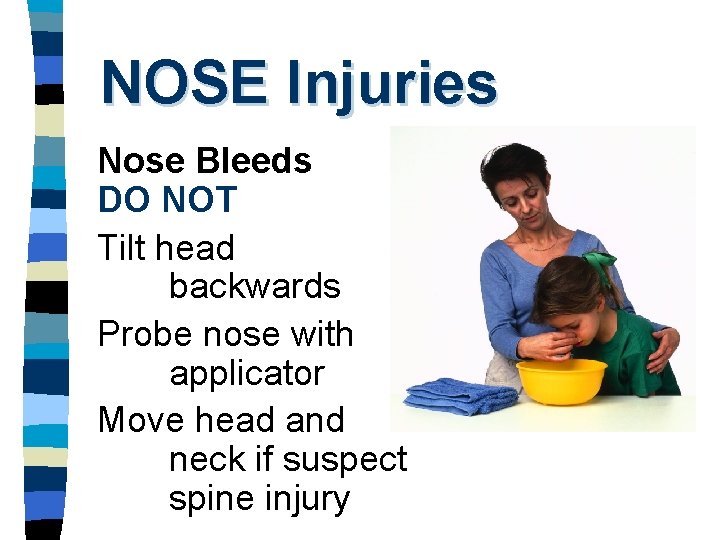
NOSE Injuries Nose Bleeds DO NOT Tilt head backwards Probe nose with applicator Move head and neck if suspect spine injury
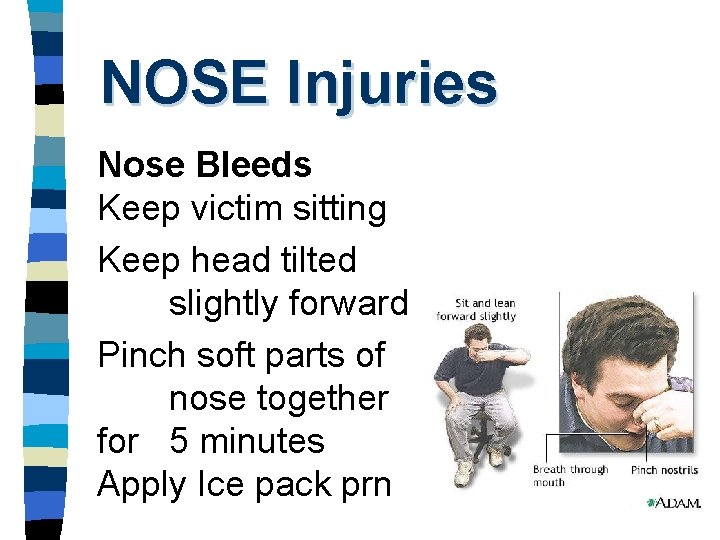
NOSE Injuries Nose Bleeds Keep victim sitting Keep head tilted slightly forward Pinch soft parts of nose together for 5 minutes Apply Ice pack prn
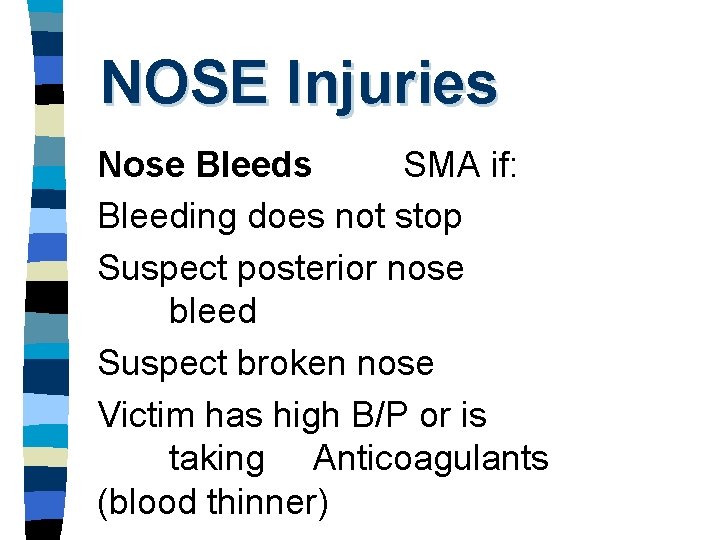
NOSE Injuries Nose Bleeds SMA if: Bleeding does not stop Suspect posterior nose bleed Suspect broken nose Victim has high B/P or is taking Anticoagulants (blood thinner)
Dental Injuries Knocked-Out Tooth Rinse mouth and use gauze to control bleeding Find tooth, handle by crown, not root Place back into socket if possible See Dentist crown root
Dental Injuries Knocked-Out Tooth DO NOT Place tooth in water, alcohol, Betadine, mouth wash, skim milk, or milk byproducts Scrub tooth Remove partially extracted tooth
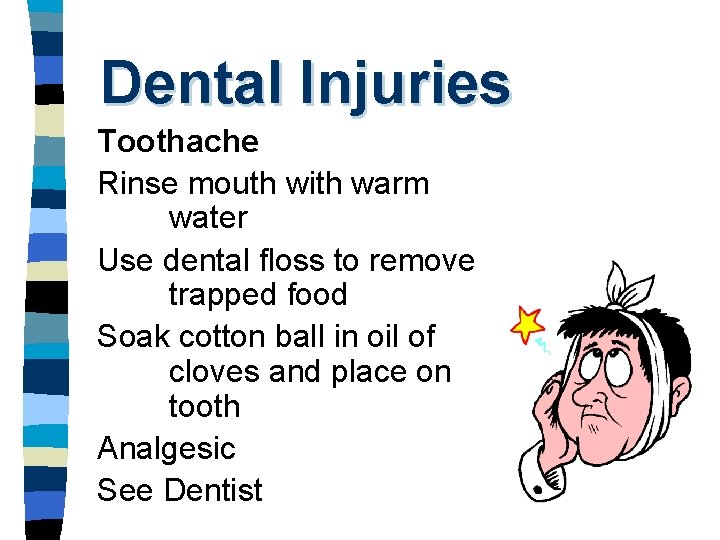
Dental Injuries Toothache Rinse mouth with warm water Use dental floss to remove trapped food Soak cotton ball in oil of cloves and place on tooth Analgesic See Dentist
Dental Injuries Toothache DO NOT Place analgesic tablet directly on tooth Wait to see dentist if there is pus or facial
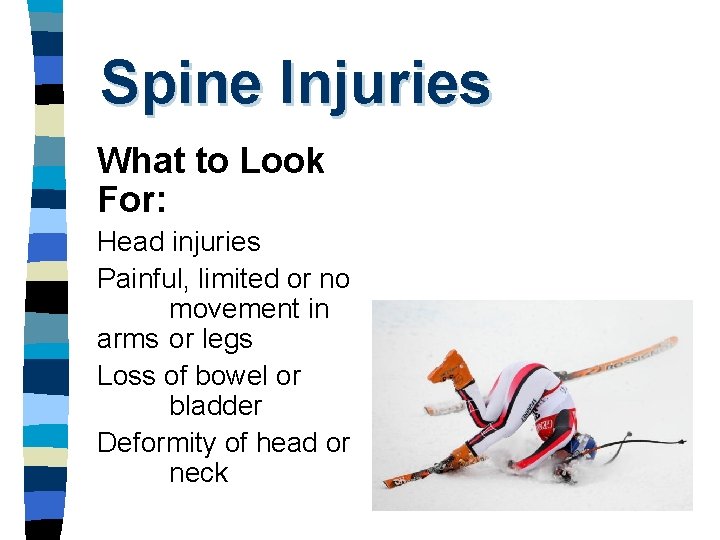
Spine Injuries What to Look For: Head injuries Painful, limited or no movement in arms or legs Loss of bowel or bladder Deformity of head or neck
Spine Injuries Pedal Pushes Hand Squeezes Have victim push foot against your hand Have victim squeeze your hand
Spine Injuries Ask: Pain? Can you move your hands and fingers? Can you move your feet and toes?
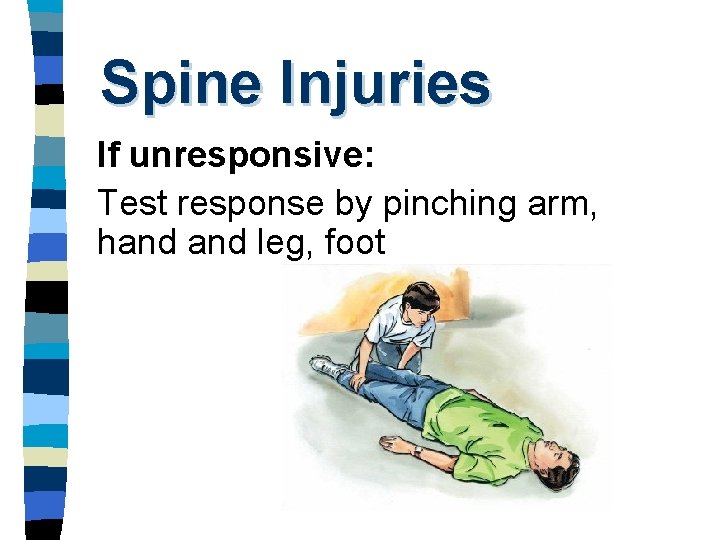
Spine Injuries If unresponsive: Test response by pinching arm, hand leg, foot
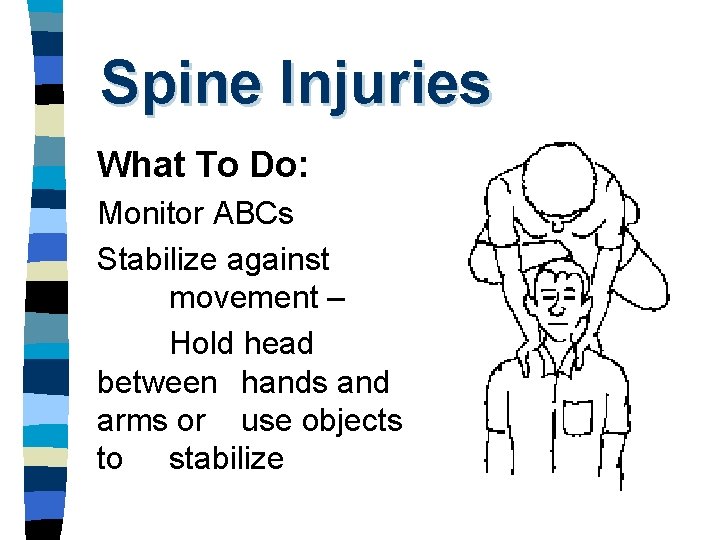
Spine Injuries What To Do: Monitor ABCs Stabilize against movement – Hold head between hands and arms or use objects to stabilize
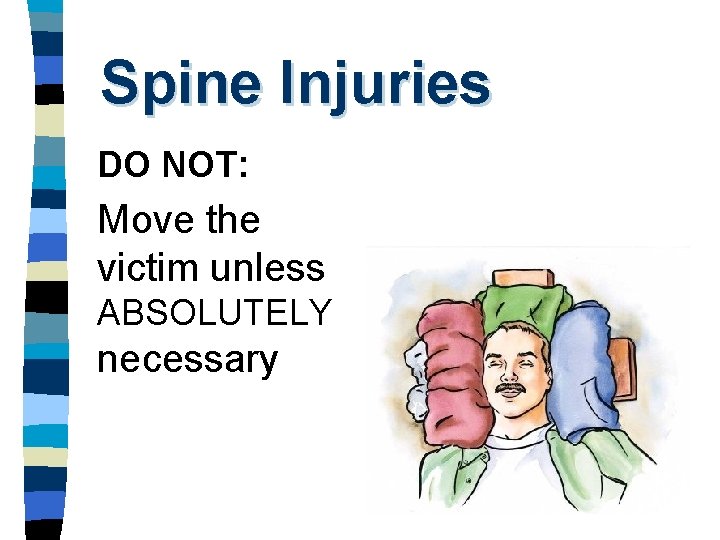
Spine Injuries DO NOT: Move the victim unless ABSOLUTELY necessary
Learning Activities 8 Head Injuries 1. For a suspected skull fx, press around the wound not directly on it. Yes
Learning Activities 8 Head Injuries 2. DO NOT removed impaled objects. Yes
Learning Activities 8 Head Injuries 3. Head injury victims should be checked for possible spine injury. Yes
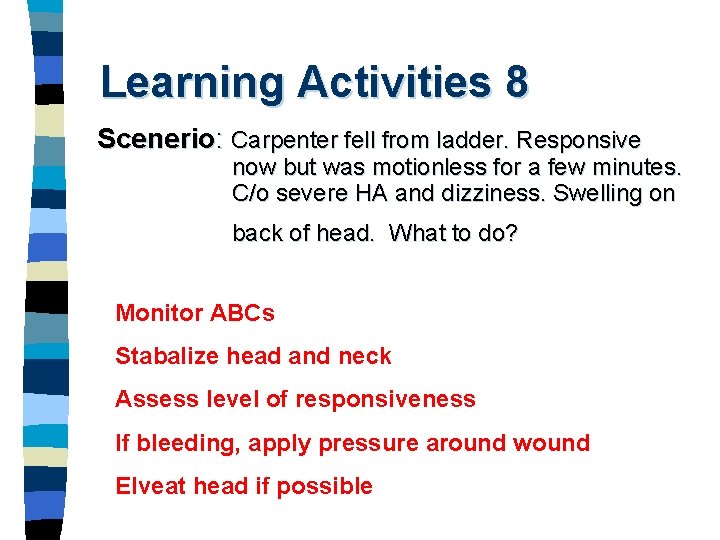
Learning Activities 8 Scenerio: Carpenter fell from ladder. Responsive now but was motionless for a few minutes. C/o severe HA and dizziness. Swelling on back of head. What to do? Monitor ABCs Stabalize head and neck Assess level of responsiveness If bleeding, apply pressure around wound Elveat head if possible
Learning Activities 8 Eye Injuries 1. After blow to eye, apply ice pack for about 15 minutes. Yes
Learning Activities 8 Eye Injuries 2. Tears are sufficient to flush chemicals from the eye. No
Learning Activities 8 Eye Injuries 3. Use a clean damp cloth to remove object from surface of eye. Yes
Learning Activities 8 Scenario: Car battery explodes. Battery cap flies off. Battery acid splashes into Sam’s eye. What to do? Flush with water for at least 20 minutes SMA
Learning Activities 8 Dental Injuries 1. Preserve a knocked out tooth in alcohol or mouth wash. No
Learning Activities 8 Dental Injuries 2. Scrub knocked-out tooth before going to dentist. No
Learning Activities 8 Dental Injuries 3. Sometimes a knocked-out tooth should be reinserted. Yes
Learning Activities 8 Scenario: Mike (age 20) was struck in mouth. Spit out 2 front teeth. What to do? Rinse mouth Stop socket bleeding Handle tooth by crown Reinsert tooth
Learning Activities 8 Spine Injuries 1. DO NOT move and stabilize against movement a victim with a suspected spine injury. Yes
Learning Activities 8 Spine Injuries 2. Inability to move fingers and or feet may indicate a spine injury. Yes
Learning Activities 8 Spine Injuries 3. A head injury may be a reason to suspect a spine injury. Yes
Learning Activities 8 Scenario: A car hits concrete median. You completed scene survey. Driver C/O numbness and loss of feeling in both legs. What to do? Monitoe ABCs Stabalize head and neck against movement Wait for EMS
First Aid Kits Item Quantity Paper or Styrofoam cup 1