
First Aid Chapter 3 Finding Out Whats Wrong

- Slides: 51
First Aid Chapter 3 Finding Out What’s Wrong
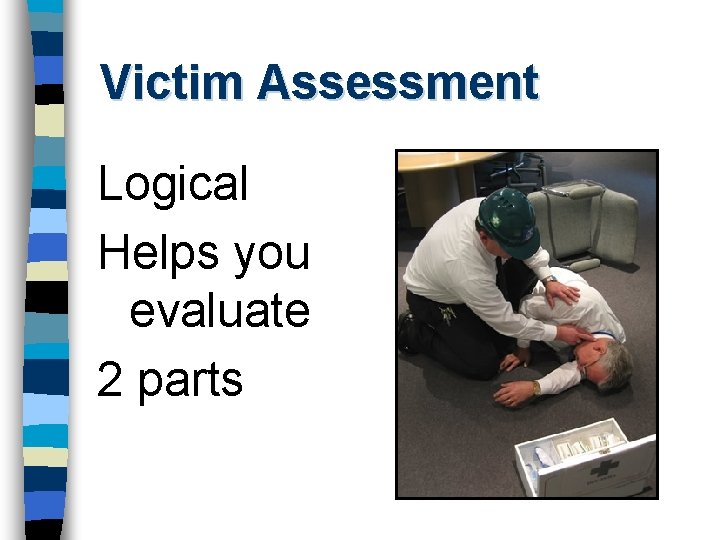
Victim Assessment Logical Helps you evaluate 2 parts
Victim Assessment Primary Determines life threatening conditions Survey Secondary Evaluates nonemergency conditions Survey
Before You Begin Survey the scene If more than 1 victim, assess the quiet one first A victim who is talking, crying obviously has an open airway and pulse
Before You Begin Most victims do not require a complete assessment For example: Cuts finger while peeling potatoes
Primary Survey Airway Breathing Circulation Hemorrhage Spinal Injury? Will effect: • when you call EMS • how you open airway • how you proceed with secondary survey
Primary Survey Goal: Quick assessment of life threatening conditions Treat any problem found before continuing. n Breathing difficulty n No pulse n Bleeding n. Spinal injury
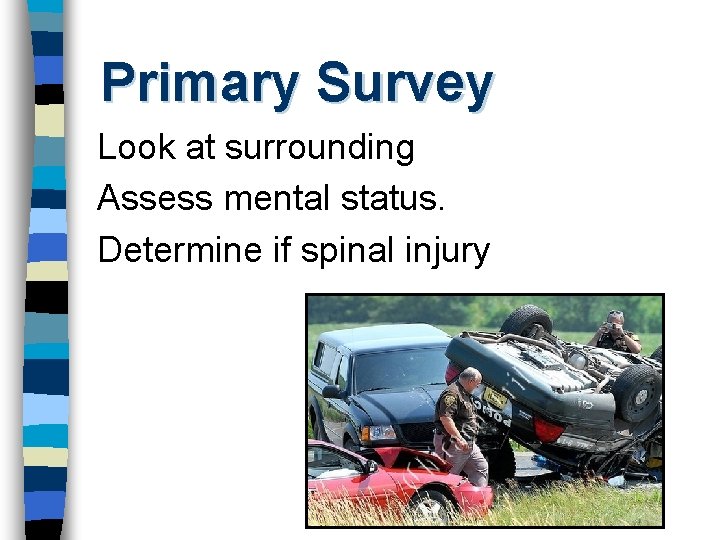
Primary Survey Look at surrounding Assess mental status. Determine if spinal injury
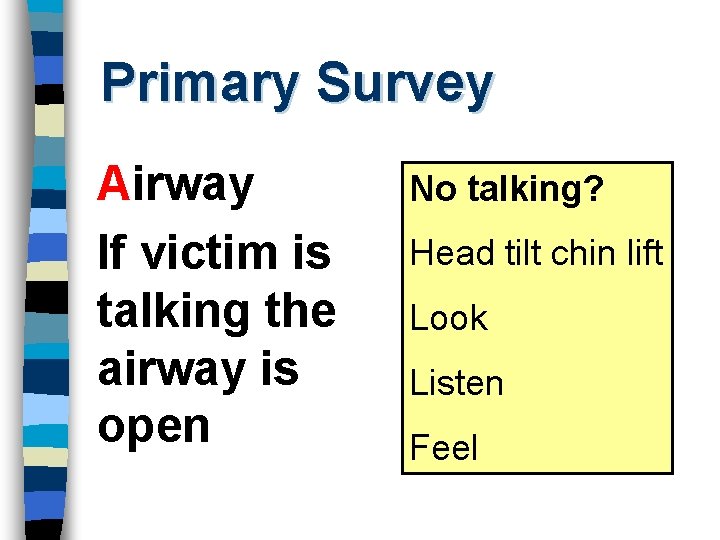
Primary Survey Airway If victim is talking the airway is open No talking? Head tilt chin lift Look Listen Feel
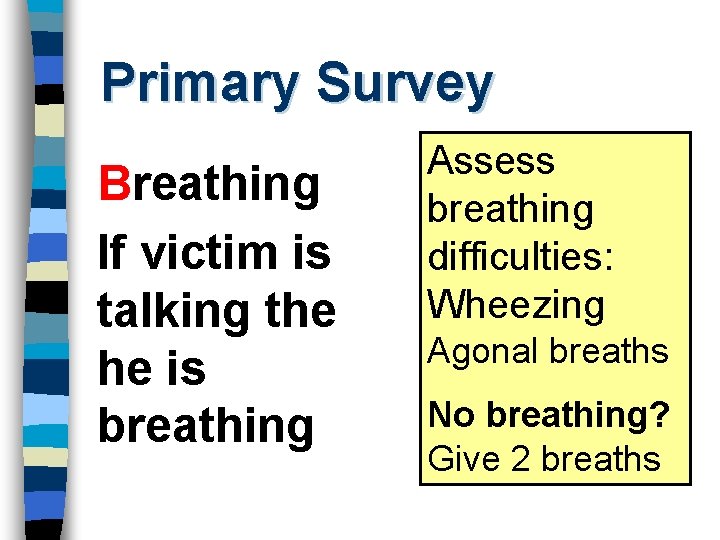
Primary Survey Breathing If victim is talking the he is breathing Assess breathing difficulties: Wheezing Agonal breaths No breathing? Give 2 breaths
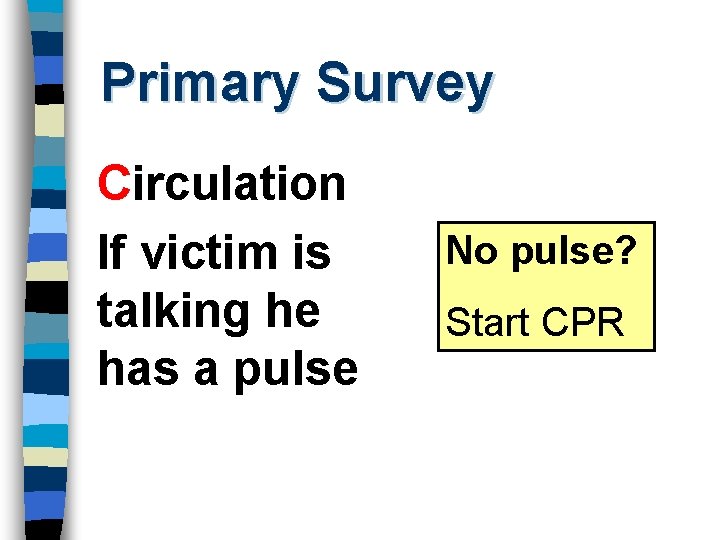
Primary Survey Circulation If victim is talking he has a pulse No pulse? Start CPR
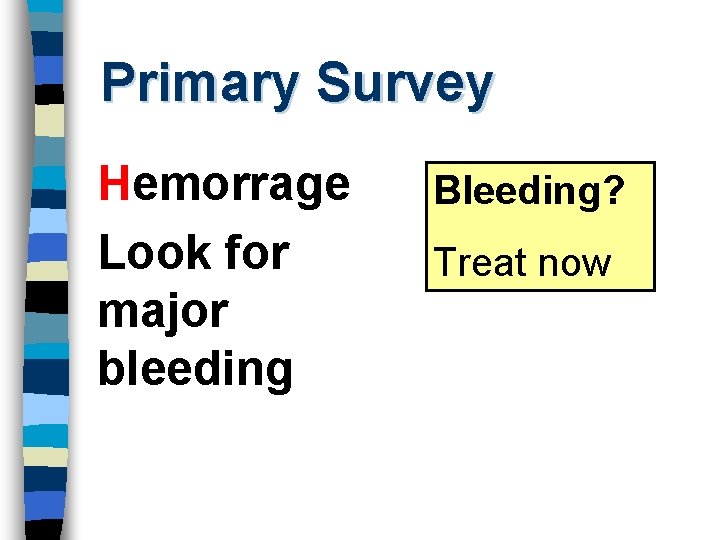
Primary Survey Hemorrage Look for major bleeding Bleeding? Treat now
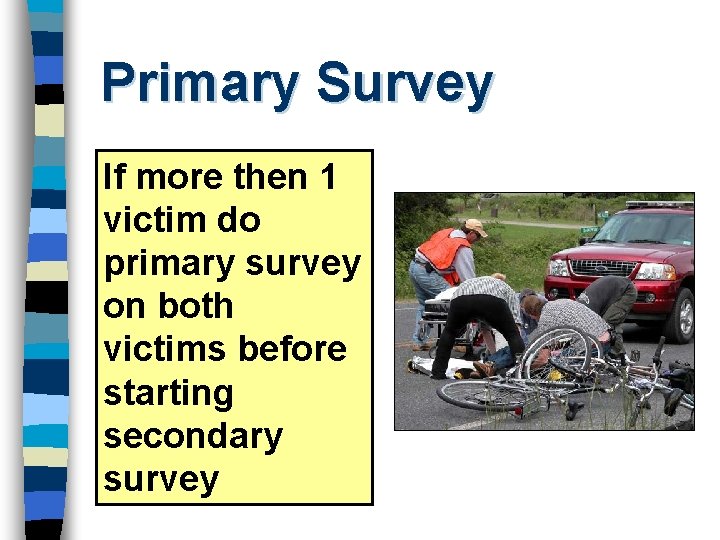
Primary Survey If more then 1 victim do primary survey on both victims before starting secondary survey
Secondary Survey Interview n. State your name n. Tell you know first aid n. Get permission
Secondary Survey Interview n. State your name n. Tell you know first aid n. Get permission Spine injury? Stabilize now if haven’t already
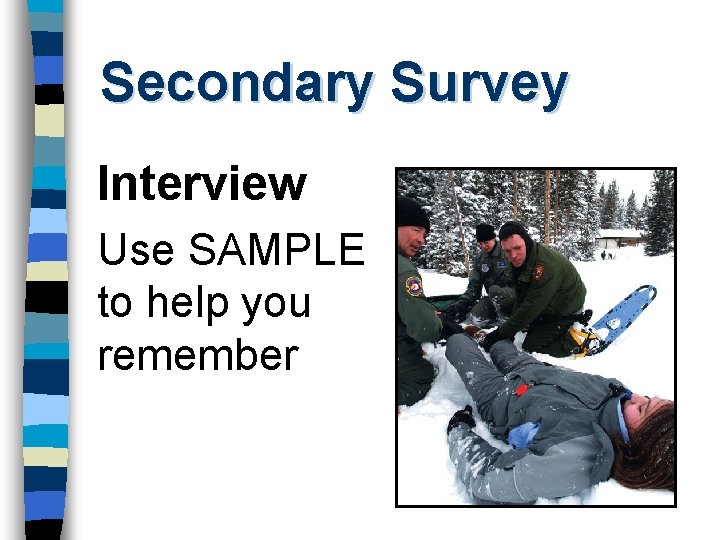
Secondary Survey Interview Use SAMPLE to help you remember
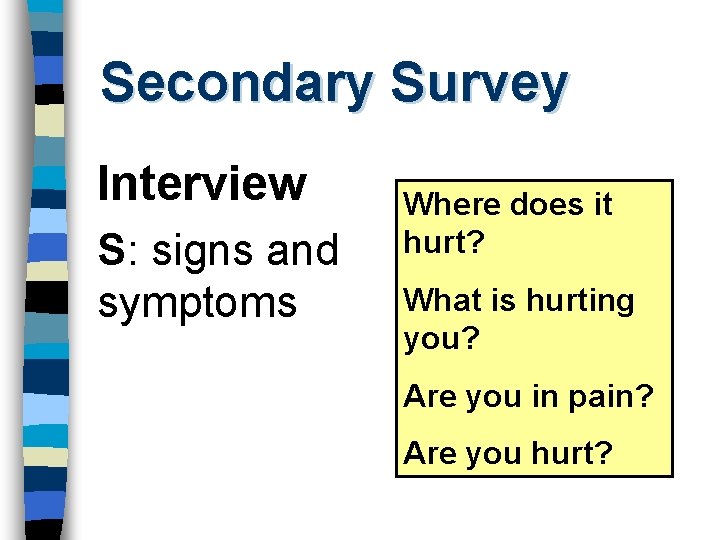
Secondary Survey Interview S: signs and symptoms Where does it hurt? What is hurting you? Are you in pain? Are you hurt?
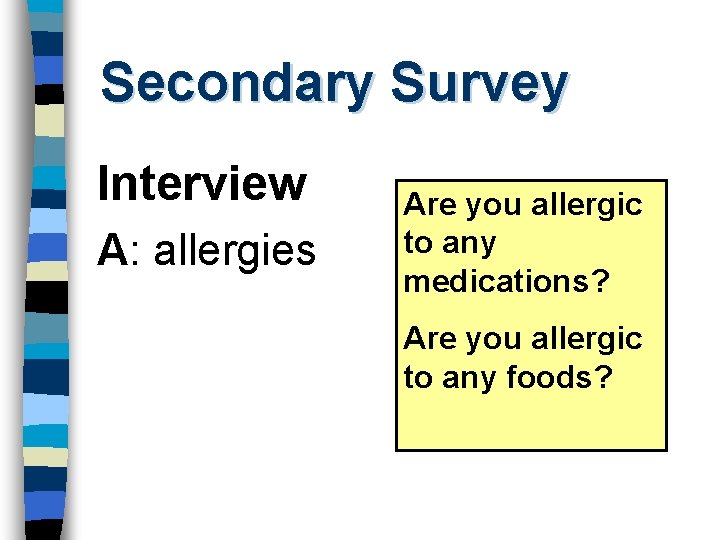
Secondary Survey Interview A: allergies Are you allergic to any medications? Are you allergic to any foods?
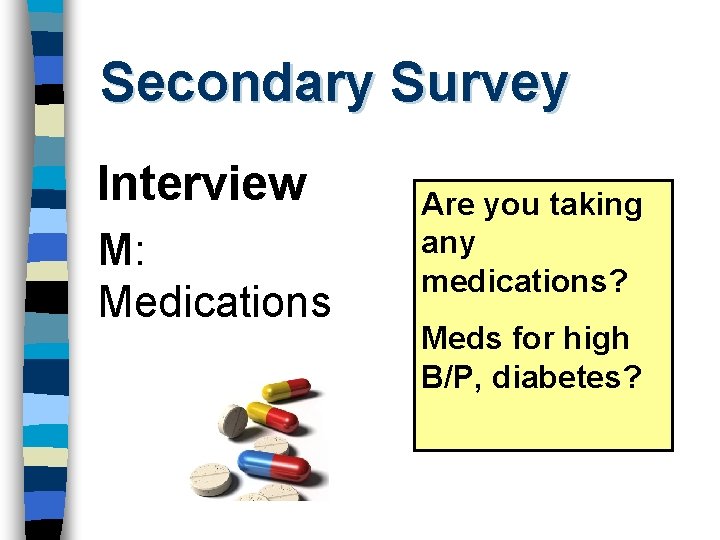
Secondary Survey Interview M: Medications Are you taking any medications? Meds for high B/P, diabetes?
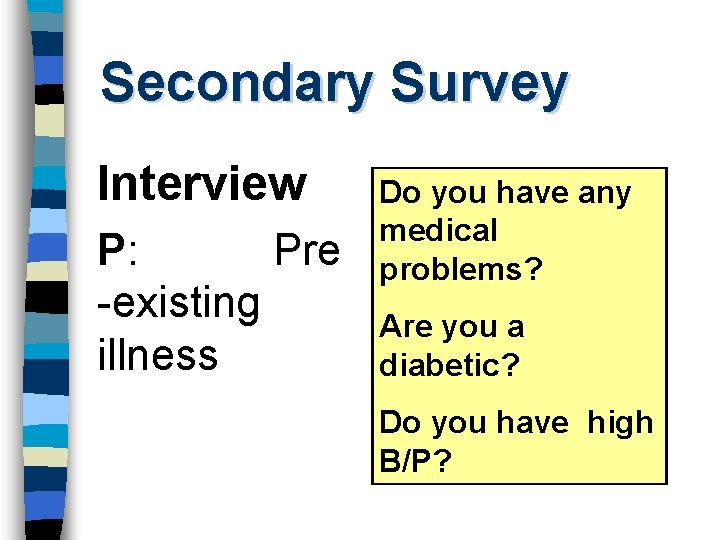
Secondary Survey Interview P: Pre -existing illness Do you have any medical problems? Are you a diabetic? Do you have high B/P?
Secondary Survey Interview L: Last time ate When was the lat time you ate? What did you eat? Is that unusual for you?
Secondary Survey Interview E: Events leading up to accident What happened? What were you doing? If fell: Did you hit your head?
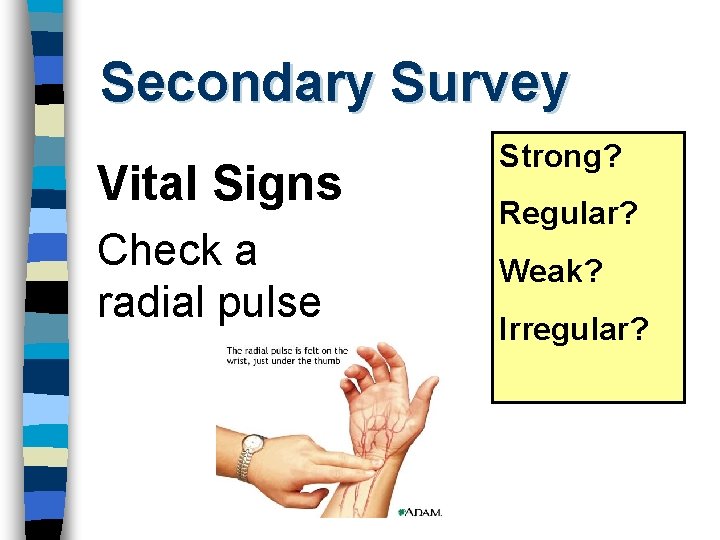
Secondary Survey Vital Signs Check a radial pulse Strong? Regular? Weak? Irregular?
Secondary Survey Vital Signs Check skin temperature and color Warm and dry? Cool and clammy? Pink? Cyanosis?
Secondary Survey Vital Signs Check breathing Unlabored? Labored? Even? Uneven?
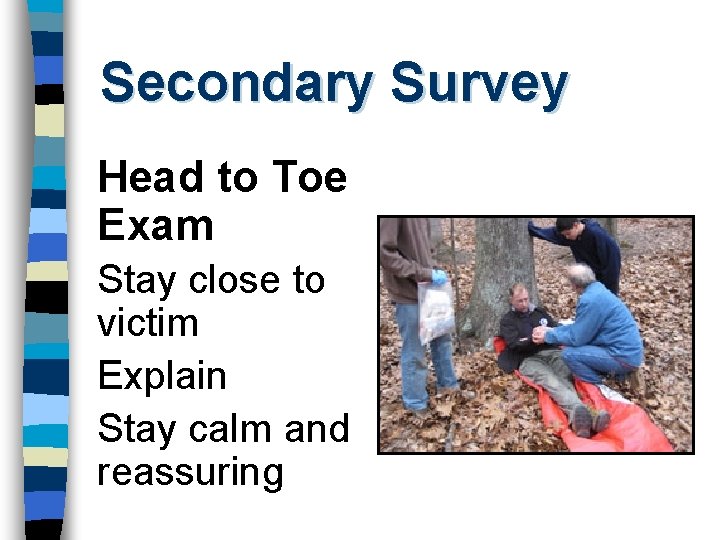
Secondary Survey Head to Toe Exam Stay close to victim Explain Stay calm and reassuring
Secondary Survey Head to Toe Exam Head and neck Do not turn or move if suspect neck or spine injury Drainage from eyes, ears, nose? Pain with movement?
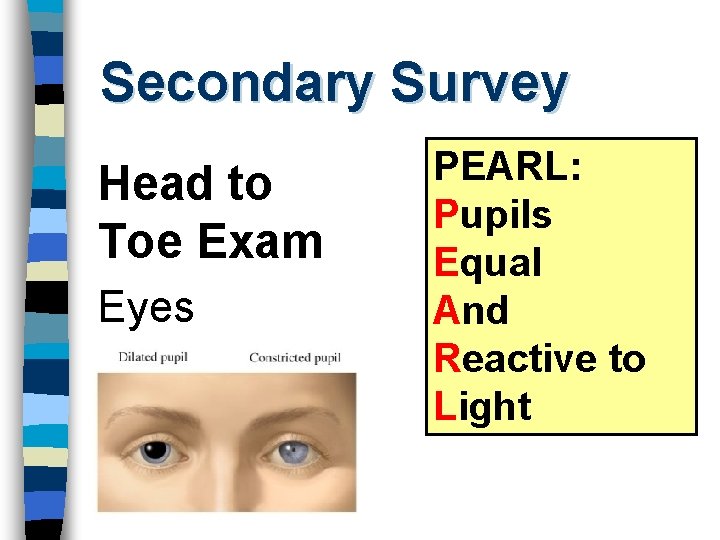
Secondary Survey Head to Toe Exam Eyes PEARL: Pupils Equal And Reactive to Light
Secondary Survey Head to Toe Exam Shoulders Shrug Pain with movement?
Secondary Survey Head to Toe Exam Arms, hands Raise, bend, wiggle, squeeze hands. Pain with movement? Grips equal?
Secondary Survey Head to Toe Exam Chest, Abdomen Take a deep breath. Pain with movement?
Secondary Survey Head to Toe Exam Legs, feet Raise, bend, wiggle. Pain with movement?
Secondary Survey Head to Toe Exam Back Do not turn if suspect neck or spine injury Can you turn over? Pain with movement?
Secondary Survey Head to Toe Exam Use common sense! Don’t ask victim to move an extremity with an obvious injury
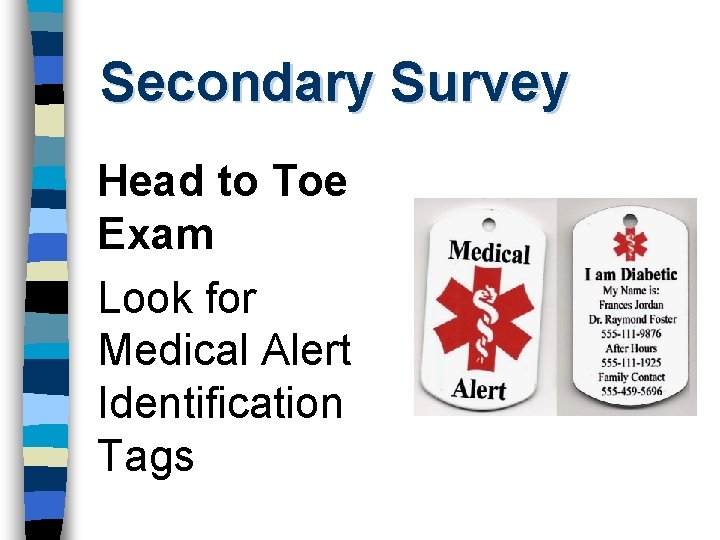
Secondary Survey Head to Toe Exam Look for Medical Alert Identification Tags
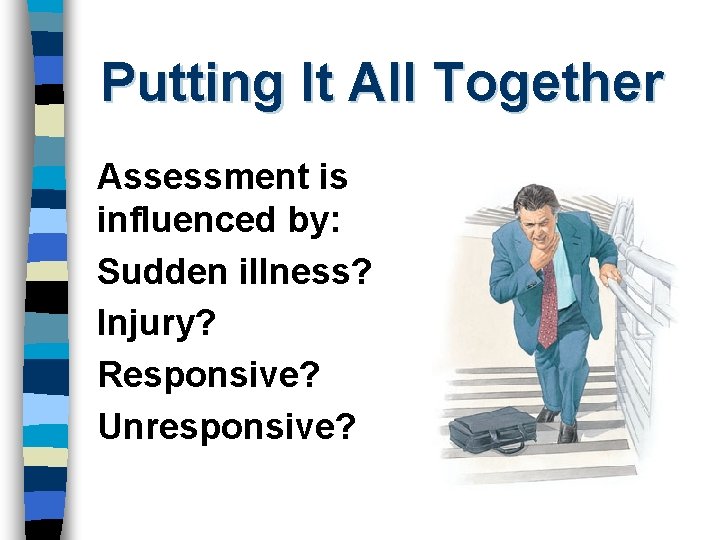
Putting It All Together Assessment is influenced by: Sudden illness? Injury? Responsive? Unresponsive?
Putting It All Together Call EMS as soon as you discover injury that requires medical tx. Continue assessment while waiting for ambulance
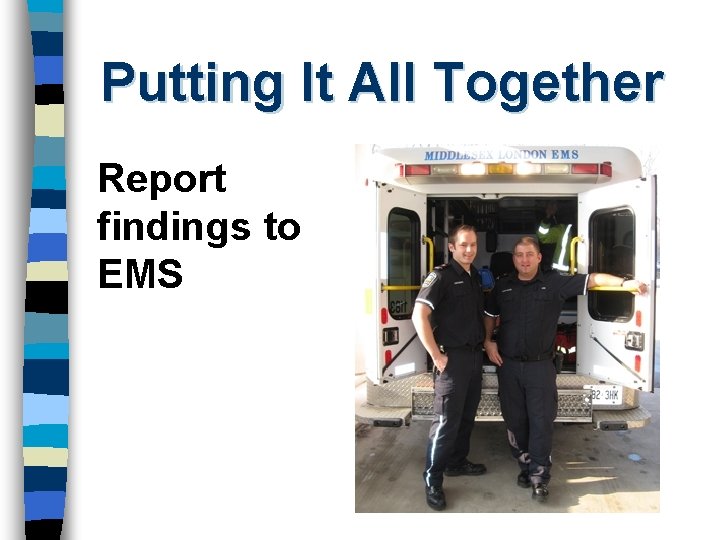
Putting It All Together Report findings to EMS
Learning Activities 3 1. Primary survey purpose is to find life threatening injuries. Yes
Learning Activities 3 2. Treat crying or screaming victims before quiet ones. No
Learning Activities 3 3. Most injured victims require a complete assessment. No
Learning Activities 3 4. In a physical exam, begin at the head and work down. Yes
Learning Activities 3 7. Always look for medical alert tags. Yes
Learning Activities 3 8. Sample helps you remember how to examine an area for injury. No
Learning Activities 3 Scenario: You are the designated first aider. Coworker has collapsed in hallway. He wears a med alert tag. . 9. You confirm the scene is safe. What do you check next? D. Responsiveness
Learning Activities 3 Scenario: You are the designated first aider. Coworker has collapsed in hallway. He wears a med alert tag. . 10. If he were unresponsive you: A. Open airway and check for breathing
Learning Activities 3 Scenario: You are the designated first aider. Coworker has collapsed in hallway. He wears a med alert tag. . 11. If he were responsive and breathing, what would you check? B. Spine injury (disability)
Learning Activities 3 Scenario: You are the designated first aider. Coworker has collapsed in hallway. He wears a med alert tag. . 12. For injured victims, which comes first? A. Physical exam
Learning Activities 3 Scenario: You are the designated first aider. Coworker has collapsed in hallway. He wears a med alert tag. . 13. Physical exam starts? A. Head
Learning Activities 3 Scenario: You are the designated first aider. Coworker has collapsed in hallway. He wears a med alert tag. . 14. Med alert tags can help identify: D. allergies, medications, medical history
Learning Activities 3 Scenario: You are the designated first aider. Coworker has collapsed in hallway. He wears a med alert tag. . 15. When checking his eyes, look for: D. Reaction of pupils to light, equal or unequal size of pupils