
First Aid at Work Level 3 COURSE TUTOR






- Slides: 148
First Aid at Work (Level 3) COURSE TUTOR: ____________
House Keeping § Fire Exits § Toilets § Schedule for today § Mobile phones § Smoking areas
Content § Roles and responsibilities of a first aider § Minor injuries § Assessing an incident § Fracture and dislocation § Managing an unresponsive casualty § Chest injuries § The respiratory system § Major illness § Wounds and bleeding § Other injuries § Shock § Heat and cold injuries § Seizures
Task § Please complete the start of your individual learning plan provided.
Roles and responsibilities of the first aider Learning objectives The learner will be able to: § Describe the legislative requirements of a first aider § Describe your role within your employment as a first aider § List items you would find in a first aid kit § Explain how the first aider takes control of the scene of an accident § Demonstrate how to correctly fill out an accident report form
Roles and responsibilities of the first aider Roles of the first aider: § Preserve Life – Administer immediate effective first aid to a casualty in order to save life. § Prevent the Condition from Worsening – Recognising and treating the cause will assist with preventing the condition from worsening. § Promote Recovery – Administer ongoing treatment and offer constant support until the arrival of qualified medical assistance.
Roles and responsibilities of the first aider Legislative Requirements First aid within the workplace is governed by legislative requirements: § The Health and Safety (First Aid) Regulations 1981 § The Health and Safety (First Aid) Regulations (Northern Ireland) 1982 § The Health and Safety at Work etc. Act 1974 § RIDDOR Reporting of Injuries Diseases and Dangerous Occurrences Regulations. § The Management of Health and Safety at Work Regulations 1999.
Roles and responsibilities of the first aider Responsibilities The responsibilities of the first aider will be dependent on specific workplace requirements, these could include: § Ensuring the first aid equipment is fit for purpose § Arriving at the scene § Ensuring the scene is safe § Contacting the emergency services § Prioritising the treatment of casualties § Clearing up after an incident § Incident reporting and recording
Roles and responsibilities of the first aider Social Action, Responsibility and Heroism Act 2015 (SARAH) Courts now have to take into account that defendants may have been acting to help society when an accident happened. Designed to help first aiders, volunteers and “good deed doers” who step in heroically in dangerous circumstances but find themselves in a courtroom if something goes wrong. legislation. gov. uk express. co. uk
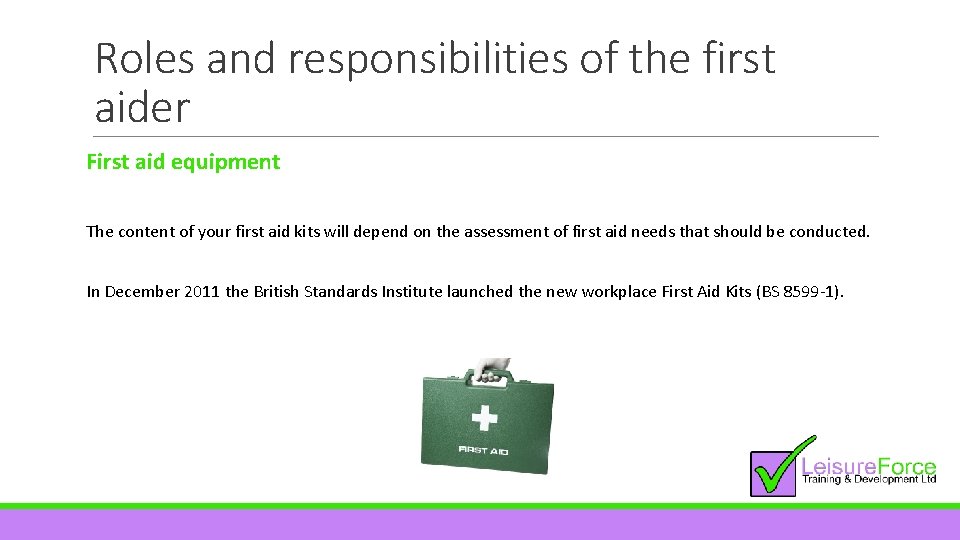
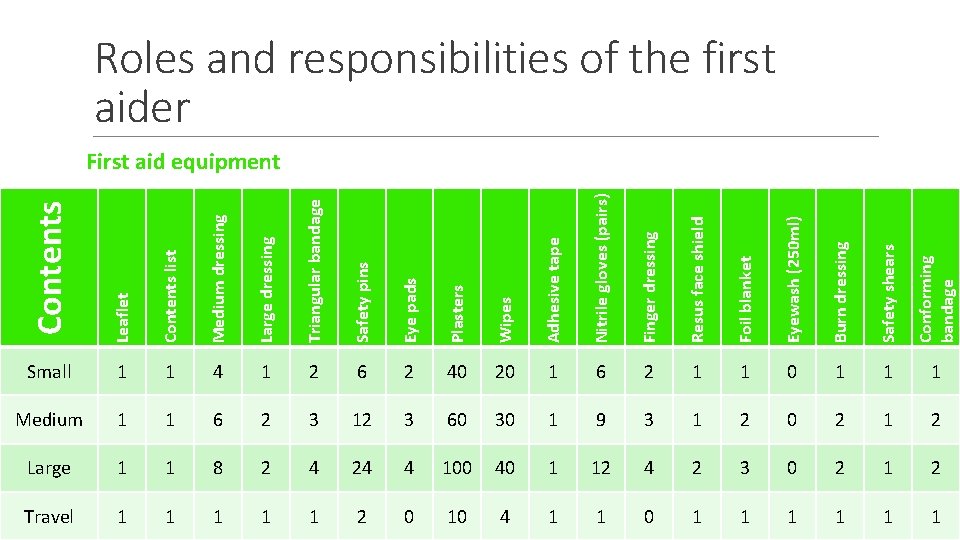
Roles and responsibilities of the first aider First aid equipment The content of your first aid kits will depend on the assessment of first aid needs that should be conducted. In December 2011 the British Standards Institute launched the new workplace First Aid Kits (BS 8599 -1).
Contents Leaflet Contents list Medium dressing Large dressing Triangular bandage Safety pins Eye pads Plasters Wipes Adhesive tape Nitrile gloves (pairs) Finger dressing Resus face shield Foil blanket Eyewash (250 ml) Burn dressing Safety shears Conforming bandage Roles and responsibilities of the first aider First aid equipment Small 1 1 4 1 2 6 2 40 20 1 6 2 1 1 0 1 1 1 Medium 1 1 6 2 3 12 3 60 30 1 9 3 1 2 0 2 1 2 Large 1 1 8 2 4 24 4 100 40 1 12 4 2 3 0 2 1 2 Travel 1 1 1 2 0 10 4 1 1 0 1 1 1
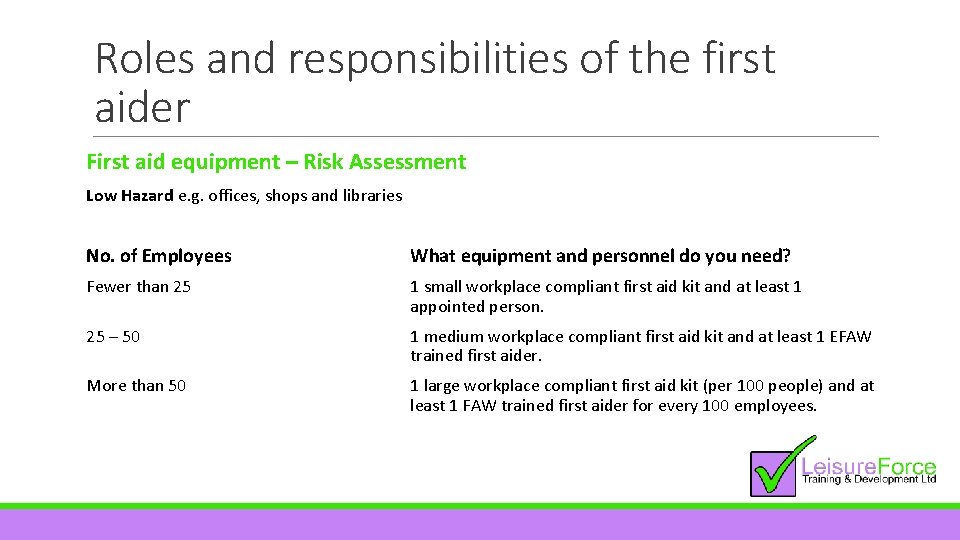
Roles and responsibilities of the first aider First aid equipment – Risk Assessment Low Hazard e. g. offices, shops and libraries No. of Employees What equipment and personnel do you need? Fewer than 25 1 small workplace compliant first aid kit and at least 1 appointed person. 25 – 50 1 medium workplace compliant first aid kit and at least 1 EFAW trained first aider. More than 50 1 large workplace compliant first aid kit (per 100 people) and at least 1 FAW trained first aider for every 100 employees.
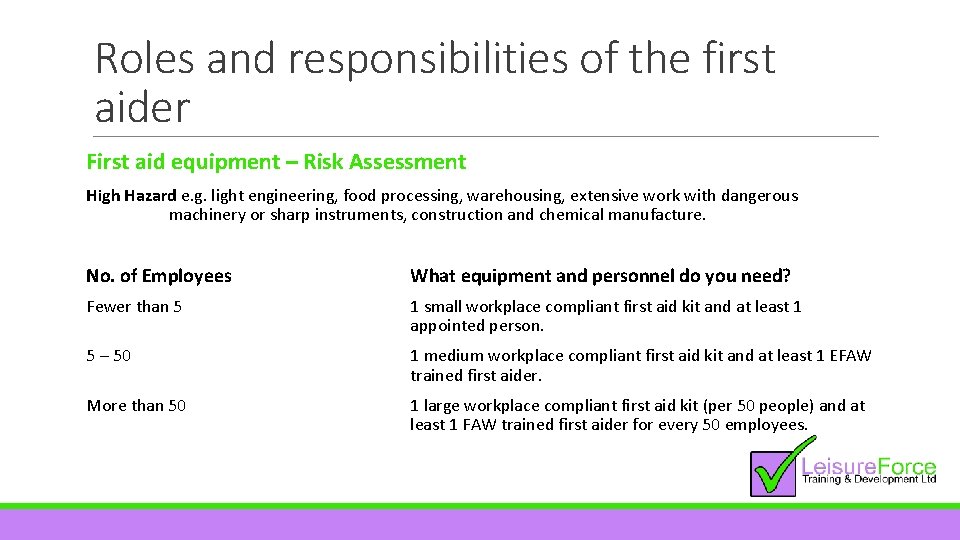
Roles and responsibilities of the first aider First aid equipment – Risk Assessment High Hazard e. g. light engineering, food processing, warehousing, extensive work with dangerous machinery or sharp instruments, construction and chemical manufacture. No. of Employees What equipment and personnel do you need? Fewer than 5 1 small workplace compliant first aid kit and at least 1 appointed person. 5 – 50 1 medium workplace compliant first aid kit and at least 1 EFAW trained first aider. More than 50 1 large workplace compliant first aid kit (per 50 people) and at least 1 FAW trained first aider for every 50 employees.
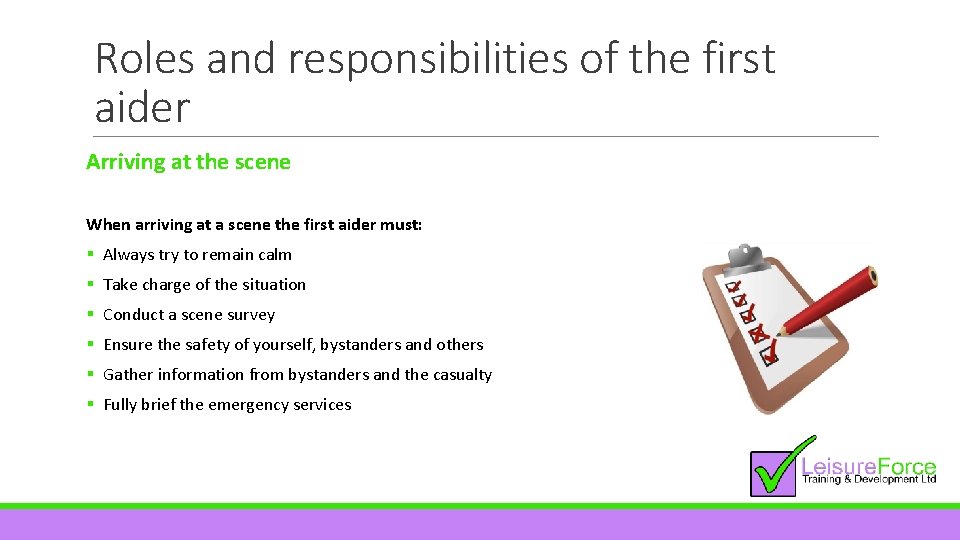
Roles and responsibilities of the first aider Arriving at the scene When arriving at a scene the first aider must: § Always try to remain calm § Take charge of the situation § Conduct a scene survey § Ensure the safety of yourself, bystanders and others § Gather information from bystanders and the casualty § Fully brief the emergency services
Roles and responsibilities of the first aider Contacting the emergency services First aiders with ether contact the emergency services themselves or instruct a bystander to do so. Contacting the emergency services at the earliest opportunity is paramount. When contacting the emergency services on ether 999 or 112, it is important that the information gives is clear, concise and sufficient.
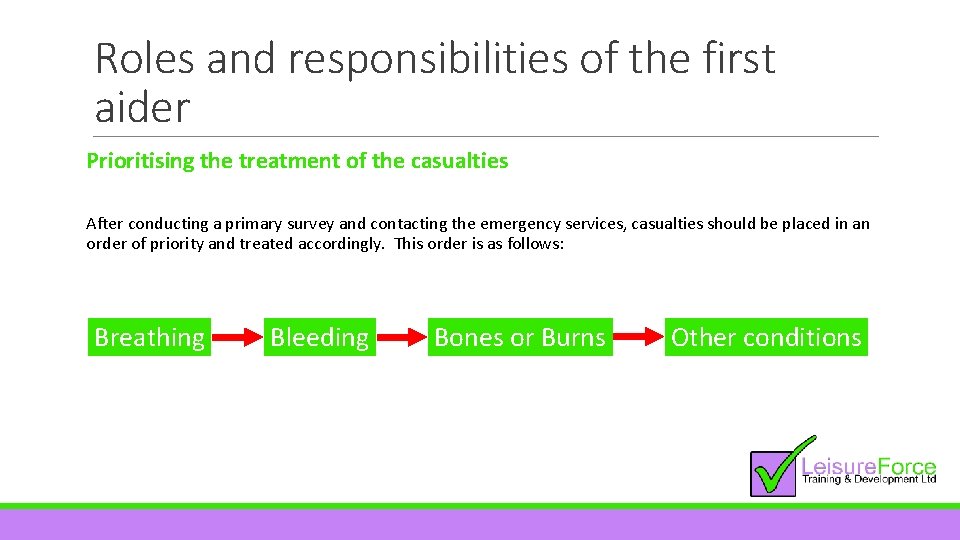
Roles and responsibilities of the first aider Prioritising the treatment of the casualties After conducting a primary survey and contacting the emergency services, casualties should be placed in an order of priority and treated accordingly. This order is as follows: Breathing Bleeding Bones or Burns Other conditions
Roles and responsibilities of the first aider Minimising infection It is important that as the first aider you do not transmit infections to your casualty or indeed contract infections from your casualty. To assist in minimising the risk of infection and cross-contamination there are various precautions that can be taken: § Having good personal hygiene § Ensuring that barrier devices are used § Covering any open cuts or sores § Minimising contact with blood or bodily fluids § Changing gloves between casualties § Washing hands thoroughly after removing gloves How to wash your hands. .
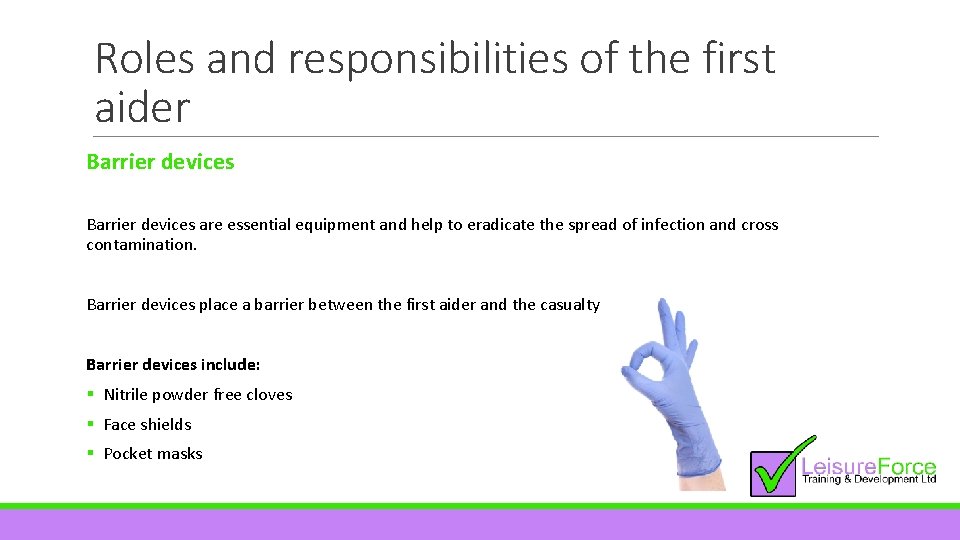
Roles and responsibilities of the first aider Barrier devices are essential equipment and help to eradicate the spread of infection and cross contamination. Barrier devices place a barrier between the first aider and the casualty Barrier devices include: § Nitrile powder free cloves § Face shields § Pocket masks
Roles and responsibilities of the first aider Clearing up after an incident Once an incident has been handed over to qualified medical assistance, then the clearing up process must commence. This process consists of the following: § Ensure that all used items such as; bandages, gloves etc. are placed in a yellow clinical waste bag or something similar. § Ensure that the area where any blood or other bodily fluids have been spilt is thoroughly cleaned. § Restock the first aid kit and replace an other equipment that may have been used during the incident. § Record and report the incident.
Roles and responsibilities of the first aider Incident recording and reporting After any first aid incident it is important the incident is recorded and reported in full. Ultimately the employer is responsible for the reporting of accidents however you should be clear on your role as the first aider in this process. The accident book should be completed in full and populated with clear and concise information. There may also be the necessity to inform RIDDOR. In cases where a public access AED has been used, there may be a requirement to report the event to your local authority or ambulance service.
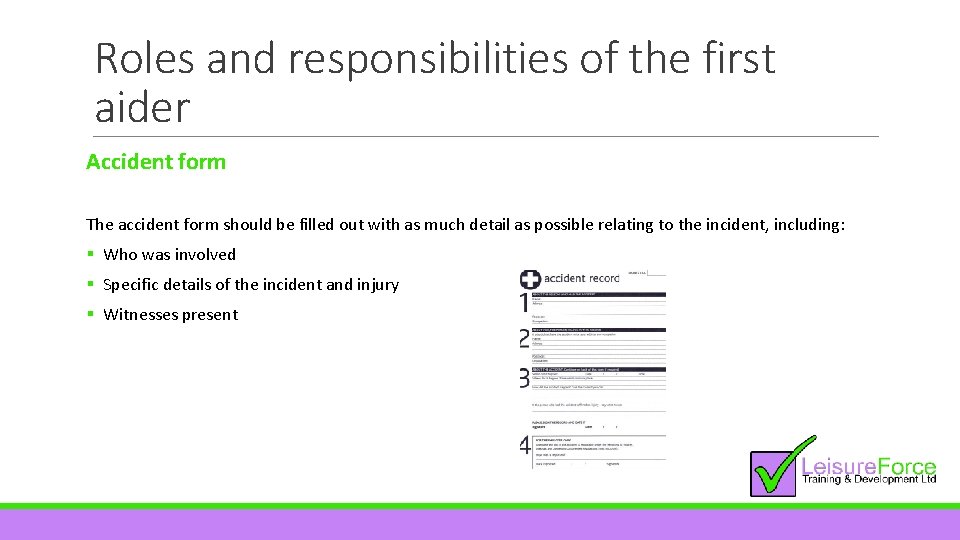
Roles and responsibilities of the first aider Accident form The accident form should be filled out with as much detail as possible relating to the incident, including: § Who was involved § Specific details of the incident and injury § Witnesses present
Roles and responsibilities of the first aider Accident form Task § In pairs choose a casualty and a first aider § The casualty chooses what injury they have suffered with and how it happened § The first aider then fills out the accident report form asking the casualty for details relating to the injury
Roles and responsibilities of the first aider Reporting of injuries, diseases and dangerous occurrence regulations (RIDDOR) RIDDOR is the law that requires employers, and other people in control of work premises, to report and keep records of: § Work-related accidents which cause death. § Work-related accidents which cause certain serious injuries (reportable injuries). § Diagnosed cases of certain industrial diseases. § Certain ‘dangerous occurrences’ (incidents with the potential to cause harm).
Roles and responsibilities of the first aider Learning outcomes The learner will be able to: § Describe the legislative requirements of a first aider § Describe your role within your employment as a first aider § List items you would find in a first aid kit § Explain how the first aider takes control of the scene of an accident § Demonstrate how to correctly fill out an accident report form
Assessing an incident Learning objectives § Describe how to survey a scene of an accident § Demonstrate how to conduct a primary survey of a casualty § Distinguish between normal and agonal breathing § Demonstrate gathering information from the casualty and conduct a secondary survey
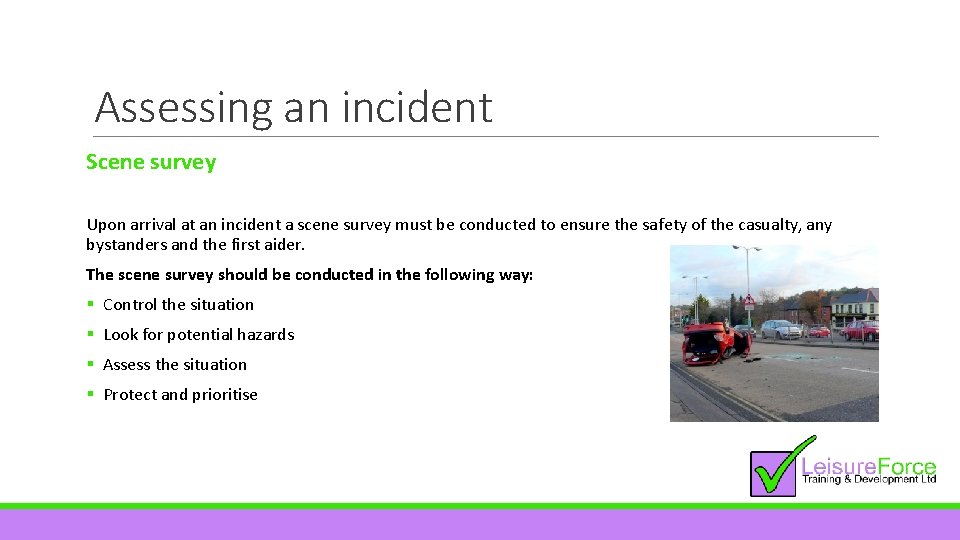
Assessing an incident Scene survey Upon arrival at an incident a scene survey must be conducted to ensure the safety of the casualty, any bystanders and the first aider. The scene survey should be conducted in the following way: § Control the situation § Look for potential hazards § Assess the situation § Protect and prioritise
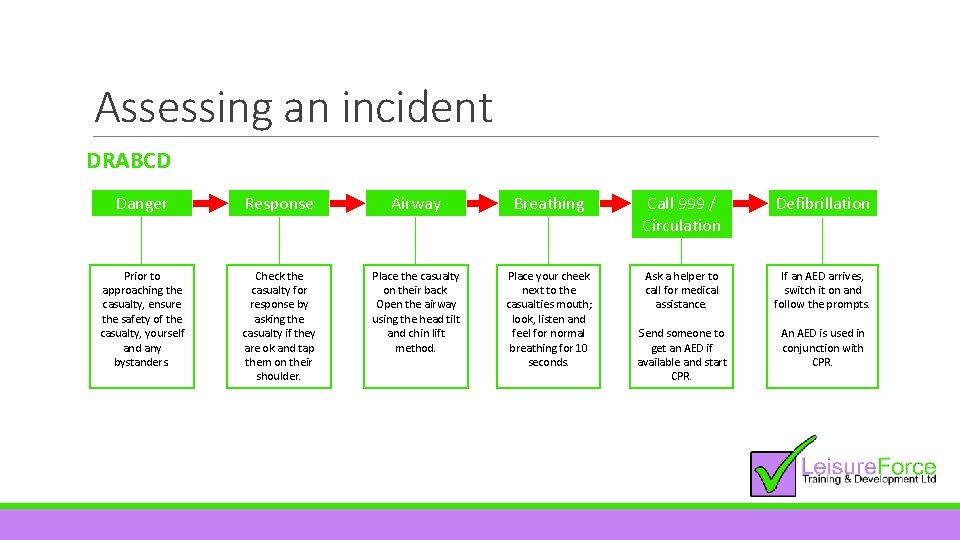
Assessing an incident Primary survey Having conducted a scene survey and established that the immediate area is safe from dangers you may now approach the casualty. An initial assessment should be conducted on the casualty which is called a primary survey. The primary survey is a systematic process of approaching, identifying and dealing with immediate and/or life threatening conditions. The primary survey can be remembered by the acronym DRABCD
Assessing an incident DRABCD Danger Response Airway Breathing Call 999 / Circulation Defibrillation Prior to approaching the casualty, ensure the safety of the casualty, yourself and any bystanders. Check the casualty for response by asking the casualty if they are ok and tap them on their shoulder. Place the casualty on their back. Open the airway using the head tilt and chin lift method. Place your cheek next to the casualties mouth; look, listen and feel for normal breathing for 10 seconds. Ask a helper to call for medical assistance. If an AED arrives, switch it on and follow the prompts. Send someone to get an AED if available and start CPR. An AED is used in conjunction with CPR.
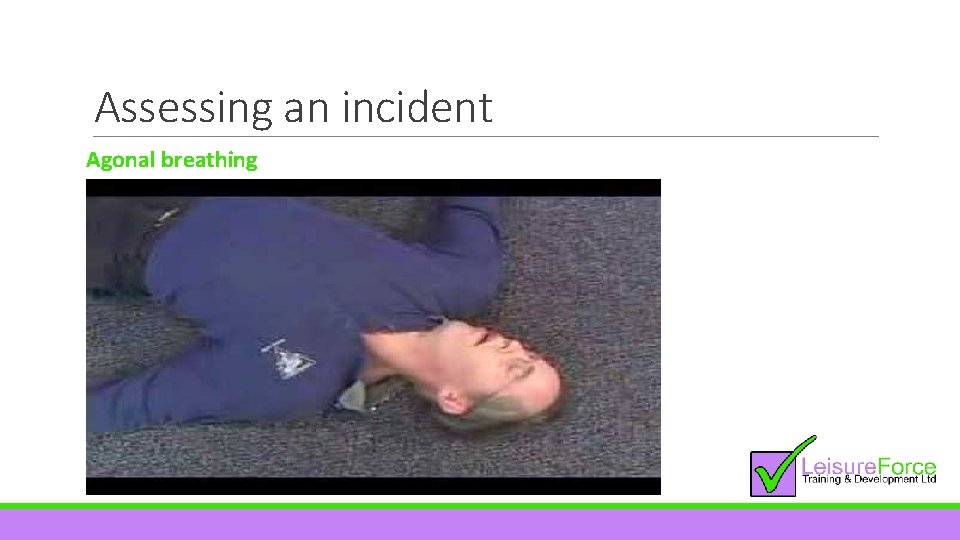
Assessing an incident Agonal breathing In the first few minutes after a cardiac arrest, a casualty maybe barely breathing or taking infrequent slow noisy gasps. Do not mistake this for normal breathing, if in any doubt act as if no breathing is present and prepare to start CPR.
Assessing an incident Agonal breathing
Assessing an incident Casualty communication Clear and effective communication should be used at all times when dealing with a casualty. A casualty maybe in a distressed or confused state, the first aider should remain calm and consider the following when dealing with the casualty: § Gather as much information as possible about the situation, let the casualty explain if possible § Only speak about facts, not what your opinion is § Speak clearly and slowly without shouting and maintain eye contact § Allow the casualty time to think and respond § Ask the casualty to assist wherever possible (to distract them)
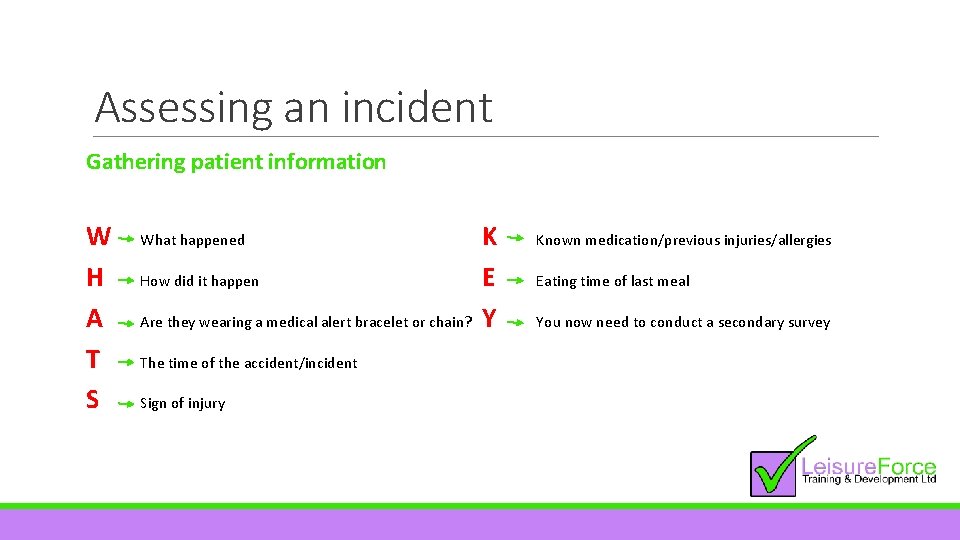
Assessing an incident Gathering patient information Whilst communicating with the casualty it is important to gather as much information about them and the situation as possible, this will help you the first aider as well as the emergency services when they arrive. The best way to gather information is to look at the casualties: § History – uncover as much information about the casualty as possible, information such as; time, location, nature of the accident, witnesses and injuries sustained. It is also important to find out if the casualty is taking any prescribed medication and a history of similar injuries or conditions. § Signs – what you as the first aider can see, smell or hear. § Symptoms – what the casualty actually feels such as any pain or feeling nauseous or weak.
Assessing an incident Gathering patient information W H A T S What happened How did it happen Are they wearing a medical alert bracelet or chain? The time of the accident/incident Sign of injury K E Y Known medication/previous injuries/allergies Eating time of last meal You now need to conduct a secondary survey
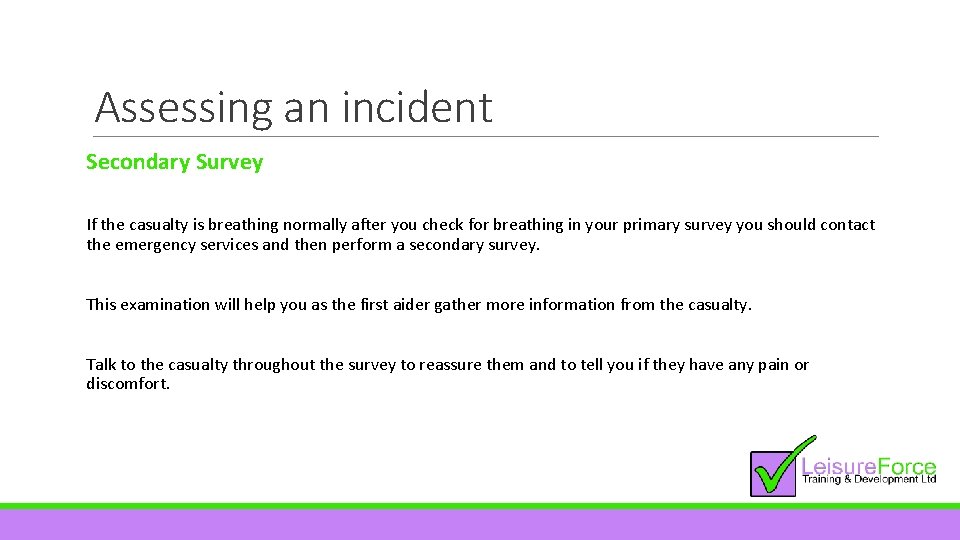
Assessing an incident Secondary Survey If the casualty is breathing normally after you check for breathing in your primary survey you should contact the emergency services and then perform a secondary survey. This examination will help you as the first aider gather more information from the casualty. Talk to the casualty throughout the survey to reassure them and to tell you if they have any pain or discomfort.
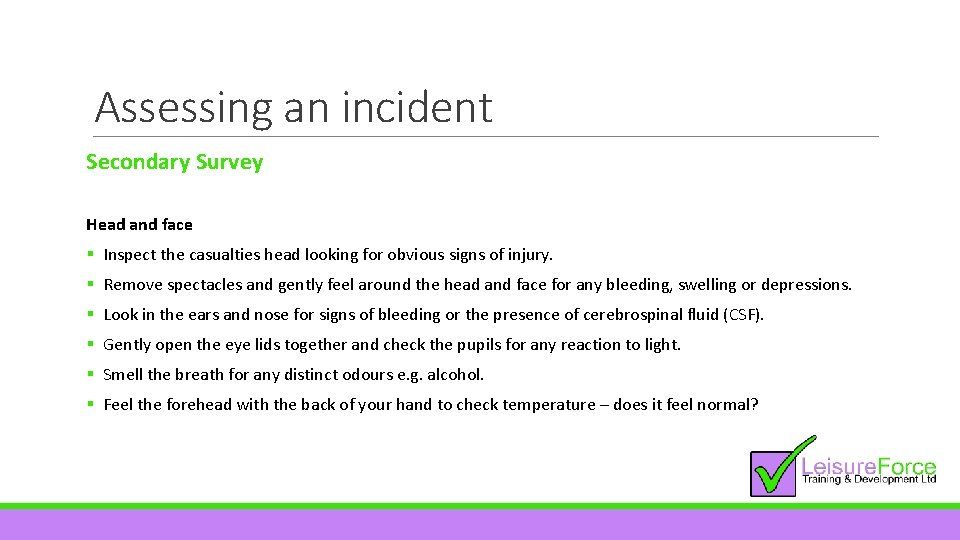
Assessing an incident Secondary Survey Head and face § Inspect the casualties head looking for obvious signs of injury. § Remove spectacles and gently feel around the head and face for any bleeding, swelling or depressions. § Look in the ears and nose for signs of bleeding or the presence of cerebrospinal fluid (CSF). § Gently open the eye lids together and check the pupils for any reaction to light. § Smell the breath for any distinct odours e. g. alcohol. § Feel the forehead with the back of your hand to check temperature – does it feel normal?
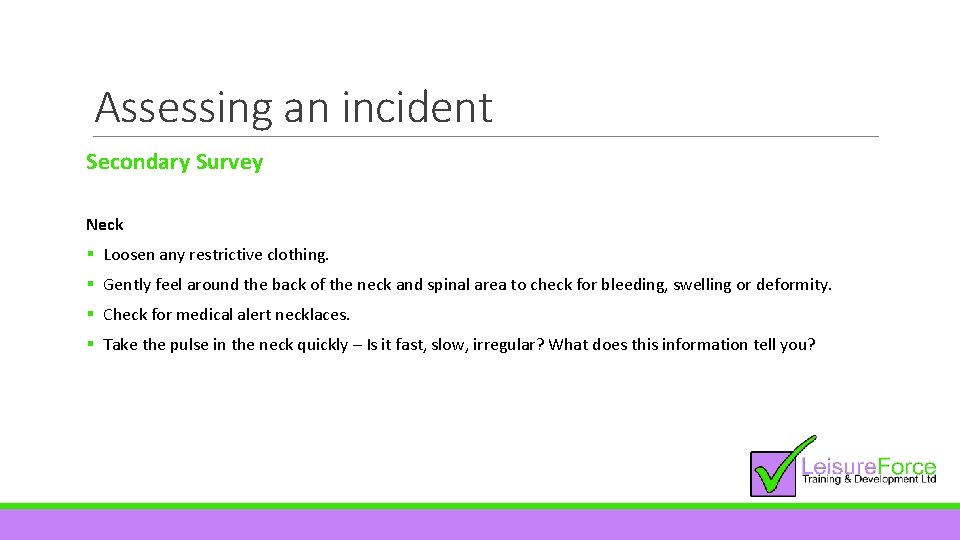
Assessing an incident Secondary Survey Neck § Loosen any restrictive clothing. § Gently feel around the back of the neck and spinal area to check for bleeding, swelling or deformity. § Check for medical alert necklaces. § Take the pulse in the neck quickly – Is it fast, slow, irregular? What does this information tell you?
Assessing an incident Secondary Survey Chest and shoulders § Gently feel around the shoulders to check for signs of deformity and bleeding. § Check the chest for signs of deformity and bleeding. Abdomen § Gently check the abdomen for signs of bleeding, swelling or unnatural softness. § If you suspect the casualty has any of the above check the stomach for any bruising if possible.
Assessing an incident Secondary Survey Spine § Check as much of the spine as possible without moving the casualty. § Feel for any tenderness or deformity as well as signs of bleeding. Pelvis § Check the hips and pelvis for deformity, unnatural positioning or bleeding.
Assessing an incident Secondary Survey Legs and feet § Check the legs and feet for bleeding, unnatural positioning, swelling and deformity. § Check the pockets for any form of identification, mobile devices which could be used to contact the emergency services, medication or any other object which may cause discomfort when moving them. Arms and hands § Check down the arms feeling for any deformity, bleeding or swelling. § Check wrists for any medical alert bracelets or tattoos. § Check wrists and in between fingers for puncture marks from injections.
Assessing an incident Learning outcomes § Describe how to survey a scene of an accident § Demonstrate how to conduct a primary survey of a casualty § Distinguish between normal and agonal breathing § Demonstrate gathering information from the casualty and conduct a secondary survey
Managing an unresponsive casualty Learning objectives § Demonstrate CPR on an adult, junior and baby casualties § Describe how to use an AED on a casualty
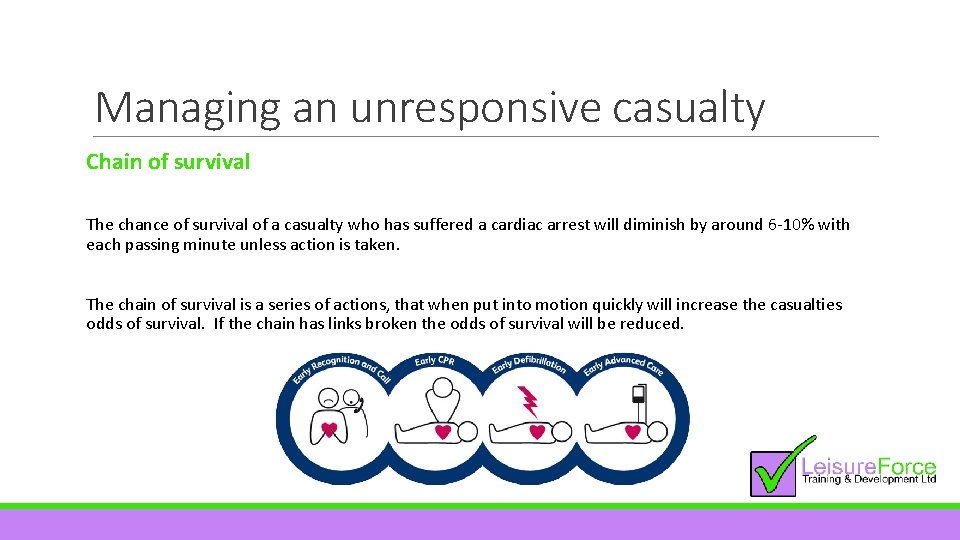
Managing an unresponsive casualty Chain of survival The chance of survival of a casualty who has suffered a cardiac arrest will diminish by around 6 -10% with each passing minute unless action is taken. The chain of survival is a series of actions, that when put into motion quickly will increase the casualties odds of survival. If the chain has links broken the odds of survival will be reduced.
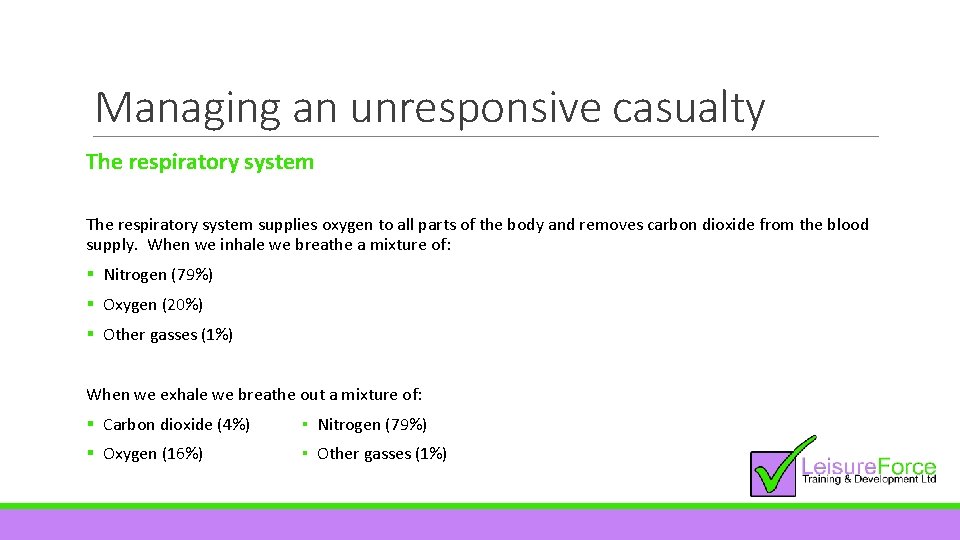
Managing an unresponsive casualty The respiratory system supplies oxygen to all parts of the body and removes carbon dioxide from the blood supply. When we inhale we breathe a mixture of: § Nitrogen (79%) § Oxygen (20%) § Other gasses (1%) When we exhale we breathe out a mixture of: § Carbon dioxide (4%) ▪ Nitrogen (79%) § Oxygen (16%) ▪ Other gasses (1%)
Managing an unresponsive casualty Cardio pulmonary resuscitation (CPR) CPR is a method of combining chest compressions with effective rescue breaths in order to artificially circulate blood and to put air into the lungs. § Cardio Heart § Pulmonary Lungs § Resuscitation Revive
Managing an unresponsive casualty Chest compressions § Chest compressions should be administered to a casualty who is not breathing normally. § For an adult, the depth of the chest compressions is 5 -6 cm (similar to the height of a credit card). § The rate of compressions should be 100 -120 beats per minute. § 30 compressions should be performed before moving onto rescue breathing.
Managing an unresponsive casualty Rescue breathing § After completing 30 chest compressions the first aider should then perform 2 rescue breaths § Each breath should take 1 second to complete. § Administering 2 rescue breaths should take no longer than 5 seconds to complete.
Managing an unresponsive casualty Compression only CPR If unable to give rescue breaths then compression only CPR may be administered. Compression only CPR requires the first aider to perform compressions on the casualty at a depth of 5 -6 cm and at a rate of 100 -120 compressions per minute continuously until medical assistance arrives.
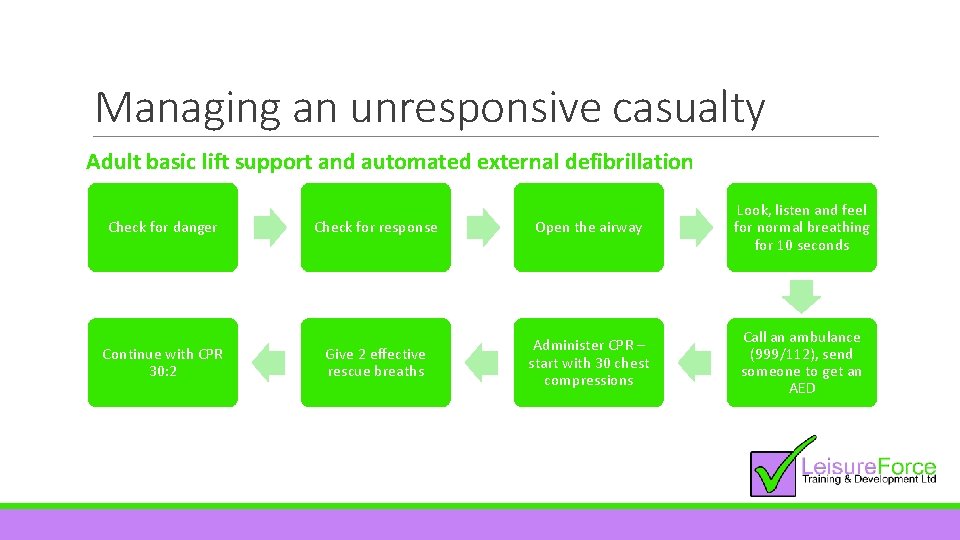
Managing an unresponsive casualty Adult basic lift support and automated external defibrillation Check for danger Continue with CPR 30: 2 Check for response Open the airway Look, listen and feel for normal breathing for 10 seconds Give 2 effective rescue breaths Administer CPR – start with 30 chest compressions Call an ambulance (999/112), send someone to get an AED
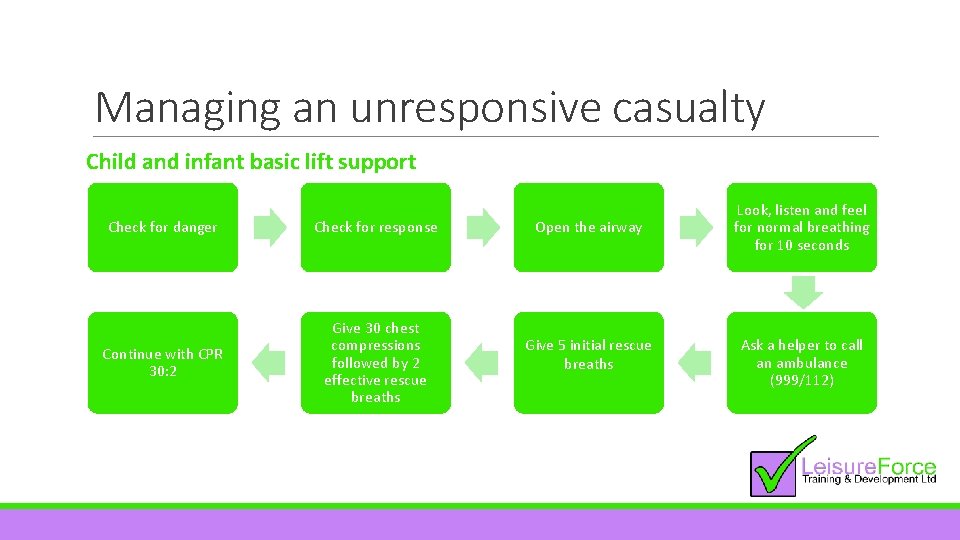
Managing an unresponsive casualty Child and infant basic lift support Check for danger Check for response Continue with CPR 30: 2 Give 30 chest compressions followed by 2 effective rescue breaths Open the airway Give 5 initial rescue breaths Look, listen and feel for normal breathing for 10 seconds Ask a helper to call an ambulance (999/112)
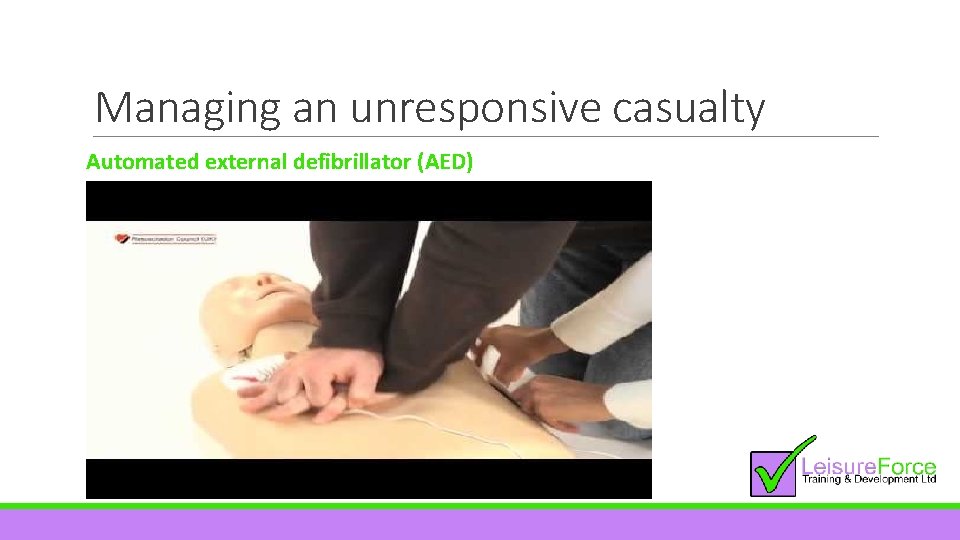
Managing an unresponsive casualty Automated external defibrillator (AED) The AED is used in conjunction with effective CPR and will prompt you to do actions. The AED is completely safe to use by anyone as it does not require any training to be able to use and will not progress to the next prompt until it has detected that the step has been completed.
Managing an unresponsive casualty Automated external defibrillator (AED)
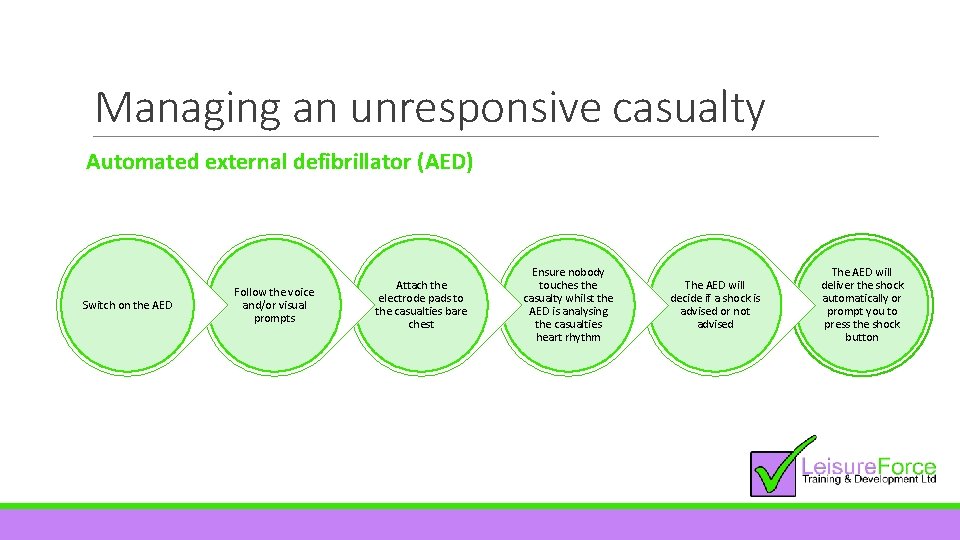
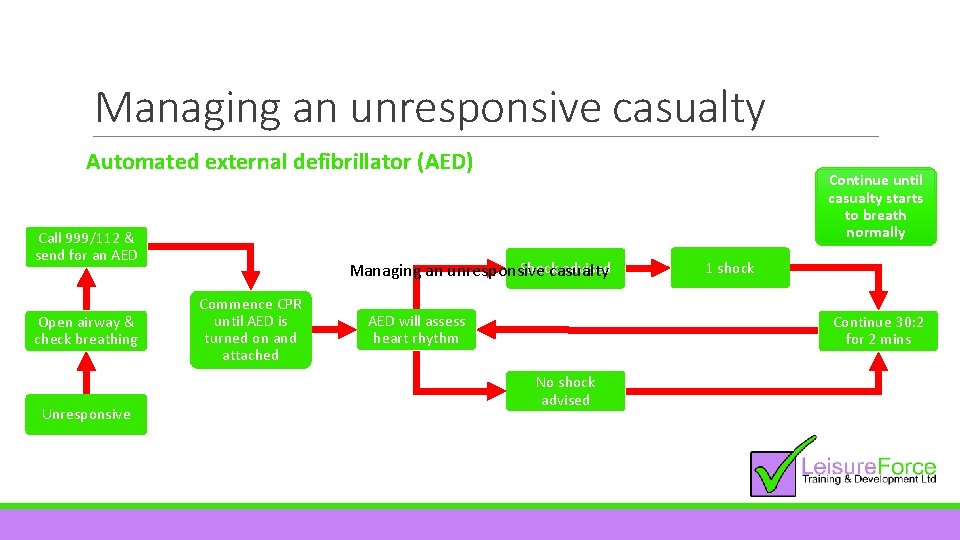
Managing an unresponsive casualty Automated external defibrillator (AED) Switch on the AED Follow the voice and/or visual prompts Attach the electrode pads to the casualties bare chest Ensure nobody touches the casualty whilst the AED is analysing the casualties heart rhythm The AED will decide if a shock is advised or not advised The AED will deliver the shock automatically or prompt you to press the shock button
Managing an unresponsive casualty Automated external defibrillator (AED) Leave the AED turned on until further medical assistance arrives as it provides a history of the casualty to the medical professionals. Do not remove the electrode pads from the casualty or turn off the AED even if the casualty regains consciousness. The AED will analyse the casualties heart rhythm every 2 minutes and advise a shock if necessary.
Managing an unresponsive casualty Automated external defibrillator (AED) Call 999/112 & send for an AED Open airway & check breathing Unresponsive Continue until casualty starts to breath normally Shock advised Managing an unresponsive casualty Commence CPR until AED is turned on and attached AED will assess heart rhythm 1 shock Continue 30: 2 for 2 mins No shock advised
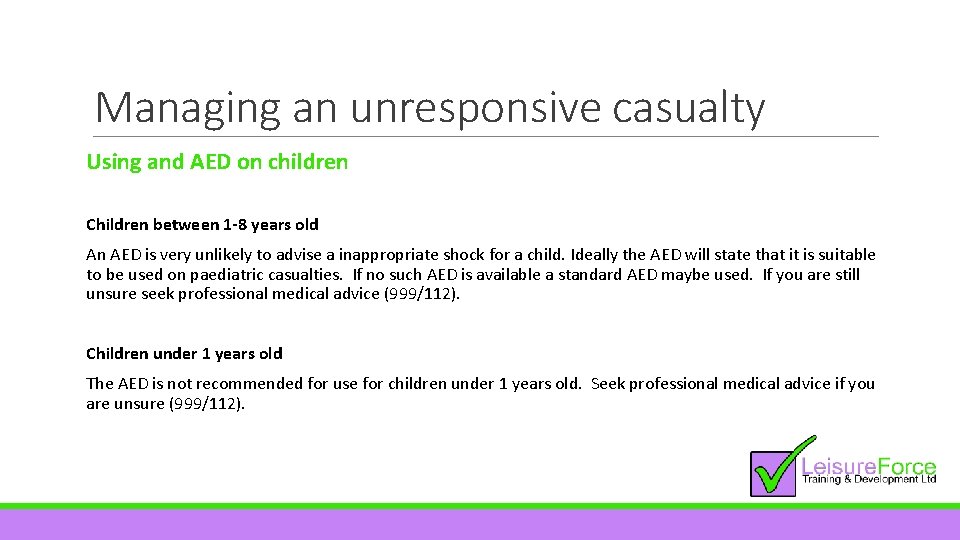
Managing an unresponsive casualty Using and AED on children Children between 1 -8 years old An AED is very unlikely to advise a inappropriate shock for a child. Ideally the AED will state that it is suitable to be used on paediatric casualties. If no such AED is available a standard AED maybe used. If you are still unsure seek professional medical advice (999/112). Children under 1 years old The AED is not recommended for use for children under 1 years old. Seek professional medical advice if you are unsure (999/112).
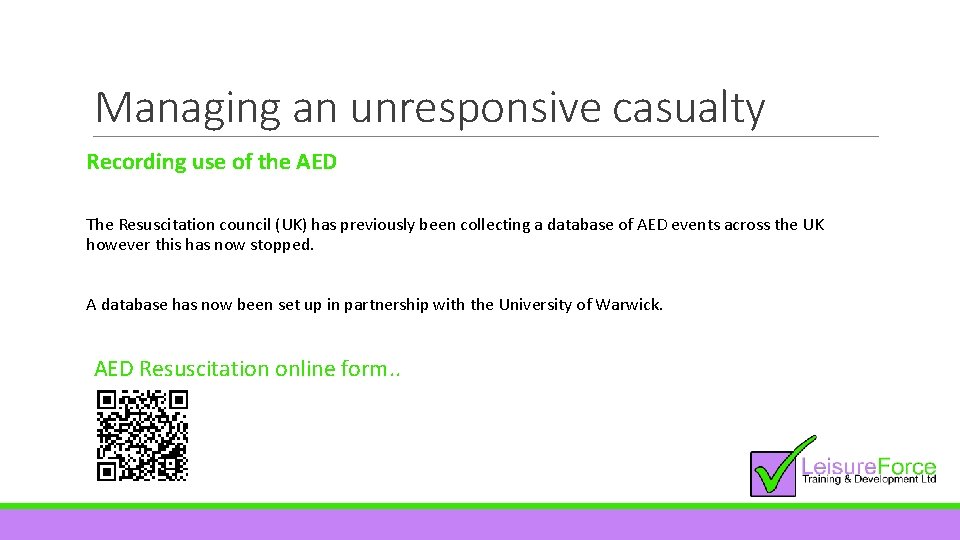
Managing an unresponsive casualty Recording use of the AED The Resuscitation council (UK) has previously been collecting a database of AED events across the UK however this has now stopped. A database has now been set up in partnership with the University of Warwick. AED Resuscitation online form. .
Managing an unresponsive casualty Agonal breathing is an abnormal pattern of breathing and brainstem reflex characterized by gasping, laboured breathing, accompanied by strange vocalizations
Managing an unresponsive casualty Learning outcomes § Demonstrate CPR on an adult, junior and baby casualties § Describe how to use an AED on a casualty
The respiratory system Learning objectives § Describe the actions to take to help a casualty who is choking
The respiratory system Obstructed airway An obstructed airway is the complete or partial blockage of the airway which leads to the lungs. An airway can be blocked in various ways: § Foreign objects § Foods § Allergic reactions § Asthma § Blood and vomit § Infections
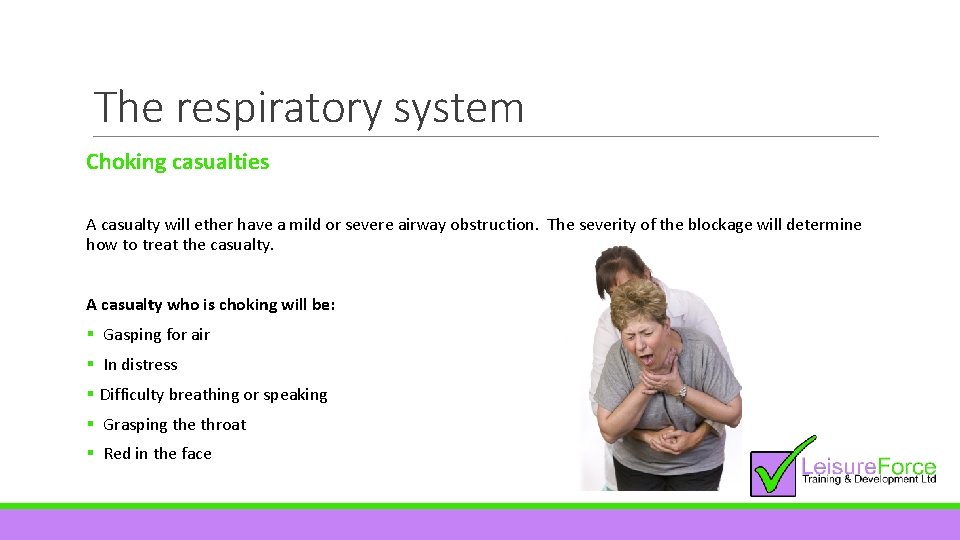
The respiratory system Choking casualties A casualty will ether have a mild or severe airway obstruction. The severity of the blockage will determine how to treat the casualty. A casualty who is choking will be: § Gasping for air § In distress § Difficulty breathing or speaking § Grasping the throat § Red in the face
The respiratory system Choking casualties A casualty with a partial blockage can be helped by: § Lean the casualty forward § Encouraging the casualty to cough This will normally clear the partial blockage.
The respiratory system Choking casualties If this procedure does not work then more aggressive action is necessary, follow the following procedure: Abdominal Thrust § Stand the casualty and put both arms around the casualties abdomen just below the rib cage. § With one hand clench your fist and place it between the naval and rib cage. § Grasp this hand with your other hand pull sharply inwards and upwards. § Repeat this up to 5 times and assess the casualties condition, if the casualties condition has not improved call 999/112 and repeat the cycles of back slaps and abdominal thrusts until qualified medical assistance arrives.
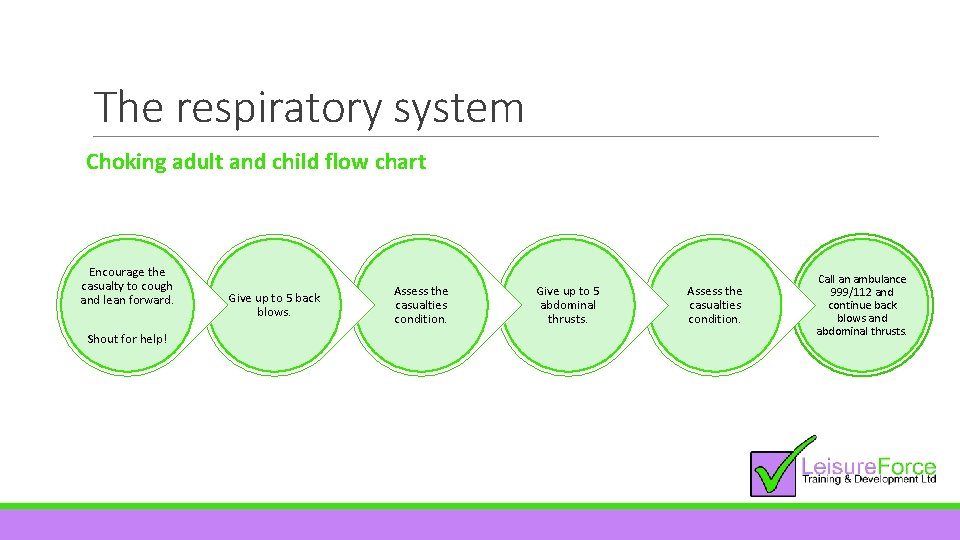
The respiratory system Choking adult and child flow chart Encourage the casualty to cough and lean forward. Shout for help! Give up to 5 back blows. Assess the casualties condition. Give up to 5 abdominal thrusts. Assess the casualties condition. Call an ambulance 999/112 and continue back blows and abdominal thrusts.
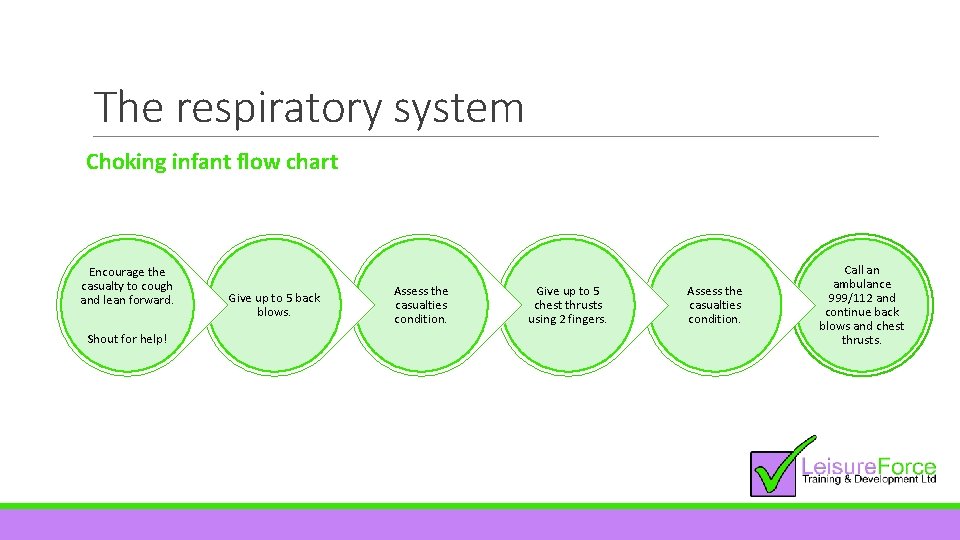
The respiratory system Choking infant flow chart Encourage the casualty to cough and lean forward. Shout for help! Give up to 5 back blows. Assess the casualties condition. Give up to 5 chest thrusts using 2 fingers. Assess the casualties condition. Call an ambulance 999/112 and continue back blows and chest thrusts.
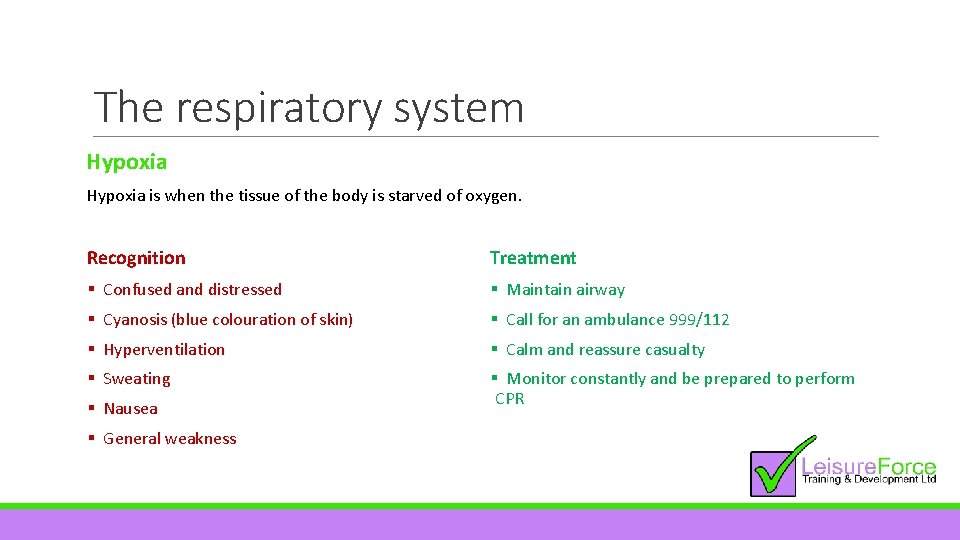
The respiratory system Hypoxia is when the tissue of the body is starved of oxygen. Recognition Treatment § Confused and distressed § Maintain airway § Cyanosis (blue colouration of skin) § Call for an ambulance 999/112 § Hyperventilation § Calm and reassure casualty § Sweating § Monitor constantly and be prepared to perform CPR § Nausea § General weakness
The respiratory system Learning outcomes § Describe the actions to take to help a casualty who is choking
Wounds and bleeding Learning objectives § Identify the differences in types of wounds § Describe the effects of blood loss § Demonstrate applying a dressing to a casualty with a minor bleed
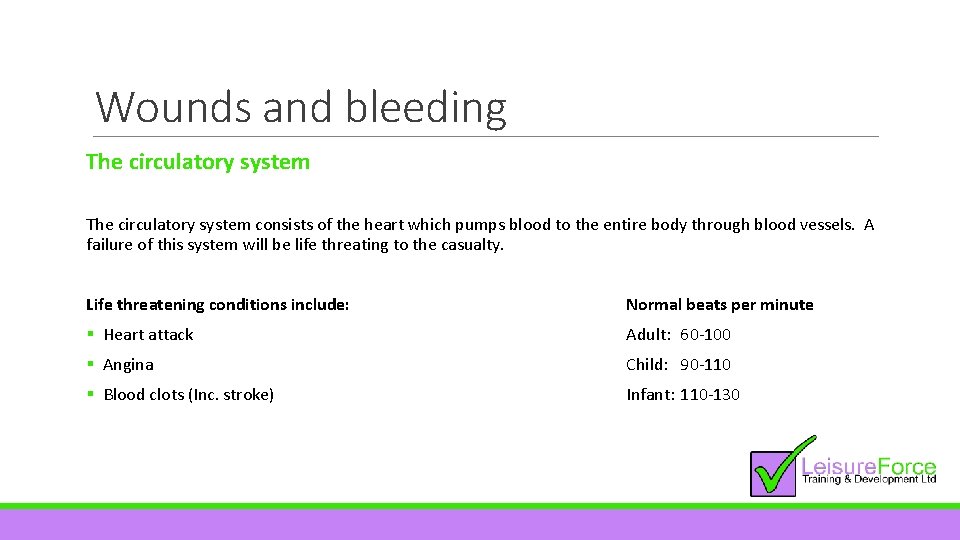
Wounds and bleeding The circulatory system consists of the heart which pumps blood to the entire body through blood vessels. A failure of this system will be life threating to the casualty. Life threatening conditions include: Normal beats per minute § Heart attack Adult: 60 -100 § Angina Child: 90 -110 § Blood clots (Inc. stroke) Infant: 110 -130
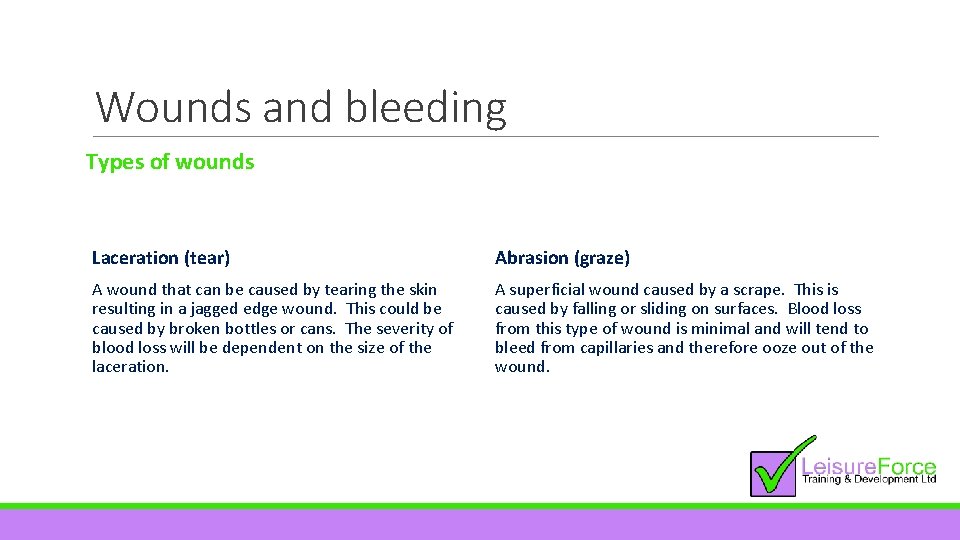
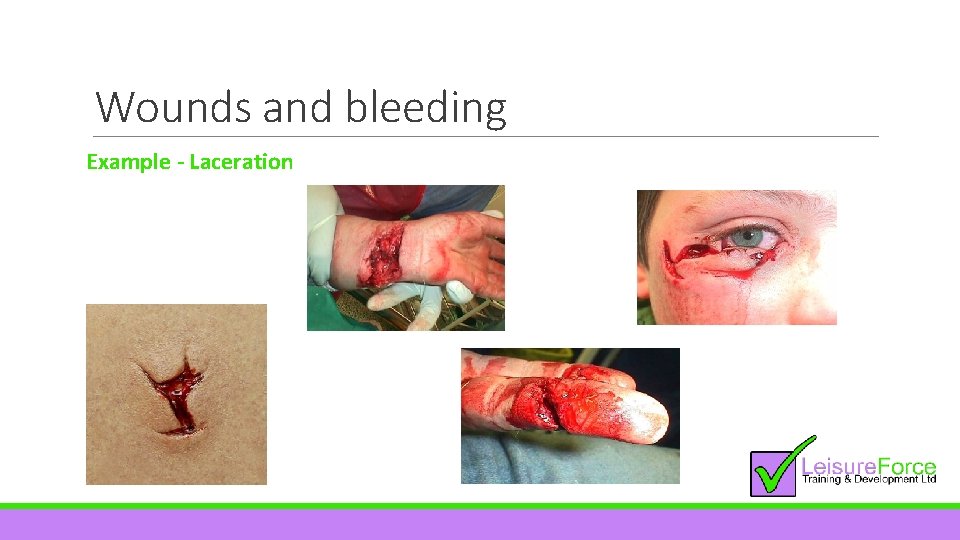
Wounds and bleeding Types of wounds Laceration (tear) Abrasion (graze) A wound that can be caused by tearing the skin resulting in a jagged edge wound. This could be caused by broken bottles or cans. The severity of blood loss will be dependent on the size of the laceration. A superficial wound caused by a scrape. This is caused by falling or sliding on surfaces. Blood loss from this type of wound is minimal and will tend to bleed from capillaries and therefore ooze out of the wound.
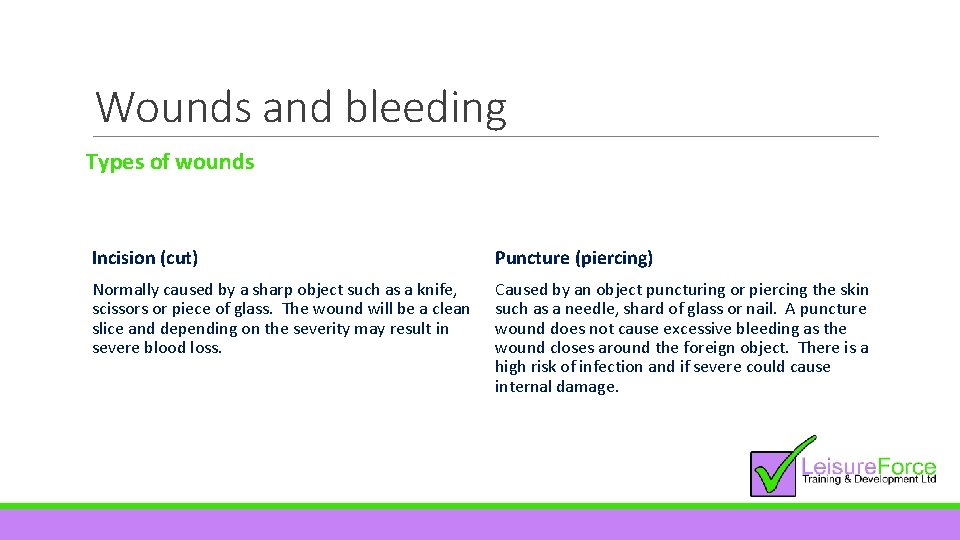
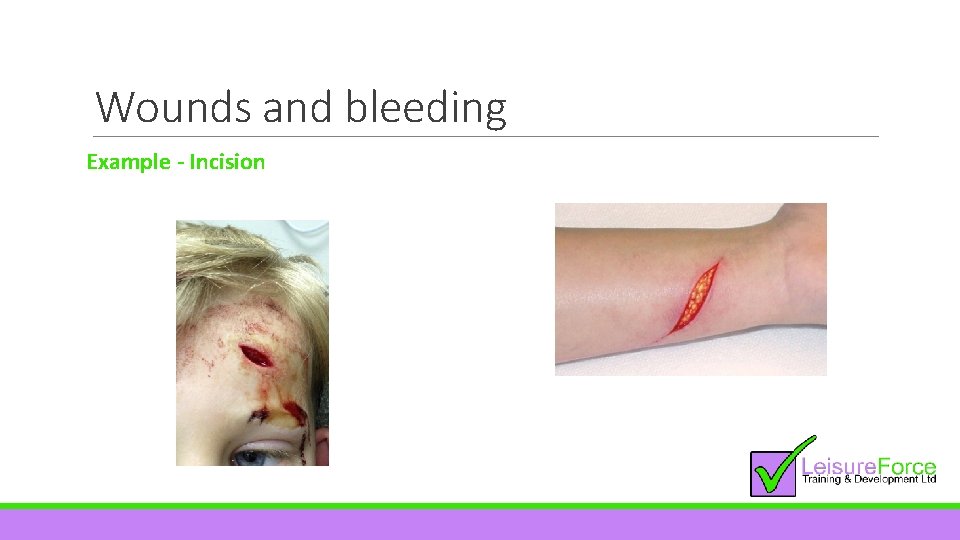
Wounds and bleeding Types of wounds Incision (cut) Puncture (piercing) Normally caused by a sharp object such as a knife, Caused by an object puncturing or piercing the skin scissors or piece of glass. The wound will be a clean such as a needle, shard of glass or nail. A puncture wound does not cause excessive bleeding as the slice and depending on the severity may result in wound closes around the foreign object. There is a severe blood loss. high risk of infection and if severe could cause internal damage.
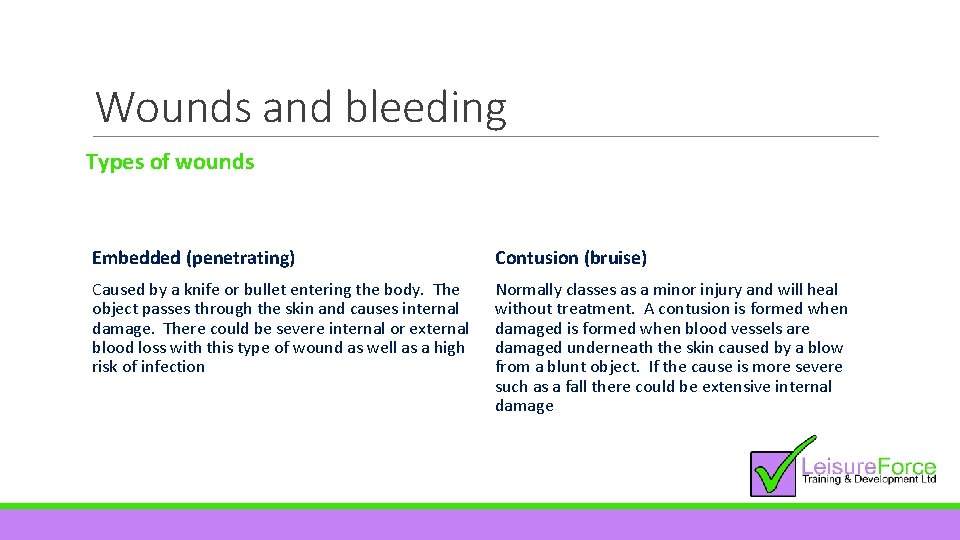
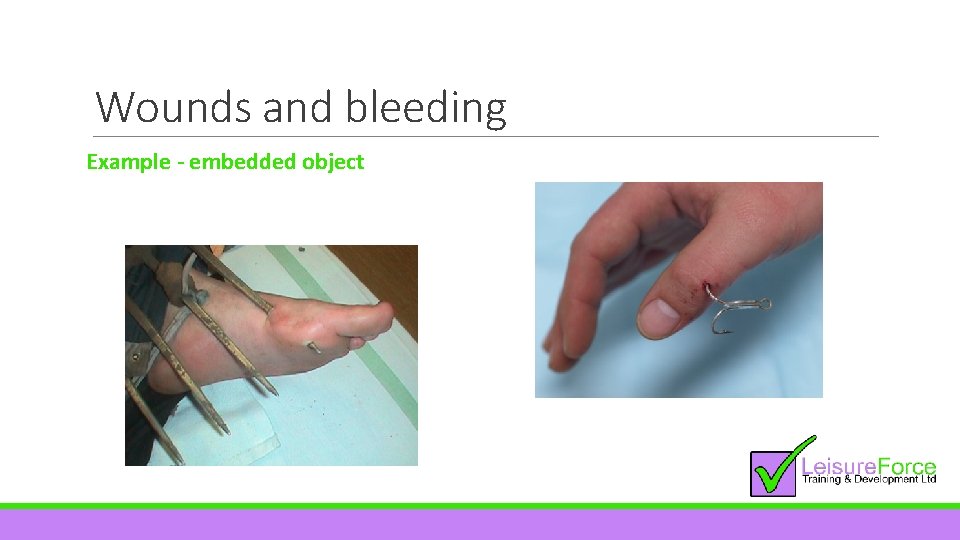
Wounds and bleeding Types of wounds Embedded (penetrating) Contusion (bruise) Caused by a knife or bullet entering the body. The Normally classes as a minor injury and will heal without treatment. A contusion is formed when object passes through the skin and causes internal damage. There could be severe internal or external damaged is formed when blood vessels are blood loss with this type of wound as well as a high damaged underneath the skin caused by a blow from a blunt object. If the cause is more severe risk of infection such as a fall there could be extensive internal damage
Wounds and bleeding Example - Laceration
Wounds and bleeding Example - Incision
Wounds and bleeding Example - embedded object
Wounds and bleeding Types of bleeding Arterial bleeding This is a bleed from an artery and will be bright red in colour, the blood will be under higher pressure and will pump in time with the casualties heart beat. Venous bleeding This bleed is from a vein and will be dark red in colour, the blood will be under lower pressure and will gush from the wound. Capillary bleeding This bleed is from damaged capillaries and will slowly ooze from the wound.
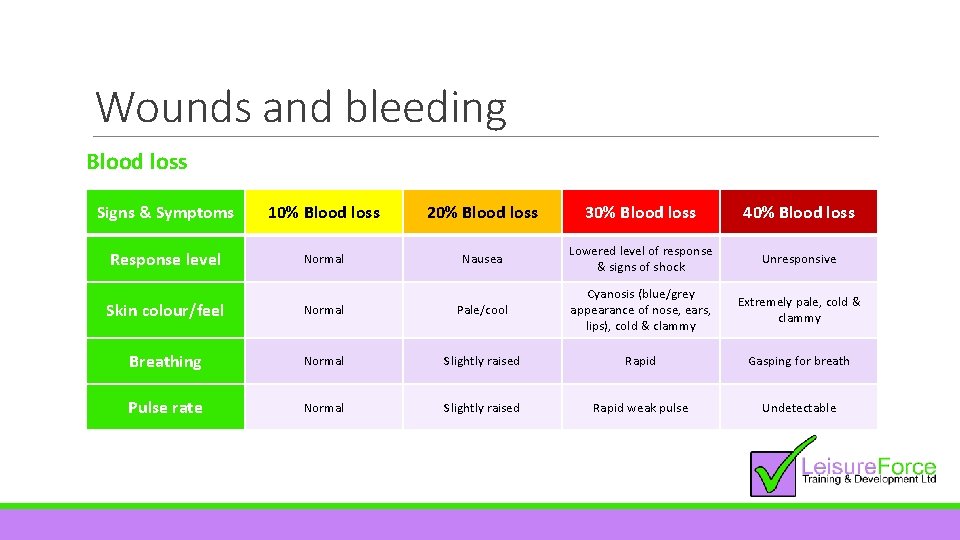
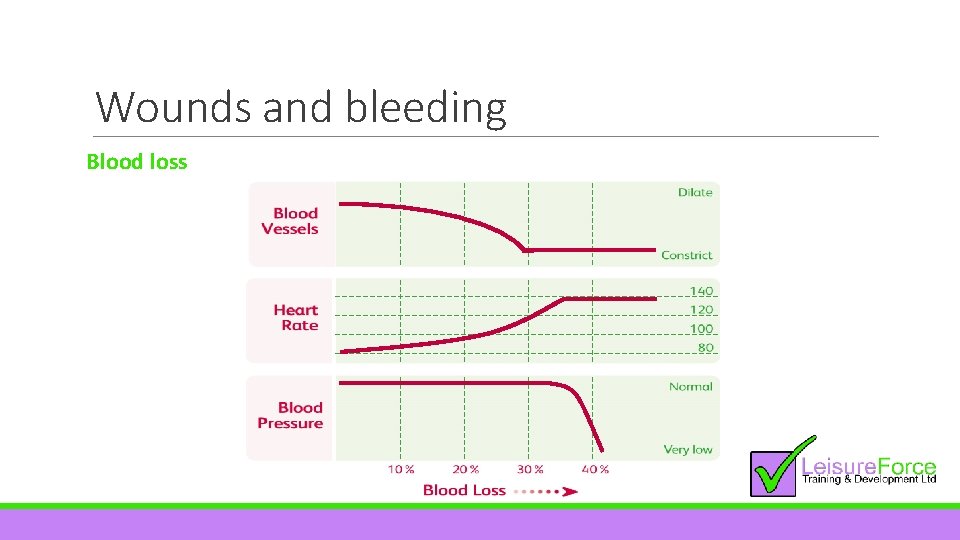
Wounds and bleeding Blood loss Signs & Symptoms 10% Blood loss 20% Blood loss 30% Blood loss 40% Blood loss Response level Normal Nausea Lowered level of response & signs of shock Unresponsive Extremely pale, cold & clammy Skin colour/feel Normal Pale/cool Cyanosis (blue/grey appearance of nose, ears, lips), cold & clammy Breathing Normal Slightly raised Rapid Gasping for breath Pulse rate Normal Slightly raised Rapid weak pulse Undetectable
Wounds and bleeding Blood loss
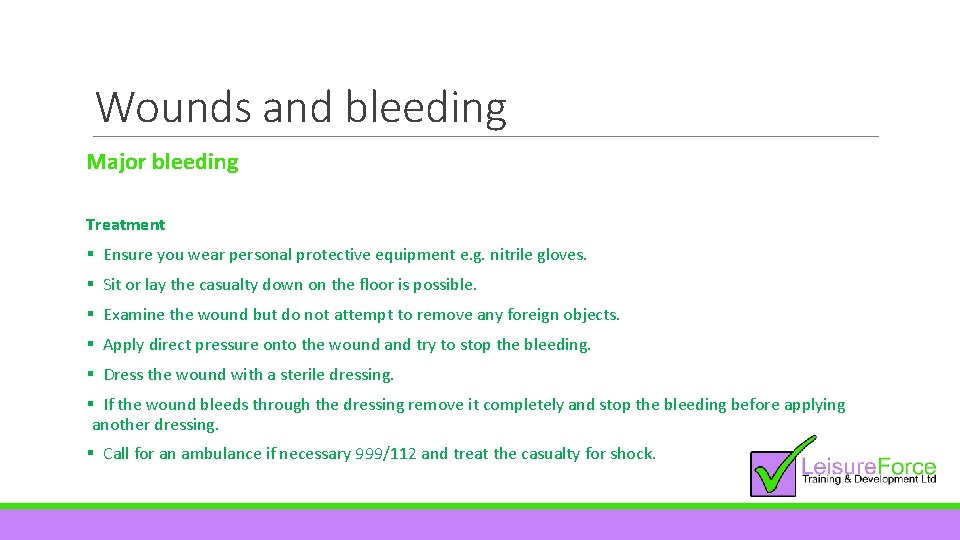
Wounds and bleeding Major bleeding Treatment § Ensure you wear personal protective equipment e. g. nitrile gloves. § Sit or lay the casualty down on the floor is possible. § Examine the wound but do not attempt to remove any foreign objects. § Apply direct pressure onto the wound and try to stop the bleeding. § Dress the wound with a sterile dressing. § If the wound bleeds through the dressing remove it completely and stop the bleeding before applying another dressing. § Call for an ambulance if necessary 999/112 and treat the casualty for shock.
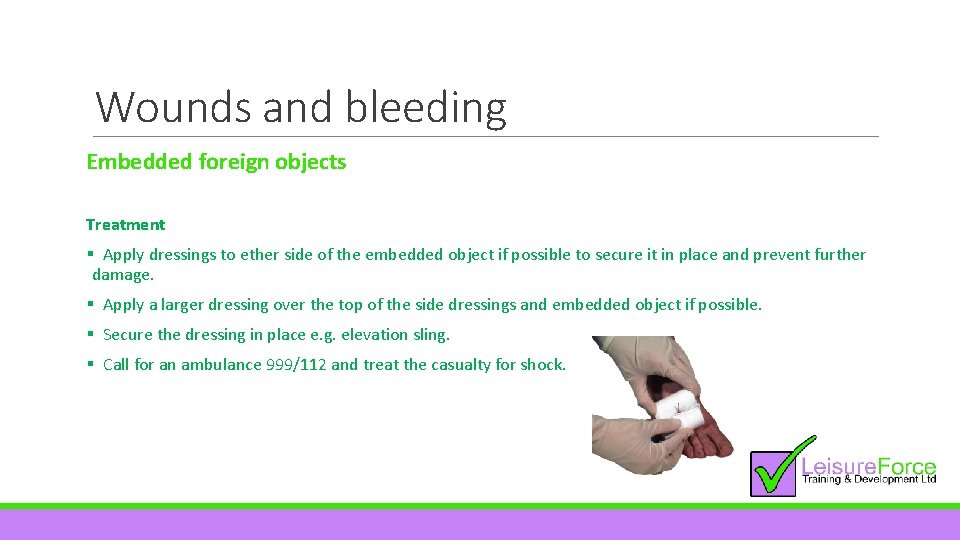
Wounds and bleeding Embedded foreign objects Treatment § Apply dressings to ether side of the embedded object if possible to secure it in place and prevent further damage. § Apply a larger dressing over the top of the side dressings and embedded object if possible. § Secure the dressing in place e. g. elevation sling. § Call for an ambulance 999/112 and treat the casualty for shock.
Wounds and bleeding Amputation can cause severe damage to bone, tendons, muscles as well as loss of blood. Treatment § Put on personal protective equipment e. g. nitrile gloves § Treat bleeding be applying pressure to the wound (direct and indirect) and treat for shock. § Call for an ambulance 999/112. § Dress the casualties wound and place the amputated part in cling film or plastic bag. Write the casualties name and details of the body part and place on ice.
Wounds and bleeding Learning outcomes § Identify the differences in types of wounds § Describe the effects of blood loss § Demonstrate applying a dressing to a casualty with a minor bleed
Shock, seizures and minor injuries Learning objectives § Describe the signs, symptoms and treatment of a casualty who is having a seizure § Describe the signs, symptoms and treatment of a casualty with a contusion § Describe the signs, symptoms and treatment of a casualty with a suspected sprain or strain § Describe the treatment for a minor cut or graze § Describe the signs, symptoms and treatment of a casualty with a burn § Describe the treatment for a foreign body in the eye
Shock Physiological shock (circulatory shock) Circulatory shock is a condition that occurs when the body’s vital organs such as the heart and brain are deprived of oxygen. due to a problem with the circulatory system e. g. blood loss, heart attach & poisoning. Recognition Treatment § Associated injury § Treat the cause of shock if applicable § Pale, cyanosis, cold and clammy skin § Lay the casualty on their back and raise their legs above the level of the heart § Rapid weak pulse § Rapid shallow breathing § Nausea and thirst § Loosen any tight clothing and keep warm § Monitor the casualties airway and breathing § Call for an ambulance 999/112 § Do not allow to eat/drink
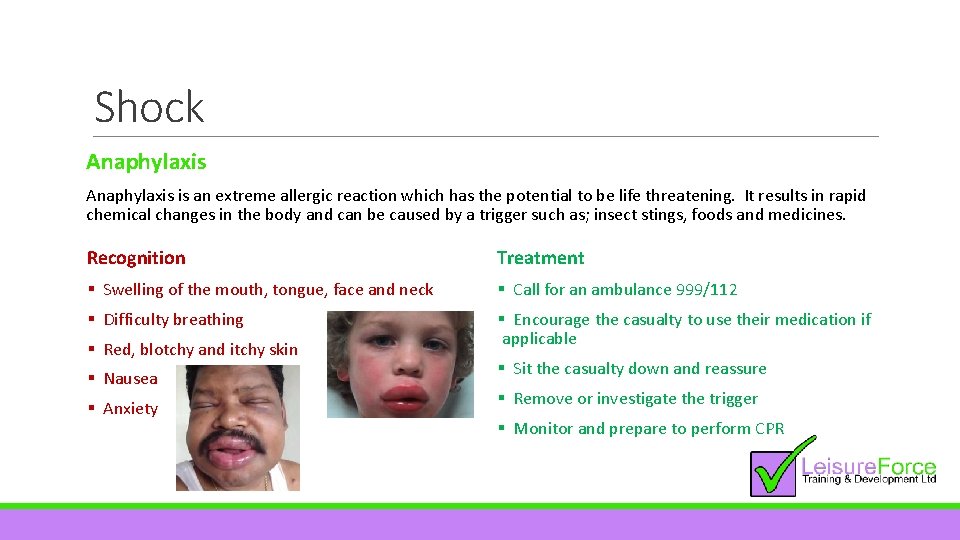
Shock Anaphylaxis is an extreme allergic reaction which has the potential to be life threatening. It results in rapid chemical changes in the body and can be caused by a trigger such as; insect stings, foods and medicines. Recognition Treatment § Swelling of the mouth, tongue, face and neck § Call for an ambulance 999/112 § Difficulty breathing § Encourage the casualty to use their medication if applicable § Red, blotchy and itchy skin § Nausea § Anxiety § Sit the casualty down and reassure § Remove or investigate the trigger § Monitor and prepare to perform CPR
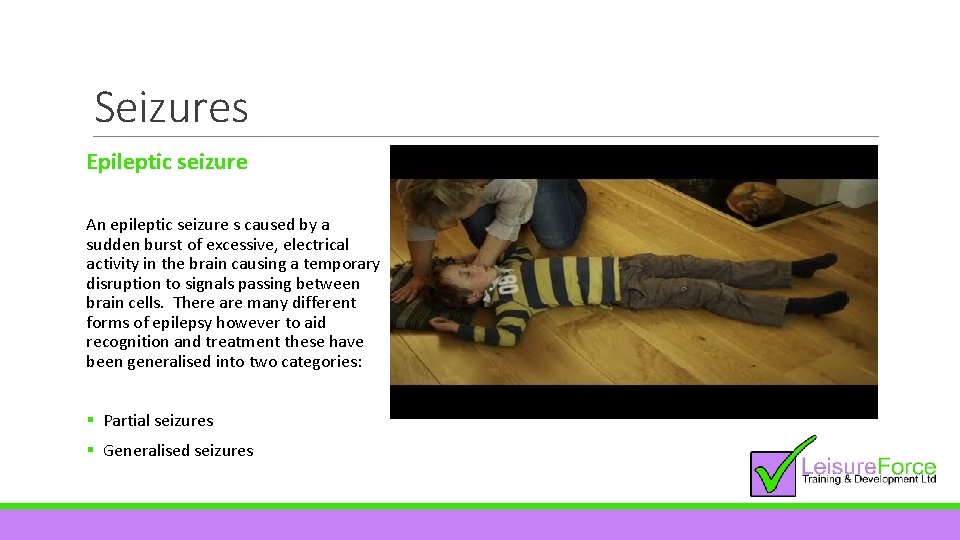
Seizures Epileptic seizure An epileptic seizure s caused by a sudden burst of excessive, electrical activity in the brain causing a temporary disruption to signals passing between brain cells. There are many different forms of epilepsy however to aid recognition and treatment these have been generalised into two categories: § Partial seizures § Generalised seizures
Seizures Partial seizure A partial seizure is a brief loss of responsiveness for a few seconds or minutes. Recognition Treatment § Staring blankly § Ensure the casualty is safe from harm § Mood swings § See is the casualty can be laid or sat down § Feeling of Déjà vu § Stay with the casualty and time the episode § Tingling sensations § If it is the first time recommend the casualty to go to hospital or call an ambulance 999/112 § Twitching (face and body)
Seizures Generalised seizure The most common and widely recognised generalised seizure is called a tonic-clonic (grand mal) seizure which affects the body in progressive ways. Prior to suffering a seizure, a casualty may be confused, have headaches or undergo strange tastes or smells; this is called an ‘aura’. Recognition – Tonic phase Recognition – Clonic phase § Convulsions § The limbs make violent jerking movements § Muscles become rigid § Rolling eyes and crying out § Arching back § Clenched teeth § Cyanosis (blue or purple colouration) § Possible loss or bladder and bowel control § Lack of consciousness
Seizures Generalised seizure Treatment § Ensure the casualties safety by removing dangerous objects which could cause injury § Remove spectacles and loosen clothing around neck if possible § Do not restrain the casualty § Record the time and duration of the seizure § If the seizure continues (depending on site policy) or there are multiple seizures, call for an ambulance 999/112 § When the seizure stops clear any excessive saliva and check airway, breathing and place into the recovery position § Reassure the casualty and be conscious of their embarrassment
Minor injuries Contusion (bruises) A bruise will often be caused by a blunt blow or a violent movement of a joint such as during a fall. Recognition Treatment § Swelling § Rest the area where the bruise has developed § Blue, purple or black colouration § Apply Ice § Probable cause associated with injury (e. g. stairs) § Compress the area § Elevate if possible RICE
Minor injuries Sprains and strains A sprain or strain attributed to activity or playing sport. It is caused by a sharp movement or overstretch to a muscle or joint. Recognition Treatment § Pain, bruising and swelling § Rest the area where the bruise has developed § Loss of movement § Apply Ice § Cramps to muscle § Compress the area § Elevate if possible RICE
Minor injuries Minor cuts and grazes A minor cut or graze will not bleed excessively therefore the main concern is to protect the wound from infection. Recognition Treatment § Will not bleed excessively § Wear appropriate personal protective equipment. (e. g. nitrile gloves) § Ooze blood § Sometimes very painful § Examine the wound for any foreign objects § Clean the effected area with a sterile cleansing wipe § Apply a sterile dressing to the wound
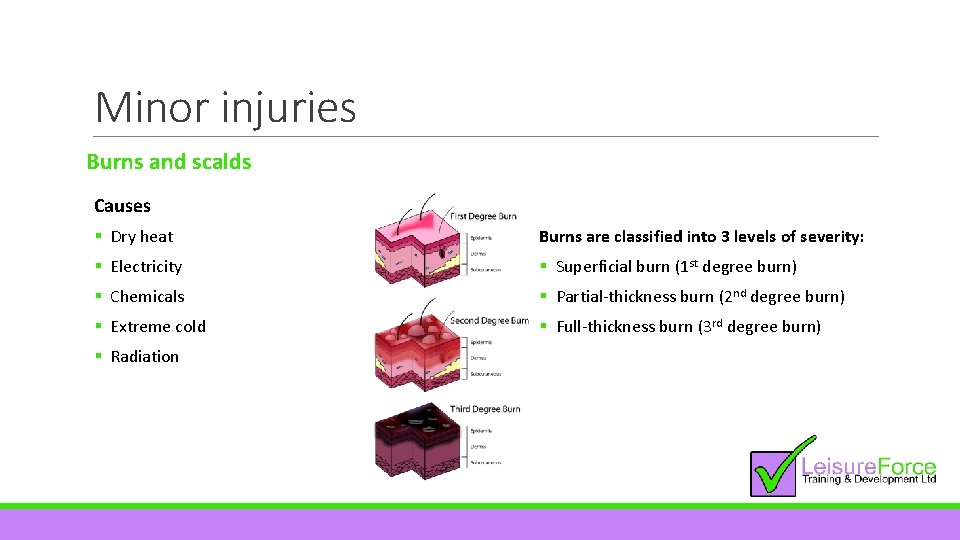
Minor injuries Burns and scalds Causes § Dry heat Burns are classified into 3 levels of severity: § Electricity § Superficial burn (1 st degree burn) § Chemicals § Partial-thickness burn (2 nd degree burn) § Extreme cold § Full-thickness burn (3 rd degree burn) § Radiation
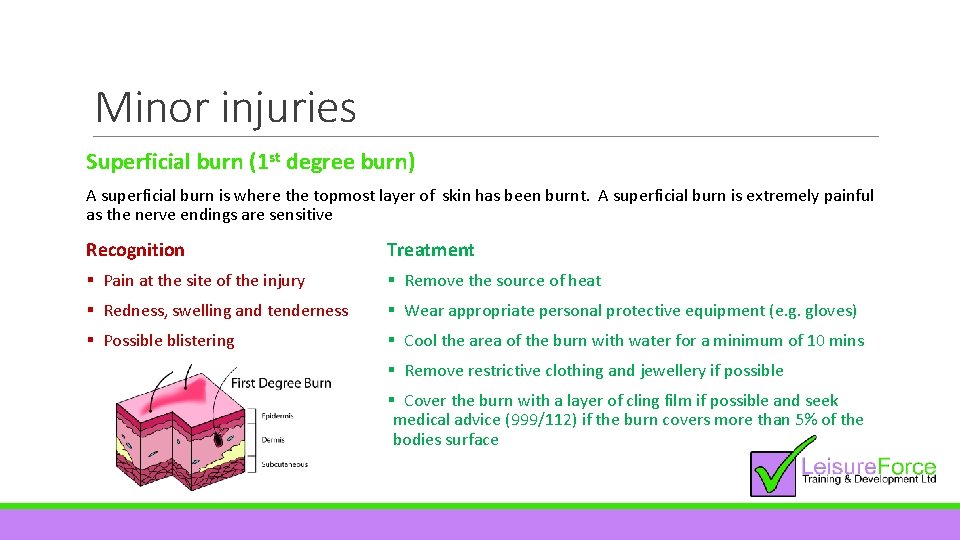
Minor injuries Superficial burn (1 st degree burn) A superficial burn is where the topmost layer of skin has been burnt. A superficial burn is extremely painful as the nerve endings are sensitive Recognition Treatment § Pain at the site of the injury § Remove the source of heat § Redness, swelling and tenderness § Wear appropriate personal protective equipment (e. g. gloves) § Possible blistering § Cool the area of the burn with water for a minimum of 10 mins § Remove restrictive clothing and jewellery if possible § Cover the burn with a layer of cling film if possible and seek medical advice (999/112) if the burn covers more than 5% of the bodies surface
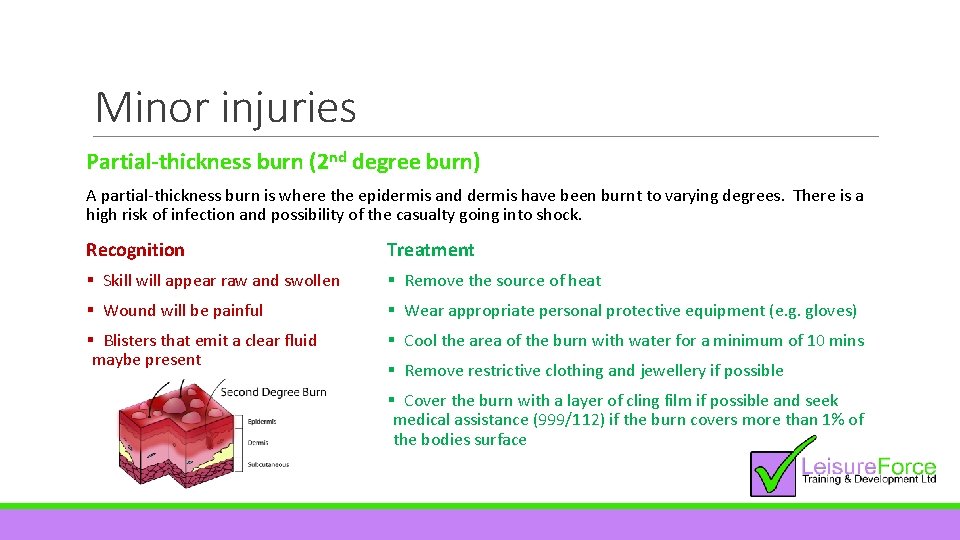
Minor injuries Partial-thickness burn (2 nd degree burn) A partial-thickness burn is where the epidermis and dermis have been burnt to varying degrees. There is a high risk of infection and possibility of the casualty going into shock. Recognition Treatment § Skill will appear raw and swollen § Remove the source of heat § Wound will be painful § Wear appropriate personal protective equipment (e. g. gloves) § Blisters that emit a clear fluid maybe present § Cool the area of the burn with water for a minimum of 10 mins § Remove restrictive clothing and jewellery if possible § Cover the burn with a layer of cling film if possible and seek medical assistance (999/112) if the burn covers more than 1% of the bodies surface
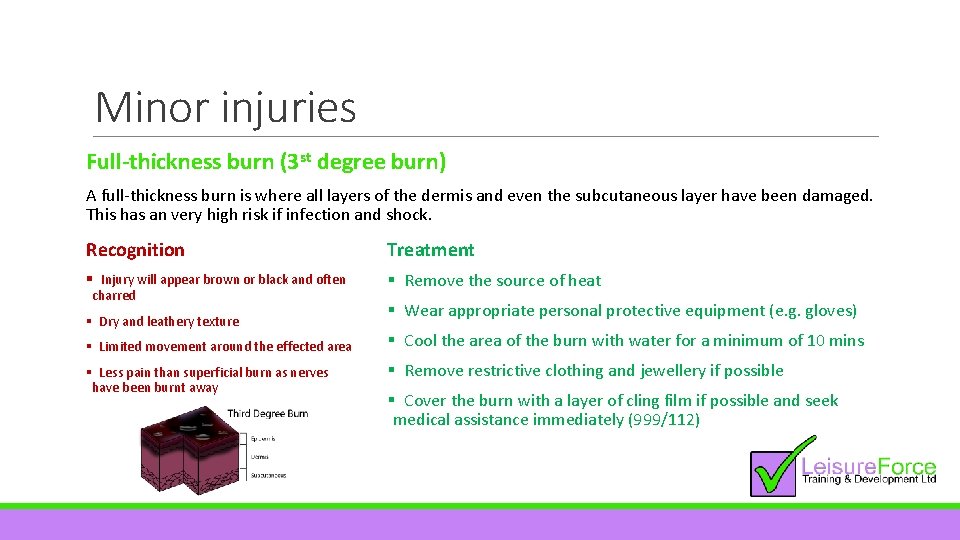
Minor injuries Full-thickness burn (3 st degree burn) A full-thickness burn is where all layers of the dermis and even the subcutaneous layer have been damaged. This has an very high risk if infection and shock. Recognition Treatment § Injury will appear brown or black and often § Remove the source of heat charred § Dry and leathery texture § Limited movement around the effected area § Less pain than superficial burn as nerves have been burnt away § Wear appropriate personal protective equipment (e. g. gloves) § Cool the area of the burn with water for a minimum of 10 mins § Remove restrictive clothing and jewellery if possible § Cover the burn with a layer of cling film if possible and seek medical assistance immediately (999/112)
Minor injuries Foreign objects can cause damage when they enter the body through wounds or orifices such as the nose or eye. You should seek medical attention unless the injury is extremely minor (e. g. surface dirt in a graze). Ear and nose treatment § Do not attempt to remove the object § Cover with a sterile dressing § Seek medical attention (999/112) for advice
Minor injuries Foreign objects Eye treatment § Do not allow the casualty to rub their eye § Lay the casualty down with their head back and ask the casualty to open their eye lids using their hands and examine the eye § Flush the eye from the centre outwards using saline solution of fresh running water § No not allow any of the liquid to run into the other eye § Cover the eye using a sterile dressing if appropriate If the object in embedded, cover both the eyes using a sterile dressing to prevent the casualty from blinking and immediately call for medical assistance (999/112).
Minor injuries Splinters are foreign objects which are embedded into the skin, these foreign objects such as; glass, wood, plastic or metal. Treatment § Wear appropriate P. P. E. (nitrile gloves) § Examine the object to see if it is possible to remove § If possible draw the splinter out in the same direction as the entry route § If the splinter is removed, clean the surrounding area using antiseptic wipe and cover using a sterile dressing If the object can not be removed, cover using a sterile dressing and advice casualty to seek medical assistance.
Shock, seizures and minor injuries Learning outcomes § Describe the signs, symptoms and treatment of a casualty who is having a seizure § Describe the signs, symptoms and treatment of a casualty with a contusion § Describe the signs, symptoms and treatment of a casualty with a suspected sprain or strain § Describe the treatment for a minor cut or graze § Describe the signs, symptoms and treatment of a casualty with a burn § Describe the treatment for a foreign body in the eye
Fracture and dislocation Learning objectives § Outline the types of fractures § Describe the signs, symptoms and treatment of a casualty who has a fracture § Describe the signs, symptoms and treatment of a casualty with a head injury § Outline the types of head injuries § Describe the signs, symptoms and treatment of a casualty with a dislocation
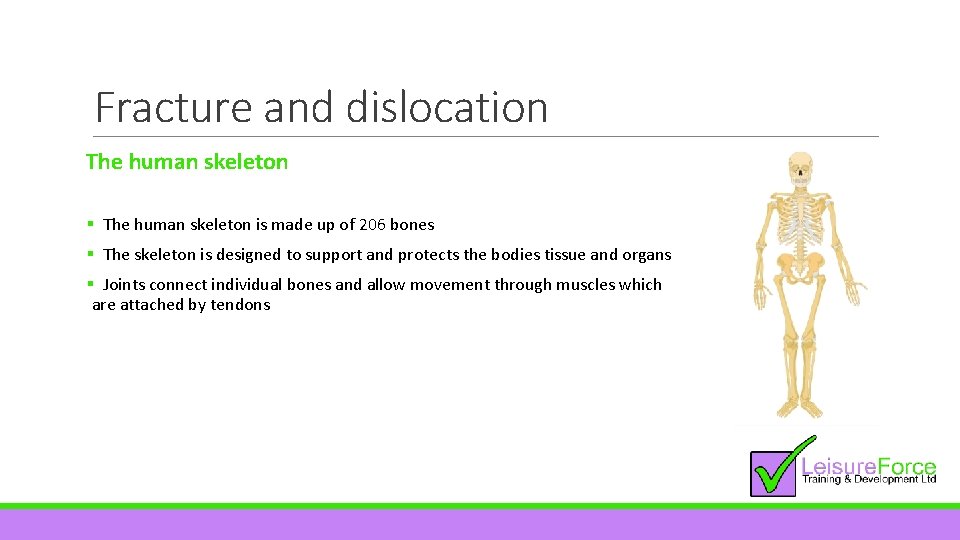
Fracture and dislocation The human skeleton § The human skeleton is made up of 206 bones § The skeleton is designed to support and protects the bodies tissue and organs § Joints connect individual bones and allow movement through muscles which are attached by tendons
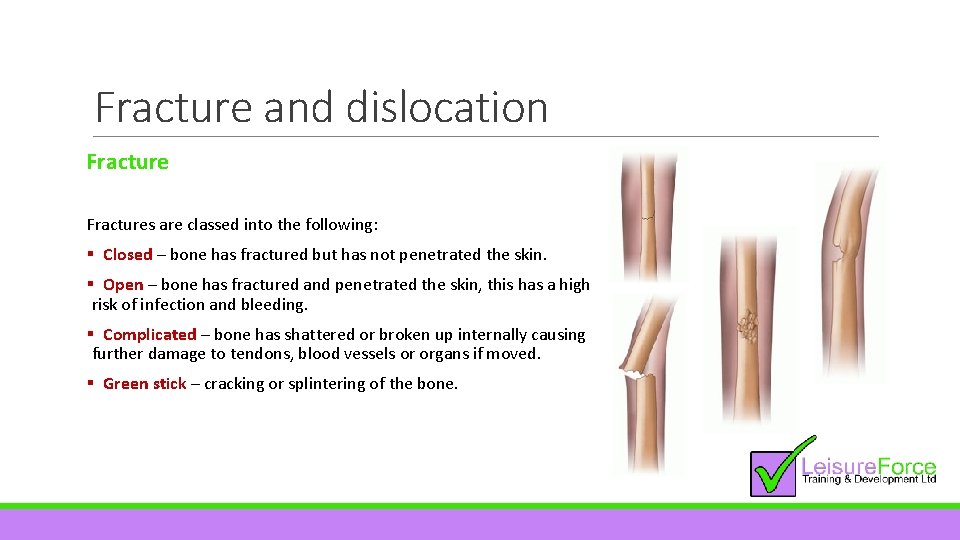
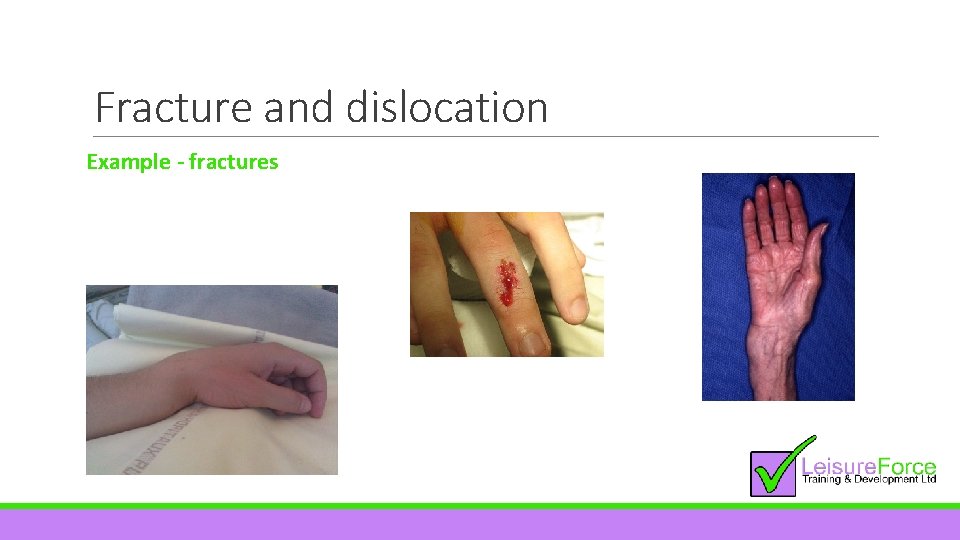
Fracture and dislocation Fractures are classed into the following: § Closed – bone has fractured but has not penetrated the skin. § Open – bone has fractured and penetrated the skin, this has a high risk of infection and bleeding. § Complicated – bone has shattered or broken up internally causing further damage to tendons, blood vessels or organs if moved. § Green stick – cracking or splintering of the bone.
Fracture and dislocation Fracture A fracture is a chip, crack or break in a bone. Recognition Treatment § Pain, swelling, tenderness and bruising around the site of the injury § Wear appropriate P. P. E. (e. g. nitrile gloves) § Associated bleeding possible in open fractures § Loss of mobility § Nausea, pale, cold clammy skin § Treat any bleeding § Immobilise the bone in the position that it is found and most comfortable § Call for an ambulance (999/112)
Fracture and dislocation Example - fractures
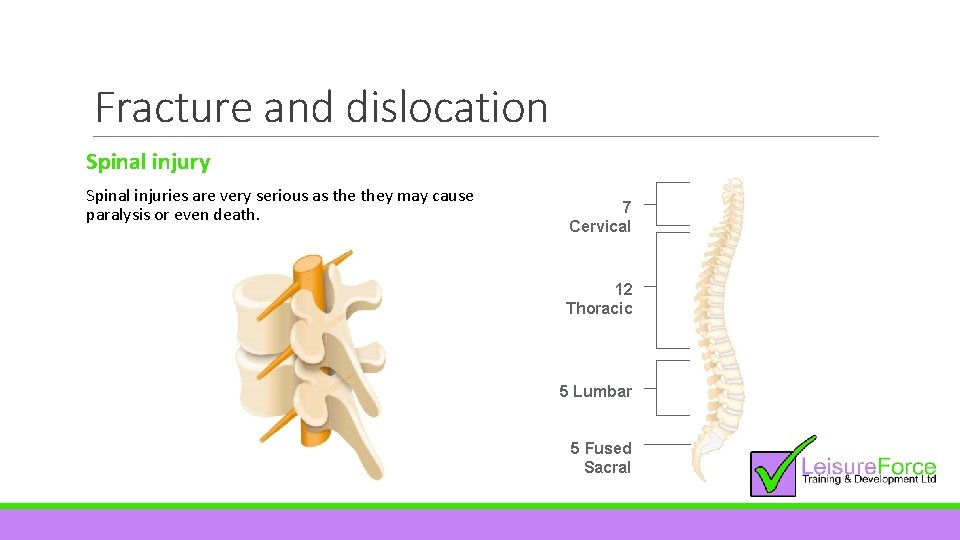
Fracture and dislocation Spinal injury Spinal injuries are very serious as they may cause paralysis or even death. 7 Cervical 12 Thoracic 5 Lumbar 5 Fused Sacral
Fracture and dislocation Spinal injury Spinal injuries are very serious as they may cause paralysis or even death. Recognition Treatment § Unusual position of the head or body § Call for medical assistance (999/112) § Pain at the site of the injury § Keep the casualty in the position that you found them and immobilise the head and neck § Lack of mobility § Reassure the casualty and ask them to remain still § Weakness and tingling sensations § Keep the casualty warm § Loss of bowl or bladder control § Keep monitoring the casualties airway and breathing § Signs of shock § Be prepared to perform basic life support
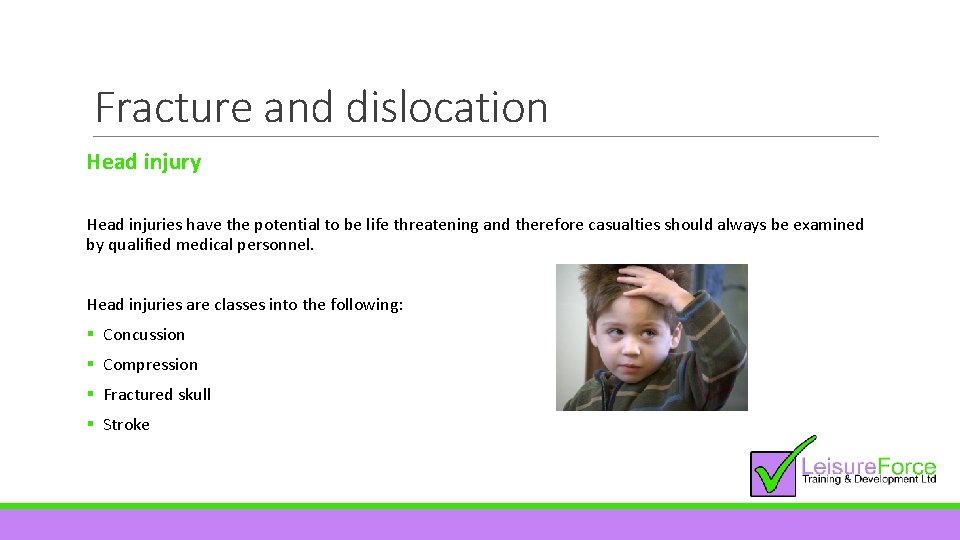
Fracture and dislocation Head injury Head injuries have the potential to be life threatening and therefore casualties should always be examined by qualified medical personnel. Head injuries are classes into the following: § Concussion § Compression § Fractured skull § Stroke
Fracture and dislocation Concussion is the shaking of the brain caused by a blow to the head which causes a temporary disturbance of normal brain activity. Recognition Treatment § Possible loss of consciousness § Treat any bleeding § Dizziness and nausea § Call for medical assistance (999/112) § Headache § Lay the casualty down on a flat surface and raise the head and shoulders § Brief loss of memory § Blurred vision § Monitor the casualty and be prepared to carry out basic life support
Fracture and dislocation Compression is a build up of pressure on the brain caused by accumulation of blood or swelling. Recognition Treatment § Intense headache § Treat any bleeding § Drowsiness § Call for medical assistance (999/112) § Unequal pupil sizes § Slow, strong pulse § Lay the casualty down on a flat surface and raise the head and shoulders § Weakness or paralysis down one side of the body § Monitor the casualty and be prepared to carry out basic life support § Noisy breathing
Fracture and dislocation Fractured skull Can ether be open or closed; caused by a blow to the head. Recognition Treatment § Associated wound § Treat any bleeding § Tenderness and pain § Call for medical assistance (999/112) § Depression or deformity of the skull § Lay the casualty down on a flat surface and raise the head and shoulders § Bruising and swelling at the site of the injury § Monitor the casualty and be prepared to carry out basic life support § Presence of cerebral spinal fluid from ears and nose
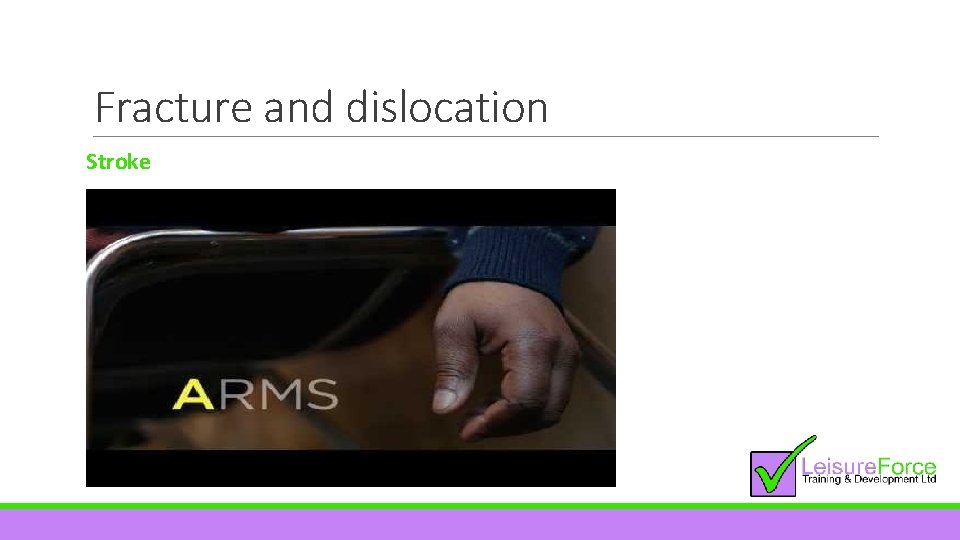
Fracture and dislocation Stroke A stroke is ether short term or permanent damage to the brain and body. If you suspect a stroke you must act FAST. Recognition Treatment § FACE – has the face dropped on one side § Call for an ambulance immediately (999/112) § ARM – can the person raise both arms? § Lay casualty down with head and shoulders raised § SPEECH – can the person speak clearly and understand what you say? § If unconscious place in recovery position § TIME to call 999/112 – early treatment can help prevent further damage § Loosen any restrictive clothing § Monitor airway and breathing and be prepared to perform basic life support
Fracture and dislocation Stroke
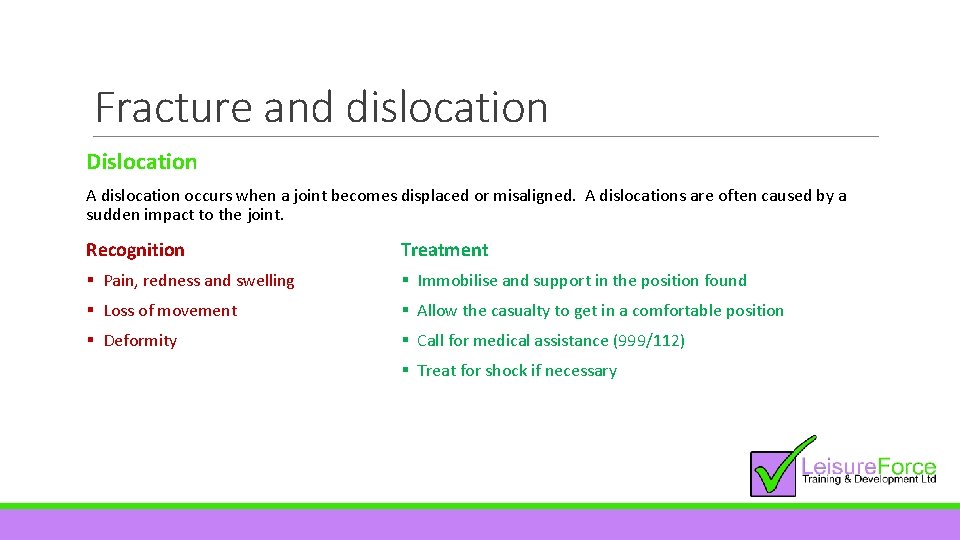
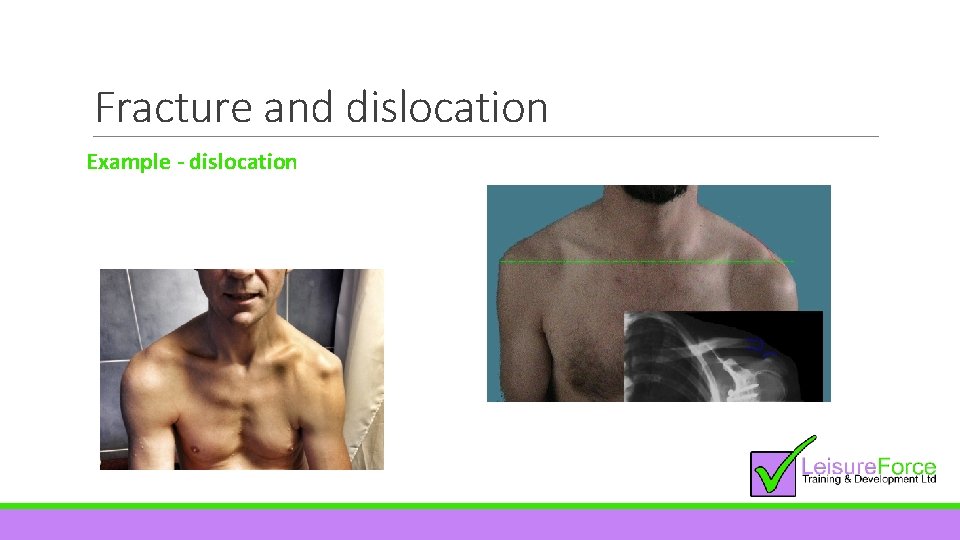
Fracture and dislocation Dislocation A dislocation occurs when a joint becomes displaced or misaligned. A dislocations are often caused by a sudden impact to the joint. Recognition Treatment § Pain, redness and swelling § Immobilise and support in the position found § Loss of movement § Allow the casualty to get in a comfortable position § Deformity § Call for medical assistance (999/112) § Treat for shock if necessary
Fracture and dislocation Example - dislocation
Fracture and dislocation Learning outcomes § Outline the types of fractures § Describe the signs, symptoms and treatment of a casualty who has a fracture § Describe the signs, symptoms and treatment of a casualty with a head injury § Outline the types of head injuries § Describe the signs, symptoms and treatment of a casualty with a dislocation
Chest injuries and major illness Learning objectives § Describe chest injuries a casualty may suffer with § Describe the signs, symptoms and treatment of a casualty suffering from a heart attack § Describe the signs, symptoms and treatment of a casualty who is suffering from angina § Describe the signs, symptoms and treatment of a casualty suffering from hypoglycaemia or hyperglycaemia § Describe the signs, symptoms and treatment of a casualty who has been poisoned § Describe the signs, symptoms and treatment of a casualty suffering from an asthma attack
Chest injuries Types of chest injury Chest injuries are serious injuries and can be life threatening. Types of chest injuries include: § Rib fracture § Flail chest § Penetrating chest wound
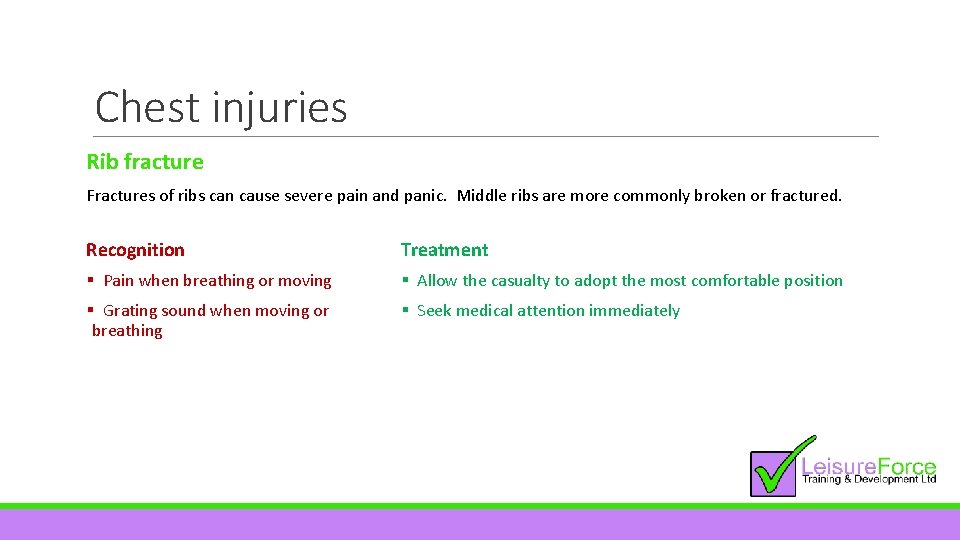
Chest injuries Rib fracture Fractures of ribs can cause severe pain and panic. Middle ribs are more commonly broken or fractured. Recognition Treatment § Pain when breathing or moving § Allow the casualty to adopt the most comfortable position § Grating sound when moving or breathing § Seek medical attention immediately
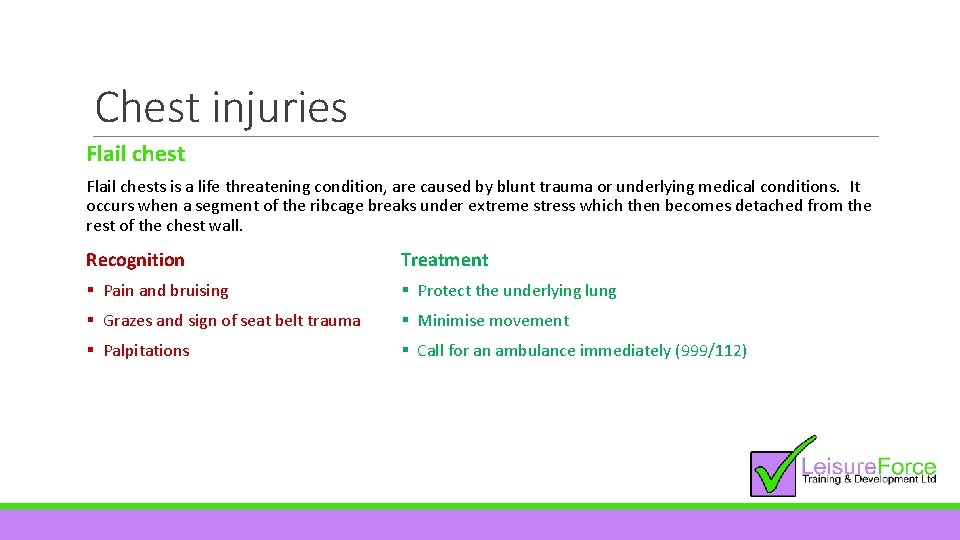
Chest injuries Flail chests is a life threatening condition, are caused by blunt trauma or underlying medical conditions. It occurs when a segment of the ribcage breaks under extreme stress which then becomes detached from the rest of the chest wall. Recognition Treatment § Pain and bruising § Protect the underlying lung § Grazes and sign of seat belt trauma § Minimise movement § Palpitations § Call for an ambulance immediately (999/112)
Chest injuries Penetrating chest wound Caused by gun shot, knife wound or other sharp objects which could penetrate the chest. Id there is a hole in the chest wall, air enters the cavity with each breath and becomes trapped. This trapped air builds up pressure as the amount increases and may collapse the lung causing severe breathing problems. Recognition Treatment § Visible open wound § Call an ambulance immediately (999/112) § Sucking sound as the air enters the chest § Wear appropriate P. P. E (e. g. nitrile gloves) § Difficulty breathing § Blood bubbling from the wound § Casualty maybe coughing up blood § Do not remove embedded objects § Lay the casualty in a comfortable position and leave the chest wound open and exposed. Control localised bleeding with direct pressure § Treat for shock and be prepared to perform basic life support
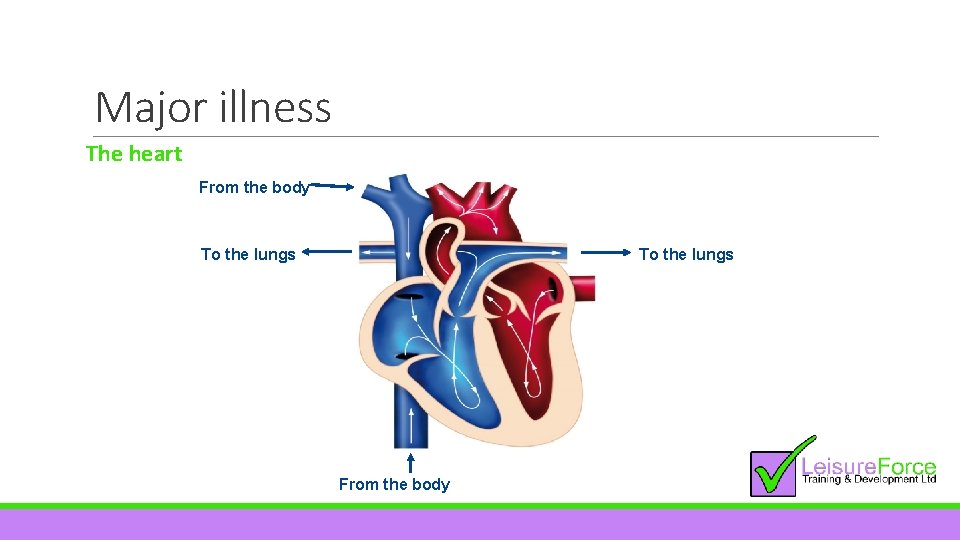
Major illness The heart From the body To the lungs From the body
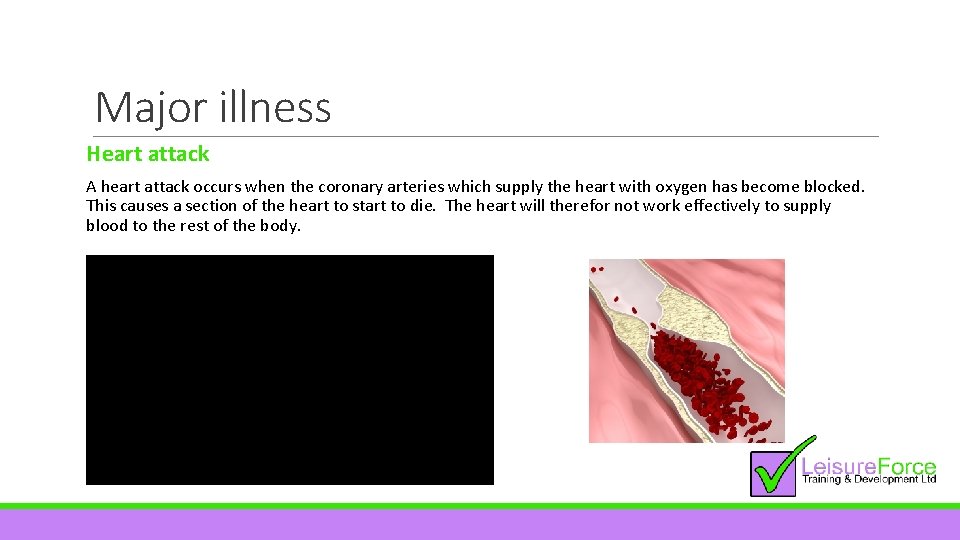
Major illness Heart attack A heart attack occurs when the coronary arteries which supply the heart with oxygen has become blocked. This causes a section of the heart to start to die. The heart will therefor not work effectively to supply blood to the rest of the body.
Major illness Heart attack
Major illness Heart attack Recognition Treatment § Tightness and/or pain in the chest (mild § Call for an ambulance immediately (999/112) or severe) § Sit the casualty down with knees raised in a W-position § Casualty clutching the chest § Loosen any restrictive clothing, keep the casualty warm and § Possible spreading of pain to the arms, comfortable neck and back § Monitor the casualties airway and breathing and be prepared § Dizziness or light headed feeling to perform basic life support § Possible shortness of breath § Nausea, sick and have cold sweats
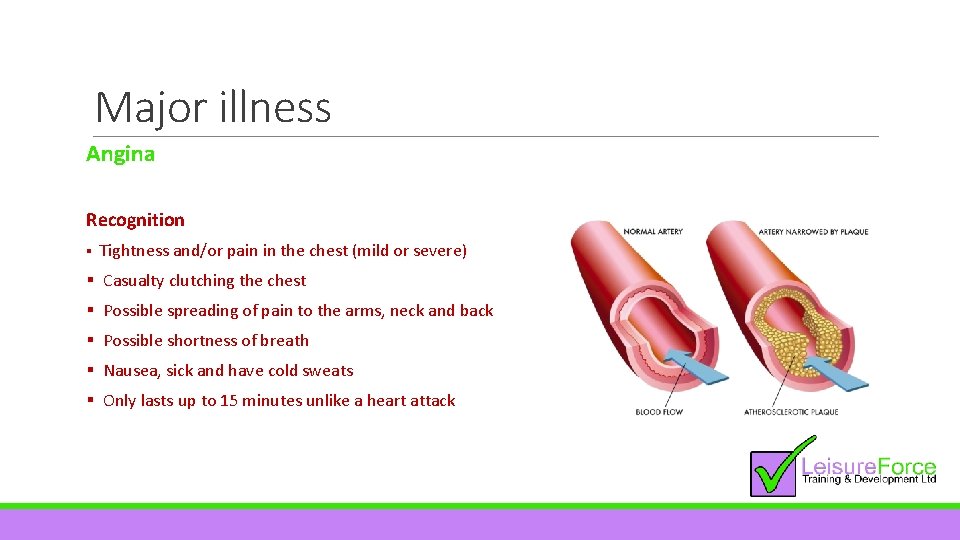
Major illness Angina Recognition § Tightness and/or pain in the chest (mild or severe) § Casualty clutching the chest § Possible spreading of pain to the arms, neck and back § Possible shortness of breath § Nausea, sick and have cold sweats § Only lasts up to 15 minutes unlike a heart attack
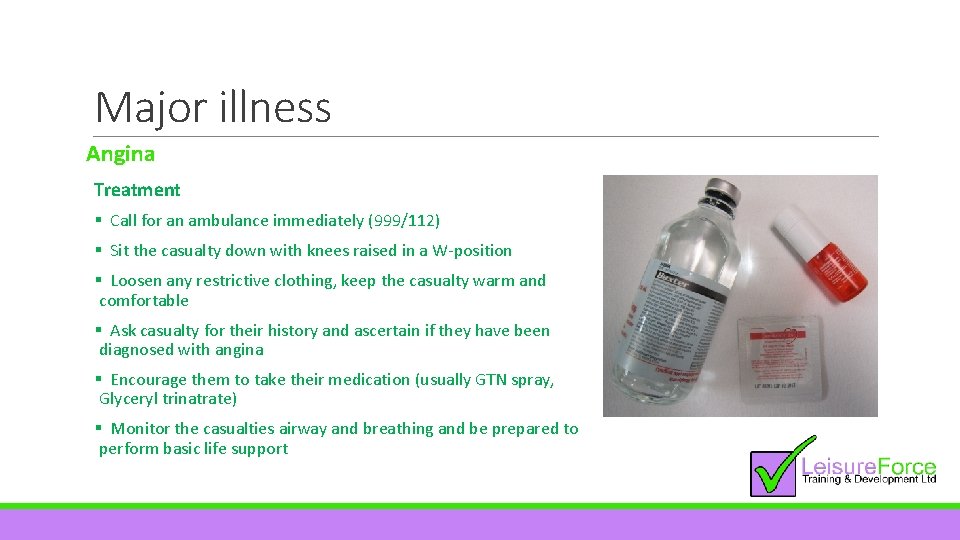
Major illness Angina Treatment § Call for an ambulance immediately (999/112) § Sit the casualty down with knees raised in a W-position § Loosen any restrictive clothing, keep the casualty warm and comfortable § Ask casualty for their history and ascertain if they have been diagnosed with angina § Encourage them to take their medication (usually GTN spray, Glyceryl trinatrate) § Monitor the casualties airway and breathing and be prepared to perform basic life support
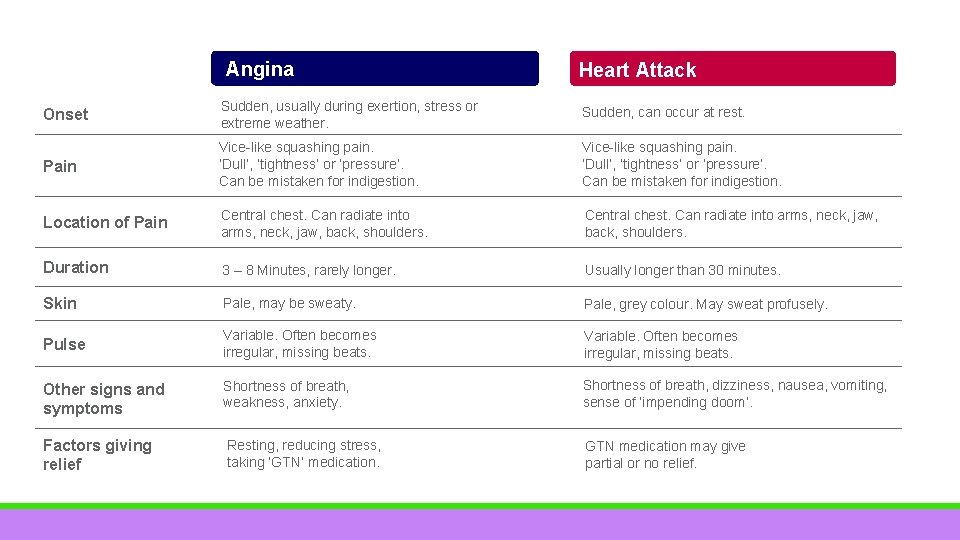
Angina Heart Attack Onset Sudden, usually during exertion, stress or extreme weather. Sudden, can occur at rest. Pain Vice-like squashing pain. ‘Dull’, ‘tightness’ or ‘pressure’. Can be mistaken for indigestion. Location of Pain Central chest. Can radiate into arms, neck, jaw, back, shoulders. Duration 3 – 8 Minutes, rarely longer. Usually longer than 30 minutes. Skin Pale, may be sweaty. Pale, grey colour. May sweat profusely. Pulse Variable. Often becomes irregular, missing beats. Other signs and symptoms Shortness of breath, weakness, anxiety. Shortness of breath, dizziness, nausea, vomiting, sense of ‘impending doom’. Factors giving relief Resting, reducing stress, taking ‘GTN’ medication. GTN medication may give partial or no relief.
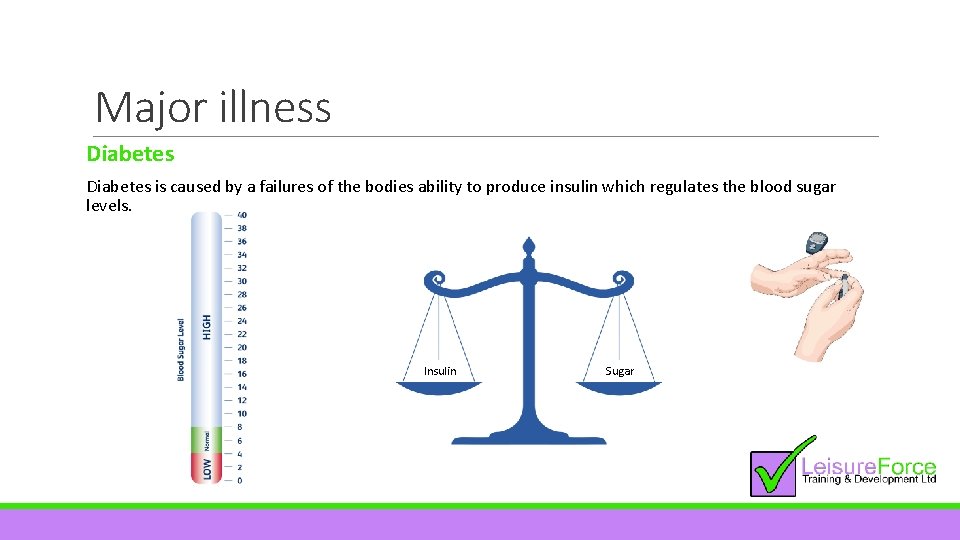
Major illness Diabetes is caused by a failures of the bodies ability to produce insulin which regulates the blood sugar levels. Insulin Sugar
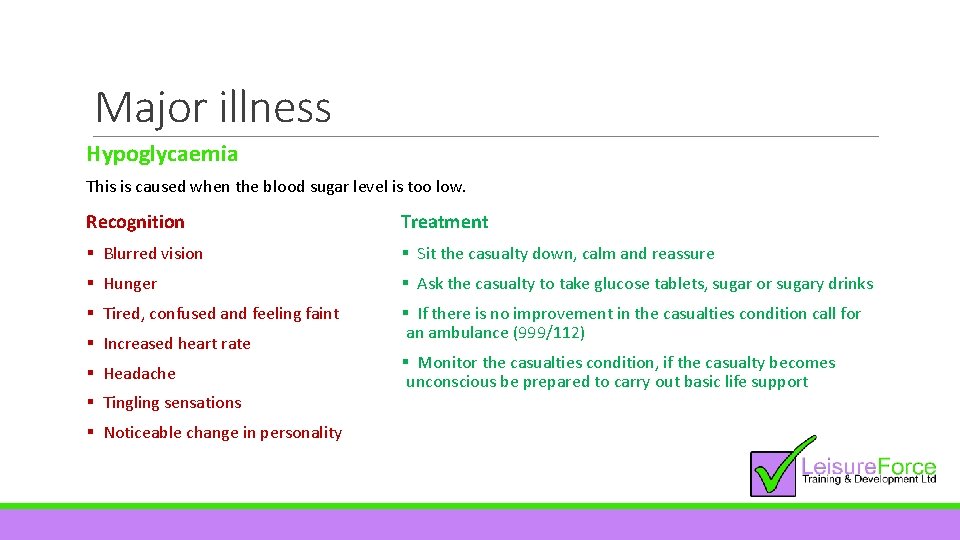
Major illness Hypoglycaemia This is caused when the blood sugar level is too low. Recognition Treatment § Blurred vision § Sit the casualty down, calm and reassure § Hunger § Ask the casualty to take glucose tablets, sugar or sugary drinks § Tired, confused and feeling faint § If there is no improvement in the casualties condition call for an ambulance (999/112) § Increased heart rate § Headache § Tingling sensations § Noticeable change in personality § Monitor the casualties condition, if the casualty becomes unconscious be prepared to carry out basic life support
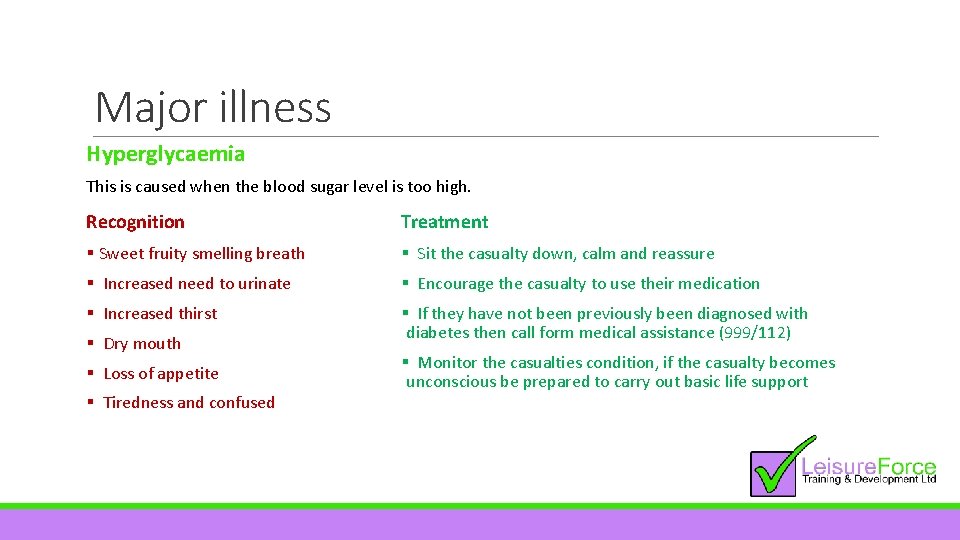
Major illness Hyperglycaemia This is caused when the blood sugar level is too high. Recognition Treatment § Sweet fruity smelling breath § Sit the casualty down, calm and reassure § Increased need to urinate § Encourage the casualty to use their medication § Increased thirst § If they have not been previously been diagnosed with diabetes then call form medical assistance (999/112) § Dry mouth § Loss of appetite § Tiredness and confused § Monitor the casualties condition, if the casualty becomes unconscious be prepared to carry out basic life support
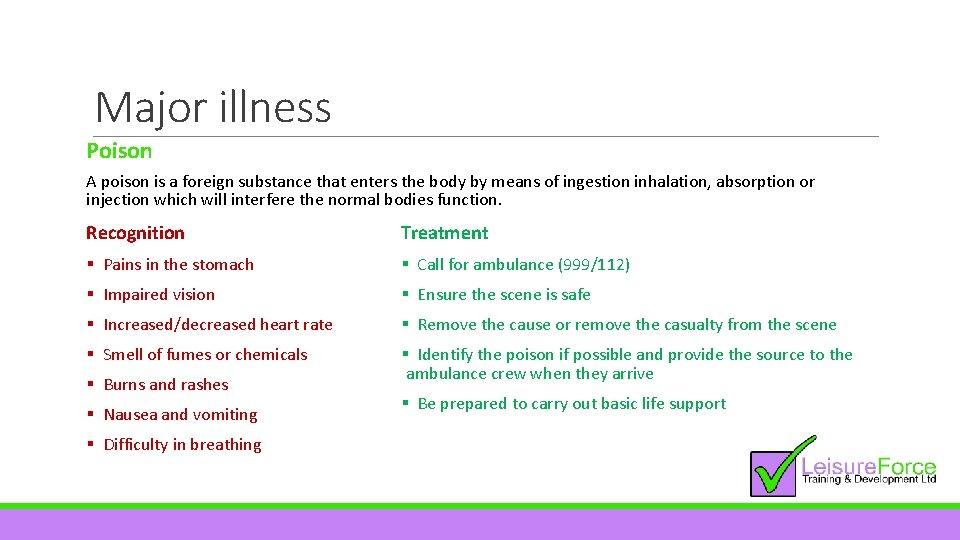
Major illness Poison A poison is a foreign substance that enters the body by means of ingestion inhalation, absorption or injection which will interfere the normal bodies function. Recognition Treatment § Pains in the stomach § Call for ambulance (999/112) § Impaired vision § Ensure the scene is safe § Increased/decreased heart rate § Remove the cause or remove the casualty from the scene § Smell of fumes or chemicals § Identify the poison if possible and provide the source to the ambulance crew when they arrive § Burns and rashes § Nausea and vomiting § Difficulty in breathing § Be prepared to carry out basic life support
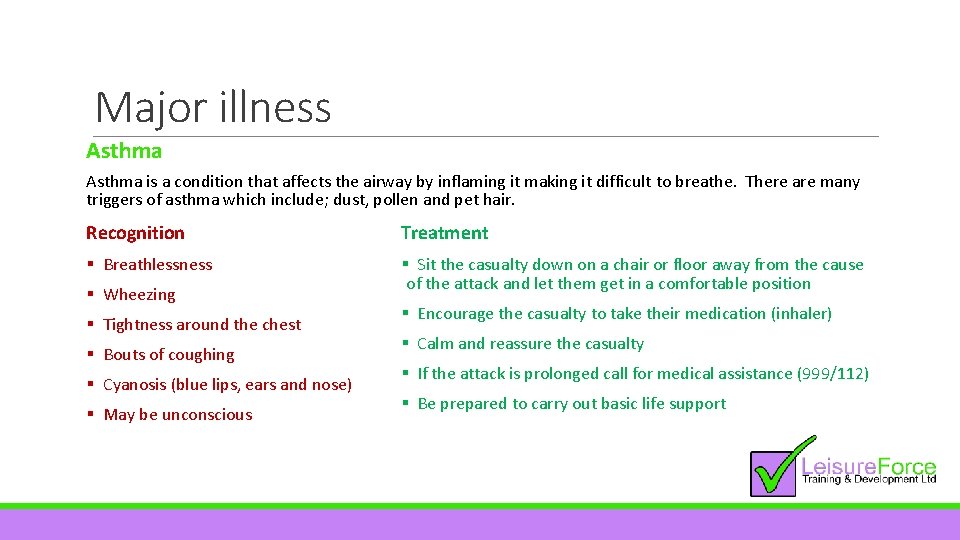
Major illness Asthma is a condition that affects the airway by inflaming it making it difficult to breathe. There are many triggers of asthma which include; dust, pollen and pet hair. Recognition Treatment § Breathlessness § Sit the casualty down on a chair or floor away from the cause of the attack and let them get in a comfortable position § Wheezing § Tightness around the chest § Bouts of coughing § Cyanosis (blue lips, ears and nose) § May be unconscious § Encourage the casualty to take their medication (inhaler) § Calm and reassure the casualty § If the attack is prolonged call for medical assistance (999/112) § Be prepared to carry out basic life support
Major illness Hyperventilation (HVS) Hyperventilation syndrome (HVS) is a name given to a collection of physical and emotional symptoms, largely brought about by hyperventilation. This happens when we over-breathe. Recognition Treatment § Breathlessness / fast breathing § Sit the casualty down on a chair or floor and let them get in a comfortable position § Tightness around the chest § Tingling (e. g. in fingers, arms, mouth) § Muscle stiffness § Trembling in hands § Dizziness, blurred vision, faintness § headaches § Calm and reassure the casualty § Encourage the casualty to slow their breathing § If the attack is prolonged call for medical assistance (999/112)
Chest injuries and major illness Learning outcomes § Describe chest injuries a casualty may suffer with § Describe the signs, symptoms and treatment of a casualty suffering from a heart attack § Describe the signs, symptoms and treatment of a casualty who is suffering from angina § Describe the signs, symptoms and treatment of a casualty suffering from hypoglycaemia or hyperglycaemia § Describe the signs, symptoms and treatment of a casualty who has been poisoned § Describe the signs, symptoms and treatment of a casualty suffering from an asthma attack
Heat, cold and other injuries Learning objectives § Describe the signs, symptoms and treatment of a casualty suffering from hypothermia § Describe the signs, symptoms and treatment of a casualty suffering from frost bite § Describe the signs, symptoms and treatment of a casualty suffering from heat exhaustion § Describe the signs, symptoms and treatment of a casualty suffering from heat stroke § Describe the signs, symptoms and treatment of a casualty with abdominal injuries § Describe the signs, symptoms and treatment of a casualty with crush injuries
Heat and cold injuries Hypothermia When the body is exposed to prolonged cold caused by weather, water etc. the bodies core temperature will drop. If the bodies core temperature drops below 35°C then the onset of hypothermia will occur. Recognition Treatment § Pale, cold skin § Remove the casualty from the source of the cold § Shivering at onset then the muscles will § Cover the casualty with blankets or ensure the room is warm stiffen as the condition gets worse (approx. 25°C) § Lethargy § Breathing, speech and pulse slowing § If the casualty is outdoors insulate the casualty from the ground § Disorientation and confusion § Give warm drinks § Diminishing level of response leading to § Monitor their condition unconsciousness and death § Call for medical assistance (999/112) if there is no improvement or is elderly or young
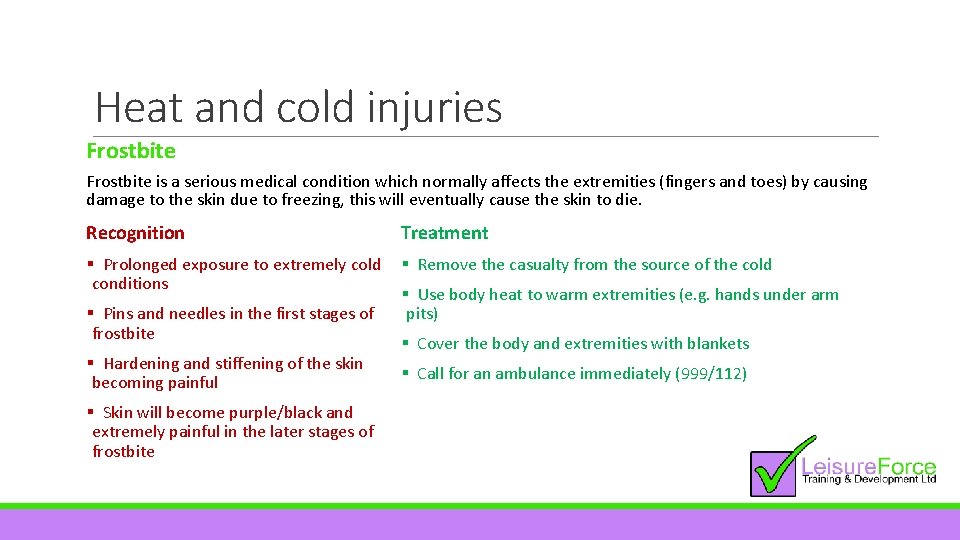
Heat and cold injuries Frostbite is a serious medical condition which normally affects the extremities (fingers and toes) by causing damage to the skin due to freezing, this will eventually cause the skin to die. Recognition Treatment § Prolonged exposure to extremely cold § Remove the casualty from the source of the cold conditions § Use body heat to warm extremities (e. g. hands under arm pits) § Pins and needles in the first stages of frostbite § Cover the body and extremities with blankets § Hardening and stiffening of the skin § Call for an ambulance immediately (999/112) becoming painful § Skin will become purple/black and extremely painful in the later stages of frostbite
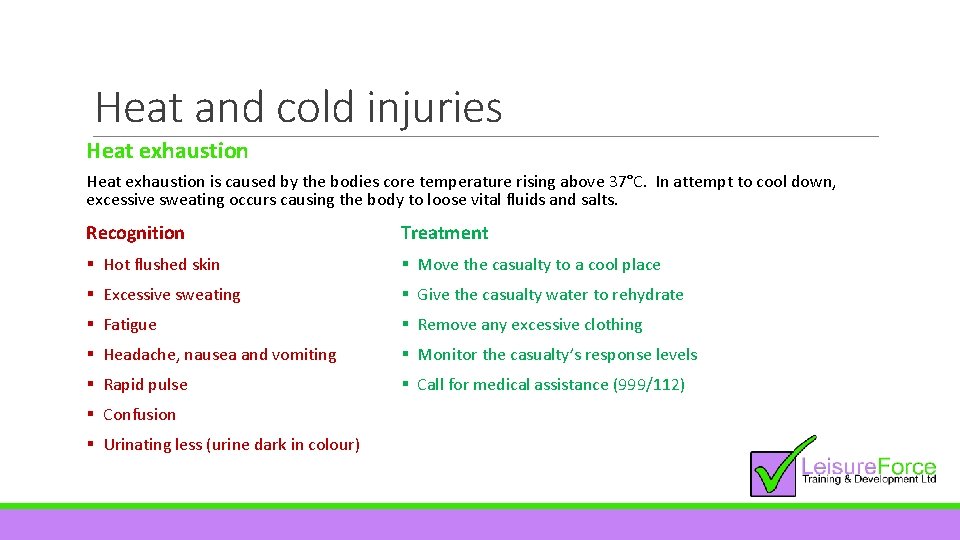
Heat and cold injuries Heat exhaustion is caused by the bodies core temperature rising above 37°C. In attempt to cool down, excessive sweating occurs causing the body to loose vital fluids and salts. Recognition Treatment § Hot flushed skin § Move the casualty to a cool place § Excessive sweating § Give the casualty water to rehydrate § Fatigue § Remove any excessive clothing § Headache, nausea and vomiting § Monitor the casualty’s response levels § Rapid pulse § Call for medical assistance (999/112) § Confusion § Urinating less (urine dark in colour)
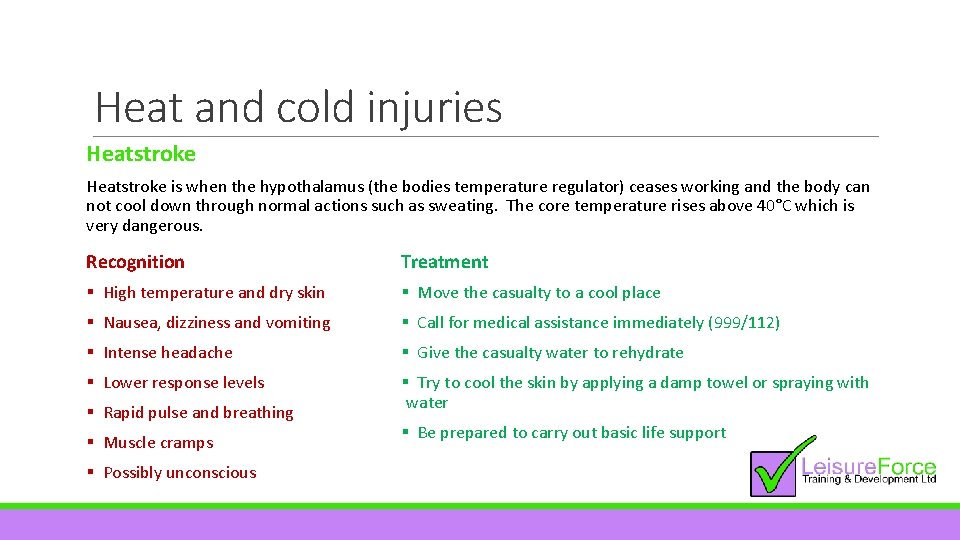
Heat and cold injuries Heatstroke is when the hypothalamus (the bodies temperature regulator) ceases working and the body can not cool down through normal actions such as sweating. The core temperature rises above 40°C which is very dangerous. Recognition Treatment § High temperature and dry skin § Move the casualty to a cool place § Nausea, dizziness and vomiting § Call for medical assistance immediately (999/112) § Intense headache § Give the casualty water to rehydrate § Lower response levels § Try to cool the skin by applying a damp towel or spraying with water § Rapid pulse and breathing § Muscle cramps § Possibly unconscious § Be prepared to carry out basic life support
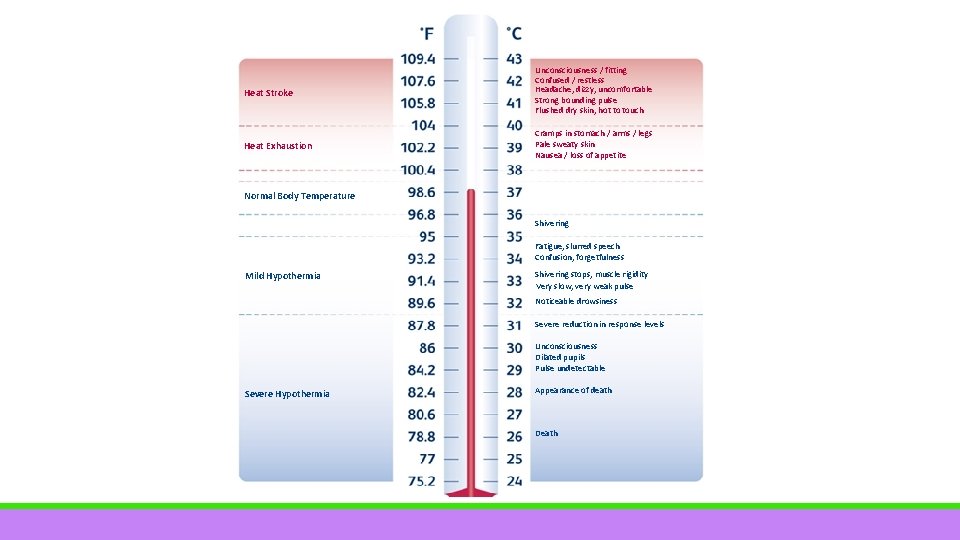
Heat Stroke Unconsciousness / fitting Confused / restless Headache, dizzy, uncomfortable Strong bounding pulse Flushed dry skin, hot to touch Heat Exhaustion Cramps in stomach / arms / legs Pale sweaty skin Nausea / loss of appetite Normal Body Temperature Shivering Fatigue, slurred speech Confusion, forgetfulness Mild Hypothermia Shivering stops, muscle rigidity Very slow, very weak pulse Noticeable drowsiness Severe reduction in response levels Unconsciousness Dilated pupils Pulse undetectable Severe Hypothermia Appearance of death Death
Other injuries Blunt abdominal trauma Common in motor vehicle accidents due to seat belts and can also be caused by punches etc. There is a concern that internal organs maybe damaged from the injury. Recognition Treatment § Abdominal pain § Call for an ambulance immediately (999/112) § Bruising and swelling § Wear appropriate P. P. E. (e. g. nitrile gloves) § Abrasions § Gather as much information as possible § Nausea and vomiting § Monitor the airway and breathing § Possible blood in the urine § Try and lay the casualty down with their knees raised, if it is not possible let the casualty sit in a comfortable position § Signs of shock § Treat for shock and be prepared to carry out basic life support
Other injuries Penetrating abdominal trauma A penetrating abdominal trauma occurs when a foreign object pierces the skin and enters the abdomen. This can cause severe damage to internal organs and blood vessels. Recognition Treatment § Visible associated wound § Call for an ambulance immediately (999/112) § Abdominal pain § Wear appropriate P. P. E. (e. g. nitrile gloves) § Nausea and vomiting § Gather as much information as possible § Distressed state § Monitor the airway and breathing § Possible blood in urine § Try and lay the casualty down with their knees raised, if it is not possible let the casualty sit in a comfortable position § Signs of shock § Treat for shock and be prepared to carry out basic life support
Other injuries Crush injuries A crush injury can cause muscle swelling and internal damage to organs and may stop blood circulating freely around the body. There is two main types of crush injuries: Compartment syndrome This is the compression of nerves, blood vessels and muscles inside a compartment within the body. This can cause tissues to die from lack of blood reaching them due to the compression of the blood vessels. Crush syndrome (Bywater's syndrome) This occurs when pressure on the muscles is released. It causes toxins to be released into the bloodstream. These toxins are highly dangerous to the kidneys and can cause renal failure and death.
Other injuries Crush injuries Recognition Treatment § Loss of sensation in the affected area § Ensure that the area is safe to approach § Pale skin § Establish how long the casualty has been crushed for. § General weakness in the area of the crush § Severe pain Ø If longer than 15 minutes leave them in the position found Ø If less than 15 minutes attempt to release the crush § Treat associated wounds and bleeding § Treat for shock § Call and ambulance (999/112) and request additional emergency services if required § Be prepared to carry out basic life support
Heat, cold and other injuries Learning outcomes § Describe the signs, symptoms and treatment of a casualty suffering from hypothermia § Describe the signs, symptoms and treatment of a casualty suffering from frost bite § Describe the signs, symptoms and treatment of a casualty suffering from heat exhaustion § Describe the signs, symptoms and treatment of a casualty suffering from heat stroke § Describe the signs, symptoms and treatment of a casualty with abdominal injuries § Describe the signs, symptoms and treatment of a casualty with crush injuries
Tasks § There are 12 questions to answer in your pack, please complete them. § Please complete your individual learning plan. § Finally complete the course evaluation sheet provided, answer honestly as all feedback helps us improve future courses.
Thank you