
FIRST A RECAP Using the whiteboard list some
FIRST A RECAP • Using the whiteboard, list some of the conventions of documentary that we covered last week. • Please can everybody (if able) to add at least one!
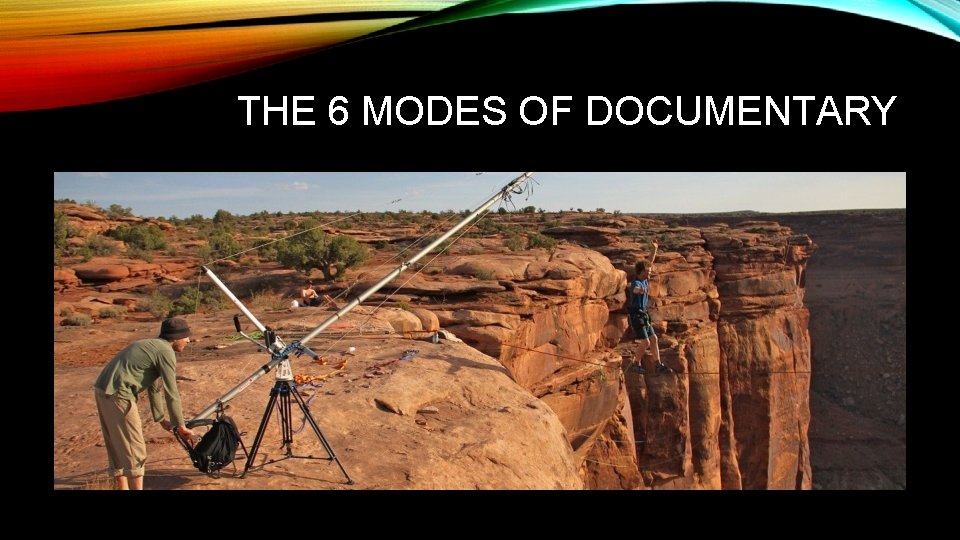
THE 6 MODES OF DOCUMENTARY
WHAT ARE THESE MODES? • In 1991, American film critic and theoretician Bill Nichols proposed that there were six different modes of documentary—poetic, expository, reflexive, observational, performative, and participatory—each containing its own specific characteristics. While some documentary films may have an overlap in traits, each mode is a category that can be boiled down to a few specific elements • This will enable you to recognise all the different types of documentaries and analyze their method of construction.
THE POETIC MODE
THE POETIC DOCUMENTARY MODE • Watch : https: //www. youtube. com/watch? v=Oac. Vy 8_n. Ji 0 Koyaanisqatsi(1982) by Godfrey Reggio https: //www. youtube. com/watch? v=76 R 2 EKEno. JQ&list=PLsu. QMy. Mn. Z 1 ne. K 4_ meur. UODKPf-JXYMczf Microcosmos – 2 mins Hugo Coulais, Louis Coulais 1996

WHITEBOARD • Please add some conventions or things you noticed about these clips
THE POETIC CONVENTIONS • Documentary-maker gives subjective view • Not in typical narrative structure • Particular mood/tone is created – enhanced by music • Often designed to persuade or carry a message • Events are under-developed and situations can be left unsolved • Unrelated shots edited together - linked by a mood/music • Perceived as Avant-garde (innovative, experimental, pushes boundaries)

EXPOSITORY MODE

WATCH THIS CLIP ABOUT BLUE PLANET II • https: //www. youtube. com/watch? v=x. Lx 4 f. Vs. Yd. TI Blue Planet ii – 3 mins BBC – 2017 • This is an expository documentary. • Write some notes about why you think it may be “expository”
IN GROUPS • Discuss the conventions of expository documentaries • List as many points as you can • Nominate a speaker to share the group list for discussion
EXPOSITORY DOCUMENTARY MODE • Expository documentaries set up a specific point of view or argument about a subject and a narrator often speaks directly to the viewer, emphasizing the relationship between the images presented on-screen and offering verbal commentary. Expository documentaries include footage that supports and strengthens the spoken argument of the film, including stock footage, archival footage, b-roll, or re-enactments of historical events. • Expository documentaries are heavily researched and constructed to inform and persuade. Unlike poetic documentary the goal of the expository mode is to present a strong argument to the audience, convincing them to believe in or agree with a certain point of view.
EXPOSITORY DOCUMENT MODE (CONT) • “Voice of God” narration. This authoritative voice accompanies the documentary’s images, defining the visuals for the audience, and explaining rhetorical content to help make the film’s case. The voice-over conveys information and does not provide personal accounts or subjective experiences to share a narrative. • A “right” answer. Expository documentaries don’t leave much to subjectivity—they want the audience to feel a certain way about the content they are seeing. Rhetorical questions, recounts of history, and interviews are often presented to support the film’s claims, along with any other relevant evidence. • Evidentiary editing. While visuals in the poetic mode documentaries are meant for emotional or artistic purposes, expository filmmakers use images as a means to support their claims. Images on-screen are explained or supported by captions or commentary. This kind of editing style is also used for news broadcasts.

OBSERVATIONAL MODE
WATCH THE FOLLOWING CLIP • https: //www. youtube. com/watch? v=_SEc. Cx. KLwk. A • Frederick Wiseman 1968 High School – 5 mins • This is an example of Observational Documentary • Take notes about the conventions • Please watch to the very end!
WHITEBOARD CONTRIBUTION • Please write on the whiteboard some of your notes about Observational Mode • Any crossover with other modes in that clip? • Possible to truly be a fly on the wall?
OBSERVATIONAL DOCUMENTARY MODE • The Observational mode, also referred to as cinema verité, direct cinema or fly-on-the-wall documentary is often regarded as a purist form of documentary telling. • Observational documentaries were essentially born out of a movement in the 1960 s and 1970 s by a group of filmmakers who referred to themselves as ‘actuality filmmakers’. • Due to the advance in technology during this time, sound and camera equipment became easier to use and maneuver. This allowed filmmakers more freedom and the ability to observe events without being intrusive to their subjects. • The concept of direct cinema is that the best way to see truth is to view it without any involvement or influence. To be a ‘fly on the wall’. This often means that the footage is raw and shaky or jumpy. Long takes. • Nothing is staged and what you see is apparently natural. There are of course arguments asking how natural someone can be when a camera is present, despite how non-intrusive it is. However this does not necessarily detract from the mode itself.
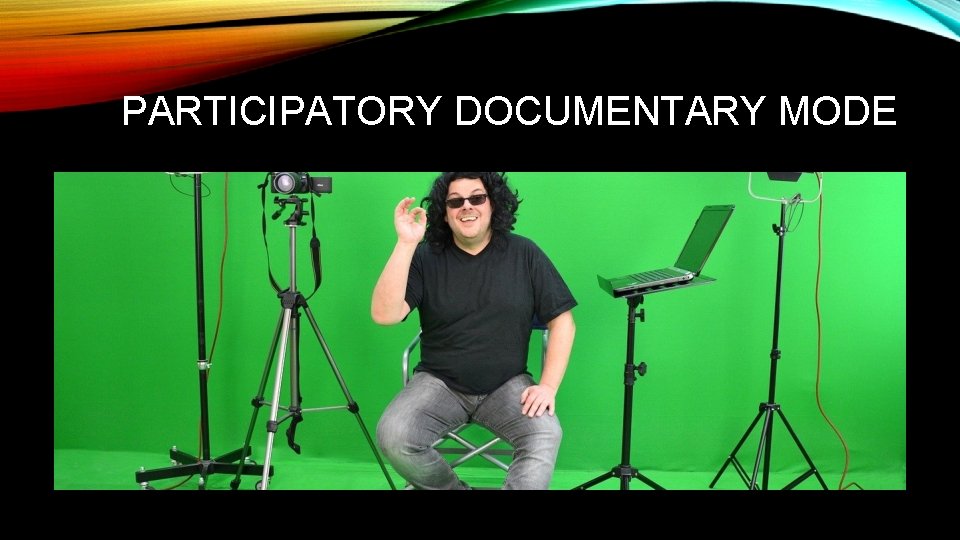
PARTICIPATORY DOCUMENTARY MODE
WATCH THE FOLLOWING CLIPS • https: //www. youtube. com/watch? v=1 NBVQB-Srpw • Louis Theroux BBC (Law and Order in Philadelphia - 2008) • 4 Mins
PARTICIPATORY MODE CONVENTIONS • The Participatory mode has become a popular form of documentary telling in the last 30 years or more with names such as Michael Moore, Nick Broomfield and Louis Theroux championing this technique. • Often this is also investigative filmmaking where a question is asked or a controversial topic is explored. • Participatory documentaries can be done by the filmmaker or director following their subject around asking questions, a technique often employed by Louis Theroux. The filmmaker does not influence the subject but will attempt to subjectively engage with their subject despite their personal beliefs.
PARTICIPATORY DOCUMENTARY MODE (CONT) • The filmmaker is a character and must either be seen or heard at some point in the movie, giving them a presence that is often as important as the primary subject. • The interviewer’s questions are included in the edit. In other documentary genres, subjects answer interview questions, but the questions themselves are edited out. In the participatory mode, the audience is allowed to see or hear the filmmaker asking the questions. This establishes a clearer relationship between the filmmaker and the interview subject, while also giving the viewer a more "behind the scenes" look at how the filmmaker elicited the subject's responses. • The viewer is aligned with the filmmaker. The audience experiences the film through the filmmaker's point of view, allowing them to share how the filmmaker felt in the moment and consider how they might have reacted in the same situation.
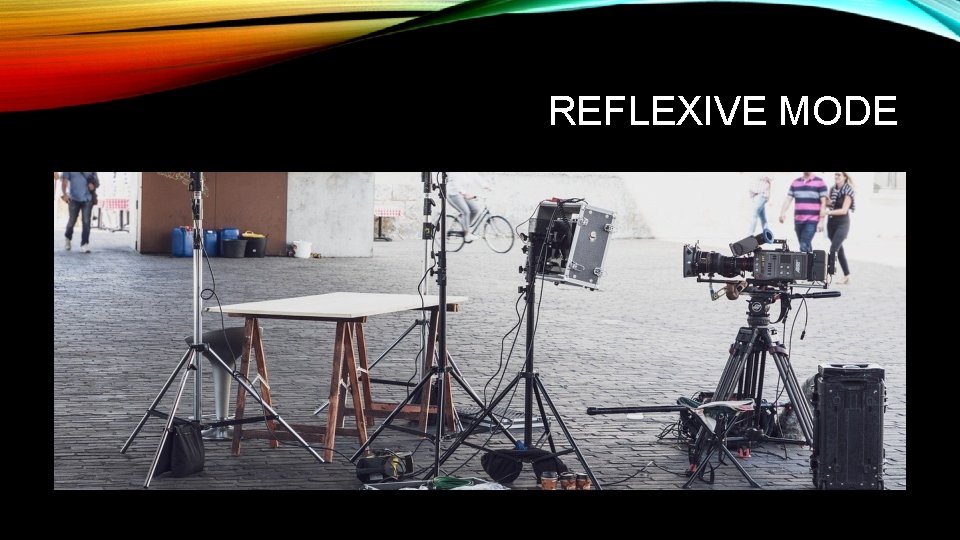
REFLEXIVE MODE
HERE ARE SOME EXAMPLES TO WATCH • https: //www. youtube. com/watch? v=Bt. Tlgxtoqhg Dziga Vertov - Man With A Movie Camera (1929) 1 min • https: //www. youtube. com/watch? v=qa. YOE 4 On_KQ • Driving Me Crazy (1988) Nick Broomfield – 2 mins • (Some bad language)

WHITEBOARD • Please add your thoughts about the clips and the conventions you noticed
REFLEXIVE MODE CONVENTIONS • Reflexive documentaries focus on the relationship between the filmmaker and the audience. Since the subject matter is often the process of documentary filmmaking itself, a cinematographer will shoot behind-the-scenes style footage of the entire film production process, including editing, interviewing, and post-production. Dziga Vertov’s reflexive documentary Man With a Movie Camera (1929) made history with its actor-less presentation of urban Soviet life. • Documentaries made in reflexive mode provoke audiences to “question the authenticity” of documentary in general • Reflexivity has been claimed to heighten the viewer's awareness with respect to the problematic relationship between reality and documentary film
REFLEXIVE MODE (CONT) • Often calls attention to the conventions of documentary filmmaking and sometimes of methodologies such as fieldwork or interview • Borrows techniques from fiction film for an emotional, subjective response. • Emphasizes the expressive nature of film; anti-realist techniques e. g. reenactments, expressive lighting, dramatic music. • Voiceover (when present) is likely to be questioning and uncertain – rather than authoritative. • Reliance on suggestion and implied meaning rather than fact • The genre of Mockumentary is closely related
PERFORMATIVE MODE • Watch • https: //www. youtube. com/watch? v=S 9__23 -zjh. M • Supersize Me – Morgan Spurlock (2004) 7 mins
PERFORMATIVE CONVENTIONS • Documentary-maker (and crew) are/interact with the subject. • Documentary-maker comments on the process of making the documentary. • The documentary is often shaped into the narrative of an investigation or search, possibly without a satisfactory conclusion. • The audience is addressed in an emotional and direct way. • Subject matter often concerns personal rather than ‘factual’ topics. • These personal, raw accounts may use reenactments, diaries and direct accounts of events
TASK • Find examples of documentaries that fit into each of these six modes.
- Slides: 28