
First 5 Partnerships Insights in SchoolBased Early Mental

First 5 Partnerships & Insights in School-Based Early Mental Health June 30, 2017
Presentation Overview Experiences from the early mental health and prevention field: 1. Power of partnerships 2. Social emotional health/ Intensive intervention 3. Early identification and screening 4. Family engagement 5. Challenges and opportunities of early prevention
Today’s Presenters • Margot Grant Gould, First 5 Association • Tammi Graham, First 5 Riverside • Adria Galarza, Lake Elsinore Unified School District • Melinda Konoske, Children & Families Commission of Orange County • Malia Ramler, First 5 Alameda
First 5 Riverside & Lake Elsinore Unified School District
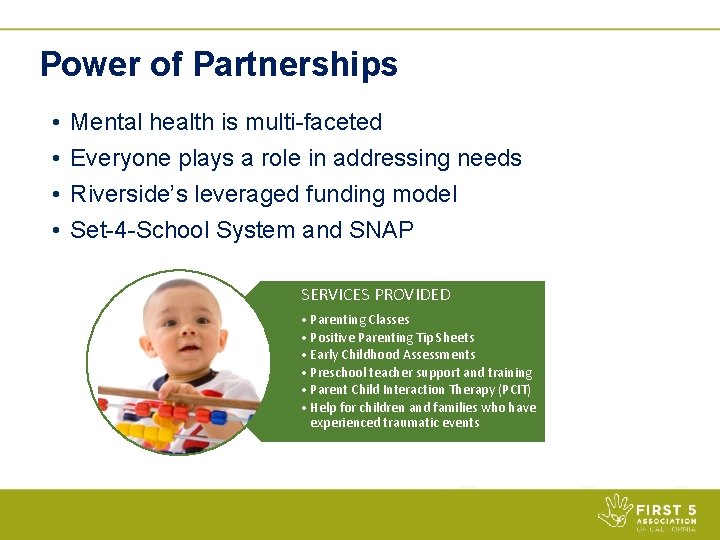
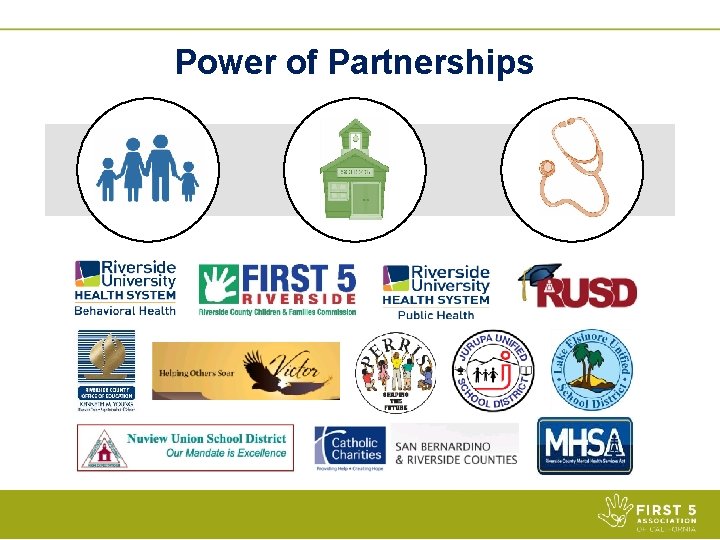
Power of Partnerships • • Mental health is multi-faceted Everyone plays a role in addressing needs Riverside’s leveraged funding model Set-4 -School System and SNAP SERVICES PROVIDED • Parenting Classes • Positive Parenting Tip Sheets • Early Childhood Assessments • Preschool teacher support and training • Parent Child Interaction Therapy (PCIT) • Help for children and families who have experienced traumatic events
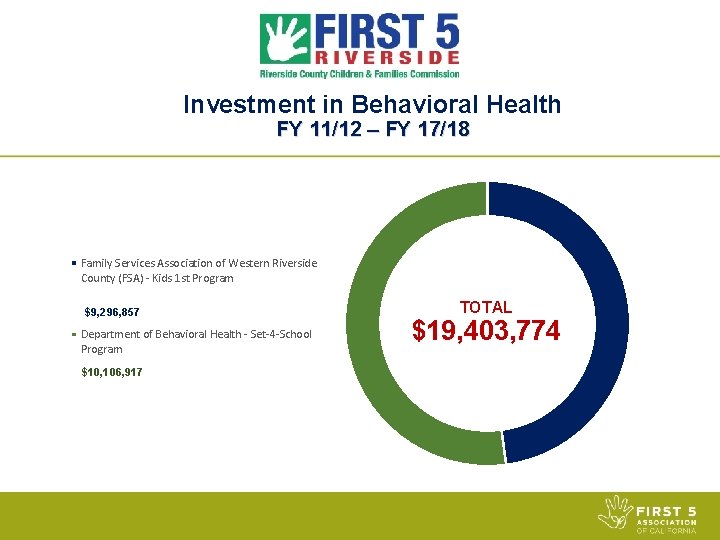
Investment in Behavioral Health FY 11/12 – FY 17/18 Funding Family Services Association of Western Riverside County (FSA) - Kids 1 st Program $9, 296, 857 Department of Behavioral Health - Set-4 -School Program $10, 106, 917 TOTAL $19, 403, 774
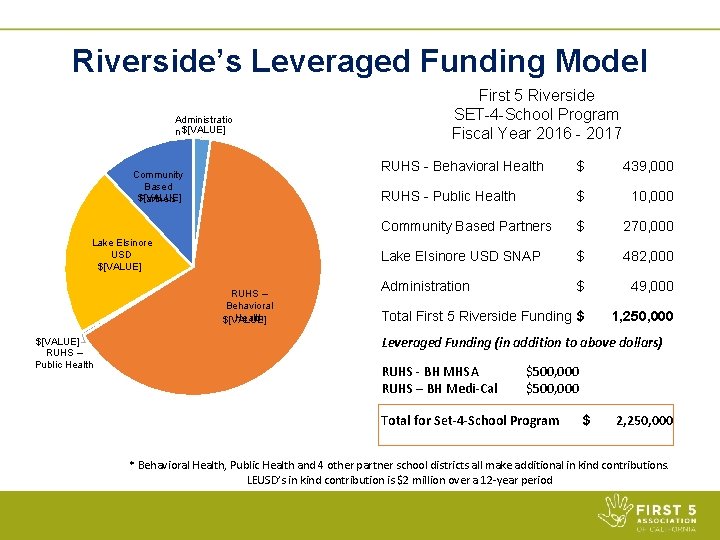
Riverside’s Leveraged Funding Model Administratio n $[VALUE] Community Based $[VALUE] Partners Lake Elsinore USD $[VALUE] RUHS – Behavioral Health $[VALUE] RUHS – Public Health First 5 Riverside SET-4 -School Program Fiscal Year 2016 - 2017 RUHS - Behavioral Health $ 439, 000 RUHS - Public Health $ 10, 000 Community Based Partners $ 270, 000 Lake Elsinore USD SNAP $ 482, 000 Administration $ 49, 000 Total First 5 Riverside Funding $ 1, 250, 000 Leveraged Funding (in addition to above dollars) RUHS - BH MHSA RUHS – BH Medi-Cal $500, 000 Total for Set-4 -School Program $ 2, 250, 000 * Behavioral Health, Public Health and 4 other partner school districts all make additional in kind contributions. LEUSD’s in kind contribution is $2 million over a 12 -year period
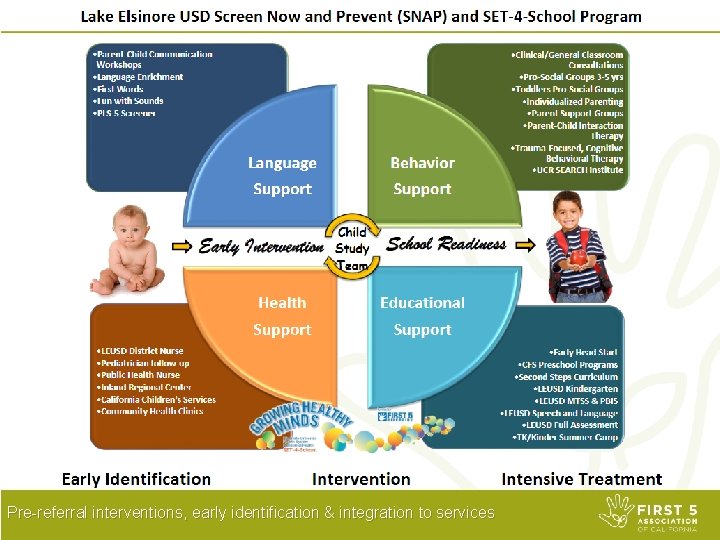
Pre-referral interventions, early identification & integration to services
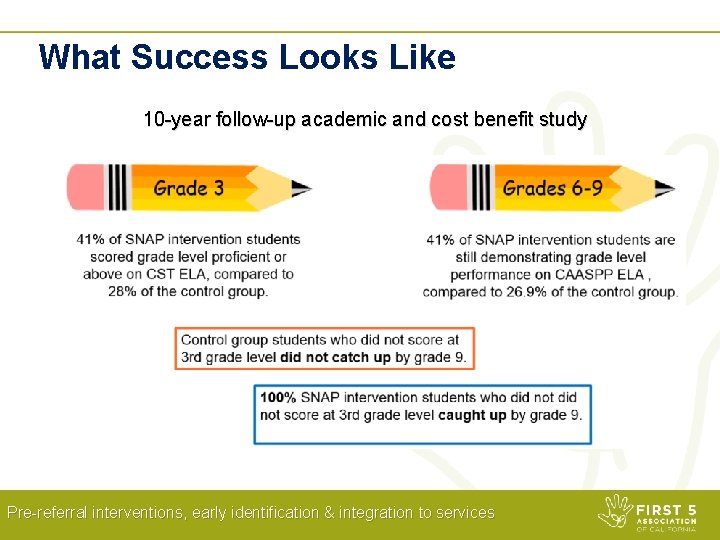
What Success Looks Like 10 -year follow-up academic and cost benefit study Pre-referral interventions, early identification & integration to services
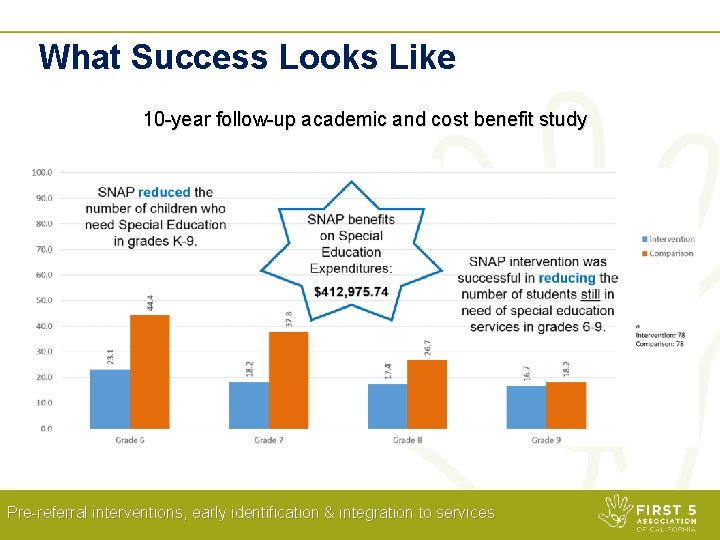
What Success Looks Like 10 -year follow-up academic and cost benefit study Pre-referral interventions, early identification & integration to services
Power of Partnerships
Children & Families Commission of Orange County
Experiences of Early Childhood Education Providers Key Findings in Orange County 1: § Over 1/4 (28%) of early education providers have behavior or mental health concerns about a child they serve § More than 1/3 (37%) of providers have asked a child to leave their program permanently due to behavioral challenges/ potential mental health concerns § Nearly 1/4 (22%) of providers were caring for a child who had been asked to leave their previous provider for behavior or mental health concerns.
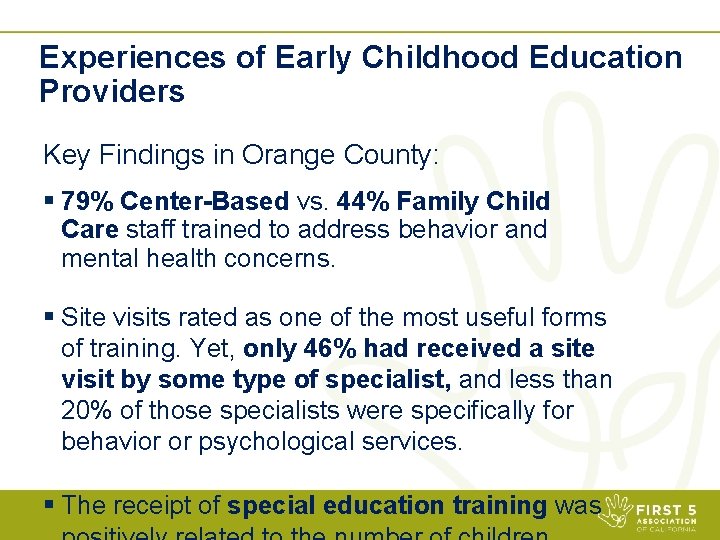
Experiences of Early Childhood Education Providers Key Findings in Orange County: § 79% Center-Based vs. 44% Family Child Care staff trained to address behavior and mental health concerns. § Site visits rated as one of the most useful forms of training. Yet, only 46% had received a site visit by some type of specialist, and less than 20% of those specialists were specifically for behavior or psychological services. § The receipt of special education training was
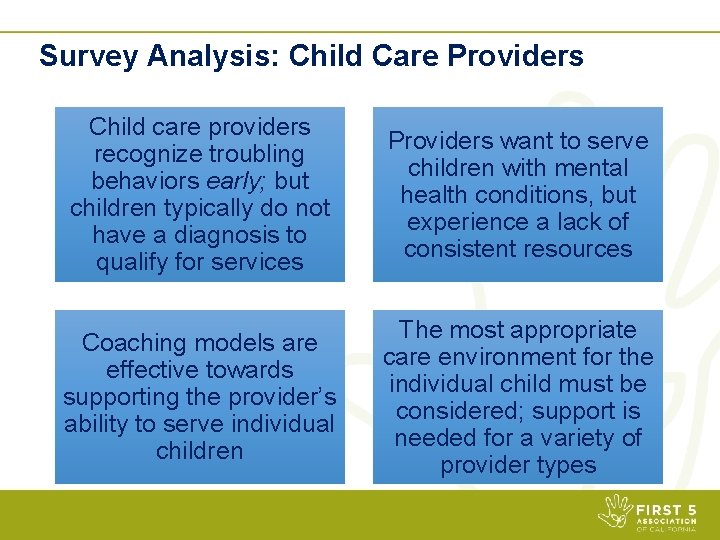
Survey Analysis: Child Care Providers Child care providers recognize troubling behaviors early; but children typically do not have a diagnosis to qualify for services Providers want to serve children with mental health conditions, but experience a lack of consistent resources Coaching models are effective towards supporting the provider’s ability to serve individual children The most appropriate care environment for the individual child must be considered; support is needed for a variety of provider types
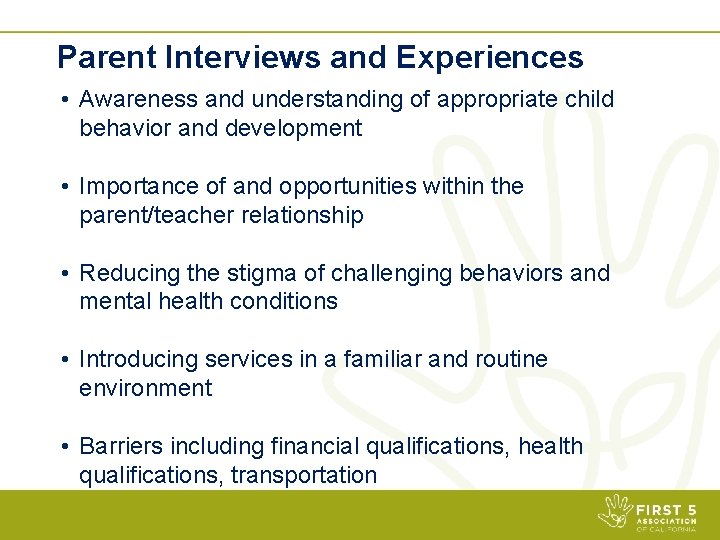
Parent Interviews and Experiences • Awareness and understanding of appropriate child behavior and development • Importance of and opportunities within the parent/teacher relationship • Reducing the stigma of challenging behaviors and mental health conditions • Introducing services in a familiar and routine environment • Barriers including financial qualifications, health qualifications, transportation
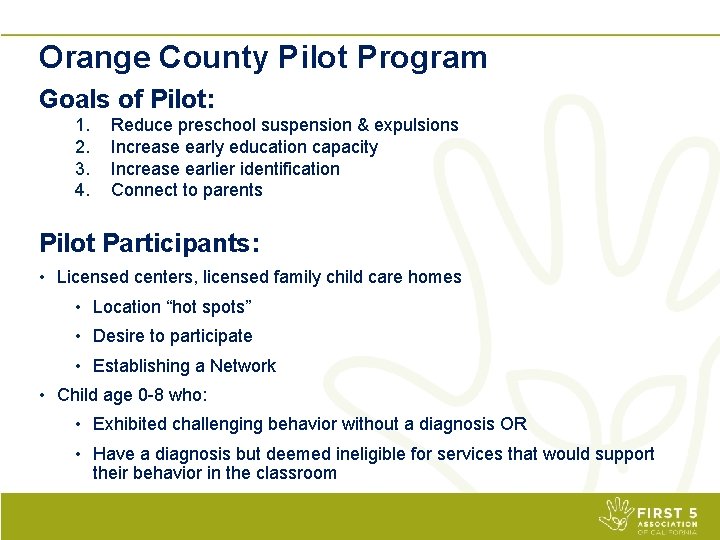
Orange County Pilot Program Goals of Pilot: 1. 2. 3. 4. Reduce preschool suspension & expulsions Increase early education capacity Increase earlier identification Connect to parents Pilot Participants: • Licensed centers, licensed family child care homes • Location “hot spots” • Desire to participate • Establishing a Network • Child age 0 -8 who: • Exhibited challenging behavior without a diagnosis OR • Have a diagnosis but deemed ineligible for services that would support their behavior in the classroom
Orange County Pilot Program • Systems development/ integration: • Help Me Grow developmental screenings • Children’s Hospital of Orange County clinical services • Community organizations behavior interventions, parent education, social services • Key Components: • • On-Site Consultation & Coaching Provider & Parent Education Referrals Direct Clinical Assessment & Services
First 5 Alameda
Unique Context of ECE • Kindergarten teachers know what research reinforces: social emotional self-regulation = ready to learn • Early care and education (ECE) ideal for social emotional learning and early identification of mental health concerns. • But must be delivered in the unique context that is ECE – Lessons learned in Alameda County: 1. Many pathways to kindergarten 2. ECE Workforce Characteristics 3. Need for developmental specificity
1) Many Pathways to Kindergarten • Unlike 1 st -12 th grade, early learning is not required • 40% of our 3 -5 year olds don’t attend licensed care • State ECE subsidy in many settings: • • School district CDC’s CBO’s FCC and FFN Private child care centers • Key Takeaways: • Engage families to increase access to and utilization of formal early learning; • Look beyond just local education agencies to all state supported preschool settings
2) ECE Workforce Characteristics • Some “givens” in the K-12 system may not apply in ECE – even when it is a school district classroom • Schedules • Compensation • Credentialing • Key Takeaways: Funding for schoolwide climate interventions need to allow for flexible use of: • Training, coaching, and release time • Differently credentialed mental health workers • Support for “job crafting” and pay parity
3) Developmental Specificity • Lower expulsion rates when teachers report having access to mental health consultation. Includes: • Classroom consultation • Individual child consultation • Early childhood mental health consultants are cross trained in both early childhood mental health, child development, and ECE practice • California Department of Ed has invested in a positive behavior support model specific to early learning – CA CSEFEL – in alignment with PBIS
Key Takeaways • Program Alignment & Partnership Opportunities: • QRIS - Professional development pathways for ECE providers and promotes ASQ/ developmental screening; In all 58 counties • Help Me Grow – Resource referrals for developmental screenings and parent education. Currently in 15 counties and expanding. • Unique Insights for ECE • Array of pathways Kindergarten – family engagement critical • Pre. K workforce differences • Developmentally specific evidence based models – like CSEFEL and ECMHC – are consistent with PBIS. • Partnerships and Leveraged Funding • What makes programs possible and successful • Blended funding streams are the norm; sustainability is the challenge • First 5 wants to be partner as you move forward with your pilot • Continued Coordination • Trainings and professional development • Shared finding of existing programs (Lake Elsinore USD) and newly created pilots (Orange County)

Thank You & Question?
- Slides: 25