
Firmspecific knowledge resources and competitive advantage The roles


- Slides: 13
Firm-specific knowledge resources and competitive advantage: The roles of economic- and relationship-based employee governance mechanisms (2009) Heli Wang, Jinyu He, Joseph T. Mahoney Presented by Jiyoon Chung Modified by Jong-kyung Park
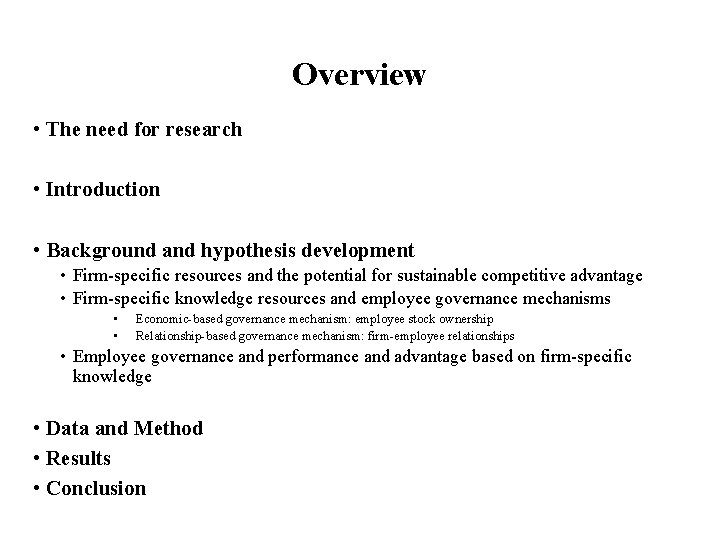
Overview • The need for research • Introduction • Background and hypothesis development • Firm-specific resources and the potential for sustainable competitive advantage • Firm-specific knowledge resources and employee governance mechanisms • • Economic-based governance mechanism: employee stock ownership Relationship-based governance mechanism: firm-employee relationships • Employee governance and performance and advantage based on firm-specific knowledge • Data and Method • Results • Conclusion
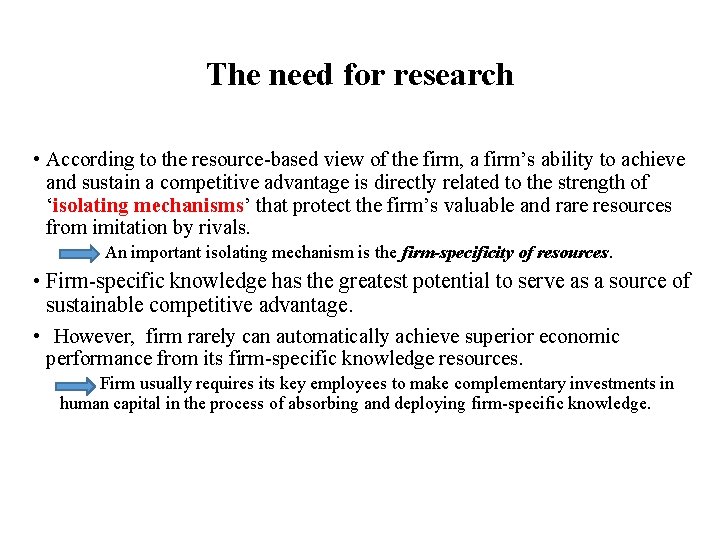
The need for research • According to the resource-based view of the firm, a firm’s ability to achieve and sustain a competitive advantage is directly related to the strength of ‘isolating mechanisms’ that protect the firm’s valuable and rare resources from imitation by rivals. An important isolating mechanism is the firm-specificity of resources. • Firm-specific knowledge has the greatest potential to serve as a source of sustainable competitive advantage. • However, firm rarely can automatically achieve superior economic performance from its firm-specific knowledge resources. Firm usually requires its key employees to make complementary investments in human capital in the process of absorbing and deploying firm-specific knowledge.
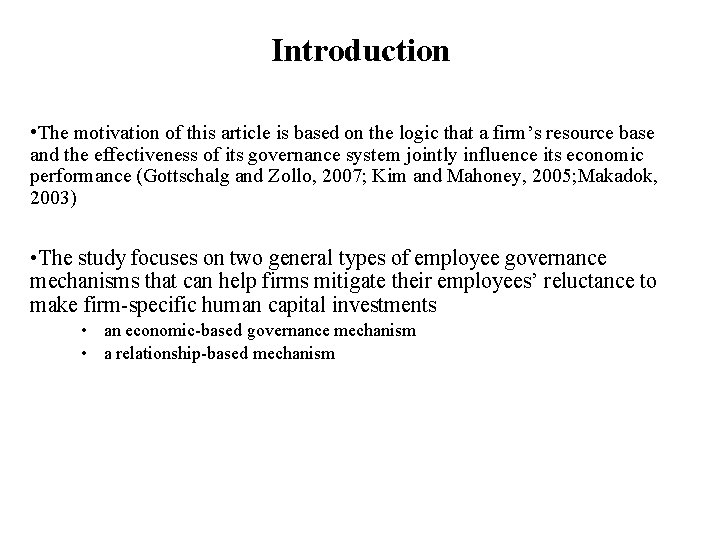
Introduction • The motivation of this article is based on the logic that a firm’s resource base and the effectiveness of its governance system jointly influence its economic performance (Gottschalg and Zollo, 2007; Kim and Mahoney, 2005; Makadok, 2003) • The study focuses on two general types of employee governance mechanisms that can help firms mitigate their employees’ reluctance to make firm-specific human capital investments • an economic-based governance mechanism • a relationship-based mechanism
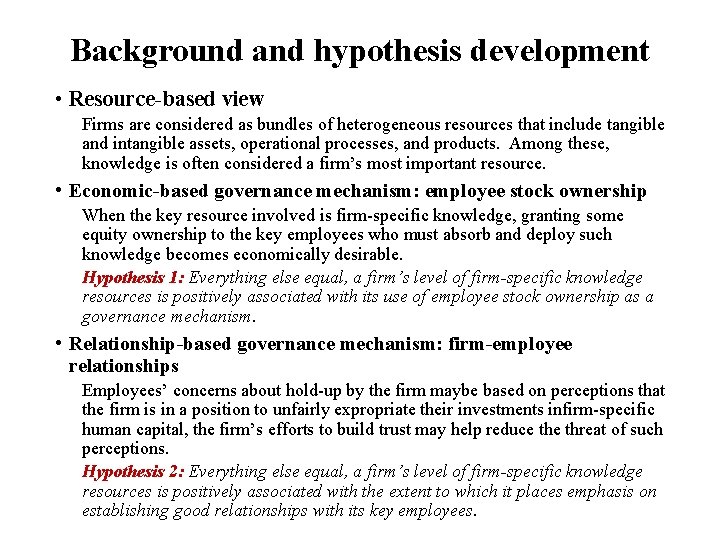
Background and hypothesis development • Resource-based view Firms are considered as bundles of heterogeneous resources that include tangible and intangible assets, operational processes, and products. Among these, knowledge is often considered a firm’s most important resource. • Economic-based governance mechanism: employee stock ownership When the key resource involved is firm-specific knowledge, granting some equity ownership to the key employees who must absorb and deploy such knowledge becomes economically desirable. Hypothesis 1: Everything else equal, a firm’s level of firm-specific knowledge resources is positively associated with its use of employee stock ownership as a governance mechanism. • Relationship-based governance mechanism: firm-employee relationships Employees’ concerns about hold-up by the firm maybe based on perceptions that the firm is in a position to unfairly expropriate their investments infirm-specific human capital, the firm’s efforts to build trust may help reduce threat of such perceptions. Hypothesis 2: Everything else equal, a firm’s level of firm-specific knowledge resources is positively associated with the extent to which it places emphasis on establishing good relationships with its key employees.
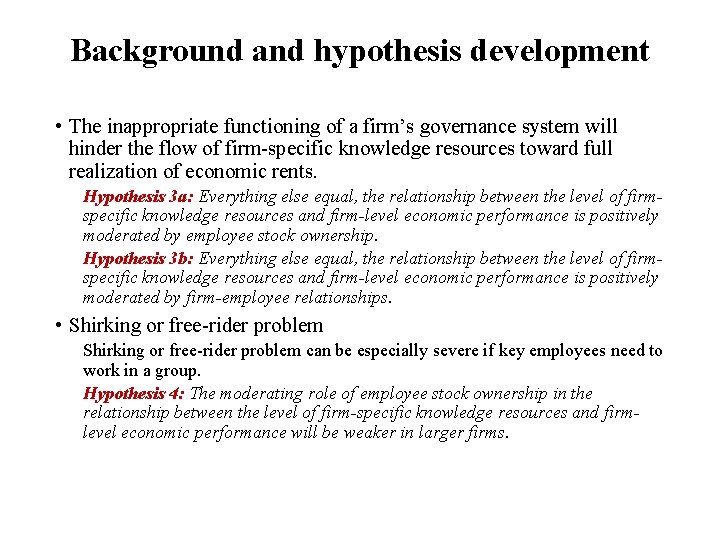
Background and hypothesis development • The inappropriate functioning of a firm’s governance system will hinder the flow of firm-specific knowledge resources toward full realization of economic rents. Hypothesis 3 a: Everything else equal, the relationship between the level of firmspecific knowledge resources and firm-level economic performance is positively moderated by employee stock ownership. Hypothesis 3 b: Everything else equal, the relationship between the level of firmspecific knowledge resources and firm-level economic performance is positively moderated by firm-employee relationships. • Shirking or free-rider problem can be especially severe if key employees need to work in a group. Hypothesis 4: The moderating role of employee stock ownership in the relationship between the level of firm-specific knowledge resources and firmlevel economic performance will be weaker in larger firms.
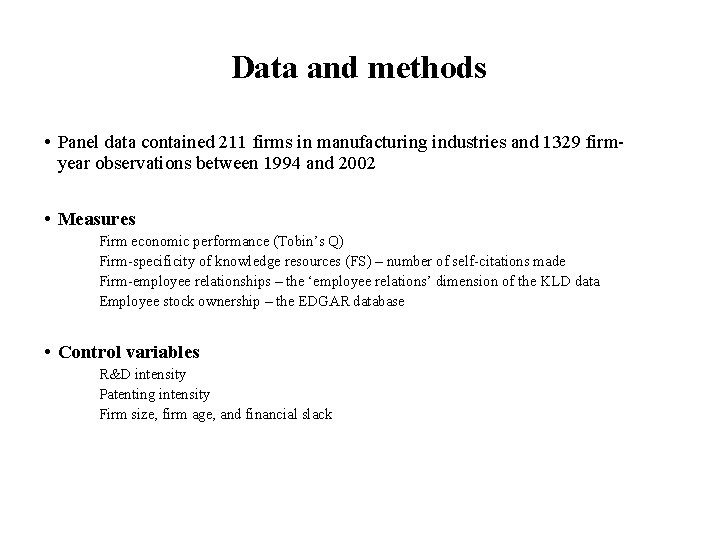
Data and methods • Panel data contained 211 firms in manufacturing industries and 1329 firmyear observations between 1994 and 2002 • Measures Firm economic performance (Tobin’s Q) Firm-specificity of knowledge resources (FS) – number of self-citations made Firm-employee relationships – the ‘employee relations’ dimension of the KLD data Employee stock ownership – the EDGAR database • Control variables R&D intensity Patenting intensity Firm size, firm age, and financial slack
Data and methods
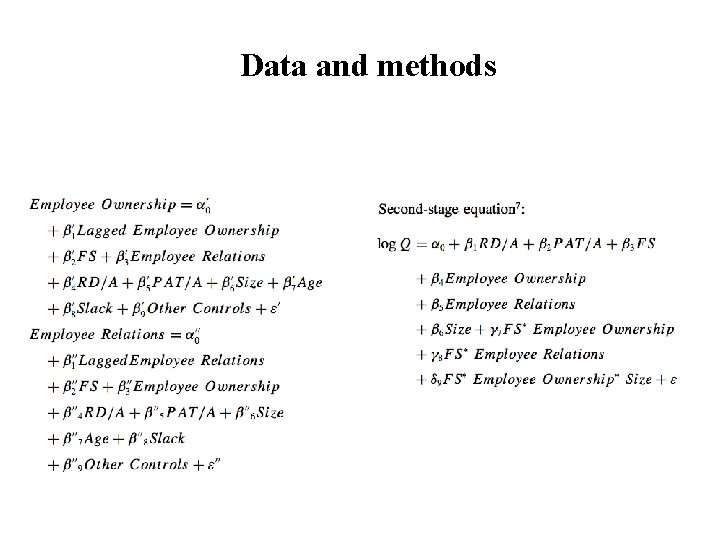
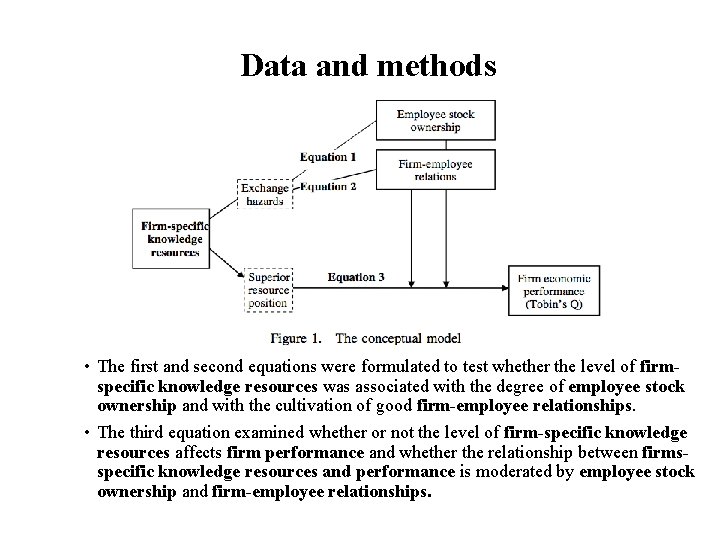
Data and methods • The first and second equations were formulated to test whether the level of firmspecific knowledge resources was associated with the degree of employee stock ownership and with the cultivation of good firm-employee relationships. • The third equation examined whether or not the level of firm-specific knowledge resources affects firm performance and whether the relationship between firmsspecific knowledge resources and performance is moderated by employee stock ownership and firm-employee relationships.
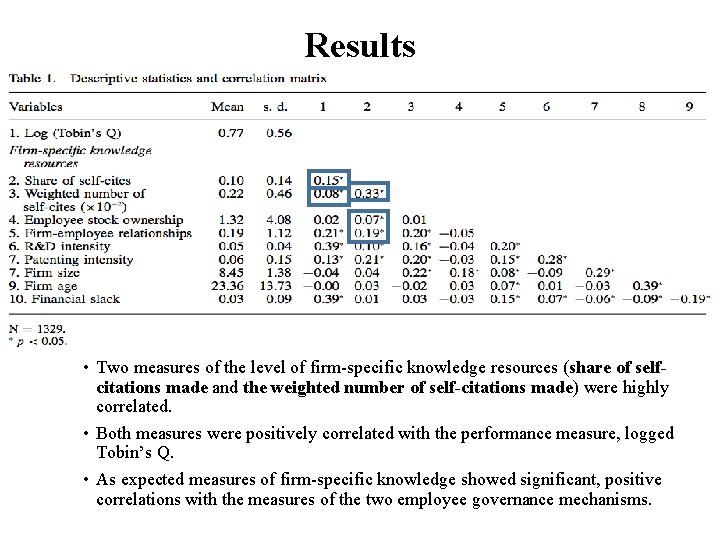
Results • Two measures of the level of firm-specific knowledge resources (share of selfcitations made and the weighted number of self-citations made) were highly correlated. • Both measures were positively correlated with the performance measure, logged Tobin’s Q. • As expected measures of firm-specific knowledge showed significant, positive correlations with the measures of the two employee governance mechanisms.
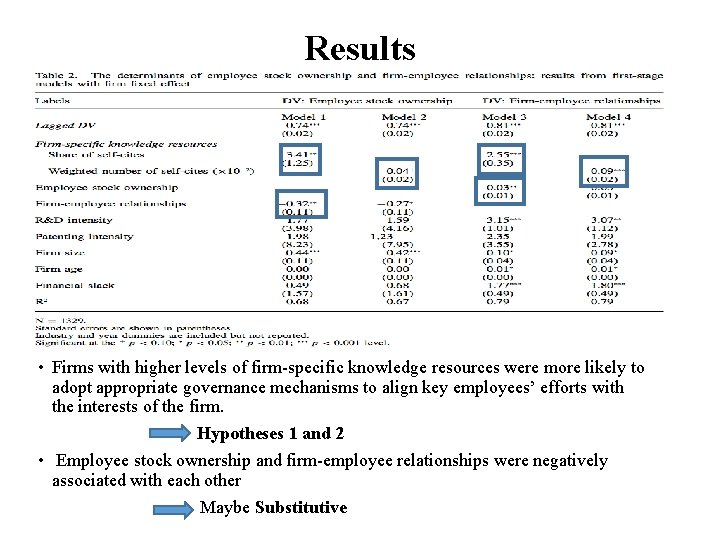
Results • Firms with higher levels of firm-specific knowledge resources were more likely to adopt appropriate governance mechanisms to align key employees’ efforts with the interests of the firm. Hypotheses 1 and 2 • Employee stock ownership and firm-employee relationships were negatively associated with each other Maybe Substitutive
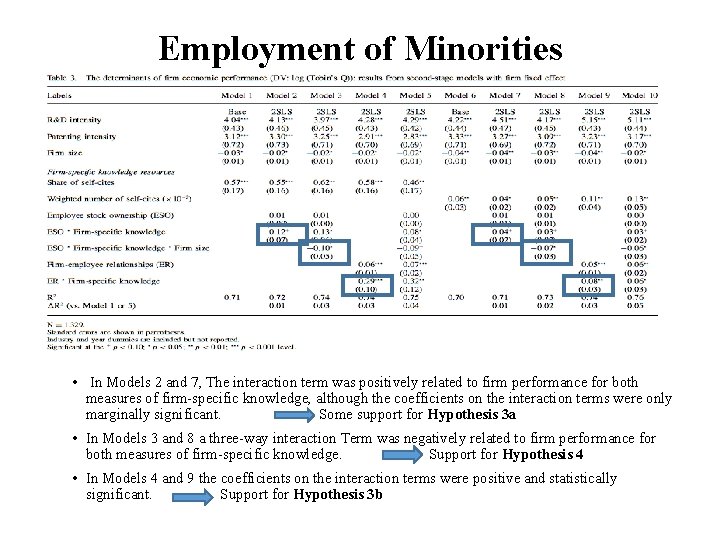
Employment of Minorities • In Models 2 and 7, The interaction term was positively related to firm performance for both measures of firm-specific knowledge, although the coefficients on the interaction terms were only marginally significant. Some support for Hypothesis 3 a • In Models 3 and 8 a three-way interaction Term was negatively related to firm performance for both measures of firm-specific knowledge. Support for Hypothesis 4 • In Models 4 and 9 the coefficients on the interaction terms were positive and statistically significant. Support for Hypothesis 3 b
Discussion and Conclusions • Firms with greater firm-specific knowledge resources are more likely to adopt governance mechanisms appropriate for reducing key employees’ concerns about hold-up by the firm. • The increased use of these governance mechanisms strengthens the relationship between the level of firmspecific knowledge and a firm’s economic performance. • Employee governance mechanisms are endogenous to the nature of firm knowledge resources.