
Firm and Household Decisions Input and output markets

- Slides: 32
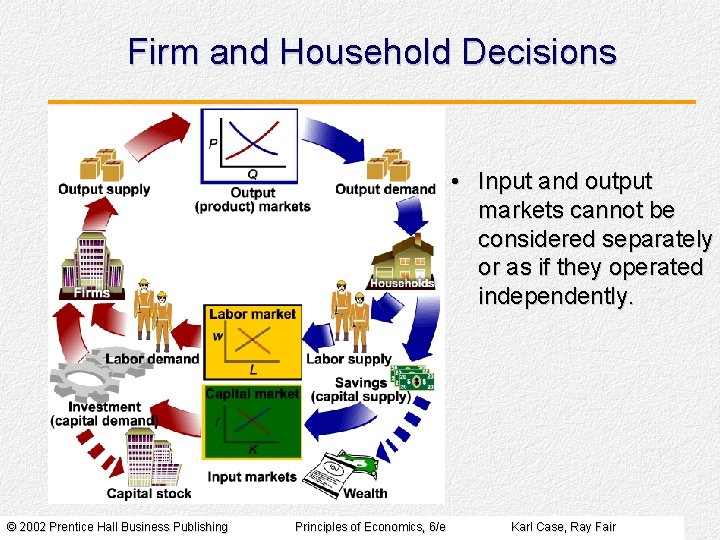
Firm and Household Decisions • Input and output markets cannot be considered separately or as if they operated independently. © 2002 Prentice Hall Business Publishing Principles of Economics, 6/e Karl Case, Ray Fair
Partial Equilibrium Analysis • Partial equilibrium analysis is the process of examining the equilibrium conditions in individual markets, and for households and firms, separately. © 2002 Prentice Hall Business Publishing Principles of Economics, 6/e Karl Case, Ray Fair
General Equilibrium • General equilibrium is the condition that exists when all markets in an economy are in simultaneous equilibrium. © 2002 Prentice Hall Business Publishing Principles of Economics, 6/e Karl Case, Ray Fair
Efficiency • In judging the performance of an economic system, two criteria used are efficiency and equity (fairness). • Efficiency is the condition in which the economy is producing what people want at the least possible cost. © 2002 Prentice Hall Business Publishing Principles of Economics, 6/e Karl Case, Ray Fair
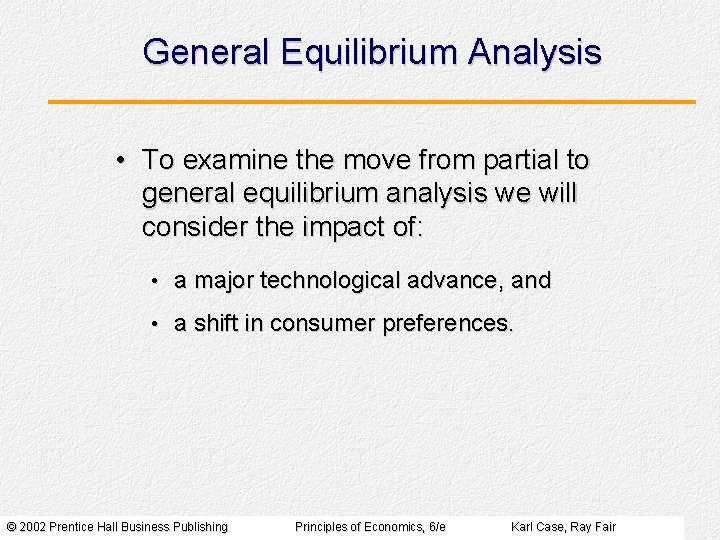
General Equilibrium Analysis • To examine the move from partial to general equilibrium analysis we will consider the impact of: • a major technological advance, and • a shift in consumer preferences. © 2002 Prentice Hall Business Publishing Principles of Economics, 6/e Karl Case, Ray Fair
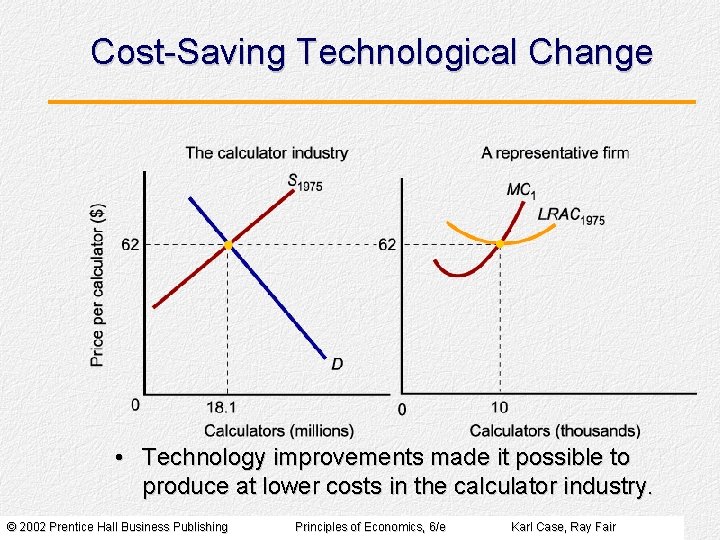
Cost-Saving Technological Change • Technology improvements made it possible to produce at lower costs in the calculator industry. © 2002 Prentice Hall Business Publishing Principles of Economics, 6/e Karl Case, Ray Fair
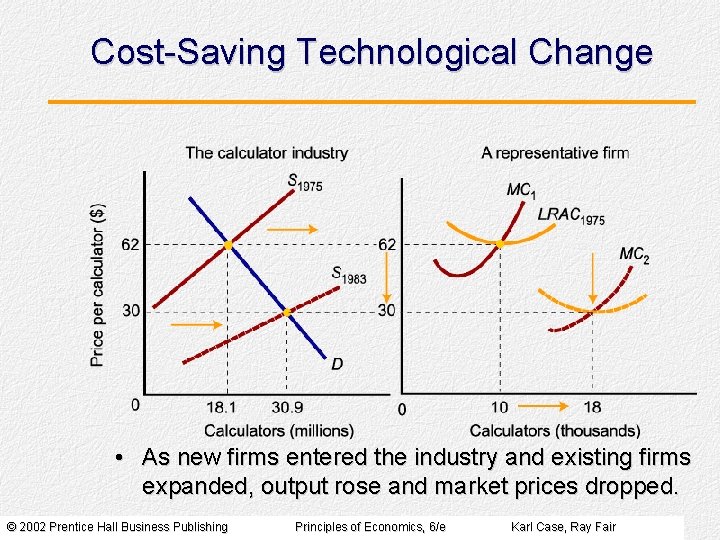
Cost-Saving Technological Change • As new firms entered the industry and existing firms expanded, output rose and market prices dropped. © 2002 Prentice Hall Business Publishing Principles of Economics, 6/e Karl Case, Ray Fair
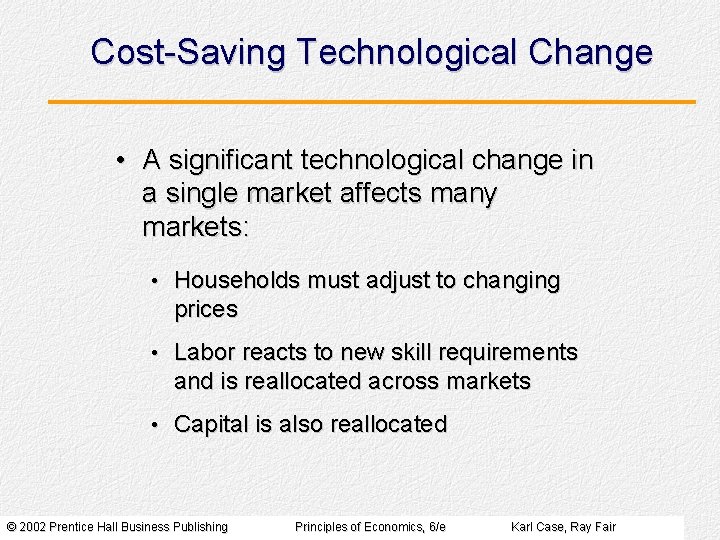
Cost-Saving Technological Change • A significant technological change in a single market affects many markets: • Households must adjust to changing prices • Labor reacts to new skill requirements and is reallocated across markets • Capital is also reallocated © 2002 Prentice Hall Business Publishing Principles of Economics, 6/e Karl Case, Ray Fair
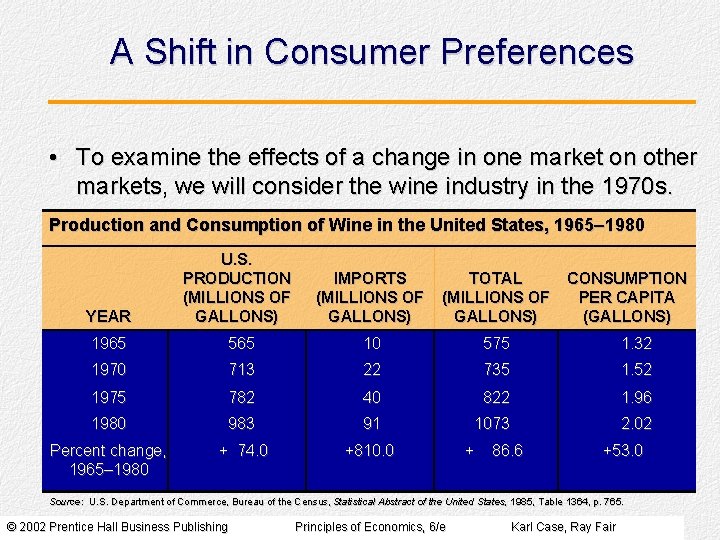
A Shift in Consumer Preferences • To examine the effects of a change in one market on other markets, we will consider the wine industry in the 1970 s. Production and Consumption of Wine in the United States, 1965– 1980 YEAR U. S. PRODUCTION (MILLIONS OF GALLONS) IMPORTS (MILLIONS OF GALLONS) TOTAL (MILLIONS OF GALLONS) 1965 565 10 575 1. 32 1970 713 22 735 1. 52 1975 782 40 822 1. 96 1980 983 91 1073 2. 02 Percent change, 1965– 1980 + 74. 0 +810. 0 + 86. 6 CONSUMPTION PER CAPITA (GALLONS) +53. 0 Source: U. S. Department of Commerce, Bureau of the Census, Statistical Abstract of the United States, 1985, Table 1364, p. 765. © 2002 Prentice Hall Business Publishing Principles of Economics, 6/e Karl Case, Ray Fair
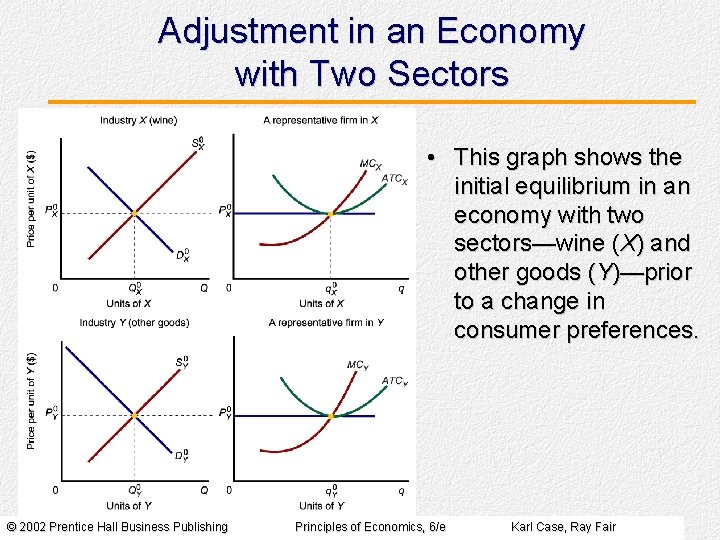
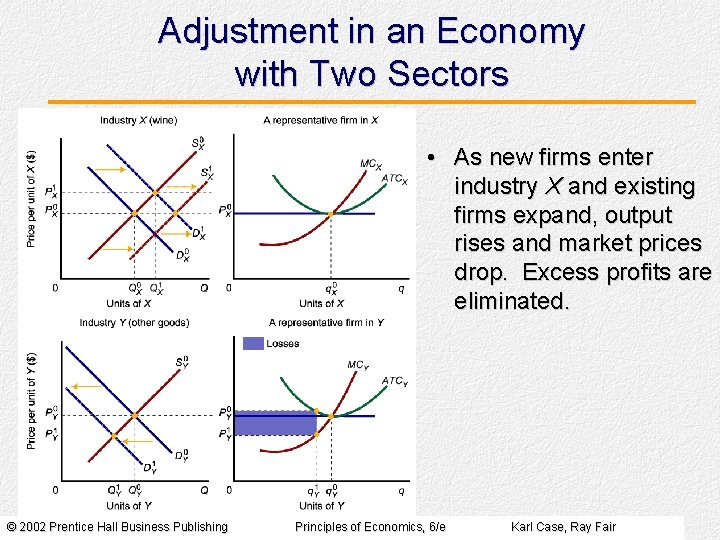
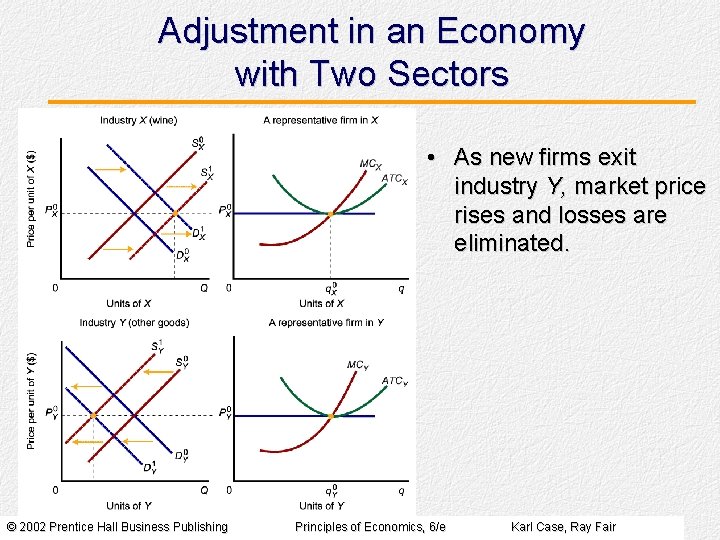
Adjustment in an Economy with Two Sectors • This graph shows the initial equilibrium in an economy with two sectors—wine (X) and other goods (Y)—prior to a change in consumer preferences. © 2002 Prentice Hall Business Publishing Principles of Economics, 6/e Karl Case, Ray Fair
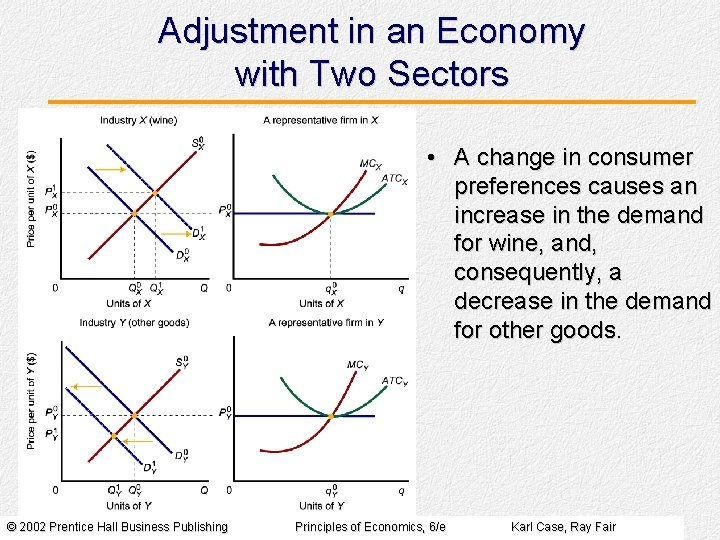
Adjustment in an Economy with Two Sectors • A change in consumer preferences causes an increase in the demand for wine, and, consequently, a decrease in the demand for other goods. © 2002 Prentice Hall Business Publishing Principles of Economics, 6/e Karl Case, Ray Fair
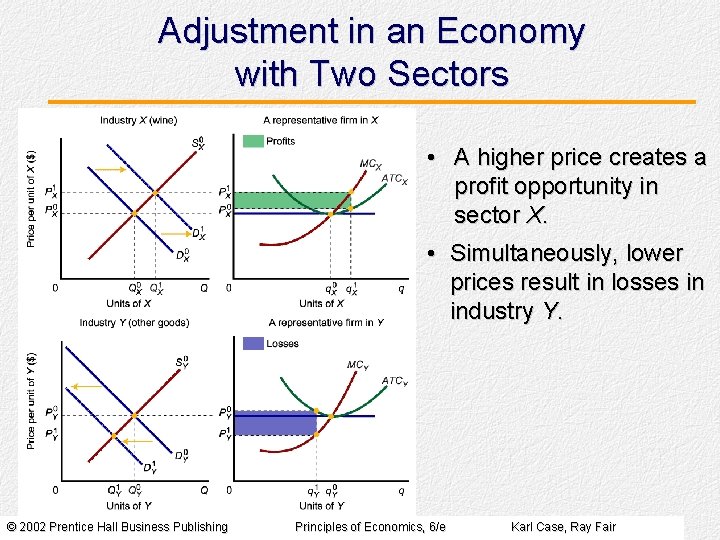
Adjustment in an Economy with Two Sectors • A higher price creates a profit opportunity in sector X. • Simultaneously, lower prices result in losses in industry Y. © 2002 Prentice Hall Business Publishing Principles of Economics, 6/e Karl Case, Ray Fair
Adjustment in an Economy with Two Sectors • As new firms enter industry X and existing firms expand, output rises and market prices drop. Excess profits are eliminated. © 2002 Prentice Hall Business Publishing Principles of Economics, 6/e Karl Case, Ray Fair
Adjustment in an Economy with Two Sectors • As new firms exit industry Y, market price rises and losses are eliminated. © 2002 Prentice Hall Business Publishing Principles of Economics, 6/e Karl Case, Ray Fair
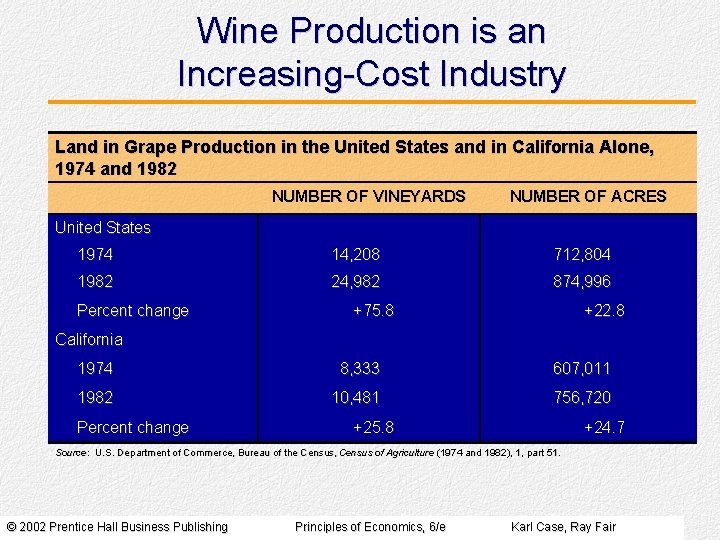
Wine Production is an Increasing-Cost Industry Land in Grape Production in the United States and in California Alone, 1974 and 1982 NUMBER OF VINEYARDS NUMBER OF ACRES United States 1974 14, 208 712, 804 1982 24, 982 874, 996 Percent change +75. 8 +22. 8 California 1974 8, 333 607, 011 1982 10, 481 756, 720 Percent change +25. 8 +24. 7 Source: U. S. Department of Commerce, Bureau of the Census, Census of Agriculture (1974 and 1982), 1, part 51. © 2002 Prentice Hall Business Publishing Principles of Economics, 6/e Karl Case, Ray Fair
Formal Proof of a General Competitive Equilibrium • This section explains why perfect competition is efficient in dividing scarce resources among alternative uses. • If the assumptions of a perfectly competitive economic system hold, the economy will produce an efficient allocation of resources. © 2002 Prentice Hall Business Publishing Principles of Economics, 6/e Karl Case, Ray Fair
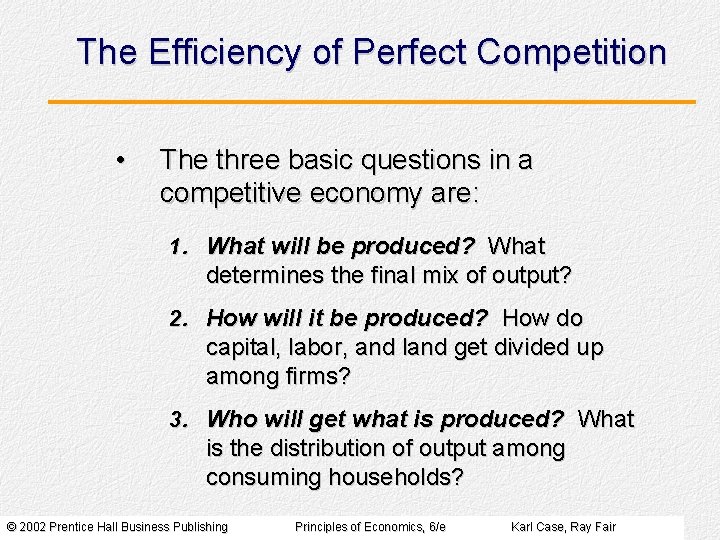
The Efficiency of Perfect Competition • The three basic questions in a competitive economy are: 1. What will be produced? What determines the final mix of output? 2. How will it be produced? How do capital, labor, and land get divided up among firms? 3. Who will get what is produced? What is the distribution of output among consuming households? © 2002 Prentice Hall Business Publishing Principles of Economics, 6/e Karl Case, Ray Fair
The Efficiency of Perfect Competition • As we will see, in a perfectly competitive economic system: 1. resources are allocated among firms efficiently, 2. final products are distributed among households efficiently, and 3. the system produces the things that people want. © 2002 Prentice Hall Business Publishing Principles of Economics, 6/e Karl Case, Ray Fair
Pareto Efficiency • Pareto efficiency, or Pareto optimality, is a condition in which no change is possible that will make some members of society better off without making some other members of society worse off. • This very precise concept of efficiency is known as allocative efficiency. © 2002 Prentice Hall Business Publishing Principles of Economics, 6/e Karl Case, Ray Fair
The Efficiency of Perfect Competition Efficient Allocation of Resources: • Perfectly competitive firms have incentives to use the best available technology. • With a full knowledge of existing technologies, firms will choose the technology that produces the output they want at the least cost. • Each firm uses inputs such that MRPL = PL. The marginal value of each input to each firm is just equal to its market price. © 2002 Prentice Hall Business Publishing Principles of Economics, 6/e Karl Case, Ray Fair
The Efficiency of Perfect Competition Efficient Distribution of Outputs Among Households: • Within the constraints imposed by income and wealth, households are free to choose among all the goods and services available in output markets. Utility value is revealed in market behavior. • As long as everyone shops freely in the same markets, no redistribution of final outputs among people will make them better off. © 2002 Prentice Hall Business Publishing Principles of Economics, 6/e Karl Case, Ray Fair
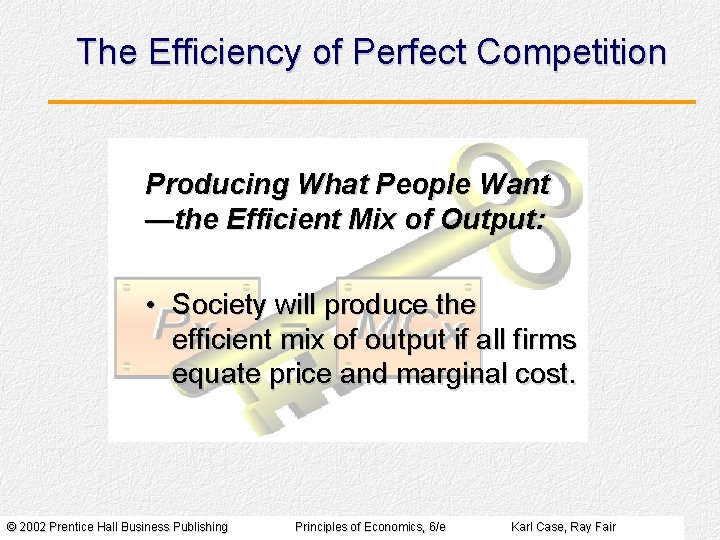
The Efficiency of Perfect Competition Producing What People Want —the Efficient Mix of Output: • Society will produce the efficient mix of output if all firms equate price and marginal cost. © 2002 Prentice Hall Business Publishing Principles of Economics, 6/e Karl Case, Ray Fair
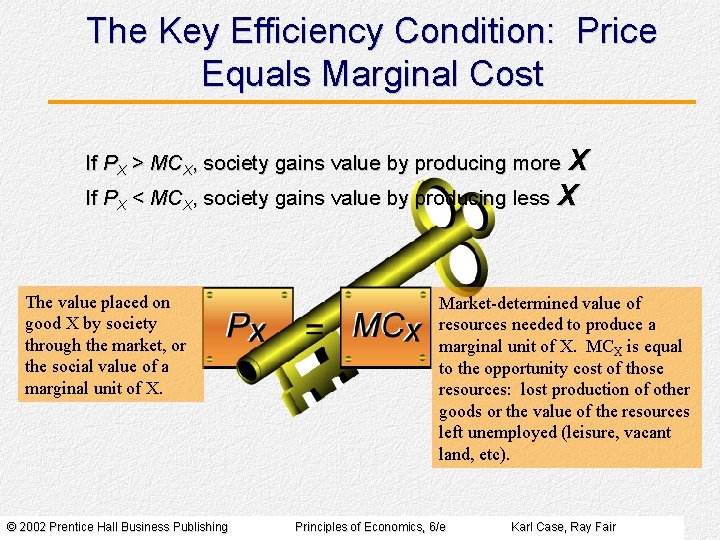
The Key Efficiency Condition: Price Equals Marginal Cost X If PX < MCX, society gains value by producing less X If PX > MCX, society gains value by producing more The value placed on good X by society through the market, or the social value of a marginal unit of X. © 2002 Prentice Hall Business Publishing Market-determined value of resources needed to produce a marginal unit of X. MCX is equal to the opportunity cost of those resources: lost production of other goods or the value of the resources left unemployed (leisure, vacant land, etc). Principles of Economics, 6/e Karl Case, Ray Fair
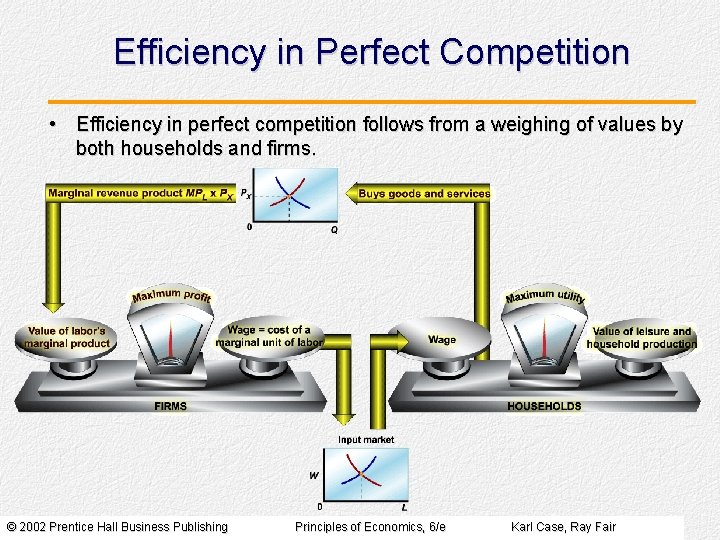
Efficiency in Perfect Competition • Efficiency in perfect competition follows from a weighing of values by both households and firms. © 2002 Prentice Hall Business Publishing Principles of Economics, 6/e Karl Case, Ray Fair
The Sources of Market Failure • Market failure occurs when resources are misallocated, or allocated inefficiently. The result is waste or lost value. Evidence of market failure is revealed by the existence of: • Imperfect markets • Public goods • Externalities • Imperfect information © 2002 Prentice Hall Business Publishing Principles of Economics, 6/e Karl Case, Ray Fair
Imperfect Markets • Imperfect competition is an industry in which single firms have some control over price and competition. • Imperfectly competitive industries give rise to an inefficient allocation of resources. © 2002 Prentice Hall Business Publishing Principles of Economics, 6/e Karl Case, Ray Fair
Imperfect Markets • Monopoly is an industry composed of only one firm that produces a product for which there are no close substitutes and in which significant barriers exist to prevent new firms from entering the industry. © 2002 Prentice Hall Business Publishing Principles of Economics, 6/e Karl Case, Ray Fair
Imperfect Markets • In all imperfectly competitive industries, output is lower—the product is underproduced—and price is higher than it would be under perfect competition. • The equilibrium condition P = MC does not hold, and the system does not produce the most efficient product mix. © 2002 Prentice Hall Business Publishing Principles of Economics, 6/e Karl Case, Ray Fair
Public Goods • Public goods, or social goods are goods and services that bestow collective benefits on members of society. • Generally, no one can be excluded from enjoying their benefits. The classic example is national defense. © 2002 Prentice Hall Business Publishing Principles of Economics, 6/e Karl Case, Ray Fair
Public Goods • Private goods are products produced by firms for sale to individual households. • Private provision of public goods fails. A completely laissez-faire market will not produce everything that all members of a society might want. Citizens must band together to ensure that desired public goods are produced, and this is generally accomplished through government spending financed by taxes. © 2002 Prentice Hall Business Publishing Principles of Economics, 6/e Karl Case, Ray Fair
Externalities • An externality is a cost or benefit resulting from some activity or transaction that is imposed or bestowed on parties outside the activity or transaction. • The market does not always force consideration of all the costs and benefits of decisions. Yet for an economy to achieve an efficient allocation of resources, all costs and benefits must be weighed. © 2002 Prentice Hall Business Publishing Principles of Economics, 6/e Karl Case, Ray Fair
Imperfect Information • Imperfect information is the absence of full knowledge concerning product characteristics, available prices, and so forth. • The absence of full information can lead to transactions that are ultimately disadvantageous. © 2002 Prentice Hall Business Publishing Principles of Economics, 6/e Karl Case, Ray Fair