
Firing Without Fear How to Conduct Employee Terminations

- Slides: 12
Firing Without Fear How to Conduct Employee Terminations With Confidence Presented By: Jean Harrington, Esq. and Gregory Tumolo, Esq.
Introduction Many employers allow fear of litigation to dictate performance management decisions There is a strong business case for terminating problem employees—if it is done correctly Substandard performance, attendance problems, violation of company policies and procedures, and misconduct negatively affect Recruitment and retention efforts Morale Productivity
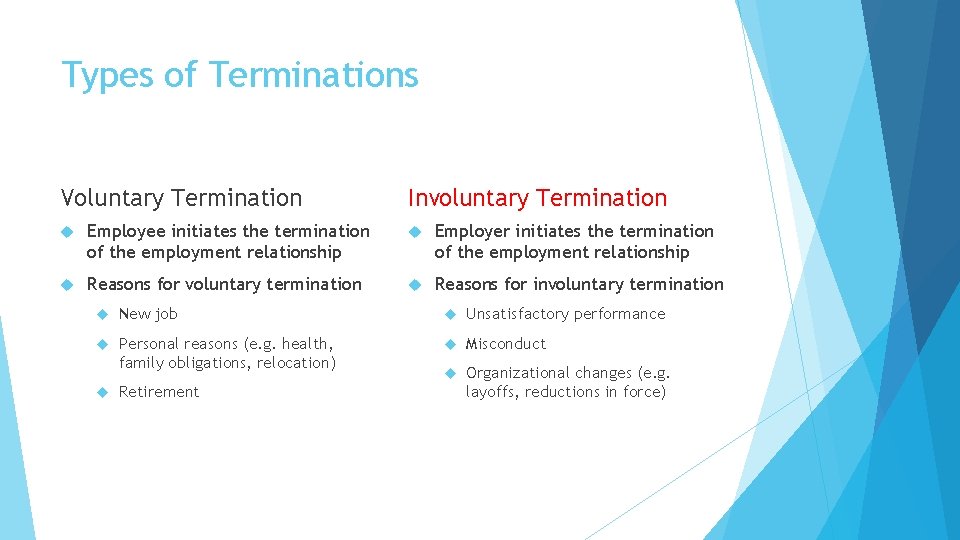
Types of Terminations Voluntary Termination Involuntary Termination Employee initiates the termination of the employment relationship Employer initiates the termination of the employment relationship Reasons for voluntary termination Reasons for involuntary termination New job Unsatisfactory performance Personal reasons (e. g. health, family obligations, relocation) Misconduct Organizational changes (e. g. layoffs, reductions in force) Retirement
Employment At-Will Rhode Island is an at-will employment state The employer or the employee may terminate the employment relationship At any time For any reason not prohibited by law With or without notice Exceptions Oral or written employment contract (e. g. termination must be “for cause” or upon specified notice) Termination violates clearly established public policy
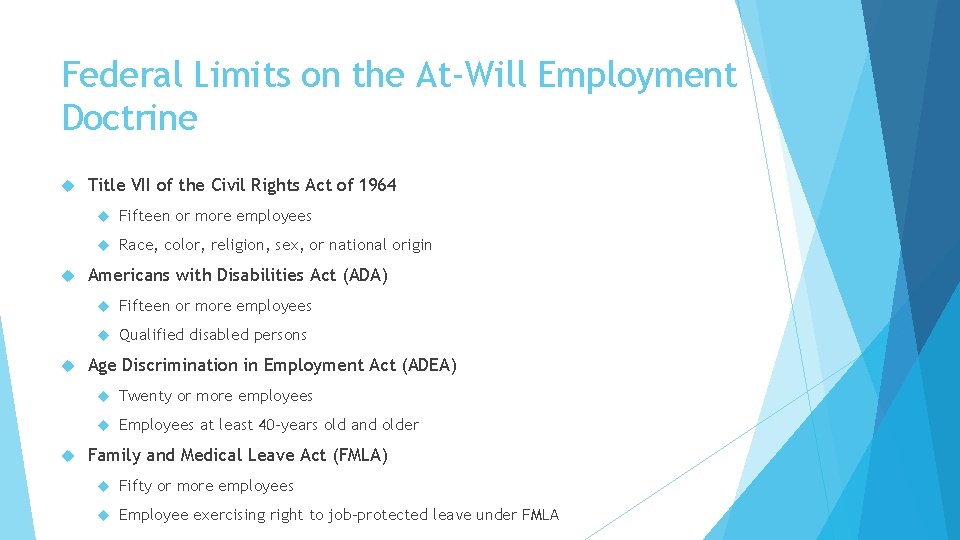
Federal Limits on the At-Will Employment Doctrine Title VII of the Civil Rights Act of 1964 Fifteen or more employees Race, color, religion, sex, or national origin Americans with Disabilities Act (ADA) Fifteen or more employees Qualified disabled persons Age Discrimination in Employment Act (ADEA) Twenty or more employees Employees at least 40 -years old and older Family and Medical Leave Act (FMLA) Fifty or more employees Employee exercising right to job-protected leave under FMLA
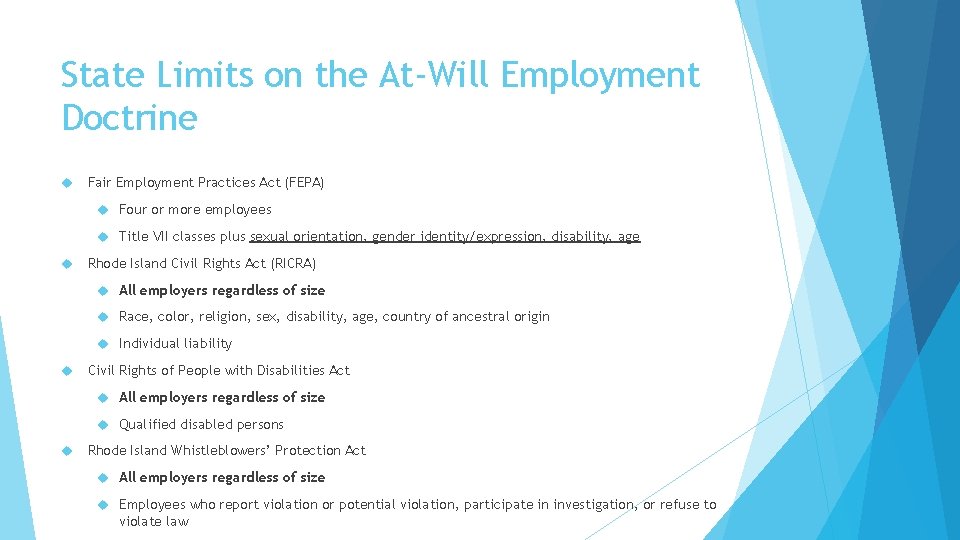
State Limits on the At-Will Employment Doctrine Fair Employment Practices Act (FEPA) Four or more employees Title VII classes plus sexual orientation, gender identity/expression, disability, age Rhode Island Civil Rights Act (RICRA) All employers regardless of size Race, color, religion, sex, disability, age, country of ancestral origin Individual liability Civil Rights of People with Disabilities Act All employers regardless of size Qualified disabled persons Rhode Island Whistleblowers’ Protection Act All employers regardless of size Employees who report violation or potential violation, participate in investigation, or refuse to violate law
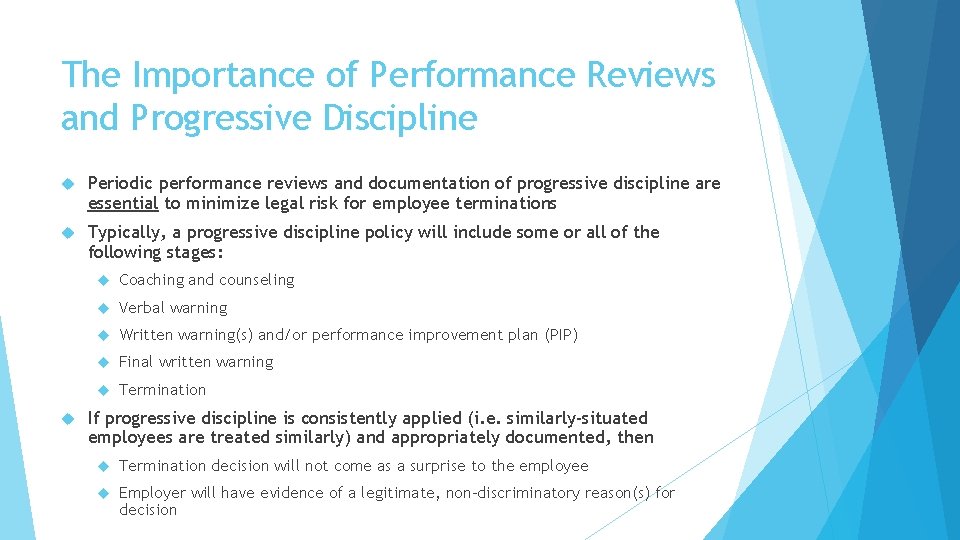
The Importance of Performance Reviews and Progressive Discipline Periodic performance reviews and documentation of progressive discipline are essential to minimize legal risk for employee terminations Typically, a progressive discipline policy will include some or all of the following stages: Coaching and counseling Verbal warning Written warning(s) and/or performance improvement plan (PIP) Final written warning Termination If progressive discipline is consistently applied (i. e. similarly-situated employees are treated similarly) and appropriately documented, then Termination decision will not come as a surprise to the employee Employer will have evidence of a legitimate, non-discriminatory reason(s) for decision
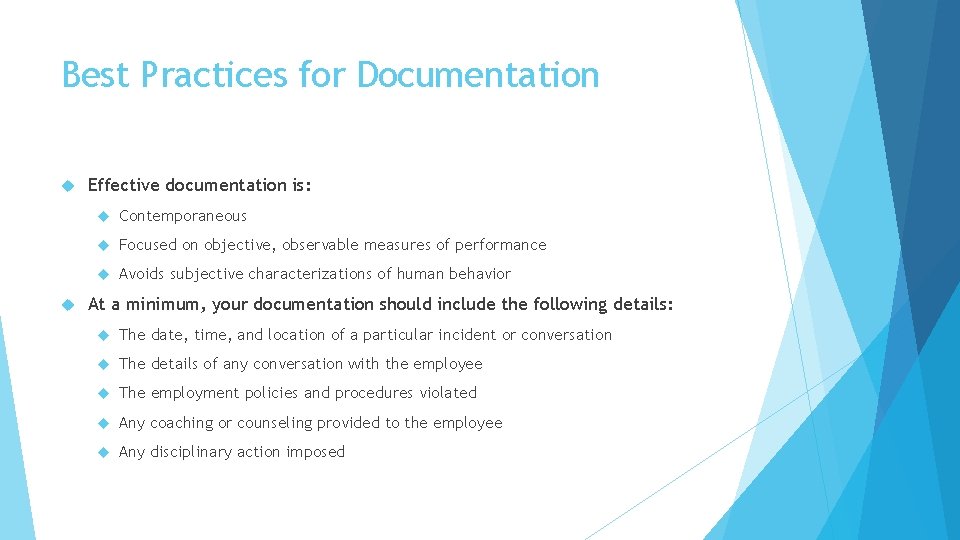
Best Practices for Documentation Effective documentation is: Contemporaneous Focused on objective, observable measures of performance Avoids subjective characterizations of human behavior At a minimum, your documentation should include the following details: The date, time, and location of a particular incident or conversation The details of any conversation with the employee The employment policies and procedures violated Any coaching or counseling provided to the employee Any disciplinary action imposed
Planning for the Termination Discussion Review documentation generated through progressive discipline Consult with legal counsel, if appropriate Arrange to have the meeting in person Select the time and place for the meeting Arrange to have a manager or HR professional present as a witness Arrange to have the employee’s physical, electronic, and financial access terminated in advance Arrange to have security present if the termination will pose a safety risk Plan in advance who is going to speak and what that person will say
During the Termination Discussion Keep it short—no more than fifteen minutes Essential topics to cover That a decision has been made to terminate employment The reason(s) and key facts supporting the termination decision The effective date of separation A review of the employee’s separation package, if any A review of the employer’s policy and procedures for handling employment references A review of post-termination legal obligations (e. g. non-competition, confidentiality) What will happen following the meeting (e. g. cleaning out workspace, return of company property, exit interview) Whom to contact for post-termination issues Treat the employee with dignity and respect
Following the Termination Discussion Be prepared for post-termination interactions with The terminated employee’s colleagues Government agencies Requests for employment references must be handled with care to avoid legal liability Understand your obligations regarding access to employee personnel files
Questions?