
Firewalls By conventional definition a firewall is a
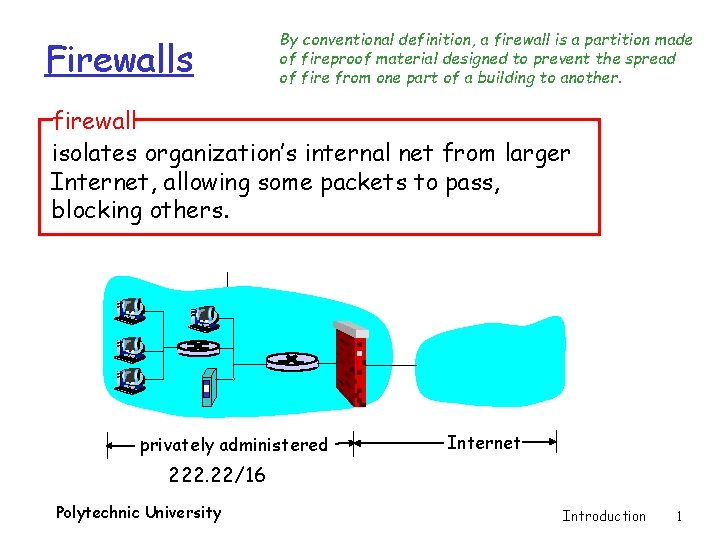
Firewalls By conventional definition, a firewall is a partition made of fireproof material designed to prevent the spread of fire from one part of a building to another. firewall isolates organization’s internal net from larger Internet, allowing some packets to pass, blocking others. privately administered Internet 222. 22/16 Polytechnic University Introduction 1
Firewall goals: r All traffic from outside to inside and vice- versa passes through the firewall. r Only authorized traffic, as defined by local security policy, will be allowed to pass. r The firewall itself is immune to penetration. Polytechnic University Introduction 2
Firewalls: taxonomy 1. Traditional packet filters m filters often combined with router, creating a firewall Major firewall vendors: Checkpoint Cisco PIX 2. Stateful filters 3. Application gateways Polytechnic University Introduction 3
Traditional packet filters Analyzes each datagram going through it; makes drop decision based on: r source IP address r destination IP address r source port r destination port r TCP flag bits m SYN bit set: datagram for connection initiation m ACK bit set: part of established connection Polytechnic University r TCP or UDP or ICMP m Firewalls often configured to block all UDP r direction m Is the datagram leaving or entering the internal network? r router interface m decisions can be different for different interfaces Introduction 4
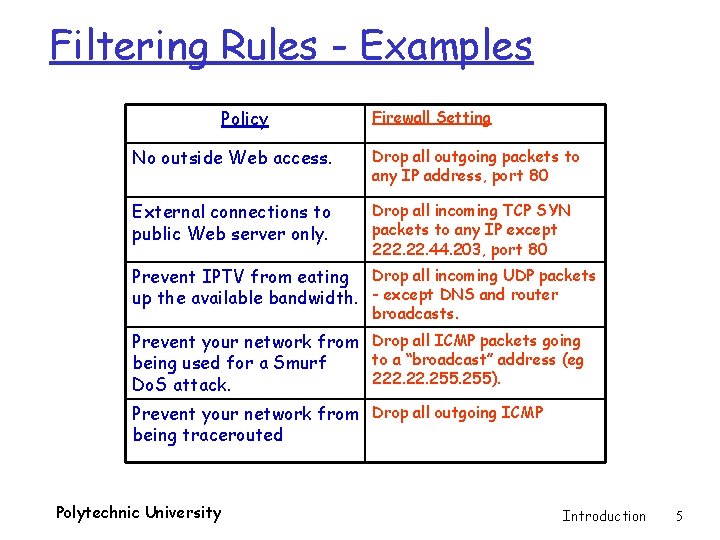
Filtering Rules - Examples Policy Firewall Setting No outside Web access. Drop all outgoing packets to any IP address, port 80 External connections to public Web server only. Drop all incoming TCP SYN packets to any IP except 222. 44. 203, port 80 Prevent IPTV from eating Drop all incoming UDP packets up the available bandwidth. - except DNS and router broadcasts. Prevent your network from Drop all ICMP packets going to a “broadcast” address (eg being used for a Smurf 222. 255). Do. S attack. Prevent your network from Drop all outgoing ICMP being tracerouted Polytechnic University Introduction 5
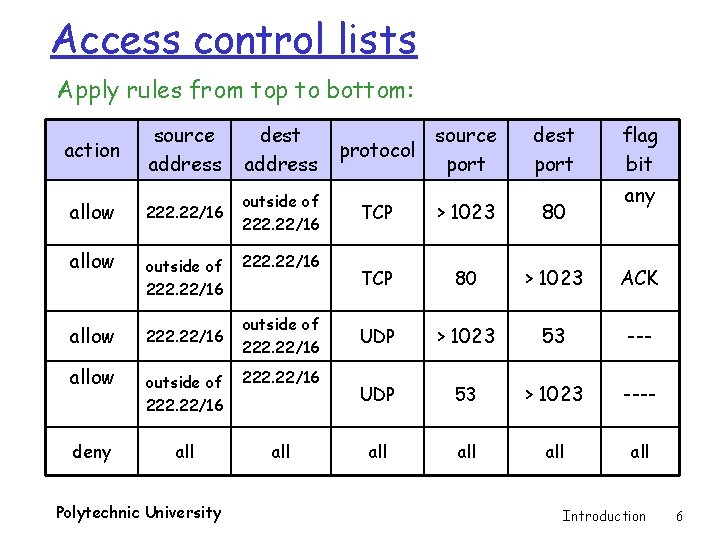
Access control lists Apply rules from top to bottom: action allow deny source address dest address 222. 22/16 outside of 222. 22/16 all Polytechnic University source protocol port dest port flag bit any TCP > 1023 80 TCP 80 > 1023 ACK UDP > 1023 53 --- UDP 53 > 1023 ---- all all Introduction 6
Access control lists r Each router/firewall interface can have its own ACL r Most firewall vendors provide both command-line and graphical configuration interface Polytechnic University Introduction 7
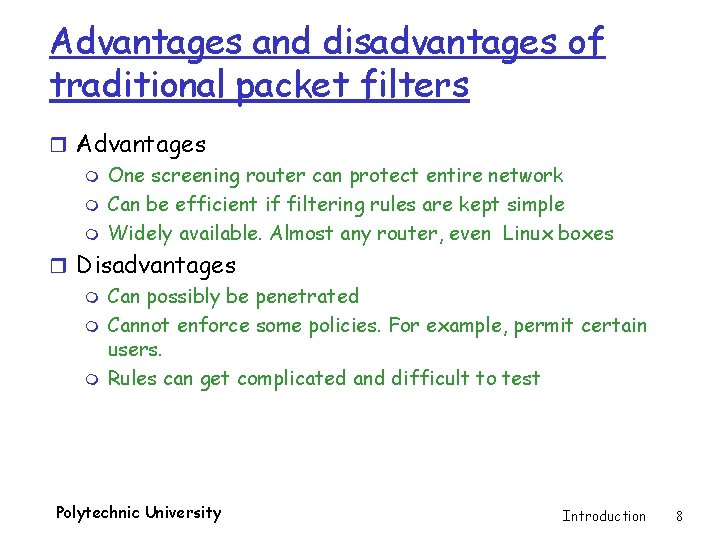
Advantages and disadvantages of traditional packet filters r Advantages m One screening router can protect entire network m Can be efficient if filtering rules are kept simple m Widely available. Almost any router, even Linux boxes r Disadvantages m Can possibly be penetrated m Cannot enforce some policies. For example, permit certain users. m Rules can get complicated and difficult to test Polytechnic University Introduction 8
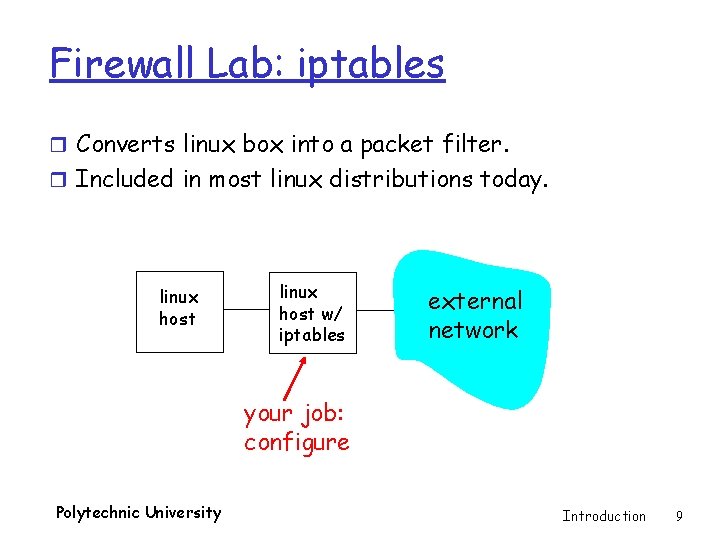
Firewall Lab: iptables r Converts linux box into a packet filter. r Included in most linux distributions today. linux host w/ iptables external network your job: configure Polytechnic University Introduction 9
Firewall lab: iptables r iptables m Provides firewall capability to a linux host m Comes installed with most linux distributions m Three types of tables: FILTER, NAT, MANGLE m Let’s only consider FILTER table for now Polytechnic University Introduction 10
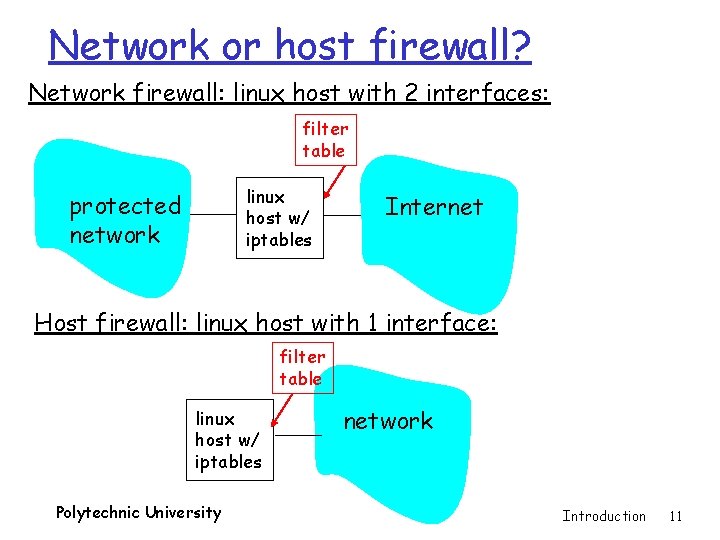
Network or host firewall? Network firewall: linux host with 2 interfaces: filter table linux host w/ iptables protected network Internet Host firewall: linux host with 1 interface: filter table linux host w/ iptables Polytechnic University network Introduction 11
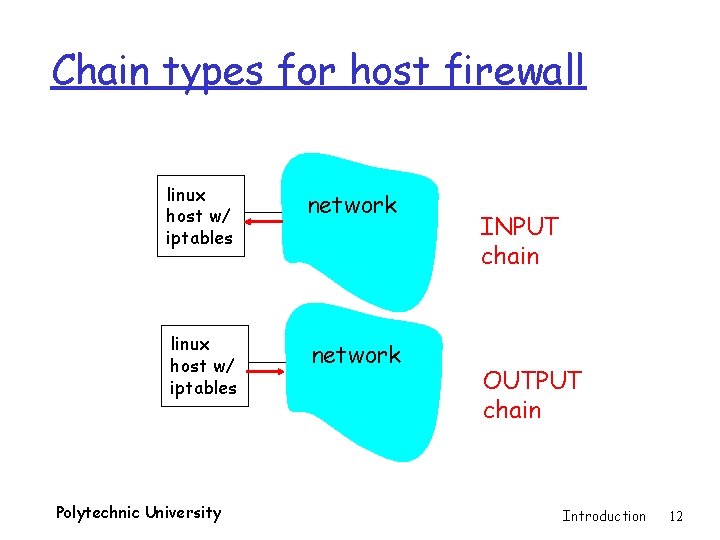
Chain types for host firewall linux host w/ iptables network Polytechnic University INPUT chain OUTPUT chain Introduction 12
INPUT, OUTPUT, FORWARD CHAINS for network firewall r INPUT chain applies for all packets destined to firewall r OUTPUT chain applies for all packets originating from firewall r FORWARD chain applies for all packets passing through firewall. Polytechnic University Introduction 13
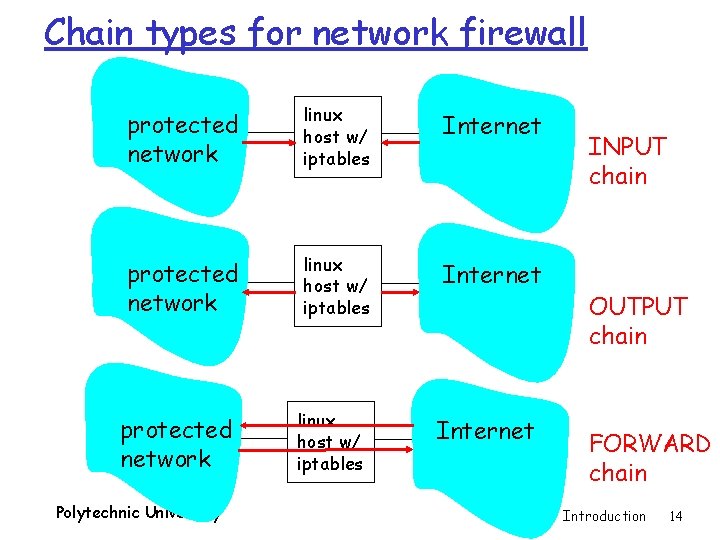
Chain types for network firewall protected network linux host w/ iptables Internet protected network Polytechnic University linux host w/ iptables Internet INPUT chain OUTPUT chain FORWARD chain Introduction 14
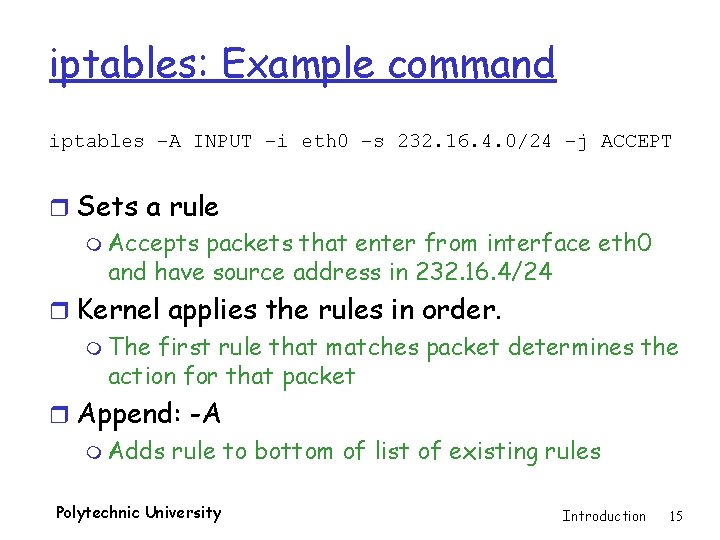
iptables: Example command iptables –A INPUT –i eth 0 –s 232. 16. 4. 0/24 –j ACCEPT r Sets a rule m Accepts packets that enter from interface eth 0 and have source address in 232. 16. 4/24 r Kernel applies the rules in order. m The first rule that matches packet determines the action for that packet r Append: -A m Adds rule to bottom of list of existing rules Polytechnic University Introduction 15
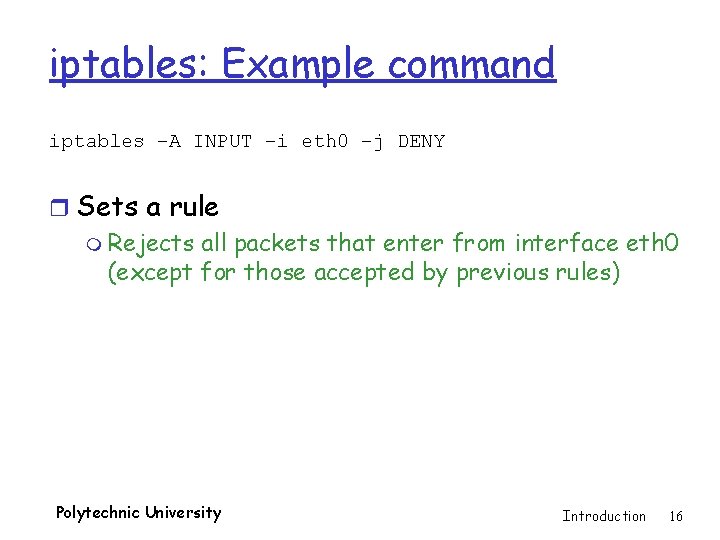
iptables: Example command iptables –A INPUT –i eth 0 –j DENY r Sets a rule m Rejects all packets that enter from interface eth 0 (except for those accepted by previous rules) Polytechnic University Introduction 16
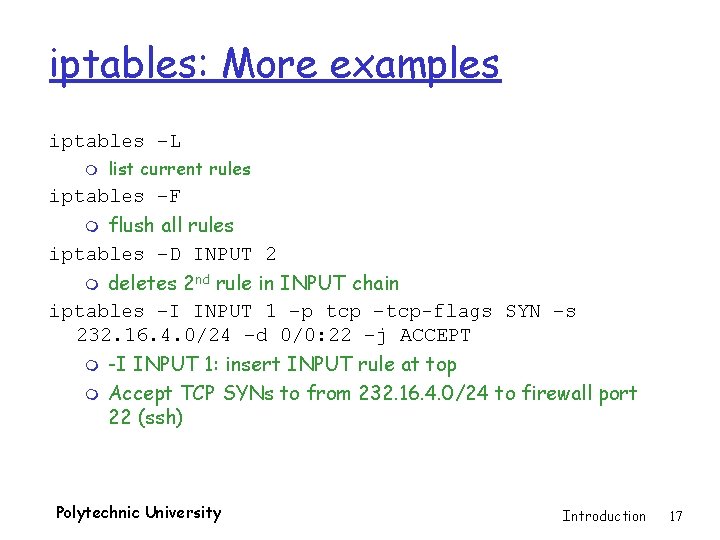
iptables: More examples iptables –L m list current rules iptables –F flush all rules iptables –D INPUT 2 m deletes 2 nd rule in INPUT chain iptables –I INPUT 1 –p tcp –tcp-flags SYN –s 232. 16. 4. 0/24 –d 0/0: 22 –j ACCEPT m m m -I INPUT 1: insert INPUT rule at top Accept TCP SYNs to from 232. 16. 4. 0/24 to firewall port 22 (ssh) Polytechnic University Introduction 17
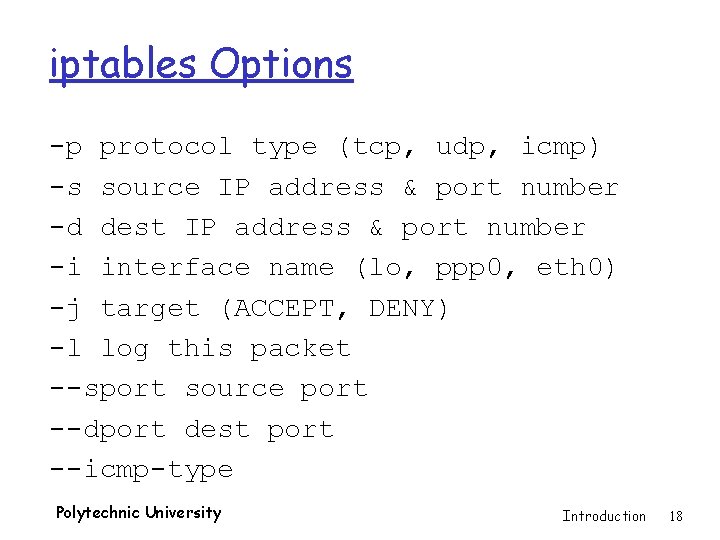
iptables Options -p protocol type (tcp, udp, icmp) -s source IP address & port number -d dest IP address & port number -i interface name (lo, ppp 0, eth 0) -j target (ACCEPT, DENY) -l log this packet --sport source port --dport dest port --icmp-type Polytechnic University Introduction 18
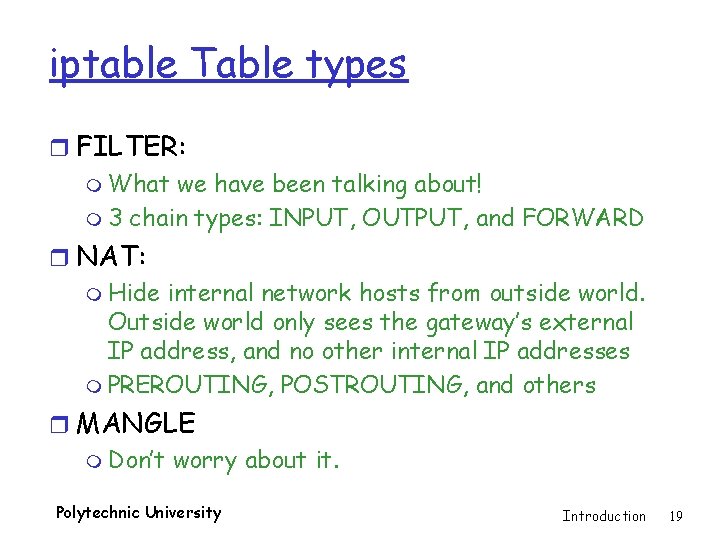
iptable Table types r FILTER: m What we have been talking about! m 3 chain types: INPUT, OUTPUT, and FORWARD r NAT: m Hide internal network hosts from outside world. Outside world only sees the gateway’s external IP address, and no other internal IP addresses m PREROUTING, POSTROUTING, and others r MANGLE m Don’t worry about it. Polytechnic University Introduction 19
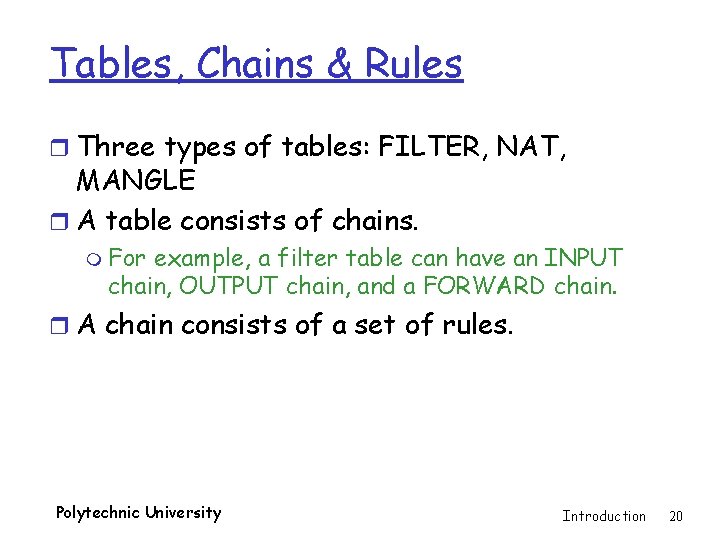
Tables, Chains & Rules r Three types of tables: FILTER, NAT, MANGLE r A table consists of chains. m For example, a filter table can have an INPUT chain, OUTPUT chain, and a FORWARD chain. r A chain consists of a set of rules. Polytechnic University Introduction 20
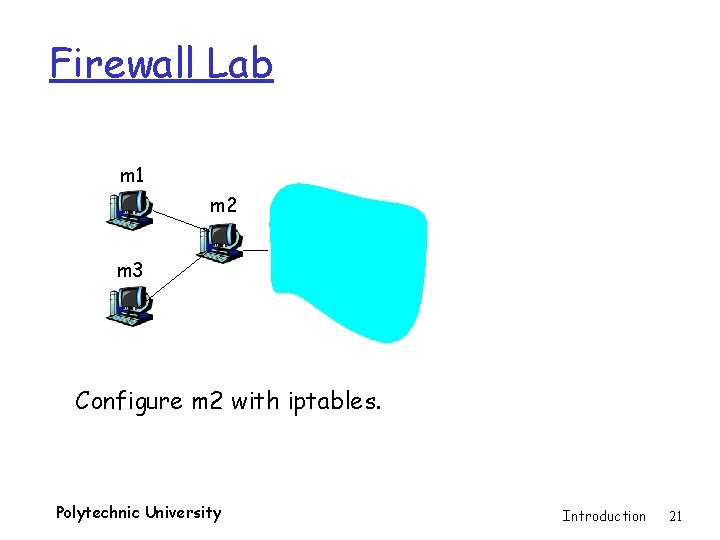
Firewall Lab m 1 m 2 m 3 Configure m 2 with iptables. Polytechnic University Introduction 21
Firewall Lab: Part A r Configure NAT in m 2 using NAT table with POSTROUTING chain: m MASQUERADE packets so that internal IP addresses are hidden from external network m From m 1 and m 3, only allow ssh to external network r This NAT configuration will remain in force throughout the lab Polytechnic University Introduction 22
Firewall Lab: Part B Rules for packets originating from or terminating at m 2 (the gateway): r Allow ssh connections originating from m 2 and destined to m 2. r Allow pings originating from m 2 and destined to m 2. r Block all other traffic to or from m 2. r Hint: Part B requires INPUT and OUTPUT chains but no FORWARD chain Polytechnic University Introduction 23
Firewall Lab: Part C r Flush filter table rules from Part B. r Allow only m 1 (and not m 3) to initiate an ssh session to hosts in the external network r Reject all other traffic r Hint: Part C requires FORWARD, INPUT and OUTPUT chains Polytechnic University Introduction 24
Stateful Filters r In earlier example, any packet with ACK=1 and source port 80 gets in. m Attacker could, for example, attempt a malformed packet attack by sending ACK=1 segments r Stateful filter: Adds more intelligence to the filter decision-making process m Stateful = remember past packets m Memory implemented in a very dynamic state table Polytechnic University Introduction 25
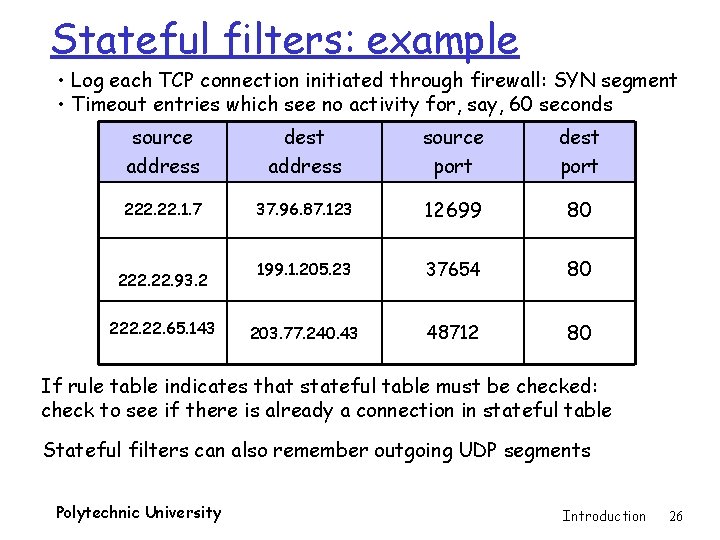
Stateful filters: example • Log each TCP connection initiated through firewall: SYN segment • Timeout entries which see no activity for, say, 60 seconds source address dest address source port dest port 222. 1. 7 37. 96. 87. 123 12699 80 199. 1. 205. 23 37654 80 203. 77. 240. 43 48712 80 222. 93. 2 222. 65. 143 If rule table indicates that stateful table must be checked: check to see if there is already a connection in stateful table Stateful filters can also remember outgoing UDP segments Polytechnic University Introduction 26
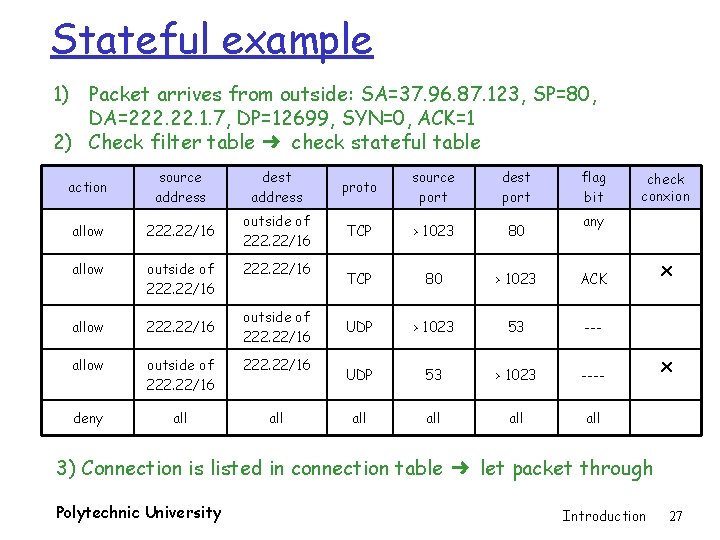
Stateful example 1) Packet arrives from outside: SA=37. 96. 87. 123, SP=80, DA=222. 1. 7, DP=12699, SYN=0, ACK=1 2) Check filter table ➜ check stateful table action source address dest address proto source port dest port allow 222. 22/16 outside of 222. 22/16 TCP > 1023 80 allow outside of 222. 22/16 TCP 80 > 1023 ACK allow 222. 22/16 UDP > 1023 53 --- allow outside of 222. 22/16 UDP 53 > 1023 ---- deny all all all 222. 22/16 outside of 222. 22/16 flag bit check conxion any x x 3) Connection is listed in connection table ➜ let packet through Polytechnic University Introduction 27
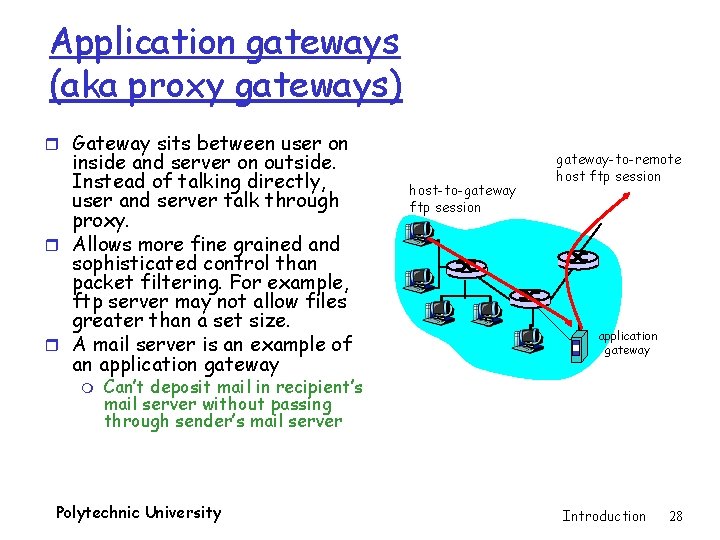
Application gateways (aka proxy gateways) r Gateway sits between user on inside and server on outside. Instead of talking directly, user and server talk through proxy. r Allows more fine grained and sophisticated control than packet filtering. For example, ftp server may not allow files greater than a set size. r A mail server is an example of an application gateway m host-to-gateway ftp session gateway-to-remote host ftp session application gateway Can’t deposit mail in recipient’s mail server without passing through sender’s mail server Polytechnic University Introduction 28
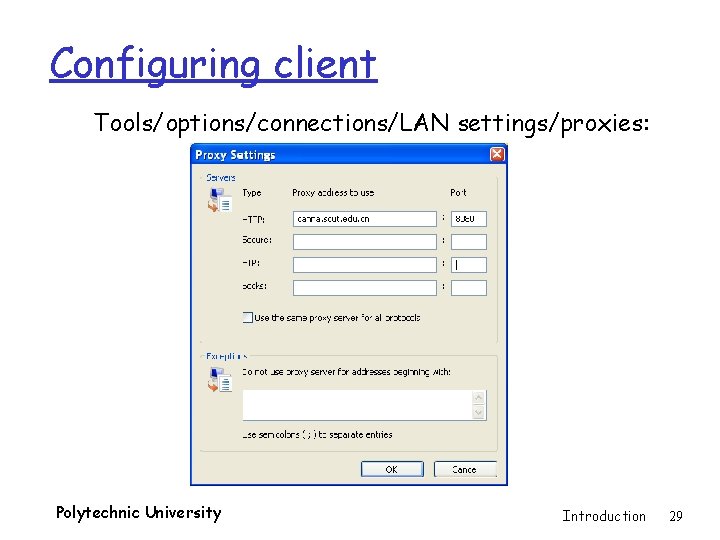
Configuring client Tools/options/connections/LAN settings/proxies: Polytechnic University Introduction 29
Advantages and disadvantages of proxy gateways r Advantages m Proxy can log all connections, activity in connections m Proxy can provide caching m Proxy can do intelligent filtering based on content m Proxy can perform user-level authentication r Disadvantages m Not all services have proxied versions m May need different proxy server for each service m Requires modification of client m Performance Polytechnic University Introduction 30
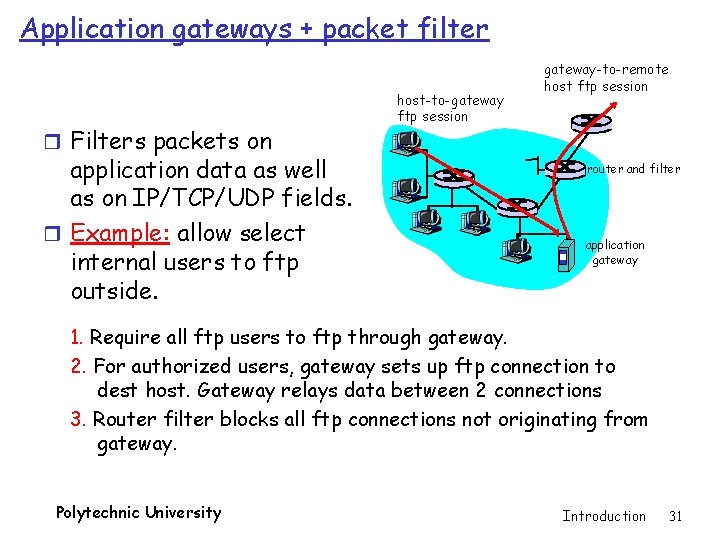
Application gateways + packet filter r Filters packets on application data as well as on IP/TCP/UDP fields. r Example: allow select internal users to ftp outside. host-to-gateway ftp session gateway-to-remote host ftp session router and filter application gateway 1. Require all ftp users to ftp through gateway. 2. For authorized users, gateway sets up ftp connection to dest host. Gateway relays data between 2 connections 3. Router filter blocks all ftp connections not originating from gateway. Polytechnic University Introduction 31
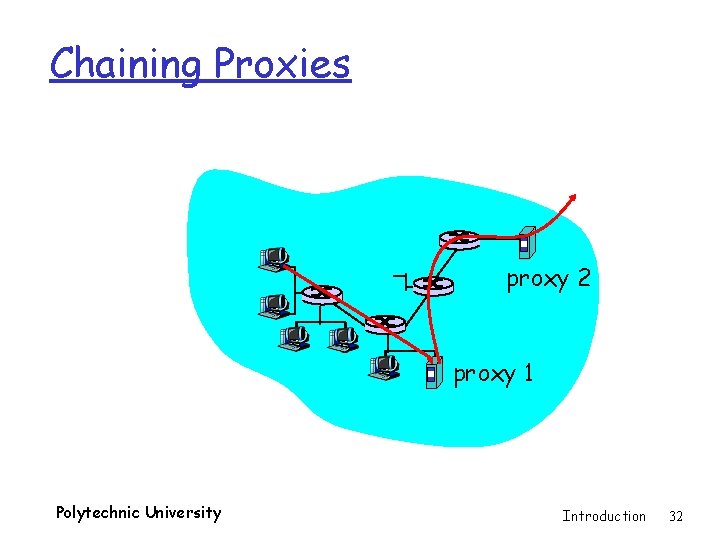
Chaining Proxies proxy 2 proxy 1 Polytechnic University Introduction 32
SOCKS Proxy protocol r Generic proxy protocol m Don’t have to redo all of the code when proxifying an application. r Can be used by HTTP, FTP, telnet, SSL, … m Independent of application layer protocol r Includes authentication, restricting which users/apps/IP addresses can pass through firewall. Polytechnic University Introduction 33
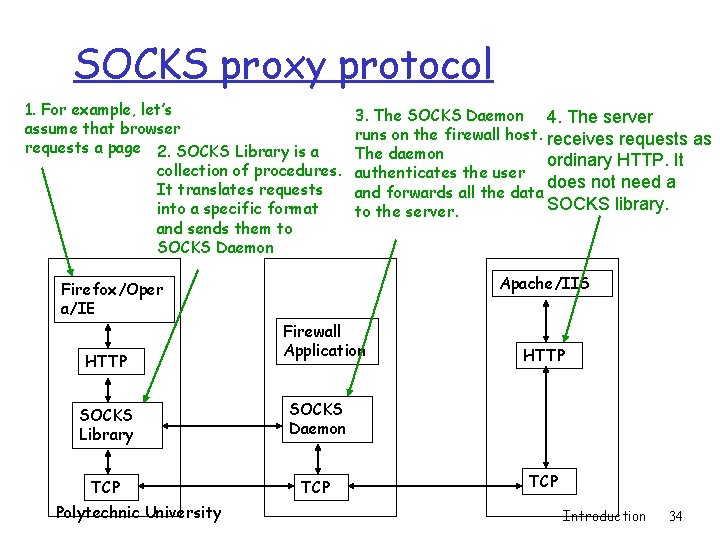
SOCKS proxy protocol 1. For example, let’s assume that browser requests a page 2. SOCKS Library is a collection of procedures. It translates requests into a specific format and sends them to SOCKS Daemon 3. The SOCKS Daemon 4. The server runs on the firewall host. receives requests as The daemon ordinary HTTP. It authenticates the user does not need a and forwards all the data SOCKS library. to the server. Apache/IIS Firefox/Oper a/IE HTTP Firewall Application SOCKS Library SOCKS Daemon TCP Polytechnic University HTTP TCP Introduction 34
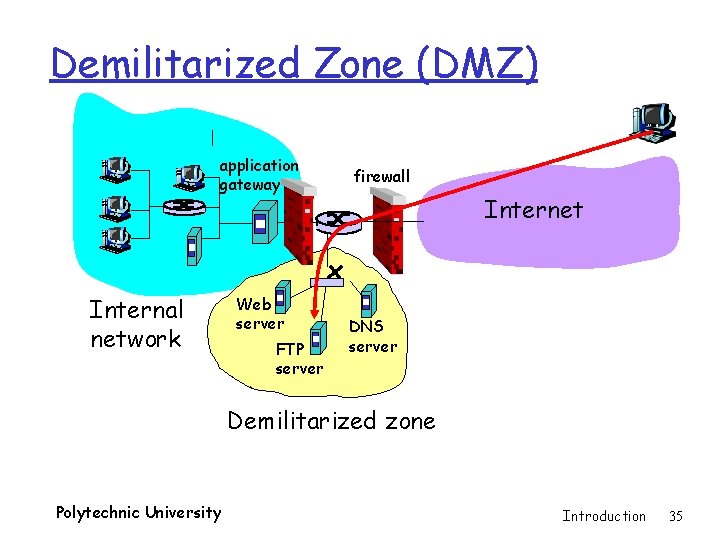
Demilitarized Zone (DMZ) application gateway Internal network Web server FTP server firewall Internet DNS server Demilitarized zone Polytechnic University Introduction 35
Firewalls: Summary r Filters m Widely available in routers, linux r Stateful filters m Maintains connection state r Application gateways m Often implemented with SOCKS today Polytechnic University Introduction 36
- Slides: 36