
FIRESTOP 101 An Introduction to Firestopping Saving Lives


- Slides: 40
FIRESTOP 101: An Introduction to Firestopping Saving Lives and Property Through Fire and Smoke Containment © 2004 IFC
Role of Firestop • What is Firestopping? “A process whereby certain materials, some of them specially manufactured, are used to resist (or stop) the spread of fire and its byproducts through openings made to accommodate penetrations in fire-rated walls, floors and floor/ceiling assemblies. ” … International Firestop Council Saving Lives and Property Through Fire and Smoke Containment © 2004 IFC
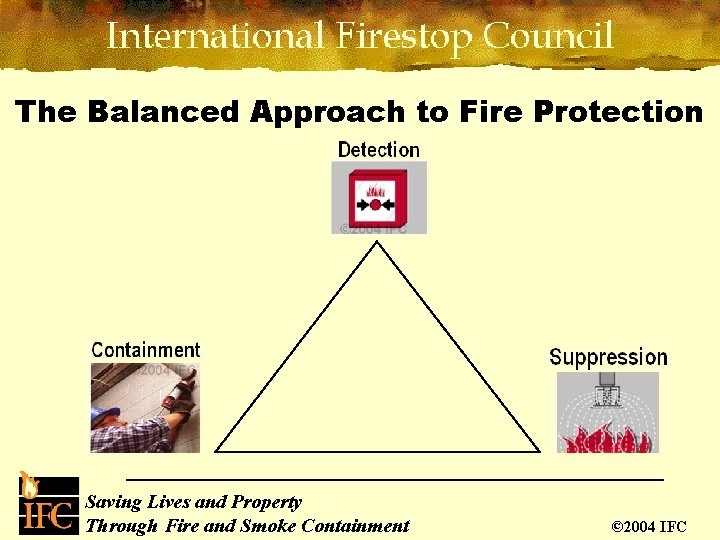
The Balanced Approach to Fire Protection Saving Lives and Property Through Fire and Smoke Containment © 2004 IFC
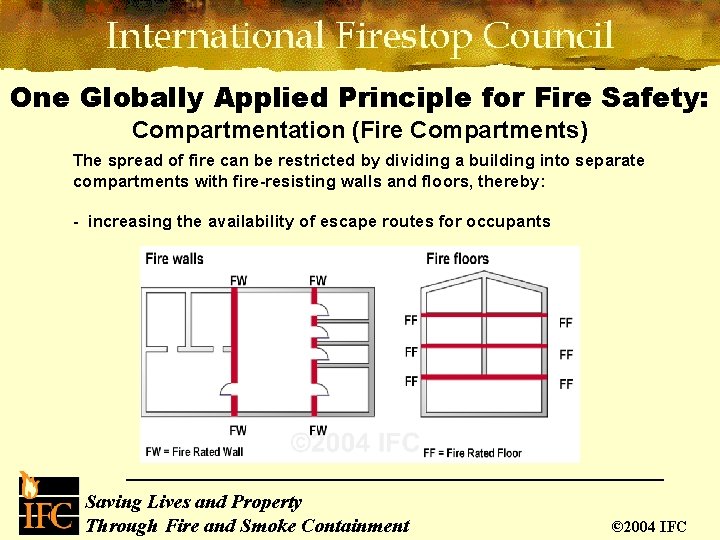
One Globally Applied Principle for Fire Safety: Compartmentation (Fire Compartments) The spread of fire can be restricted by dividing a building into separate compartments with fire-resisting walls and floors, thereby: - increasing the availability of escape routes for occupants Saving Lives and Property Through Fire and Smoke Containment © 2004 IFC
Fire Statistics What is the leading killer in fires? SMOKE & TOXIC GASES Saving Lives and Property Through Fire and Smoke Containment © 2004 IFC
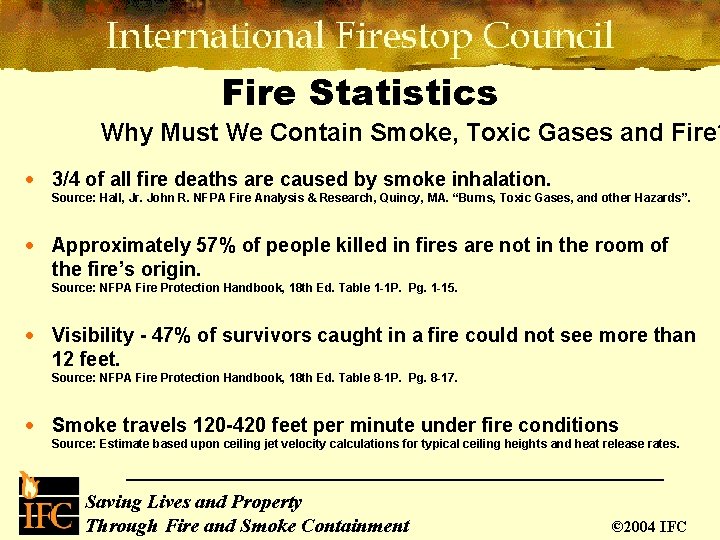
Fire Statistics Why Must We Contain Smoke, Toxic Gases and Fire? · 3/4 of all fire deaths are caused by smoke inhalation. Source: Hall, Jr. John R. NFPA Fire Analysis & Research, Quincy, MA. “Burns, Toxic Gases, and other Hazards”. · Approximately 57% of people killed in fires are not in the room of the fire’s origin. Source: NFPA Fire Protection Handbook, 18 th Ed. Table 1 -1 P. Pg. 1 -15. · Visibility - 47% of survivors caught in a fire could not see more than 12 feet. Source: NFPA Fire Protection Handbook, 18 th Ed. Table 8 -1 P. Pg. 8 -17. · Smoke travels 120 -420 feet per minute under fire conditions Source: Estimate based upon ceiling jet velocity calculations for typical ceiling heights and heat release rates. Saving Lives and Property Through Fire and Smoke Containment © 2004 IFC
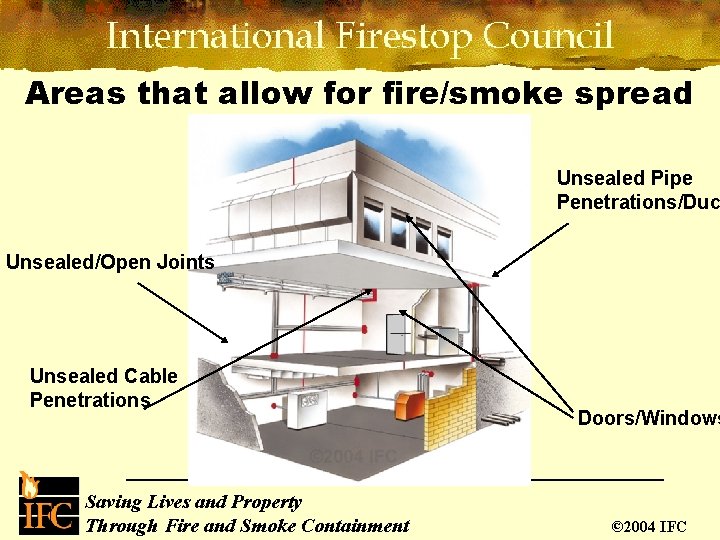
Areas that allow for fire/smoke spread Unsealed Pipe Penetrations/Duc Unsealed/Open Joints Unsealed Cable Penetrations Saving Lives and Property Through Fire and Smoke Containment Doors/Windows © 2004 IFC
How Do Firestop Products Work? • Through-penetration firestop products work by filling the voids around penetrating items in fire rated walls and floors. • Some firestop products intumesce or expand in the presence of heat. • The intumescing action seals and stops the spread of flames and smoke to other floors and rooms for penetrations that melt or change shape in a fire (eg. Plastic pipe) Saving Lives and Property Through Fire and Smoke Containment © 2004 IFC
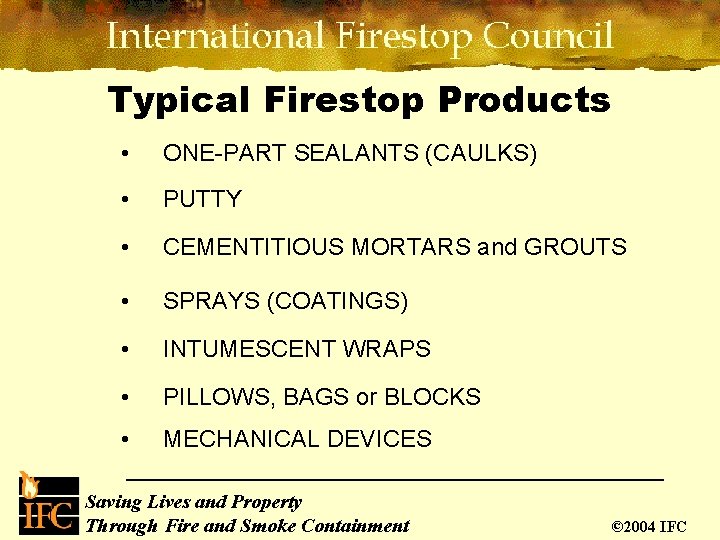
Typical Firestop Products • ONE-PART SEALANTS (CAULKS) • PUTTY • CEMENTITIOUS MORTARS and GROUTS • SPRAYS (COATINGS) • INTUMESCENT WRAPS • PILLOWS, BAGS or BLOCKS • MECHANICAL DEVICES Saving Lives and Property Through Fire and Smoke Containment © 2004 IFC
Types of Firestop Systems • Through Penetrations • Membrane Penetrations • Fire Resistive Construction Joints • Perimeter Joints Saving Lives and Property Through Fire and Smoke Containment © 2004 IFC
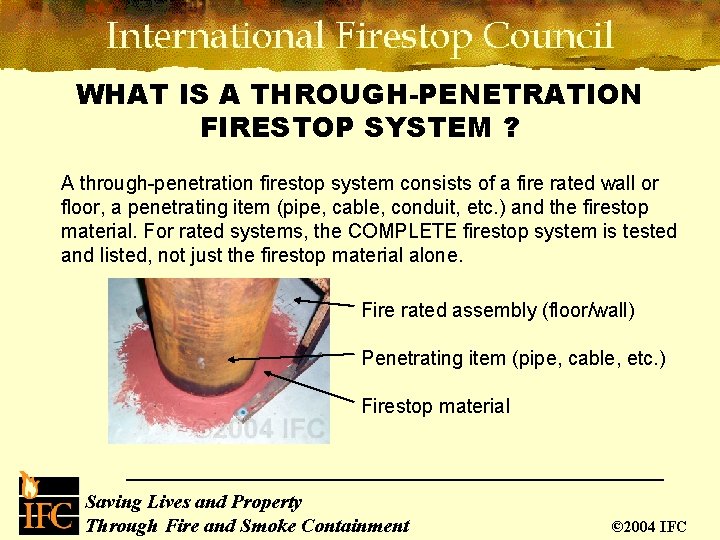
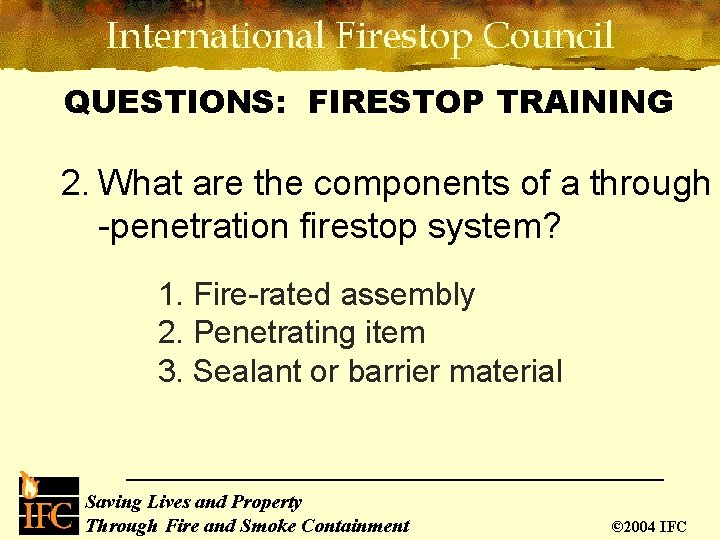
WHAT IS A THROUGH-PENETRATION FIRESTOP SYSTEM ? A through-penetration firestop system consists of a fire rated wall or floor, a penetrating item (pipe, cable, conduit, etc. ) and the firestop material. For rated systems, the COMPLETE firestop system is tested and listed, not just the firestop material alone. Fire rated assembly (floor/wall) Penetrating item (pipe, cable, etc. ) Firestop material Saving Lives and Property Through Fire and Smoke Containment © 2004 IFC
ASTM E 814 / UL 1479 Standard Method of Fire Tests of Through-Penetration Firestops • • F-Rating - Flame does not pass through for test duration. T-Rating - The time by which the non-fireside reaches approximately 400 ºF (325 above ambient). – To receive either rating the firestop must pass hose stream. • L-Rating (optional) - Amount of air leakage through the FS system @ ambient & 400°F. Determines the system’s ability to restrict the movement of smoke. Measured in CFM/sq. ft. The lower the number, the better. Saving Lives and Property Through Fire and Smoke Containment © 2004 IFC
Factors Affecting Firestop Performance Through Penetrations • • Type of penetrating item(s) Size of penetrating item(s) Percent fill (cables) Annular space Fire severity and duration Floor or wall construction type Floor or wall thickness Stud width for gypsum wall assemblies Saving Lives and Property Through Fire and Smoke Containment © 2004 IFC
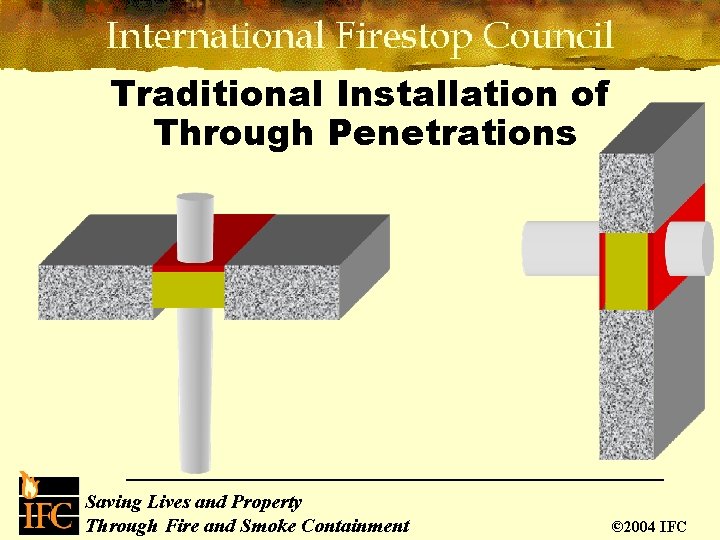
Traditional Installation of Through Penetrations Saving Lives and Property Through Fire and Smoke Containment © 2004 IFC
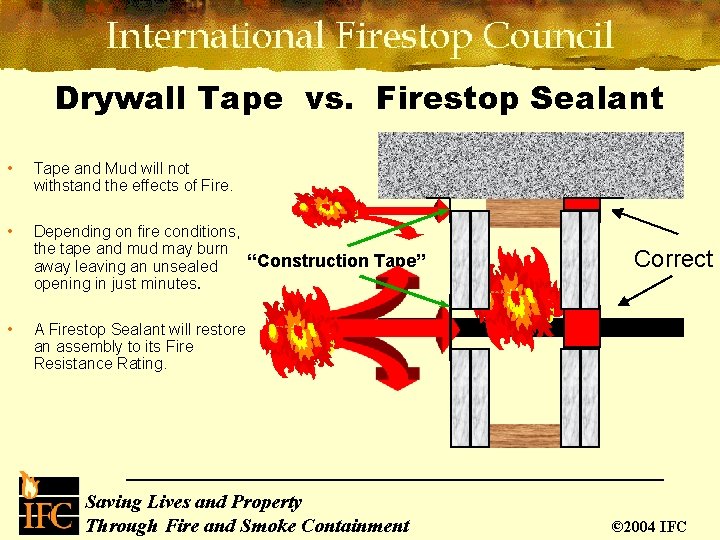
Drywall Tape vs. Firestop Sealant • Tape and Mud will not withstand the effects of Fire. • Depending on fire conditions, the tape and mud may burn “Construction Tape” away leaving an unsealed opening in just minutes. • Correct A Firestop Sealant will restore an assembly to its Fire Resistance Rating. Saving Lives and Property Through Fire and Smoke Containment © 2004 IFC
What is a Membrane Firestop Penetration? • Membrane Penetration – An opening made through one side (wall, floor, ceiling membrane) of an assembly. – Example: Toilet or sink piping • Membrane Penetration Firestop – A material, device or construction installed to resist, for a prescribed time period, the passage of flame and heat through openings in a protective membrane in order to accommodate cables, cable trays, conduit, tubing, pipes or similar items. Saving Lives and Property Through Fire and Smoke Containment © 2004 IFC
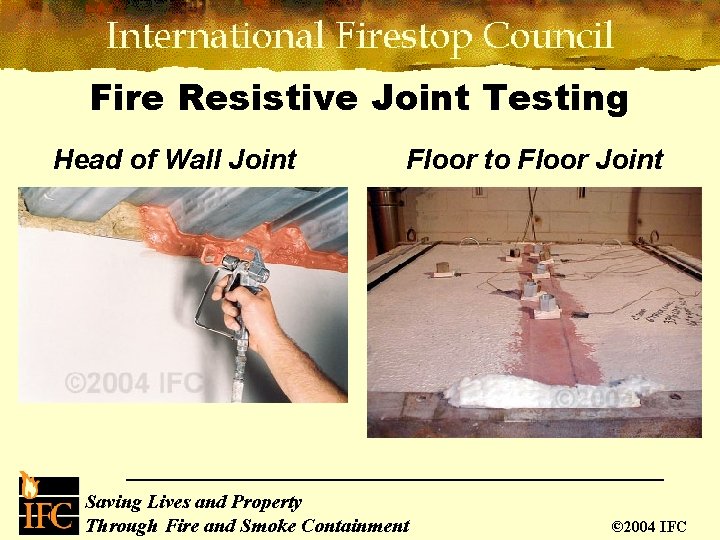
What is a Fire Rated Joint System? A fire rated joint system consists of specified materials designed and tested to resist the passage of flames and hot gasses sufficient to ignite cotton waste for a prescribed period of time in accordance with UL 2079. Head of Wall Expansion Joints Vertical Control Joints Saving Lives and Property Through Fire and Smoke Containment © 2004 IFC
ASTM E 1966 / UL 2079 - Test Standard Tests for Fire Resistance of Building Joint Systems • Joint system is cycled (typically 500 times) through intended range of movement before fire exposure per ASTM E 1399 • Assembly Rating - Measures both the fire and temperature ratings on the non-fireside (both required to pass test) • Same time/temperature curve as ASTM E 814 – Hose stream is only required for top-of-wall and wall-to-wall joints Saving Lives and Property Through Fire and Smoke Containment © 2004 IFC
Factors Affecting Firestop Performance Joints • • • Movement requirements Joint width Fire severity and duration Floor and wall construction type Floor and wall thickness Saving Lives and Property Through Fire and Smoke Containment © 2004 IFC
Fire Resistive Joint Testing Head of Wall Joint Floor to Floor Joint Saving Lives and Property Through Fire and Smoke Containment © 2004 IFC
Goal of Building Codes and Regulations The goal is: Life Safety of Occupants and Protection of Property All regulations are based on this objective Saving Lives and Property Through Fire and Smoke Containment © 2004 IFC
Building Codes Model Codes That Require Firestop · International Building Code (IBC) · Life Safety Code (NFPA 101) · National Electrical Code (NFPA 70) · NFPA 5000 (NFPA Building Code) · Legacy US building codes (UBC, SBC, NBC) Saving Lives and Property Through Fire and Smoke Containment © 2004 IFC
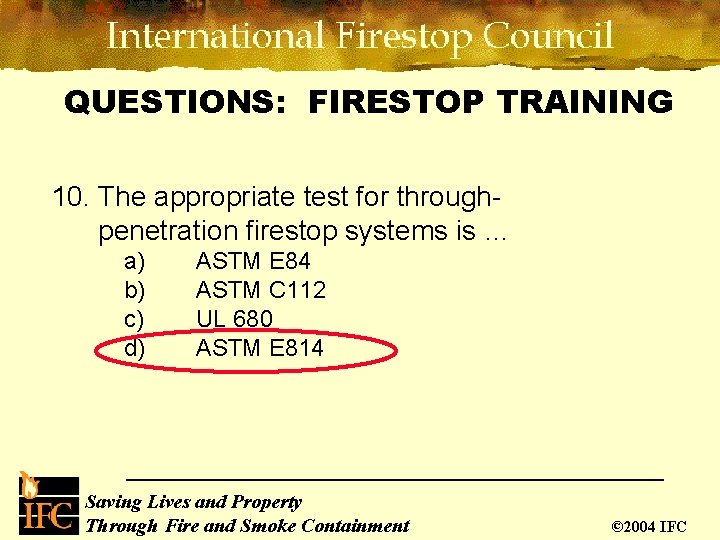
How Do We Measure Firestop Performance? The fore-runner and basic model for current test standards is ASTM E 119 (UL 263, NFPA 251) STANDARD TEST METHODS for FIRE TESTS of BUILDING CONSTRUCTION AND MATERIALS. The most important test for through penetration fire stop systems is ASTM E 814, STANDARD TEST METHOD for FIRE TESTS of THROUGH-PENETRATION FIRESTOPS. The most important test for fire resistive joint systems is ASTM E 1966, TESTS FOR FIRE RESISTANCE OF BUILDING JOINT SYSTEMS. In addition, UL has developed its own test standard, UL 1479 FIRE TESTS OF THROUGH-PENETRATION FIRESTOPS, and UL 2079 TESTS FOR FIRE RESISTANCE OF BUILDING JOINT SYSTEMS. Saving Lives and Property Through Fire and Smoke Containment © 2004 IFC
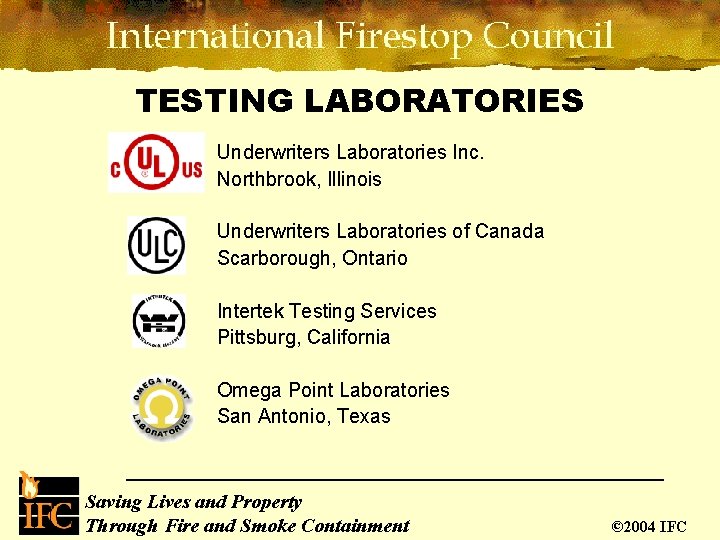
TESTING LABORATORIES Underwriters Laboratories Inc. Northbrook, Illinois Underwriters Laboratories of Canada Scarborough, Ontario Intertek Testing Services Pittsburg, California Omega Point Laboratories San Antonio, Texas Saving Lives and Property Through Fire and Smoke Containment © 2004 IFC
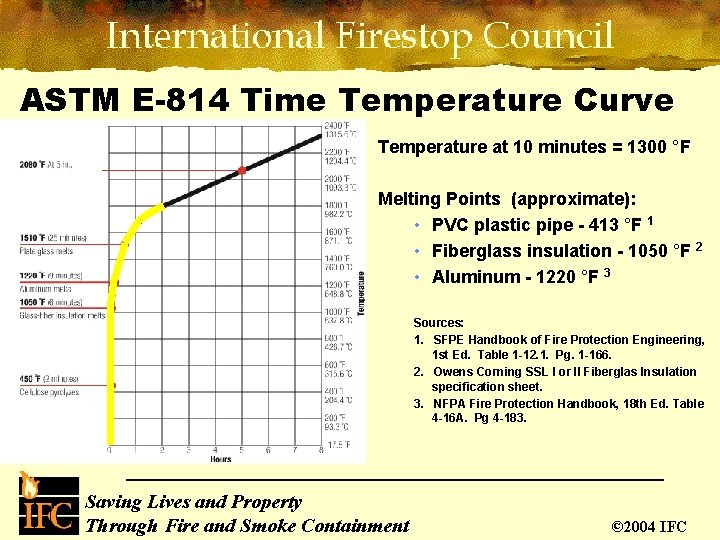
ASTM E-814 Time Temperature Curve Temperature at 10 minutes = 1300 °F Melting Points (approximate): • PVC plastic pipe - 413 °F 1 • Fiberglass insulation - 1050 °F 2 • Aluminum - 1220 °F 3 Sources: 1. SFPE Handbook of Fire Protection Engineering, 1 st Ed. Table 1 -12. 1. Pg. 1 -166. 2. Owens Corning SSL I or II Fiberglas Insulation specification sheet. 3. NFPA Fire Protection Handbook, 18 th Ed. Table 4 -16 A. Pg 4 -183. Saving Lives and Property Through Fire and Smoke Containment © 2004 IFC
Engineering Judgments Guidelines for creating/evaluating EJ’s • Issued by qualified technical personnel (FPE). • Based upon previously tested system. • Issued only for a single job and location. • Based upon assumption that the recommended firestop system would pass UL 1479 (ASTM E 814) or UL 2079(ASTM E 1966) for the required rated period of time. Saving Lives and Property Through Fire and Smoke Containment © 2004 IFC
Engineering Judgments (Contin. ) Guidelines for creating/evaluating EJ’s • Clearly indicate that the system is an EJ and not a listed system. • Identify the job, location and fire rating conditions. • Provide descriptions of systems (products, densities, depths, annular space, etc. ). Saving Lives and Property Through Fire and Smoke Containment © 2004 IFC
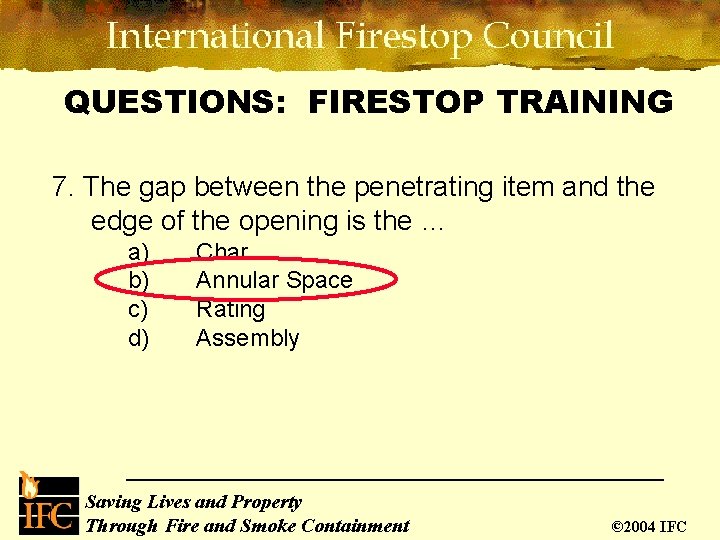
Key Firestop Terms and Definitions WALL or FLOOR ASSEMBLY - A fire resistance rated wall or floor that contains through-penetrations. THROUGH-PENETRATION - An opening (hole) that has been made through a fire rated wall or floor. PENETRANT (or Penetrating item) - Pipes, electrical conduit, cables, cable trays, or ducts that have been placed through a fire rated assembly. ANNULAR SPACE - The gap between the penetrating item and the edge of the opening. A point of contact or an area where no gap exists is referred to as ZERO ANNULAR SPACE. FILL MATERIAL - The firestop sealant material that is placed in and/or around the opening. Saving Lives and Property Through Fire and Smoke Containment © 2004 IFC
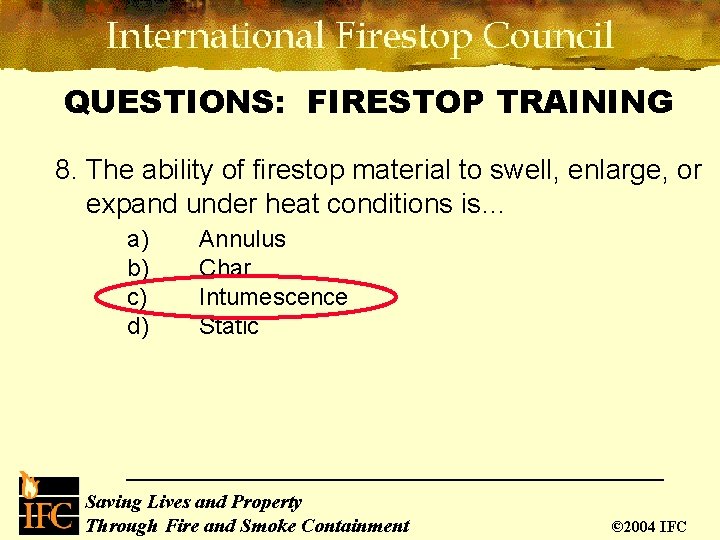
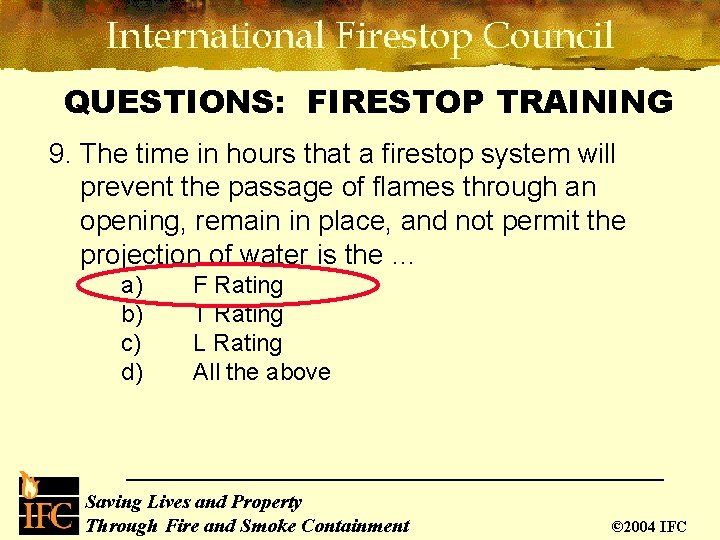
Key Firestop Terms and Definitions BACKING MATERIAL or FORMING MATERIAL - Noncombustible material used to provide support for fire-rated sealant (i. e. foam backer rod or mineral wool) INTUMESCENT - The ability of firestop to swell, inflate, or expand with heat. Some firestop sealants will intumesce when exposed to the intense heat of fire causing them to close gaps or voids in through-penetration openings. COLLAR - A sheet metal restricting device normally used in conjunction with plastic pipe to direct and control the intumescent action of the firestop sealant with which it is filled. F- RATING - The time in hours that a firestop system will prevent the passage of flames through an opening, remain in place, and not permit the projection of a water stream as determined by standard test methods ASTM E 814 or UL 1479. T- RATING - The time in minutes required for the temperature on the unexposed surface of a firestop system or any penetrating item to rise 325 o F above the ambient temperature as determined by ASTM E 814 or UL 1479. Saving Lives and Property Through Fire and Smoke Containment © 2004 IFC
Why Are Firestop Products So Important? • Simply put, firestop systems are and have been required by all model building codes. • More importantly, firestop products play a significant role in reducing the number of lives and property lost unnecessarily due to the rapid spread of fire and smoke. • Mandated for public safety • Mandated for property loss management Saving Lives and Property Through Fire and Smoke Containment © 2004 IFC
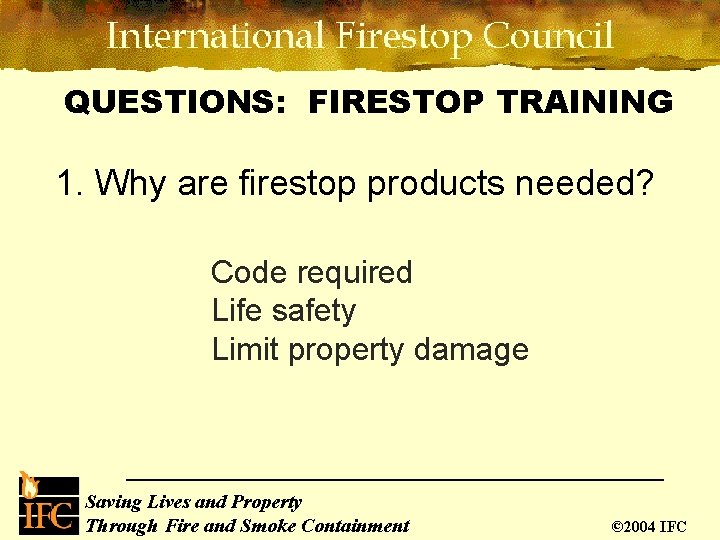
QUESTIONS: FIRESTOP TRAINING 1. Why are firestop products needed? Code required Life safety Limit property damage Saving Lives and Property Through Fire and Smoke Containment © 2004 IFC
QUESTIONS: FIRESTOP TRAINING 2. What are the components of a through -penetration firestop system? 1. Fire-rated assembly 2. Penetrating item 3. Sealant or barrier material Saving Lives and Property Through Fire and Smoke Containment © 2004 IFC
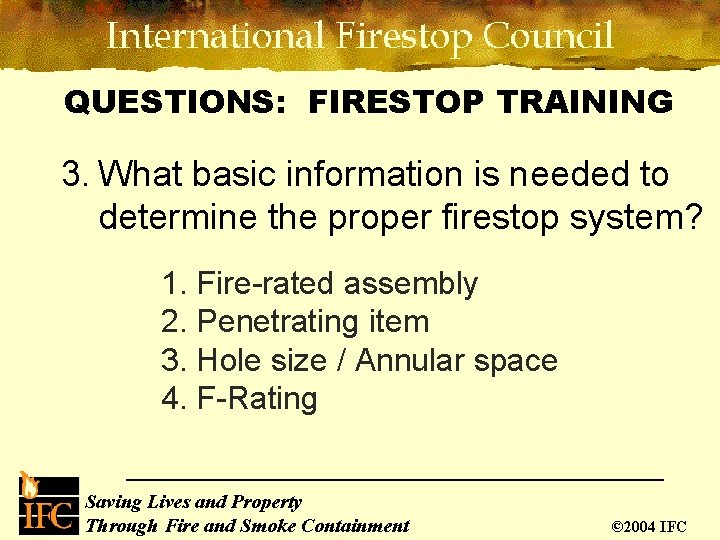
QUESTIONS: FIRESTOP TRAINING 3. What basic information is needed to determine the proper firestop system? 1. Fire-rated assembly 2. Penetrating item 3. Hole size / Annular space 4. F-Rating Saving Lives and Property Through Fire and Smoke Containment © 2004 IFC
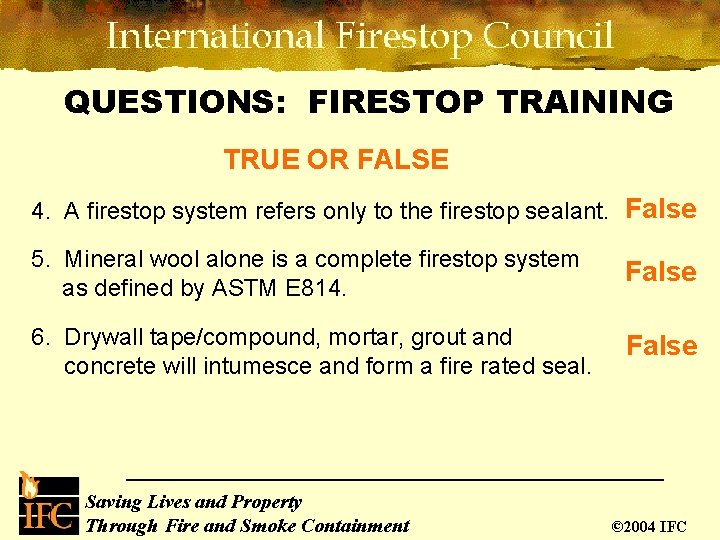
QUESTIONS: FIRESTOP TRAINING TRUE OR FALSE 4. A firestop system refers only to the firestop sealant. False 5. Mineral wool alone is a complete firestop system as defined by ASTM E 814. False 6. Drywall tape/compound, mortar, grout and concrete will intumesce and form a fire rated seal. False Saving Lives and Property Through Fire and Smoke Containment © 2004 IFC
QUESTIONS: FIRESTOP TRAINING 7. The gap between the penetrating item and the edge of the opening is the … a) b) c) d) Char Annular Space Rating Assembly Saving Lives and Property Through Fire and Smoke Containment © 2004 IFC
QUESTIONS: FIRESTOP TRAINING 8. The ability of firestop material to swell, enlarge, or expand under heat conditions is… a) b) c) d) Annulus Char Intumescence Static Saving Lives and Property Through Fire and Smoke Containment © 2004 IFC
QUESTIONS: FIRESTOP TRAINING 9. The time in hours that a firestop system will prevent the passage of flames through an opening, remain in place, and not permit the projection of water is the … a) b) c) d) F Rating T Rating L Rating All the above Saving Lives and Property Through Fire and Smoke Containment © 2004 IFC
QUESTIONS: FIRESTOP TRAINING 10. The appropriate test for throughpenetration firestop systems is … a) b) c) d) ASTM E 84 ASTM C 112 UL 680 ASTM E 814 Saving Lives and Property Through Fire and Smoke Containment © 2004 IFC
About the IFC The International Firestop Council is a not-for-profit association of manufacturers, distributors and installers of fire protective materials and systems. IFC's mission is to promote the technology of fire containment in modern building construction through research, education and development of safety standards and code provisions. Website - www. firestop. org Email - Info@firestop. org Saving Lives and Property Through Fire and Smoke Containment © 2004 IFC
Available educational seminars on our website include…. . • Firestop 101 – An introduction to firestopping • Perimeter Curtain Wall Fire Protection • Firestop System Selection • Flexible Duct Wrap Systems • Fire Protection of Construction Joints Saving Lives and Property Through Fire and Smoke Containment © 2004 IFC