
Fires breakup group report Rapporteur Pablo Saide Chair
Fires breakup group report Rapporteur: Pablo Saide Chair: Jack Dibb
Main Discussion points
Smoke Age • Difference between “Clock” age (time from emissions) vs “photochemical” age. • “Clock” age can be estimated with models vs “photochemical” age that comes from measurements. Can we consolidate them somehow? • Different ratios explored for photochemical age by different groups • Anyone that has an age estimate should share it to intercomparison (Bob Yokelson)
SEAC 4 RS and BBOP • For wildfires, SEAC 4 RS was mainly focus in the long range while BBOP focused on the close range, which makes them complementary • We should look for opportunities for dates where there is overlap • There is potential collaboration, but we not necessary need to have a joint paper.
Emission factors • Different groups working for different species, we should try to consolidate them in a data base and compare to available emissions (FINN, QFED, FLAMBE). Send to Bob Yokelson. • Types of emissions factors: – Close range (“real” emissions) – Grid scale (for modeling purposes) • Bob Chatfield interested in interacting with any measurement people to apply his approach to compute emission factors.
Ag fires vs Wildfires • There is a need to identify the key differences, groups already finding these • Keep in mind that Ag fires are mostly fresh, while most Wildfire smoke was aged/old • ARCTAS data can complement data with fresher wildfire smoke
Golden days • 9/11 for smoke and clouds (DC-8, ER-2, and SPEC) • 9/23 best for ag fires (DC-8 nailed a lot of good ones). • 8/26 best for wildfires (DC-8 great flight plan and AQUA, but not ER-2) • 8/6 best all around, i. e. wildfire sampling, smoke over clouds, coordination with ER-2 and BBOP and MBO and MODIS. DIAL and in-situ, etc. • 8/19 MISR, MODIS, (DC-8, ER-2), sampling of several smoke plumes of different ages, ARM site overpass. Ralph Kahn coordinating. • Need to further select good “legs” where we can do comparison of insitu and remote sensing
Ongoing studies
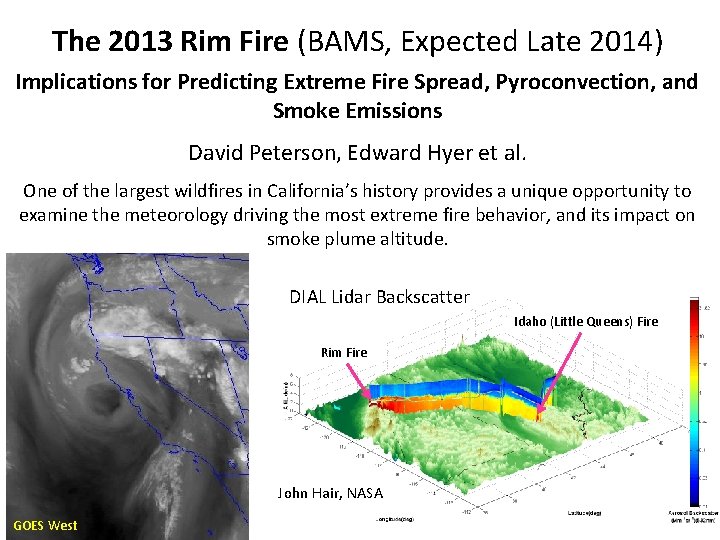
The 2013 Rim Fire (BAMS, Expected Late 2014) Implications for Predicting Extreme Fire Spread, Pyroconvection, and Smoke Emissions David Peterson, Edward Hyer et al. One of the largest wildfires in California’s history provides a unique opportunity to examine the meteorology driving the most extreme fire behavior, and its impact on smoke plume altitude. DIAL Lidar Backscatter Idaho (Little Queens) Fire Rim Fire John Hair, NASA GOES West
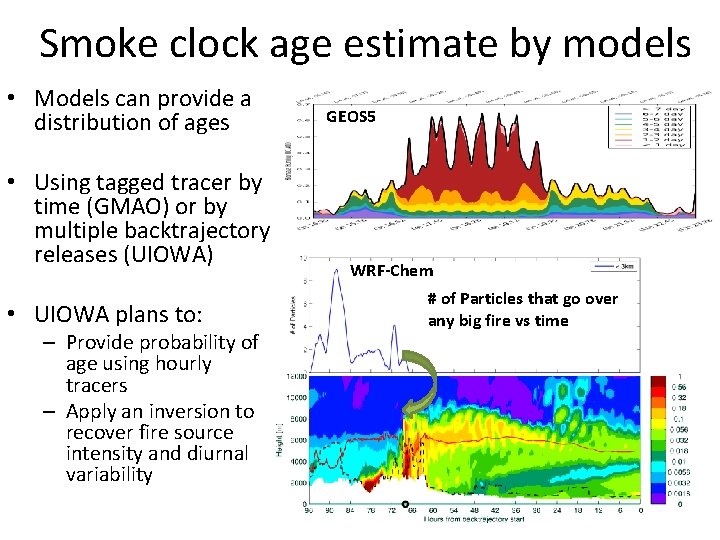
Smoke clock age estimate by models • Models can provide a distribution of ages • Using tagged tracer by time (GMAO) or by multiple backtrajectory releases (UIOWA) • UIOWA plans to: – Provide probability of age using hourly tracers – Apply an inversion to recover fire source intensity and diurnal variability GEOS 5 WRF-Chem # of Particles that go over any big fire vs time
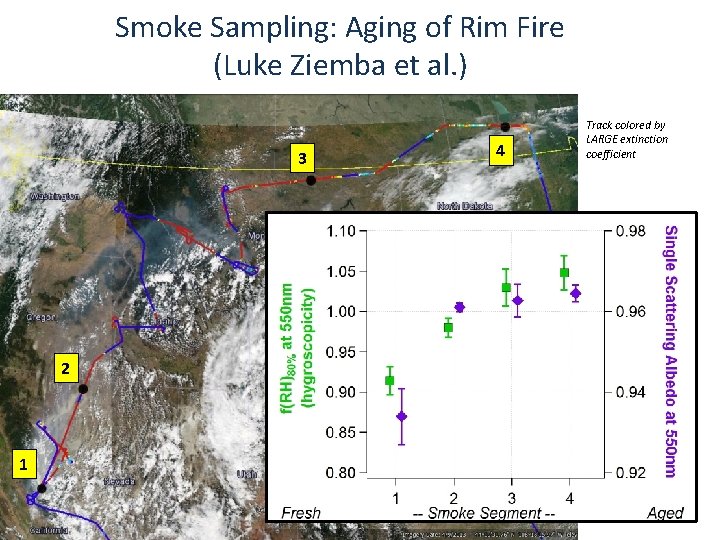
Smoke Sampling: Aging of Rim Fire (Luke Ziemba et al. ) 3 2 1 4 Track colored by LARGE extinction coefficient
Assessing smoke evolution with chemical clocks Jack Dibb and others
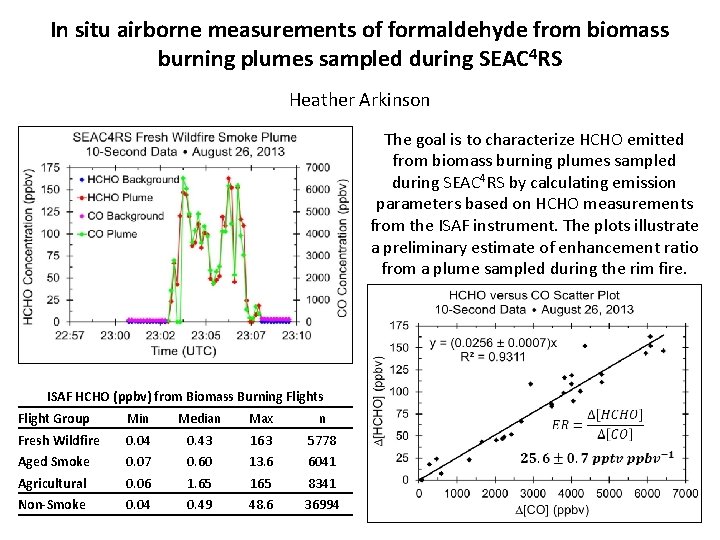
In situ airborne measurements of formaldehyde from biomass burning plumes sampled during SEAC 4 RS Heather Arkinson The goal is to characterize HCHO emitted from biomass burning plumes sampled during SEAC 4 RS by calculating emission parameters based on HCHO measurements from the ISAF instrument. The plots illustrate a preliminary estimate of enhancement ratio from a plume sampled during the rim fire. ISAF HCHO (ppbv) from Biomass Burning Flights Flight Group Min Median Max n Fresh Wildfire 0. 04 0. 43 163 5778 Aged Smoke 0. 07 0. 60 13. 6 6041 Agricultural 0. 06 1. 65 165 8341 Non-Smoke 0. 04 0. 49 48. 6 36994
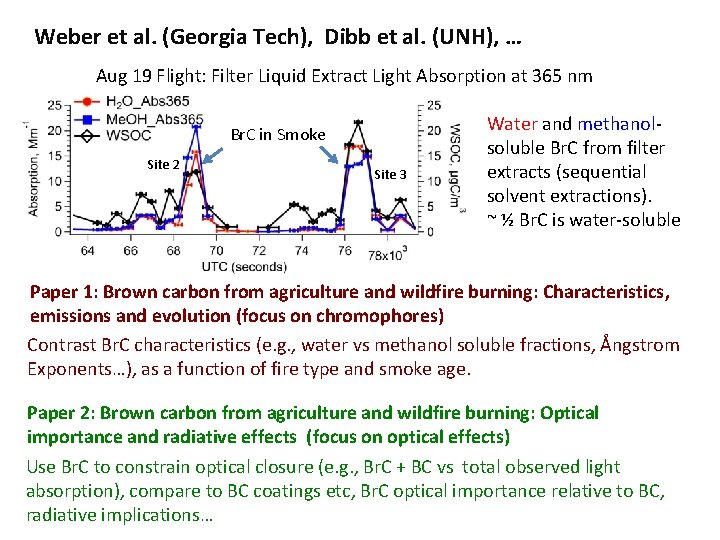
Weber et al. (Georgia Tech), Dibb et al. (UNH), … Aug 19 Flight: Filter Liquid Extract Light Absorption at 365 nm Br. C in Smoke Site 2 Site 3 Water and methanolsoluble Br. C from filter extracts (sequential solvent extractions). ~ ½ Br. C is water-soluble Paper 1: Brown carbon from agriculture and wildfire burning: Characteristics, emissions and evolution (focus on chromophores) Contrast Br. C characteristics (e. g. , water vs methanol soluble fractions, Ångstrom Exponents…), as a function of fire type and smoke age. Paper 2: Brown carbon from agriculture and wildfire burning: Optical importance and radiative effects (focus on optical effects) Use Br. C to constrain optical closure (e. g. , Br. C + BC vs total observed light absorption), compare to BC coatings etc, Br. C optical importance relative to BC, radiative implications…
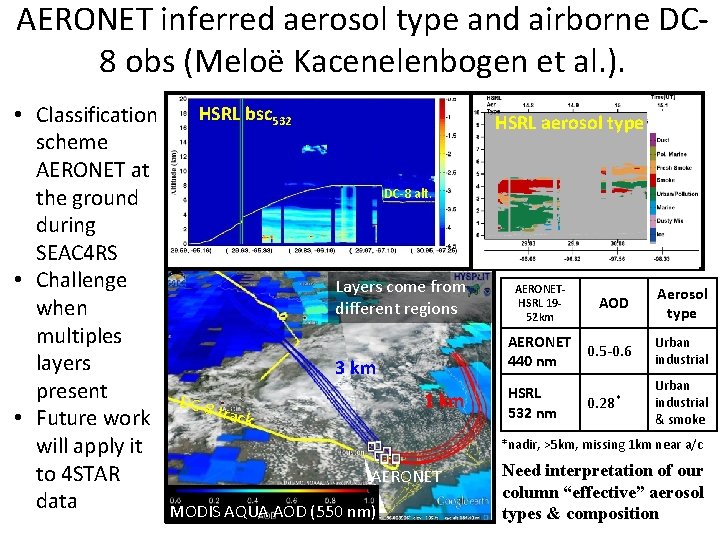
AERONET inferred aerosol type and airborne DC 8 obs (Meloë Kacenelenbogen et al. ). • Classification scheme AERONET at the ground during SEAC 4 RS • Challenge when multiples layers present • Future work will apply it to 4 STAR data HSRL bsc 532 HSRL aerosol type DC-8 alt. Layers come from different regions 3 km DC-8 1 km track AERONETHSRL 1952 km AOD Aerosol type AERONET 0. 5 -0. 6 440 nm Urban industrial HSRL 532 nm Urban industrial & smoke 0. 28* *nadir, >5 km, missing 1 km near a/c AERONET MODIS AQUA AOD (550 nm) Need interpretation of our column “effective” aerosol types & composition
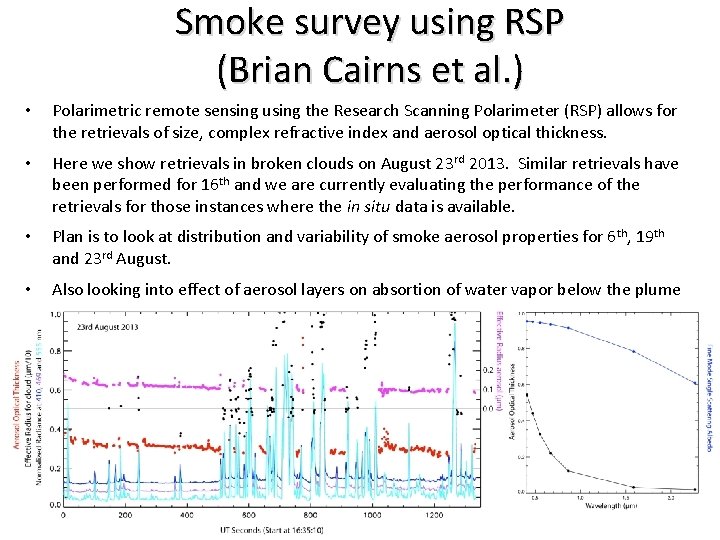
Smoke survey using RSP (Brian Cairns et al. ) • Polarimetric remote sensing using the Research Scanning Polarimeter (RSP) allows for the retrievals of size, complex refractive index and aerosol optical thickness. • Here we show retrievals in broken clouds on August 23 rd 2013. Similar retrievals have been performed for 16 th and we are currently evaluating the performance of the retrievals for those instances where the in situ data is available. • Plan is to look at distribution and variability of smoke aerosol properties for 6 th, 19 th and 23 rd August. • Also looking into effect of aerosol layers on absortion of water vapor below the plume
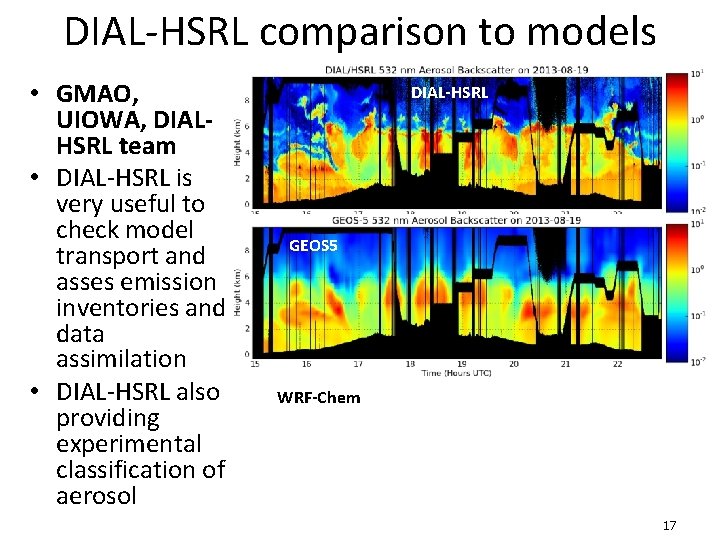
DIAL-HSRL comparison to models • GMAO, UIOWA, DIALHSRL team • DIAL-HSRL is very useful to check model transport and asses emission inventories and data assimilation • DIAL-HSRL also providing experimental classification of aerosol DIAL-HSRL GEOS 5 WRF-Chem 17
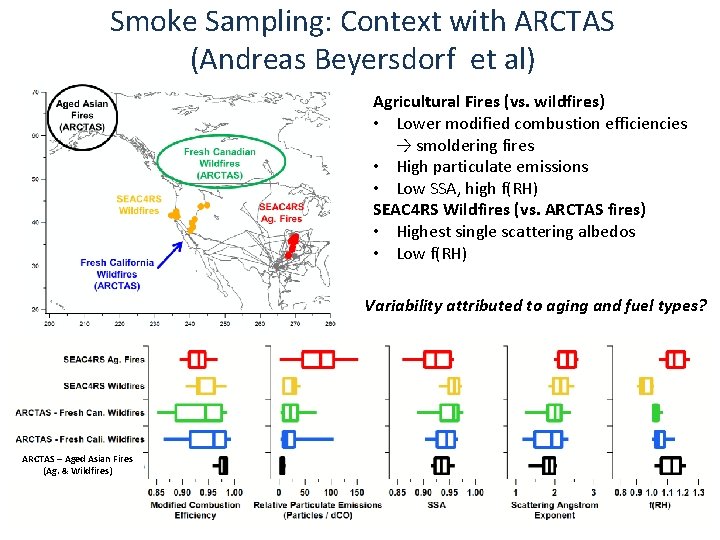
Smoke Sampling: Context with ARCTAS (Andreas Beyersdorf et al) Agricultural Fires (vs. wildfires) • Lower modified combustion efficiencies → smoldering fires • High particulate emissions • Low SSA, high f(RH) SEAC 4 RS Wildfires (vs. ARCTAS fires) • Highest single scattering albedos • Low f(RH) Variability attributed to aging and fuel types? ARCTAS – Aged Asian Fires (Ag. & Wildfires)
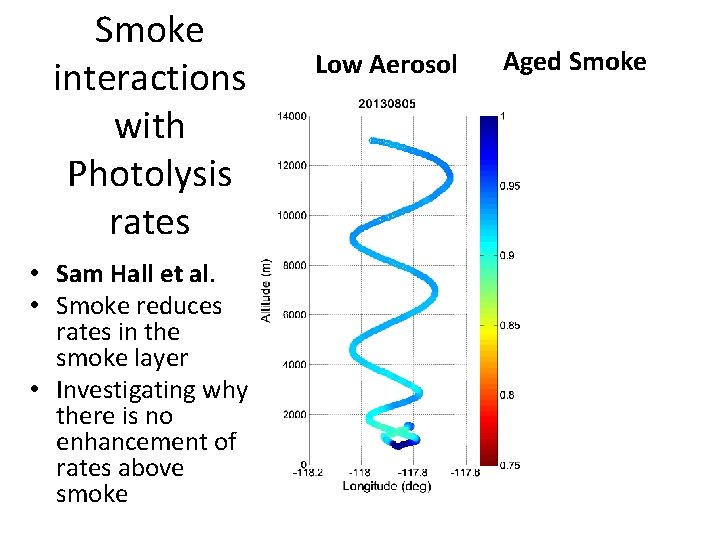
Smoke interactions with Photolysis rates • Sam Hall et al. • Smoke reduces rates in the smoke layer • Investigating why there is no enhancement of rates above smoke Low Aerosol Aged Smoke
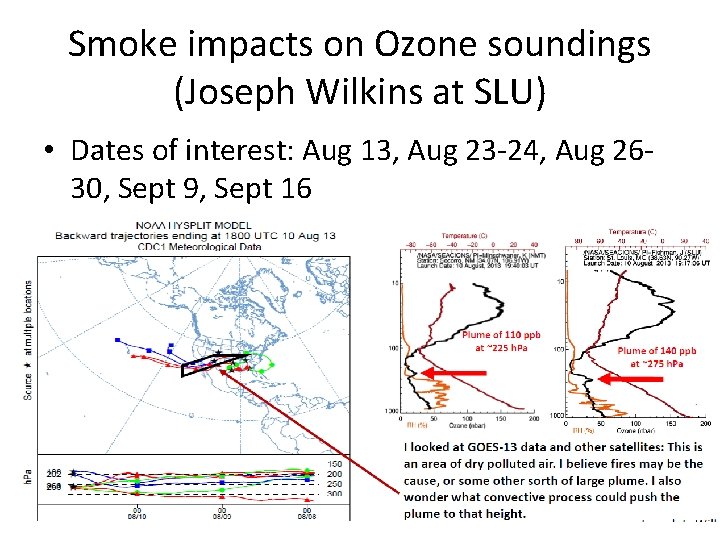
Smoke impacts on Ozone soundings (Joseph Wilkins at SLU) • Dates of interest: Aug 13, Aug 23 -24, Aug 2630, Sept 9, Sept 16
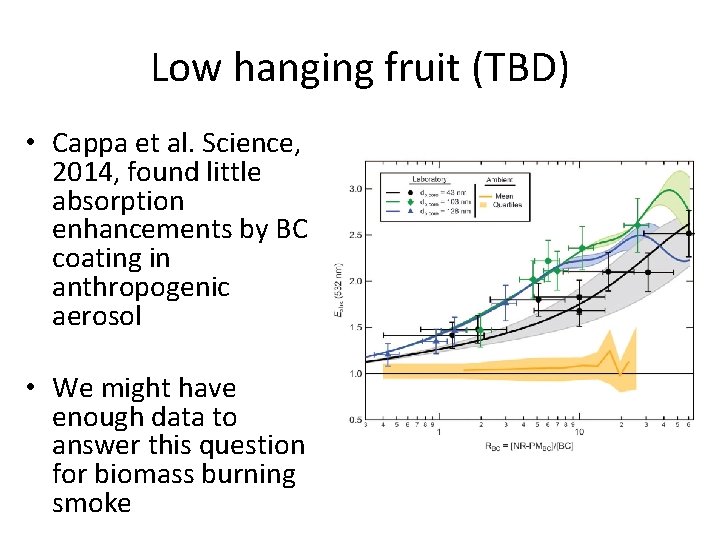
Low hanging fruit (TBD) • Cappa et al. Science, 2014, found little absorption enhancements by BC coating in anthropogenic aerosol • We might have enough data to answer this question for biomass burning smoke
Other studies (no slides or title, let me know if I didn’t get it right ) • Karl Froyd et al, Photochemical clocks, Delta benzene vs CO or other conserved tracer. Also looking at transport mechanisms for coarse aerosols • Xiaoxi Liu, Emissions of Sulfur and Chlorine and Evolution of PAN from Biomass Burning – Clear differences between Ag vs Wildfire • Andreas Beyersdorf et al, Use of CO 2 and Other Tracers for Determination of Biogenic and Biomass Burning Emissions • Heather Arkinson et al. : – – Formadehyde role on fresh fire plumes Ozone evolution on smoke plumes Primary vs secondary aerosol production Looking at Ag vs Wildfires differences
Other fire related studies (more on Aerosol report) • Michal Segal Rozenhaimer et al. , “Classification of airmass types relevant to air quality and radiative balance studies derived from SEAC 4 RS observations” • Charles Brock et al. – Emission factors for Ag. Fires combined with SENEX – Radiative forcing – Vertically resolved optical properties • Sebastian Schmidt et al. Connections between remote sensing and in-situ
Other fire related studies • Ann Perring, Joshua Schwarz, et al. , – Studying BC coating and changes in hygroscopicity with smoke age. – Try to unify SSA measurements with in-situ BC • Taylor Shingler, Armin Sorooshian, et al. , “Size. Resolved, Subsaturated, Aerosol Hygroscopicity during the SEAC 4 RS Field Campaign”, with a focus on smoke • Pedro Campuzano-Jost et al. , – Aged smoke layer over SE US, even when typical gas-phase indicators are back at background levels there is a signal in AMS – Contribution to organic sulfur to smoke plumes
Other fire related studies • Katie Travis et al. , “Biomass Burning Plumes During SEAC 4 RS and the Impact of Fires on Ozone Air Quality in the U. S. “ • Simone Meinardi at UCI could do complete speciation of smoke plumes by request if someone is going to use it
Please send 1 slide with title, description and figures to include in the final report! Thanks! pablo-saide@uiowa. edu
- Slides: 26