
FIREGROUND OPERATIONS Primary Secondary Search Procedures CREDITS IFSTA
- Slides: 20
FIREGROUND OPERATIONS Primary & Secondary Search Procedures
CREDITS � � � � IFSTA FIRE ESSENTIALS 5 TH EDITION CH. 8 FIRETRAINING TOOLBOX. COM FDNY SEARCH POLICY AND PROCEDURES SAN DIEGO METRO ZONE POLICY SO FIREHOUSE. COM “FIREFIGHTER SURVIAL TACTICS” BY JOHN SALKA JR. FIRE ENGINEERING “ TEN COMMANDMENTS OF A SAFE SEARCH” BY ROBERT MORAN STAFF AT FEDERAL FIRE SAN DIEGO STATION 17
� � � Enabling objectives Identify the differences of a primary and secondary search Describe the procedures when searching off an attack line or tag line Define the various advantages and disadvantages to the different types of search techniques Identify the skills and knowledge to search various occupancies including vessel's Identify some basic victim grabs and drags
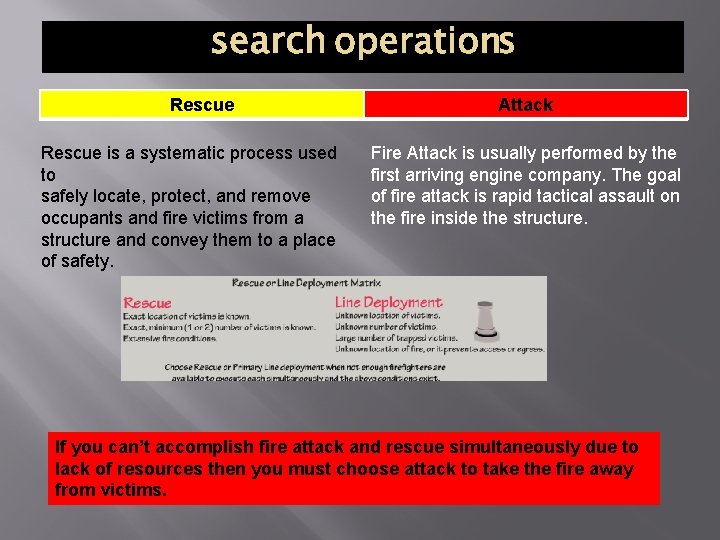
SEARCH OPERATIONS Rescue is a systematic process used to safely locate, protect, and remove occupants and fire victims from a structure and convey them to a place of safety. Attack Fire Attack is usually performed by the first arriving engine company. The goal of fire attack is rapid tactical assault on the fire inside the structure. If you can’t accomplish fire attack and rescue simultaneously due to lack of resources then you must choose attack to take the fire away from victims.
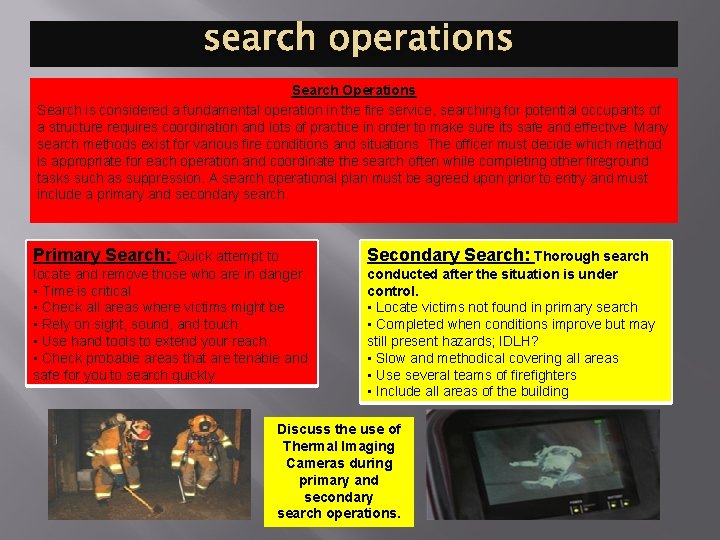
SEARCH OPERATIONS Search Operations Search is considered a fundamental operation in the fire service, searching for potential occupants of a structure requires coordination and lots of practice in order to make sure its safe and effective. Many search methods exist for various fire conditions and situations. The officer must decide which method is appropriate for each operation and coordinate the search often while completing other fireground tasks such as suppression. A search operational plan must be agreed upon prior to entry and must include a primary and secondary search. Primary Search: Quick attempt to Secondary Search: Thorough search locate and remove those who are in danger. • Time is critical. • Check all areas where victims might be. • Rely on sight, sound, and touch. • Use hand tools to extend your reach. • Check probable areas that are tenable and safe for you to search quickly conducted after the situation is under control. • Locate victims not found in primary search • Completed when conditions improve but may still present hazards; IDLH? • Slow and methodical covering all areas • Use several teams of firefighters • Include all areas of the building Discuss the use of Thermal Imaging Cameras during primary and secondary search operations.
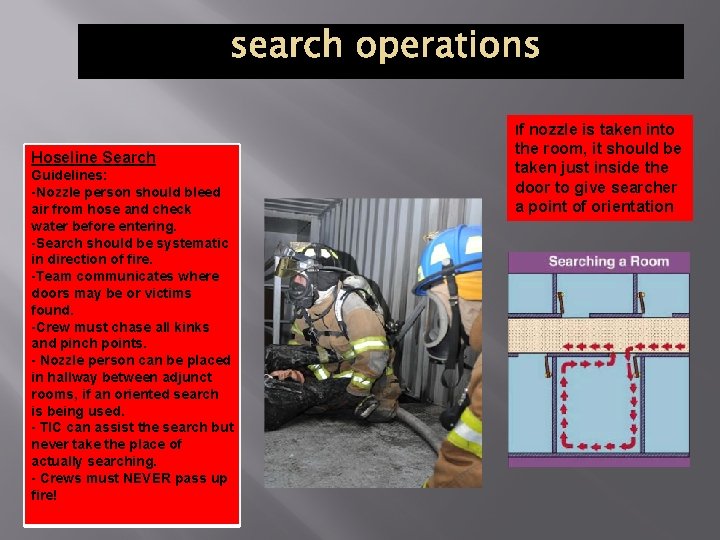
SEARCH OPERATIONS If nozzle is taken into Hoseline Search Guidelines: -Nozzle person should bleed air from hose and check water before entering. -Search should be systematic in direction of fire. -Team communicates where doors may be or victims found. -Crew must chase all kinks and pinch points. - Nozzle person can be placed in hallway between adjunct rooms, if an oriented search is being used. - TIC can assist the search but never take the place of actually searching. - Crews must NEVER pass up fire! the room, it should be taken just inside the door to give searcher a point of orientation
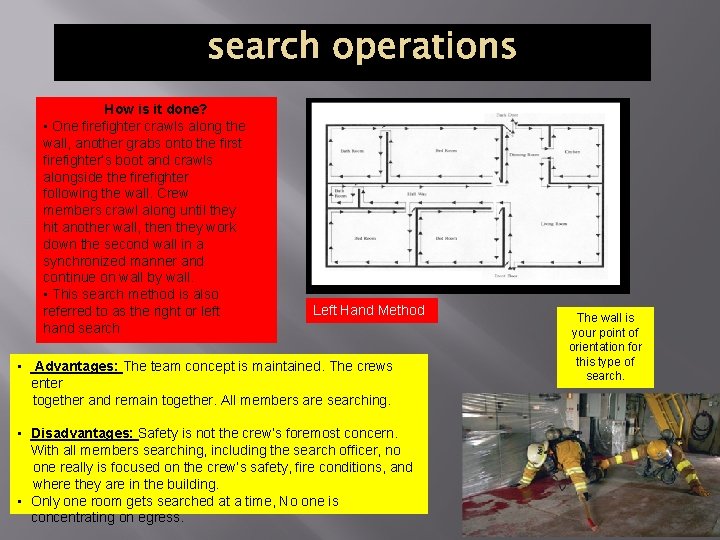
SEARCH OPERATIONS How is it done? • One firefighter crawls along the wall, another grabs onto the first firefighter’s boot and crawls alongside the firefighter following the wall. Crew members crawl along until they hit another wall, then they work down the second wall in a synchronized manner and continue on wall by wall. • This search method is also referred to as the right or left hand search Left Hand Method • Advantages: The team concept is maintained. The crews enter together and remain together. All members are searching. • Disadvantages: Safety is not the crew’s foremost concern. With all members searching, including the search officer, no one really is focused on the crew’s safety, fire conditions, and where they are in the building. • Only one room gets searched at a time, No one is concentrating on egress. The wall is your point of orientation for this type of search.
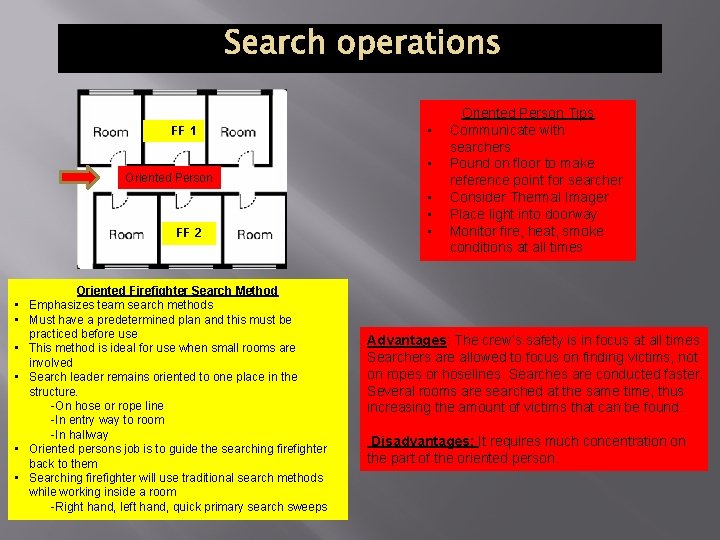
SEARCH OPERATIONS FF 1 Oriented Person FF 2 • • • Oriented Firefighter Search Method Emphasizes team search methods Must have a predetermined plan and this must be practiced before use This method is ideal for use when small rooms are involved Search leader remains oriented to one place in the structure. -On hose or rope line -In entry way to room -In hallway Oriented persons job is to guide the searching firefighter back to them Searching firefighter will use traditional search methods while working inside a room -Right hand, left hand, quick primary search sweeps • • • Oriented Person Tips Communicate with searchers Pound on floor to make reference point for searcher Consider Thermal Imager Place light into doorway Monitor fire, heat, smoke conditions at all times Advantages: The crew’s safety is in focus at all times. Searchers are allowed to focus on finding victims, not on ropes or hoselines. Searches are conducted faster. Several rooms are searched at the same time, thus increasing the amount of victims that can be found. Disadvantages: It requires much concentration on the part of the oriented person.
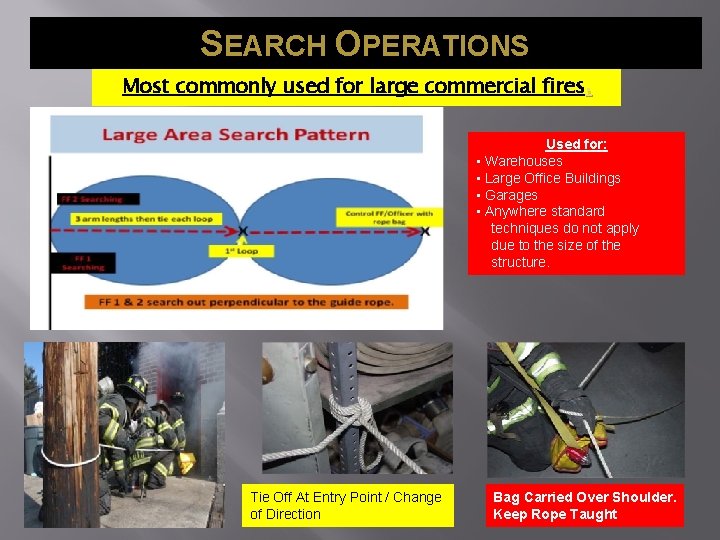
SEARCH OPERATIONS Most commonly used for large commercial fires. Used for: • Warehouses • Large Office Buildings • Garages • Anywhere standard techniques do not apply due to the size of the structure. Tie Off At Entry Point / Change of Direction Bag Carried Over Shoulder. Keep Rope Taught
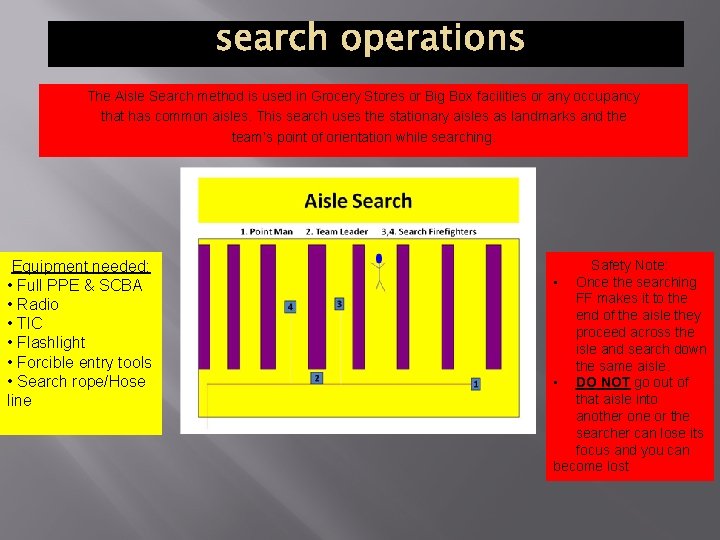
The Aisle Search method is used in Grocery Stores or Big Box facilities or any occupancy that has common aisles. This search uses the stationary aisles as landmarks and the team’s point of orientation while searching. Equipment needed: • Full PPE & SCBA • Radio • TIC • Flashlight • Forcible entry tools • Search rope/Hose line Safety Note: • Once the searching FF makes it to the end of the aisle they proceed across the isle and search down the same aisle. • DO NOT go out of that aisle into another one or the searcher can lose its focus and you can become lost
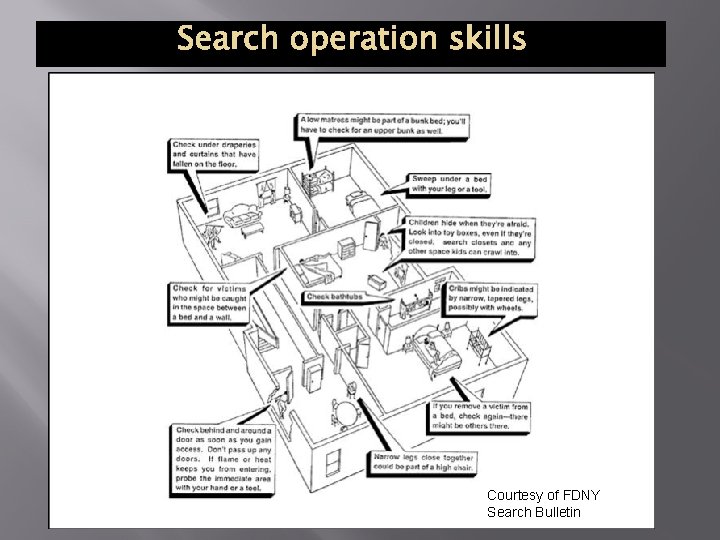
Courtesy of FDNY Search Bulletin
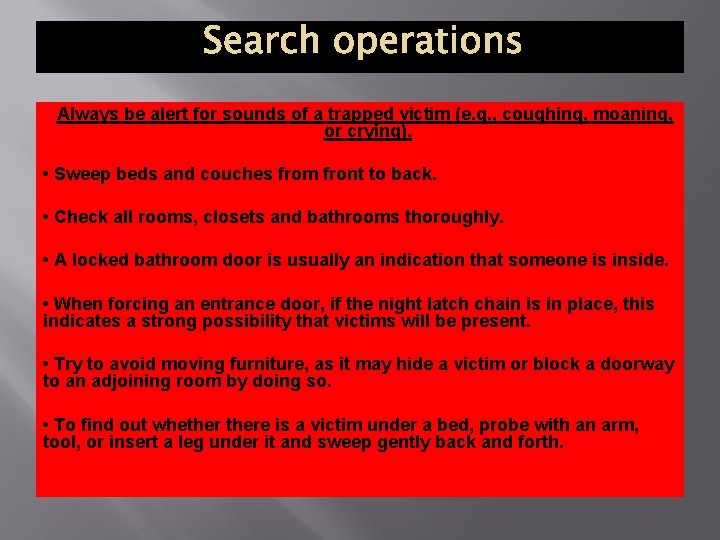
SEARCH OPERATIONS Always be alert for sounds of a trapped victim (e. g. , coughing, moaning, or crying). • Sweep beds and couches from front to back. • Check all rooms, closets and bathrooms thoroughly. • A locked bathroom door is usually an indication that someone is inside. • When forcing an entrance door, if the night latch chain is in place, this indicates a strong possibility that victims will be present. • Try to avoid moving furniture, as it may hide a victim or block a doorway to an adjoining room by doing so. • To find out whethere is a victim under a bed, probe with an arm, tool, or insert a leg under it and sweep gently back and forth.
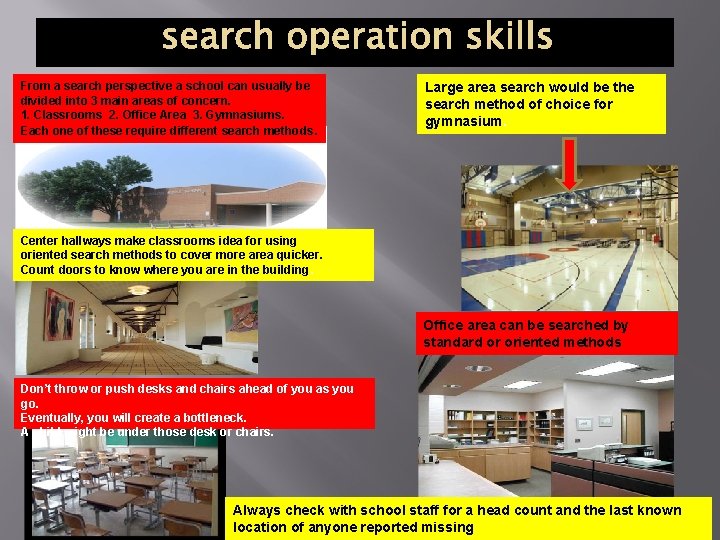
From a search perspective a school can usually be divided into 3 main areas of concern. 1. Classrooms 2. Office Area 3. Gymnasiums. Each one of these require different search methods. Large area search would be the search method of choice for gymnasium. Center hallways make classrooms idea for using oriented search methods to cover more area quicker. Count doors to know where you are in the building. Office area can be searched by standard or oriented methods Don’t throw or push desks and chairs ahead of you as you go. Eventually, you will create a bottleneck. A child might be under those desk or chairs. Always check with school staff for a head count and the last known location of anyone reported missing
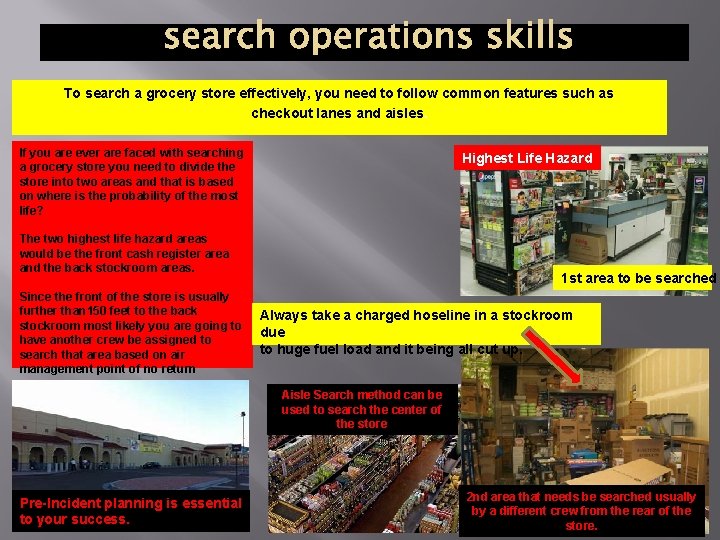
To search a grocery store effectively, you need to follow common features such as checkout lanes and aisles. If you are ever are faced with searching a grocery store you need to divide the store into two areas and that is based on where is the probability of the most life? Highest Life Hazard The two highest life hazard areas would be the front cash register area and the back stockroom areas. Since the front of the store is usually further than 150 feet to the back stockroom most likely you are going to have another crew be assigned to search that area based on air management point of no return 1 st area to be searched Always take a charged hoseline in a stockroom due to huge fuel load and it being all cut up. Aisle Search method can be used to search the center of the store Pre-Incident planning is essential to your success. 2 nd area that needs be searched usually by a different crew from the rear of the store.
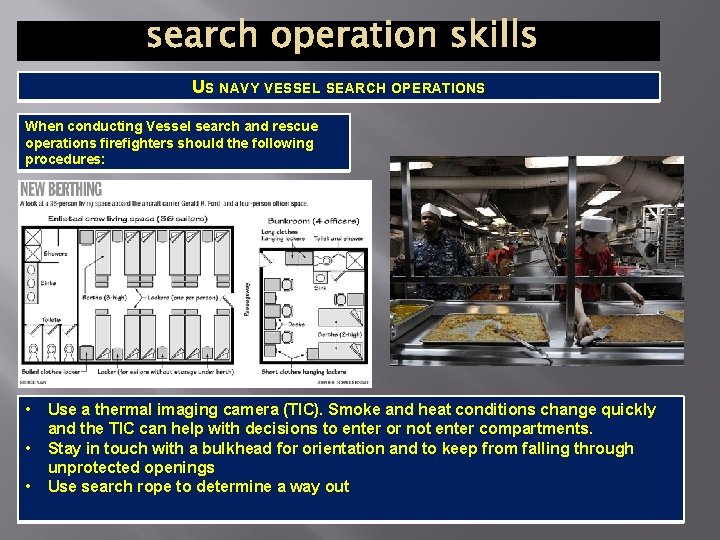
US NAVY VESSEL SEARCH OPERATIONS When conducting Vessel search and rescue operations firefighters should the following procedures: • • • Use a thermal imaging camera (TIC). Smoke and heat conditions change quickly and the TIC can help with decisions to enter or not enter compartments. Stay in touch with a bulkhead for orientation and to keep from falling through unprotected openings Use search rope to determine a way out
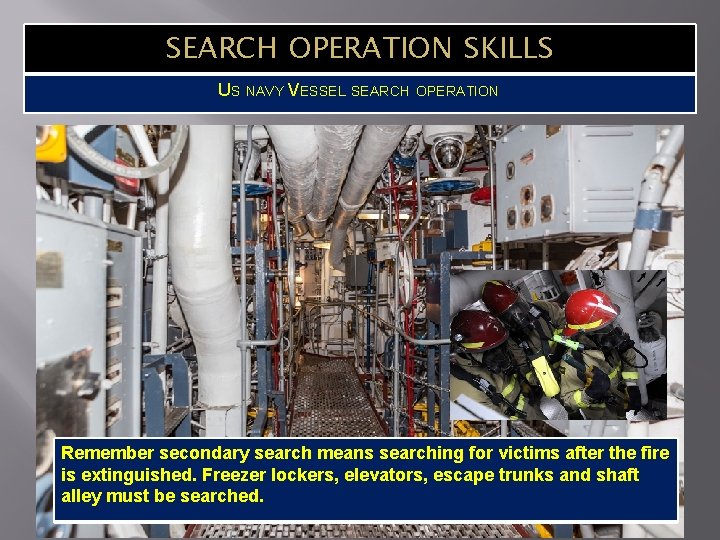
SEARCH OPERATION SKILLS US NAVY VESSEL SEARCH OPERATION Remember secondary search means searching for victims after the fire is extinguished. Freezer lockers, elevators, escape trunks and shaft alley must be searched.
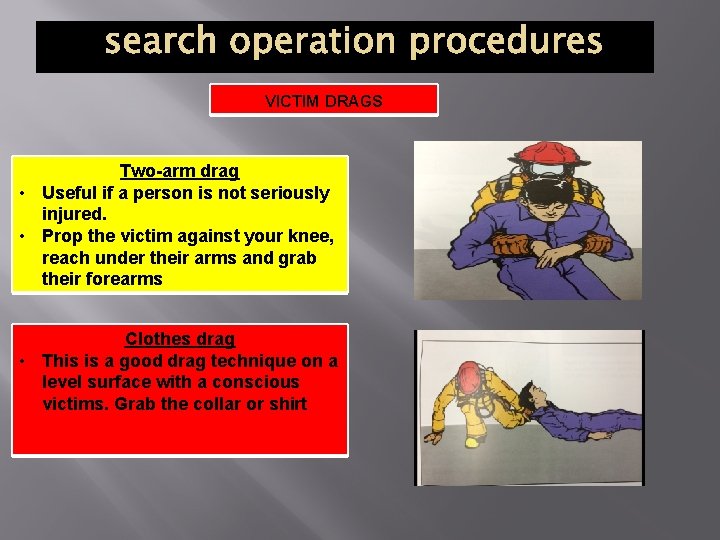
VICTIM DRAGS Two-arm drag • Useful if a person is not seriously injured. • Prop the victim against your knee, reach under their arms and grab their forearms Clothes drag • This is a good drag technique on a level surface with a conscious victims. Grab the collar or shirt
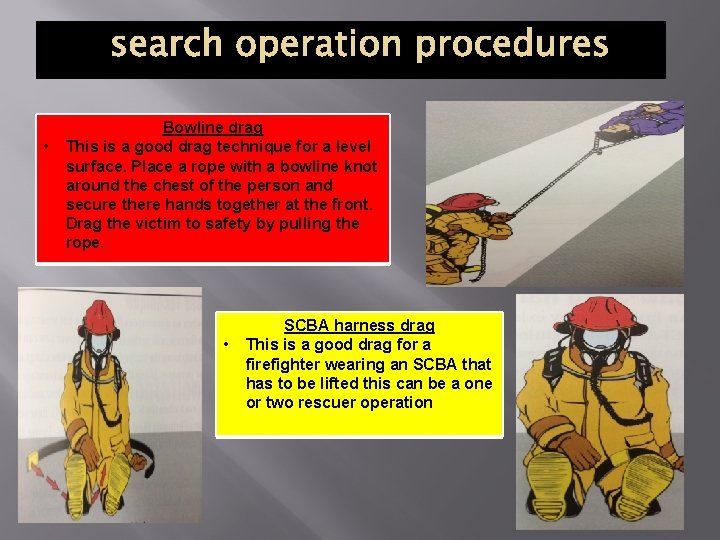
SEARCH OPERATION PROCEDURES • Bowline drag This is a good drag technique for a level surface. Place a rope with a bowline knot around the chest of the person and secure there hands together at the front. Drag the victim to safety by pulling the rope. • SCBA harness drag This is a good drag for a firefighter wearing an SCBA that has to be lifted this can be a one or two rescuer operation
� � � Enabling objectives Identify the differences of a primary and secondary search Describe the procedures when searching off an attack line or tag line Define the various advantages and disadvantages to the different types of search techniques Identify the skills and knowledge to search various occupancies including vessel's Identify some basic victim grabs and drags
Questions ?