
Firefly Synchronisation Java Demo in 1 D Array
![Main method public static void main(String[] args) { // inputs for running firefly algorithm](https://slidetodoc.com/presentation_image/24beb313e3a0e799c6a2ee343d04e328/image-5.jpg "Main method public static void main(String[] args) { // inputs for running firefly algorithm")
![update. Fireflies. State() - Update fireflies' state public static int [] update. Fireflies. State(int](https://slidetodoc.com/presentation_image/24beb313e3a0e799c6a2ee343d04e328/image-8.jpg "update. Fireflies. State() - Update fireflies' state public static int [] update. Fireflies. State(int")
![neighbor. Is. Flashing() - if fireflies[num]'s neighbor or itself is flashing public static boolean](https://slidetodoc.com/presentation_image/24beb313e3a0e799c6a2ee343d04e328/image-9.jpg "neighbor. Is. Flashing() - if fireflies[num]'s neighbor or itself is flashing public static boolean")
- Slides: 11
Firefly Synchronisation Java Demo in 1 D Array
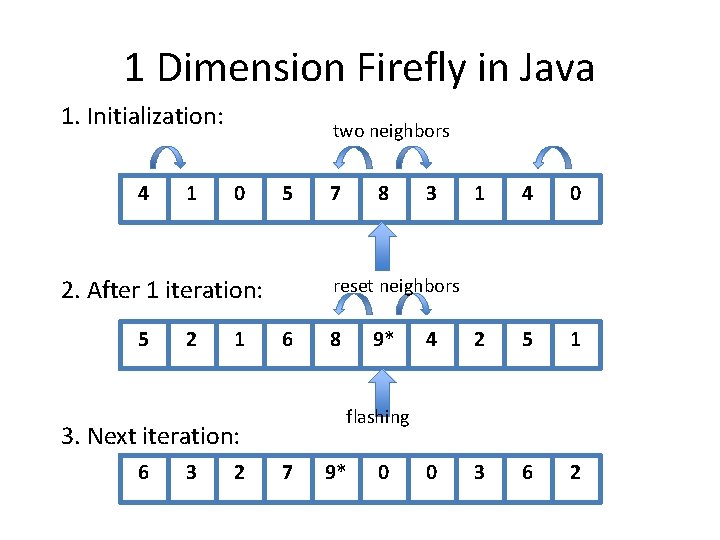
1 Dimension Firefly in Java 1. Initialization: 4 1 two neighbors 0 5 2. After 1 iteration: 5 2 1 3 2 8 3 1 4 0 4 2 5 1 0 3 6 2 reset neighbors 6 8 9* flashing 3. Next iteration: 6 7 7 9* 0
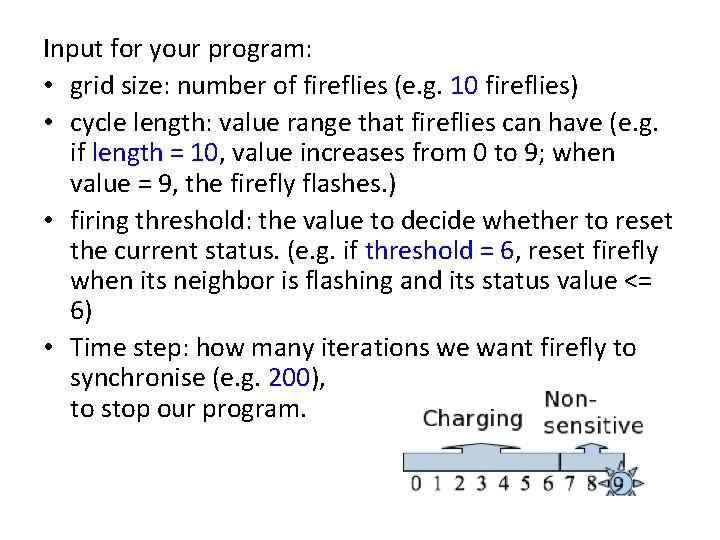
Input for your program: • grid size: number of fireflies (e. g. 10 fireflies) • cycle length: value range that fireflies can have (e. g. if length = 10, value increases from 0 to 9; when value = 9, the firefly flashes. ) • firing threshold: the value to decide whether to reset the current status. (e. g. if threshold = 6, reset firefly when its neighbor is flashing and its status value <= 6) • Time step: how many iterations we want firefly to synchronise (e. g. 200), to stop our program.
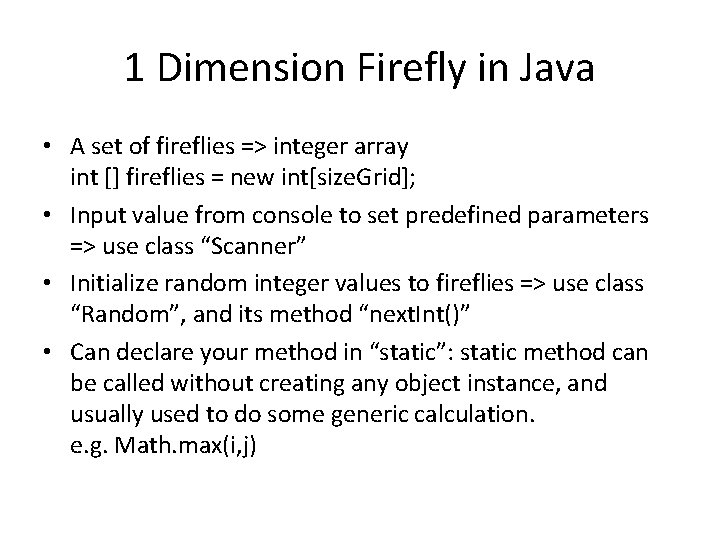
1 Dimension Firefly in Java • A set of fireflies => integer array int [] fireflies = new int[size. Grid]; • Input value from console to set predefined parameters => use class “Scanner” • Initialize random integer values to fireflies => use class “Random”, and its method “next. Int()” • Can declare your method in “static”: static method can be called without creating any object instance, and usually used to do some generic calculation. e. g. Math. max(i, j)
Main method public static void main(String[] args) { // inputs for running firefly algorithm int grid. Size = 10; int cycle. Length = 10; int firing. Threshold = 6; int num. Time. Steps = 200; } // call our main method here by passing on the 4 inputs simple. Fireflies(grid. Size, cycle. Length, firing. Threshold, num. Time. Steps);
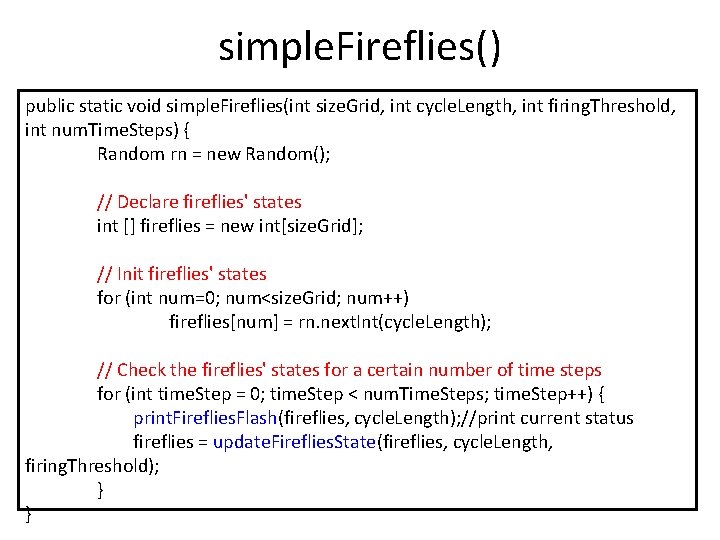
simple. Fireflies() public static void simple. Fireflies(int size. Grid, int cycle. Length, int firing. Threshold, int num. Time. Steps) { Random rn = new Random(); // Declare fireflies' states int [] fireflies = new int[size. Grid]; // Init fireflies' states for (int num=0; num<size. Grid; num++) fireflies[num] = rn. next. Int(cycle. Length); // Check the fireflies' states for a certain number of time steps for (int time. Step = 0; time. Step < num. Time. Steps; time. Step++) { print. Fireflies. Flash(fireflies, cycle. Length); //print current status fireflies = update. Fireflies. State(fireflies, cycle. Length, firing. Threshold); } }
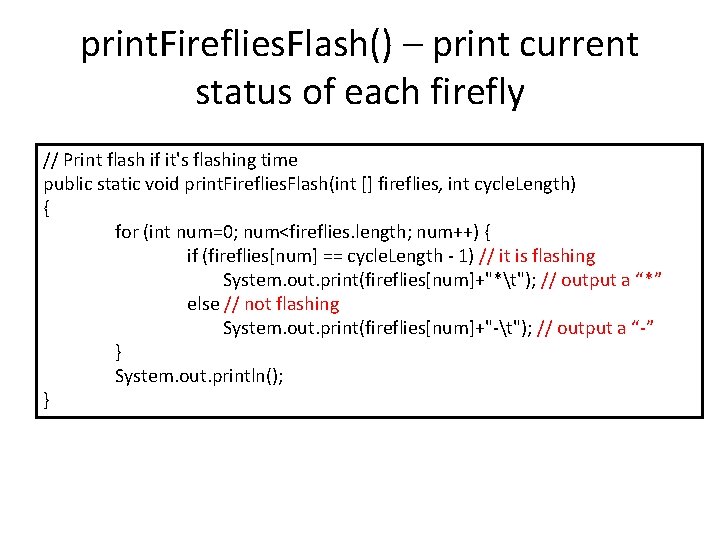
print. Fireflies. Flash() – print current status of each firefly // Print flash if it's flashing time public static void print. Fireflies. Flash(int [] fireflies, int cycle. Length) { for (int num=0; num<fireflies. length; num++) { if (fireflies[num] == cycle. Length - 1) // it is flashing System. out. print(fireflies[num]+"*t"); // output a “*” else // not flashing System. out. print(fireflies[num]+"-t"); // output a “-” } System. out. println(); }
update. Fireflies. State() - Update fireflies' state public static int [] update. Fireflies. State(int [] fireflies, int cycle. Length, int firing. Threshold){ int [] fireflies. Tmp = new int[fireflies. length]; } for (int num=0; num<fireflies. length; num++) { // if rules are satisfied, reset the firefly if (fireflies[num] < firing. Threshold && neighbor. Is. Flashing(fireflies, num, cycle. Length)) { fireflies. Tmp[num] = 0; } else {// otherwise, increase the status value by 1 fireflies. Tmp[num] = (fireflies[num] + 1) % cycle. Length; } } return fireflies. Tmp; // return the updated status values of fireflies Symbol “a%b”: modular arithmetic, return the remainder in division a/b.
neighbor. Is. Flashing() - if fireflies[num]'s neighbor or itself is flashing public static boolean neighbor. Is. Flashing(int [] fireflies, int num, int cycle. Length){ for (int n = Math. max(0, num-1); n <= Math. min(fireflies. length-1, num+1); n++) { if (fireflies[n] == cycle. Length - 1) return true; } num-1 num+1 } return false; 2 8 When n = Math. max(0, num-1), fireflies[n] is the left neighbor of fireflies[num] is not the first firefly in the array. When n = Math. min(fireflies. length-1, num+1), fireflies[n] is the right neighbor of fireflies[num] is not the last firefly in the array. 0
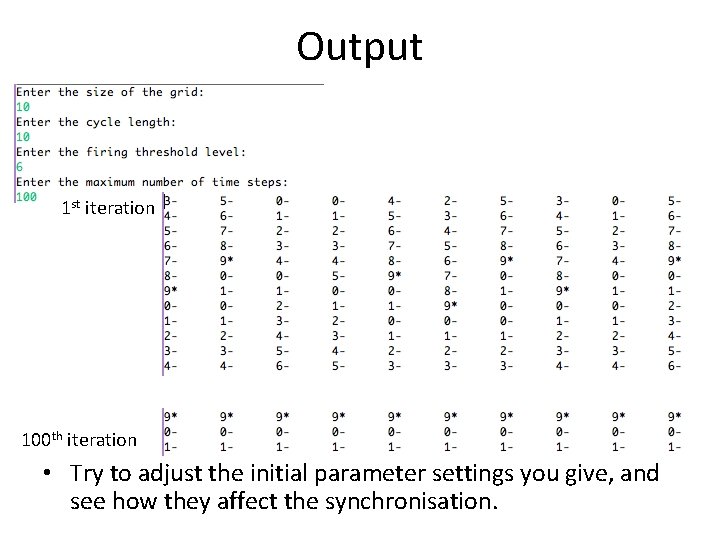
Output 1 st iteration 100 th iteration • Try to adjust the initial parameter settings you give, and see how they affect the synchronisation.
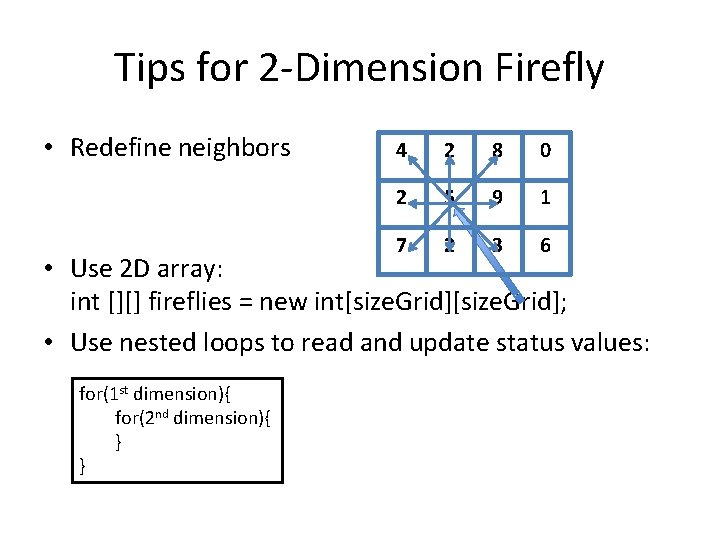
Tips for 2 -Dimension Firefly • Redefine neighbors 4 2 8 0 2 5 9 1 7 2 3 6 • Use 2 D array: int [][] fireflies = new int[size. Grid]; • Use nested loops to read and update status values: for(1 st dimension){ for(2 nd dimension){ } }