
Firefighters Support Foundation ICS Rightsizing for Each Event

- Slides: 34
Firefighters Support Foundation ICS: Rightsizing for Each Event v 1. 0
About FSF The Firefighters Support Foundation is a 501 c 3 non-profit organization whose primary mission is to develop, produce and distribute training programs to firefighters and all first responder professionals. All of our programs are distributed free of charge. ICS: Rightsizing for Each Event 2
Permission is granted to reproduce or distribute this material so long as the Firefighters Support Foundation is credited as the source ICS: Rightsizing for Each Event 3
Accompanying Video This Power. Point presentation accompanies the video presentation of the same title. ICS: Rightsizing for Each Event 4
Presenter August Vernon Operations Officer Forsyth, NC County Office of Emergency Management Instructor Incident Management, Mass Violence, Crisis Planning, Terrorism ICS: Rightsizing for Each Event 5
ICS Overview • Course is not an “Introduction to ICS” session. • Plenty of excellent ICS courses and resources available at no-cost. Check fema. gov • The Incident Command System (ICS) is a valuable and effective tool that can be used by any sized agency/entity to manage incidents and events of any size and type. ICS: Rightsizing for Each Event 6
ICS Overview • During this presentation, many minor, everyday incidents (e. g. , structural fires, traffic accidents, medical emergencies, robberies, etc. ) are occurring , and the response to them can be managed utilizing the Incident Command System (ICS). • The form and scope/scale of the ICS implementation will vary considerably, according to the situation • Some of these every day incidents may be resolved not utilizing the Incident Command System (ICS) and the job still gets done! ICS: Rightsizing for Each Event 7
ICS Overview • Course is designed as a “food for thought” workshop and to foster thought and discussion on the practical and realistic use of ICS. • Some of the ICS materials presented in the presentation are pulled from readily available ICS training soucres such as FEMA. ICS: Rightsizing for Each Event 8
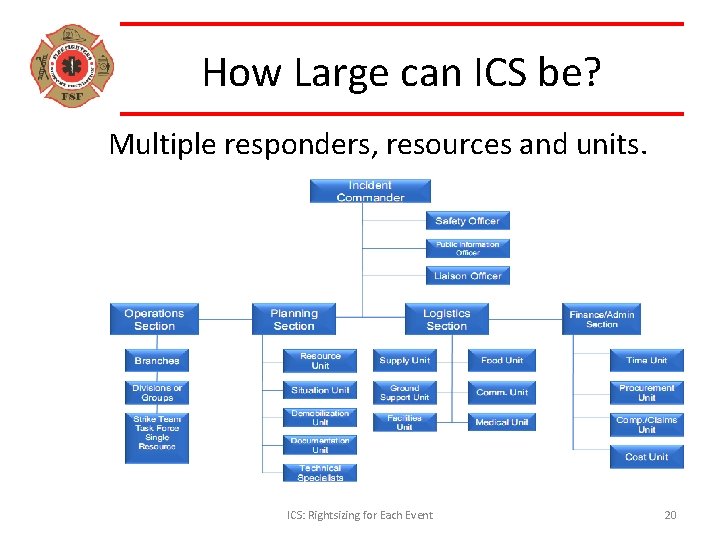
ICS Myths • ICS takes too many people. Just look at how complicated an ICS org chart is! • ICS is just for large incidents or disasters. It’s too cumbersome for small, routine incidents. • ICS is just for fire and police departments. ICS: Rightsizing for Each Event 9
The Facts of Life!! • Anyone can be trained to use ICS to effectively manage any incident. • ICS is a management system…not just an organizational chart. • ICS will enhance accountability and bring order to an otherwise chaotic event (if used properly). • This takes continuous training and practice. ICS: Rightsizing for Each Event 10
ICS Overview • The vast majority of public safety/emergency incidents are handled on a daily basis by a single jurisdiction or agency at the local level. • However, there are instances when incident management must involve multiple jurisdictions, additional agencies, and different emergency responder disciplines. • Any incident can have a mix of external influences, political, economic, social, environmental, and cost implications with potentially serious longterm effects to the community. • Larger, more complex or high-impact incidents require effective and efficient coordination across this broad spectrum of organizations and activities to come to a safe resolution. ICS: Rightsizing for Each Event 11
ICS 101 The Incident Command System: – Is a standardized, on-scene, all-hazards incident management concept/system. – Based on military and business principals. – Allows its users to adopt an integrated organizational structure to match the complexities and demands of single or multiple incidents without being hindered by jurisdictional or agency boundaries. – It can grow or shrink to meet different needs. This flexibility makes it a very cost-effective and efficient management approach for both small and large incidents. ICS: Rightsizing for Each Event 12
ICS 101 (2) • ICS represents “best practices” and has become a standard for emergency management/public safety activities across the United States. • ICS is used successfully at all levels of government (local, regional, state, federal and tribal) and nongovernmental agencies. • ICS is also utilized by many private sector entities to manage internal and external crisis and disasters. ICS: Rightsizing for Each Event 13
ICS 101 (3) • ICS in it’s current recognized form was developed in the 1970 s following a series of catastrophic fires in California's urban/wildland interface. • Property damage ran into the millions, and many people died or were injured. • The personnel assigned to determine the causes of this wildfire disaster studied the case histories and discovered that response problems could rarely be attributed to lack of resources or failure of tactics. ICS: Rightsizing for Each Event 14
ICS 101 (4) • Surprisingly, the studies discovered that response problems were far more likely to result from inadequate management than from any other single reason. • It is very important to recognize that they identified that response problems and failures could rarely be attributed to lack of resources or failure of tactics. • We can eventually get plenty of the right type of resources to any incident, and first responders/public safety are usually efficient/effective at their operational tactics. • But, even in 2013 the same issue of inadequate management continues to haunt us. ICS: Rightsizing for Each Event 15
ICS 101 (5) Weaknesses in incident management were often due to: • Lack of accountability, including unclear chains of command supervision. • Poor communication due to both inefficient uses of available communications systems and conflicting codes and terminology. • Lack of an orderly, systematic planning process. • No common, flexible, predesigned management structure that enabled commanders to delegate responsibilities and manage workloads efficiently. • No predefined methods to integrate interagency requirements into the management structure and planning process effectively. ICS: Rightsizing for Each Event 16
ICS 101 (6) • An efficient and effective application of the Incident Command System (ICS) can address all the major weaknesses that were just identified. • But for that to happen all jurisdictions, agencies and responders need to have a better understanding of the realistic applications of ICS during an incident. ICS: Rightsizing for Each Event 17
Best Practices Using management best practices, ICS helps to ensure: – The safety of responders and others. – The achievement of tactical objectives. – The efficient use of resources. ICS: Rightsizing for Each Event 18
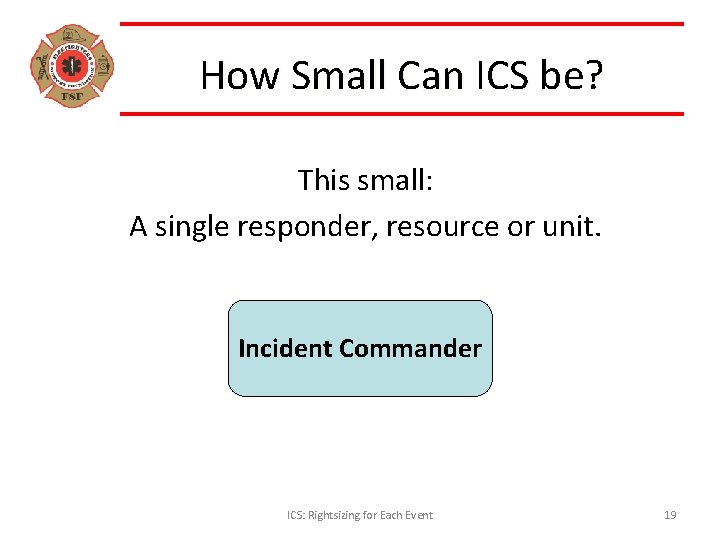
How Small Can ICS be? This small: A single responder, resource or unit. Incident Commander ICS: Rightsizing for Each Event 19
How Large can ICS be? Multiple responders, resources and units. ICS: Rightsizing for Each Event 20
Incidents Managed ICS is flexible and scalable to any incident: Fires, both structural and wildland Natural disasters, such as tornadoes, floods, ice storms, or earthquakes Human and animal disease outbreaks Search and rescue missions (land, sea and air) Hazardous materials incidents (fixed or transportation) Criminal acts and crime scene investigations (manhunts, SWAT ops, major crime scenes, riots, etc. ) – Terrorist incidents, including the use of weapons of mass destruction – National Special Security Events, such as Presidential visits or the Super Bowl – Other planned events, such as festivals, airshows, parades or demonstrations – – – ICS: Rightsizing for Each Event 21
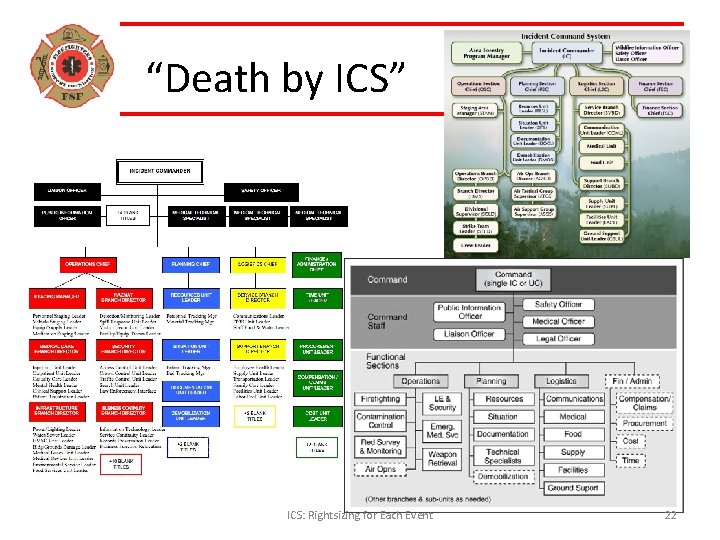
“Death by ICS” ICS: Rightsizing for Each Event 22
ICS Principles • • • Common terminology A modular organization Integrated communications Unity of command A unified command structure Consolidated Incident Action Plans (IAP) A manageable span of control Designated incident facilities Comprehensive resource management Media, Media ICS: Rightsizing for Each Event 23
Law Enforcement and ICS • Some law enforcement agencies utilize ICS on a daily basis on everyday incidents, and all major/highimpact incidents, and are excellent ICS practitioners. • Some utilize ICS only on major/high-impact type incidents and may or may not be effective. • Some never use it at all and say they will use it on the “big one” type of disaster which means they will not have much practice or experience with ICS = FAIL. ICS: Rightsizing for Each Event 24
Law Enforcement and ICS (2) • This does not mean that these agencies are not doing a good job. These agencies do an excellent job at law enforcement operations/investigations. • The nature of law enforcement duties requires that most calls and incidents are handled by 1 or 2 officers/deputies very quickly. This is not conducive to “large-scale” or “multi-agency” ICS type of operations. • This can lead to coordination and communications breakdowns and issues when operating in a “multi-agency” or “Unified Command” environments. ICS: Rightsizing for Each Event 25
Give the Troops Breathing Room • Incident Commander/Unified Commanders needs to allow responders/staff the flexibility and responsibility to conduct their missions/activities. • Avoid micro-managing. • Depends on size, scope, scale of the incident and the span of control. ICS: Rightsizing for Each Event 26
ICS Limitations • ICS does require training and experience. • Very difficult to put someone into the system who is not familiar with it, especially if they are in a command/leadership role. • ICS is not compatible with the day to day functions and positions of certain agencies, which could make a difficult transition during a crisis. ICS: Rightsizing for Each Event 27
ICS Limitations (2) • When the current version of ICS was established in 2004 as the national standard, it was required of all agencies receiving homeland security funds and other type federal grants. • This has still not been occurring. • Different versions of ICS were used for decades and are still floating around. ICS: Rightsizing for Each Event 28
ICS Limitations (3) • When jurisdictions do not use ICS to manage incidents, especially multi-agency or high-impact incidents, this leads to confusion and serious problems. • Agencies will then rely on experience, tradition and Standard Operating Guidelines, which may not be up to the task • For ICS to be effective, everyone operating within it’s framework needs to be trained on and experienced with the ICS system. ICS: Rightsizing for Each Event 29
Moving Forward • If ICS is used on a daily or regular basis, the expanding of the system should go very smoothly during disasters or large scale incidents. • ICS should be used for planned events. This can include parades, protests, major sporting events, festivals, airshows, live stock shows, races, concerts, flu shot clinics, etc. • Training, training (on or using ICS) – both classroom and field training. ICS: Rightsizing for Each Event 30
Moving Forward (2) • Exercises, exercises. Tabletops, Functional Drills or Full Scale Exercises(using ICS). • ICS should be addressed in city, county, regional, state emergency management allhazard/multi-hazard plans. • ICS should be addressed in SOP’s/SOG’s. • Use “ICS Lite” -- avoid death by ICS: Rightsizing for Each Event 31
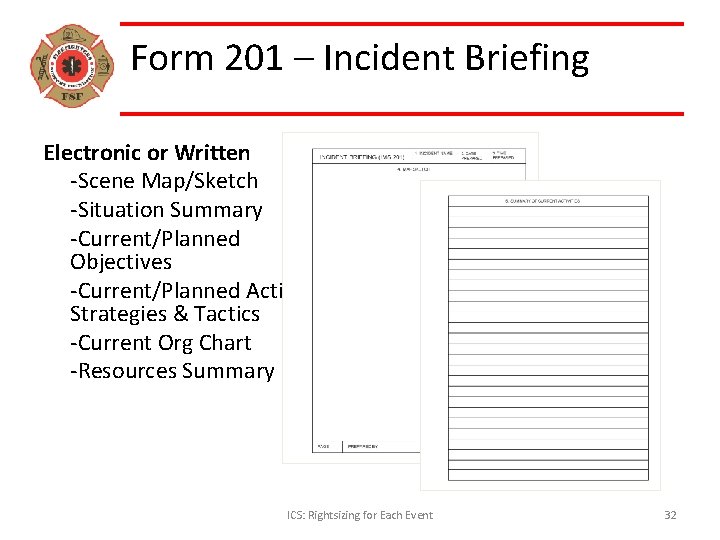
Form 201 – Incident Briefing Electronic or Written -Scene Map/Sketch -Situation Summary -Current/Planned Objectives -Current/Planned Actions, Strategies & Tactics -Current Org Chart -Resources Summary ICS: Rightsizing for Each Event 32
Closing • Again, this course is designed as a “food for thought” workshop and to foster thought and discussion on the practical and realistic use of ICS. • ICS is proven –right size it for your events and incidents • Also I will state again, the Incident Command System (ICS) is a valuable and effective tool that can be used by any sized agency/entity to manage incidents and events of any size and type. ICS: Rightsizing for Each Event 33
Thank you and be safe! ICS: Rightsizing for Each Event 34