
Firearm Toolmark Identification Introduction The following resource is


- Slides: 67
Firearm & Toolmark Identification
Introduction The following resource is provided by the Scientific Working Group for Firearms & Toolmarks (SWGGUN) to assist forensic experts in describing the scientific basis of their discipline in preparation for evidence admissibility hearings. The material posted here is for you to prepare yourself when educating the criminal justice system. The information contained within this presentation was not designed to be all-inclusive and can be adapted to meet your specific needs.
Outline Basic Overview of Science & Forensic Science n Fundamentals of Firearm & Toolmark Identification n The Five Prongs of Daubert n Summary n
Basic Overview of Science & Forensic Science n What is Science? n Scientific Method n To be Scientific… n What is Forensic Science?
Basic Overview What is Science? n A systematic gathering of knowledge. n The observation, identification, description, experimental investigation and theoretical explanation of phenomena.
Basic Overview Scientific Method Procedures for the systematic gathering of knowledge. These procedures generally involve: Stating a problem n Developing a hypothesis n Testing a hypothesis n Forming a theory n Using theories to predict events n
Basic Overview To be Scientific… n The theory must be testable. n The theory must be validated through the testing of the fundamental propositions upon which the science is based.
Basic Overview What is Forensic Science? The application of science to law.
Fundamentals of Firearm & Toolmark Identification n n Definitions Fundamental Propositions (1 & 2) Examination Method Range of Conclusions
Fundamentals of Firearm & Toolmark Identification Definition: Firearm & Toolmark Identification An empirical comparative analysis that can determine if a striated or impressed mark was produced by a particular tool.
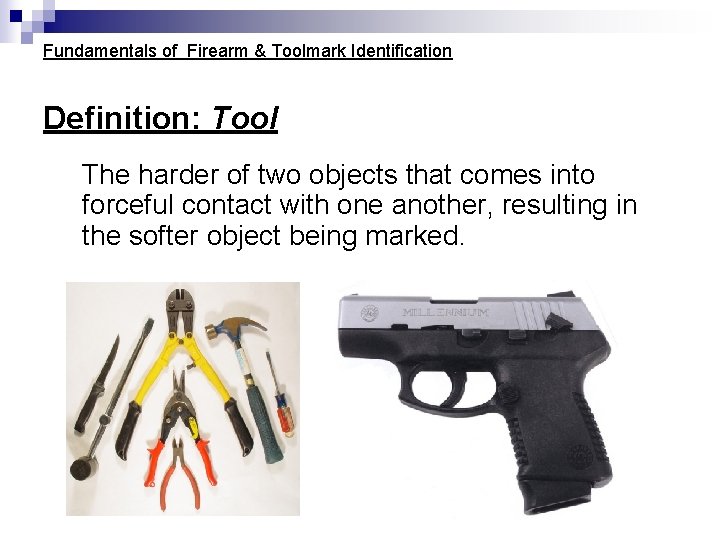
Fundamentals of Firearm & Toolmark Identification Definition: Tool The harder of two objects that comes into forceful contact with one another, resulting in the softer object being marked.
Fundamentals of Firearm & Toolmark Identification Definition: Toolmark Features imparted on an object by the contact and force exerted from a tool. n Two Types – Impressed Toolmarks o Striated Toolmarks o
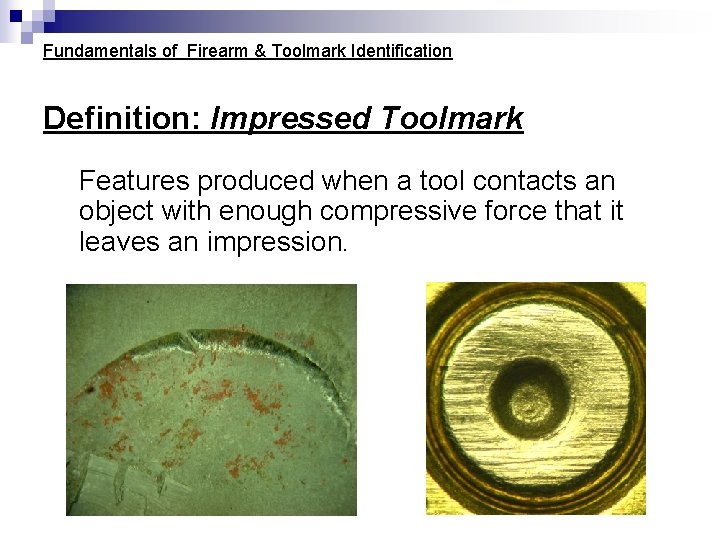
Fundamentals of Firearm & Toolmark Identification Definition: Impressed Toolmark Features produced when a tool contacts an object with enough compressive force that it leaves an impression.
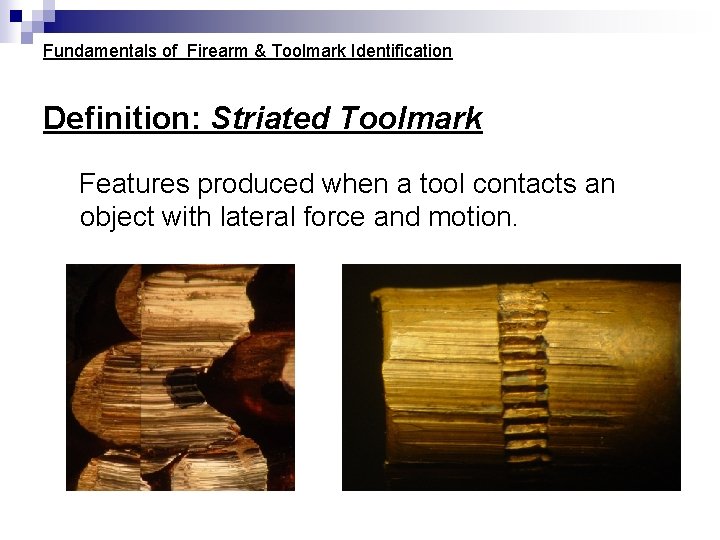
Fundamentals of Firearm & Toolmark Identification Definition: Striated Toolmark Features produced when a tool contacts an object with lateral force and motion.
Fundamentals of Firearm & Toolmark Identification The Science of Firearm & Toolmark Identification is based on two fundamental propositions:
Fundamentals of Firearm & Toolmark Identification Proposition #1 Toolmarks imparted to objects by different tools will rarely if ever display agreement sufficient to lead a qualified examiner to conclude the objects were marked by the same tool. That is, a qualified examiner will rarely if ever commit a false positive error (misidentification).
Fundamentals of Firearm & Toolmark Identification Proposition #2 Most manufacturing processes involve the transfer of rapidly changing or random marks onto work pieces such as barrel bores, breechfaces, firing pins, screwdriver blades, and the working surfaces of other common tools. This is caused principally by the phenomena of tool wear and chip formation, or by electrical/chemical erosion. Microscopic marks on tools may then continue to change from further wear, corrosion, or abuse.
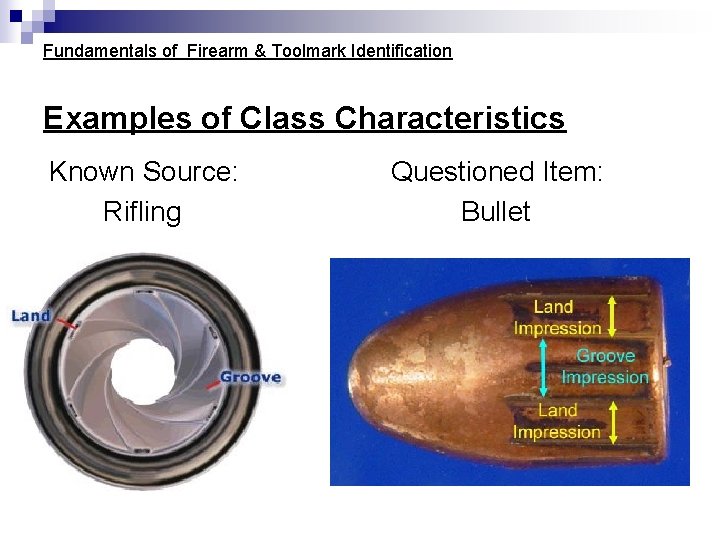
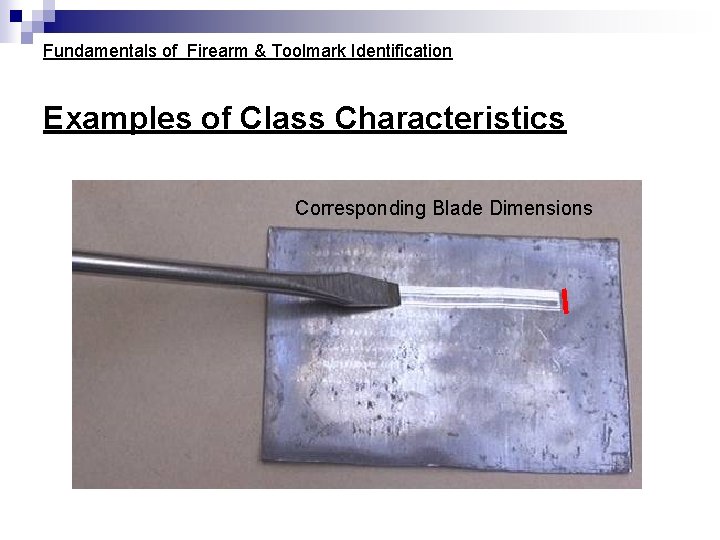
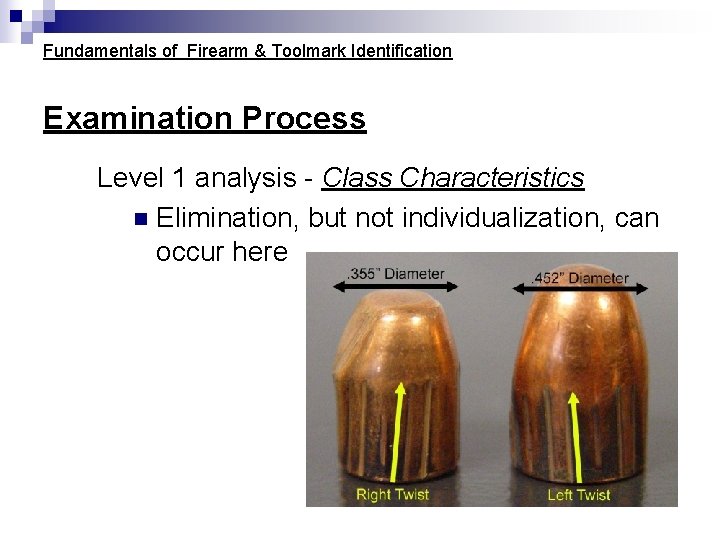
Fundamentals of Firearm & Toolmark Identification Definition: Class Characteristics General and/or measurable features of a specimen which indicate a restricted group source. They result from design factors, and are therefore determined prior to manufacture.
Fundamentals of Firearm & Toolmark Identification Examples of Class Characteristics Known Source: Rifling Questioned Item: Bullet
Fundamentals of Firearm & Toolmark Identification Examples of Class Characteristics Corresponding Blade Dimensions
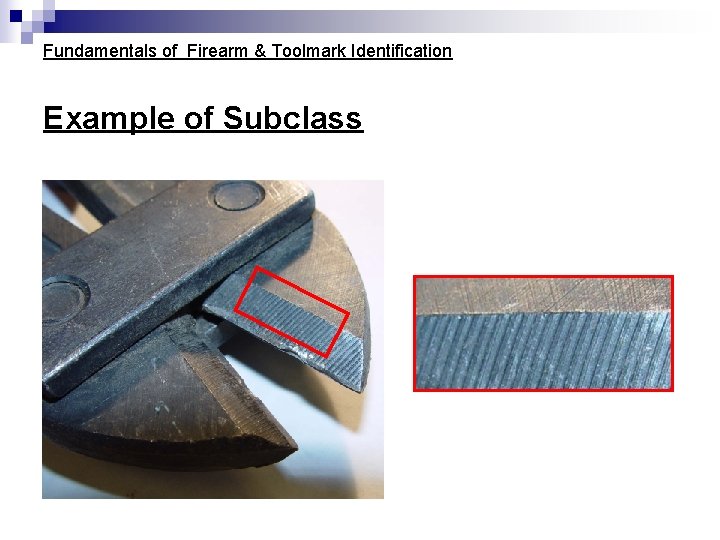
Fundamentals of Firearm & Toolmark Identification Definition: Subclass Characteristics Features that may be produced during manufacture that are consistent among some items fabricated by the same tool. These are not determined prior to manufacture and are more restrictive than class characteristics.
Fundamentals of Firearm & Toolmark Identification Example of Subclass
Fundamentals of Firearm & Toolmark Identification Definition: Individual Characteristics Marks or features produced by the random imperfections or irregularities of tool surfaces. These characteristics can be used to individually associate a tool to a toolmark.
Fundamentals of Firearm & Toolmark Identification How are individual characteristics produced? These random imperfections or irregularities can be produced by: n n n Manufacture Wear from Use Wear from Abuse
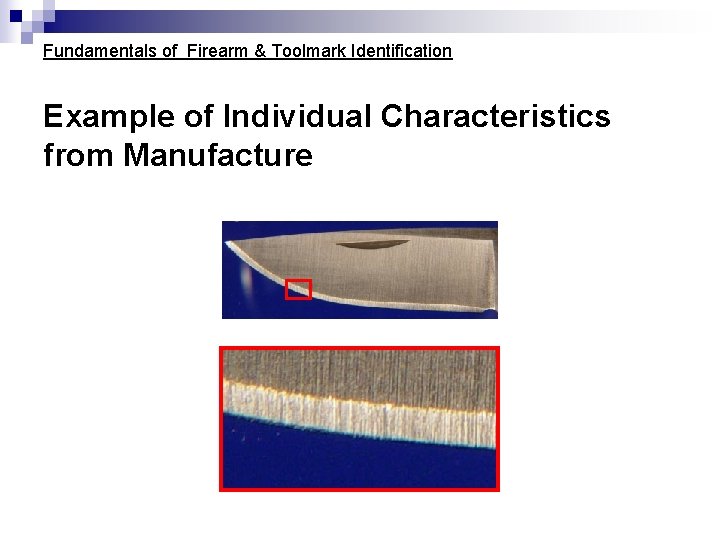
Fundamentals of Firearm & Toolmark Identification Example of Individual Characteristics from Manufacture
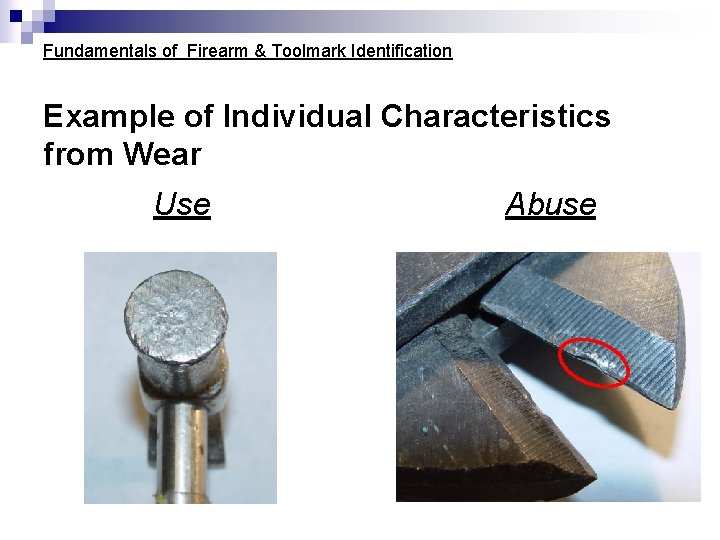
Fundamentals of Firearm & Toolmark Identification Example of Individual Characteristics from Wear Use Abuse
Fundamentals of Firearm & Toolmark Identification Examination Process Level 1 analysis - Class Characteristics n Elimination, but not individualization, can occur here
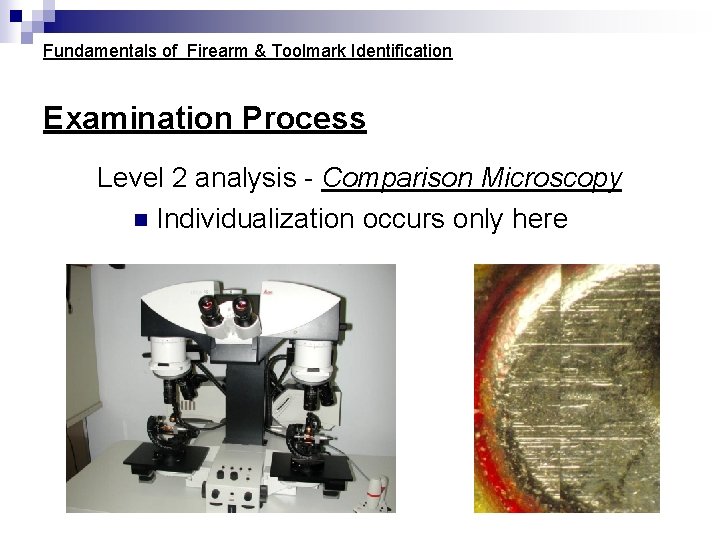
Fundamentals of Firearm & Toolmark Identification Examination Process Level 2 analysis - Comparison Microscopy n Individualization occurs only here
Fundamentals of Firearm & Toolmark Identification Range of Conclusions n Identification n Inconclusive n Elimination
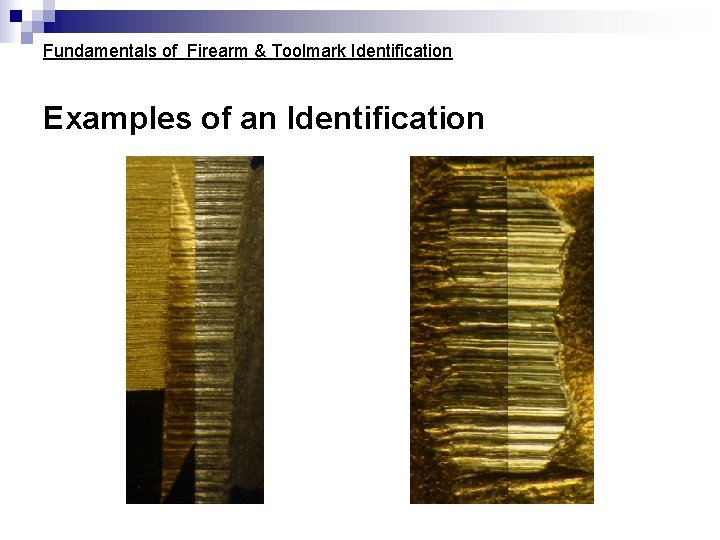
Fundamentals of Firearm & Toolmark Identification Range of Conclusions - Identification If the quality and character of the toolmark have sufficient detail, an identification can be concluded based on the correspondence of individual characteristics.
Fundamentals of Firearm & Toolmark Identification Examples of an Identification
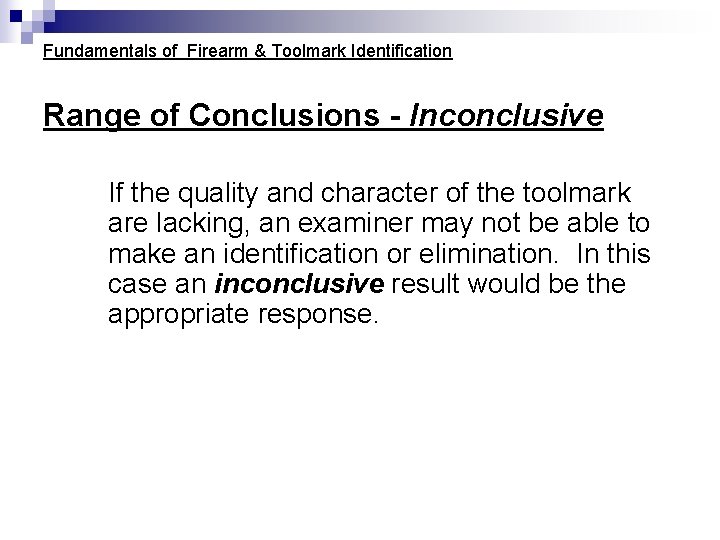
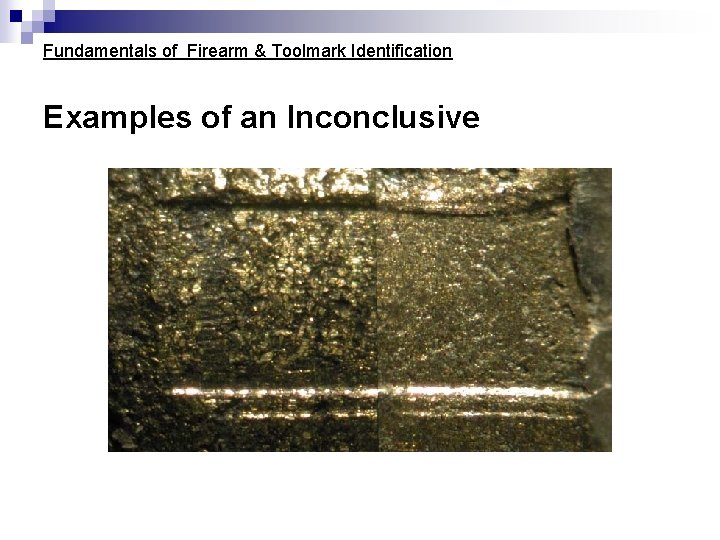
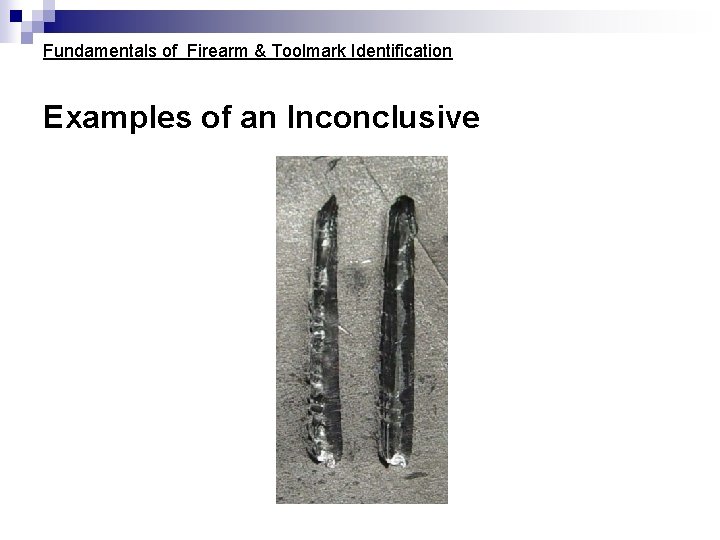
Fundamentals of Firearm & Toolmark Identification Range of Conclusions - Inconclusive If the quality and character of the toolmark are lacking, an examiner may not be able to make an identification or elimination. In this case an inconclusive result would be the appropriate response.
Fundamentals of Firearm & Toolmark Identification Examples of an Inconclusive
Fundamentals of Firearm & Toolmark Identification Examples of an Inconclusive
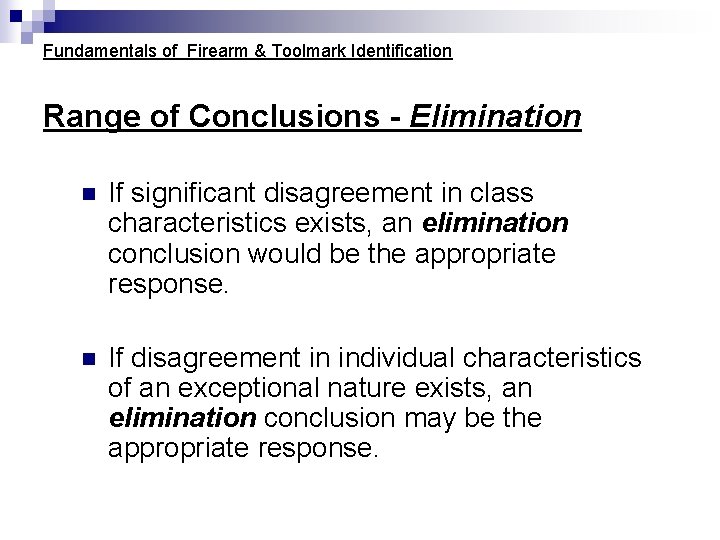
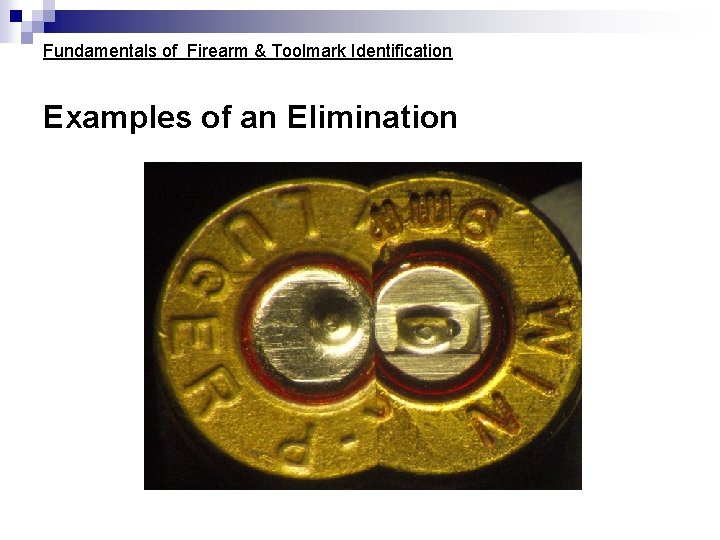
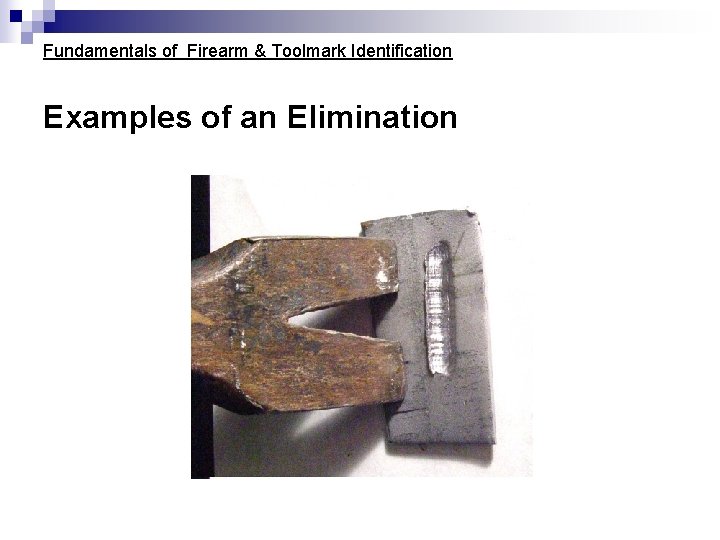
Fundamentals of Firearm & Toolmark Identification Range of Conclusions - Elimination n If significant disagreement in class characteristics exists, an elimination conclusion would be the appropriate response. n If disagreement in individual characteristics of an exceptional nature exists, an elimination conclusion may be the appropriate response.
Fundamentals of Firearm & Toolmark Identification Examples of an Elimination
Fundamentals of Firearm & Toolmark Identification Examples of an Elimination
Basis for Firearm & Toolmark Identification n Standards of Identification n Objective vs. Subjective Examinations n What makes an Identification possible? n Significance of Conclusions
Basis for Firearm & Toolmark Identification Standard - I “The Theory of Identification as it pertains to the comparison of toolmarks enables opinions of common origin to be made when unique surface contours of two toolmarks are in ‘sufficient agreement. ’” Objectively stated AFTE Identification Standard (1992)
Basis for Firearm & Toolmark Identification Standard - II “Agreement is significant when it exceeds the best agreement demonstrated between toolmarks known to have been produced by different tools and is consistent with the agreement demonstrated by toolmarks known to have been produced by the same tool. ” Objectively stated AFTE Identification Standard (1992)
Basis for Firearm & Toolmark Identification Standard Summary In the application of the objective AFTE Theory of Identification Standard, a subjective determination must be made by a qualified examiner as to the amount of agreement necessary for an identification to exist.
Basis for Firearm & Toolmark Identification Definition: Objective Examination An objective examination is one that can be repeated by different scientists and if using the same type of equipment and following the same procedures, will result in essentially the same conclusions every time.
Basis for Firearm & Toolmark Identification Definition: Subjective Examination The results of a subjective examination are based on an individual’s opinion. This does not mean that this type of examination is unreliable or unscientific. There is subjectivity in every science and in every test, whether it being a doctor diagnosing a head cold or a chemist determining where to set the base line on a scientific instrument.
Basis for Firearm & Toolmark Identification What makes an identification possible? n n Proposition #2 A sound examination method o n By employing the precepts of empirical research or study in the comparison of two toolmarks. Specialized training to develop cognitive skills o An examiner undergoes standardized technical training that develops cognitive skills to recognize, differentiate and understand the patterns of marks and their uniqueness.
Basis for Firearm & Toolmark Identification Significance of Conclusions n Based on Propositions #1 and #2, an individual association or identification conclusion can be effected. These individual associations result from the “practical certainty” of the validated theory and not from “absolute certainty”.
Five Prongs of Daubert n Testability n General Acceptance n Peer Review n Known or Potential Error Rate n Maintenance of Standards & Controls
Five Prongs of Daubert- Testability Definition: Testability A critical evaluation process that supports or refutes a hypothesis.
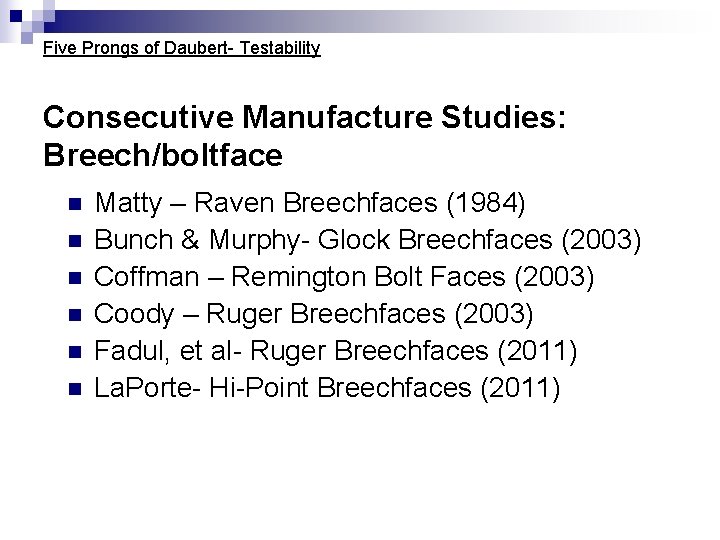
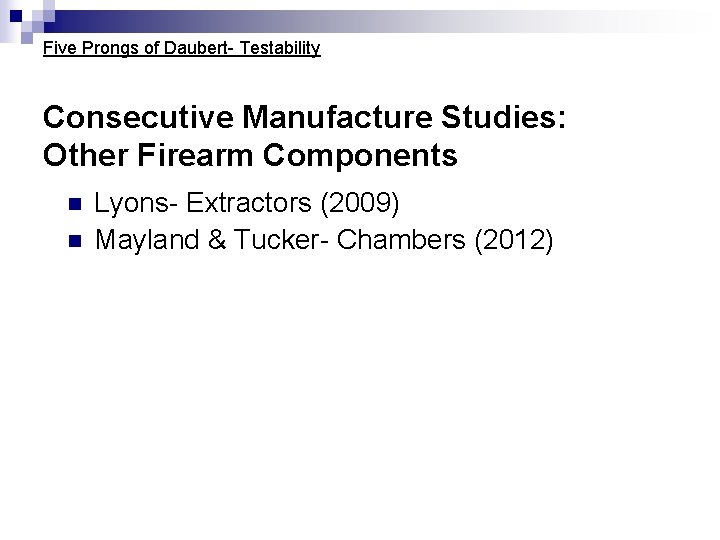
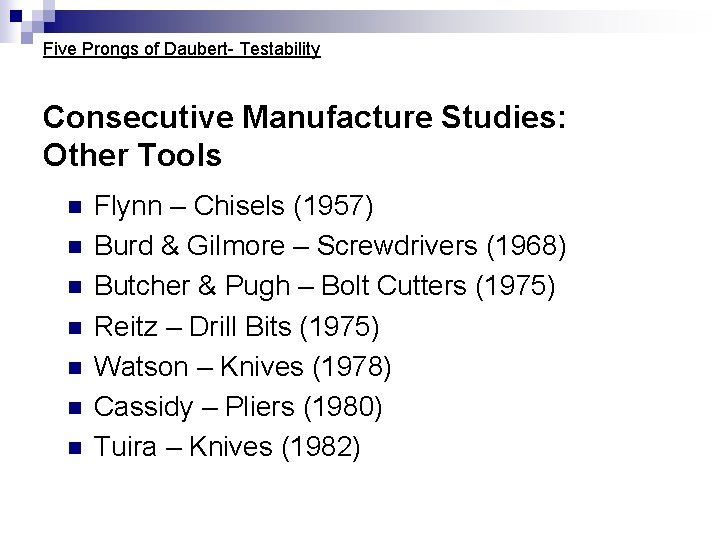
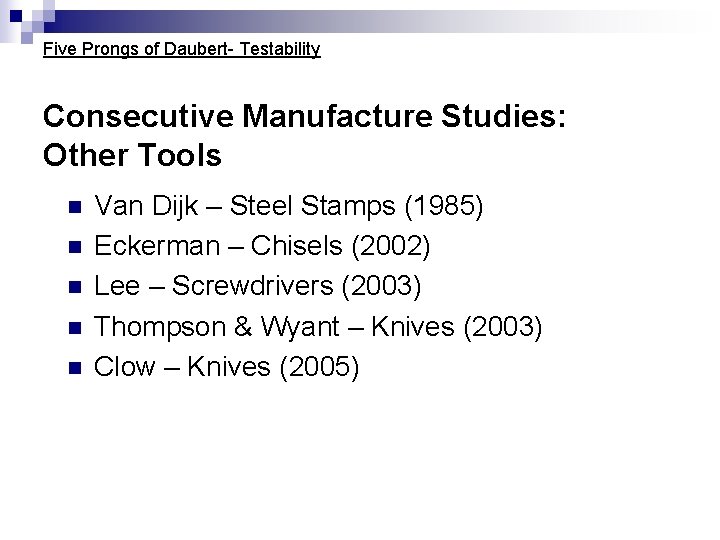
Five Prongs of Daubert- Testability What evidence exists to support the science of Firearm & Toolmark Identification? Numerous empirical and validation studies of consecutively manufactured tools have been published over the past 50 years.
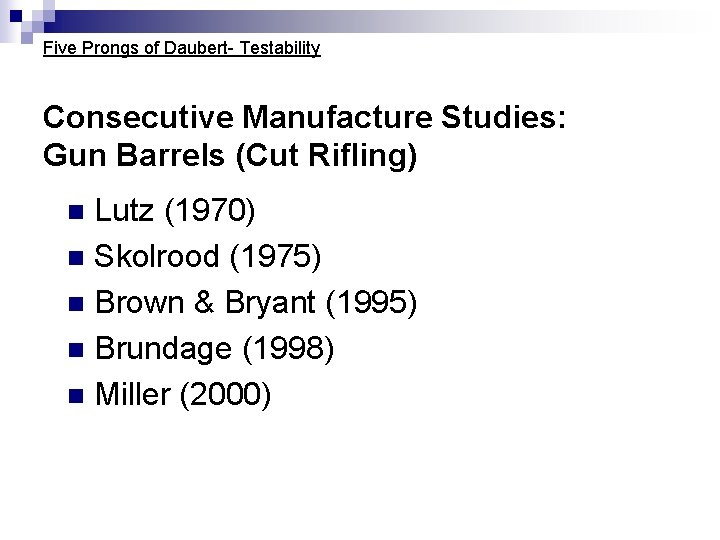
Five Prongs of Daubert- Testability Consecutive Manufacture Studies: Gun Barrels (Cut Rifling) Lutz (1970) n Skolrood (1975) n Brown & Bryant (1995) n Brundage (1998) n Miller (2000) n
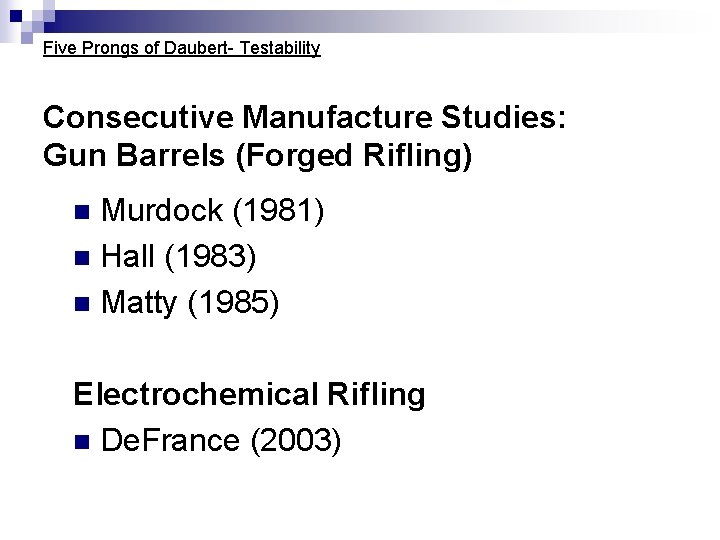
Five Prongs of Daubert- Testability Consecutive Manufacture Studies: Gun Barrels (Forged Rifling) Murdock (1981) n Hall (1983) n Matty (1985) n Electrochemical Rifling n De. France (2003)
Five Prongs of Daubert- Testability Consecutive Manufacture Studies: Breech/boltface n n n Matty – Raven Breechfaces (1984) Bunch & Murphy- Glock Breechfaces (2003) Coffman – Remington Bolt Faces (2003) Coody – Ruger Breechfaces (2003) Fadul, et al- Ruger Breechfaces (2011) La. Porte- Hi-Point Breechfaces (2011)
Five Prongs of Daubert- Testability Consecutive Manufacture Studies: Other Firearm Components n n Lyons- Extractors (2009) Mayland & Tucker- Chambers (2012)
Five Prongs of Daubert- Testability Consecutive Manufacture Studies: Other Tools n n n n Flynn – Chisels (1957) Burd & Gilmore – Screwdrivers (1968) Butcher & Pugh – Bolt Cutters (1975) Reitz – Drill Bits (1975) Watson – Knives (1978) Cassidy – Pliers (1980) Tuira – Knives (1982)
Five Prongs of Daubert- Testability Consecutive Manufacture Studies: Other Tools n n n Van Dijk – Steel Stamps (1985) Eckerman – Chisels (2002) Lee – Screwdrivers (2003) Thompson & Wyant – Knives (2003) Clow – Knives (2005)
Five Prongs of Daubert- Testability Summary of Empirical Research These studies have been found to support Proposition #2: Most manufacturing processes involve the transfer of rapidly changing or random marks onto work pieces such as barrel bores, breechfaces, firing pins, screwdriver blades, and the working surfaces of other common tools. This is caused principally by the phenomena of tool wear and chip formation, or by electrical/chemical erosion. Microscopic marks on tools may then continue to change from further wear, corrosion, or abuse.
Five Prongs of Daubert- General Acceptance Definition: General Acceptance The approval by a particular authoritative body of a technique or methodology. In addition to the forensic science community: n n n Numerous colleges & universities have courses in Firearm & Toolmark Identification Funding of scientific research in the area of Firearm & Toolmark Identification has been granted to researchers outside the firearm and toolmark community. Accepted in court testimony for almost 90 years
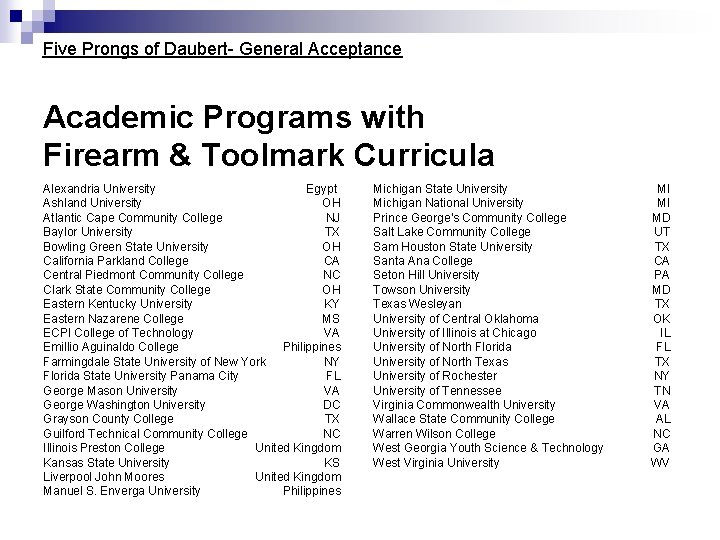
Five Prongs of Daubert- General Acceptance Academic Programs with Firearm & Toolmark Curricula Alexandria University Egypt Ashland University OH Atlantic Cape Community College NJ Baylor University TX Bowling Green State University OH California Parkland College CA Central Piedmont Community College NC Clark State Community College OH Eastern Kentucky University KY Eastern Nazarene College MS ECPI College of Technology VA Emillio Aguinaldo College Philippines Farmingdale State University of New York NY Florida State University Panama City FL George Mason University VA George Washington University DC Grayson County College TX Guilford Technical Community College NC Illinois Preston College United Kingdom Kansas State University KS Liverpool John Moores United Kingdom Manuel S. Enverga University Philippines Michigan State University Michigan National University Prince George's Community College Salt Lake Community College Sam Houston State University Santa Ana College Seton Hill University Towson University Texas Wesleyan University of Central Oklahoma University of Illinois at Chicago University of North Florida University of North Texas University of Rochester University of Tennessee Virginia Commonwealth University Wallace State Community College Warren Wilson College West Georgia Youth Science & Technology West Virginia University MI MI MD UT TX CA PA MD TX OK IL FL TX NY TN VA AL NC GA WV
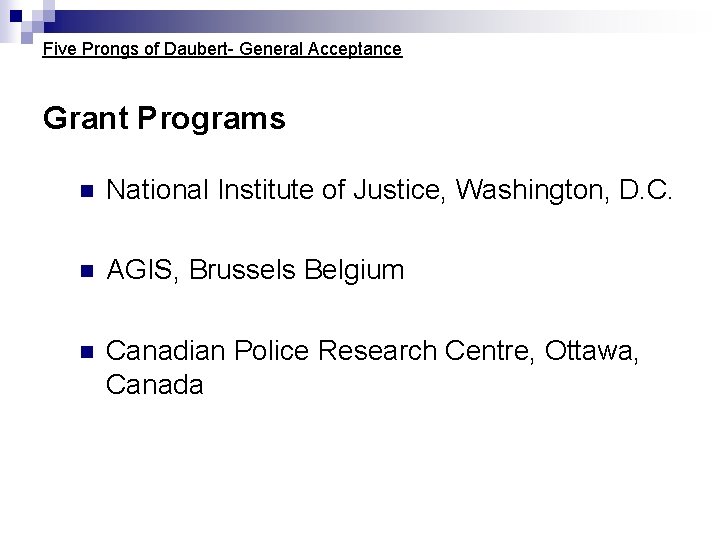
Five Prongs of Daubert- General Acceptance Grant Programs n National Institute of Justice, Washington, D. C. n AGIS, Brussels Belgium n Canadian Police Research Centre, Ottawa, Canada
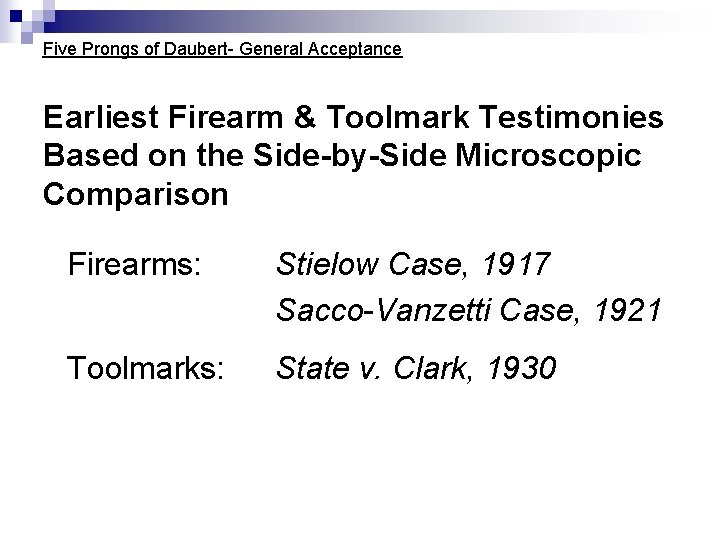
Five Prongs of Daubert- General Acceptance Earliest Firearm & Toolmark Testimonies Based on the Side-by-Side Microscopic Comparison Firearms: Stielow Case, 1917 Sacco-Vanzetti Case, 1921 Toolmarks: State v. Clark, 1930
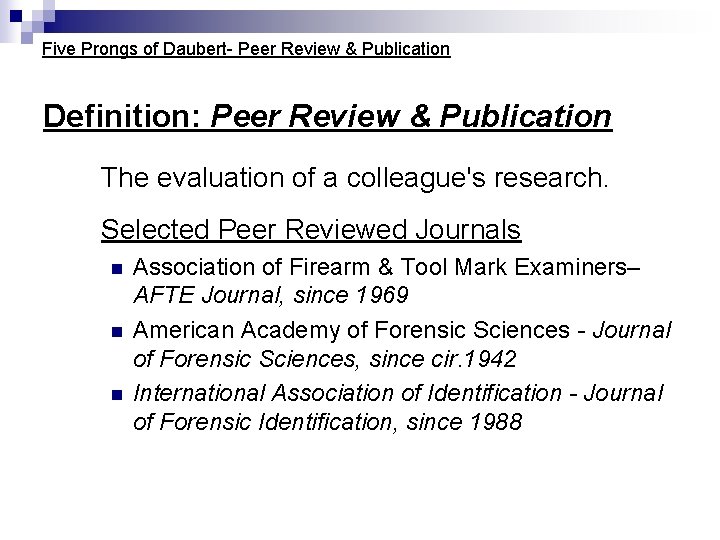
Five Prongs of Daubert- Peer Review & Publication Definition: Peer Review & Publication The evaluation of a colleague's research. Selected Peer Reviewed Journals n n n Association of Firearm & Tool Mark Examiners– AFTE Journal, since 1969 American Academy of Forensic Sciences - Journal of Forensic Sciences, since cir. 1942 International Association of Identification - Journal of Forensic Identification, since 1988
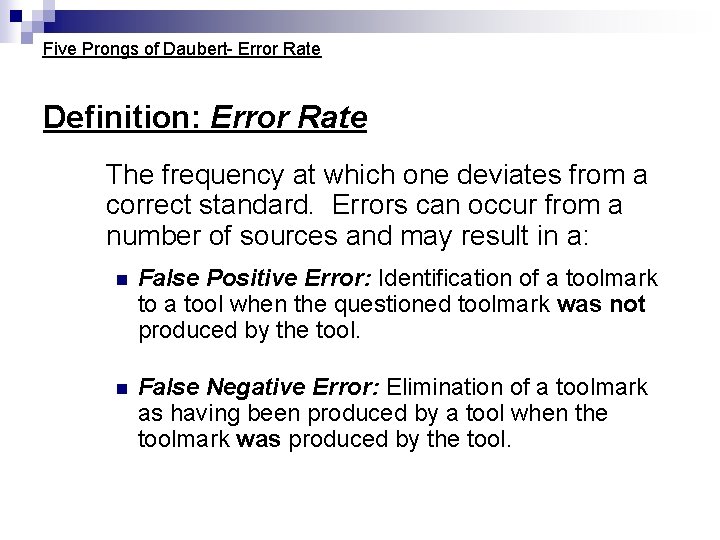
Five Prongs of Daubert- Error Rate Definition: Error Rate The frequency at which one deviates from a correct standard. Errors can occur from a number of sources and may result in a: n False Positive Error: Identification of a toolmark to a tool when the questioned toolmark was not produced by the tool. n False Negative Error: Elimination of a toolmark as having been produced by a tool when the toolmark was produced by the tool.
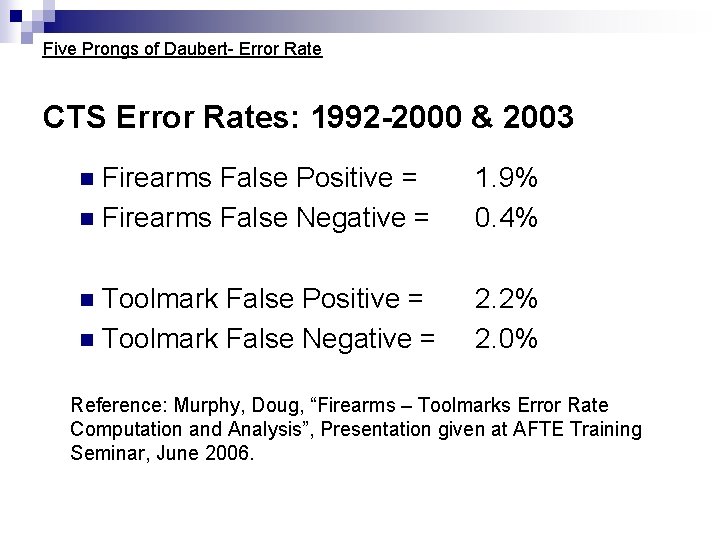
Five Prongs of Daubert- Error Rate CTS Error Rates: 1992 -2000 & 2003 n Firearms False Positive = n Firearms False Negative = 1. 9% 0. 4% Toolmark False Positive = n Toolmark False Negative = 2. 2% 2. 0% n Reference: Murphy, Doug, “Firearms – Toolmarks Error Rate Computation and Analysis”, Presentation given at AFTE Training Seminar, June 2006.
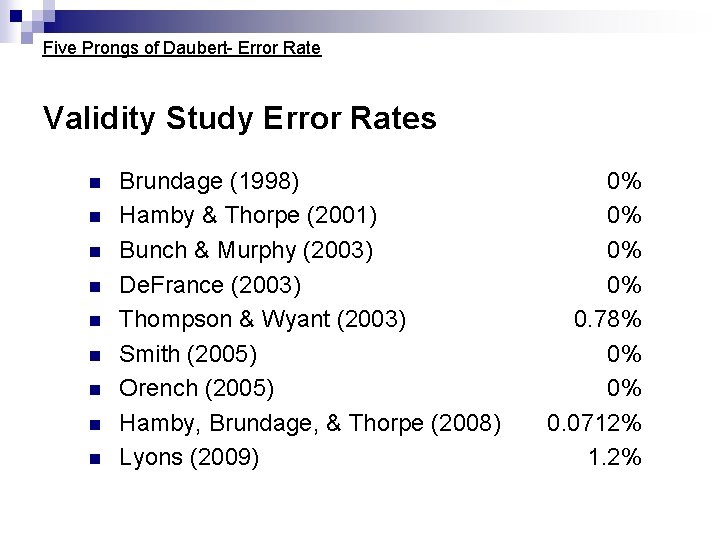
Five Prongs of Daubert- Error Rate Validity Study Error Rates n n n n n Brundage (1998) 0% Hamby & Thorpe (2001) 0% Bunch & Murphy (2003) 0% De. France (2003) 0% Thompson & Wyant (2003) 0. 78% Smith (2005) 0% Orench (2005) 0% Hamby, Brundage, & Thorpe (2008) 0. 0712% Lyons (2009) 1. 2%
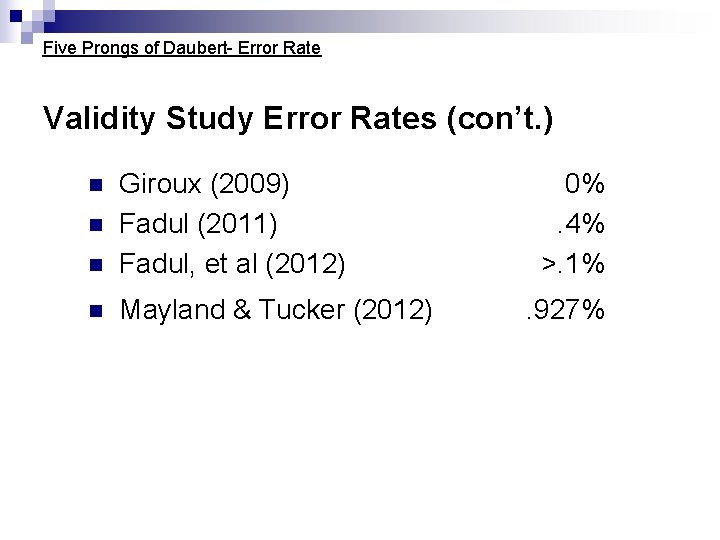
Five Prongs of Daubert- Error Rate Validity Study Error Rates (con’t. ) n Giroux (2009) Fadul (2011) Fadul, et al (2012) n Mayland & Tucker (2012) n n 0% . 4% >. 1%. 927%
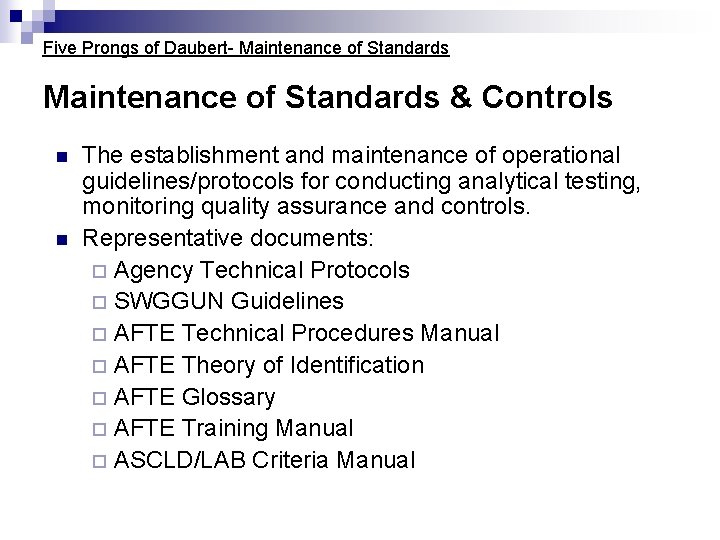
Five Prongs of Daubert- Maintenance of Standards & Controls n n The establishment and maintenance of operational guidelines/protocols for conducting analytical testing, monitoring quality assurance and controls. Representative documents: o Agency Technical Protocols o SWGGUN Guidelines o AFTE Technical Procedures Manual o AFTE Theory of Identification o AFTE Glossary o AFTE Training Manual o ASCLD/LAB Criteria Manual
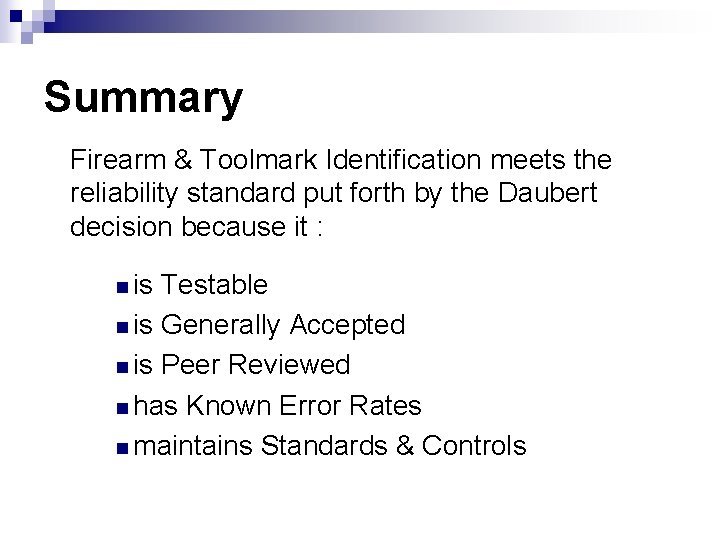
Summary Firearm & Toolmark Identification meets the reliability standard put forth by the Daubert decision because it : n is Testable n is Generally Accepted n is Peer Reviewed n has Known Error Rates n maintains Standards & Controls
Updated 6/8/2012