
Fire Safety of HydrogenFueled Vehicles SystemLevel Bonfire Test
Fire Safety of Hydrogen-Fueled Vehicles: System-Level Bonfire Test by R. Rhoads Stephenson Motor Vehicle Fire Research Institute www. mvfri. org rodys@earthlink. net MVFRI

High Pressure Cylinder Tests (part of FMVSS 304) • Bonfire test is routinely done for CNG • A similar test has been drafted for H 2 • Bare tank and PRD are exposed to bonfire for 20 minutes. Must either: – Remain intact, or – Vent safely • Problems – Fire not well specified – just temperatures under tank – PRD must be shielded from direct flame MVFRI

304 Test on CNG Tank MVFRI
FMVSS 304 - Conclusions • Tank Burst is very energetic – Mechanical energy is released in milliseconds – Unacceptable to have tank burst – PRD must work • 304 is mainly a PRD test – not a tank test – No modern composite tank will last for 20 minutes MVFRI
Hydrogen Burst Test • Goals: (1) Study the fire resistance of the tank, and the temperature and pressure its contents prior to burst (2) Determine the characteristics of the energy release from a fire induced burst • Performed 304 -like test w/o PRD MVFRI

Hydrogen Fuel Tank Test Setup Instrumentation – Tank internal temperature and pressure – Exterior temperatures – Blast pressures at 4 locations – Visual and IR video MVFRI Tank positioned in bonfire test rig 6

Burst Test MVFRI
Tank Failure Times • The composite material on the surface of the tank ignited 45 seconds into the test • The tank ruptured 6 minutes and 27 seconds into the test MVFRI

Burst Test Conclusions • Temperature and pressure inside tank increased a negligible amount – Temperature up 20 C – Pressure up 200 psi (13 bar) • Largest fragment (14 Kg) landed 80 meters (270 feet) away • 43 psi overpressure at 2 m (6. 3 feet) • 6 psi overpressure at 6. 5 m (21 feet) MVFRI
Burst Test Conclusions It is unacceptable for a H 2 tank to burst!! The PRD valve must work! MVFRI
Conclusions (continued) • Successful operation of PRD is a systemlevel issue – – – – Number and location of tanks Plumbing Number and location of PRDs Redundant PRDs? Sizing of vent lines Shielding and insulation of tanks Flow of flames around fuel system • A bare tank with a single PRD does not simulate a real vehicle MVFRI
System-Level Bonfire Test • Europeans require bonfire test on plastic fuel tanks – ECE R-34 Annex 5 • Test is not required in the US, but most tanks sold in US are qualified with this test MVFRI
ECE R-34 Test • Whole vehicle or buck used • Tank is filled 50% with gasoline • Exposed to gasoline pool fire – One minute at full heat flux – One minute with ceramic screen which cuts heat flux • The tank “passes” if it survives for 2 minutes of exposure MVFRI
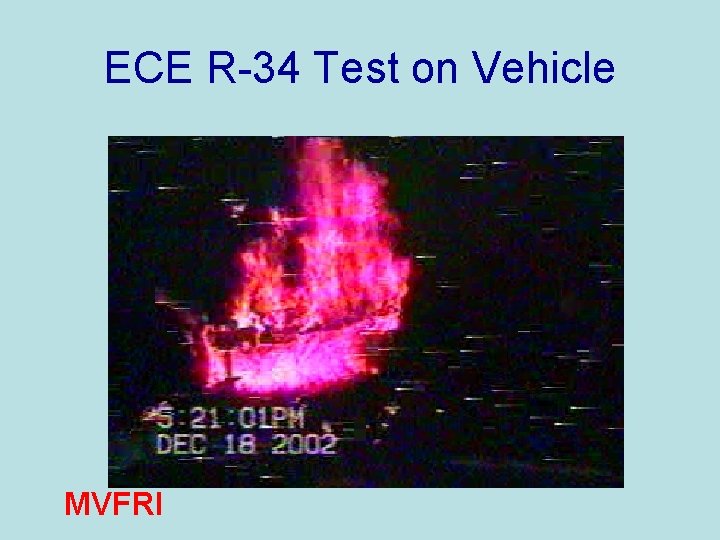
ECE R-34 Test on Vehicle MVFRI
Observations • Tank “passed” the test at 2 minutes • Tank failed 7 seconds later • Two minutes may be long enough for an uninjured person to escape – It is clearly too short if the occupant needs to be extricated MVFRI
Proposed System Level Test for H 2 • Composite hydrogen tanks are plastic • Why not apply something similar to European ECE R-34 test? • It tests the whole system • It is independent of the hydrogen storage technology – Compressed gas – Liquid Hydrogen – Hydrides MVFRI
Modifications • Replace gasoline pool fire with a propane planer flame – diffused through sand – Easier to control – Less air pollution concern • Exposure duration ? – Suggest 20 minutes like FMVSS 304 – Must either vent safely or stay intact MVFRI
Future Work • Vehicle level test will be performed – Issue to study: Passenger compartment may become untenable well before 20 minutes – Debug the test procedure • Recommend to NHTSA MVFRI
Other Comments • “Active PRD” • Remote Defueling MVFRI

Questions? Please visit our website at: www. mvfri. org MVFRI
- Slides: 20