
FIRE PROTECTION Fire Extinguisher Types Volume 1 Issue
- Slides: 6
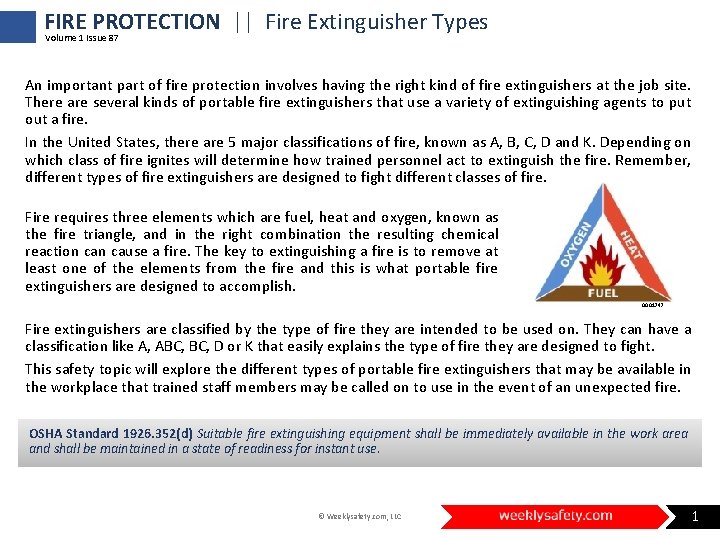
FIRE PROTECTION || Fire Extinguisher Types Volume 1 Issue 87 An important part of fire protection involves having the right kind of fire extinguishers at the job site. There are several kinds of portable fire extinguishers that use a variety of extinguishing agents to put out a fire. In the United States, there are 5 major classifications of fire, known as A, B, C, D and K. Depending on which class of fire ignites will determine how trained personnel act to extinguish the fire. Remember, different types of fire extinguishers are designed to fight different classes of fire. Fire requires three elements which are fuel, heat and oxygen, known as the fire triangle, and in the right combination the resulting chemical reaction cause a fire. The key to extinguishing a fire is to remove at least one of the elements from the fire and this is what portable fire extinguishers are designed to accomplish. 0001747 Fire extinguishers are classified by the type of fire they are intended to be used on. They can have a classification like A, ABC, D or K that easily explains the type of fire they are designed to fight. This safety topic will explore the different types of portable fire extinguishers that may be available in the workplace that trained staff members may be called on to use in the event of an unexpected fire. OSHA Standard 1926. 352(d) Suitable fire extinguishing equipment shall be immediately available in the work area and shall be maintained in a state of readiness for instant use. © Weeklysafety. com, LLC 1
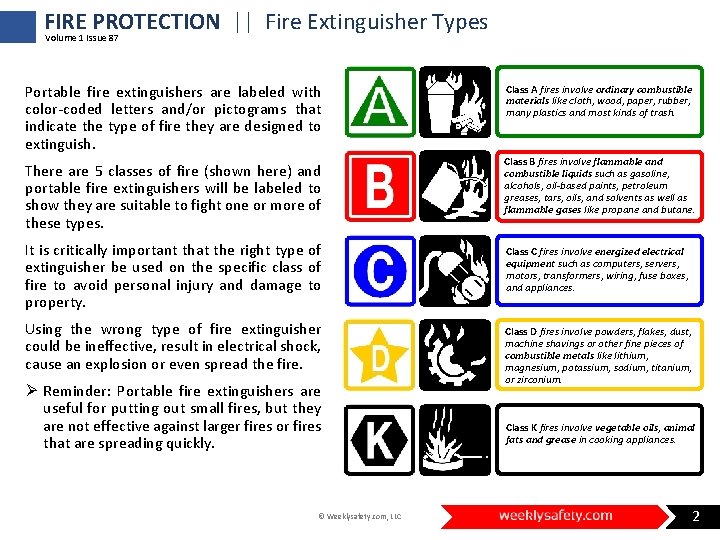
FIRE PROTECTION || Fire Extinguisher Types Volume 1 Issue 87 Portable fire extinguishers are labeled with color-coded letters and/or pictograms that indicate the type of fire they are designed to extinguish. There are 5 classes of fire (shown here) and portable fire extinguishers will be labeled to show they are suitable to fight one or more of these types. It is critically important that the right type of extinguisher be used on the specific class of fire to avoid personal injury and damage to property. Using the wrong type of fire extinguisher could be ineffective, result in electrical shock, cause an explosion or even spread the fire. Ø Reminder: Portable fire extinguishers are useful for putting out small fires, but they are not effective against larger fires or fires that are spreading quickly. © Weeklysafety. com, LLC Class A fires involve ordinary combustible materials like cloth, wood, paper, rubber, many plastics and most kinds of trash. Class B fires involve flammable and combustible liquids such as gasoline, alcohols, oil-based paints, petroleum greases, tars, oils, and solvents as well as flammable gases like propane and butane. Class C fires involve energized electrical equipment such as computers, servers, motors, transformers, wiring, fuse boxes, and appliances. Class D fires involve powders, flakes, dust, machine shavings or other fine pieces of combustible metals like lithium, magnesium, potassium, sodium, titanium, or zirconium. Class K fires involve vegetable oils, animal fats and grease in cooking appliances. 2
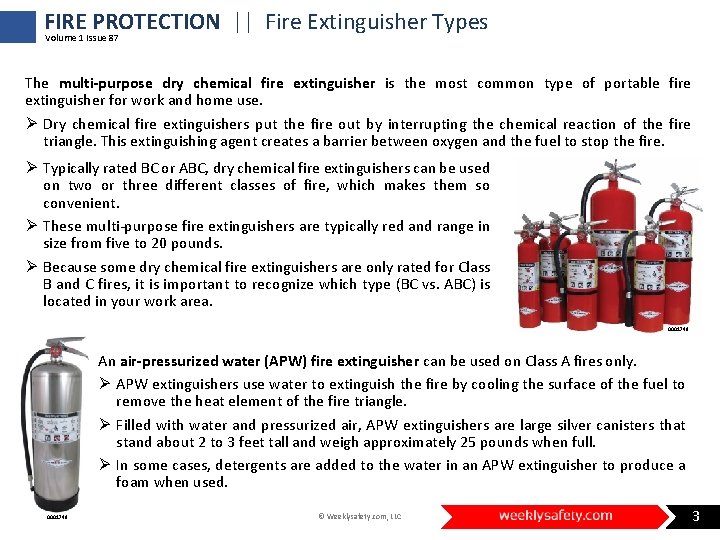
FIRE PROTECTION || Fire Extinguisher Types Volume 1 Issue 87 The multi-purpose dry chemical fire extinguisher is the most common type of portable fire extinguisher for work and home use. Ø Dry chemical fire extinguishers put the fire out by interrupting the chemical reaction of the fire triangle. This extinguishing agent creates a barrier between oxygen and the fuel to stop the fire. Ø Typically rated BC or ABC, dry chemical fire extinguishers can be used on two or three different classes of fire, which makes them so convenient. Ø These multi-purpose fire extinguishers are typically red and range in size from five to 20 pounds. Ø Because some dry chemical fire extinguishers are only rated for Class B and C fires, it is important to recognize which type (BC vs. ABC) is located in your work area. 0001748 An air-pressurized water (APW) fire extinguisher can be used on Class A fires only. Ø APW extinguishers use water to extinguish the fire by cooling the surface of the fuel to remove the heat element of the fire triangle. Ø Filled with water and pressurized air, APW extinguishers are large silver canisters that stand about 2 to 3 feet tall and weigh approximately 25 pounds when full. Ø In some cases, detergents are added to the water in an APW extinguisher to produce a foam when used. 0001749 © Weeklysafety. com, LLC 3
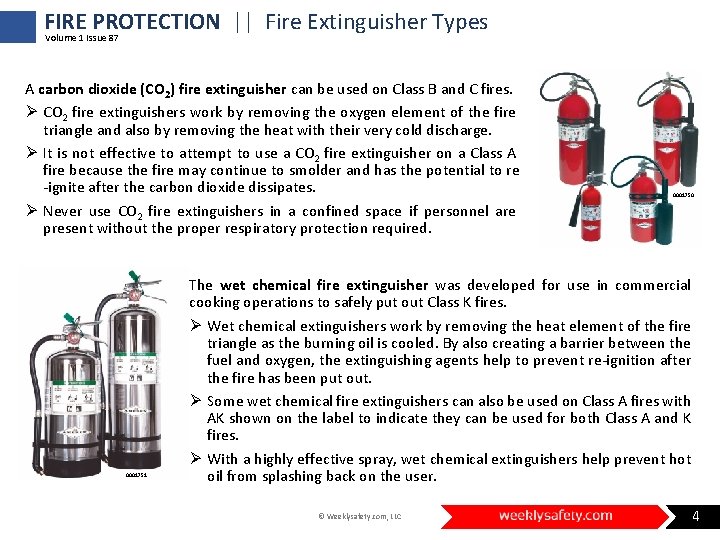
FIRE PROTECTION || Fire Extinguisher Types Volume 1 Issue 87 A carbon dioxide (CO 2) fire extinguisher can be used on Class B and C fires. Ø CO 2 fire extinguishers work by removing the oxygen element of the fire triangle and also by removing the heat with their very cold discharge. Ø It is not effective to attempt to use a CO 2 fire extinguisher on a Class A fire because the fire may continue to smolder and has the potential to re -ignite after the carbon dioxide dissipates. Ø Never use CO 2 fire extinguishers in a confined space if personnel are present without the proper respiratory protection required. 0001751 0001750 The wet chemical fire extinguisher was developed for use in commercial cooking operations to safely put out Class K fires. Ø Wet chemical extinguishers work by removing the heat element of the fire triangle as the burning oil is cooled. By also creating a barrier between the fuel and oxygen, the extinguishing agents help to prevent re-ignition after the fire has been put out. Ø Some wet chemical fire extinguishers can also be used on Class A fires with AK shown on the label to indicate they can be used for both Class A and K fires. Ø With a highly effective spray, wet chemical extinguishers help prevent hot oil from splashing back on the user. © Weeklysafety. com, LLC 4
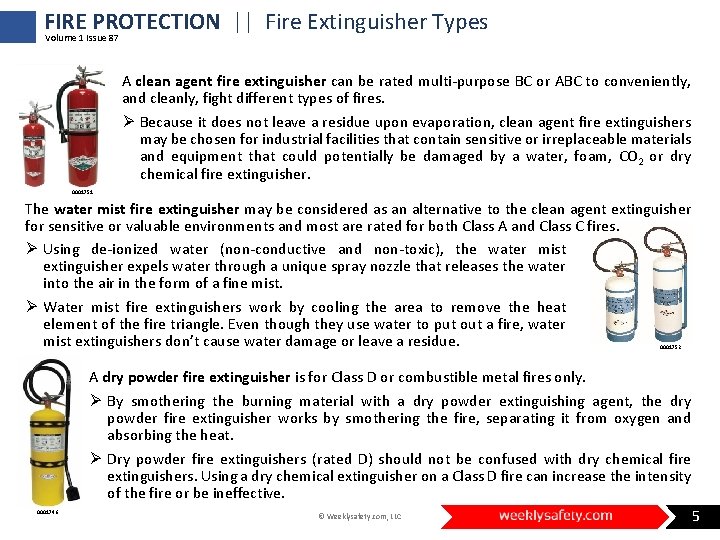
FIRE PROTECTION || Fire Extinguisher Types Volume 1 Issue 87 A clean agent fire extinguisher can be rated multi-purpose BC or ABC to conveniently, and cleanly, fight different types of fires. Ø Because it does not leave a residue upon evaporation, clean agent fire extinguishers may be chosen for industrial facilities that contain sensitive or irreplaceable materials and equipment that could potentially be damaged by a water, foam, CO 2 or dry chemical fire extinguisher. 0001751 The water mist fire extinguisher may be considered as an alternative to the clean agent extinguisher for sensitive or valuable environments and most are rated for both Class A and Class C fires. Ø Using de-ionized water (non-conductive and non-toxic), the water mist extinguisher expels water through a unique spray nozzle that releases the water into the air in the form of a fine mist. Ø Water mist fire extinguishers work by cooling the area to remove the heat element of the fire triangle. Even though they use water to put out a fire, water mist extinguishers don’t cause water damage or leave a residue. 0001752 A dry powder fire extinguisher is for Class D or combustible metal fires only. Ø By smothering the burning material with a dry powder extinguishing agent, the dry powder fire extinguisher works by smothering the fire, separating it from oxygen and absorbing the heat. Ø Dry powder fire extinguishers (rated D) should not be confused with dry chemical fire extinguishers. Using a dry chemical extinguisher on a Class D fire can increase the intensity of the fire or be ineffective. 0001746 © Weeklysafety. com, LLC 5
FIRE PROTECTION || Fire Extinguisher Types Volume 1 Issue 87 COPYRIGHT AND DISCLAIMER This material is the copyrighted property of Weeklysafety. com, LLC. Purchase of this material from Weeklysafety. com, LLC grants the owner the right to use this material for workplace safety and education purposes only. Use of this material for any other purpose, particularly commercial use, is prohibited. This material, including the photos, may not be resold. Weeklysafety. com, LLC does not warrant or assume any legal liability or responsibility for the accuracy, completeness, or usefulness of any information, apparatus, product, or process disclosed in these materials. Photos shown in this presentation may depict situations that are not in compliance with applicable Occupational Safety and Health Administration (OSHA) safety requirements. These materials are meant for informational purposes only and it is not the intent of Weeklysafety. com, LLC to provide compliance-based training. The intent is more to address hazard awareness in the construction and related industries, and to recognize the potential hazards present in many workplaces. These materials are intended to discuss Federal Regulations only, as individual State requirements may be more stringent. Many states operate their own state OSHA and may have standards that are different from information presented in this training. It is the responsibility of the employer and its employees to comply with all pertinent OSHA safety rules and regulations in the jurisdiction in which they work. PHOTO ACKNOWLEDGMENTS Unless specified below, all photos are the copyrighted property of Weeklysafety. com, LLC and may not be used in any other training materials or resold for any purpose. • 0001746 Amerex; Class D. amerex-fire. com/products/class-d-stored-pressure-dry-powder-extinguisher/ • 0001747 Wikimedia Commons; Fire triangle. en. wikipedia. org/wiki/File: Fire_triangle. svg • 0001748 Amerex; Dry Chemical. amerex-fire. com/products/abc-multi-purpose-stored-pressure-dry-chemical-extinguishers/ • 0001749 Amerex; Model 240 Water Extinguisher. amerex-fire. com/products/model-240 -water-extinguisher/ • 0001750 Amerex; Carbon Dioxide. amerex-fire. com/products/carbon-dioxide-stored-pressure-extinguishers/ • 0001751 Amerex; Wet Chemical. amerex-fire. com/products/wet-chemical-stored-pressure-class-k-kitchen-extinguishers/ • 0001751 Amerex; Halotron Clean Agent. amerex-fire. com/products/halotron-i-clean-agent-extinguishers/ • 0001752 Amerex; Water Mist. amerex-fire. com/products/water-mist/ For more information on this weekly safety topic, other topics that are available and the full list of FAQs please visit www. weeklysafety. com or email safety@weeklysafety. com. © Weeklysafety. com, LLC 6